BONVALOT, Gabriel.MareMagnum

1 366 résultats
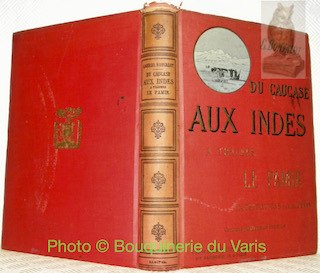
1 28x18,5 cm., legatura in mezza tela, piatti marmorizzati, titolo in oro al dorso, pagg. XII, 458, 250 illustrazioni in nero di diversi formati, alcune su pagina intera su tavola fuori testo, carta geografica dell'itinerario, in lingua francese, prima edizione, piccole sfilacciature al dorso, ma buon esemplare Racconto del viaggio del noto esploratore francese partendodal Caucaso compiuto nel 1885. Dal Mar Caspio a Samarcanda, dove fu fatto prigioniero, e India dove fu di nuovo fatto prigioniero. Molto interessante e ampiamente illustrato.
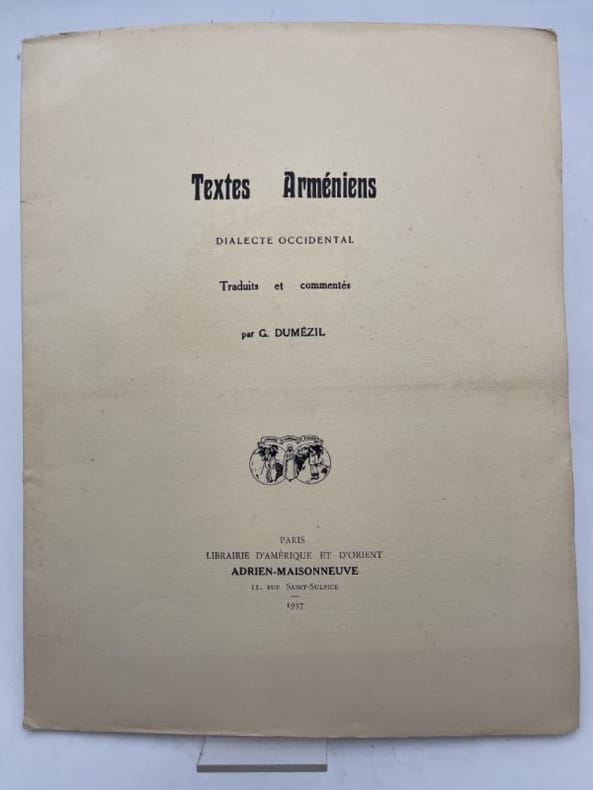
1937187992Adrien Maisonneuve Paris, Adrien Maisonneuve, 1937. In-4 carré broché de 39 pages. Édition originale rare des Textes arméniens publiés par Georges Dumézil, grand philologue, historien des religions et comparatiste. Cet ouvrage rassemble et commente un ensemble de textes en langue arménienne, traduits, annotés et accompagnés dune introduction critique. Il sinscrit dans les premiers travaux orientalistes de Dumézil, avant ses grandes synthèses sur les structures indo-européennes. Louvrage illustre son érudition linguistique et son intérêt pour les littératures du Caucase et de lArménie, alors peu accessibles aux chercheurs occidentaux. Témoignage des débuts scientifiques de Georges Dumézil, futur académicien et grande figure des études indo-européennes.
1900nf1859Imprimerie Paul Dupont Broché 1900 RARE. In-8 (16 x 24 cm), broché, 242 pages, carte dépliante in fine, très rare ouvrage ; petit manque et pliures au dos bruni, mors fendus aux coiffes, par ailleurs intérieur bien conservé, assez bon état général. Livraison a domicile (La Poste) ou en Mondial Relay sur simple demande.
Fine English Original imitation leather bound. Large Roy. 8vo. (25 x 17 cm). In Uighur Turkish with Arabic letters. Reprint. [xxxii], 662, [3] p., b/w and color plts., many color and b/w folding maps and plates. Muhammad Amin Bughra (1901-1965) was a Turkic Muslim leader, who planned to set up an independent state, the First East Turkestan Republic. In the spring of 1937, rebellion again broke out in southern Sinkiang. A number of factors contributed to the outbreak. In an effort to appease the Turkic Muslims, Sheng Shicai had appointed a number of their non-secessionist leaders, including Khoja Niyaz Hajji and Yulbars Khan, another leader of the Kumul uprising (February 20, 1931- November 30, 1931), to positions of influence in the provincial government, both in Di Hua (modern Ürümqi) and Kashgar. At the same time, educational reforms, which attacked basic Islamic principles, and the atheistic propaganda program, which was being extended into the south, were further alienating the local population from Sheng's administration. In Kashgar Mahmud Sijang, a wealthy Muslim, former leader of the Turpan uprising (1932), and one of Sheng's appointees, became the focal point for opposition to the government. Meanwhile, in Afghanistan under Sardar Mohammad Hashim Khan, Muhammad Amin Bughra, the exiled leader of the Turkish Islamic Republic of East Turkestan (TIRET, known as the first East Turkestan Republic), had approached the Japanese ambassador in 1935 with "a detailed plan proposing the establishment of an 'Eastern Turkestan Republic' under Japanese sponsorship, with munitions and finance to be supplied by Tokyo. he suggested as the future leader of this proposed Central Asian 'Manchukuo' none other than Mahmud Sijang (Mahmut Muhiti - commander of the 6th Uyghur Division, stationed in Kashgar as part of the Sinkiang provincial armed forces, since July 20, 1934), amongst the invitation at such political entity as Greater East Asian Co-Prosperity Sphere how active member." However, this plan was aborted when Mahmud, fearful for his life, fled from Kashgar to India on April 2, 1937, after failed attempt of Sheng Shicai to disarm his troops by offering to " modernize " weapons of 6th Uyghur Division, prior which all old weapons of Division was to be given over to Urumchi representatives. Mahmud's flight sparked an uprising amongst his troops against provincial authorities. Those who were pro-Soviet in any way were executed, and yet another independent Muslim administration was set up under leadership of the close associate of Mahmut Muhiti General Abduniyaz (killed in action in Yarkand on August 15, 1937), who adopted a command of troops, which enlisted about 4,000 soldiers and officers, consisted of 4 regiments, two of them being stationed in Kashgar, one in Yangihissar, one in Yarkand, also one brigade was stationed in Ustin Atush and one cavalry guard escadron in Kashgar. Sheng Shicai's provincial troops were defeated and routed by rebels in the fierce battle near city of Karashahr in July,1937, but eventually the uprising was quelled by Soviet troops (by the so-called Kyrgyz Brigade, about 5,000 troops, consisted of two tactical groups- Oshskaya and Narinskaya, each included 2 mountain regiments, one of Red Army and one of NKVD, reinforced by armoured vehicles, tank battalion (21 BT-7) and aviation; there were unconfirmed reports of the use of chemical weapons by these intervention forces against rebels), invited by Sheng Shicai to intervene in the August, 1937. In 1940, Muhammad Amin Bughra published this book, Sharkiy Turkestan Tarihi (East Turkestan History) while in exile in Kashmir, which described the history of the region from ancient times to the present day, and contained an analysis of the reasons for the loss of its independence in the middle of the eighteenth century. In 1940 Isa Yusuf Alptekin and Ma Fuliang who were sent by Chiang Kai-shek, visited Afghanistan and contacted Bughra, they asked him to come to Chongqinq
New Turkish Original bdg. HC. 4to. (31 x 22 cm). In Turkish with facsimiles of Ottoman documents. 832 p., color and b/w ills. Osmanli arsiv kayitlarinda 93 Harbi Batum muhacirleri. Batumi and its history, the villages in the region and archives found in the documentation of the names of the tribe and the battalion and armed struggle of the people of Batumi against the Russian army. After the war, the names of the immigrant villages established in many parts of Anatolia, the household and the population information, the names of the settlers... In Batumi and around, the historical process of the settlement of tens of thousands of immigrant families who migrated from Batumi, Acara, Çürüksu, Artvin, Livane, Savsat, Imerhev, Maçahel, Ardanuç, Murgul, Borçka and Maradit into various parts of Anatolia. In addition there are visual materials of first immigrants' petitions, gravestones, photos, school, mosque and fountain... It's prepared based on the Ottoman archival documents besides a few oral history citations.
New New English Original binding with original dust wrapper. Oblong 4to. (31 x 30 cm). In Turkish and English. Color ills. 543 p., 1 folding map. Very heavy volume. From Siberia to Anatolia the Turks on the rock.= Sibirya'dan Anadolu'ya tastaki Türkler. TURCOLOGY Central Asia Caucasus Stone Turkic art History of Turkic art Turkestan Travel Siberia.
61026Paris, E. Plon 1888, 280x195mm, XII- 458pages, reliure d'éditeur. Percaline rouge, plat supérieur illustré ,tranches dorées, coiffe supérieure endommagée, autrement bon état. Bien complet de la carte dépliante.
Fine Turkish Original bdg. HC. 4to. (29 x 20 cm). In Kabardian (Circassian) in Cyrillic, Russian, and Turkish. 480 p. Çerkes yemekleri.= Adige skhinig'uekher: Blyuda Adigskom (Cherkesskoi) kuzin. Recipes of Circassian cuisine.
Very Good Turkish Paperback. Cr. 8vo. (20 x 14 cm). In Crimean Turkish (Cyrillic script). 222, [2] p., color ills. ISBN: 582501247. Akilli kirpinen ayneci tilki. Krimtatar halk masallari. Toplagan, islegen ve tertib etgen: Ablüziz Veliev. A rare fairytale book compiled and printed by Crimean intellectuals during their exile in Uzbekistan.
Very Good Turkish, Ottoman (1500-1928) Original color map. Atlas folio. (55 x 46 cm). In Ottoman script. Scale: 1/400.000. [OTTOMAN MAP of CAUCASIA] Yekaterinodar - Yeysk - Maykob - Anapa. Shows Krasnodar, Maikop, Yeysk, Anapa and shores of Black Sea. At northeast, map shows Kuban river (Kuban nehri) and its basin in Circassia (Republic of Adygea). Maykop is the capital city of the Republic of Adygea in Russia, located on the right bank of the Belaya River (a tributary of the Kuban River). Yekaterinodar (Krasnodar) at north of map, near to Maykop. From northwest to south east, map shows Black Sea shores of the extensive area with interesting details in Ottoman Turkish script. Also shown Belaya, Chokhrak and Dakh Rivers in addition all south land of Krasnodar Krai of the Northwestern Caucasus until southern Georgian borders and Georgia. Almost all toponyms are in Ottoman Turkish.
Very Good Turkish, Ottoman (1500-1928) Original color map. Elephant folio. (60 x 50 cm). In Ottoman script. Scale: 1/300.000. [MAP of KRASNODAR - YEYSK] Yeysk. Bedlapaglia, Yekaterinodar, Anapa. Shows Yeysk, a port and a resort town in Krasnodar Krai, Russia, situated on the shore of the Taganrog Gulf of the Sea of Azov in north, Yekaterinodar (Krasnodar) in south, Anapa (Bigurkal) etc.
Very Good Turkish, Ottoman (1500-1928) Original color map. Elephant folio. (60 x 50 cm). In Ottoman script. Scale: 1/300.000. [MAP of KRASNODAR - YEYSK] Yeysk. Bedlapaglia, Yekaterinodar, Anapa. Shows Yeysk, a port and a resort town in Krasnodar Krai, Russia, situated on the shore of the Taganrog Gulf of the Sea of Azov in north, Yekaterinodar (Krasnodar) in south, Anapa (Bigurkal) etc.
Very Good Turkish, Ottoman (1500-1928) Original color map. Atlas folio. (55 x 46 cm). In Ottoman script. Scale: 1/400.000. [OTTOMAN MAP of CAUCASIA] Yekaterinodar - Yeysk - Maykob - Anapa. Shows Krasnodar, Maikop, Yeysk, Anapa and shores of Black Sea. At northeast, map shows Kuban river (Kuban nehri) and its basin in Circassia (Republic of Adygea). Maykop is the capital city of the Republic of Adygea in Russia, located on the right bank of the Belaya River (a tributary of the Kuban River). Yekaterinodar (Krasnodar) at north of map, near to Maykop. From northwest to south east, map shows Black Sea shores of the extensive area with interesting details in Ottoman Turkish script. Also shown Belaya, Chokhrak and Dakh Rivers in addition all south land of Krasnodar Krai of the Northwestern Caucasus until southern Georgian borders and Georgia. Almost all toponyms are in Ottoman Turkish.
Very Good Uighur Paperback. Roy. 8vo. (24 x 17 cm). In Uighur with Arabic letters. 188 p., b/w ills. Ülke tarihi. 2 volumes in 1. [Reprint]. Extremely rare. This rare work, originally published in Urumqi in 1947 and written in Uyghur Turkish dialect, was republished in facsimile by a publishing house from Istanbul - Zeytinburnu in the '70s. After 10 years of struggle against Russian and Chinese domination in East Turkestan, Polat Kadir Turfanî played an important role in the initiation of national activities during his 21-year period in action. His works, which he created as a journalist and historian, are still used as a reference today. Extensive history of China's Xinjiang region where Uighur Turks live.
New Turkish Paperback. 4to. (27 x 21 cm). In Turkish. 428 p. I. Uluslararasi Geçmisten Günümüze Kirgiz-Türk Iliskileri Sempozyumu bildirileri: (3-5 Mayis 2013, Bursa). Not in OCLC.
New English Original bdg. HC. 4to. (30 x 21 cm). In Turkish with English abstracts. 2 volumes set: (660 p.; 663 p.), b/w and color ills. CIEPO 22 Symposium: Comite International des Etudes Pre-Ottomanes et Ottomanes, 4-8 October 2016, Trabzon, Turkey.= CIEPO 22 Sempozyum. Uluslararasi Osmanli Öncesi ve Osmanli Çalismalari Komitesi. Bildiriler kitabi. 2 volumes set.
New New Persian Original bdg. Dust wrapper. Roy. 8vo. (24 x 17 cm). In Persian and Azerbaijani. 836 p. Etymological dictionary of new Turkish.= Yeni Tu?rkc?enin etimolojik so?zlu?g?u?.= Farhang-i Turkî-i navîn: Ta'ammulâtî dar 'arsah-'i rîshah'shinâsî (Turkî-Fârsî): Hamrâh bâ jadvalî az kalimât-i Turkî-i dakhîl dar Fârsî va tahlîl-i rîshah'shinâsî-i ânân.
1903AUB-2476Paris, éd. Lucien Laveur s.d. (1903). Bon et gd in-8 broché, couverture ornée d'éd., XL + 331 pages avec annexes + planches. Couverture usagée. Ttaduction et présentation par Maurice PAILLON.
Very Good Turkish, Ottoman (1500-1928) Paperback. Roy. 8vo. (24 x 16 cm). In Ottoman script. 61 p. Divân-i Kadi Burhaneddin: Gazel ve rübâiyatindan bir kisim ve tuyuglari. Kadi Ahmad Burhan al-Din was an Oghuz vizier (high-ranking minister) and atabeg (a noble custodian of the crown prince) to the Eretnid rulers of Anatolia. In 783 AH (1381-1382), he took over Eretnid lands and claimed the title of sultan for himself. He is most often referred to by the title kadi, or Islamic judge, his first position under the Eretnids. He was an outstanding poet, who wrote primarily in Persian. Qâzi A?mad Borhan al-Din played significant role in the development of the Azeri Turkish poetry. His diwan comprises 1,500 ghazals, 119 tuyughs, and a few distichs. According to J. Rypka, he was "a poet of profane love; mystical notes are sounded more rarely in his work". Despite his ability, he was relatively unknown, and his work had little influence on later Azeri or Ottoman poetry. First printed appearing in the Ottoman / Turkish literature. Roum: 1338 = Gregorian: 1922. Özege 4169.
69238Grenoble, Didier et Richard, 1936, in 4° broché, XXIX-195 pages ; couverture rempliée illustrée.
Fine English Paperback. Pbo. 4to. - Large Roy. 8vo. (27.5 x 19.5 - 26.5 x 18 cm). 522 p.; 429 p. B/w ills. Kafkas kaynaklarina göre ilk yaratilislar - ilk insanlik - Kafkas gerçekleri. 2 volumes set.
Fine English Original bdg. HC. Roy. 8vo. (24 x 17 cm). In Crimean Turkish (Cyrillic script) and Russian. 320 p. Rakamlar saatlik eteler. Kirimtatar halkinin öz-özüni cedvelge aluvi (1966, 1971, 1973-1974 ss). Tarihi vesikalar.= Slori svidetelstvuyut. Po materialam samoperepisi Krimskotatarskogo naroda (1966, 1971, 1973-1974 gg). Ismoruchni documenti. Details of the population census of the people after the Crimean exile, 1963-1974.
New English Original bdg. HC. In original publisher's special slip-case. Large roy. 8vo. (25 x 17 cm). In English, Russian, and Turkish. 3 volumes set: ([xxii], [vi], [vii], 1956 p.). From representation to phobia Islam in Central Asia.= Islam v Tzentral Asii: Ot predstavitelstva k fobii.= Temsilden fobiye Orta Asya'da Islâm. 3 volumes set. Vol. 1: Tanimadan tanimalamaya. Vol. 2: Türk'ün Tanrisi'ndan, Tanri'nin Türkü'ne. Vol. 3: Aydinliktan Aydinlanmaya. A very heavy set.
As New English Paperback. Pbo. 4to. (34 x 25 cm). In Turkish and Ottoman Turkish. [ix], [ix], 176, 163 p.; 608 p. facsimile. Defter-i Hakani dizisi VII: 370 numarali Muhasebe-i Vilâyet-i Rûm-ili defteri (937 / 1530). (Dizin ve tipkibasim =[Index and facsimile]). Vol.1: Pasa (Sofya) ve Vize livalari ile Sagkol kazalari (Edirne, Dimetoka, Ferecik, Kesan, Kizil-agaç, Zagra-i Eski-hisar, Ipsala, Filibe, Tatar-bazari, Samakov, Üsküb, Kalkan-delen, Kirçova, Manastir, Pirlepe ve Köprülü). Vol.2: Çirmen, Müselleman-i Çingane, Müselleman-i Kizilca, Silistre, Kefe, Nigbolu ve Vidin livalari, Çirmen ve Vize müsellemleri, Yörük ve Tatar cemaatleri ile Voynugan-i Istabl-i Amire ve Kibtiyan-i Vilayet-i Rum ili. (Dizin ve tipkibasim =[Index and facsimile]). I-II. 2 volumes set.
New English Paperback. 4to. Text in Russian, with some texts in English and Arabic. 652 p., ills. Epitaphs of Muslim scholars in Samarkand (10th-14th centuries). Edited by Bakhtiyar Babadjanov, Lola Dodkhudoeva, ?shirbek Muminov, Ulrich Rudolph. The book contains texts in Arabic script of 239 epitaphs of Central Asian scholars who lived from the 10th to 14th centuries with their representations, photos, translations into Russian and commentaries. It includes an introductory article, detailed scholarly indices, a glossary, bibliography, and other illustrations. The published materials are original sources for the study of the politics of religion under the Qarakhanid Dynasty (992-1211), for the mechanisms of cooperation between the state and religion, and for the role of Islamic scholars in mediating between the authorities and the pubslic. The publication will benefit researchers in religious studies, Islamic studies, anthroplogy, history, and al those interested in the evolution of traditional Islam in Central Asia.