Hind R. - Hulland W.MareMagnum

716 résultats
Raffigurazione della battaglia e della morte di Selim Pasha
Raffigurazione del recupero notturno dei feriti, dopo la battaglia
A chi legge, Trotti luogoten. Gen. in ritiro 1 21x14 cm., in brossura, sopraccoperta in acetato, pp. 31 (1), bella Tavola formato 60,5x41,5 cm. raffigurante il campo di battaglie con indicazione a colori delle varie truppe dislocate, prima edizione, con testi in italiano e testi in francese, buone condizioni. RARO Quadro Dimostrativo delle Truppe Componenti la 2? Divisione del Corpo di Spedizione in Oriente alla data delli 16 agosto 1855 - Relazione circa alla parte avuta dalla 2? Divisione sarda, nella battaglia di Traktir, delli 16 agosto 1855, diretta al Comandante in Capo del Corpo di Spedizione in Oriente, firmato Trotti. Luogoten. Gen. Comandante, in italiano - Grand Quartier G?n?ral devant S?bastopol le 18 aout 1855, firmato Le G?n?ral Major Protenfeld, in francese - Comando Generale del Corpo di Spedizione in Oriente, Rapporto del Generale Alfonso Lamarmora al Ministro della Guerra, firmato Alfonso Lamarmora, in italiano - Ordini generale di encomio di Lamarmora, in italiano; di P?lissier A: Le general en chef, in francese; di James Simson, Le g?n?ral en chef (Anglais), in francese.
Torino, 1857. Tratta dall’album “Ricordo pittorico militare della spedizione sarda in Oriente negli anni 1855 - 56. Pubblicato d’ordine del Ministro di Guerra per cura del Corpo Reale di Stato Maggiore”. Tavola XXIII. Incisione su acciaio, confini in colore d'epoca, cm 74 x 81 circa (il foglio). Bella raccolta iconografica e tecnica della guerra di Crimea. Buono stato di conservazione. .
Grande TAVOLA di cm. 45x36,7 con la CARTA TOPOGRAFICA in scala metrica di 1 a 40.000, corsi d'asqua in azzurro; indicante con vari simboli a COLORI e TRATTEGGI le posizioni di Sardi, Francesi, Turchi prima della battaglia; e, sotto, nei periodi 1°, 2° , 3° quelle di Russi, Sardi, Francesi, Turchi, Inglesi. Importante tavola proveniente dal prestigioso e raro album "Ricordo della Spedizione Sarda in Oriente", stampato a opera dei Reduci nel 1884 e riproducente quello più grande del marzo 1857.
un vol in 8 cm. 22,5x13,6 pp. VIII-488 Legatura coeva mz. pelle verde dorso a riquadri e scritte oro piatti rigidi marezzati Piccola gora al bordo bianco delle prime 7 cc. modeste fioriture della carta Buon esemplare molto ben conservato con "70 planches ou gravures de batailles, vaisseaux, costumes, etc, etc,...."
Tratta da “Seat of War in the East”. Paul & Dominic Colnaghi & C.°, London 1855 – 1856. Tonolitografia in recente ma bella coloritura a mano, cm 37 x 55,5 circa (il foglio). Disponiamo di numerose tavole appartenenti alla prima o seconda serie. Le tavole sono tutte delineate da William Simpson e litografate da vari autori, tra cui E. Walker, J. Needham, T. Picken e altri. Tranne un minimo e lieve foxing, bella coloritura e in buono stato di conservazione.
trad. di Sergio Mancini tela edit. con sovrac. ill.
228057Marseille, Collection Raoul et Jean Brunon, s.d. (1954) in-4, 30 pp., texte sur deux colonnes, avec des illustrations dans le texte et 6 planches, broché sous couverture illustrée en couleurs. Couverture usée.
Milano, Mondadori, 2002, 8vo tutta tela editoriale con sovraccopertina illustrata a colori, pp. 325 con illustrazioni nel testo (Supplemento a Il Giornale) .
22365 C. Woodham - Smith Balaclava. La carica dei 600. Milano, BUR 2002 italiano, cm 22,5 x 15 pp. 324 (1) La storia della Brigata di cavalleria leggera di sua Maestà Britannica e dei suoi cavalleggeri. Lieve ingiallimento sui margini delle pagine.
In-8 (cm. 21), cartonato editoriale, sovracoperta, pp. 324. In ottimo stato (nice copy).
Very Good English Paperback. Demy 8vo. (21 x 14 cm). In English, German, and Russian. [3], 60, [4] p., b/w ills. Bakhchisarai historic reserve guide.= Historisch Kulturelle denkmaler in Bachtschissarai.= Bahchisaraiskiy istoriko-kulturniy zapovednik.
Very Good English Paperback. Pbo. Roy. 8vo. (24 x 17 cm). In Turkish. [32] p., b/w and color plts. Signed and inscribed by Imre. First Edition. Rare. Babam Ahmet Veli Ibrahim Menger.
Very Good English Paperback. Pbo. Demy 8vo. (21 x 14 cm). In Turkish. 2 b/w portrait of Resulzade, 40, 44 p. Two studies each other in one. Azerbaycan kültür gelenekleri ve çagdas Azerbaycan edebiyati. Resulzade's important works on Azerbaijani cultural traditions and contemporary literary history. First Editions in 1949. Second Edition.
New New English Original bdg. Dust wrapper. In publisher's special slip-case. Roy. 8vo. (23 x 16 cm). In Turkish. Color and b/w ills., maps and tables. 4 volumes set: ([xx], 686 p.; [xx], 504 p.; [xi], 872 p.; [xxxiv], 302 p.). A very heavy set. Avrasya'da Yeniden Çizilen Sinirlar, Insa Edilen Kimlikler Projesi. 4 volumes set: Vol. I: Bagimsizliklarinin Yirminci yilinda Orta Asya Cumhuriyetleri. Türk dilli halklar - Türkiye ile iliskiler. Vol. II: Bagimsizliklarinin Yirminci yilinda Azerbaycan, Gürcistan ve Ukrayna. Türk dilli halklar - Türkiye ile iliskiler. Vol. III: Sovyetler Birligi'nin dagilmasindan Yirmi yil sonra Rusya Federasyonu. Türk dilli halklar - Türkiye ile iliskiler. Vol. IV: Sovyet sonrasi dönemde Türk dilli halklar, dil sorunu, yeniden biçimlenen kimlikler. [Ataturk Turkish Turkey Türkei Turquie Turchia Turquía Kalkun Turkish Türkisch Turc Turque Turco Tyrkisk of the Turkish language Linguistics Linguistic study Studies Work SSCB USSR The Russian Federation Central Asia Asian culture Foreign affairs Diplomacy Diplomats Diplomat International relations Azerbaijan Georgia Georgian Azerbaijani Ukraine Ukrainian History Social Historical Politics Politica Political Policy Caucasia Kaukasus Caucase Turcology Turcologie Turkic Turkica Turcica Turk Turks Crimea Crimean Kirim].
Fine English Paperback. Cr. 8vo. (20 x 14 cm). In Turkish. [vi], 120 p., b/w plts. Avraham Firkowicz was a Turkic-speaking Karaite Jew from what is now Western Ukraine, who spent much of his life in extensive travels, during which he obsesively looked for ancient Jewish manuscripts. The academic world owes to this picturesque man three most important collections of Jewish manuscripts ever collected by a single man. During his short stay in Istanbul in the Tanzimat Period produced there several important Karaite books in Turkish, and his activities in the Ottoman capital paved, in many senses, the way for far-going transformation of Karaite life there and in Russia, which ultimately helped rise of Turkic nationalism.
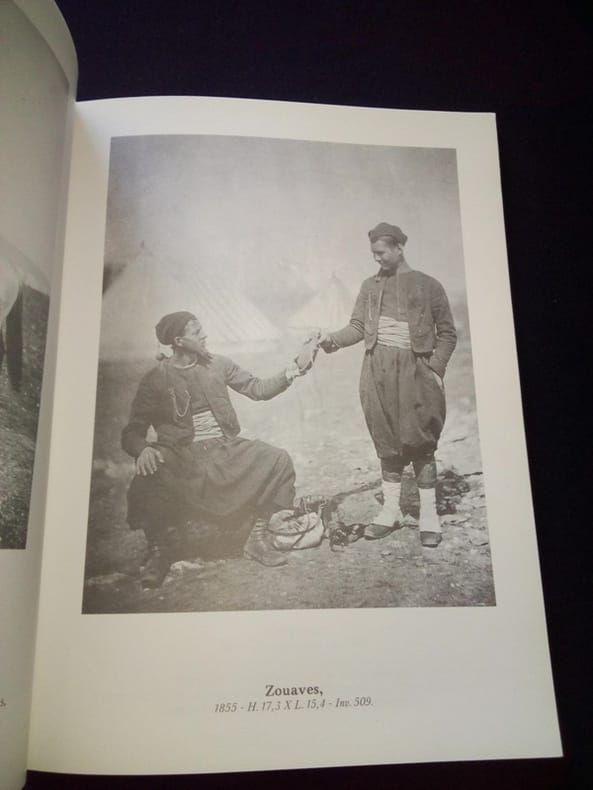
1994RES34L315Musée de Chantilly 1994 Catalogue de l'exposition des photographies de Fenton sur la guerre de Crimée - broché - non paginé ( 72 pages ) - Fenton fit 360 photographies en Crimée .
1994RES34L315Musée de Chantilly 1994 Catalogue de l'exposition des photographies de Fenton sur la guerre de Crimée - broché - non paginé ( 72 pages ) - Fenton fit 360 photographies en Crimée .
Very Good Turkish, Ottoman (1500-1928) Original autograph manuscript letter sent to Haci Giray family for condolences on Haci Giray's death. 38x21 cm. On a special paper with 'ahar'. Sealed. 1 p. Has six lines. With a legible script and fine calligraphic style. It starts with 'huve'. He was a Turkish statesman, governor and member of state council according to Sicill-i Osmânî by Süreya and Türkischer Biographischer Index. The House of Giray (Crimean Tatar: Geraylar, Turkish: Âl-i Cengiz), also Girays, were the Genghisid/Turkic dynasty that reigned in the Khanate of Crimea from its formation in 1427 until its downfall in 1783. The dynasty also supplied several khans of Kazan and Astrakhan between 1521 and 1550. Apart from the royal Girays, there was also a lateral branch, the Choban Girays (Çoban Geraylar). Before reaching the age of majority, young Girays were brought up in one of the Circassian tribes, where they were instructed in the arts of war. The Giray khans were elected by other Crimean Tatar dynasts, called myrzas (mirzalar). They also elected an heir apparent, called the qalgha sultan (qalga sultan). In later centuries, the Ottoman Sultan obtained the right of installing and deposing the khans at his will. Giray family settled in Adrianople (Edirne) city in 17th century.
Very Good English Original autograph letter signed by Vladimir Fedorovich Minorsky, sent to Turkish professor and historian Osman Turan, (1914-1978), was born in year when World War I started. He had some bad conditions in his childhood. Being in Ankara in years when DTCF established was a great chance for him. He was trained by Fuat Köprülü. His studies in the first period were about pre-Islamic Turkish history. But his studies after he became associate-professor were about Seljukians. There isn't a better studying in this field yet than his studies. (Source: Osman Turan's Life (1914/17 - 1978) and Historiography, Tufantoz). Letter has 12 lines in front, and 4 lines on verso, in English completely. It has a plan of a library, probably in the UK which shows Trinity and Sydney Colleges, etc. Letter says: "Dear Dr. Turan, Very good. We shall be waiting for your on Friday. If you are not engaged come andd have lunch with us at 12.45. If you cannot come at 2.30 and I shall show you the Library. Looking forward to meeting you. Yours sinccerely, V. Minorsky'. "When you come to No 9 push the door in front of you...". Repaired margins. Minorsky was a Russian Orientalist best known for his contributions to the study of Persian and Kurdish history, geography, literature, and culture. Minorsky was born in Korcheva, in the Konakovsky District of the Russian oblast of Tver, northwest of Moscow on the upper Volga River, a town now submerged beneath the Ivankovo Reservoir. There he was a gold medallist of the Fourth Grammar School. In 1896 he entered Moscow University to study law, graduating in 1900, then entered the Lazarev Institute of Oriental Languages where he spent 3 years preparing for a diplomatic career. He made his first trip to Iran in 1902, where he collected material on the Ahl-e Haqq. In 1903 he entered the Russian Ministry of Foreign Affairs, serving 1904-1908 in Persia (now Iran), first in the Tabriz Consulate-General and then the Tehran Legation, and 1908-1912 in Saint Petersburg and Tashkent. In 1911, jointly the Four-Power (British, Russian, Turkish, and Persian) Commission, he carried out a mission in North-Western Persia to delimit the Turko-Persian border, and also published a monograph on the Ahl-i ?aqq religion for which he was awarded the Gold Medal of the Ethnography Section of the Imperial Society of Natural Sciences in Moscow. One of the most important Kurdish manuscripts he obtained during this period was The Forqan ol-Akhbar, by Hajj Nematollah, which he later wrote about in "Etudes sur les Ahl-I Haqq, I.", Revue de L'Histoire des Religions, tome XCVII, No. 1, Janvier 1928, pp. 90-105. His surveys in Iran also provided invaluable material for his 1915 work, Materialï dlya izucheniya vostoka (Materials for the Study of the East), published by the Imperial Russian Ministry of Foreign Affairs, St. Petersburg. From 1915-17 he served as Chargé d'affaires in the Russian Legation at Tehran. As the Bolshevik Revolution of 1917 made problematic his return to Russia, in 1919 he moved to Paris where he worked at the Russian Embassy. There his expertise in Middle Eastern and Caucasian affairs was useful during the Versaille and Trianon peace settlements. In 1923 he began to lecture on Persian literature at the École nationale des langues orientales vivantes, where he subsequently taught Turkish and Islamic history. In 1930 he was named Oriental Secretary to the 1931 International Exhibition of Persian Art at Burlington House, London, and in 1932 was made a lecturer in Persian at London's School of Oriental Studies. In 1933 he became Reader in Persian Literature and History, University of London; Professor of Persian in 1937; and in 1944 retired. During World War II, SOAS had evacuated to Christ's College, University of Cambridge, and there the Minorskys retired apart from a year (1948-49) at Fuad University, Cairo. In 1934 Minorsky was one of the distinguished participants in the Ferdowsi Millenary Celebration in Tehran. Minorsky received n
Very Good Turkish Original autograph greeting card signed by Edige Mustafa Kirimal sent to 'Bahire Hanim'. 10x12 cm (Open size: 10x24 cm). In Turkish. 1 p. Written on the card as print 'Die besten Münche zum Jahresmeschel'. Dated 'Münih, 23.12.1963'. 8 lines. Written 'Yeni yilinizi candan kutlar, saglik ve saadet diler, samimî selâm ve hürmetlerimizin kabulünü rica ederiz'. This is a new year celebration and greetings. Kirimal is best known for his meticulous research and publications on the history of Crimean Tatars in the first half of the 20th century. He served as the editor of Dergi, one of the publications of the Institute for the Study of the USSR in Munich, and was among the first scholars to explore the fate of ethnic minorities living in the Soviet Union. Edige's father Mustafa Shinkievich, who came from a Lithuanian Tatar (also known as Polish Tatar) family, had moved to Crimea before World War I. He was a descendent of soldiers under the command of the Golden Horde Khan Toktamish who had fled to Lithuania in the late 14th century. Born in Bahçesaray in 1911, Edige received his early education in Dereköy, near Yalta and graduated from the Russian gymnasium in Yalta. He enrolled in the Institute of Pedagogy in Simferopol (now Crimean State University of Engineering and Pedagogy), but his involvement in Crimean Tatar nationalist activities made it impossible for him to remain in Crimea. The Soviet repression, marked by the arrest, execution and deportation of thousands of Tatars, forced him to flee to Azerbaijan and then to Iran. He arrived in Istanbul in 1932. Two years later, he joined his uncle Yakup Shinkievich, who was serving as Muftu of the Lithuanian Muslims in Vilnius, a city then under Polish occupation. Edige graduated from the University of Vilnius with a degree in political science in 1939. Following the invasion of Poland by German forces in September 1939, he left for Berlin and then for Istanbul. During the German occupation of Ukraine and Crimea (1941-44), Kirimal was active in Germany, trying to secure rights and protection for the Crimean Tatars, and later helped refugees from Crimea settle in German camps. After World War II ended, Kirimal pursued graduate studies and received his doctorate degree from the University of Münster in Germany. His often quoted monograph, Der nationale Kampf der Krim-türken (Emsdetten/Westfalen, 1952), was based on his dissertation. He joined the staff of the newly founded Institute for the Study of the USSR (Institut zur Erforschung de UdSSR) in Munich in 1954 and became the editor of Dergi, the Institute's publication in Turkish. Kirimal published numerous articles on the history and nationalist struggle of Crimean Tatars under Russian and Soviet rule. He was fluent in Russian, Turkish, Polish and German. He retired in 1972 when the Institute closed, and died in 1980 in Munich. (Source: International Committee for Crimea).
30991Paris, Phébus, coll. "D'ailleurs", 1991 - in-8 broché, couv. illustrée à rabats, 264 pages, avec 6 dessins de l'auteur - excellent état
IN 8° OBLUNGO ( cm.26,5 X 39, 1 CARTA CON NOTIZIE STATISTICHE INTORNO ALLE POTENZE BELLIGERANTI + c.5 COSI' RIPARTITE : a) PIANTA DI SEBASTOPOLI CON LE SUE FORTIFICAZIONI BATTERIE E PORTATA DEI SUOI CANNONI .b) PIANTA DELLA CRIMEA.<BR> c) PIANTA DELLA GUERRA DEL DANUBIO. d) PIANTA DELLA GUERRA IN ASIA. e) PIANTA DI KRONSTAD CON SUE FORTIFICAZIONI, BATTERIE E PORTATA DEI SUOI CANNONI. f) PIANTA<BR>DELLA GUERRA DEL NORD. LE CARTE, SONO DELLA LITOGRAFIA BALLAGNY in b/n. COPERTINA EDITORIALE IN BROSSURA VERDE CON TITOLO. INTERESSANTE ATLANTE SULLA GUERRA DI CRIMEA ( 1854 - 55 ), CAUSATA DALLE MIRE ESPANSIONISTICHE DELLA RUSSIA ZARISTA VERSO I BALCANI, ED ALLO SBOCCO DELLE NAVI RUSSE SUL MAR NERO, CONTRASTATE DA UNA COALIZIONE DI STATI EUROPEI ALLEATI DELL'IMPERO OTTOMANO TRA CUI REGNO UNITO, FRANCIA E REGNO DI SARDEGNA.NEL MARZO DEL 1854, LA REGINA VITTORIA E NAPOLEONE III, DICHIARAVANO UFFICIALMENTE GUERRA ALLA RUSSIA. ANCHE IL REGNO DI SARDEGNA SI UNI' ALL'IMPRESA : IL PRESIDENTE DEL CONSIGLIO CAVOUR CONSIDERAVA L'INTERVENTO UN BUON TRAMPOLINO DI LANCIO PER ENTRARE A FAR PARTE DEL GIOCO POLITICO EUROPEO E, NEL 1855 INVIO' UN CORPO DI SPEDIZIONE CAPEGGIATO DAL GENERALE ALFONSO LAMARMORA. NEL 1856, SEBASTOPOLI CADDE. AL CONGRESSO DI PARIGI LO ZAR ALESSANDRO II, ACCETTO' IL PRINCIPIO DI NEUTRALITA' SUL MAR NERO.TRACCE DI POLVERE ALLE CARTE ED ALLA BROSSURA, MINIMI SEGNI DEL TEMPO<BR>AL DORSO DELLA BROSSURA NEL PIEDE, ALTRIMENTI OTTIMA CONSERVAZIONE.ID 3373
Very Good English Paperback. Pbo. Demy 8vo. (21 x 14 cm). In Turkish. 1 b/w portrait of Resulzade, 71 p. Asrimizin Siyavus'u. Prep. by Arasoglu. F¿rst Edition in 1923 in Ottoman Turkish. This is Second Edition. In modern Turkish. A study on thoughts on independence and future of Azerbaijan and Russian imperialism.