1 605 résultats
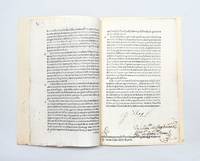
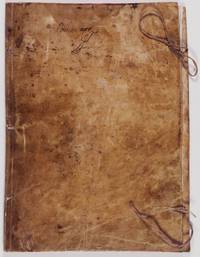
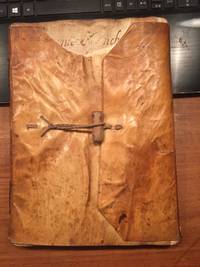
16106653Madrid 1610. Hardcover Tapa dura. 300x210mm. 11¾x8¼". Manuscrito. Dado en Madrid a 2 de noviembre de 1610. En folio 300 x 210mm. 12 folios en pergamino en cuadernillo cosido. Escritura humanística pausada no librada o redonda de privilegios sobre caja de escritura marcada en tinta roja y pautada. Numerales romanos al uso de la cancillería. Invocación destacada en fol. 1r. con letra capital ornamentada. Algunas mayúsculas destacas de módulo superior al resto que marcan el inicio de los distintos traslados documentales que incluye el privilegio. Suscripciones de notario en todos los folios. Marcas de cancelación de folio superior en algunos folios. Algunas adicciones interlineales que corrigen el texto principal de mano posterior a la del texto principal. Suscripciones y anotaciones al final del documento en letra humanística corriente o cursiva. Último folio pautado pero sin texto. Dentro de carpeta. Documento de excepcional interés histórico y literario otorgado por el rey Felipe III a Ana Quijada de Salazar nieta de Alonso Quijada el auténtico nombre del hidalgo don Quijote personaje principal en la novela Don Quijote de la Mancha. Ana Quijada de Salazar 1577-1614 de Esquivas era hija de Juan Quijada de Salazar el cual casó en Illescas con Leonor de Salcedo. Su abuela fue Ana Suárez Medina hija de Gonzalo Medina Godoy alcalde de los hijodalgo que fue procesado por la inquisición pero finalmente liberado por ser a su vez nieto de Diego Muñiz de Godoy caballero de Santiago y por lo tanto cristiano viejo. Su bisabuela sería María de Salazar 1537 hermana de Diego de Salazar el que sería a su vez bisabuelo de la esposa de Miguel de Cervantes. Ambas poseen un tío abuelo común fray Alonso Quijada de la orden de San Agustín modelo del personaje de Quijote. Es en casa de este Alonso Quijada en donde se hospeda Cervantes durante sus estancias en Esquivias. Estudio diplomático y contenido textual: Carta de privilegio real otorgada por Felipe III con traslado de carta de venta de juro y carta de pago emitida a petición de la interesada Ana Quijada de Salazar dada en Madrid el 2 de noviembre de 1610. En fol. 1r. doble invocación explicita gráfica y textual: En el nombre de la Sanctísima Trinidad y de la eterna unidad padre hijo y espíritu sancto Notificación: Quiero que sepan por esta mi carta de privilegio o por su traslado signado de escribano público Intitulación completa: Como yo Don Phelippe por la gracia de dios rey de Castilla . Expositio: Vi una mi carta de venta firmada de mi mano y una carta de pago en ella firmada de don Juan Yváñez de Segovia caballero de la orden de Calatrava y mi tesorero general que son del tenor siguiente. A continuación traslado de la carta de venta y de la carta de pago: Traslado de la carta de venta del rey Felipe III de un juro de al quitar de 187.500 maravedíes a 22.000 el millar por 425.000 maravedíes a favor de Ana Quijada de Salazar dada en Aranda el 28 de agosto de 1610. Intitulación completa: - Directio: A vos el presidente y los del mi consejo de hacienda y contaduría mayor de ella bien sabéis que para ayuda a los grandes gastos que entonces se le ofrecieron al rey mi señor que sancta gloria aya y a mí para la defensa de los reynos contra los turcos y los moros y otros infieles enemigos se han gastado las rentas reales. y teniendo que proveer de mucha suma de dineros para la sustentación de estos reinos y no habiendo ayado manera alguna mejor se acuerda situar en algunas rentas y patrimonios de ellas maravedíes de juro alquitar para aquellas personas a quien se vendieren - Dispositio: Por ende otorgo y conozco que vendo a doña Ana Quisada de Salaçar hija de don Juan Quisada de Salaçar y doña Leonor de Salcedo su mujer vecina del lugar de Esquivias para ellas sic y para sus herederos ciento y ochenta y siete mil quinientos maravedíes en cada un año por quatro ciento y veinte y cinco mil maravedíes que por ello pagó en dineros contados a don Juan Yváñez de Segovia para ayudar a cumplir y pagar lo susodicho Con facultad de poderse quitar para que los tenga situados en ciertas rentas de las alcabalas de la ciudad de Toledo - A continuación cláusulas preceptivas penales y corroborativas pertinentes. - Data y validación: Dada en Aranda a veynte y ocho días del mes de agosto de mil seiscientos y diez años yo el Rey yo Alonso Núñez de Valdivia y Mendoza secretario del Rey nuestro señor la fiz escribir por su mandado. - A continuación en fol. 5v. traslado de la carta de pago de Juan Ibáñez de Segovia tesorero del rey a Ana Quijada de 187.500 maravedíes de juro alquilar a razón de 22.000 maravedíes el millar a disfrutar desde el 17 de junio de 1610 en adelante dada en Madrid a 9 de septiembre de 1610. - A continuación copia de la diligencia de emisión de la carta de privilegio de la venta del juro dada en Madrid a 11 de noviembre de 1610. - A continuación copia de carta de confirmación del rey Felipe III de la carta de venta y carta de pago anteriores a petición de Ana Quijada. - Finalmente data del privilegio real: Dada en la villa de Madrid a dos días del mes de noviembre año del nacimiento de nuestro salvador Jesucristo de mil y seisçientos y diez años. - Validación del privilegio real: numerosas suscripciones del canciller notario contador de rentas escribano etc. El expediente original que se quedó en la Contaduría Mayor de Hacienda se encuentra en el Archivo General de Simancas en el Fondo de Instituciones del Antiguo Régimen sección Contaduría Mayor de Hacienda Contaduría de Mercedes Juros del Reinado de Felipe III con el título: Juro a favor de Ana Quijada Salazar signatura: ES.47161.AGS/2.13.2.3//CME 520 12. Existen además otros tres expedientes sobre juros de esta misma persona uno de ellos de fecha anterior con las signaturas CME 517 74; CME 523 37 y CME 374 53. Ninguno se encuentran digitalizados en PARES Sobre Cervantes en Esquivias Catalina de Palacios y su relación con la familia de Ana Quijada: sacado de http://www.esquivias.es/la-ciudad/informacion-turismo/62-cervantes-esquivias-y-el-quijote. El primer hecho que demuestra la presencia de Cervantes en Esquivias se produce en septiembre de 1584 cuando Cervantes viaja a Esquivias para entrevistarse con Juana Gaitán viuda de su amigo el poeta Pedro Laínez e intentar publicar su obra póstuma: el Cancionero. Cervantes recibe un poder de manos de Juana Gaitán a través de un documento firmado el 22 de septiembre de 1584 ante el escribano de Esquivias Agustín del Castillo. Su cometido es entregar dicho poder así como el Cancionero a Ortega Rosa procurador de causas en los Reales Consejos de Madrid. Así debido a este viaje a Esquivias Cervantes conoce a la que sería su esposa Catalina de Palacios. El noviazgo fue corto ya que contrajeron matrimonio el 12 de diciembre de 1584 en la Iglesia Parroquial de Esquivias bendijo la unión el cura Juan de Palacios tío materno de Catalina y cabe destacar que Miguel alcanzaba ya la edad de 37 años cuando Catalina tenía tan sólo 19. El matrimonio duró 32 años hasta que el 22 de abril de 1616 el Príncipe de los Ingenios encontró la muerte. Vivieron juntos en Valladolid y Madrid volviendo a vivir en Esquivias en determinadas ocasiones donde acudían para visitar a la familia asistir a bautizos donde ejercían como padrinos a la inauguración de la ermita de San Roque en 1602 en 1610 pasaron una temporada en la villa y el último viaje que realizó Cervantes fue precisamente a Esquivias unos meses antes de morir así queda reflejado en el prólogo de su obra póstuma Los Trabajos de Persiles y Segismunda donde dice: ".viniendo otros dos amigos y yo del famoso lugar de Esquivias." Sobre Catalina de Salazar datos sacados de la misma página web: Nació en 1565 en la cuna de una de las familias hidalgas de más rancio abolengo de Esquivias los Salazar. Fueron sus padres: Catalina de Palacios y Fernando de Salazar y Vozmediano. Era la mayor de cuatro hermanos: Nicolás y Gonzalo que murieron siendo niños; Francisco que fue cura de Esquivias y heredero de la familia; y Fernando que terminó siendo fraile franciscano en el convento de San Juan de los Reyes de Toledo con el nombre de fray Antonio de Salazar. Su abuela materna María de Salazar sería hija de Diego García de Salazar. Una hermana de dicho Diego también llamada María de Salazar sería la bisabuela de Ana Quijada de Salazar. En esta última María de Salazar se produce el entronque de las familias Salazar y Quijada. A la boda de Catalina y Miguel de Cervantes no acudieron ni la madre de Catalina ni los padres de Cervantes hecho que también se debe a la reciente viudez de la suegra de Cervantes y a la enfermedad de su padre Rodrigo de Cervantes que murió unos meses después del enlace. Finalmente las familias tuvieron una buena relación como queda patente al contemplar que al hacer testamento Rodrigo de Cervantes nombra como albaceas a su mujer Leonor de Cortinas y a su consuegra Catalina de Palacios. Después de casarse el matrimonio formado por Miguel de Cervantes y Catalina de Palacios se alojó en la casa de fray Alonso Quijada de Salazar pariente lejano de Catalina concretamente era sobrino del bisabuelo de Catalina es decir tío abuelo de Ana Quijada Salazar hermano de su abuelo Gabriel Quijada. En realidad este Alonso Quijada es pariente más cercano de nuestra Ana Quijada que de la propia Catalina como se deduce de sus propios apellidos aunque ambas son sobrinas del mismo en el que Cervantes se basó para escribir el personaje de Don Quijote quedando demostrada su existencia en diversos documentos en los que se puede ver su firma autógrafa. El 9 de agosto de 1586 firma en Toledo dos documentos junto a su suegra. Uno de ellos es una carta de poder de Catalina de Palacios a su yerno Miguel de Cervantes según la cual le otorga toda potestad sobre sus bienes nombrándole administrador absoluto de toda su hacienda y dejándola en sus manos. Por él podría cobrar convenir y vender el documento revela que en el hogar de Esquivias reinaba la concordia y las buenas relaciones que tenía con su suegra cuando demostró tanta confianza en él. El otro documento notable es la carta dotal de Miguel de Cervantes a su esposa en la cual se reseñan los bienes inmuebles que recibe de su suegra y que tenían un valor de algo más de 400 ducados. Miguel se instala con su esposa de momento pero pronto iniciará un permanente peregrinaje que será una constante a lo largo de su vida. A los tres años de casarse debido a su oficio de recaudador de impuestos debe trasladarse a Sevilla pero hace continuos viajes a Esquivias. Permanece en Esquivias hasta el 24 de abril de 1587 cuando se dirige a Toledo siguiendo a la procesión de Santa Leocadia y después se marcha a Sevilla donde obtiene el cargo de comisario real de abastos para la Armada Invencible. Inicia así un constante peregrinaje por Andalucía como recaudador pero también realiza constantes viajes a Esquivias para visitar a la familia y acudir a actos sociales y a Madrid para publicar sus obras. A mediados de junio de 1594 cuando termina su trabajo como comisario Cervantes abandona Sevilla y de paso hacia Madrid vuelve a Esquivias donde permanece dos meses ya que en agosto se instala en Madrid con su esposa. Pero a finales de año recibe comisión para cobrar rentas reales en Granada se dirige a Esquivias con su esposa y comienza la comisión. En febrero de 1599 se traslada de nuevo a Esquivias y en agosto de 1600 se dirige a Toledo junto a Catalina para asistir al ingreso de su cuñado Fernando de Palacios como novicio en San Juan de los Reyes. Toma el nombre de fray Antonio de Salazar cuando se hace franciscano. El 19 de agosto hace testamento antes de ingresar en el monasterio el documento demuestra la cordial relación entre fray Antonio su hermana y Cervantes. A mediados de 1604 Miguel cumple el objetivo de reunir a toda su familia sus hermanas su sobrina y su mujer con la que se instala en Valladolid pero a principios de 1606 con su esposa vuelve a establecerse en Esquivias y realiza viajes a Toledo sin embargo a mediados de año otra vez tras la corte se trasladan a Madrid. En la primavera de 1611 viajan a Esquivias donde permanecen hasta el 31 de enero de 1612 cuando vuelven a Madrid acompañados por su sobrina Constanza. A principios de abril de 1616 Miguel de Cervantes realizó su último viaje a Esquivias donde se quedará pocos días para regresar a Madrid ya enfermo de hidropesía y morirá el 22 de abril. En 1617 su esposa Catalina gestiona con Juan de Villarroel la impresión de Los Trabajos de Persiles y Segismunda su obra póstuma. Catalina morirá el 30 de octubre de 1616 en Madrid y será enterrada junto a su esposo tal y como expresó en su testamento: ".deseo me entierren en el Convento de las Trinitarias junto a mi esposo al que tanto amé en vida." hardcover
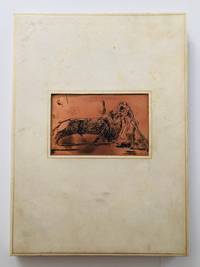
192315073AB1923. Munich Verlagsanstalt D.& R.Bischoff 1923. 335 : 245 cm. 2 leaves 21 signed original etchings by Willi Geiger. Original-vellum portfolio original engraving plate mounted on front cover gilt title on spine filettes slipcase signed Enders. One of only 21 copies of the deluxe edition A printed on Shidzuka Japan. - All copies of this edition are very rare each copy is unique because of the mounted original engraving plate in this copy it is plate no. 5. All etching singed by Geiger. Very striking images which deteced that the artist was very engaged with bull fight. The 'Stierkampf' bull fight is one of the most impressive series of the artist. - A mint copy only front board with a few minor stains. - See Thieme/B. XIII 346 1912. hardcover
1625154780Madrid. a ultimo de Octubre de mil y seiscientos y venticinco años "last day of October" 1625. Signed royal ordinance for the registration of seamen Important printed state paper signed by the king - "Yo El Rey" - Philip IV 1605-1665 setting out instructions for a large scale registration of sailors in the Spanish royal navy addressing the always pressing issue of impressment. Also signed by one of the king's leading military advisers. Philip is probably best remembered as "a peerless patron"; at Buen Retiro his pleasure palace on the outskirts of Madrid "he was surrounded by a brilliant circle of poets and playwrights - including Lope de Vega Calderón de la Barca Antonio Hurtado de Mendoza Francisco de Quevedo y Luis Quiñones de Benavente" the central hall el Salón de Reinos decorated by his court painters headed by Velásquez. Diccionario Biográfico electrónico. He was somewhat less apt in his policy decisions failing in his efforts at domestic and military reform too reliant on the junta system implemented under his favourite and chief minister Gaspar de Guzmán conde de Olivares. Philip was notably more forward thinking and successful in his handling of the navy to which he applied a "sensible pragmatic approach" Goodman p. 32. Throughout his reign there was no "weakening of the importance attached to naval forces" ibid. p. 156 and the Junta de Armadas was the only such committee to survive the eventual fall of Olivares untouched. The present ordinance created regional administrative officials responsible for the initiation of a registry of mariners and the issue certificates to pilots masters gunners carpenters and other naval tradesmen who for their part were ordered to provide detailed personal information. This data was to be recorded in a ledger a copy of which should be sent to the War Council and regularly updated. Failure to comply could result in a severe fine and two years of exile. The directives were to be implemented "generalmente en estos Reynos in all the territories of the Spanish Empire" thus including Spanish possessions in America and Asia. The creation of this matricula - "a register of all seafaring folk designed to provide central control over their movements and availability for armada service" - is one of the distinctive features of early seventeenth-century Spanish naval organization "Nothing like them would appear anywhere else in Europe until Colbert's famous classes maritimes of the 1660s. Madrid's compulsion would arouse resistance on the coast" ibid. pp. 192-3. The countersignatory Bartolomé Aguilar y Anaya c.1563-c.1630 was an influential military administrator under both Philip IV and his father. He entered the service of Ãlvaro de Bazán marquis of Santa Cruz at the age of 17 taking an active part in his patron's conquest of Portugal his campaigns in the Azores and in the preparation of the Great Armada of 1588. On the death of Santa Cruz his rise continued under the protection of the secretary of war Andrés de Prada who appointed him first officer of the sea section of the war secretariat "primer oficial en la sección de Mar de la SecretarÃa de Guerra" in 1594 DB-e. In 1600 he was granted the formal title of royal secretary and in 1606 himself became secretary of war; during the second decade of the 17th century he was secretary of the board of galleys directing the supply of ammunition for the expedition to Brazil in 1625 at which time he had assumed one of the prized seats on the council of war and in the 1630s he was a member of the highly influential Junta de Armadas. Folio pp. 3 on a single bifolium. Printed order with the king's signature countersigned by his secretary of war Bartolomé Aguilar y Anaya manuscript docketing on the first page. Modern marbled paper wrappers. Light toning some marginal fox spots but overall very good. David Goodman Spanish Naval Power 1589-1665. Reconstruction and Defeat. 1997. unknown
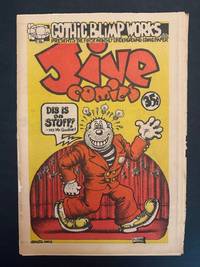
196913188East Village New York: Peter Leggieri and the East Village Other 1969. First Edition. Original Wraps. Very Good in Wraps. First Edition. Original Wraps. "During its eight-issue run the publication displayed comics in both color and black-and-white. The first issue was titled Gothic Blimp Works Presents: Jive Comics. Vaughn Bodé was the founding editor but soon stepped down after the first two issues. At Bodé's invitation Bhob Stewart became the publication's editor introducing a line-up of contributing artists and writers that included Larry Hama Michael Kaluta Willy Mendes George Metzger Ralph Reese Steve Stiles and Bernie Wrightson. The first two issues also featured work by Bodé Joel Beck Roger Brand Robert Crumb Kim Deitch Simon Deitch Bill Griffith Ron Haydock Jay Lynch Trina Robbins Spain Rodriguez Art Spiegelman John Thompson Larry Todd and S. Clay Wilson." While Zap Comix officially started the underground comics movement in the US Blimp Works created national readership and networks to collectively identity as a distinct comic art movement. Features the distinctive oversexualized art of Robert Crumb known for his characters as Mr. Natural and Keep on Truckin'. Important collection billed as "the first Sunday underground comic paper." Scarce complete holdings in the US. Light chipping fading fold lines one issue with dampstaining and general newsprint toning else tight bright and unmarred. Complete run of eight issues with color and b/w illustrations. fo. Var. pg. Peter Leggieri and the East Village Other unknown
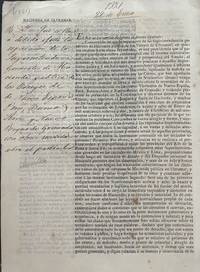
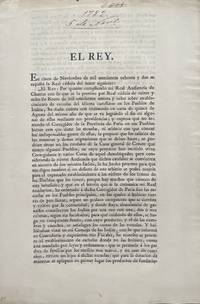
18212758Spain: s.n 1821. First edition. Unbound as published. Signed at the end undecipherable. With date 1821 29. de Enero and summary note on the first page by a contemporary hand in ink. Folded once. Small closed tears at the gutter. Sporadic foxing. In fine condition. First edition. Unbound as published. 4 p. A scarce royal decree on the creation and definition of the office of the General Superintendency in the Spanish Viceroyalties in the Americas.<br /> During the dusk of the Spanish Empire a bulk of administrative reforms were introduced trying to avoid the disintegration of the overseas territories especially in the Americas. By the present royal instruction Fernando VII introduced the office of the Superintendencies in the Viceroyalties of New Spain Peru New Granada and Buenos Aires the RÃo de la Plata and detailed the duties of the position in fifteen articles. <p><br /> <br /> “Y ellà también el de 29 de enero de 1811sic! impreso que contiene una Instrucción en 15 ArtÃculos para los nuevos Superintendentes que por la misma fuerza de los principios liberales quedaban privados de todo conocimiento en los asuntos contenciosos de Real Hacienda lo cual era también aplicable a la Junta Superior y del Vice-Patronato que tampoco tendrÃan los Intendentes porque lógicaÂmente pasaba a los Gobenadores polÃticos. Por supuesto estaba abolido el Fuero de Hacienda y se les cortaba casi totalmente cualquier inicitiva para reformar el sistema. De 3 y 4 de noviembre de 1820 datan las propuestas para la separación de la Superintendencia …. El Real Decreto de 29 de enero de 1821 pasó a las Cortes en 7 de marzo siendo aprobado en 7 de abril ….†Navarro GarcÃa 1959 p. 147 note 61; text reproduced: pp. 221–6<p><br /> <br /> Scarce we could trace only one copy in Spain at the Biblioteca Lázaro Galdiano IB 11662-50.<br /> Literature: Navarro GarcÃa L.: Intendencias en Indias. Sevilla: Escuela de Estudios Hispano-Americanos. 1959. [s.n] unknown
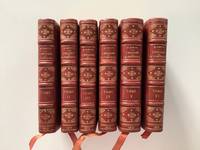
181518769AB1815. 6 volumes. Paris Nepveu 1815. 135 : 9 cm. With 54 partly folded engraved plates. Red contemporary calf binding spine richly decorated in gold 2 red back labels ornamental burdure on the boards. Rare describtion of the kingdoms of Spain and Portugal with beautiful engraved illustrations of small gengre-scenes farmers military persons religious persons bull fight traditional costumes dancing scenes views and so on. -Very mint copy in extraordinary decorative bindings. - Brunet I 1226; Graesse I 530; Colas 439; Hiler 113; Lipperheide Jc 8. hardcover
18152757Spain 1815. First edition. Unbound as published. Dated on the top of the first page and numbered at the lower left corner in ink by a contemporary hand. Printed on Santiago Serra’s paper: watermark of an ornamented Maltese cross and the word “Capelladesâ€. In fine condition. First edition. Unbound as published. 4 p. <p><br /> Royal order concerning the establishment and finance of schools in Indian communities in South America for the teaching of the Castilian language.<br /> This 1815 Royal order is a reinforcement and partly a reprint of a previous ordinance concerning the establishment of schools for teaching the Spanish language in the pueblos de Indios January 28 1778 and a supplement November 5 1782 which — as a response to the appeal of the Corregidor de la Provincia de Paria — permits to finance these schools and provide the salary of the teachers by newly imposed taxes on the local indigenous communities. <p><br /> <br /> Apparently not all the desirable schools were established by 1815 and in a response to another appeal this time by Tadeo JoaquÃn Gárate Cañizares’ 1774–1827 a former Deputy of the Cortes Generales y Extraordinarias in Puno viceroyalty of Peru Charles III’s earlier order and the encouragement of the taxation were repeated and reinforced by Ferdinand VII.<p><br /> <p><br /> <br /> Scarce WorldCat locates only 2 copies worldwide UC Berkeley Libraries; Harvard University. unknown
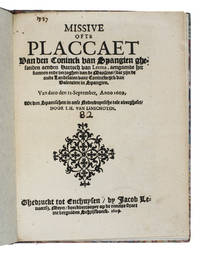
1609ABC_46561Enkhuizen 1609. 4to. Jacob Lenaertsz Meyn Modern marbled paper over boards new endpapers. With an ornamental woodcut title vignette and a woodcut initial. 3 ll. First edition of the Dutch translation by Jan Hughen van Linschoten ca. 1563-1611 of a proclamation decreed on 9 April 1609 by King Philip III of Spain 1578-1621 ordering the Duke of Lerma Francisco Gómez de Sandoval y Rojas 1552/53 - 1625 to expel the Moriscos Spanish muslims who were forced by the Spanish crown and Roman Catholic church to convert into Christianity from Spain. The present decree which was adopted gradually by several Spanish territories first Valencia then Aragon Catalonia Andalusia et cetera provided the Duke of Lerma free reign to carry out the expulsion of the Moriscos by whatever means they see fit to confiscate all their lands and goods and to set an example for everyone who was sympathetic to the Moors. Expelling the Moriscos from Spain however was a real mistake and contributed to the decline of the Spanish reign. The expulsion of the Moriscos led to depopulation and therefore to economic collapse. The present proclamation was therefore of great importance for the Dutch as during the Twelve Years' Truce 1609-1621 the Dutch military war with Spain changed into an economic war. An important decree in the history of the Eight Years' War 1568-1648 between the Dutch Republic and Spain.With some numbers in manuscript on the first two pages. Lacking the blank leaf A4. With a few very minor spots on the first two leaves very slightly browned but overall in good condition.l Knuttel 1630; STCN 830501231; Tiele 790. hardcover
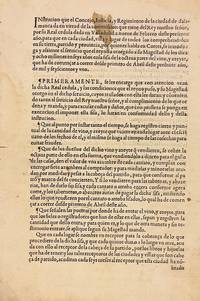
16013683Salamanca: S.n. 1601. First edition. Signed at foot by a municipal officer Diez de la Puente. One-page contemporary manuscript on p. 3 relating to the administration of the tax. Unbound as issued. Pinholes at gutter some edge chipping and small dents brown stain affecting the upper portion throughout. Otherwise a good well-preserved copy. First edition. Signed at foot by a municipal officer Diez de la Puente. One-page contemporary manuscript on p. 3 relating to the administration of the tax. Unbound as issued. 4 last 2 blank p. <p><br /> Unrecorded 1601 ordinance from Salamanca enforcing the Armada-era servicio de millones Spain’s foundational fiscal levy.<br /> <p><p><br /> Printed ordinance issued by the municipal council of Salamanca implementing the royal tax known as the servicio de los dieciocho millones. In accordance with the royal cédula of 9 February 1601 the Concejo Justicia y Regimiento instructs subordinate towns and villages to collect an eighth part of all wine and olive oil sold to be remitted through a chain of local receivers. The text regulates how wine and oil must be measured recorded and taxed forbids additional repartimientos and orders prompt transfer of funds to the city’s main treasury. Dated at Salamanca 10 March 1601 and naming four municipal commissioners appointed for its execution it represents the earliest stage of local enforcement of Philip III’s fiscal scheme transforming the national levy into a functioning municipal excise. A contemporary handwritten endorsement below the text signed by Diez de la Puente attests its execution. Accompanying the printed ordinance is a contemporary manuscript headed on p. 3 “Dudas que se ofrecen en la administración de las sisas†listing practical questions concerning the execution of the tax—registration and measurement of goods roles of administrators and receivers form of payment penalties and conditions of tax farming arrendamiento.<br /> <p><p><br /> The servicio de los dieciocho millones formed part of the broader system of millones taxes created by the Cortes of Castile to meet the Crown’s desperate financial needs after the prolonged wars of Philip II. The servicio de millones had first been introduced by royal request and approved by the Cortes on 4 April 1590 conceived to raise eight million ducats over six years to finance the royal expenditure associated with the Armada campaign against England and other military commitments. Rather than remaining temporary it evolved into a regular levy on six staple items—wine oil vinegar meat soap and tallow candles—collected through local sisas and eventually forming the backbone of Castile’s fiscal structure. By 1600–1601 under Philip III the scheme was renewed and expanded to eighteen million ducats its collection entrusted to municipal governments such as Salamanca’s Concejo Justicia y Regimiento. As described in Bartolomé Yun Casalilla’s Sobre la transición al capitalismo en Castilla this marked a transition from feudal income to a centralized fiscal system financed through municipal taxation embedding local economies within the machinery of the Habsburg war state. The present ordinance captures this process of consolidation—when the monarchy sought tighter control over municipal revenues demanded proper accounting and remittance of surpluses and aimed to prevent arbitrary over-taxation—reflecting both the fiscal strain and administrative centralization characteristic of early-seventeenth-century Spain.<br /> <p><p><br /> Reference: Yun Casalilla B. 1987. Sobre la transición al capitalismo en Castilla: EconomÃa y sociedad en Tierra de Campos 1500–1830. Valladolid: Junta de Castilla y León ConsejerÃa de Educación y Cultura.<br /> <p>. [S.n.] unknown
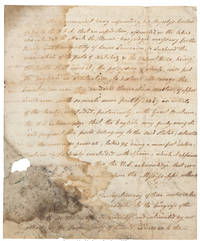
1797List2522New Orleans 1797. Three pages of a bifolium 8 x 9 ½ inches New Orleans; May 31 1797. Fair only with moisture damage and some text illegible. Fair. An interesting document from the period following the Treaty of San Lorenzo and before the eventual surrender of Natchez to the Americans in 1798 in which the governor of Louisiana and West Florida Francisco Luis Hector de Carondelet issues a statement regarding the delayed withdrawal of Spanish troops from the region. Carondelet is concerned with the British presence in the area and notes that it is a violation of “the treaty concluded with Spain†- or Pinckney’s Treaty which opened up navigation rights of the Mississippi to the United States. The letter describes the possibility of escalating hostilities between the United States Great Britain and Spain as a result of an impending American mission against the Illinois the motives of which Carondelet questions as he notes that “These hostile dispositions can naturally only concern these provinces because the U.S. are in peace with all the savages…†He raises the possibility of British invasion of Louisiana and potential danger to the city of New Orleans and states that the Spanish will maintain their presence at Natchez and Walnut Hills unless the American soldiers withdraw. This is a copy of Carondelet’s speech in the hand of Lieutenant Piercy Smith Pope and we find no other record of it. A full transcription follows:<br /> <br /> “The Government being informed by his Majesty’s Ambassador to the U.S. that an expedition assembled on the lakes was intended to attack the Illinois has judged necessary for the surety and tranquility of Lower Louisiana to suspend the evacuation of the posts of Natchez & the Walnut Hills being the posts that cover it; the possession of which will put the English in a situation to disturb and ravage the country in case they rendered themselves masters of upper Louisiana with so much more facility as by an article of the treaty concluded posteriously with Great Britain the U.S. acknowledge that the English may freely navigate and frequent the posts belonging to the said States; situated on the river in general lakes &c being a manifest contradiction to the treaty concluded with Spain which it appears. because by this the U.S. acknowledge that no other nation can navigate upon the Mississippi without the consent of Spain.<br /> <br /> . the legitimacy of these motives the .presented to the Congress of the U.S. with all the necessary veracity and intimated by our orders in the Commissary of Limits as well as to the Commandant of the Detachment of American troops now at Natchez. We are now informed that a detachment of the army of the U.S. cantoned on the Ohio are on their way by Holstein towards Natchez while the Militia of Cumberland are intimated to hold themselves ready to march at the first notice.<br /> <br /> These hostile dispositions can naturally only concern these provinces because the U.S. are in peace with all the savages the anterior menaces of the Commissary of Limits & the Commandant of the detachment of Americans now at Natchez; the immediate rupture & if the American Gazettes are to be believed already effected between France our intimate ally and the U.S. engage us to be on our guard to defend our property with that valor & energy which the inhabitants of these Provinces have manifested on all occasions with the advantage and superiority which a knowledge of our local situation will procure and that confidence which right and justice inspires. If the Congress of the U.S. had no hostile intention against these provinces they will either leave the post of Natchez or Walnut Hills the only bulwarks of Lower Louisiana that can stop the courses of the English or that they give us security against the article of the Treaty with Great Britain which exposes lower Louisiana to be pillaged and destroyed down to the Capitol. We will then deliver up the said posts and lay down our arms which they have forced us to take up by arming their Militia in time of peace and sending a considerable body of troops by round about ways to surprise us.<br /> <br /> New Orleans 31st May 1797 <br /> <br /> A copy of the Baron de Carondelet’s Proclamation. <br /> P. Popeâ€<br /> <br /> Overall a document of significance in United States / Spanish relations in the period following Pinckney’s Treaty worthy of further study for scholars of the diplomatic history of the period. unknown
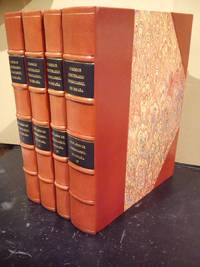
194828761EDICION DE LUJO NUMERADA.- Madrid: Edita el Ministerio de Obras Públicas Se imprimió en la imprenta Editorial Magisterio Español 1948.- 4 VOLS. 3 h. X p. 1 h. 441 p. = 4 h. 437 p. 2 h. = 3 h. 394 p. 2 h. = 3 h. 585 p. 1 h.: Vol. 1º. con retrato fotográfico de Franco a plena página tras la portada fotografías del archivo de Tomás Magallón y un mapa de Puerto Rico por Roberto Ferrer / Vol. 2º. con fotografías del archivo de Tomás Magallón planos y mapas de Roberto Ferrer / Vol 3º. fotografías del Marqués de Santa María del Villar planos gráficos y mapas de Roberto Ferrer / Vol. 4º. Con reproducción de acuarelas en láminas a todo color de Carlos Saenz de Tejada y dibujos intercalados en el texto a dos colores por Lorenzo Goñi. Los 4 vols. con artísticas letras capitulares grabadas en madera por José Antonio Marín; 4º mayor 295 x 235 cm.; Magistralmente encuadernado en Media Piel chagrén a puntas de color rojo lomera dorada con 5 nervios y 2 tejuelos.- EDICION DE 1200 EJEMPLARES en diversas series siendo el 1º el Nº CXLV el 2º el Nº 109 el 3º el Nº 562 y el 4º el Nº 111 / CONTIENE: Vol. 1º. Maximiano García Venero: Historia anecdítica del ferrocarril en España; J. Gimeno Lassala: Los ferrocariles españoles en Filipinas y Puerto Rico; Enrique Castillo: Los ferrocarriles españoles y las organizaciones internacionales de transportes / Vol. 2º. José María Rovero Aguilar y Otero: Han pasado cien años; Carlos Fernández Casado: Las vias de comunicación españolas en la iniciación de los ferrocarriles; Francisco Wais: Nacimiento desarrollo y constitución de la red española; Manuel M. Arrillaga: La iniciativa y actividad españolas en sus ferrocarriles; Carlos Botín: Los ferrocarriles de vía estrecha; Alejandro Mendizabal: Explotación de ferrocarriles por el Estado.; Agustín M. Aleixandre: Automotores; Ramón Mª. Serret: La energía en la red de los ferrocarriles españoles su importancia presente y futuro; José R. Mencos: Aplicaciones de la electricidad en los ferrocarriles; Juan L. de Chicheri y Federico Escario: Servicio de los trenes; Pablo Fraile Gabarret: El material movil. / Vol. 3º. Mariano Tortosa: La vía; Casimiro Juanes: Los puentes; Manuel Villar Lopesino: La locomotora de vapor; Mario Viani: La iniciación de la tracción eléctrica en los ferrocarriles españoles y la electrificación de la sección Barcelona-Mataró; Julio Nogués Caiz: Las instalaciones de seguridad señales y enclavamientos; Gregorio Pérez Conesa: Construcción de nuevos ferrocarriles; Miguel Otemendi: Los ferrocarriles metropolitanos; Federico Valenciano: Los tranvías en España; José de Aguiinaga: Ferrocarriles de montaña; Conde de Guadalhorce: El porvenir del ferrocarril; José Mª. García-Lomas: El ferrocarril y la economía nacional. / Vol. 4º. Jacinto Benavente: Viajes y viajeros; W. Fernández Florez: Contribución al estudio del viajero; Eugenio D'Ors: Mente y Tren; Alfredo Marqueríe: Anécdota y poesía del equipaje; Gerardo Diego: El ferrocarril en la poesía; Enrique Jardiel Poncela: Las 5 clases de nuestros vagones ferroviarios; T. Llorente Falcó: Los ferrocarriles levantinos; Natalio Rivas: El ferrocarril de la Andalucía oriental; Luis Antonio de Vega: Los ferrocarriles del Protectorado; José María Pemán: Trenes por Andalucía; Federico García Sanchiz: Ventanillas del tren; G. Marañón: Extremadura; José Filgueira Valverde: Galicia; Concha Espina: Caminos de hierro; Pío Baroja: El tren y el paisaje en la tierra vasca; Ricardo del Arco y Raray: Aragón; Francisco de Cossío: Castilla La Vieja; Pedro Mourlane Michelena: Meditación en Castilla La Nueva sobre el paisaje y los jardines; José Pla: El paisaje del Camino de hierro Barcelona-Mataró; Lorenzo Riber: Itinerario Lírico de Mallorca; F. J. Sánchez Cantón: El ferrocarril en las bellas artes españoles. En excelente estado de conservación con magnífica encuadernación. FERROCARRILES TRANSPORTES RED VIARIA Y OBRAS PÚBLICAS EN GENERAL Libro en español [Edita el Ministerio de Obras Públicas ?] Se imprimió en la imp hardcover
171150903Alagon Zaragoza Spain 1711. Hardcover. Folio. 12x9". 8 leaves the final leaf backed in paper. Manuscript bound in limp vellum. Protected with 2 paper leaves and 2 maroon silk sheets bound and encased within plain contemporary paper-backed vellum covers with cloth string ties. Contains 2 leaves with gorgeous full-page illustrations elaborately hand-colored in ink and gilt the first depicting the family arms of García the second with the royal arms of Don Felipe within decorative borders. Fine clear cursive hand in black ink within two sets of double-ruled borders 25 lines per page; 7 gold capitals superimposed on a landscape within square black borders mark the sub-sections of the text followed by initial lines in gilt letters. Text and illuminations fine and clean; vellum covers lightly soiled. Text block now loose within covers.<br /> <br /> Early eighteenth-century illuminated "carta de hidalguia" manuscript a patent of nobility for one Alonso García an inhabitant of Montejo de la Vega de la Serrezuela in the Spanish province of Segovia Castilla and León. The motto appearing on his arms reads: García De Arriba Nadie Diga May No One Speak from Above. The royal decree of King Felipe V is dated 5 May 1711; the document was notarized on 12 June 1711 in Alagón a municipality located in the Spanish province of Zaragoza. In addition to the notarial stamp of the king Yo el Rey at least four witnesses have signed the manuscript on the final page. The document concludes with the formula: "El Mgd. Majestad hace merced à Alonso García vecino y natural del lugar de Montejo de la Vega de que por los días de su Vida pueda gozar; y ser reputado en la dicha Villa y demas partes que residiere por hijodaldgo y obtener las preheminencias que por ello le tocaren." The Majesty grants Alonso García a resident and native of Montejo de la Vega that he may enjoy for the days of his life and be well-regarded as a noble in that town and other places in which he may reside and obtain the privileges to which he is entitled. References: Revista de historia y de genealogía española 1912-1931 p.102: Alonzo García is noted in a list of those ennobled in the State of Castilla Castile since the year 1710. hardcover
180512798Madrid 1805. Madrid 1805-1807. En folio. 6 volúmenes. Texto a dos columnas. Encuadernación de la época en piel adornos y letrería dorada en la lomera. Primera edición de esta nueva recopilación de leyes de España mandada formar por Carlos IV donde se reforma la Recopilación publicada por Felipe II en 1567 y se reincorporan las pragmáticas cédulas decretos órdenes y otras providencias no recopiladas y expedidas hasta 1804. Ejemplar completo del sexto y último volumen publicado en 1807 que contiene sus tres índices generales y el suplemento correspondiente a los años de 1805 y 1806 y suele faltar en la mayoría de ejemplares que se ofrecen. Palau describe este volumen como libro independiente. Obra importante que conformó el cuerpo legislativo del siglo diecinueve es la primera recopilación moderna de las leyes de España. Ante la necesidad de un nuevo cuerpo legislativo Carlos IV comisionó a Juan de la Reguera Valdelomar la realización del trabajo el cual fue aprobado por la Junta de Recopilación creada al efecto. Fue un proyecto ambicioso que finalizó con la Real Cédula de 15 de julio de 1805 promulgando la Novísima Recopilación. Sin embargo la técnica jurídica y la orientación política era idéntica a la Nueva Recopilación publicada en el siglo dieciocho lo que convirtió a la Novísima en una obra vieja desde su nacimiento. Se convirtió en el texto fundamental para los estudios de derecho ya que los Borbones habían logrado introducir en las universidades el derecho real frente al derecho común y se mantuvo vigente hasta la aprobación del Código civil de 1889 siendo derogada de forma paulatina a medida que se fueron promulgando las constituciones y los diferentes códigos. Muy buen ejemplar impreso sobre fuerte papel limpio. unknown
1881ABC_45368London sketchbook used in the Mediterranean 1881. Small oblong 8vo 85 x 13 cm. Half checkered black morocco smooth spine divided into 6 fields by 5 gold fillets pebble-textured cloth sides each board with a gold fillet with pencil sleeve and frayed strap to hold the sketchbook easily in hand while drawing. With advertising label of Lechertier Barbe & Co. Artists colourmen and Stationers Regent Street London with prices of the various sketchbooks for sale; at the head the artists initials and date: J.M. 1881. Album sketchbook containing 28 pencil drawings 1 double-page 2 colored drawings and 4 watercolors 1 double-page with handwritten captions in English. 70 pp. Very charming album apparently made during a Mediterranean cruise ca. 1881. The cruise began in Marseille and ended in Biarritz:The Notre Dame de la Garde in Marseille drawing; View of Palma de Mallorca: deleted Minorca Menorca; or: Ibiza; drawing; Two women in Algiers: one standing one sitting drawing; Sketch of a mosque in Algiers drawing; Street in the old city of Algiers colored drawing; Charming view of a café with people sitting outside under banana palm trees colored drawing; Beautiful double-page view of the recently built 1872 Notre Dame dAfrique on a hill above Algiers watercolor; Moslem cemetery in Algiers watercolor; Beautiful watercolor of a street in Oran; Les deux-Frères in the harbor of Nemours now: Ghazaoue drawing; The old harbor of Biarritz drawing; Moorish woman with a description of her costume drawing; pasted to inside back board: Plant Salide drawing.The strap is frayed but the sketchbook is further in very good condition. ABE CAT Art History hardcover
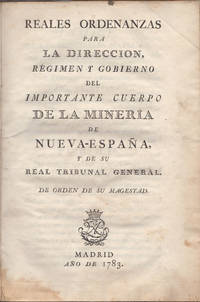
178344308Madrid: n.p. 1783. First edition. Full contemporary cat's paw vellum. Boards worn with some loss to the tail of the spine hinges split though firm dampstained along bottom edge some ink smudges especially to edges of frontispiece section titles in manuscript on each page otherwise contents quite sharp and overall about very good. 2 lvs xlvi 214 pp. Illus. with an engraving by Joaquin Fabregat of the Spanish arms and depicting mining implements. Folio. Signed in ink with Galvez' paraph under his printed name. First edition of this "rare and valuable compendium of the old mining laws and mineral customs printed only for the use of the parties concerned" Sabin and meant to govern the workings of silver mining in New Spain. Galvez was a special Minister of the Indies who was instructed to reform the mining laws of Mexico. In this work which could only be owned by Spanish-born miners he not only transcribed all the royal decrees concerning mining in New Spain but also provided information concerning mining operations training discovery of new mines and technology and governance. Signed in manuscript with his rubric attesting to the accuracy of the copy. Further editions were published in 1785/6 in Lima both folio and quarto and in Santiago in 1833. Sabin 56260. Palau 203088 & 251937. Medina BHA V: 5040. Maffei/Figueroa Bibl. Esp. Minerales. n.p. hardcover
199528829Troy Missouri U.S.A.: Greenwood Pub Group. New. 1995. Hardcover. 0313294593 . FREE UPGRADE to Courier/Priority Shipping Upon Request - IN STOCK AND IMMEDIATELY AVAILABLE FOR SHIPMENT - --BRAND NEW FLAWLESS COPY NEVER OPENED -- 388 pages. -- with a bonus offer-- . Greenwood Pub Group hardcover
200016664International Auctioneers. New. 2000. Paperback. FREE UPGRADE to Courier/Priority Shipping Upon Request - IN STOCK AND IMMEDIATELY AVAILABLE FOR SHIPMENT - Flawless -- with a bonus offer-- . International Auctioneers paperback
200016665Madrid Spain: International Auctioneers. New. 2000. Paperback. FREE UPGRADE to Courier/Priority Shipping Upon Request - IN STOCK AND IMMEDIATELY AVAILABLE FOR SHIPMENT - Flawless -- with a bonus offer-- . International Auctioneers paperback
18505353Spain 1850. Very good. 45pp. Small quarto. Contemporary calf gilt. A few minor abrasions along spine edges and corners worn. Occasional minor dust-soiling or foxing to text. An intriguing handwritten manual on cockfighting describing different types of roosters and the rules for fighting them presumably produced in Spain in the first half of the 19th century. The subtitle of the work touts it as in English translation "a very useful work for cockfighting fans." The manuscript includes passages with headings such as "Nobleza antiguedad y utilidad del juego de Gallo" "Nobility antiquity and usefulness of the Rooster game" "De las peleas en general" "Of fights in general" "Condiciones para carear la guerra" "Conditions to face war" "Condiciones en las peleas de navaja" "Conditions in knife fights" "Observaciones acerca del acto de las peleas" "Observations about the act of fighting" "De las circumstancias del Gallero de las cosas anexas a su egercicio y de su gratificacion" "Of the circumstances of the Gallero of the things annexed to his exercise and gratification" "Sobre preparacion de los gallos para las peleas de pico" "On the preparation of roosters for beak fights" "Del modo de disponer los gallos para las peleas de navaja" "How to arrange the roosters for knife fights" as well as passages on the rules for fighting and comparing roosters by weight age and other means and more. A substantial portion of the latter part of the manual is devoted to describing about thirty different "Colores de los gallos" and color patterns which include various shades and patterns of "Indio" "Giro" "Canelo" "Blanco" "Prieto" "Pintojo" and "Tabao." The last section contains a "Regimen para curar las enformedades que mas generalmente padecen los gallos" "Regimen for curing diseases that roosters most generally suffer from".<br /> <br /> Though an undated manuscript the binding appears to emanate from the first half of the 19th century. The ownership inscription and stamp on the first flyleaf indicates the work was owned by Fermin Canella Secades of the University of Oviedo in Spain. Canella Secades lived from 1849 until 1924 so could have owned the work anywhere within those years but the manuscript was most assuredly produced earlier. Though he was a prolific author the handwriting of the ownership inscription presumably belonging to Canella Secades does not match the handwriting in the manuscript and the ownership inscription and stamp were most certainly added later. In any case the present manuscript is a fascinating collection of useful information regarding one of the more esoteric bloodsports in the world which is still legal in parts of Spain and Mexico as well as many other countries and still practiced in numerous places where it's clearly illegal. unknown
2014ABE-1617037402226Fantagraphics Books 2014 STILL SEALED! LONG SOLD OUT! VERY RARE! Zap is the most aesthetically important comics series ever published. A bold claim demonstrated within this gorgeous slipcased Limited Edition. It is a 5 volume set which comes with a portfolio of art covers. Sealed in its slipcase this is the complete Zap collection. It has a unique extra; an unpublished 17th issue. Another volume relates the history of Zap by the artists themselves PLUS a volume of archival prints of all 17 Zap covers. Robert Crumb Rick Griffin Paul Mavrides Victor Moscoso Spain Rodriguez Gilbert Shelton Robert Williams and S. Clay Wilson . Robert Crumb kicked off the underground comics movement with his classic solo first issue of Zap in 1968. By Zap #2 he had begun assembling seven of the best the fiercest and the most stylistically diversified cartoonists to come out of the countercultural kiln. All of them were extremists of one sort or another a dream team of the wildest most technically skilled and stylistically diverse cartoonists to come out of the countercultural scene. They were a ragtag bunch of fascinating wide-ranging personalities who somehow came together to produce a fruitful decades-long collaboration. This is a mind-blowing anthology of abstract hallucination searing social satire and shocking sexual excess that inspired the subsequent wave of alternative cartoonists like Daniel Clowes Chris Ware and Charles Burns. The Complete Zap Comix collects every issue of Zap each cover and story and even the Zam mini comic jam among the Zap artists in a sleekly designed five-volume slipcased hardcover set. This gorgeous box set includes an introduction by founder R. Crumb and an oral history of Zap by noted comics historian Patrick Rosenkranz. It also comes with a limited-edition portfolio of Zap covers by the eight artists in high resolution scans specially printed on acid-free 100% cotton fine-art paper printed with heavily pigmented inks. Say it again; Zap is the most historically and aesthetically important comics series ever published. This is one mighty collection for the serious archivist or indeed for any collector of graphics. It weighs in at 22lbs/10kg. THIS IS AN ESSENTIAL LIMITED EDITION FOR THE SERIOUS COLLECTOR. Limited Edition. Hardcover. New. Fantagraphics Books hardcover
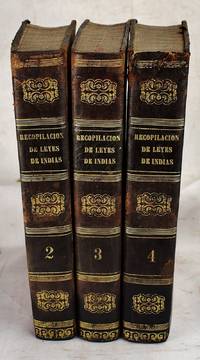
17561912260004En Madrid : Por Antonio Balbas 1756. 2nd. Hardcover. Very Good. Spanish Colonial Law 3 of 4 volumes. Includes vols. 2-4. Lacking volume 1. Bound in contemporary full Spanish calf. Gilt spines. Minor shelf wear to covers. Bindings sound. 3 298; 3 302; 2 364 leaves. Pages generally clean and unmarked. Text in double columns with printed marginalia. Spanish language. First published in 1681 De Leyes de Indias collected the laws of the Spanish American colonies including both Latin American and the Philippines. Each law indicates the year king and place of issue. An important reference for the origins and development of Latin American law. The laws recorded in this edition remained theoretically in force in Spanish America for over three centuries. Published in nine books this set includes the following: Third book. Of the Domain and Royal jurisdiction of the Indies.; Fourth Book. Of the Discoveries.; Fifth book. Of the Terms Division and Aggregation of Governments.; Sixth book. Of the Indians.; Seventh book. Of the Investigators and Commission judges.; Eighth book. Of the Accounts Accounting and their Ministers.; Ninth book. Of the Real Audiencia and House of Hiring that resides in Seville.; Indexes. <br> Refs: Palau 252516n; Medina BHA 3763; Sabin 68387. <br> This is an oversized or heavy book which requires additional postage for international delivery outside the US. En Madrid : Por Antonio Balbas hardcover
181675588Madrid 1816. illus crisp copy. Royal order reestablishing the Jesuits in Spanish domains. unknown
23020602Schanes & Schanes 1980. 1st Edition 1st Printing. No Binding. VERY FINE. Large Portfolio. 16 x 11 3/4 inches. Signed and numbered collection of 13 prints. Limited to 1200 copies. This is number 1098. All prints signed and numbered by the artist. In cover illustrated folder with black illustration embossed in silver. All prints in black/white very nicely printed. Like numbered booklet/guide included. VERY FINE. all corners pointed. Without tears creases bumps or chips. Not marked and very clean and bright. All items carefully wrapped and sent boxed. <br/> <br/> Schanes & Schanes unknown
1663Bostonbookfair1Manuscript. 17th century 1663-1695<br /><p>Spanish church register of the village of Montánchez is a municipality located in the province of Cáceres Extremadura Spain. Written in several hands on paper. Folio 29 x 22 cm approx. 135 leaves. Characteristic limp vellum binding. Damage to top cover. First leaves wormed else good.</p>
160548560Mogvntiae Mainz Andreas Wechsel 1605. 4to. Contemp. full vellum raised bands blindstamped covers. Printers wood-cut device on titlepage. 16619;63836 pp. A bit of browning to the first few leaves. A few scattered brownspots. Printed in double columns. <br/><br/><em>This is the first edition containing all 30 books. The first 20 books were published in Spanish in 1601. Marianas's importent history of Spain deals with the country from the first settlements to the death of King Ferdinand who united the Crowns of Castile and Aragon."Among his Maraina's literary labours the most important is undoubtedly his great work on the history of Spain which is still remembered today. There was published as late as 1854 in Madrid an improved and richly illustrated edition continued up to that year. The work first appeared as "Historiæ de rebus Hispaniæ libri XX. Toleti typis P. Roderici 1592". A later edition of the compiler himself carried on still further is "De rebus Hispaniæ libri XXX" published at Mainz in 160 the item offered. This edition bears the imprimatur of the order for the thirty books given by Stephan Hojeda visitor from Dec. 1598 and of the provincial from 1604. The author had in the mean time converted a Latin edition into Spanish and this appeared complete containing the thirty books of the Latin edition at Toledo in 1601. This went through a number of editions during the lifetime of the author and through others after his death" The Catholic Encyclopedia. </em> hardcover