Zeller, JohannesAntiquariat.de

206 résultats
183733318Zürich gedruckt in der Bürkischen Offizin, 1837. VIII, 182 Seiten. Originalbroschur 20 cm
1880262841Heidelberg: C. Winter 1880. 528p. bound in later blue boards with leather spine ownership stamp of Harvard professor Max Loehr; small bookseller's label at the end. On the Shi jing an ancient Chinese anthology of poetry and songs. C. Winter unknown books
1898603457Leipzig: Rob. Forberg 1898. Softcover. Very Good. First edition. Folio. Six nested bifolia with a single-sheet-insert making 26 pages. Text in German and English. The outer most bifolium neatly separated along the fold with both leaves present a tear on the front cover light edgewear and age toning still a very good and complete copy. For voice and piano. Plate number 5200. Rob. Forberg unknown
18392134162Tübingen, C. F. Osiander 1838-1839. XXVI, 787, (1), VI, 785, (1) Seiten. 8° (22 x 14 cm). Etwas späterer, schlichter Halbleinenband. [Hardcover / fest gebunden].
1891159731Bonn: Verlag von Emil Strauss 1891. XII, 402; VII, 396 Seiten. Frakturdruck. 8° (17,5-22,5 cm). Dekorativer Halblederband der Zeit mit goldgeprägtem Rückentitel. [Hardcover / fest gebunden].
1878132775Bonn, Emil Strauß 1878. XV, 232 Seiten. Mit einer gest. Porträt-Tafel unf Buchschmuck. Reich vergoldeter, roter Original-Leinwand-Einband. (Geringe Gebrauchsspuren). 20,5x14,5 cm
1876128017(Stuttgart. Privatdruck. Im November 1876). XI, 244 Seiten. Mit einem Stahlstichportät von Adolf Neumann gegenüber dem Titel u. miteingebundener Originalbroschur. Brauner, geprägter Leinwand-Einband mit vergoldetem Rückentitel in ansprechender Erhaltung. (Miteingebundenes Umschlagblatt fleckig u. gebräunt. Porträt u. Titelblatt teils stockfleckig). 20x13,5 cm
18981502061898. 339 S. Halbleinen, verstärkte Ecken, Frakturschrift, marmorierter Schnitt, Rücken mit Goldprägung
1894116350L. Prang Boston MA 1894. Paperback. Very Good. 12mo 6.75 - 7.75'' tall. Paperback. Book Condition: Very Good. L. Prang Boston MA 1894. 12 pages. Nice Firm Clean copy ! Light general wear. Tip missing from rear cover. Size: 12mo 6.75 - 7.75'' tall. Yawcob Strauss Series. Children Humor::Comics/Cartoons Humor::Humor 6618 6618 L. Prang Boston MA paperback
1899456498Leipzig : F. E. C. Leuckart 1899. First Edition. Hardcover. Good copy in the original colour-printed paper-wrapped boards decorated to appear as a leather over cloth copy. Spine bands and panel edges somewhat bumped and rubbed with age. Bumped corners. End papers slightly scratched. Book plate of Alfred M. Hale to inside front boards. Remains well-preserved overall. Date is suggested/cannot be verified. Physical description; 1 miniature score 139 pages ; 23 cm. Subjects; Symphonic poems ; Scores. Symphonic poems. Leipzig : F. E. C. Leuckart hardcover
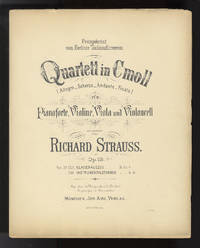
188634527München: Jos. Aibl PNs R.2579 R.2580 1886. Folio 340 x 270 mm. Unbound as issued. Score: 1f. title i dedication 65; Violin: 12; Viola 12; Violoncello: 12 pp.<br /> <br /> With "Preisgekrönt vom Berliner Tonkünstlerverein" to head of title and printed dedication "Seiner hoheit Georg II. Herzog von Sachsen-Meiningen in ehrfurcht und dankbarkeit zugeeignet."<br /> <br /> Slightly browned and chipped. Wrappers lacking. First Edition later issue. TrV 137.<br /> <br /> Premiered on 8 December 1885 by the composer and members of the Halir Quartet. Jos. Aibl [PNs R.2579, R.2580] unknown
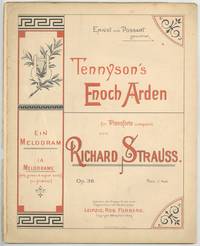
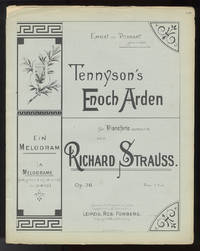
189834551Leipzig: Rob. Forberg PN 5200 1898. Folio. Original publisher's light green decorative wrappers. 1f. recto title printed in red and black verso publisher's advertisement 23 pp.<br /> <br /> With printed dedication "Ernst von Possart gewidmet" to head of upper wrapper. <br /> <br /> Wrappers slightly worn and chipped. Small handstamp to blank lower margin of title "G. Schirmer 35 Union Square New York." First Edition. Scarce. TrV 181. Mueller von Asow I p. 234. <br /> <br /> Tennyson's Enoch Arden premiered in München on 24 March 1897 at Mathildensaal with Ernst v. Possart as speaker and the composer at the piano. Rob. Forberg [PN 5200] unknown
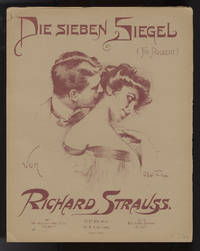
190034539Berlin: Adolph Fürstner 1900. 5 folios. Original publisher's wrappers with lithographic illustration of loving couples to uppers series title within decorative borders with floral cornerpieces to uppers and publisher's advertisements to lowers.<br /> <br /> Includes:<br /> No. 1: Ein Odbach gegen Sturm und Regen. PN 5801. 7 pp.<br /> No. 2: Gestern war ich Atlas. PN 5796. 7 pp.<br /> No. 3: Die sieben Siegel. PN 5802. 7 pp.<br /> No. 4: Morgenrot. PN 5802. 11 pp.<br /> No. 5: Ich sehe wie in einem Speigel. PN 5416. 9 pp.<br /> <br /> With printed dedication "Meinen lieben Schweigereltern gewidmet." Small handstamp "Made in Germany" to upper left corner of uppers. <br /> <br /> Slightly worn and browned; some wrappers loose. First Edition first issue no. 5.<br /> First Edition later issue nos. 1-4.<br /> TrV 199. Adolph Fürstner unknown
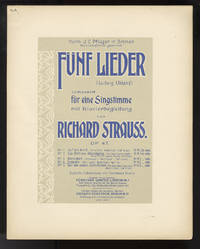
190034538Berlin: Adolph Fürstner 1900. 5 folios with original publisher's wrappers series titling to uppers publisher's advertisements to lowers.<br /> <br /> Includes:<br /> No. 1: Auf ein Kind. PN 5798. 5 pp.<br /> No. 2: Des Dichters Abendgang. PN 5802. 11 pp.<br /> No. 3: Rückleben. PN 5796. 9 pp.<br /> No. 4: Einkehr. PN 5796. 9 pp.<br /> No. 5: Von den sieben Zechbrüdern. PN 5166. 23 pp.<br /> <br /> With printed dedication to "Herrn J.C. Pflüger in Bremen freundschaftlichst gewidmet." small handstamps to upper left corners of uppers.<br /> <br /> Somewhat worn and browned more significantly to no. 1. First Edition first issue of no. 5 the others later issues. TrV 200. Adolph Fürstner unknown
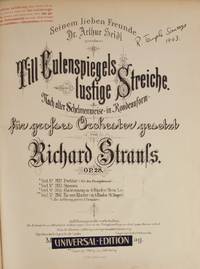
189641120München: Jos. Aibl Verlag PN 2832 1896. Folio. Full dark blue cloth with titling and owner's name "R. Temple Savage" gilt to upper titling gilt to spine. 1f. recto title verso "Orchesterbesetzung" 3-60 pp. With notice of the 4-hand arrangement by O. Singer added to title and "Lith. Anst. v. C. G. Röder" to foot. <br /> <br /> With red handstamped copyright notice to upper inner corner of title and rectangular Univeral-Edition overpaste to lower margin; small octagonal ivory label laid down over printed prices.<br /> <br /> Provenance<br /> Richard Temple Savage 1909-1996 bass clarinettist under Sir Thomas Beecham in the London Philharmonic Orchestra 1934-1946 then Chief Librarian and member of the orchestra at the Royal Opera House Covent Garden with his handstamp "The Property of R. Temple Savage" within rectangular border to front free endpaper and signature and date of 1943 to upper outer corner of title. <br /> <br /> Binding slightly worn rubbed and bumped. Minor internal wear and browning; upper outer corners slightly creased. First Edition later issue. Sonneck Orchestral Music p. 453. Fuld p. 580. Trenner 171. Asow I p. 156. <br /> <br /> Strauss "emerged soon after the deaths of Wagner and Brahms as the most important living German composer. During an artistic career which spanned nearly eight decades he composed in virtually all musical genres but became best known for his tone poems composed during the closing years of the 19th century and his operas from the early decades of the 20th. .<br /> <br /> Shortly after the Guntram première he decided to compose a one-act opera Till Eulenspiegel bei den Schildbürgern though he never got beyond an incomplete text draft. Why he scrapped the opera for a tone poem is not clear but judging from his programme notes the symphonic work is based on a different scenario: 'Once upon a time there was a knavish fool named Till Eulenspiegel. He was a wicked goblin up to new tricks'. Till rides on horseback through the market mocks religion disguised as a cleric flirts with women engages in academic double talk with his philistine audience and by the end finds himself on the scaffold soon to be hanged. Strauss did not call Till a tone poem but rather a 'Rondeau Form for Large Orchestra'. Richard Specht suggested this might well have been the first prank given that the only connection with the old French forme fixe is in the spelling. Strauss later described the structure as being an 'expansion of rondo form through poetic content' and cited Beethoven's Eighth Symphony as his model. Given the libertine qualities of young Till as well as the episodic nature of the work a rondo would seem quite appropriate. But as in Don Juan the form is hardly conventional: the sense of rondo is achieved mostly by the return of Till's two themes to articulate his various adventures. Completed in May 1895 the compact Till Eulenspiegel was introduced with great success six months later and remains Strauss's most often performed orchestral piece. That he had learnt much about orchestral detail and nuance during the six years since Tod und Verklärung is evinced by his brilliant use of the ratchet when Till rides through the market or by the piercing D clarinet when he whistles in the face of death." Bryan Gilliam and Charles Youmans in Grove Music Online. Jos. Aibl Verlag [PN 2832] unknown
186719791Paris / Bruxelles Librairie internationale / Lacroix, Verboeckhoven et Cie 1867
1874TS088801874 452 p., paperbound (partly loose, blank corner of front and back cover missing). Unopened copy.
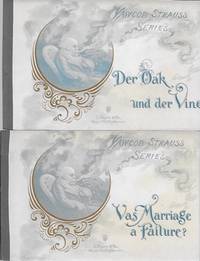
1894806148Boston: L. Prang & Co 1894. 1st. Softcover. Near Fine/None. Louis Prang. 4 volumes stiff light-green covers with color illustration b&w frontispiece in each. Leedle Yawcob Strauss: 14 pages 5 color plates. Yawcob's Dribulations: 17 pages 7 color plates. Der Oak une der Vine: 15 pages 5 color plates. Vas Marriage a Failure: 14 pages 5 color plates. Slight rubbing to covers; volumes in excellent condition. Record # 806148 L. Prang & Co paperback
186530639ABWien, C. A. Spina, o. J. (um 1865). Quer-4°. 19 S. gestochene Noten und lithogr. Titelblatt. Illustr., lithogr. Orig.-Umschlag.
187030640ABWien, C. A. Spina, o. J. (um 1870), Quer-4°. 19 S. gestochene Noten und lithogr. Titelblatt. Illustr., lithogr. Orig.-Umschlag.
188654809St. Petersburg Russia: A. Buttner associated with Aug. Cranz of Hamburg 1886. Presumed First Edition First Printing thus from this publisher. Wraps. Good. Oversized approximately 10 inches by 11.75 inches. 8 pages. Wraps Sheet music. Illustrated/lithographed cover. Some soiling and creasing. Text is in German. Johann Baptist Strauss II 25 October 1825 - 3 June 1899 also known as Johann Strauss Jr. was an Austrian composer of light music particularly dance music and operettas as well as a violinist. He composed over 500 waltzes polkas quadrilles marches and other types of dance music as well as several operettas and a ballet. The Russian March is a march by Johann Strauss II Op. 426. The work was premiered on April 29 1886 in the riding hall of the Guard Regiment in St. Petersburg Russia. In 1886 Johann Strauss visited Russia for the first time since 1869 accepting an invitation from the ladies of St. Petersburg society to participate in several charity events. At a gala concert held in the riding hall of the Russian Horse Guards Regiment the composer presented the waltz Les Dames de St. Pétersbourg-written specifically for his Russian tour-which later became known as Wiener Frauen Op. 423. The polka An der Wolga Op. 425 was also composed during this period. Many works created during Strauss's earlier visits to Russia were performed. A new release was the march Garde à Cheval which was later retitled Russischer Marsch. The work was dedicated to the reigning Tsar Alexander III. Incidentally this 1886 trip to Russia proved to be the composer's last. The duration of the piece is 4 minutes and 2 seconds cited in references. This time may vary slightly depending on the conductor's musical interpretation. The Russischer Marsch one of Johann Strauss's 'characteristic marches' belongs to that group of new compositions with which the Viennese maestro charmed audiences attending his series of charity concerts in St. Petersburg in 1886. This trip to Russia made at the invitation of the 'Russian Society of the Red Cross' and a children's charity was to be Johann's final visit there and came after a lapse of seventeen years since his last concert engagement at nearby Pavlovsk 1869. The court society which surrounded the Tsar may have known little of life in Russia thirty years earlier but was well aware of Strauss's reputation as the darling of the public and as a favorite of the Imperial family through his triumphant 'Russian summers' at Pavlovsk during the years 1856-65. The appearance of the Viennese maestro in St. Petersburg in 1886 once again occasioned an outbreak of 'Strauss fever' with shops offering pictures busts and statuettes of the conductor/composer. The venue for the 1886 charity concerts was the vast riding school of the Horse Guards Regiment in St. Petersburg and the 80-strong orchestra of the Imperial Russian Opera had been provided for the concerts. Johann conducted his own compositions. The majority of the works he performed were those which had proved popular in Pavlovsk during the 1850s and 1860s but these were supplemented by more recent works like the Brautschau-Polka op. 417 and Schatz-Walzer op. 418 both based on themes from his latest operetta success Der Zigeunerbaron The Gypsy Baron 1885. In addition Johann composed four new works especially for his 1886 Russian visit - 2 waltzes a polka and a march. It was at his third concert on 29 April 1886 = 17 April Russian calendar that he unveiled his Marche des Gardes à Cheval March of the Horse Guards written as a tribute to the Tsar's bodyguard in whose riding school the concerts took place. Although the Marche des Gardes à Cheval is without doubt "uniquely interesting" as the critic of the St. Petersburger Zeitung opined of this and the polka-mazurka Mon salut = An der Wolga op. 425 its title does not really suit the character of the piece. Far from being a 'cavalry march' in the style of the Grossfürsten-Marsch op.107 or the Caroussel-Marsch op. 133 for example this work is more descriptive of heavily-laden Russian foot-soldiers trudging wearily through the snow even to the extent of the diminuendo at the end of the piece as the column of soldiers disappears into the distance. Thus much more apposite was the name with which the march was rechristened for audiences in Vienna when Johann conducted its first performance there as an encore item during Eduard Strauss's benefit concert in the Musikverein on 7 November 1886: the Russischer Marsch. This was also the title under which August Cranz published the work together with the composer's dedication to "his Majesty Alexander III Emperor of Russia etc. etc" A. Buttner [associated with Aug. Cranz of Hamburg] paperback
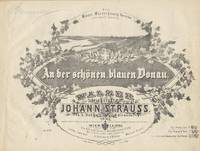
186841391Wien: C. A. Spina PN C.S. 19.216 1868. Oblong folio. Modern marbled wrappers. 1f. recto illustrated lithographic title verso publisher's engraved catalogue of music by Johann Josef and Eduard Strauss 3-11 pp. engraved music. "Druck von A. Eckel in Wien" printed to foot of first page of music. Title lists arrangements for piano 4-hands and for men's 4-part choir with piano.<br /> <br /> Title page depicts the Danube river and Vienna with light signature in pencil "Breuning" to upper innercorner.<br /> <br /> The highest opus numbers listed in the publisher's catalogue are for Johann Strauss Op. 320; Josef Strauss Op. 232; and Eduard Strauss Op. 32.<br /> <br /> Slightly worn; narrow strip of paper reinforcement to outer margin of first and last leaves. First Edition later issue of the solo piano version of the famous Blue Danube Waltz. SEV Vol. 7 p. 480. Fuld p. 147. C. A. Spina [PN C.S. 19.216] unknown
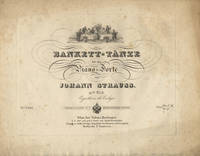
183722051Wien: Tobias Haslinger PN T.H. 7381 1837. Oblong folio. Unbound as issued. 10 pp. Engraved. With decorative vignette of five gentlemen and two ladies at a banquet to title. First Edition. Weinmann p. 20. Schönherr & Reinöhl p. 153. Tobias Haslinger [PN] T.H. 7381 unknown
184214224Wien: Tobias Haslinger PN T.H. 8591 1842. Folio. Unbound as issued. i title 2-3 pp. Engraved. Minor creasing to lower margin; occasional minor staining. Additional publisher's stamp Frankfurt C.A. Andre to title. First Edition. Weinmann p. 25. Tobias Haslinger [PN T.H. 8591] unknown
1838000284Wien: Tobias Haslinger 1838. Book. Poor. Cloth. Poor. No dust jacket. Multiple pieces of sheet music have been rebound in a cloth cover. Also includes Ball-Racketen Walzer fur das Piano-Forte No 7351; Kronungs-Walzer fur das Piano-Fort No 7061; Die Nachtwandler Walzer fur das Piano-Forte No 6957; Frohsinns-Scepter Walzer von Jos. Lanner No 3030; and Millionar-WalzerNo 2441. Program from Van Cliburn March 10 1968 concert at Academy of Music Philadelphia laid in. . Tobias Haslinger Hardcover