29 599 résultats
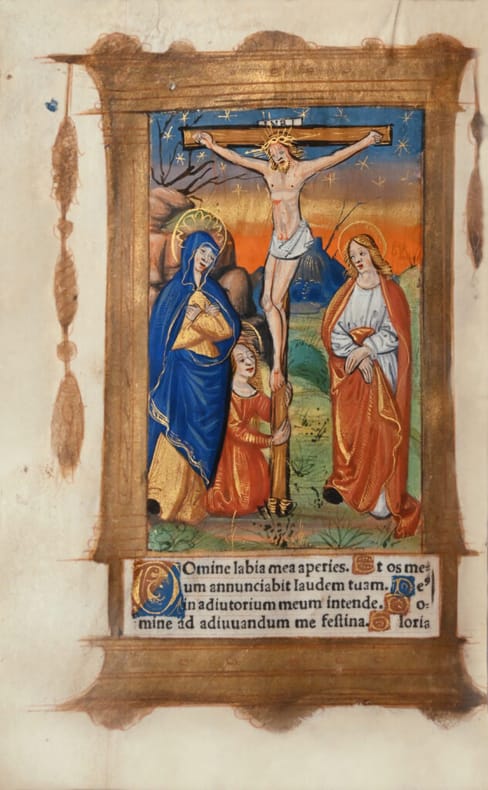
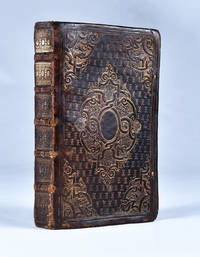
151829908Paris: Germain Hardouyn. Colophon: "ont este imprimees a Paris pour Germain Hardouyn demorant entre les deux portes du Palais a lenseigne de Saincte Marguerite. 1518. First of the edition. Printed on vellum and beautifully illuminated with forty hand-painted miniatures. There are sixteen large and twenty four small miniatures i.e. metalcuts painted in blue red brown green yellow white and gold and numerous one- and two-line initials in gold and blue pictorial metal-cut borders throughout partly illuminated. With full page miniatures: Skeleton Maria with the infant Jesus Jesus on Mount of Olives Flight to Egypt The Three Magi Nativity Crucification etc. 8vo 17.8 x 11/0 cm handsomely bound in eighteenth century full marbled polished calf the edges gilt the spine with raised bands gilt decorated. 112 leaves printed on vellum in a Gothic typeface twenty-four lines per page. Almanach / Calendar for the years 1518 -1525. Signatures: A - O8 14 quires = 112 leaves complete. A handsome and well preserved copy complete. A FINE PRINTED BOOK OF HOURS FROM THE EARLY 16TH CENTURY PARIS. In the late fifteenth and early sixteenth century printed books of hours like the present copy were produced in greater numbers than manuscript horae in part in order to meet the demands of a bourgeoning middle class audience that could afford such items.<br> RARE. Not in Brunet Bohatta Lacombe Mortimer French Adams Germain Hardouyn. (Colophon: "ont este imprimees a Paris pour Germain Hardouyn demorant entre les deux portes du Palais a lensei hardcover
LCS-18624L’ornementation comprend également 21 vignettes coloriées à l’époque et enluminées. Paris, Germain Hardouyn, 1518. In-8 imprimé sur peau de vélin de (84) ff. en 11 cahiers signés A-K par 8 et L par 4. Caractères romains, 31 lignes. La marque des Hardouin occupe le f. A1. 17 grandes figures dont l’Homme anatomique. 21 petites vignettes enluminées, 4 bordures originales enluminées. Complet. Plein velours brun du XVIIIe siècle, qq. usures. 171 x 110 mm.
BB08<p>Paris Germain Hardouyn 1518.</p><p>8vo 171 x 110 mm printed on vellum skin of 84 ll. in 11 quires signed A-K by 8 and L by 4. Roman characters 31 lines. The mark of the Hardouins is printed on l. A1.</p><p>17 large figures including the anatomical Man. 21 small illuminated vignettes 4 illuminated borders. Complete.</p><p>Full brown velvet from the 18th century signs of wear.</p><p><b>Precious Book of Hours printed on vellum skin decorated with 17 full-page engravings illuminated with gold at the time with 21 small vignettes equally illuminated and with numerous gilt initials on a blue or red background. </b></p><p>The calendar is dated 1518.</p><p>Lacombe 290 ; Van Praet Catalogue p. 112 n°135 ; Brunet <i>Heures</i> n°251.</p><p>The iconography is composed besides the printer's mark and the anatomical man of 16 large full-page figures all colored with shimmering colours and inserted inside gilt framings. </p><p>The 16 engravings represent:</p><p><i>- St John the Evangelist.</i></p><p><i>- Arrest of Jesus.</i></p><p><i>- Adam and Eve.</i></p><p><i>- Annunciation.</i></p><p><i>- Visitation.</i></p><p><i>- Nativity.</i></p><p><i>- Annunciation to the Shepherds. </i></p><p><i>- Adoration of the Magi.</i></p><p><i>- Presentation at the temple.</i></p><p><i>- Flight into Egypt. </i></p><p><i>- Presentation of Mary at the Temple.</i></p><p><i>- Bathsheba in her bath.</i></p><p><i>- Resurrection of Lazarus</i></p><p><i>- Crucifixion.</i></p><p><i>- Pentecost.</i></p><p><i>- Annunciation</i>of a different manner.</p><p>The illustration also contains 21 vignettes hand-colored at the time and illuminated.</p><p>This precious Book of Hours entirely rubricated is thus decorated with all its capital letters painted in gold on an alternated red or blue background. </p><p><b>Brunet underlines the rarity of Books of Hours printed by the Hardouins when they are rubricated and illuminated.</b></p><p>" <i>We can find quite precious copies because of the paintings and decorated letters that illustrate them. It appears that those gilt and coloured letters are the work of Germain Hardouyn 'in arte litteriare peritissimus' as bears the subscription of the Hours of the Virgin dated 1514</i> " Brunet V 1628.</p><p>Gilles Hardouyn settled at the end of the Nostre dame Bridge where he worked from 1509 until 1521.</p><p>After this date his associate Germain Hardouyn who was his associate in the bookshop succeeded him and temporarily occupied his home. He himself printed until 1528.</p><p><b>Precious copy illuminated on vellum skin coming from the library of Montalembert</b> with ex-libris and stamp of the <i>Earl of Montalembert</i>.</p><p><br /></p><p><u>French</u></p><p>Paris Germain Hardouyn 1518.</p><p>In-8 imprimé sur peau de vélin de 84 ff. en 11 cahiers signés A-K par 8 et L par 4. Caractères romains 31 lignes. La marque des Hardouin occupe le f. A1.</p><p>17 grandes figures dont l'Homme anatomique. 21 petites vignettes enluminées 4 bordures originales enluminées. Complet.</p><p>Plein velours brun du XVIIIe siècle qq. usures.</p><p>171 x 110 mm.</p><p><b>Précieux livre d'Heures imprimé sur peau de vélin orné de 17 gravures à pleine page enluminées à l'or à l'époque de 21 petites vignettes également enluminées et de nombreuses initiales en or sur fond bleu ou rouge.</b></p><p>La calendrier porte la date de 1518.</p><p>Lacombe 290 ; Van Praet Catalogue p. 112 n°135 ; Brunet Heures n°251.</p><p>L'iconographie se compose outre le feuillet de marque et l'homme anatomique de 16 grandes figures à pleine page toutes coloriées en teintes chatoyantes et insérées dans des encadrements à portique dorés.</p><p>Les 16 grandes gravures représentent :</p><p><i>- Saint Jean l'évangéliste</i></p><p><i>- L'Arrestation du Christ</i></p><p><i>- Adam et Eve</i></p><p><i>- L'Annonciation</i></p><p><i>- La Visitation</i></p><p><i>- la Nativité</i></p><p><i>- l'Annonce aux bergers</i></p><p><i>- L'Adoration des mages</i></p><p><i>- La Présentation au temple</i></p><p><i>- La Fuite en Egypte</i></p><p><i>- La Présentation de Marie au Temple</i></p><p><i>- Bethsabée au bain</i></p><p><i>- La Résurrection de Lazare</i></p><p><i>- La Crucifixion</i></p><p><i>- La Pentecôte</i></p><p><i>- L'Annonciation </i>de facture différente</p><p><b>L'ornementation comprend également 21 vignettes coloriées à l'époque et enluminées.</b></p><p><b>Ce précieux livre d'Heures entièrement rubriqué </b>est ainsi orné de toutes ses majuscules peintes en or sur fond rouge ou bleu alterné.</p><p><b>Brunet souligne la rareté des livres d'Heures imprimés par les Hardouin lorsqu'ils sont rubriqués et enluminés.</b></p><p>" <i>Il se trouve des exemplaires assez précieux à cause des peintures et des lettres ornées qui les décorent. Il paraît que ces lettres en or et en couleur sont l'ouvrage de Germain Hardouyn 'in arte litteriare peritissimus' ainsi que le porte la souscription des Heures de la Vierge à la date de 1514</i> " Brunet V 1628.</p><p>Gilles Hardouyn s'établit au bout du pont Nostre dame où il exerça de 1509 jusqu'en 1521.</p><p>Après cette année son associé Germain Hardouyn qui avait été son associé dans la librairie lui succéda et occupa momentanément son domicile. Il imprima lui-même jusqu'en 1528.</p><p><b>Précieux exemplaire enluminé sur peau de vélin</b><b> provenant de la Bibliothèque de Montalembert </b>avec ex-libris et cachet du Comte de Montalembert.</p> hardcover
Veduta panoramica della città di Roma presa dall'alto della via Flaminia. Incisione in quattro fogli con 42 rimandi e descrizione in calce contornata da due figure leonine. Eccezionale rarità, l'unico volume che la menziona "Le Piante di Roma delle Collezioni Private" a cura di Marigliani- Sciolari pag. 239, edito a cura della Provincia di Roma nel 2007, presenta solo uno dei 4 fogli sbagliando l'attribuzione datazione e descrizione poiché sino ad oggi si conosceva solo il foglio in alto a sinistra, mentre non era mai stato censito anche il secondo che completa la veduta e riporta la firma dell'autore e gli altri due con rimandi e descrizione storica della città. La stampa è applicata su tela e presenta alcuni restauri.Dimensioni: 465x1400 mm (la sola veduta) 740x1400 mm (dimensione con rimandi e descrizione). Exsclusive, extremely rare and unrecordered panoramic view of the city of Rome taken from the top of via Flaminia. Engraving in four sheets (two for the view and two for the 42 references and historical descriptive text surrounded by two lions). The only one complete exemplar known. Until now, only the left half of the view was known and its author, whose signature appears in the right half, was unknown. (Ref: “Le piante di Roma delle Collezioni private” Marigliani-Sciolari p. 239). A masterpiece by the architect Giorgio Domenico Fossati (1705-1785). Condition report: glued on canvas, few little restorations.
2691Paris: Guillaume Anabat for Germain Hardouyn 1 October 1505 Almanac for 1505-1520. <p>Octavo. Printed on vellum. Collation: a-n8 o4: 108 ff. unnumbered. Blackletter type. Large Hardouyn device on title-page Renouard 434; Nettekoven p. 135 no. 223; Hardouyn's Planetary Man cut; three large cuts St. John with the Poisoned Cup The Betrayal of Christ and The Holy Trinity with the Church and its four Cardinal Virtues; Zöhl p. 174; twelve mid-size cuts The Life of Christ; Nettekoven pp. 122-123 no. 211-222; 26 smaller cuts of saints and biblical subjects; a small cut of the crucifixion on the final leaf; each page printed within an elaborate multi-block border sometimes incorporating letterpress captions. 194 x 124 mm. Decorated throughout; the larger initials illuminated with floral decoration in gold and colors; rubricated with the small initials and line-fillers supplied in gold on red or blue grounds; the arms on Hardouyn's device painted over with an unidentified coat of arms; the borders on a1r and a2v colored early but later than the illumination and rubrication. Early recipe for a rhubarb-based purgative in manuscript on a rear endleaf. binding: Later sixteenth century calf over paste boards elaborately tooled in gilt triple fillet border large strapwork and arabesque cornerpieces large strapwork and arabesque centerpiece with two lion's heads and a blank central oval in between a semé of fleurons spine with five raised double bands the compartments tooled with azured ovals and vines; two pairs of ties now lacking; three vellum endleaves at front and rear including the pastedowns.</p> <p>COLOPHON: Ces presentes heures a lusaige de Romme furent acheuees le premier iour de Octobre Lan Mil cinq cens et cinq. Par Guillaume Anabat imprimeur demourant a Paris en la rue sainct Jehan de Beauuais pres les escolles du decret a lenseigne des connis. Pour Germain Hardouin libraire demourant empres la grant porte du palais a limage saincte Marguerite.</p>. <p>An unsophisticated copy of this handsome book of hours the earliest dated production of Anabat's press.</p><br /> <br/><br/><br /> <p>Anabat was a native of Brittany; his press was active in Paris between 1505 and 1510. All of the books that he printed were done for other publishers; the vast majority were books of hours printed for the brothers Gilles and Germain Hardouyn who specialized in the production and sale of horae.</p><br /> <br/><br/><br /> <p>The metalcuts that illustrate this edition are the work of two distinct hands. The twelve smaller cuts depicting the life of Christ are copies based on a set that was produced for Thielman Kerver and Georg Wolff c. 1497; they were first used by the Hardouyn brothers in 1503. They have been attributed to the Master of the Très Petites Heures d'Anne de Bretagne also known as the Master of the Apocalypse Rose of the Sainte-Chapelle; this artist has been tentatively identified as Jean d'Ypres the son of Colin d'Amiens See Caroline Zöhl's article in the 2007 festschrift for François Avril Quand la peinture était dans les livres. He produced many designs for the illustration of books of hours in the period 1480-1510; he is also responsible for a small number of manuscripts as well as some celebrated designs for tapestries. The three large cuts that start the volume however are the work of Jean Pichore who was active in Paris c. 1500-1520. His illustrations in the renaissance style replaced the gothic designs of the Master of the Apocalypse Rose of the Sainte-Chapelle as the dominant mode in the illustration of Paris books of hours; this volume captures that transition perfectly with the more refined and sophisticated Pichore blocks standing in counterpoint to the slightly stiff cuts of the earlier master. The artist responsible for the Planetary Man cut which had appeared in earlier Hardouyn books of hours has not been identified.</p><br /> <br/><br/><br /> <p>This edition exists in two quite distinct states. In one each page is printed within an elaborate composite border made up of numerous small blocks and sometimes incorporating letterpress captions; our copy is an example of this state. In the other the text and illustrations are printed entirely without borders with the exception of the colophon leaf which has the same architectural border in both states. A copy of the state without borders is at Penn State; it has been digitized and can be seen online at Lehigh University's Digital Library of Illuminated Manuscripts. It is unclear at this point which state has priority or whether one is more common than the other.</p><br /> <br/><br/><br /> <p>PROVENANCE: Unidentified arms on title-page - Georges Quesnoy early inscription on rear endleaf - several other early ownership inscriptions now largely illegible on endleaves.</p><br /> <br/><br/><br /> <p>CONDITION: Leaves a1r and o4v rather rubbed with some loss; some occasional soiling and staining; the vellum at times somewhat cockled. The boards slightly warped; extremities a bit rubbed; rear hinge cracked. Despite these flaws still a pleasing and unsophisticated copy.</p><br /> <br/><br/><br /> <p>REFERENCES: Bohatta 807; Moreau 1505 85; Renouard 50; Tenschert & Nettekoven 65-67 Heribert Tenschert & Ina Nettekoven Horae B.M.V.: 158 Stundenbuchdrucke der Sammlung Bibermühle 1490-1550 Rottalmünster 2003; see also Ina Nettekoven Der Meister der Apocalypsenrose der Sainte Chapelle und die Pariser Buchkunst um 1500 Turnhout 2004 and Caroline Zöhl Jean Pichore: Buchmaler Graphiker und Verleger in Paris um 1500 Turnhout 2004. Copies: Bibl. Mazarine; Musée des Beaux-Arts Paris the Dutuit copy incomplete; John Rylands Library; Museo Civico Pavia; Tresoar Leeuwarden; Williams College; the Morgan Library; Princeton; Penn State; the Newberry Library incomplete; the University of Kansas; the Huntington Library; the Bibermühle collection three copies.</p> Paris: Guillaume Anabat for Germain Hardouyn, 1 October 1505 (Almanac for 1505-1520) unknown
16064235<p>Prague: Aegidius Sadeler 1606. </p><p>Price: $25000.00 </p><p>Oblong folio: 34.7 x 203.5 cm. Engraved title page and 50 engraved plates.</p><p>FIRST EDITION.</p><p>A very fine broad-margined copy with very rich and clear impressions of the plates. Occ. marginal soiling a few pin-prick wormholes in the margins of a few leaves. Bound in contemporary morocco richly tooled in gold. With an engraved allegorical title with the main title incised within a wolf's hide hung on a monument; an engraved dedication to Matthaeus Wacker von Wackenfels numbered'1' with the text incised on a stone tablet between flanking obelisks and with two putti supporting the dedicatee's arms; and 49 full-paged engraved plates ca. 170 x 270 mm all numbered and signed 'Marco Sadeler excudit' with descriptive captions in Italian.</p><p>This is the first edition. Thirty-six of these images were copied by Aegidius Sadeler from Etienne Du Pérac's " Vestigi dell'Antichità di Roma" Rome 1575. For the other images Sadeler drew on drawings by Jan Breughel the elder and Pieter Stevens. Marco Sadeler whose name appears on the plates was an engraver and print seller in Prague in the early 1600's and probably the nephew of Aegidius. In the middle of the 17th century a copy of the 1606 edition found its way to Rome where it was copied for Giovanni Giacomo de' Rossi by Girolamo Ferri and published in 1660.<br /><br />In this series the artists have depicted the ancient monuments of Rome Tivoli and Pozzuoli as they appeared in the late sixteenth- and early seventeenth-century: crowned with vegetation half-buried by the rising ground level and encroached upon by a host of post-Roman structures. The scenes are alive with Rome's inhabitants: herdsmen mule-drivers cattle sheep and every manner of citizen. The images in which the ruins are depicted in their un-restored state and within the context of their early modern environments serve as a record of the monuments as they appeared in this period and evoke the atmosphere of daily life in early modern Rome.<br /><br />Sadeler and The Bay of Naples: <br /><br />In addition to the views of Rome the Sadeler series also includes a number of plates of ruins and views of the Bay of Naples and its environs: the Gulf of Baiae Cuma Lago Averno the Campi Flegrei Capo Miseno and the Villa Agrippina at Oplontis and other places within the confines of Pozzuoli.</p><p>Cicognara 3871; Hollstein. Dutch & Flemish XXI 151-201; Fowler 283 2nd ed.; Catalogue of the exhibition "Vestigi delle antichita . Momenti dell'elaborazione di un'immagine" edited by Anna Grelle Rome 1987 pages 123-144 and passim.</p> Aegidius Sadeler, books
36820Paris Simon Vostre 1500 In-12 (181 x 110 mm) de 90 feuillets de papier verg non chiffrs, signs a-k8 et l10, maroquin havane fonc, plats orns d'un large encadrement de filets et fleurons pousss froid, rappel du dcor sur le dos nerfs, filets or sur les coupes; doublures de maroquin rouge ornes de filets et motifs floraux encadrant une vierge mosaque en maroquin bleu nuit et crme et rehausse de jeux de filets dors, gardes de soie moire rouge, doubles gardes de papier peigne, tranches dores et ciseles. Bote-tui en maroquin bleu nuit, double en maroquin rouge (Lortic).Trs belle publication de Philippe Pigouchet ralise pour le libraire Simon Vostre, compose sur 26 lignes par page, avec sur la page de titre la grande marque de Philippe Pigouchet. L'ouvrage comporte au verso de la page de titre un almanach pour les 24 annes (1497-1520) suivi du calendrier, et est illustr de 16 grandes figures pleine page graves sur cuivre qui reprsentent: L'Homme anatomique - Le Martyre de saint Jean - L'Arrestation du Christ et le baiser de Judas - L'Arbre de Jess - La Visitation - La Crucifixion - La Descente du saint Esprit - La Nativit - L'Annonce aux bergers - L'Adoration des mages - La Prsentation au Temple - La Fuite en Egypte - La Mort de la Vierge - Bethsabe au bain - Le Jugement dernier - La Sainte trinit et l'glise. Le texte est encadr chaque page de bordures histories divises en petits compartiments enfermant chacun une lgante composition. Ces bordures admirablement graves sont d'une richesse tonnante et intressante par la varit des sujets reprsents: scnes de chasse, chimres et animaux fantastiques, scnes de la vie quotidienne, rjouissances populaires (danses, festins, arbres de mai, collations champtres...), scnes de l'histoire sainte, Sybilles et Vertus... En particulier, la danse macabre est illustre de 78 petits tableaux reprsentant des hommes et des femmes en habits du temps (l'astrologue, le bourgeois, le mdecin, l'avocat, la cordelire, la chambrire, la marchande...). L'ornementation a t enrichie de 78 petites vignettes in texte reprsentant des scnes de la vie du Christ ou des Saints. L'illustration de ce livre d'heures reprend les burins utiliss pour l'dition de 1498 considre comme une des plus belles ditions de Simon Vostre et un des chefs d'Suvre de l'imprimeur Pigouchet. Elle est abondamment reproduite dans l'ouvrage de Claudin, Histoire de l'imprimerie de France au XVe et XVIe sicles (Paris, 1901, tome II, pages 25 et suivantes). Exemplaire comportant les initiales calligraphies en rouge ou en bleu, reli par Lortic, avec son tiquette colle en haut de la premire page de garde. Brunissures quelques feuillets.
Pianta archeologica a proiezione verticale con alzato incisa da Etienne Duperac per l’editore Lorenzo Vaccari. Ricostruzione ideale della Roma Antica eseguita dal Duperac dopo un serio esame della pianta Severiana e della pianta archeologica di Pirro Ligorio, il maggiore studioso dei monumenti antichi di Roma dell’epoca. All’interno della città, è delineato ciascun edificio, riportando i nomi di quelli principali; questi includono il Colosseo, il Pantheon, le Terme di Diocleziano e il Circo Massimo. Fuori città sono contrassegnati le tenute di campagna (per esempio, i Giardini di Domiziano), i monumenti funerari (come i Mausolei di Adriano e di Augusto, ed i circhi di Nerone e Adriano). La lastra è stata intagliata dall’incisore ed editore parigino Étienne Dupérac, che si fece chiamare Stephanus durante il suo periodo di lavoro a Roma (1569-1582). Nella dedica a Carlo IX, l’autore stesso spiega come questa carta sia il frutto di quindici anni di studio di tutte le rovine e dei monumenti della Roma Antica e dei testi letterari correlati. In particolare, viene riportato un dettagliato resoconto della scoperta della pianta Severiana, i cui resti furono scoperti nella chiesa dei SS. Cosma e Damiano nel 1562. Hülsen segnala come unico esemplare originale conosciuto quello conservato al British Museum, che reca il nome dello stampatore Francesco Villamena. Inoltre, aggiunge che, nel catalogo della stamperia dei Vaccari è annoverata la “Roma antica d’otto fogli reali, intagliata per mano di Stefano Duperach Parisino”, a lui sconosciuta. Frutaz obietta giustamente che la tiratura di Villamena sia solo una ristampa, databile ai primi del ‘600, quando l’editore era attivo a Roma. Nelle nostre ricerche, abbiamo finalmente rinvenuto un esemplare originale della pianta, finora sconosciuto, che è assolutamente da identificarsi con la “Roma antica d’otto fogli reali” del catalogo Vaccari, citata da Hülsen. Infatti l’esemplare, conservato nella collezione cartografica della Newberry Library di Chicago, reca proprio l’imprint di Lorenzo Vaccari, editore anche della raccolta I Vestigi dell’Antichità di Roma Raccolti et Ritratti in Perspettiva con ogni diligentia da Stefano Dv Perac Parisino (1575). Tra il 1649 ed il 1660, Gian Giacomo de Rossi ne pubblica una ristampa, utilizzando i medesimi rami (presumibilmente acquisiti dalla bottega del Villamena), ma aggiungendo scene dell’Antica Roma e una legenda tipografica con 159 richiami a monumenti. L’opera è descritta nell’ultimo catalogo della tipografia de Rossi, redatto da Lorenzo Filippo nel 1735 (p. 16, n. 1) come “Roma Antica di Stefano du Perac Parigino intagliata a bulino da Francesco Villamena co’ trionfi de Romani antichi, intagliati a bulino da Jacopo Lauro in dodici fogli reali grandi”. Dunque le tavole aggiuntive dei trionfi sono, secondo il catalogo, incise da Giacomo Lauro. Tale attribuzione viene respinta da Ashby e quindi da Hollstein, che attribuisce la lastre a Peter de Jode. La tipografia de Rossi fu venduta da Lorenzo Filippo, costituendo il fondo principale della neonata (1738) Calcografia Camerale (poi Regia, quindi Nazionale e oggi Istituto Centrale per la Grafica), luogo in cui sono ancora conservati i rami originali, erroneamente sotto il nome di Francesco Villamena. In alto, lungo il bordo superiore, è impresso il titolo: URBIS ROMAE SCIOGRAPHIA EX ANTIQUIS MONUMENTIS ACCURATISS. DELINEATA. A sinistra lo stemma con la sigla S.P.Q.R. (Senatus Populus Que Romanus). Nel cartiglio in basso a destra, con la raffigurazione dei gemelli Romolo e Remo, troviamo incisa la dedica: KAROLO IX GALLIARUM REGI CHRISTIANISSIMO STEPHANUS DU PERAC PARISIENSIS Quanta fuerit veteris illius popuki R. potentia atque amplitudo, karole regu[m] maxime, omnes sciunt:quae autem ipsius urbis, antiquis temporibus, maiestas ac pulchritudo, non alinde melius ac certius cognosci potest, quam ex admirabilibus veterum aedifitioru[m] vestigiis, q... Vertical projection archaeological map, engraved by Etienne Duperac for the publisher Lorenzo Vaccari. Ideal reconstruction of Ancient Rome carried out by Duperac after a serious examination of the Severian map and the archaeological work by Pirro Ligorio, the greatest scholar of ancient monuments in Rome at the time. Inside the city, each building is outlined with the names of the main ones; these include the Colosseum, the Pantheon, the Baths of Diocletian and the Circus Maximus. Outside the city are marked the country estates (for example, the Gardens of Domitian), the funerary monuments (such as the Mausoleums of Hadrian and Augustus, and the circuses of Nero and Hadrian). The plate was carved by the Parisian engraver and publisher Étienne Dupérac, who called himself Stephanus during his period of work in Rome (1569-1582). In the dedication to Charles IX, the author himself explains how this work is the result of fifteen years of study of all the ruins and monuments of Ancient Rome and related literary texts. In particular, a detailed account is given of the discovery of the Severian map, the remains of which were discovered in the church of Saints Cosma and Damiano in 1562. Hülsen reports as the only known original example the one preserved at the British Museum, which bears the name of the printer Francesco Villamena. Furthermore, he adds that the catalogue of the Vaccari print shop includes the "Roma antica d’otto fogli reali, intagliata per mano di Stefano Duperach Parisino”, unknown to him. Frutaz rightly objects that the Villamena's edition is only a reprint, datable to the early 17th century, when the publisher was active in Rome. In our research, we finally found an original example of the map, hitherto unknown, which is absolutely to be identified with the "Ancient Rome of eight royal sheets" of the Vaccari catalogue, quoted by Hülsen. In fact the exemplar, preserved in the cartographic collection of the Newberry Library of Chicago, bears the imprint of Lorenzo Vaccari, publisher also of the collection I Vestigi dell'Antichità di Roma Raccolti et Ritratti in Perspettiva con ogni diligentia by Stefano Dv Perac Parisino (1575). Between 1649 and 1660, Gian Giacomo de Rossi published a reprint, using the same plates(presumably acquired from the Villamena workshop), but adding scenes from Ancient Rome and a typographical legend with 159 references to monuments. The work is described in the last catalogue of de Rossi's printing house, edited by Lorenzo Filippo in 1735 (p. 16, n. 1) as "Roma Antica di Stefano du Perac Parigino intagliata a bulino da Francesco Villamena co’ trionfi de Romani antichi, intagliati a bulino da Jacopo Lauro in dodici fogli reali grandi”. So the additional plates of the triumphs are, according to the catalogue, engraved by Giacomo Lauro. This attribution is rejected by Ashby and then by Hollstein, who attributes the plate to Peter de Jode. The de Rossi printing house was sold by Lorenzo Filippo, constituting the main fund of the newborn (1738) Calcografia Camerale (later Regia, then Nazionale and now Istituto Centrale per la Grafica), where the original plates are still preserved, mistakenly under the name of Francesco Villamena. Example of the third state of four (cfr. Bifolco-Ronca, p. 2359) with the imprint Cura et Tipis Io. Iacobi de Rubeis in Romae ad Templ. Stae. Mae. De Pace cum Privil. Sum. Pont. Excudebat Romae Io. Iacob. De Rubeis. Etching with engraving, a very good example of the De Rossi edition, with decorations and the key-numbers on the lower part; minor repairs perfectly realized, otherwise in excellent condition. Literature Bifolco-Ronca, Cartografia e topografia italiana del XVI secolo, pp. 2358-59, tav. 1214, III/IV; Destombes (1970): n. 96; Caldana (2013): n. I.12; Frutaz (1962): n. XXII e tavv. 37-50; Grelle Iusco (1996): pp. 172, 379; Hollstein (1952): IX, p. 202, nn. 403-414; Hülsen (1915): XI, pp. 60-62, nn. 56-59; Mostra Bergamo (2016): n. 72; Sca...
In folio oblungo (mm. 272x410), 3 opere in 1 vol., elegante legatura in p. pelle settecentesca, sottili cornici decorate ai piatti con al centro tit. in oro, dorso a cordoni con decoraz. e tit. oro su tassello, dentelles dorate ai risg., tagli dorati. L’album contiene una straordinaria raccolta di tavole così composta: I - FALDA Gio. Battista / VENTURINI Gio. Francesco - in 4 parti - dedicate a: 1° “"Le fontane di Roma nella piazze e luoghi publici della città" con li loro prospetti come sono al presente, disegnate et intagliate da Gio. Battista Falda”, date in luce.. da Gio. Giacomo de Rossi, l’anno 1691, con 33 tavole numerate (inclusi il frontesp. e la belliss. tav. di dedica ad Agostino Chigi, Principe di Farnese) - 2° “"Le fontane delle ville di Frascati nel Tusculano", con i loro prospetti, disegnate et intagliate da Gio. Battista Falda”, con 18 tavole numerate (inclusi il frontesp. e la tavola figur. alla dedica al Card. Gio. Francesco Negroni) - 3° “"Le fontane ne’ palazzi e ne’ giardini di Roma", con li loro prospetti et ornamenti, disegnate ed intagliate da Gio. Francesco Venturini”, con 28 tavole numerate (inclusi il frontesp. e la tavola figur. alla dedica al Papa Innocentio XI) - 4° “"Le fontane del Giardino Estense in Tivoli" con li loro prospetti e vedute della cascata del fiume Aniene disegnate ed intagliate da Gio: Francesco Venturini”, con 28 tavv. numerate (inclusi il frontesp. e la belliss. tavola figur. alla dedica a Francesco II, Duca di Modana, Reggio, etc.). Raccolta completa - di complessive 107 tavv. - di questa magnifica pubblicazione antica, con animate vedute stupendamente incise in rame. Cfr. Choix de Olschki,Xi,16899: “Sans doute la plus belle publication sur les fontaines de Rome et environs qui ait jamais paru. Les parties III et IV, sauf une planche gravée par L. Rouhier e 4 par Falda, sont l’oeuvre de G. Fr. Venturini, un des graveurs les plus habiles de cette époque. II - VERGELLI Gioseppe Tiburtio “"Le fontane publiche delle piazze di Roma moderna", disegnate a G. T. Vergelli Recanatese, intagliate da Pietro Paolo Girelli Romano e date in luce con la Stampe Originali da Matteo Gregorio Rossi Romano”, l’anno MDCXC, con 31 tavole numerate (inclusi il frontesp. e la pregevole tavola alla dedica al Papa Alessandro VIII). Nel ns. esemplare questa bellissima raccolta è stata inserita accanto a quella del Falda (prima parte), ponendo cioè la veduta della stessa fontana l’una a fronte dell’altra (quelle del Vergelli naturalmente non hanno la stessa numeraz. di quelle del Falda). "Edizione originale", completa, collazionata con l’esemplare della Biblioteca Nazionale di Firenze. Cfr. Choix de Olschki,XI,18221 che cita l’ediz. del 1773 con 1 tav. in più: “ces estampes à l’imitation de celles de Falda avaient été dessinées au XVII siècle. Suite rare”. Mancano al Berlin Kat. III - “"Nuova Raccolta di fontane che si vedano nel alma città di Roma, Tivoli e Frascati". All’Ill. Sig. Andrea Corsini Marchese di Sismano Casigliano e Civitella”, Gio Jacomo Rossi formis Rome alla Pace all’insegna di Parigi, D.D.D. (1650 ca.). Questa pregevole e ricchissima raccolta è composta di 41 fogli di cui 26 con 2 vedute per foglio e 15 con 1 veduta a p. pag., finemente inc. in rame da Giovanni Maggi (con data 1618), Dominique Barrière e Francesco Corduba, per complessive 67 bellissime tavole di vedute (8 dedicate alle fontane di Frascati, 8 di Tivoli e le restanti di Roma). Cfr. Cat. British Library,II, p. 799 per una raccolta di 29 tavv. - La Civica Raccolta delle Stampe Bertarelli di Milano possiede un esempl. con 58 tavv. di questa serie (1 su ogni foglio). Solo lieve alone marginale sulle ultime 9 tavole, altrimenti bello e fresco esemplare su carta distinta.
In-8° (cm. 25 ca.), pp. 21 inclusi i piatti. Brossura editoriale. Strappetto a un i bordo del piatto ant. Ultimo duerno staccato. "II Papa "fu cagione, per circa venti volte, di calate di genti forestiere, che chiamava a propria difesa... Gl' italianii, rivendicando il proprio dirtto su Roma capitale... intesero ... di rendere l'eterna città non a se stessa, non all'Italia soltanto, ma anche "al mondo moderno".".
14914196<p>Venice: Theodorus de Ragazonibus 23 August 1491</p><p>Quarto: 20.5 x 14.9 cm. 52 leaves. Collation: a-f8 g4<br /></p><p>SIXTH EDITION OF THE SOLINUS 1st ed. 1473. THIS IS THE FIRST AND ONLY EDITION WITH THE "MIRABILIA ROMAE".</p><p>Bound in early vellum with later endpapers. A fine fresh copy with nice margins printed on high-quality paper. First leaf slightly soiled and with mild wear to the edges a few trivial light stains verso of final leaf lightly soiled faded early inscription to title.</p><p>The "Mirabilia Romae" Marvels of Rome has achieved iconic status. It is the oldest extant guidebook to the city of Rome and the forerunner to all later guides to the Eternal City. Composed around 1143 possibly by a certain Benedict a canon of St. Peter's it serves as a guide to the ruins of the ancient city with explanations of the origins and functions of the buildings and places described see below for a discussion of the contents.</p><p>The book was a bestseller for over 300 years from the Middle Ages to the Roman Renaissance appearing in numerous cheaply-printed editions in the 15th and early 16th c. the majority of them small slim octavos of just a few leaves. As a result of heavy use by tourists and pilgrims copies of all editions are extremely rare. Of the 111! editions recorded in ISTC dating from ca. 1472 to ca. 1511 many survive in only single copies and almost all in fewer than five. The work is very rare in North America with the text represented in only twelve North American institutions see the references at the foot of this description.</p><p>The 1491 "Mirabilia" which appeared in a more substantial volume along with the ancient 3rd c. "Marvels of the World" by Solinus has fared better. In North America this 1491 edition is held by 9 institutions: Walters Art Museum Harvard LC BYU Huntington Smithsonian Newberry UT Austin and Yale.</p><p>The mix of lore and fact found in the "Mirabilia" made the text a natural companion to the "Mirabilia" Solinus who "routinely eschews the mundane in favor of the bizarre to use geography as a structure through which wonders might be revealed."</p><p>The text is divided into chapters that describe in this order: the walls of Rome the city gates the hills of Rome the bridges the "palaces" of the emperors-with mention of the columns of Trajan and Antoninus Pius and the apocryphal "Palace of Nero"; triumphal and memorial arches baths theatres the Vatican obeliskthought to house the ashes of Julius Caesar in its bronze finial cemeteries and catacombs both pagan and Christian the places where the saints suffered martyrdom the giant bronze pine cone the "pigna" temples the Capitol the "marble horses" the Quirinal Dioscuri the equestrian statue of "Constantine" i.e. Marcus Aurelius the Colosseum the Pantheon and the church of Santa Maria in Ara Coeli with an account of Octavian's vision of the Madonna and Child.</p><p>The often fantastic tales recounted in the Mirabilia were sure to inspire a sense of wonder in the pilgrims and tourists who came to marvel at the ruins which helps to explain why the guidebook remained so popular even after the 15th c. humanists and antiquarians had begun to tease out the reality of Rome's antiquities through a more scientific examination of ruins and texts.</p><p>The "Mirabilia" describes the vanished Capitolium as a palace composed almost entirely of gold said to be worth "a third of the word's wealth". Within this temple were as many statues as there were provinces all facing a statue that represented Rome. They were adorned "by mathematical art" with bells around their necks as a sort of ancient early warning system. Whenever one of the provinces anywhere in the empire would start a revolt its corresponding statue would turn away from the statue of Rome and its bell would begin to ring. The Senate would then mobilize and send troops to crush the uprising.</p><p>In the description of the Colosseum the seed of historical truth the colossus of Nero depicted as the sun god Sol gives rise to a marvelous conception of the amphitheater as a temple of the Sun the great opening above once covered with a gilded bronze dome that mimicked the sky complete with thunder and lightning and rain that was pumped through lead "fistula". The artificial sky was adorned with golden images of the planets and Luna riding her four-horse chariot. A monumental statue of the Sun whose head reached to the sky stood within bearing an orb in his hand a symbol of the Earth. Pope Sylvester we are told destroyed the temple but the arm and head of the statue were still to be seen in the Lateran where the general public misidentified them as belonging to Sampson. The colossal arm and head -moved to the Capitoline in 1471- are now recognized as those of the emperor Constantine.</p><p>However the "Mirabilia" also contains much that is factual or nearly so and we can sense a desire to make accurate statements the heights of the columns of Antoninus Pius and Trajan for instance and to solve what were certainly difficult puzzles the workings of the ancient baths. The "Mirabilia" also preserves for us the names and details of monuments known to the author but later destroyed such as the elusive "Arcus Pietatis" near the Pantheon and the 4th century arch of Gratian Valentinian and Theodosius See Richardson New Topographical Dictionary pp. 26 28. But what is perhaps most valuable to us is the window that the "Mirabilia" provides into the medieval perception of Rome a city of pagan ruins and Christian monuments in which emperors saints prophetic youths and Virgil the Magician inhabit the same landscape.</p><p>Solinus:</p><p>"Gaius Julius Solinus who probably lived between the middle and the end of the third century was concerned with geography though not in the modern sense of the term. His work is entitled Collectanea Rerum Memorabilium but in the Middle Ages when it was widely read it was also known as Polyhistor to emphasize the great number of curiosities that were collected there. The work is a careful compilation from many literary sources chiefly Pliny the Elder but also Pomponius Mela and Suetonius along with various other geographical treatises that are no longer extant. Solinus noted down all the unusual things he came across when reading these works about peoples and their customs animals and plants…</p><p>"The work opens with a full treatment of Rome and Roman history from the kings to the principate of Augustus. The area examined is then extended to Italy and then to Greece and the Black Sea Germany Gaul Britain and Spain; this counterclockwise tour ends with Africa Arabia Asia Minor India and the kingdom of the Parthians in accordance with a systematic geographical plan that is one of the most characteristic features of the work. It enjoyed considerable success in the Middle Ages when it was also read and studied as a summary of the excessively vast Naturalis Historia of Pliny the Elder. It did not however altogether replace it with the result that it enjoyed so to speak a success parallel to that of its more illustrious predecessor."Conte</p><p>"Referring to the reading of Pliny and Solinus in the Middle Ages and Renaissance Anthony Grafton writes: 'Generations of readers thrilled like Desdemona listening to Othello at these tales of strange creatures foods and burial customs – and were no doubt stimulated by them to see the inhabitants of strange lands as literally outlandish less than civilized or even less than human.' Charles Raymond Beazley has made note of this remarkable appeal: 'The compilation of Solinus… became so fashionable in the Middle Ages and exercised so powerful an influence on the geographical imagination that it cannot be passed over. It is simply a collection of marvels chiefly of natural history brought together apparently on the principle 'Credo' or at least 'Lego quia impossibile.'… no one ever influenced Christian geography more profoundly or mischievously."</p><p>"References to and borrowings from Solinus can be found in a wide variety of medieval texts stretching though the whole of the medieval period. Readers of Solinus ranged from Augustine to Bede to Dante and Solinus' influence can be seen in examples as varied as the Hereford Mappa mundi ca. 1300 and Fazio degli Uberti's verse epic 'Dittamondo' 14th c. in which Solinus in the place of Dante's Virgil guides a pilgrim on a tour of the known world. The interest in Solinus had not waned by the fifteenth century… While geography was not a primary area of interest for the humanists Solinus Pliny and authors like them were widely read and commented upon by Renaissance scholars… The strong interest in antiquity that characterized the Renaissance continued the medieval curiosity for the Roman compilers who seemed to have succeeded in encapsulating the entire world and all the knowledge in it."Dover and McDonough</p><p>Hain-Copinger 14880; BMC V 478; Schudt le guide di Roma 565; Goff S 620; GW M42830. North American holdings of the Mirabilia editions ca. 1470-1511: Canadian Center for Architecture Claremont Colleges Getty Harvard Huntington LC Metropolitan Museum of Art Morgan Library NYPL Walters Museum Library Williams Yale</p> Theodorus de Ragazonibus, 23 August books
in-folio, ff. 6, pp. 122, 1 f. con grande impresa tipografica, registro e colophon; bella legatura coeva in pergamena floscia; entro astuccio moderno in tela, tassello granata al dorso. Carattere corsivo, grandi iniziali istoriate. Illustrato da 23 silografie di vari formati riproducenti piante, monumenti, rilievi, inclusa la grande pianta di Roma su doppio foglio firmata dal celebre calligrafo G.B. Palatino, autore di altre illustrazioni del libro. Prima edizione illustrata di questa celebre opera di topografia e archeologia di Roma imperiale, col testo ampiamente rivisto (rispetto alla prima edizione in formato in ottavo e senza figure, pubblicata da Ant. Blado nel 1534). Il foglio 2 contiene la dedica a Francesco I Re di Francia (che in altra tiratura con alcune varianti, sarà sostituita dalla dedica a ''Catelanus Trivultius''). Stupendamente impressa con il bellissimo carattere corsivo dei fratelli bresciani Dorico, costituisce il fondamento per le altre opere successive sull'argomento. Riporta la prima raffigurazione in un libro del gruppo scultoreo del Laocoonte, benché sia citato un rame di Marco Dente del 1523. Il capolavoro venne ritrovato nel 1506 nella Domus Aurea; all'enorme scavo assistettero di persona Michelangelo e Giuliano da Sangallo, inviati dal papa a controllare il ritrovamento. Eccezionale esemplare, fresco e marginoso su carta crocchiante.. "The handsomely illustrated statues of the ‘Lupa Capitolina' and the Laocöon are remarkable, this depiction being ‘one of the earliest known". Fowler 189. Cicognara 3778. Mortimer, Harvard Cat. 284. Schudt 605. Olschki, Choix XI, 17512. Schlosser 601..
26-EFo.J. Bleistift, mit nur teilweise sichtbarer Umfassungslinie, auf gelblichem Transparentpapier. 23,5/23,2:43,8 cm. - Rechte obere Ecke ergänzt, mit mehreren winzigen Löchlein.
24-Go.J. Öl, auf Karton, um 1830, verso mit schwarzer Feder beschriftet ?Venus Tempel zu Rom? sowie darunter mit Kreide von fremder Hand fälschlich bezeichnet ?Franz Ludwig Catel?. 24,1:19,2 cm. Die Authentizität des Gemäldes wurde von Gerd Bartoschek, Potsdam bestätigt (siehe: Villa Grisebach, Berlin, Auktion 27.11.2013, Kat.-Nr. 124). Es handelt sich um eine Variante des ehemals in Schloß Charlottenburg in Berlin befindlichen Gemäldes ?Ruinen des Tempels der Venus und Roma in Rom? (Öl auf Leinwand, 35:29 cm). Vergleichsliteratur: Zerstört, entführt, verschollen. Die Verluste der preußischen Schlösser im Zweiten Weltkrieg. Gemälde I. Bearbeitet von G. Bartoschek u. Chr. M. Vogtherr. Potsdam, Stiftung Preußischer Schlösser und Gärten Berlin-Brandenburg, 2004, S. 101.
Due voli. in-folio. 2 cc. (frontespizio in italiano e latino), antiporta incisa, 2 cc. (dedica a Leopoldo I d'Austria in italiano e latino), 1 c. (imprimatur e al verso tavola incisa), 1 c. (prefazione e al verso spiegazione della prima tavola), 101 tavv. (numerate 1-100 più una non numerata tra la 53 e la 54) su 101 cc. che contengono anche il testo esplicativo, 2 cc. (spiegazioni aggiuntive per le prime 12 figure), 1 c. (indice). - 2 cc. (frontespizio in italiano e latino), antiporta incisa, 4 cc. (dedica a Giuseppe I in italiano e latino), 1 tavola non numerata, 2 cc. (prefazione in italiano e latino), 1 c. (imprimatur e al verso testo esplicativo della prima tavola), 118 tavv. numerate, su 105 cc. che contengono anche il testo esplicativo, 2 cc. (indice), 1 tavola introduttiva e 8 cc. (breve trattato sulla pittura a fresco). Legature in pergamena coeva leggermente diverse tra di loro. Prima rara edizione.
In-folio (mm 298 195). Carte [250], con la prima bianca; [52]. Collazione: a-G8 H10 i-U8 x10 A8 B12 C-I8; AA-DD8 EE FF10. Spazio delle iniziali vuoto con suggerimento di lettere. Carattero romani (R 94) su 55 righe. Copia con ampie ma leggere macchie di umidità alle pagine iniziali, alcune più marginali alla fine. Legatura in pelle coeva su tavole di legno, con motivi arabeschi impressi sui piatti, dorso con titolo manoscritto su carta; con difetti. Ex-dono del XVI secolo sulla pagina del titolo, alcune glosse dalla stessa mano nel testo.
Acquatinte stampate ad inchiostro bistro, 1781, firmate in lastra in basso a destra e datate in basso al centro. Magnifiche prove, impresse su carta vergata coeva con filigrana, sottili margini, leggere abrasioni al verso, nel complesso in eccellente stato di conservazione. Serie completa delle quattro famose vedute del carnevale romane incise dal Sandby su disegno di David Allan (Alloa 1744 - Edimburgo 1796). Alla grande maggioranza di pitture, incisioni, acquerelli e disegni che illustrano le feste del carnevale romano con un eccesso di "colore", si contrappone questa serie, che descrive quei medesimi festosi eventi con un asciutto e spiritoso sguardo pur rilevandone la nascosta eleganza e sontuosità. Le acquetinte di Sandby sono tratte da una serie di dieci disegni di Allan eseguiti durante i suoi soggiorni romani e ora conservati nella Collezione Reale del Castello di Windsor.La tecnica dell’acquatinta, conferisce all’opera quel particolare tono simile all’acquarello rendendo le opere molto affascinanti. Raro set completo in straordinario stato di conservazione. Dimensioni 550x370 circa ognuna. Paul Sandby was a landscape painter and printmaker. David Allan was one of the first painters in Scotland to record the everyday life of ordinary people. He was based in Rome from around 1767 to 1777 where he painted historical subjects, portraits and the everyday life around him in a series of watercolours. In Scotland he enjoyed a successful career as both an artist and a teacher of art. Some of David Allan's watercolours of Rome were copied by Paul Sandby in London, as prints. The technique of aquatint (used here) allowed the engraver to create the effect of colour washes with the addition of etched lines for detail. This is a technique that provides an additional layer of meaning to the scene. The aquatint allows tonal variation and contrast which in turn creates atmosphere. There is a tremendous amount of detail in the print, and any British observer at the time would have received a good impression of what Rome was like from this print. Sandby's re-creation of Allan's watercolour would have made the image much more accessible through multiple copies. Only the most popular or marketable images would be copied as prints. The composition is quite complex. The background of the street and buildings is rendered with single point perspective, where the landscape appears to recede away to a single point in the distance. The viewpoint Allan chose was a low one. This means that the buildings appear to loom over the scene and a lot of sky is shown. In contrast, the action on the ground occupies only the lower third of the composition; Allan did not "zoom in" on any one aspect but created a general view of the scene. In this view, two British travellers on horseback are confronted by the extravagant costumes and masked figures from the entertainers at a Roman carnival. Despite their politeness these grotesque figures are slightly disturbing. Perhaps this scene demonstrates the alien and disorientating feeling of visiting a new city and discovering bizarre customs which the traveller has never experienced before.
120211Roma: Edizioni Eos 2013. Perfetto Mint. Libro d'artista realizzato a mano facente parte della collana "25 libri / 25 artisti" "Je est un autre" del 2013-2015. Composto da una sovraccoperta dipinta a mano dal curatore"; una copertina rigida; il frontespizio; un testo di Kounellis; una immagine dipinta alle pagine centrali 4 e 5 eseguita a mano dall'artista su ogni libro variazione dello stesso motivo grafico;" Colophon. Le due pagine dipinte e la copertina sono realizzate con bitume ad acqua. L'opera originale di Kounellis misura cm 50 x 72. Folio Cm 50 x 36. pp. 8 2 quartini. Perfetto Mint. Edizione di 10 esemplari numerati e firmati. <em>La serie "25 libri / 25 artisti" "Je est un autre" è";" stata esposta nell'omonima mostra presso lo Studio Varroni dall'ottobre 2016 al febbraio 2017.</em> Edizioni Eos, unknown
In-folio, cartella originale rigida, che contiene in fogli sciolti il frontespizio della serie, le 12 litografie a colori, tutte numerate, con timbro a secco “La margherita” firmate dall’autore e con l’indicazione del soggetto; tiratura limitata. Ottimo esemplare.
La rarissima veduta aerea di Roma di Balthasar Jenichen, pubblicata a Norimberga. La veduta di Jenichen deriva a sua volta da una xilografia della Cosmographia di Sebastian Münster (Basilea, 1550), che raffigura Roma così com'era intorno al 1490 (Per la veduta di Münster si veda A. Frutaz, Le piante di Roma, XCVIII)."Orientata con nord in basso. A proiezione obliqua; veduta prospettica. È una ripetizione del panorama comparso la prima volta col Bergomensis (1490) e, con lievi modificazioni, ripetuto poi nello Schedel, nel Munster e in altre edizioni tutte inspirate al panorama, detto di Mantova, e che rappresenta Roma sotto il Pontificato di Alessandro VI. Forse lo Jenicken ricalca un vecchio rame senza mai aver visto Roma, sicché non riesce ad interpretare la linea della cupola del Pantheon, colloca l'Aventino presso la Porta del Popolo e qua e là dissemina altri errori topografici. L'assenza del Colosseo ricollega la presente pianta più direttamente al Munster" (cfr. Scaccia Scarafoni, p. 74)."In alto a sinistra legenda con lettere di rimando in veduta (A-Z). È noto un solo altro esemplare con iscrizioni in caratteri gotici conservato al Paul Getty Museum ed un altro con iscrizioni in caratteri romani conservato presso la BVE. Si tratta pertanto di una pianta di estrema rarità e peraltro graficamente assai raffinata" (cfr. Marigliani p. 121, che erroneamente raffigura e attribuisce la copia con caratteri gotici allo Jenichen).Il lettering del nostro esemplare è in latino, mentre esiste una copia con caratteri gotici, di dimensioni ridotte. Un esempio (ex collezione Pecci-Blunt) si trova al Getty Museum, un altro è pubblicato su Marigliani, altro ancora è descritto da Scaccia Scarafoni alla Biblioteca Nazionale di Roma.La veduta dello Jenichen è sconosciuta a Frutaz, mentre Hollstein ne descrive solo 2 esemplari nelle collezioni dei gabinetti delle stampe di Berlino e Monaco. Scaccia Scarafoni descrive l'esemplare presso la Biblioteca Nazionale di Roma; Jenichen è stato il principale editore tedesco di carte topografiche. Insieme al connazionale Matthias Zündt si interessarono particolarmente alle cosiddette carte d'occasione - nate per documentare avvenimenti - e ne produssero diverse sulla scia e nella tradizione di quelle dei loro omologhi editori italiani. Data la loro natura effimera, sono tutte rare o introvabili.La veduta di Roma, priva di data, può essere ricondotta la periodo 1562-1590 in base alle informazioni sul periodo di attività dell'artista. Una datazione intorno al 1570 ci sembra più compatibile con alcuni dei lavori topografici - datati - dell'artista.Acquaforte e bulino, impressa su carta vergata coeva priva di filigrana, con margini, in perfetto stato di conservazione. Rarissima.BibliografiaScaccia Scarafoni, Le Piante di Roma, pp. 74-75, n. 129; Marigliani, Le piante di Roma nelle collezioni private, p. 121, n. 17; Hollstein XL B, p. 54, n. 150; G.K. Nagler, Lexicon, VI, p. 439, n. 2; Andresen II, Nr. 279; Passavant IV, p. 429, n. 27; Le Blanc, II, p. 429, n. 27. The very rare Balthasar Jenichen's etched bird's-eye view of Rome, published in Nuremberg. Jenichen's view in turn derived from a woodcut in Sebastian Münster's Cosmographia (Basel, 1550), which depicts Rome as it was about 1490 (For Münster's view, see A. Frutaz, Le piante di Roma, XCVIII).Münster's table with lettered names keyed to buildings and monuments on the view has been shifted from the foot to the upper left-hand corner in Jenichen and the present view. In its place at foot are eight quatrains of German verse on the rulers of Rome, the last line of which reads: Das spricht Balthasar Jenichen. Lettering in the present view is Latin, while there is a copy with Gothic lettering, reduced in size. One example (ex Pecci-Blunt collection's) is at the Getty Museum, another one is published in Marigliani - who erroneously attributes the copy with Gothic characters to Jenichen. Unknown by Frutaz; Hollstein describes only 2 example of this very rare work. Scaccia Scarafoni listed the further example at the Biblioteca Nazionale di Roma (that own also the copy with Gothic text).Jenichen was the leading German publisher of news-sheet maps. Jenichen and compatriot Matthias Zündt took particular interest in the conflict and produced views and maps of it that equaled and surpassed those of their Italian counterparts. Given their ephemeral nature, all are rare and desirable.The view of Rome, undated, can be traced back to the period 1562-1590 according to the artist's period of activity. A dating around 1570 seems to us to be more compatible with some of the artist's topographical and dated works.Etching and engraving, printed on contemporary laid paper, with margins, perfect condition.LiteratureScaccia Scarafoni, Le Piante di Roma, pp. 74-75, n. 129; Marigliani, Le piante di Roma nelle collezioni private, p. 121, n. 17; Hollstein XL B, p. 54, n. 150; G.K. Nagler, Lexicon, VI, p. 439, n. 2; Andresen II, Nr. 279; Passavant IV, p. 429, n. 27; Le Blanc, II, p. 429, n. 27.
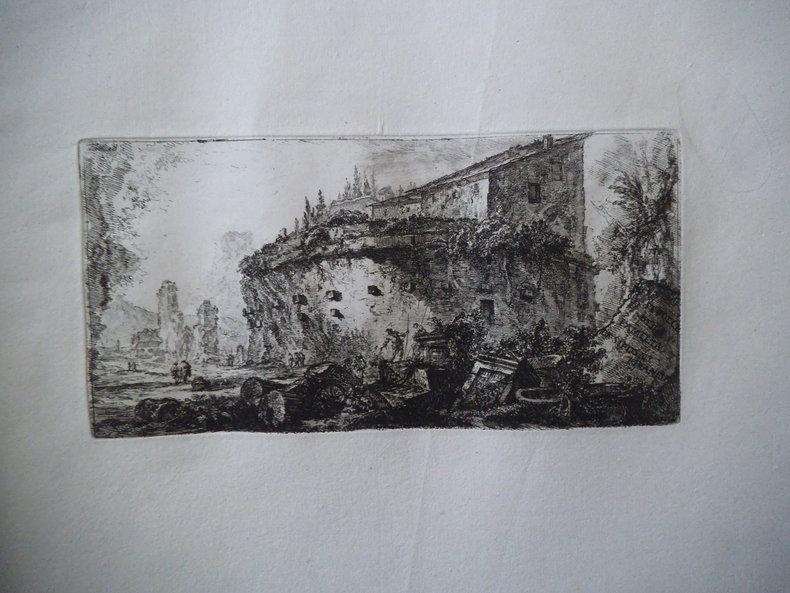
10603Suite de 28 gravures, plus les quatre pages de titre, elles aussi gravées, sur vélin fort, à grandes marges, en un volume In folio à l’italienne plein cuir fauve, 550x435mm, double filet à froid sur les plats. Titre gravé, 355x245mm à la cuvette, deuxième titre 295 x 165mm à la cuvette 3 titre 495x165mm à la cuvette.. Ponte di Rimino Indice dellie Tavole conetenute in quest’Opera (avec des erreurs dans la présentation et la numérotation des planches) planche 5 : Veduta delle’ Arco fabricato in onore d’Augusto Cav. Piranesi inc.en marge inférieure le numéro dans la planche angle supérieur droit.397x257 à l cuvette. Planche 6 : Parto del Foro di Nerva , numéro dans la planche angle supérieur droit. 270x136mm à la cuvette. Planche 7 : Arco di Tito in Roma 265x130mm à la cuvette, numéro dans la planche partie supérieure droite. Planche 9 : Arco Di Constatino in Roma. Piranesi F au bas à gauche dans la gravure. Le numéro 9 est à peine visible, noyé dans les hachures. Planche11: Tempo di Giano et Arco degli Argentieri eretto a settimio Severo in Roma. Piranes Fecit , numéro dans la gravure angla supérieur droit. 266x135mm à la cuvette Planche 12 : Anfiteatro Flavius dessto il colosseo in Roma. Piranese fecit dans la marge inférieure gauche ainsi que le numéro. 273x135mm à la cuvette. Planche 13 : Arco di Settimio. 1) Tempo della concordia 2) Salta di camidoglio. Piranesi s. en marge inférieure droite Israël Silvestre del en marge inférieure gauche.. Planche 14 Ponte Senatorio aggi deto ponte Rotto 1)Tempio di Vesta-2) Tempio della Fortuna virile-3) Porte dell’antico Palation. Piraneses sc. En marge inférieure droite, Israël Silvestre del, .en marge inférieure gauche 259x122mm à la cuvette.Numéro gravé dan la planche angle supérieur droit. Planche 15 : Foro di Augusto Piranese fecit dans la gravure angle inférieur droit. Numéro dans la gravure angle supérieur droit. 265x135mm à la cuvette. Planche16 : Ponte di Rimino fabricato da Augusto e da Tiberio Imperatori. Piransesi fécit en marge inférieure gauche. Numérotation en marge inférieure gauche. 264x136mm. Planche 17 : Antichi A Roma Fuori di Roma Designate ed incise da Gaimbatistta Piranesi Architetto Veneziano Partie seconda. Piranesi fécit en marge inférieure gauche Roma Si vende d’alla auttore dirimpetto l’Academia di Franzia. Arco di Romano erroto ad Augusto. Numérotation dans la gravure angle supérieur droit. 264x130mm. Planche 18 :Sepolcro degliseipioni sull’ant via Appia. Piranese dans la gravure. Numérotation dans la gravure angle supérieur gauche. 272x136m à la cuvette. Planche 20 : Arco di Rimino fabricatada da Augusto. Piranese dans la planche, sous le titre à droite. Numérotation dans la gravure angle supérieur droit 271x137mm à la cuvette. Planche 21 : Tempio di Pola in Istria. Piranes fecit dans la petite marge inférieure gauche. Numérotation dan la marge inférieure droite. 258x126mm, à la cuvette .Planche 22 Rovesio del tempio di Pola in Istria 1) Rovescio di un altro tempio. Piranesi fecit en marge inférieure gauche. Numérotation dans la gravure angle supérieur droit. 255x130mm à la cuvette. Planche 23 : Antféteado di Pola in Istria Vicino al mare. Piranesi fecit en marge inférieure gauche ; Numérotation en marge inférieure gauche. 264x13mm à la cuvette. Planche 24 : Arci di Pola in Istria Vicino alla Porta. Piranesi fecit en marge inférieure gauche. Numérotation (tav) en marge inférieure droit. Planche 25 : Anfiteato di Verona detto l’Arena. Titre gravé dans la planche dans la partie inférieure gauche. Numérotation angle supérieur gauche. 264x130mm à la cuvette. Planche 26 : Tempo di ditunno all Venet ra fuligno e spolette Allevene. Titre et signature Piranese, gravés à la pointe au bas à droite. Numérotation angle supérieur droit. 269x135mm à la cuvette. Planche 27 : Sepolcro delle tres Fratelle curiati in Atrano Titre et signature, Piranese, gravés dans la planche, angle inférieur droit. 262x133mm à la cuvette. Planche 28 : Arco di traiano in Ancona Piranese fécit gravé au dessus du titre. 272x135mm à la cuvette. Planche 29 : Sepolco di Metella deto Capo di Bove. Piranese fecit , double signature La première gravée en majuscules, la seconde au dessous en minuscules. Il s’agit de la planche 20 dont le chiffre 0 a été recouvert du chiffre 9 à la plume. 270x136mm à la cuvette. Planche 30 : Parte dell’antica Via Appia fuoris di Porta Sebastiano circa tre miglia. Piranes fecit au bas à gauche en marge inférieure. Numérotation dans la planche angle supérieur droit. 270x135mm à la cuvette. Planche 31 Arco di Galieno 1) Facciata della chiesa di S. Vito. Piranesi fecit en marge inérieure droite. Numérotation dans la planche angle supérieur droit. 270x136mm à la cuvette. Planche 32 Tempio di Minerva Madica Franc. Piranesi fecit en marge inférieure droite Numérotation en marge supérieure droite. Belles épreuves après 1760. Une déchirure en marge extérieure d’une planche réparée, sans atteinte à la gravure. Traces de tampons effacés, avec habiles recouvrements pour certaines. Fort rare.
La Bibbia di San Paolo (Bible of St. Pauls Outside the Walls). Istituto Poligrafico e Zecca dello Stato (Editalia), Roma, 1992. Facsimile del codice membranaceo dell’Abbazia di San Paolo fuori le Mura, Roma (secolo IX), per la corte di Carlo il Calvo. Commentario a cura di G. Arnaldi, S. Baiocchi, B. Bischoff, L. Maximilians, H. de Sainte-Marie, M. L. di Franco, J. E. Gahede, J. Gribomont, J. Mallet, F. Mütherich, G. Nardin, S. Pisano, A. Pratesi, K. F. Werner ormato cm 33x27 cm. 580 pagine; carta filigranata con 73 tavole fuori testo, legatura in mezza pelle ed in seta ricamata. Due contenitori-espositori in plexiglass permettono di proteggere il codice e il commentario. Formato facsimile 37x45 cm. Pagine 684. Tiratura limitata e numerata a 1000 esemplari. Condizioni ottime.
17673939Paris:: M. Lambert for Briasson 1767. SOLE EDITION. Three tall octavo volumes:. 19.5 x 12.8 cm. Vol I: xxxvi 571 pages.; Vol II: vj 656 pages; Vol III: vi 290 286 1 pp. Collation: I. a-b8 c2 A-Z8 Aa-Mm8 Nn6 plus 22 plates; II. a3 A-Z8 Aa-Ss8; III. a3 A-S8 T4 a-s8 plus 8 plates Bound in contemporary mottled calf spines gilt with morocco labels light wear small imperfections. Internally all three volumes are in excellent condition. All 30 plates are crisp and in fine impressions. First and sole edition of this comprehensive catalogue of the collection of Pedro Francisco Dávila. The Dávila catalog as it has become known describes 8096 mineral specimens that encompass a large range of localities including a suite of specimens from Potosà in Spanish America as well as many items from Canada Mexico and Paraguay. In addition the catalog lists 5253 shells 600 preserved animals 101 plants 3915 fossils 154 bezoars and calculi and 402 books. Over 12000 prints and engravings 1741 original artworks 441 maps as well as various scientific instruments and precious stones are also described. "Pedro Francisco Dávila possessor of the largest collection of natural history specimens in Paris and wishing to establish an institution in Spain to preserve it approached King Carlos III of Spain. But political difficulties and an approaching war with England distracted the king who declined the purchase. Because of debts incurred building the collection creditors forced Dávila to put the accumulation up for auction in Paris. For this purpose a detailed collection catalog was required. Dávila had already written many descriptions but it was his introduction through Balthasar Sage to the young Romé de l'Isle that created this remarkable record of the collection. "Romé de l'Isle took the existing material added considerably to the mineralogical descriptions and put the catalog into publishable form. In this task he was assisted by Abbé Duguat who helped with the mineralogical descriptions and Abbé Gua de Malves 1712-1786 who described the shells. Through their efforts two volumes describing natural history specimens were produced one of which was entirely devoted to minerals. In addition a third volume written by Romé de l'Isle probably with assistance from Pierre Remy describes the fossils artwork and books. The published catalog provides a detailed insight into his collection his special tastes and preferences. The major value of the collection lay in its superb mineral specimens many of which were finely crystallized examples. Romé de l'Isle fully described the many fine mineralogical specimens which included examples of native silver from Norway cassiterite from the Dutch East Indies crocoite from Siberia pyrite from Columbia and calcite from Saxony etc. Dávila had been a collector for over 20 years when his accumulation was auctioned. In that time he or his agents had acquired specimens at other auctions including those that liquidated the collections of Albertus Seba in 1752 the Abbé Joly de Fleury in 1755 Claude Geoffroy in 1753 and others. Dávila's catalog received wide distribution in Paris London Amsterdam Rotterdam and Basle. This helped push the total realized by Dávila to over 800000 Spanish reales more than enough to pay of his creditors and to finance a second collection which he immediately began to build. Within two or three years he had again amassed a sizable collection specializing in minerals and selected with more knowledge and experience than his first collection had been. Once again he dreamed of establishing the cabinet in Madrid. In October 1771 this became reality when King Carlos III agreed to take over his collections with Dávila serving as director for life. This enormous collection eventually passed into the National Museum of Natural Sciences in Madrid where Dávila's specimens are still preserved today."The Mineralogical Record Conlon 67:1238; Nissen ZBI 1050; Sinkankas 1594; Wilson History of Mineral Collecting 1994: 136-40 166 & 209 provides a detailed history of the collections M. Lambert for Briasson, unknown books
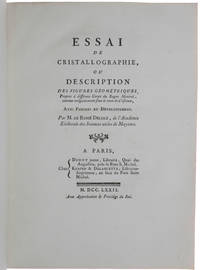
17725371Paris: Didot jeune and Knapen & Delaguette 1772. First edition. <p>First edition a magnificent and very rare large paper copy both larger and printed on thicker paper than the octavo issue of one of the fundamental works of modern crystallography; it appeared 12 years before Haüy's Essai d'une Théorie sur la Structure des Cristaux. "Very scarce. The Cristallographie ranks as one of the great contributions to the science of crystals. In it Roméde L'Isle attempted to make a comprehensive classification of crystals" Schuh.</p>. A FUNDAMENTAL WORK OF MODERN CRYSTALLOGRAPHY - VERY RARE LARGE PAPER COPY. <p>First edition a magnificent and very rare large paper copy both larger and printed on thicker paper than the octavo issue of one of the fundamental works of modern crystallography; it appeared 12 years before Haüy's Essai d'une Théorie sur la Structure des Cristaux. Romé de L'Isle established that various shapes of crystals of the same natural or artificial substance are all closely related to each other. Measurements he took with a goniometer enabled him to determine that the angles between corresponding faces of a crystal are always the same which earlier had only been described in specific cases in particular by Niels Steno this is often described as the first law of crystallography. In addition he demonstrated that these angles are a characteristic of mineral type introduced the concept of truncation and also enlarged the crystallographic vocabulary. He "identified 110 crystal forms drawing upon Linnaeus who had listed forty and described in minute detail the minerals that exhibited them. He subdivided the various substances into salts stones pyrites and metallic minerals stating that he agreed with Linnaeus that geometrical form is the chief characteristic by which minerals may be classified. Also like Linnaeus he held that saline principles imprinted their own geometrical form upon the earthy constituent of each mineral" DSB. "Very scarce. The Cristallographie ranks as one of the great contributions to the science of crystals. In it Romé de L'Isle attempted to make a comprehensive classification of crystals. By the time he wrote his volume he was extremely familiar with the subject and this work greatly surpassed all previous works in scope and detail. To apply his classification he adopted a morphological approach in which he attempted to relate the diverse forms of crystals of the same substance. As a general morphological concept he introduced the idea of the 'primitive form'. All crystals of the same inorganic substance no matter how different in appearance had a fundamental and common geometrical form - the primitive form - to which their actual crystal shapes related . In this first edition of the Cristallographie Romé de L'Isle identifies 110 crystal forms by which minerals crystallize. Grouped under each of these shapes are describe the minerals that exhibit similar habits including the approximate angles between crystal faces. These forms were all derived from a common saline ingredient in every mineral that worked at a molecular level" Schuh. Pages xii-xxviii contain an annotated bibliography of the principal works on crystals. The only large paper copy listed by ABPC/RBH is the Norman-Freilich copy but our copy is significantly larger than even that copy 265 x 205mm versus 249 x 193mm.</p> <br /> <p>"Romé the son of a lieutenant in the cavalry studied humanities at the Collège Ste. Barbe in Paris. In 1756 he entered the Royal Corps of Artillery and Engineering which he accompanied as a secretary to the French Indies in the following year. From 1758 until 1761 he was in the enclave of Pondicherry French India. When it fell to the English in 1761 Romé was taken prisoner and transported to China where he stayed until 1764 when he returned to France" DSB. </p> <br /> <p>"Romé de L'Isle had started collecting minerals during his travels as a naval officer. Back in Paris after the Indian Wars he was introduced into mineralogy by the apothecary chemist and mineralogist Balthazar Georges Sage 1740-1824 who became his friend. It was very fashionable at the time in Paris to have a mineral collection. The owner of an important private collection Pedro Francisco Davila wanted to sell his. At Sage's suggestion he asked Romé de L'Isle to draw up the inventory. Romé made a very thorough job of it the inventory running up to three thick volumes. This was his first work on mineralogy published in 1767 Catalogue systématique et raisonné des curiosités de la nature et de 1'art qui composent le cabinet de M. Davila. It gave him the opportunity to study crystalline forms in detail and led to his Essai de Cristallographie 1772 .</p> <br /> <p>"The context of the time was not very favourable for such studies for had not the famous French naturalist Buffon written in his Natural history of Minerals volume 1 1783: 'One has pretended that rhombohedra constitute a specific character of calcareous spar without being attention to the fact that some vitreous or metallic substances also crystallize in rhombohedra and that if calcareous spar does crystallize often in rhombohedra it also takes different other forms; and our crystallographers when trying to borrow from geometricians the way to transform a rhombohedron into an octahedron a pyramid or a lens have done nothing more than substitute ideal combinations to the real facts of Nature. This crystallization in rhombohedra like all others will never have a specific character. Not only is there no crystalline form common to different substances but conversely there are few substances which do not present different crystallization forms as shown by the prodigious variety of forms of calcareous spar itself' .</p> <br /> <p>"In the preface Romé noted that 'of the curious phenomena of the mineral kingdom those which struck him most were the regular and constant forms taken by some bodies designated by the name of crystals.' He was encouraged by the works of Linnaeus he added to undertake the study of the angular forms of crystals and of their transformations. Their polyhedral shape was only known from the Ancients only for quartz diamond and a few others and Romé widely extended this observation. Minerals were divided by him into four classes: salts stony pyritic and metallic. For each mineral the most frequent forms observed are described with a reference to Linnaeus's classification in Systema naturae . Steno's ideas relative to the growth of quartz layer by layer are quoted at length and Romé de L'Isle felt that they could be applied to all crystals. The book was a success acclaimed by Linnaeus himself and brought international fame to Romé de L'Isle . The importance of Romé de L'Isle's work was stressed by Haüy who wrote Leçons de Physique 1795: 'To the exact descriptions he gave of the crystalline forms he added the measure of the angles and which was essential showed that these angles were constant for each variety. In one word his crystallography was the fruit of an immense work almost entirely new and most precious for its usefulness.'</p> <br /> <p>"Romé de L'Isle was also the first mineralogist to give a rational description of twins . He described for instance the dovetail twin of gypsum and the feldspars twins. He introduced the term macle to designate a crystal in which 'one half is produced by the inversion in the opposite sense of the other half of the same crystal' - a property which he demonstrated by the concordance of angles" Authier pp. 313-6. </p> <br /> <p>"Romé's friendship with Sage brought him membership in a number of learned societies including the academies of Mainz Stockholm Berlin and St. Petersburg. But it did him no service with the Paris Académie des Sciences which rejected him on the ostensible grounds that he was a mere 'catalogue maker.' It is likely that Romé's controversies with Buffon also played a part in his rebuff by the Academy" DSB.</p> <br /> <p>Freilich sale 460; Hoover 2681; Norman 1847; Schuh Mineralogy & Crystallography: A Bibliography 1469 to 1920 4151; Ward & Carozzi 1906; Wellcome IV p. 553. Authier Early Days of X-ray Crystallography 2013. </p> <br/> <br/> 4to 265 x 205 mm pp. v viii-xxxii 427 3 including half-title with 2 folding letterpress tables and 10 folding engraved plates. Contemporary calf spine gilt in compartments with red morocco lettering-piece red edges. Didot jeune and Knapen & Delaguette unknown
In-folio grande; pp. (4), 171, (5), 24 tavole fuori testo, una ripiegata, incise su rame da Domenico Franceschini su disegni del'autore,. Legatura in mezza pergamena con segni di usura. Sontuosa opera a stampa sul Colosseo, la pubblicazione piu' estesa sull'anfiteatro romano (Olschki Coix XI, 16952). "Un'introduzione sui teatri e gli anfiteatri, e cinque libri su questo monumento insigne dell'antichita', dottamente estesi e pieni di critica e di erudizioneO (Cicognara 3730). Rossetti II, 5097.