2 245 résultats
(4) ff., VIII-135-[46]-(1)-136 à 192 pp., (38) ff pour les observations météorologiques, (2) ff d'errata Veau marbré, dos à nerfs ornè, pièce de titre rouge, tranches rouges (Reliure de l'époque) 1763, 1763, in-4, (4) ff, VIII-135-[46]-(1)-136 à 192 pp, (38) ff pour les observations météorologiques, (2) ff d'errata, Veau marbré, dos à nerfs ornè, pièce de titre rouge, tranches rouges (Reliure de l'époque), Édition originale, ornée d'une carte dépliante de la Martinique de cette relation rédigée par le botaniste natif de la Martinique, Thibault de Chanvalon (1723-1788). Membre du conseil supérieur de l'île, il fut chargé d'en dresser la statistique. L'ouvrage renferme des renseignements sur la population, dont une étonnante description des "américains", l'économie, l'esclavage, la géographie, la faune et la flore, le climat, etc. L'année même de la publication de ce volume, Chanvalon sera nommé intendant de la nouvelle colonie de Guyane, là où le royaume plaçait ses espoirs après la perte du Canada ; l'expédition sera un véritable désastre, à la fois sur le plan humain et financier, entraînant la perte de milliers de colons et de plusieurs millions de livres. Bel exemplaire, malgré une trace d'eau sur le plat supérieur et une mouillure peu prononcée dans l'angle inf. des premiers et des derniers cahiers. Provenance : Cachet ancien de la Bibliothèque de Leugny. Chadenat, n°1067. ? Leclerc, n°311. ? Sabin, n°11936
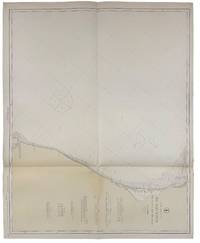
191640718Washington D.C.: Published by the United States Coast and Geodetic Survey 1916. Large folding nautical chart printed on heavy paper stock. Colored. A rare original coastal survey of the coastline north of Tampa including Tarpon Springs Palm Harbor Hudson and Anclote Keys.<br/> <br/> Established by President Thomas Jefferson in 1807 as the Survey of the Coast the U.S. Coast and Geodetic Survey was the United States' first civilian scientific agency. This agency has followed its mission to survey the U.S. coastline create nautical charts of the coast and help increase maritime safety since its founding and has often played fascinating roles in significant chapters of U.S. history. It served in all theaters of the Civil War in the service of the Union Army and Navy pioneered acoustic exploration in the wake of the sinking of the Titanic and during WWI it worked to detect enemy submarines. In addition this agency worked to survey and produce detailed maps and renderings of the U.S. coast. These nautical survey maps commonly referred to as "T-sheets" provide fascinating insights into the history of the United States coastline which has and will continue to shift. These maps are the most important data source for understanding the physical and ecological characteristics of the U.S. shoreline. The present map is a highly detailed and accurate sea chart of the Tampa region and an important historical view of a developing Florida. Published by the United States Coast and Geodetic Survey unknown
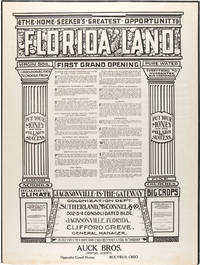
1911WRCAM55624Jacksonville Fl.: Sutherland McConnel & Co. 1911. Broadside 24 1/4 x 18 1/4 inches. Faint tideline along right edge and bottom edge. Very good. A dazzling large-format promotional real estate poster touting the wonders of the Sunshine State in the early 20th century. Issued a decade before the Florida land boom really caught fire this broadside is emblematic of the promotions that led thousands to invest in their savings for the dream of a quick profit or a comfortable retirement. Advertising language is incorporated into and ranged around & inside a large arch with a citrus and floral background and two large pillars. The poster was commissioned by the Colonization Department of Sutherland McConnel & Company a Jacksonville real estate development company and was designed for use by Auck Brothers agents for Sutherland McConnel in Bucyrus Ohio. <br> <br> Among the "1000000 acres to choose from" speculators and farmers are called to the "First Grand Opening" of land in Duval County "generally considered to be the best tract for general farming purposes in the State of Florida.some 27000 acres in extent virtually in a solid body commencing within ten miles of the heart of the city of Jacksonville a most patronized South- Atlantic seaport." The poster touts Florida for its virgin soil pure water good schools fine churches a healthful climate big crops altitude and drainage and more. <br> <br> Two small "coupons" are incorporated at the bottom of the poster encouraging the interested real estate buyer to "Tear this off and mail today without fail!!" One is an order form for a promotional catalog entitled "Will Florida Land Earn Money." The other coupon reserves "a berth for me in your Special Sleeping Cars for the LandSeeker's Excursion on the First or Third Tuesday in February March or April 1911." <br> <br> Rare with only one copy listed in OCLC at the University of Florida. OCLC 22288349. Sutherland, McConnel & Co. unknown books
1731189044-1Leiden, P. van der Aa 1731. Kl.8°. (1 w. Bl.), 13 nn. Bll., 290 S.; S. (291) -582, (1 w. Bl.) Mit 2 (wdh.) gest. Titelvign., 9 gef. Kupfern von Soto u. 1 gef. Karte von Florida. Marmor. Lederband der Zeit mit reicher Rückenverg., rotem Rückenschild u. Marmorpapier-Vorsätzen.
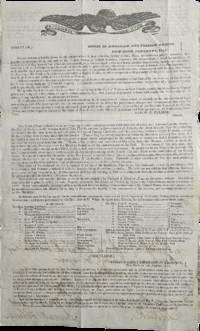
1831List3518New York City 1831. Two-page printed circular measuring 7 ¾ x 12 ¾ inches with manuscript note from Aaron H. Palmer. Folded with some small tears larger tear at seal not intersecting with text. Overall excellent. Aaron Haight Palmer 1779–1863 was the director of the “American and Foreign Agency for Claimsâ€â€”essentially a high-end collections agency—and later Consul General of the Republic of Ecuador. He was extremely well-connected and his activities included a tour of Europe and Asia to gather information about commerce there for the Rothschilds.1 <br /> <br /> Offered here is an 1831 circular from Palmer’s Agency signed by Palmer and sent to A. Lang Esq. in Selkirk Scotland. The circular advertises the sale of “a large tract of land lying on the Gulf of Mexico in East Florida†which “is owned in sole propriety by Richard S. Hackley Esq. an American citizen.†Hackley 1770–1843 a merchant and later US Consul in Spain had been deeded twelve million acres of land around present-day Tampa by the Duke of Alagon in 1819—who himself had been granted the land by Ferdinand VII in 1817. The circular extols the virtues of the land for sale especially Tampa as “a favorable site for the foundations of a great maritime city†and Chatham Bay’s “proximity to the West India marketsâ€. At the time Florida was in the midst of the Seminole Wars; the Treaty of Payne’s Landing would soon demand that all Indigenous people in Florida leave for Indian Territory. It is not clear what came of Palmer’s attempt to sell Hackley’s land; the latter’s heirs’ claims to his estate were settled in 1908 when the US Supreme Court decided that the Kingdom of Spain had annulled the grant prior to the Adams-OnÃs Treaty giving Florida to the US.<br /> <br /> We find one copy of the circular on OCLC. Of interest to historians of the settlement of Florida.<br /> <br /> 1 Jessica Lepler “‘There is no need for anyone to go to America’: commercial correspondence and nineteenth-century globalisation†Rothschild Archive https://www.rothschildarchive.org/materials/no_need_to_go_to_america.pdf accessed February 12 2026. unknown
190840737Washington D.C.: Published by the United States Coast and Geodetic Survey 1908. Large folding nautical chart printed on heavy paper stock. Colored. A rare original coastal survey of the Gulf coasts of Florida Alabama Mississippi and Louisiana including the Keys Fort Myers Sarasota Tampa Panama City Destin Pensacola Gulf Shores Mobile Biloxi Gulfport New Orleans and the Mississippi Delta.<br/> <br/> Established by President Thomas Jefferson in 1807 as the Survey of the Coast the U.S. Coast and Geodetic Survey was the United States' first civilian scientific agency. This agency has followed its mission to survey the U.S. coastline create nautical charts of the coast and help increase maritime safety since its founding and has often played fascinating roles in significant chapters of U.S. history. It served in all theaters of the Civil War in the service of the Union Army and Navy pioneered acoustic exploration in the wake of the sinking of the Titanic and during WWI it worked to detect enemy submarines. In addition this agency worked to survey and produce detailed maps and renderings of the U.S. coast. These nautical survey maps commonly referred to as "T-sheets" provide fascinating insights into the history of the United States coastline which has and will continue to shift. These maps are the most important data source for understanding the physical and ecological characteristics of the U.S. shoreline. The present map is a highly detailed and accurate sea chart of the coasts Florida Alabama Mississippi and Louisiana along the Gulf of Mexico and an important historical view of the developing states. Published by the United States Coast and Geodetic Survey unknown
191640717Washington D.C.: Published by the United States Coast and Geodetic Survey 1916. Large folding nautical chart printed on heavy paper stock. Uncolored. Rare original coastal survey of Florida's Apalachee bay.<br/> <br/> Established by President Thomas Jefferson in 1807 as the Survey of the Coast the U.S. Coast and Geodetic Survey was the United States' first civilian scientific agency. This agency has followed its mission to survey the U.S. coastline create nautical charts of the coast and help increase maritime safety since its founding and has often played fascinating roles in significant chapters of U.S. history. It served in all theaters of the Civil War in the service of the Union Army and Navy pioneered acoustic exploration in the wake of the sinking of the Titanic and during WWI it worked to detect enemy submarines. In addition this agency worked to survey and produce detailed maps and renderings of the U.S. coast. These nautical survey maps commonly referred to as "T-sheets" provide fascinating insights into the history of the United States coastline which has and will continue to shift. These maps are the most important data source for understanding the physical and ecological characteristics of the U.S. shoreline. The present map of the Florida coastline is notable for the inclusion of St Marks light house built at the head of the St Marks River to assist in navigation to and from the important 19th century agricultural port of St Marks. This map is a highly detailed and accurate sea chart of the Apalachee Bay from Fish Creek to Alligator Point and an important historical view of a developing Florida. Published by the United States Coast and Geodetic Survey unknown
191640680Washington D.C.: Published by the United States Coast and Geodetic Survey 1916. Large folding nautical chart printed on heavy paper stock. Colored. A rare coastal survey of Apalachee Bay including Alligator Point and St. George Island.<br/> <br/> Established by President Thomas Jefferson in 1807 as the Survey of the Coast the U.S. Coast and Geodetic Survey was the United States' first civilian scientific agency. This agency has followed its mission to survey the U.S. coastline create nautical charts of the coast and help increase maritime safety since its founding and has often played fascinating roles in significant chapters of U.S. history. It served in all theaters of the Civil War in the service of the Union Army and Navy pioneered acoustic exploration in the wake of the sinking of the Titanic and during WWI it worked to detect enemy submarines. In addition this agency worked to survey and produce detailed maps and renderings of the U.S. coast. These nautical survey maps commonly referred to as "T-sheets" provide fascinating insights into the history of the United States coastline which has and will continue to shift. These maps are the most important data source for understanding the physical and ecological characteristics of the U.S. shoreline. The present map is a highly detailed and accurate sea chart of the Apalachee Bay and an important historical view of a developing Florida. Published by the United States Coast and Geodetic Survey unknown
192040721Washington D.C.: Published by the United States Coast and Geodetic Survey 1920. Large folding nautical chart printed on heavy paper stock. Uncolored. A rare original coastal survey of Apalachicola Bay and Cape San Blas including St. George Island.<br/> <br/> Established by President Thomas Jefferson in 1807 as the Survey of the Coast the U.S. Coast and Geodetic Survey was the United States' first civilian scientific agency. This agency has followed its mission to survey the U.S. coastline create nautical charts of the coast and help increase maritime safety since its founding and has often played fascinating roles in significant chapters of U.S. history. It served in all theaters of the Civil War in the service of the Union Army and Navy pioneered acoustic exploration in the wake of the sinking of the Titanic and during WWI it worked to detect enemy submarines. In addition this agency worked to survey and produce detailed maps and renderings of the U.S. coast. These nautical survey maps commonly referred to as "T-sheets" provide fascinating insights into the history of the United States coastline which has and will continue to shift. These maps are the most important data source for understanding the physical and ecological characteristics of the U.S. shoreline. The present map of the Florida coastline precedes the development of the town of Eastpoint and the building of the John Gorrie Memorial Bridge which connects Eastpoint with Apalachicola. The current site of Eastpoint is marked as Godleys Bluff on the present map. This map is a highly detailed and accurate sea chart of the coastal Florida and an important historical view of the developing state. Published by the United States Coast and Geodetic Survey unknown
191640703Washington D.C.: Published by the United States Coast and Geodetic Survey 1916. Large folding nautical chart printed on heavy paper stock. Colored with minor wear. A rare coastal survey of Florida around Daytona including Ormond Beach Daytona Beach Port Orange New Smyrna Beach and Edgewater.<br/> <br/> Established by President Thomas Jefferson in 1807 as the Survey of the Coast the U.S. Coast and Geodetic Survey was the United States' first civilian scientific agency. This agency has followed its mission to survey the U.S. coastline create nautical charts of the coast and help increase maritime safety since its founding and has often played fascinating roles in significant chapters of U.S. history. It served in all theaters of the Civil War in the service of the Union Army and Navy pioneered acoustic exploration in the wake of the sinking of the Titanic and during WWI it worked to detect enemy submarines. In addition this agency worked to survey and produce detailed maps and renderings of the U.S. coast. These nautical survey maps commonly referred to as "T-sheets" provide fascinating insights into the history of the United States coastline which has and will continue to shift. These maps are the most important data source for understanding the physical and ecological characteristics of the U.S. shoreline. The present map is a highly detailed and accurate sea chart of the Daytona area and an important historical view of a developing Florida. Published by the United States Coast and Geodetic Survey unknown
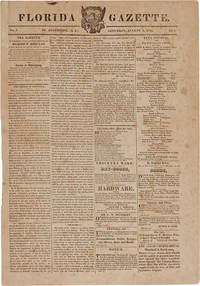
1821WRCAM39560St. Augustine: Richard W. Edes & Co. 1821. 4pp. Cut of the Seal of the United States in masthead. Early horizontal fold. Neatly separated at center fold unobtrusive tape repair at head of center fold on pp.1 and 4. Light foxing small ink stain in upper margin of first page not affecting text. Very good. The fourth issue of the FLORIDA GAZETTE the first American newspaper in Florida. The GAZETTE began publication in July 1821 at the time of Spain's cession of the Floridas to the United States; Florida Territory was organized the following year. This issue of the weekly newspaper prints the names of the St. Augustine city council an account and description of the "Creoles of Louisiana" from the LOUISIANA ADVERTISER a lengthy article on the treatment of dysentery various advertisements letters a notice on the capture of five escaped slaves and local news including a story on a "splendid ball" thrown by the American officers of the St. Augustine garrison for the Spanish ladies and gentlemen of the town. OCLC lists only five institutions holding any issues of the GAZETTE. Edes died of yellow fever in October and the last recorded issue dates from Dec. 22 1821. A rare early Florida imprint. SERVIES 1075. Richard W. Edes & Co. unknown books
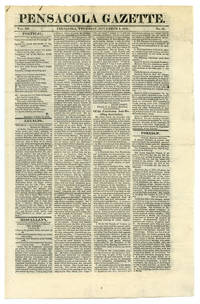
1826WRCAM51016Pensacola 1826. 4pp. Bifolium. Creases on final page flattened with repair tape. Bright and clean. Very good plus. An incredibly early edition of one of the first newspapers in Florida. The PENSACOLA GAZETTE was founded in 1824 and was issued on a weekly basis for approximately thirty-five years ending in 1861. This four-page issue covers basic interests such as foreign affairs local news and classifieds. Rare. unknown books
1876244152Jacksonville Florida 1876. 4 pp. pen and ink on a single folded sheet. 1 vols. 12mo. Old folds. Fine. 4 pp. pen and ink on a single folded sheet. 1 vols. 12mo. The First Florida Retiree. "Spinner a strong nationalist was an important adviser to Chase on matters such as the circulation of greenbacks which bore Spinner's distinctive hard-to-duplicate signature and the creation of a national banking system. . Needing large numbers of reliable employees not subject to military service he was the first governmental administrator to turn to women. He vigorously defended their employment against critics hired over one hundred paid them well by the standards of the time and insisted on their continued employment after the war. . When a new secretary of the treasury in 1875 assumed control over the appointment of clerks however Spinner feared that dishonest people might be hired and he would be held responsible. He resigned and moved to Jacksonville Florida where he enjoyed a vigorous outdoor life until his death in that city." ANB<br/>Francis E. Spinner 1802-1890 served as Treasurer of the United States under Presidents Lincoln Johnson and Grant. In the angling world he is notable as the recipient of letters from Oliver Gibbs published as Lake Pepin Fish-Chowder 1869. In retirement in Florida he writes to George Dawson editor of the Albany Evening Journal and a noted American angling author whose Pleasures of Angling with Rod and Reel 1876 is the first American book devoted to fly fishing. Spinner writes "I am so glad to learn that you have been persuaded to publish your fish letters in book form . when yours comes out it will be read with pleasure." He then goes on to describe fishing for trout on McGirt's Creek a tributary of the St. Johns River and catching a cat fish of 18-1/2 pounds "on one of Chapman's 'No. 4 Minnow bait' . I mention this because I cannot learn from anyone that a cat fish was ever known before to strike at artificial bait." Spinner concludes lyrically "The orange and other of the citrus family are in bloom now . Whoever at the North that can afford to and who has nothing else to do and that does not spend his winters in this Elysium is to be pitied. Do come." <br/>An excellent letter with outstanding content. unknown books
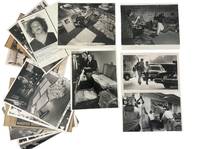
1970231661970. Narcotics raids arrests rehabilitation scenes and evidence displays across Florida in press photographs and magazine pages. Photograph archive spanning Miami Fort Lauderdale Pasco County and related Florida sites from 1970 to the early 1990s establishing how drug control operated through police action newspaper circulation and treatment institutions during the War on Drugs. Produced for press use by newspaper staff photographers wire services and law enforcement publicity channels the group shows the public face of narcotics enforcement at the point when South Florida had become a major corridor in the national drug economy and anti drug policy was being made newly visible through staged photographs official briefings and widely circulated arrest imagery. Named figures included such as Bob Gladden Larry Csonka Jim Kiick Admiral Rickover Carl Mingo and several rehab subjects identified by hand on the versos. The photographs depict suspects detained searched paraded identified displayed beside seized contraband and in other cases shown within rehabilitation settings revealing how law enforcement courts newsrooms and treatment programs handled the same crisis through different institutional forms.<br /> <br /> Photo archive of 18 press photographs including 16 silver gelatin press photographs and 2 wire photos approximately 8 x 10 inches Florida 1970 to early 1990s. The core images show narcotics policing in action: a helmeted officer beside a paddy wagon crowded with detainees; a bench filled with young men under detention in an interior holding space; two handcuffed men led from a courthouse or station entrance; a police-released mugshot with typed caption identifying former New England Patriots running back Bob Gladden after arrest in Fort Lauderdale on a marijuana charge; and a street arrest with an armed officer escorting a suspect between parked cars. Several photographs center on the staged display of evidence including tables covered with packets of drugs stacked currency pistols taped "cookie sheets" and open suitcases packed with bricks or cutting materials. One image shows a narcotics dog inspecting rows of luggage; another shows officials at microphones before a sign for the Vice President's National Narcotics Border Interdiction System; another records cocaine seized from a concealed boat compartment. The group also includes rehabilitation scenes with young adults identified en verso in cursive extending the archive beyond arrest photography into treatment culture. Versos carry a dense record of press handling and editorial use including Miami Herald staff photo stamps dated Dec. 15 1970 and Jan. 5 1971 a St. Petersburg Times credit and clipping backing for a Pasco County drug ring case dated May 29 1974 typed bureau captions circled editorial notations such as "cocaine" "marijuana" "drug raid" and "Operation Crackdown" plus handwritten shot descriptions and date-used stamps.<br /> <br /> The earliest prints fall at the threshold of the modern War on Drugs while later additions carry the record forward into the crack era and the more theatrical seizure photography of the 1980s and early 1990s. Florida is central to that story not only as a site of smuggling and interdiction but as a place where narcotics enforcement became highly visual with press conferences celebrity linked arrests tactical raids canine inspections and rehabilitation coverage all translated into newspaper images for public consumption. The present grouping combines an earlier core of related press photographs with later additions and it preserves a strong visual record of how narcotics control was communicated to the public through local papers wire distribution and agency captioning. Light surface wear minor edge and corner handling editorial markings and stamps to versos scattered adhesive residue and toning; overall very good condition. A concentrated Florida press record of the machinery publicity and human management of drug enforcement across two decades. unknown
191640693Washington D.C.: Published by the United States Coast and Geodetic Survey 1916. Nautical chart printed on heavy paper stock. Colored. A rare coastal survey of Florida from Sanibel Island to Fort Myers Beach including Naples and Marco Island.<br/> <br/> Established by President Thomas Jefferson in 1807 as the Survey of the Coast the U.S. Coast and Geodetic Survey was the United States' first civilian scientific agency. This agency has followed its mission to survey the U.S. coastline create nautical charts of the coast and help increase maritime safety since its founding and has often played fascinating roles in significant chapters of U.S. history. It served in all theaters of the Civil War in the service of the Union Army and Navy pioneered acoustic exploration in the wake of the sinking of the Titanic and during WWI it worked to detect enemy submarines. In addition this agency worked to survey and produce detailed maps and renderings of the U.S. coast. These nautical survey maps commonly referred to as "T-sheets" provide fascinating insights into the history of the United States coastline which has and will continue to shift. These maps are the most important data source for understanding the physical and ecological characteristics of the U.S. shoreline. The present map is a highly detailed and accurate sea chart of the coast around Fort Myers and an important historical view of a developing Florida. Published by the United States Coast and Geodetic Survey unknown
191640732Washington D.C.: Published by the United States Coast and Geodetic Survey 1916. Large folding nautical chart printed on heavy paper stock. Colored. A rare original coastal survey of Cape Sable and Everglades National Park.<br/> <br/> Established by President Thomas Jefferson in 1807 as the Survey of the Coast the U.S. Coast and Geodetic Survey was the United States' first civilian scientific agency. This agency has followed its mission to survey the U.S. coastline create nautical charts of the coast and help increase maritime safety since its founding and has often played fascinating roles in significant chapters of U.S. history. It served in all theaters of the Civil War in the service of the Union Army and Navy pioneered acoustic exploration in the wake of the sinking of the Titanic and during WWI it worked to detect enemy submarines. In addition this agency worked to survey and produce detailed maps and renderings of the U.S. coast. These nautical survey maps commonly referred to as "T-sheets" provide fascinating insights into the history of the United States coastline which has and will continue to shift. These maps are the most important data source for understanding the physical and ecological characteristics of the U.S. shoreline. The present map is a highly detailed and accurate sea chart of the Everglades and an important historical view of a developing Florida. Published by the United States Coast and Geodetic Survey unknown
191640731Washington D.C.: Published by the United States Coast and Geodetic Survey 1916. Large folding nautical chart printed on heavy paper stock. Uncolored with minor wear. A rare original coastal survey of Florida along Everglades National Park and including Marco Island.<br/> <br/> Established by President Thomas Jefferson in 1807 as the Survey of the Coast the U.S. Coast and Geodetic Survey was the United States' first civilian scientific agency. This agency has followed its mission to survey the U.S. coastline create nautical charts of the coast and help increase maritime safety since its founding and has often played fascinating roles in significant chapters of U.S. history. It served in all theaters of the Civil War in the service of the Union Army and Navy pioneered acoustic exploration in the wake of the sinking of the Titanic and during WWI it worked to detect enemy submarines. In addition this agency worked to survey and produce detailed maps and renderings of the U.S. coast. These nautical survey maps commonly referred to as "T-sheets" provide fascinating insights into the history of the United States coastline which has and will continue to shift. These maps are the most important data source for understanding the physical and ecological characteristics of the U.S. shoreline. The present map is a highly detailed and accurate sea chart of the Everglades National Park and an important historical view of a developing Florida. Published by the United States Coast and Geodetic Survey unknown
192040728Washington D.C.: Published by the United States Coast and Geodetic Survey 1920. Large folding nautical chart printed on heavy paper stock. Colored with minor wear and small loss to the top margin. A rare original coastal survey of the St Johns River and Lake George in north-central Florida bisected into two parts.<br/> <br/> Established by President Thomas Jefferson in 1807 as the Survey of the Coast the U.S. Coast and Geodetic Survey was the United States' first civilian scientific agency. This agency has followed its mission to survey the U.S. coastline create nautical charts of the coast and help increase maritime safety since its founding and has often played fascinating roles in significant chapters of U.S. history. It served in all theaters of the Civil War in the service of the Union Army and Navy pioneered acoustic exploration in the wake of the sinking of the Titanic and during WWI it worked to detect enemy submarines. In addition this agency worked to survey and produce detailed maps and renderings of the U.S. coast. These nautical survey maps commonly referred to as "T-sheets" provide fascinating insights into the history of the United States coastline which has and will continue to shift. These maps are the most important data source for understanding the physical and ecological characteristics of the U.S. shoreline. The present map is a highly detailed and accurate sea chart of the Lake George region and an important historical view of a developing Florida. Published by the United States Coast and Geodetic Survey unknown
192053711Fort Pierce FL: n.p. 1920-1931. Oblong 4to. 12.25 x 7.5 in. 24 silver gelatin linen-backed photographs dated & negative number in lower margin of image each mounted on linen hinge sized 6.75 x 10.25 in. Contemporary limp pebbled leather post-binder yapp edges nickel-plated screw posts at gutter margin rounded corners wear rubbing w/o spine wear & minor loss to couple corners still a G exemplar with photos in excellent condition. This remarkable promotional photo album provides a series of photographs documenting the impact of the explosion of development interest in Florida during the Roaring 20s by offering a visual record over 11 years of the building and opening of the Port of Fort Pierce. The album opens with an image dated May 8 1921 showing the last 100 yards to be cut for the a 100 foot wide and 4 foot deep channel the Tuscawilla dredge finishing the last portions of the cut and finally the opening of the Fort Pierce Inlet to the sea which would scour the channel to a depth of 12 feet. A photo dated April 10 1924 shows the operation to dredge the inlet down to 25 feet in order to allow freighters and steamships to enter the Port. Due to erosion local interest began construction of another jetty in 1926 which is shown with railroad tracks stretching to the sea in December 1927 followed by images of the historic dredger the Corozal which had worked on digging the Panama Canal and was capable of dredging to a depth of 50 feet. Finally in Nov. 1929 the Port opened for business with the 4-masted lumber schooner Catherine Scott picking up a load of lumber for delivery to Cuba Feb. 5 1930 followed by the 2339 gross ton SS Betty Weems a Baltimore & Carolina Steamship Company freighter arriving amidst inaugural celebrations of the use of the Fort Pierce Port and opening. There are an addition number of photos up to July 1931 showing such ships as the oil tanker SS Herbert G. Wylie the SS Lillian a freighter owned and operated by A.H. Bull & Co. of New York and a number of other Baltimore & Carolina Steamships. Although the Port had been finished and opened by the end of 1929 the Great Depression and land bust in Florida resulted in such land developments as Indrio and San Lucie never being completed and the area would eventually prove successful as a Naval Amphibious Training Base during World War II with over 140000 troops trained and processed during the War. n.p., hardcover
185334119Paris: Jannet 1853. 160 228pp. Contemp. full calf 16mo raised bands. This is a later edition of the 1586 original edition. Clark: Travels in the old south vol. 1# 16: "This volume contains basic material on the French colony at Fort Caroline and provides as well a description of this early frontier region and the problems confronting colonizing undertakings. The account is contained in three letters of Laudonniere during the years 1562 1564 and 1565. In the present work the editor evidently added the account of De Gourgues expedition in 1567." See the Streeter Sale vol. 2# 1170. Church 131. Sabin 39234. One of the earliest and rarest books relating to Florida. This work also contains one of the earliest accounts of the Native Americans of the southeast. Jannet hardcover books
191740682Washington D.C.: Published by the United States Coast and Geodetic Survey 1917. Nautical chart printed on heavy paper stock. Colored. A rare coastal survey of the Pensacola area including Destin Fort Walton Santa Rosa Island and Pensacola Beach.<br/> <br/> Established by President Thomas Jefferson in 1807 as the Survey of the Coast the U.S. Coast and Geodetic Survey was the United States' first civilian scientific agency. This agency has followed its mission to survey the U.S. coastline create nautical charts of the coast and help increase maritime safety since its founding and has often played fascinating roles in significant chapters of U.S. history. It served in all theaters of the Civil War in the service of the Union Army and Navy pioneered acoustic exploration in the wake of the sinking of the Titanic and during WWI it worked to detect enemy submarines. In addition this agency worked to survey and produce detailed maps and renderings of the U.S. coast. These nautical survey maps commonly referred to as "T-sheets" provide fascinating insights into the history of the United States coastline which has and will continue to shift. These maps are the most important data source for understanding the physical and ecological characteristics of the U.S. shoreline. The present map is a highly detailed and accurate sea chart of the Pensacola area and an important historical view of a developing Florida. Published by the United States Coast and Geodetic Survey unknown
88 pages. Features: Fantastic fold-out two-panel colour cover photo of the four Richardsons of Regina who are world curling champions; Brief article on how Nanaimo Realty paid its realtors to lose weight - and sales increased!; Nice one-page black and white Volkswagen photo ad entitled "Who backs up the Volkswagen?"; Nice one-page colour photo ad for Florida orange juice shows smiling girl wearing white ear muffs; What Winter Does to Canada - and vice versa; What to wear to a Fashion Opening - photo-illustrated article; Duel in the Kitchen (fiction); The Return of the Winter Carnivals; The Simple Joys of Camping in a Snowdrift; Hockey Isn't As Rough as it Used to Be - Part 1 of Jack Adams' "My 43 Years in Hockey" - photo-illustrated article (with large photo of Howie Meeker pounding a limp Canadien); The Second Splendid Discovery of Spices; How to Gain Entree to the Social Pages; Canada's world champions of Curling - Ernie Richardson and the Richardsons of Regina; Population Explosion on the Ski Slopes; Skier's Dream - two-page colour-photo-illustrated brief article with two maps describe how Franz Wilhelmsen and the Garibaldi Olympic Committee seek to have the massive potential of Whistler Mountain developed for the Winter Olympics of 1968; Best and Worst Movies of 1960; Escape to the Sun - Robert Thomas Allen's road trip from California to Florida; Seagrams ad features colour painting of winter carnival by Henry Simpkins; Large colour ad for Apollo Beach waterfront real estate development near Tampa; Canadian Club colour-photo one-page ad features Walter Gonnason falling into an ice crevasse on Mount Victoria Glacier in Alberta; Why color TV isn't here yet - and when it may be; Colour-photo Coke ad on back cover features skating couple; and more. Discrete six-inch clear archival tape repair to bottom left corner of front cover, otherwise unmmarked with average wear. A quality copy of this great vintage issue. Magazine
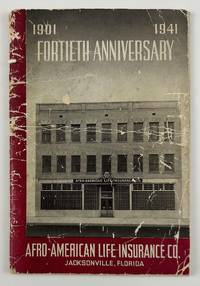
194112634N.p. likely Jacksonville Fl. 1941. 4612pp. Original pictorial wrappers stapled. Substantial creasing rubbing dust-soiling and overall wear to wrappers. Faint foxing and spotting to initial and terminal leaves but mostly clean internally. Very good. A rare pamphlet celebrating the fortieth anniversary of the Afro-American Life Insurance Company an important African-American-owned-and-operated insurance company in Florida. The work includes reproductions of congratulatory letters to the company from Florida governor Spessard Holland and others portraits and information on the company’s founders passages on the history of the company information on the successes of the company’s current operations and more. The work is interspersed throughout with a legion of photographs showing the company at work scenes from various branch offices the company’s Funeral Services Division and so forth.<br /> <br /> "Florida's First African-American Insurance Company -1901-2001. The Afro-American Insurance Company formerly the Afro-American Industrial and Benefits Association was founded in 1901 to provide affordable health insurance and death benefits to the state's African-Americans. Founded by the Reverend E.J. Gregg E.W. Latson Abraham Lincoln Lewis A.W. Price Dr. Arthur W. Smith J.F. Valentine and the Reverend J. Melton Waldron the Afro's first office at 14 Ocean Street was destroyed by the great Jacksonville Fire two months after it opened on May 3 1901. It then moved to 621 Florida Avenue the home of treasurer and future president Abraham Lincoln Lewis 1865-1947. From their next home office at 105 E. Union Street the company wrote millions of dollars of insurance policies and started district offices in Georgia Alabama Louisiana and Texas." - Historical marker at the site of the company's original location in Jacksonville.<br /> <br /> OCLC reports just two copies at Howard and the University of North Florida. unknown
191740711Washington D.C.: Published by the United States Coast and Geodetic Survey 1917. Large folding nautical chart printed on heavy paper stock. Colored. A rare original coastal survey of Charlotte Harbor including Boca Grande and the Charlotte Harbor estuary Florida's second largest estuary and fabled home of mythical pirate Jose Gaspar during Florida's second Spanish period.<br/> <br/> Established by President Thomas Jefferson in 1807 as the Survey of the Coast the U.S. Coast and Geodetic Survey was the United States' first civilian scientific agency. This agency has followed its mission to survey the U.S. coastline create nautical charts of the coast and help increase maritime safety since its founding and has often played fascinating roles in significant chapters of U.S. history. It served in all theaters of the Civil War in the service of the Union Army and Navy pioneered acoustic exploration in the wake of the sinking of the Titanic and during WWI it worked to detect enemy submarines. In addition this agency worked to survey and produce detailed maps and renderings of the U.S. coast. These nautical survey maps commonly referred to as "T-sheets" provide fascinating insights into the history of the United States coastline which has and will continue to shift. These maps are the most important data source for understanding the physical and ecological characteristics of the U.S. shoreline. The present map is a highly detailed and accurate sea chart of Charlotte Harbor and an important historical view of a developing Florida. Published by the United States Coast and Geodetic Survey unknown
186439285Tallahassee and Quincy Florida; Charleston Columbus 1864. Each a single leaf varying lengths in ink manuscript. Occasional light wear Very Good.<br /> <br /> Shipments of cattle and salt beef to Confederate troops in the field are the primary subject of these letters. Logistic and administrative matters railroad availability and other aspects of supplying the troops are discussed. <br /> Pleasants Woodson White "was born in Georgia in 1820 the son of a Methodist minister who soon moved his family to Quincy Florida. Young White studied at Emory and began practicing law in Quincy in 1848. He was commissioned a major in the Confederate Army in 1861 and as Chief Commissary Officer for Florida commanded the important depot at Quincy. In 1863 despite his attempts at secrecy White's difficulties in supplying beef cattle to the army became known. The shortages thus revealed influenced the military campaign of 1864. White became active in politics after the war and served as Judge of the Second Judicial Circuit 1869-79. He also served as Commissioner of Lands and Immigration from 1881 to 1885 a period of railroad expansion in which his office was deeply involved. He became an attorney for the Florida Coast Line Canal and transport Company which controlled vast acreage near Miami. White became an ardent booster of the South Florida climate and divided his last years between his citrus groves in Lemon city and his civic and business interests in Quincy. He died in 1919" online University of North Florida Digital Commons. unknown