8 986 résultats
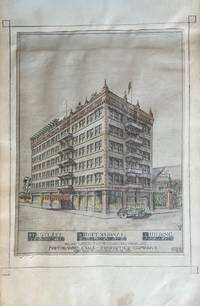
192259524Los Angeles CA: Wholesale Properties 607 Van Nuys Building 1922. Oblong atlas folio. 17 x 12 in. 15 leaves black paper stock interleaved as paper guards for silver-print blow-up of TLS from Title Insurance & Trust Company 3 hand-coloured elevation and interior renderings w/ initials L.B. & steer’s skull below 5 hand-coloured floor plan drawings w/ architectural design details 1 blueprint map demarcating the “Location of Westlake Professional Building.†Black pebbled buckram post-binder gilt lettering stamped on front cover some scuffing edgewear minor soiling wear to screw-posts still VG exemplar. An exceptional architectural sales album for the historic Westlake Professional Building renamed Macarthur Park Medical Plaza 2007 Wilshire Blvd. designed to serve the burgeoning medical professionals in Southern California during the Roaring 20’s. This building designed by Charles S. MacKenzie a noted San Jose CA architect for the Wholesale Properties Corp. was “one of the earliest extensions of the medical community to Wilshire Boulevard . . . and had special amenities for medical professionals including gas electric and vacuum outlets in each suite circulating ice water and compressed air.†At a reported cost of $ 350000 the structural engineers were Noice & Merrill out of Los Angeles and building contractors were Walace & Bush. The enlarged linen-backed silver print of the TLS outlines the acceptance of the terms of the Trust to manage the building while the architectural renderings vividly portray the exterior elevation and interior amenities of the stately building erected at the corner of Orange & Westlake in 1922-1923. The Wholesale Properties Corp. intended to capitalize as well on the extension of Orange across Westlake Park connecting the area directly to downtown Los Angeles and with anticipation of when the street would be renamed the historic Wilshire Blvd. No similar albums located in Worldcat; See: Intensive Survey: Westlake Recovery Community Redevelopment Area City of Los Angeles 2009 pp. 16 74-75. Wholesale Properties, 607 Van Nuys Building, hardcover
19012693Berkeley: University of California Press 1901. First Edition — Primera edición. Hardcover — Tapa dura. 265x180mm. 10½x7". Berkeley University of California Press 1901-1923. 12 volúmenes. En 4º 265 x 180mm. -1: 378 pp. mapa plegado y más de 30 ilustraciones en blanco y negro -2: 164 pp. ilustraciones en blanco y negro -8: 358 pp. ilustraciones en blanco y negro -9: 235 pp. -10: 288 pp. ilustraciones en blanco y negro -11: 465 pp. -13: 414 pp. mapas plegados y láminas en blanco y negro -14: 488 pp. mapa plegado y láminas en blanco y negro -15: 384 pp. láminas y plegados en blanco y negro -20: 389 pp. -21: 332 pp. 97 láminas y plegados en blanco y negro. Encuadernación en tela editorial. Primera edición. La publicación se mantuvo activa de 1901 a 1964. Incluye tÃtulos muy interesantes acerca de muchas tribus de indos indÃgenas de Norteamérica. University of California Press hardcover
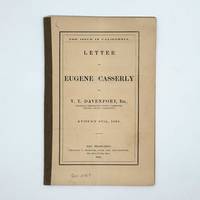
1861370854San Francisco: Charles F. Robbins 1861. First edition. 15 1pp. 8vo. Original wrappers crudely rebacked with tape. First edition. 15 1pp. 8vo. Scarce speech by Casserly a noted early California newspaperman and politician advocating to the Chairman of the Democratic County Committee a war Democrat i.e. pro-Lincoln Unionist position shortly after the start of the Civil War and just prior to the September elections. Casserly's speech laments the Democratic support given by the party to John R. McConnell in the gubernatorial election suggesting in no uncertain terms that votes for McConnell amount to votes for Jefferson Davis. In the September 1861 election with the Democrats in California split over secession Republican supporters of Lincoln took control of the state house and Leland Stanford was elected governor. OCLC cites 10 copies in institutions; scarce on the market with no examples recorded by Rare Book Hub. Sabin 11367 Charles F. Robbins unknown
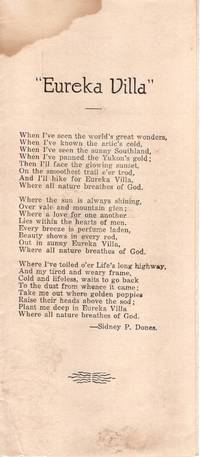
192612988Los Angeles or Chicago 1926. Single sheet 9.25 x 16 inches folded three times vertically to form a slim 8pp. pamphlet. Dampstain to top margin throughout moderate soiling throughout especially along bottom margin slight biopredation to one panel. About very good. A rare pamphlet touting the advantages of Eureka Villa a 1920s real estate development near Los Angeles intended for African American home buyers. Sydney Dones was the developer and head of the Eureka Villa Improvement Association with offices in Los Angeles and Chicago. Eureka Villa was founded on about a thousand acres purchased by Dones and his fellow investors in 1924 near the long-abandoned Mexican mining town of Val Verde. The planned community was envisioned as an affordable and welcoming home and vacation destination for Black folks in southern California who were otherwise excluded from most public amenities and priced well out of home ownership anywhere near the city. The present pamphlet or flyer includes a poem about the community by Dones himself information on how to buy a lot a short introduction by Dones but is mostly comprised of a long series of detailed questions and answers about the development. An example of the latter: "Q. What work can we get near Eureka A. Eureka is just one and a half hours' ride from Hollywood where a large number of our people are employed and too there will be a number of people needed to build Eureka Villa." Just four copies reported in OCLC at the Huntington Bancroft UC-San Diego and Princeton. unknown
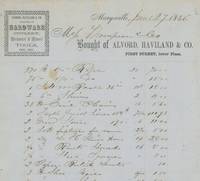
1860List2417Marysville 1860. Marysville 1850s-1860s the bulk mid-1850s. A collection of documents including eleven receipts three manuscript legal documents four manuscript documents relating to land claims; five partially printed documents relating to land claims; two letters from the US Land Office in Marysville 1858 regarding land claims; six billheads from Marysville firms with receipts for a range of goods some illustrated; one letter from Marysville written in 1853 concerning a death in a family. Generally fine condition. Fine. A mini-archive or assemblage of documents relating to the early Euro-American citizens of Marysville and its environs in the 1850s. The population of Marysville grew quickly after the town’s incorporation to 10000 by the mid-1850s due to its strategic location close to the gold fields but the levee system put in place to control flood damage limited the town’s growth beyond this initial phase. The documents here relate to Marysville in this early period of growth and include several quitclaim land deeds as well as illustrated billheads. As a group they offer an ephemeral record of the city in its early period with the legal documents and deeds showing the means with which the area was settled. A well preserved group overall. unknown
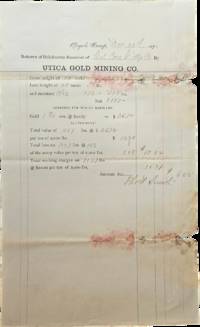
1898List3118Calaveras County California 1898. Seventy-two documents. Most sheets measure about 14 x 16 inches and are folded in half. Folded some with tears and water damage; overall very good to excellent. The Utica Mining Company was owned by mining moguls Alvinza Hayward Charles D. Lane and W.S. Hobart and ran mines in Calaveras County California. This area located on a portion of the Mother Lode had been an exceptionally productive gold mining district; its productivity declined in the latter half of the 19th century until new techniques especially in hard rock mining created a “Second Gold Rush†in the late 1880s that lasted until World War I.1 The Utica company owned two mines with nine claims—the Utica mine and the Gold Cliff mine—and employed about 250 men at its peak. It also owned the water source in the town of Angels Camp and some claimed essentially ran a company town there.2 Among multiple other accidents and controversies it was alleged after a cave-in that killed seventeen miners that Utica’s owners had known that a disaster was likely and had failed to act.3<br /> <br /> Offered here is a collection of documents mainly payrolls of the Utica Mining Company dating between 1889 and 1898. There are also receipts for goods and services including from D. D. Demarest who owned the Altaville Foundry and reports on sulphurets. Payrolls are organized by which jobs the men worked milling ditch work etc. Employees are identified mostly by full names except for one: “Chinaman†who appears on several early 1889 documents. However the company seemed to have hired a second Chinese laborer by July of that year as he and his compatriot are identified by name: Ah Fun and Ah Sing. According to the Calaveras Heritage Council there was a lively community of Chinese miners just outside Angels Camp in the midcentury though it declined precipitously as the century went on particularly following the 1882 Chinese Exclusion Act.1<br /> <br /> Of interest to historians of mining in central California.<br /> <br /> 1 Judith Marvin “Angels Camp†Calaveras History https://www.calaverashistory.org/angels-camp 2011.<br /> 2 “C.D. Lane’s Address†Daily Miner-Transcript September 8 1896 2.<br /> 3 “Entombed Alive. Dreadful Disaster in a California Quartz Mine†The El Paso Journal December 28 1889 6. unknown
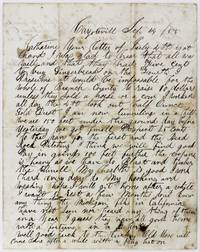
18553206Coyoteville: September 12 1855. Very good. 2pp. plus integral blank. Original mailing folds moderate toning staining and ink spotting but still easily readable. Bottom fourth of integral blank excised. An informative Gold Rush letter about mining in the long-vanished ghost town of Coyoteville which was an extraordinarily rich gold area for a couple of years in the early 1850s. A noted tunneling method nicknamed "coyoteing" was developed in the town and subsequently inspired the name of the town. In the present letter Moses Pine writes to "Catherine" in Branch County Michigan and signs his name simply as "Mose Esq" at the conclusion. The author informs Catherine presumably his wife or sister of his activities some of the economic realities and some of the practical details of prospecting for gold in California. Presuming that "it would be impossible for the whole of Branch County to raise $10 unless they sell a horse" Pine comments that he had ginger bread on the Fourth of July after working all day and yielding a "half Ounce Gold Dust." He then provides a detailed description of his mining: "I am now tunneling in a hill. We are 150 feet under the ground. Day before yesterday we got small respect 25 cents to the pan for the first and the bed rock pitching. I think we will find good pay in the going 100 feet further the expense is heavy as we have to blast and timber the tunnel." Pine also talks of his health and that "I work hard every day do my cooking and baking." He then expresses his hope to get back to Michigan to "rest a few months" but knows nothing of other Michigan folks in California: "Have not seen nor heard anything of them in a year. I guess they have all gone home with a fortune in a horn. Well good luck to the lucky. Old Mose will come home after a while with a pretty hat on." A nicely-detailed letter from an unusual and obscure Gold Rush location. September 12 unknown
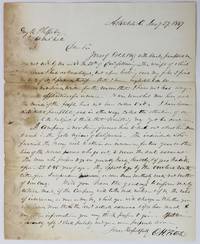
18492389Ashtabula Oh: January 29 1849. About very good. 1pp. on a bifolium. Previously folded. Light dampstaining and short closed tears along gutter somewhat affecting first few lines of text but not overall sense. An interesting letter from O.H. Field an aspirational field representative of the Connecticut Mutual Life Insurance Company in Ashtabula Ohio to the company secretary George R. Phelps inquiring about a policy for a group of men headed to the Gold Rush in California in January 1849. Connecticut Mutual was founded in Hartford three years prior to the composition of this letter in 1846. Fitch's missive begins with a report on his efforts to drum up interest in life insurance in his area with pamphlets and other materials sent to him by Phelps: <br /> <br /> "Yours of Oct 1 1849 with blanks pamphlets &c was not received by me until the 25th of Dec. following. I have not had any definitive applications for insurance. It was somewhat new here and the minds of the people had not been called to it. I have however distributed pamphlets and in other ways called the attention of our citizens to the subject. I think that something yet might be done.<br /> <br /> The letter goes on to describe a potential policy for a group soon leaving for the Gold Rush and requests a favorable rate in order to stimulate interest in policies from additional parties: <br /> <br /> "A company is now being formed to head out about ten men to work in the gold regions of California. The individuals who furnish the money wish to obtain an insurance for two years on the lives of the several persons who go out to secure the amount advanced. The men who propose to go are generally hardy healthy & of good habits & from 25 to 45 years of age. They expect to go by the overland route either from Independence Missouri or some more southerly route not south of Vera Cruz. Will you have the goodness to inform me by return mail if the company will take such risks -- & if so the rates of insurance as near as may be which you will charge -- whether you will insure more than the amt. actually advanced & if so how much & any other information you may think proper to give. If I receive a favorably sic reply I shall probably send you more proposals soon."<br /> <br /> A neat letter concerning the preparations and considerations necessary for a journey to California in the early days of the Gold Rush and the role and rise of early American insurance companies in the planning of such lengthy and dangerous overland travel. January 29 unknown
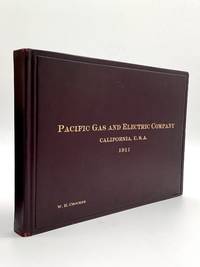
191179971San Francisco: Pacific Gas and Electric 1911. First Edition. Hardcover. Near fine. Oblong octavo: 268 2 pp. with numerous photographic illustrations and a folding color map. In the publisher's maroon leather binding with gilt-stamped titling and blind-stamped borders. All edges gilt with marbled endpapers. Some mild wear to the corners and tips; else near fine.<br /> <br /> From the library of William Henry Crocker with "W. H. Crocker" stamped in gilt on the front panel. William Henry Crocker 1861-1937 was part of the influential Crocker family one of the "Big Four" families associated with the Central Pacific Railroad. He was President of the Crocker National Bank one of California's leading financial institutions in the early 20th century and played an important role in rebuilding San Francisco after the 1906 earthquake. Crocker also made various philanthropic contributions to the city's cultural and educational institutions.<br /> <br /> This publication provides a comprehensive overview of the infrastructure and service areas of major California utility companies including Pacific Gas and Electric Company PG&E California Gas and Electric Corporation CG&E and San Francisco Gas and Electric Company SFG&E. Pacific Gas and Electric hardcover
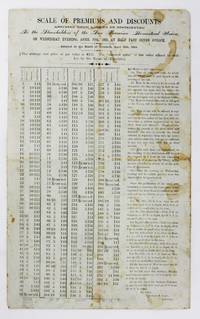
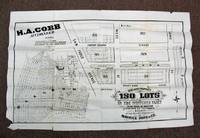
18626105San Francisco 1862. Good. Broadside about 14 x 8.5 inches. Previously folded with separation along horizontal fold line from right edge. Minor edge wear plus short closed tear at center of left edge. Moderate staining and soiling. An unrecorded broadside concerning values on parcels of land in what is now San Francisco's Mission District that were set to be auctioned to shareholders in the San Francisco Homestead in April 1862. The broadside contains a table that displays lot numbers and the assessed values of those lots as well as the "premium" or "discount" relative to the average assessed values of all lots which was $141. At right are specific rules for shareholders bidding on lots at the distribution and several notes on adjustments to the surveyed lot sizes and dimensions. Many of the lots in this section are on Mission Street Valencia Street Old San Jose Road or somewhere in between. Not present but referenced in the text of this broadside is a map that would have shown the lots and their corresponding numbers. A very interesting document of land sales on the south side of San Francisco during the midst of the Civil War. Not in OCLC. unknown
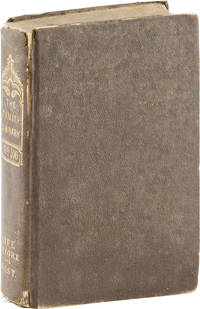
184054539New York: Harper and Brothers 1840. First Edition. Generally accepted second printing lacking the dot over the "i" in the copyright notice and with the broken running head on p.9. 12mo 15.5cm. In original brown publisher's cloth BAL binding A stamped in gilt on spine; plain endpapers; 1-3 4-483pp. A desirable copy in the original binding with a two-inch crack to the front joint chips to head and tail and gentle rubbing to boards; text mildly foxed; nonetheless stable and upright: Very Good. <br /> <br /> #106 of the Harpers' Family Library. With contemporary ex-libris of Elizabeth Dodge and later gift inscription dated 1900. A memoir of Dana's time trading hides along the coast of California in the 1830s. Immediately popular the work had a wide influence on American seafaring literature including the work of Herman Melville and is a rare and rich account of California before the Gold Rush ANB Zamorano 80. BAL 4434. ZAMORANO 80 #26. COWAN p. 156. SABIN 18448. GROLIER AMERICAN 100 #46. Cf. GRAFF 998. Harper and Brothers unknown
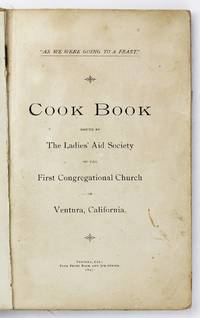
18976345Ventura Ca: Free Press Book and Job Office 1897. Good. 11620pp. Original printed cloth wrappers. Moderate wear and soiling to wraps rear wrapper detached. Scattered manuscript notes throughout plus manuscript additions to rear blanks. Even toning and scattered staining other signs of use. Extremely scarce late 19th-century community cook book published in Ventura California in 1897. Several hundred recipes are attributed to members of the local Ladies' Aid Society and advertisements for local businesses are scattered throughout. One chapter prints a handful of "Spanish Recipes" which include Havana Soup Pastel de Pescado Spanish Liver and Spanish Jerked Chicken. Other colorful recipes are Italian Herring Salad Mrs. Saxby's Chicken Salad Van Deusen's Gold Load Eureka Sponge Cake and Apple Pie Without Apples. The present copy contains additional manuscript recipes and notes on the preponderance of the twenty rear blank pages dated 1917 to 1923. They contain instruction for items such as Rosa's Wonderful Coffee Cake and Mrs. Nance's Biscuit but also comprise four pages of manuscript notes on the packing and preserving of local fruits including apricots strawberries and currants. Well used but a unique copy with numerous manuscript additions and also extremely scarce. We locate copies at Berkeley and Yale only. Free Press Book and Job Office unknown
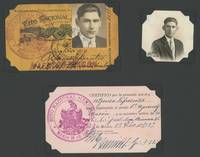
1940List3659Mexico and California 1940. Photo album measuring 7 ¼ x 11 ¼ inches containing approximately eighty-five photographs generally 4 ½ x 2 ½ inches and smaller with three Rito Nacional Mexicano Freemason membership cards one 1943 tax return and one 1943 letter. Album cover broken and beginning to detach else excellent; contents excellent to Near Fine. A photo album belonging to the Sifuentes also recorded as Cifuentes family of Santa Ana California. Alfonso Sifuentes Rodarte 1896/9–1994 was born in Coahuila and his wife Enriqueta “Harriet†Gonzalez Galvan 1903–d. in Jalisco. The couple married in Orange California in 1923. The album situates the family at several Santa Ana addresses including W 4th Street and E 1st Street the latter appearing on a 1927 Masonic membership card from the University of Mexico; commercial signage also suggests an address on Bristol Street.<br /> <br /> The earlier photos from the 1920s and 30s show children and family playing and posing in front and back yards beach trips and two formal baby shots real photo postcards; two men pose in sombreros and stylish young ladies pose with a car in front of the house. What are likely photos with extended family look to have been taken on a farm. There are also wedding and church shots and later photos of men in uniform—Alfonso Sifuentes joined the Coast Guard during World War II. Photos are occasionally captioned in Spanish on the verso giving names and relations.<br /> <br /> The 1943 letter included in the album is from a fellow Coast Guardsman “Andrés†to his girlfriend Celia Sifuentes one of the family's daughters. Andrés mentions translated passing “the famous exams . without incident†and how much he enjoys spending time with Sifuentes’ family: “I wish my parents had the harmony that exists in your home.†According to the National Parks Service some 500000 Mexican Americans served in World War II while at the same time facing anti-Mexican and anti-Latine sentiment at home.<br /> <br /> Of interest to historians of Mexican American and Southern California regional history in the interwar era. unknown
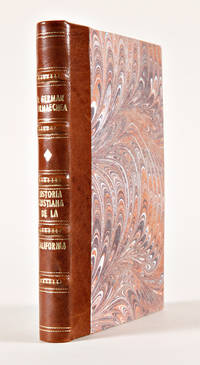
1864WRCAM56183Mexigo sic: Impenta sic de Pedro Murguia 1864. 3-238pp. plus five leaves of appendix and index. Lacks half title. Modern half calf and marbled boards spine gilt with raised bands. Small chips to upper margin of titlepage and first few leaves not affecting text light soiling to titlepage occasional light tidelines to upper gutter textblock. Light tanning and occasional foxing throughout. Good plus. First Spanish edition of this history of early missionary activities of the Spanish in Arizona and California mainly dealing with the period from Kino and Salviaterra through the establishment of the missions. This is the second edition overall translated by German Madrid y Ormaechea from the French HISTOIRE CHRÉTIENNE DE LA CALIFORNIE Plancy 1851. The identity of the author Madame la Comtesse de remains unknown. <br> <br> Howes collates this incorrectly calling for 238 pages and five plates. This is evidently a mistranscription of five leaves which are found at the end of this copy and the Yale copy and which Howes does not mention. Further the Yale copy is in a contemporary binding with no evidence of plates ever having been present nor are they mentioned on the Library of Congress card. This edition like the first is uncommon. HOWES C61. SABIN 32032. COWAN p. 282 French ed. Impenta [sic] de Pedro Murguia hardcover books
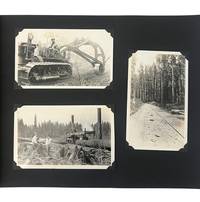
1930234241930. California photo Album documenting 1930's roadside commerce's Oil and logging industries and desert sightseeing across Southern California and Death Valley circa 1930s. Include logging photographs made when steam power still ran the woods before the gasoline tractor and chainsaw displaced the steam donkey engine and the logging railroad. The photographs were made just as the paved highway and the auto court were turning the California desert and mountains into a tourist destination reachable by family car. John Marshall High School in Los Angeles shown new and unweathered in the album opened its doors on January 26 1931 fixing the album's date to that year or shortly after.<br /> Photo Album of 116 silver gelatin photographs mostly snapshot format ranging approx 3 x 5 to 5 x 7 inches California Sierra Nevada and Death Valley circa 1931 to 1935. The logging images show a tracked crawler tractor fitted with a tall steel arch for skidding logs a steam donkey engine venting steam beside a yarding spar rigged with cables decked logs stacked on railcars marked with painted numbers a single rail line running through uncut timber and a man in suspenders and field hat standing beside a standing tree with a felling axe and undercut wedge driven into the trunk. The Southern California group includes wooden oil derricks stepped up a steep eroded canyon wall three women in cloche hats and drop-waist dresses standing arm in arm on a pile of oil-field casing pipe a touring sedan with passengers parked among the derricks a typed caption reading "No 4. Artist's Drive. Death Valley" above eroded badland hills the neon-topped "El Don Motel" sign advertising kitchenettes and refrigeration the "Beechwood Motor Apartments" and "Aut-O-Tel" auto court a palm-lined commercial street with a Citizens Bank and parked Model A automobiles the Collegiate Gothic John Marshall High School captioned in pencil the grounds of the Hotel del Coronado covered wagons drawn up in a mountain meadow a backyard scene of an older couple outside a board cabin and harbor views with a small fishing boat numbered "A 619." Photographs are mounted with black corner tabs on black album leaves several captioned in pencil or by typed slip.<br /> Southern California in the early 1930s was the most prolific oil-producing region in the world with derricks crowding canyons and city lots from Signal Hill to the Newhall fields and the album captures ordinary visitors treating an active oil field as a sightseeing stop. The same years saw the auto court and motel emerge along the new highways and the El Don and Aut-O-Tel signs document that roadside lodging industry in its first decade. The logging photographs record steam-era timber work the crawler tractor and steam donkey caught at the moment mechanized gasoline equipment was about to replace them. Overall in very good condition with some fading to individual prints. The album places steam-era timber work and first-decade California auto travel side by side recorded firsthand during the years of the development of roadside infrastructure. unknown
186939163San Francisco: Lith. Britton & Rey 1869. 1st printing. OCLC records a single copy at UC Berkeley. Folding map now housed in an archival mylar sleeve. Edge chips with tear in margin of lower left. Occasional small separation at fold junctures. Very Good. Constant ratio linear horizontal scale: 900. Terms of Sale printed in upper left under Auctioneer's name. Single sheet of light weight paper almost newsprint printed black recto only. Folded 5x. Map shows two perspectives: the section of Oakland wherein resides the tract on left and the tract itself on right larger scale area bounded generally by San Pablo Ave. 28th St. Grove St. and 26th St. Block numbers tract names owners of large parcels street names railroads etc. Oriented with north toward top. Unfolded oblong format: 23-71/2" x 35-7/8". Folded: 9-3/8" x 4-1/4" <br/><br/> Lith. Britton & Rey unknown books
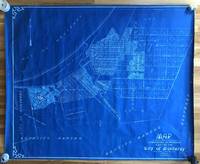
1900511Monterey Ca 1900. About very good. Large blueprint map 52.5 x 65 inches. Light wear and occasional creasing. Several closed tear repaired on verso. Right edge trimmed slightly affecting image and text. A rare and giant cadastral map showing new subdivisions east of downtown Monterey in what are now the Del Monte area and the neighboring town of Seaside north of the present-day airport. The map is quite detailed drawn at a scale of 300 feet to the inch and begins in the west at the grounds of the Del Monte Hotel which today is the Naval Postgraduate School. East of the hotel grounds are the newly organized neighborhoods of Live Oaks Park and Del Monte Grove north of the Del Monte Racetrack now the Monterey Fairgrounds. At the very center of the map is the Laguna del Rey and beyond the lagoon are several other extensively plotted areas called "Lake Side Tract" "Vista Del Rey Tract" "East Monterey" "Hot Springs Tract" and "Del Monte Heights" which now make up the town of Seaside. Property inland and to the east of these tracts is surveyed in larger unnamed plots. The map was compiled by Howard D. Severance who became the City Engineer of Monterey in 1906 and was responsible for several similar but smaller maps in the second half of that decade that are located at the Monterey Public Library. We do not locate any copies of the present map in OCLC. unknown books
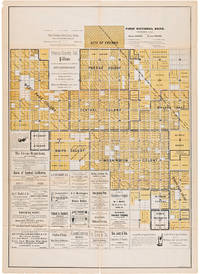
1890WRCAM46178Fresno Ca.: William Harvey 1890. Tinted map 32 1/4 x 23 1/4 inches. Text on verso. Minor edge wear. Some small neat splits at cross-folds five-inch closed separation along one fold with no loss. Very good. An elaborate and handsome map and promotional for agricultural land in Fresno California. The map was lithographed by the notable San Francisco firm of H.S. Crocker & Company. The map shows several "colonies" or "tracts" in a wide area of Fresno and what is most notable about it is the small amount of land still available for sale. Most of the lots shown had been sold and the owners' names are identified. Real estate agent William Harvey however still had thirty-two lots available in the South Washington Colony with terms as follows: "sold in 20-acre tracts all the ditches constructed by the owner conveying water to the highest point in every 20-acre lot; price $100 per acre. Terms one-fourth cash; balance any time within four years with interest at the rate of 8 per cent." The lower portion of the map is taken up with advertisements for a variety of local businesses including banks and agricultural concerns. The verso of the map contains text in six columns headlined "Fresno Raisin District of California!" and is a lengthy promotional for the lands and their excellent properties for planting vineyards and engaging in raisin production. <br> <br> OCLC locates three copies: at California State University Fresno; the Bancroft Library; and Yale. A scarce California map and agricultural promotional. OCLC 24032427 58875969. William Harvey unknown books
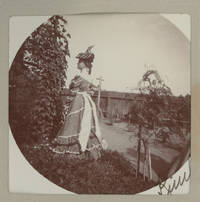
1899List805Los Angeles and Vicinity 1899. Oblong quarto green cloth 11 ¾ x 5 ¾ inches with 98 photographs. Very Good. Frances Coulter the daughter of a department store magnate in turn-of-the-century Los Angeles was a socialite who regularly made the society pages of Los Angeles newspapers. The collection of photographs here - preserved in their original oblong green cloth album - give a candid look at upper class California in the 1890s. The bulk of the images show Frances and her friends in varied scenes of society gaiety: dressed formally on the beaches staging goofy scenes including a mock proposal drinking from a water hose and many scenes involving costumes and umbrellas. Some of the photographs interestingly were taken with a Kodak No. 2 camera which was in production until 1895 producing distinct circular images. Some of the scenes show the beaches of Santa Monica. Overall the collection offers an uncommon look into Los Angeles at the end of the 1890s when the city had only 100000 residents. Frances's father B.F. Coulter was a minister from Kentucky and some of the photographs show the Coulters at home. A very good collection images with slight fading album with a slightly musty odor but overall well preserved. books
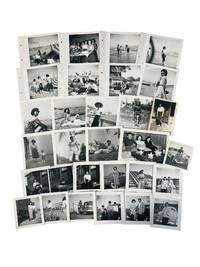
1952228981952. Post WWII Japanese American Los Angeles California Japanese American family photograph archive 1952-1953 documenting the rebuilding of Nisei and Sansei community life in Los Angeles during the decade following the wartime incarceration of Japanese Americans under Executive Order 9066. The photographs record a network of relatives and friends living in the South Los Angeles communities of Gardena and Compton neighborhoods that became important centers of Japanese American resettlement after families returned from War Relocation Authority camps in 1945. Domestic portraits social gatherings and beach outings show a generation reestablishing family life friendships and leisure activities in Southern California only a few years after their forced removal from the West Coast. Through candid images of everyday recreation and neighborhood gatherings the archive documents the process by which Japanese American families rebuilt social networks and community identity in postwar Los Angeles.<br /> <br /> Archive of thirty original black and white silver gelatin photographs created primarily between 1952 and 1953 most measuring approximately 3.5 x 4 inches and many bearing handwritten captions identifying individuals and locations including Compton Gardena Redondo Beach and Catalina Island. Several photographs record gatherings at 942 E. Victoria Street in Gardena an address associated with Japanese American families returning to the area after the war. The images depict domestic interiors informal group portraits and neighborhood gatherings among a circle of friends whose captions identify individuals including Susie Fukutomi Jane Tamayo Ann Motoyoshi and Violet Muramato. One photograph dated August 24 1952 shows Fukutomi Tamayo and Motoyoshi laughing together with their feet in the surf at Redondo Beach. Another photograph portrays Violet Muramato seated outside a Southern California home wearing a patterned skirt and blouse framed by stucco architecture and palm trees characteristic of mid century residential neighborhoods. Additional photographs show multigenerational family portraits gatherings of young women indoors and excursions to Catalina Island while several images depict friends and relatives posed beside automobiles typical of early 1950s California life.<br /> <br /> The photographs collectively document a moment when Japanese American families across Los Angeles were reconstructing everyday life after years of displacement and incarceration. Between 1942 and 1945 more than 120000 people of Japanese ancestry were removed from their homes and confined in camps administered by the War Relocation Authority. Light handling wear with several minor corner creases; handwritten identifications remain clear and legible and photographs remain crisp without significant fading or toning. Overall very good condition. When restrictions on returning to the West Coast were lifted in 1945 many families resettled in neighborhoods such as Gardena and Compton where Japanese American churches businesses and social networks gradually reemerged. The scenes of beach recreation domestic gatherings and neighborhood visits preserved in this archive illustrate the social rebuilding of those communities during the early 1950s. unknown
1952WRCAM56683N.p. likely Sacramento 1952. Panoramic silver gelatin photograph 8 x 33 3/4 inches. Short closed tear and mild crease near upper left corner slight silvering to image. Still in very good condition. A handsome group photograph memorializing the attendees of the 1952 annual conference of the Northern California Young Buddhist League. The photograph depicts over 200 finely-dressed Japanese-American men and women and even a few Anglo Americans organized by region which are indicated by printed signs. The delegates to the conference came from Lodi Placer Marysville Sacramento Delta Stockton and Florin. A sign hanging on a building behind the delegates reads "Greetings Busseis" a general term for Buddhist youth. <br> <br> Interestingly 1952 was the year that several chapters of Young Buddhists and other Japanese American mutual aid societies and support groups successfully implemented several changes to Japanese immigration policies brought about by the Immigration and Nationality Act of 1952 the McCarran-Walter Act. While this law still provided for some discriminatory policies it also allowed a new path to citizenship for most Asian Americans. Groups such as the Northern California Young Buddhist League helped many Japanese-American Issei attain citizenship previously forbidden by U.S. immigration law. <br> <br> A rare image with no copies reported in OCLC. unknown books
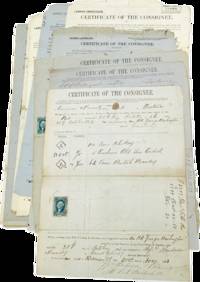
80033A group of 18 Landing Certificates containing the “Oath of the Master and Mate†and recording the type and amount of goods that arrived at the Port of Victoria from San Francisco in 1863. The documents contain signatures of various ship captains crew and consuls. Some contain official seals and tax stamps. Goods range from 100 cases of whiskey to cases of clothing refined sugar and opera glasses. <br /> <br /> Each of the documents is signed by Allen Francis 1815-1886 the U.S. Consul at Victoria Vancouver Island who was appointed to the post in 1862 by President Abraham Lincoln. He held the post throughout the American Civil War.<br /> <br /> At this time consuls were appointed to every major foreign port and played an important role for American ships in foreign ports. Before Francis appointment there had never been a consulate on the Pacific Coast of British North America. But once the war was underway British and U.S. relations deteriorated and President Lincoln needed a trusted representative to keep a vigilant eye on the British governor and Southern sympathizers on Vancouver Island and in British Columbia. “Francis’s activities far exceeded the normal responsibilities of such a political office. He maintained a network of spies in Victoria employed to keep him abreast of any pro-Confederate activity on either Vancouver Island or in British Columbia with its transitory population of American miners from the now-divided states.†James Robbins Jewell Thwarting Southern Schemes and British Bluster in the Pacific Northwest University of California Press 2015.<br /> <br /> The documents are generally legal size printed in black on lightweight white or light blue paper with handwritten information. Some general edgewear mild toning and creases from prior folds. unknown
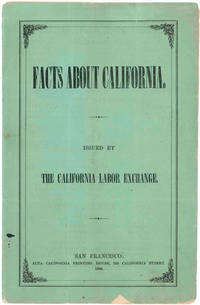
1869WRCAM48138San Francisco: Fred'k MacCrellish & Co. 1869. 12pp. printed in double columns plus 4pp. of advertisements and advertisements wrappers. Original printed green wrappers. Two vertical creases small chips in edges of wrappers. Stitching loosening. Very good. A scarce pamphlet inducing working men and women to come to California where jobs are promised to be plentiful and the living good. Two pages of text list scores of occupations the number of workers desired in each the pay and the slots already filled. Other tables provide statistics on the cost of living in California. Women are encouraged to come as are unskilled laborers and there is information on education resources in the state and the potential for farmers. The California Labor Exchange was established in April 1868 to provide "poor people residents of the State and immigrants with employment." They boast that in their first eight months of operation they found employment for upwards of 12000 people. The advertisements are for some of the most prominent and influential businesses in California at the time including the Pacific Mail Steamship Company Wells Fargo the ALTA CALIFORNIA NEWSPAPER and the Bank of California. Scarce; OCLC locates a total of eight copies. COWAN p.201. SABIN 10003. OCLC 19381623 228682803. Fred'k MacCrellish & Co. unknown books
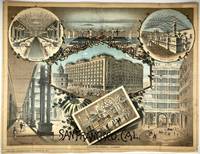
18861931San Francisco 1886. Good. Chromolithograph 19.75 x 25.5 inches. Backed on archival card. Light soiling and wear several closed tears resolved by backing. Slight losses at two corners. A handsome view of the Palace Hotel issued with the Christmas number of the San Francisco Newsletter in 1886. The lithograph depicts the building in a central vignette surrounded by scenes of the interior spaces. These include the lobby the courtyard corridor dining room the sixth floor conservatory and a view from the roof overlooking the Bay. The Palace Hotel was constructed in 1875 and boasted 775 rooms making it the largest hotel in the Western United States; it was likewise the tallest building in San Francisco for at least a decade. The Palace was gutted by fire in the 1906 earthquake but was rebuilt in 1909 and is still a landmark building today. We find one listing in OCLC for this item as a separate piece at Stanford University. unknown books
Abundant black and white illustrations and reproductions of photos. Features: A Bandit's Bride - Part I - Pancho Villa, the bandit-Revolutionist of Mexico, rescued the heroine of this exclusive narrative from a loveless marriage with a Mormon and married her himself - one of the most remarkable stories of love, battle and intrigue ever published; Unknown Animals of the African Wilds - J.A. Jordan describes recent finds such as the Okapi, Bongo, Giant Pig, Pygmy Elephant, the "dingonek", and the "Rhodesian Monster" - article with photos; Private McTosher Discovers London - the adventures of a Highland soldier visiting London for the first time; A Flying Man in South America - Part IV - John G. Barron took a monoplane to South America and performed flying shows for 2.5 years, often before people who had never before seen a plane; How We Salved the Vigilant - While some of the crew headed for safety aboard a Dutch liner, three remaining crewmembers managed to safely guide the Vigilant to port!; The Finding of the "Mollybaun" - the discovery of a big nugget in Coolgardie, Western Australia, leads to multiple murders; Strange Stories of the War - a selection of incidents entitled A Kite Balloon Adventure, The Lady of the Manor, Mixed Identities, The "Phantom Sniper", The Subaltern's Gun, and The Mysterious Message; On the Borders of Tibet - Part III - Reginald Farrar spent two years wandering - largely among wild lands and wilder people whose chief desire was to build the intruding foreigner up in a damp bonfire to smoulder to death - with photos; The Ring - a dramatic story of the old days in New Zealand, before white and Maori had settled down in friendship; Historic Crimes and Mysteries - The Vanished Boatswain, The Monster of Regendorf, Bavaria; Remittance Men - an account of sundry remittance men the author met during his sojourn in Africa; The Tragedy of Sanborn Harbour - wholesale murder at the cod-fishing station on remote Nagai Island, Alaska; Photo of 'two Indians squaws' casting ballots in California for the Presidential election; Photo of 'The Human Fly' scaling a tall building in Birmingham, Alabama; and more. pp. 4 [ads], [2], 194-284, 5-16 [ads]. Unmarked with light wear. A quality vintage copy of this wonderful issue. Book