8 986 résultats
191052181San Francisco & Stockton CA: Southern Pacific Tibbitts Photographer ca. 1910. One large silver gelatin photograph sized 16 x 20 in. mounted on black board sized 22 x 26 in. with printed title label mounted below the photograph preserved in original Arts & Crafts darkly stained wooden frame sized 27.5 x 31.5 in. some chipping rubbing scuffing & edgewear to frame still an excellent image with strong contrast. This fantastic large photograph probably hung in one of the Southern Pacific Railway stations as a promotional photo for the company’s attempt to change the “wild west†perception of California and Nevada and instead show the natural beauty and grandeur of the West. The vineyards near Stockton California are from the 19th century until today one of the most productive wine regions in the country and their prize-winning wines contribute to the international reputation of fine quality California Wines. Tibbitts 1863-1937 was a renowned professional San Francisco photographer who worked extensively for the Southern Pacific Railroad starting in 1892 photographing landscapes towns agriculture parks and other local scenes to promote the economic development and tourism trade of the Southern Pacific Railroad. In addition he was later one of the official photographers for the Panama-Pacific International Exposition and one of the founding members of the California Camera Club. Such large images as this one by Tibbits are quite scarce. Southern Pacific, Tibbitts Photographer, unknown
192062329Portland OR Spokane WA San Francisco CA & Seaside OR: Lyle E. Lewis Dance Orchestra ca. 1920-1944. Eight vols. 1st - 4to. 48 pp unpaginated. on thick black paper w/ 100’s of pieces of ephemera mounted and laid-in including 7 silver gelatin photographs sized from 5 x 7 in. up to 8 x 10 in. many different TLS and ALS most on stationery letterhead for assorted hotels KGW Radio and others many newspaper clippings tickets promotional brochures advertising cards dance tickets along with a spoof printed “Wanted†notice for Ted Mullen alias Sourdough Sullen with $ 500 million reward offered and large double-page advertising broadside on yellow-gold tinged thick paper stock at rear for gig in Astoria OR under the auspices of the Co. L 186th Infantry Oregon National Guard. Contemporary pebbled black boards punch-sewn at gutter margin chipping edgewear still VG- exemplar; 2nd - 4to. 92 pp unpaginated w/ majority of leaves on ruled paper including 18 leaves of mylar sleeves featuring the majority of the 23 silver gelatin photographs most sized 8 x 10 in. photographer’s imprints on versos remainder w/ clippings promotional announcements tickets broadsides ALS & TLS documents throughout along with a long radio program script. Contemporary 2-ring blue cloth binder rounded corners some edgewear rubbing still VG; 3rd-7th - 16mo. Five daily diaries Approx. 700 pp unpaginated. w/ approx. 4000 words manuscript annotations in ink & pencil throughout featuring some laid-in miniature photos receipts business cards including 1 photographic souvenir business card for Cole McElroy’s Dance Band and Cole McElroy’s Spanish Ballroom 1 tiny postage stamp photo of Lewis at his bungalow in Seaside all bound in cloth some wear still VG grouping; 8th - 12mo. Approx. 150 pp unpaginated. of ruled paper mostly typescript ink & pencil manuscript some ruling throughout annotations & checkmarks last 4th or so blank. Flexible black cloth 6-ring binder business card for Lewis as Commercial Agent for ACME Fast Freight taped in on front pastedown 3 blank routing order forms in red & black some scuffing edgewear still VG all from the library of Genevieve Martha Lewis Levin 1911-1994. This unusually well-preserved archive of a Roaring 20’s Jazz Orchestra musician and Band Leader in the Pacific Northwest reveals the exuberance and business success of this largely forgotten artist through his successful years before foundering during the Great Depression. Both scrapbooks open with clippings thank you and recommendation letters as well as dance broadsides and photographs during 1926 at the height of Lyle Lewis’s orchestra appreciation. Testimonials include B.J. Saad who owned the Garden Dancing Palace and stated “I have taken the Garden which is second to no other ballroom west of Chicago. That is why I have secured Lyle Lewis recognized as one of the best orchestra leaders on the Coast.†C.W. Craig of Lipman Wolfe & Co. department store extolls that Jazz music dance held at the Multnomah Hotel March 16 1926 that “I don’t think we have ever enjoyed better or more up to date dance music than that furnished by your splendid aggregation.†Broadsides and notices advertise the Lewis Jazz Orchestra playing the Grand Ball Room at the Masonic Temple Congress Hotel leading McElroy’s Oregonians at the McElroy’s Spanish Ballroom the Dessert Hotel Oasis near Spokane parties for Studebaker and more. One of the mounted letters includes a rather sad severance letter signed by Cole McElroy explaining the circumstances of Lyle Lewis’s leaving stating “I realise that you were a victim of circumstances. On account of the fact that you had a fine band organized. . . certain music masters of the theatre jobs saw fit to take your men away from you thereby breaking up your fine band and forcing me to make a deal for another organization.†McElroy 1888-1947 was known as “Pop†McElroy was a popular band leader who during the years before World War I and after played the Palm Gardens often and had great success in his McElroy Spanish Ballroom which opened in 1926 and then opened another Seattle McElroy Ballroom in 1928. Several TLS on letterheads include those for KXL Radio station KGW Radio Station and the KOIN Studio Director for The Portland News which played three nights a week on air for over six months. The many photographs capture the Lyle Lewis band joking around with their instruments on the road fully arrayed on stage in the Radio Station posing at various venues stages and even one as late as 1939 conducting the Lyle E. Lewis Dance Orchestra. The band included Cluet Mansfield formerly with Henry Halsted band William Webber on drums Eddie Scroggins & Frank Champion as sax players G. Berardinelli on Bass and also played dances at the Irvington Club Multnomah Athletic Club and for a while with the historic Congress Hotel in Portland which had been the City’s first reinforced concrete building erected during the Progressive Era and by 1924 expanded to 119 rooms with vibrant Jazz ballroom. The daily diaries for 1929 and 1930 show that Lewis regularly played at the Cotillion Hall now the Crystal Ballroom initially at $ 7.00 per night in 1929 and then steadily dropping to less than half by 1933. He writes about traveling for a gig in San Francisco with Mansfield in 1929 leaving Tuesday and arriving Wednesday Sept. 18 1929 driving 40 mph and getting 19 miles to the gallon with a drive made in 19 hours and 15 minutes. He played extensively at the Bungalow Club in Seaside OR which had opened originally June 19 1920 and for more than 25 years was the destination for the biggest names in the Big Band Jazz era including Lyle E. Lewis Cole McElroy Duke Ellington Bob Crosby Glenn Miller and tragically became connected with the death of Jimmie Lunceford who died from a heart attack just before playing his last set at the Bungalow after playing McElroy’s Ballroom in Portland 2 nights before. Lewis 1890-1948 was a popular Portland Oregon based jazz band & orchestra leader who managed to lie about his age and enlist at 15 in the Oregon National Guard Co. G 3rd Battalion served for three years and in May 1910 married Genevieve Franklin while working as salesman and musician before World War I Following the War he quickly became a successful band leader including successful stints with the Cole McElroy Spanish Ballroom Congress Hotel Multnomah Hotel Bungalow Garden Ballroom as well as the Coronado Hotel in California. As indicated by the daily diaries he maintained a fairly close relationship with his daughter Genevieve “Martha†but became largely estranged from his wife Genevieve living in separate rooming houses or hotels. Still in her position as a sales manager she managed to convince Meier & Frank to hire him as their house band for store functions and the restaurant while during the Great Depression he mostly worked for the US Forest Service mapping division while his show business largely disappeared. By 1943 he became the commercial agent for ACME Fast Freight where he worked as commercial agent until his death. This cataloguer could find no surviving recorded discography record for Lyle E. Lewis and his assorted incarnations although there are a few recordings for the Cole McElroy Band from 1926-1928 which most likely would have included him as band leader and musician. Lyle E. Lewis, Dance Orchestra, hardcover
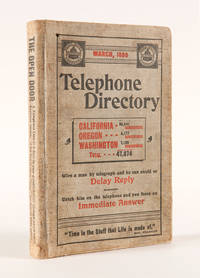
1899WRCAM56200San Francisco: Pacific States Telephone Companies 1899. 4vi2vii-viii4942pp. Original printed buckram boards. Small hole drilled through front and rear boards for hanging. Boards soiled and edge worn remains of adhesive to rear pastedown bookplate affixed to rear pastedown. Minor soiling and tanning to text small tear in upper part of pp. 493-94 affecting a few letters of text. Very good overall. Scarce telephone directory for California Oregon Washington and northern Idaho advertising listings for all 47874 subscribers often including addresses. The front pastedown provides instructions for how to use the telephone and make calls along with advice on telephone etiquette and how to contact non-subscribers. Although the telephone had been around for over twenty years at this point people apparently still benefited from the advice to "speak in a moderate tone and directly into the transmitter with the lips as close as possible to the mouthpiece." Likewise callers are advised to be clear about who they are and whom they are calling: "Much friction and annoyance will be avoided if this simple plan is carried out." <br> <br> After a few pages with information on long distance and line rates there is a "Supplemental List" for San Francisco dated April 1 1899 and printed on pink paper. Between pp.vi-vii of this supplement facing a page titled "Chinese Exchange" is a yellow leaf printed in Chinese on one side. The final leaf and rear pastedown have additional information on features available to subscribers and printed in black and red on the rear board is a map of the coverage area highlighting the "21000 miles of copper wire" running up and down the west coast. <br> <br> The directory begins with San Francisco listings organized alphabetically by subscriber and then covers the rest of California - Acampo to Zaca - alphabetically by city. Next are Oregon listings printed on pink paper and arranged alphabetically by city. Washington follows again arranged alphabetically by city; and then the final two pages include listings for sixteen towns in north Idaho. <br> <br> The invention of the telephone by Alexander Graham Bell in March 1876 created a new and swiftly-developing commercial market for rapid communication. Less than a year later the first newspaper report was delivered over the phone. The invention of the microphone in 1877 paired nicely with the new telephone technology and the Bell Telephone Company was born in July of that year. The first telephone directory in the U.S. was issued in New Haven Connecticut seven month later in February 1878 and the second directory in the U.S. was issued in San Francisco in June 1878. <br> <br> OCLC lists five copies of this March 1899 issue: Yale damaged Sacramento Public Library L.A. County Natural History Museum and the Nevada State Library. OCLC 55676511 19667877 29785821. Pacific States Telephone Companies hardcover books
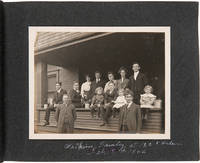
1906WRCAM55775Pasadena Los Angeles Long Beach and elsewhere described below 1906. 103 silver gelatin photographs from 1 1/4 x 1 to 4 3/4 x 5 inches mounted to album leaves. Oblong octavo album. Limp textured calf. Some wear and rubbing. One or two smudges to captions photographs in excellent condition overall. Very good. An engaging and remarkably well-preserved album recording over a year in the life of a large and jovial Church of the Brethren family from Pasadena. Most photos are captioned in white pencil often with location and date but rarely identifying the people photographed; some photos also include a date stamp including month and day. <br> <br> Although the identity of the skilled amateur photographer is not revealed the families featured appear to be part of one of the large migrations of the Brethren to Southern California. In search of cheap fertile land the Brethren typically migrated west in groups by which they could more easily hold on to their faith and lifestyle while at the same time winning converts by demonstrating their prosperous communities and godly lives. One of the families may be the Snyders as two photos of a house labeled "752 Hull St. Pasadena" matches the address of one J.S. Snyder in THE BRETHREN FAMILY ALMANAC for 1908. There is also a photo labeled "Watkins Family at 122 N. Hudson" and while that address is not found in the ALMANAC there is a T.J. Watkins listed with a post office box in Los Angeles. <br> <br> The album follows the family on an extensive tour of Southern California - from the mountains to the beach to the desert. The album begins with a number of photos of the extended family in various poses groupings and settings around a house in Pasadena. Some of the family group photos are repeated shots with only minor changes in composition. <br> <br> The tour begins with a Fourth of July picnic in Eaton Canyon in the foothills just above Pasadena; views of and from Mt. Wilson including a man riding a burro; the Pasadena Library; San Gabriel Mission; Hotel Green Pasadena; Pasadena High School at Euclid and Sierra Madre; and the train station at Lordsburg a Brethren settlement now La Verne. Interspersed are six photos of floats in the 1906 Tournament of Roses Parade. There are also views of the Salt Lake Railroad Station and other scenes of downtown Long Beach including the Bath House; a shack near Redlands; the Riverside Cactus Garden; a bridge over Devil's Gate Reservoir; the hotels Raymond and Maryland both in Pasadena; the Ocean Park Bath House on Christmas Day 1905; Port Los Angeles Railway Station; the First Brethren Church in Los Angeles and the Baptist Brethren Church on Hull Street in Pasadena. There are also several photos of the grand houses on Orange Grove Boulevard in Pasadena. <br> <br> An exceptional vernacular photograph album of Southern California. unknown books
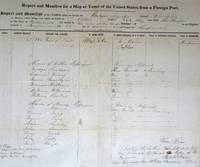
1850List2418Callao: Alsop and Company 1850. Folded ship manifest measuring 15 ¼ x 12 ½ inches. Fine condition with slight normal wear. A very scarce Gold Rush period shipping manifest for the Barque Equator captained by William Weir listing the passengers and cargo for a voyage to San Francisco in December of 1850 with notations showing the vessel’s arrival in San Francisco in May of 1851. Alsop & Co. was the work of Joseph Alsop the grandson of Continental Congress delegate John Alsop and his friend Henry Chauncey. Originally from Middletown Connecticut the pair established Alsop & Co. in New York City in 1824 and would eventually play a large role in the gold trade in California and trade extensively in South and Central America. Chauncey Alsop and others were among the partners in the trans-Panamanian railway that helped transform trans-continental trade in 1850. One of Alsop & Co.’s treasure boxes was aboard the S.S. Central America when it sank in 1857 carrying gold to the Eastern United States from Panama. <br /> <br /> The shipping manifest offered here lists the primary cargo as 195 tons of coal and also lists the names of fourteen passengers on the voyage. Imported coal - from Callao in this case - was essential to heat houses and run furnaces at factories including assay offices before the development of a local coal industry in California. We find only two instances of Gold Rush-era ship manifests - which were usually thrown away - surfacing in the trade or auction records this one and one other which sold for $3600 at PBA Galleries in 2014. Alsop and Company unknown
1950227511950. Japanese American California Japanese American family photograph archive 1950s documenting everyday life in Southern California during the decade following the forced wartime incarceration of Japanese Americans under Executive Order 9066. The photographs record domestic routines family celebrations and recreational outings among a Nisei and Sansei generation rebuilding community life after release from War Relocation Authority camps in 1945. Rather than depicting the confinement and dispossession that dominate the visual record of Japanese American wartime experience the images show families participating in the expanding consumer culture and leisure environment of postwar California. Smiling portraits backyard gatherings and excursions to regional landmarks illustrate how Japanese American families navigated the transition from wartime displacement to postwar stability asserting belonging within American suburban and urban life while rebuilding family networks disrupted by incarceration.<br /> <br /> Archive of approximately seventy two original silver gelatin photographs created during the 1950s depicting Japanese American family life across Los Angeles County and surrounding regions. Photographs range in size from approximately 3.75 x 4.5 inches to 8 x 10 inches. The images show informal family portraits children playing in residential yards and gatherings inside modest homes furnished with mid century décor including a television console and living room seating. Numerous photographs document recreational travel and tourism including visits to Griffith Park where family members ride the miniature railroad and trips to Disneyland shortly after the park's opening in 1955 with photographs taken along Main Street U.S.A. and before Sleeping Beauty's Castle. Additional photographs record outings to the San Gabriel and San Bernardino mountain ranges picnic scenes and group portraits taken during day trips to parks and scenic overlooks. Clothing and hairstyles visible throughout the photographs reflect the fashion and social aspirations of mid century Southern California including neatly pressed shirts dresses and casual leisure wear associated with postwar prosperity.<br /> <br /> These photographs document a formative period in Japanese American history when communities across California rebuilt social and economic life following the disruption of wartime incarceration. More than 120000 people of Japanese ancestry had been removed from the West Coast between 1942 and 1945 and confined in War Relocation Authority camps including thousands from the Los Angeles region. By the early 1950s many families were reestablishing homes businesses and neighborhood networks while participating in the broader culture of postwar suburban growth and leisure tourism. Minor handling wear to a few prints with mild corner curling; overall very good condition. This archive provides visual evidence of the social reintegration of Japanese American families within the everyday landscapes of Southern California during the early Cold War era. unknown
1st edition. Original peach colored printed wrappers, stitched, 88 pages. Singerman 1461. Cohen, prominent San Francisco lawyer, book collector, and leader of the Jewish community, was unjustly accused of embezzling funds which belonged to creditors of the firm of Adams & Co. , a banking house which had recently defaulted. The case involved transactions with the California Steam Navigation Company. In 1862 the case was dismissed and Cohen, who became chief counsel to the Central Pacific Railroad, was vindicated. His lawyer, Trenor W. Park, had moved from his native Vermont to California in 1852, where he was counsel to the Vigilance Committee and became involved with Fremont in the Mariposa Mine; Stanly was a North Carolina Congressman who had moved to San Francisco in the 1850's. II Harv. Law Cat. 644. Cowan 133. Greenwood 769. Rocq 8030. Cohen 13950. OCLC lists 16 copies worldwide. Wrappers and title page lightly foxed, Very Good Condition. (kh-5-61)
1835bn1889A Paris, chez Arthus Bertrand, libraire, rue Hautefeuille, n°23, Saint-Servan, imprimerie de J.-M. Lebien, rue des Bas-Sablons, Saint-Servan, chez D. Lemarchand, libraire Relié 1835 Un volume relié, in-8° demi-basane, reliure établie à la fin du XX° siècle, couverture en partie conservée, premier plat et quatrième plat, le dos n'a pas pu être sauvé semble-t-il, complet des deux planches présentent dans ce second volume : Vue de l'établissement russe de la Bodega, a la côte de la nouvelle Albion en 1828, Vue du port et de la vallèe de l'Anaroura dans l'ile de Waho. Faux-titre, gravure, titre, puis 438 pages, une feuille d'errata. Ouvrage rarissime, le CCFR ne référence que 3 exemplaires complets qui sont respectivement à Nantes, Bordeaux et Saint-Malo. D'autres exemplaires du volume 1 sont dans quelques bibliothèques. Un libraire américain prétend qu'il ne reste que 12 exemplaires complet dans le monde. Exemplaire relié (sauvé) par un amateur qui habitait le long de la Rance, à quelques encablures de Saint-Malo et donc de Saint-Servan ville où le livre a été publié ; quelques rousseurs, une mouillure en début d'ouvrage jusqu'à la page 60 environ, des rousseurs importantes en fin d'ouvrage dans la table des matières, sinon intérieur frais. Livraison a domicile (La Poste) ou en Mondial Relay sur simple demande.
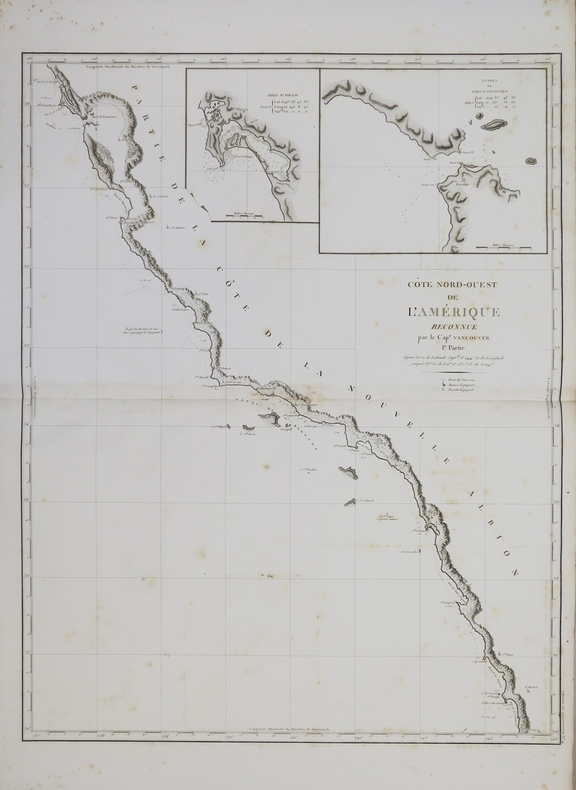
1820LBW-3716[1800-circa 1820]. 765 x 612 mm.
Iconic cover photo of Albert Einstein at blackboard proving the principle of Equivalence. 56 pages. Features: Exploring Prehistoric Georgia; Radio Facsimile (early fax machine development) - article with great photos; Building the World's Deepest-Water Bridge - connecting San Francisco and Oakland; Preserving rose bushes with paraffin for shipping; Nova Herculis recently discovered; Amazing growth in the packaging industry; Sundials and their construction - part IX - the principle and construction of the armillary sphere; The Oddest Thing About the Jews - Why Jews have some diseases more and others less than Gentiles - they often are first-class insurance risks; Stout "Scarab" auto photos and write-up; Photo of Einstein with Leo J. Scanlon; Tiny race cars - a developing sport; Astounding facts about American homes and sanitary conditions; Creative photo enlargement; Rapidly growing hybrid poplars; Frederick H. Ecker on progress in this age of science; Photo of harvesting American-grown rubber in California - Guayule; and more. Above-average external wear and soiling. Openings at each end of coverfold. Chip from lower corner of back cover. An uncommon Einstein collectible. Please note that large faint text appearing on image is not on magazine. Magazine
[6], 169 pages. Glossary. Profusely illustrated with excellent black and white photos. Photographic endpapers. Stated first edition. A thorough and practical exposition of the breaking out of the range raised colt. Chapters include: The Horsebreaker; The First Lesson; The Sack Hobble; Bad Habits Controlled; His First Shoeing; Basic Fundamentals; The Two Rein; The Mountain Raised Bronc; Ground Work; The Stake Rope. Publisher's faux leather brown cloth decorated in gilt. No dust jacket, presumably as issued. Somewhat above-average external wear. Binding intact. Prior owner's details atop copyright page. A worthy vintage copy of this exceptionall guide, written by a seasoned expert. Book
2012210662Paso Robles: Nazraeli Press 2012. Rilegato mezza tela sovracoperta half-cloth binding dust jacket. Ottimo Fine. <strong>Six by Six: Set 4 Volume 5</strong>. With a separate exhibition-quality <strong>original print</strong> numbered and signed by the Artist on 11 x 14 inch paper. 29 colour photographs / Con una <strong>stampa originale</strong> sciolta su carta pesante numerata e firmata da Doug Rickard Esemplare 74/100. Cm 355x275. 29 fotografie a colori. 4to cm 37x295. pp. 32. Ottimo Fine. Prima edizione di 100 esemplari numerati e firmati First edition of 100 numbered and signed copies. <em><strong>A New American Picture</strong> di Doug Rickard offre una prospettiva sorprendente e fresca sulla fotografia di strada americana. Mentre a prima vista l'opera appare rassicurante familiare e ben all'interno dei confini tradizionali del genere la sua metodologia è"; tutt'altro che convenzionale. Tutte le immagini sono prese da Google Street View;" per un periodo di due anni Rickard ha approfittato dell'archivio di immagini della piattaforma per "guidare" virtualmente per le strade sconosciute e trascurate d'America luoghi deserti che sono stati dimenticati economicamente devastati e abbandonati.</em> Nazraeli Press, hardcover
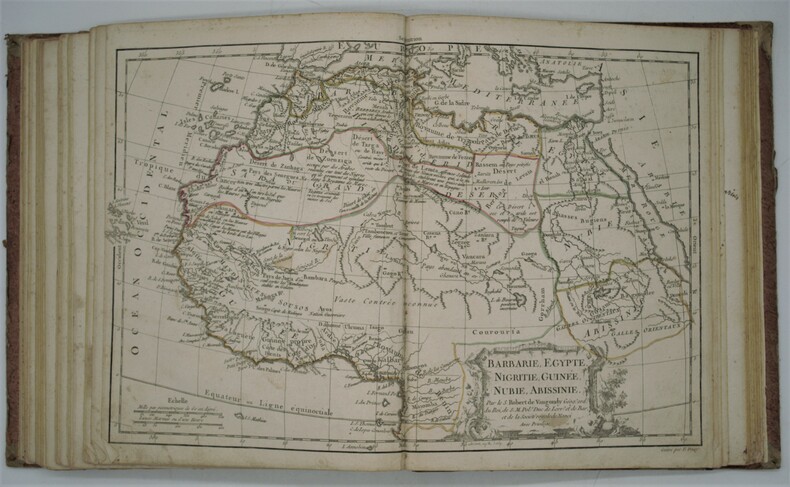
1790PHO-731Paris: Chez de S. Delamarche, Géographe, Rue du Foin St. Jacques, au Collège de Mtre. Gervais, 1790. in-4 (230x280) ,relié demi-daim époque , manque sur un coté [1-2, titre gravé] 3-6 [introduction gravée], [4, tableaux et listes gravés], 52 cartes doubles, gravées sur cuivre avec cartouches ornées, couleur du contour d'origine, gravées par E. Dussy, en fin d’ouvrage une grande carte dépliante de la Grèce par Barbié du bocage. rare atlas mis à jour par François Delamarche qui avait repris le fond de Robert de Vaugondy. Commentaires au crayon d’époque sur le dos de quelques cartes , quelques mouillures et taches, réparation au titre et à une carte.
1939List1206Mostly Los Angeles 1939. Oblong quarto containing 117 photographs. Sixty-two of the photographs involve motorcycles directly either action shots or posed shots in attire with many others showing scenery from motorcycle tours. Some photographs missing those present are in excellent condition with fine contrast very good condition overall. Very Good. A charming album documenting the lives of a couple from California and their love of motorcycle touring and racing in the late 1930s uncommon for the many pictures of women in motorcycle clothing that are included. Some of the photographs document travels some in the west such as the Boulder Dam Arizona Big Bear Lake etc. and some at a motorcycle meet in Marion Indiana. Several photos show a crashed U.S. Army bomber at Miner Field in Inglewood. Several show San Gabriel Canyon on Thanksgiving 1937 with one showing a portrait of a woman captioned “Drunk Again.†Another shows a national time trial race in San Diego. The photos seem to follow a tight-knit group of friends with nicknames such as “Little Marvin†and “The Mad Russian.†Overall a charming document of late 1930s motorcycle culture in Los Angeles. unknown
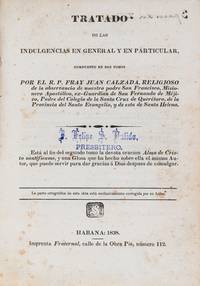
1838RF1306<p><b>Missionary Work Among the Indians in Alta California and the Early Explorers A Rare Cuban Imprint </b></p><p>2 volumes. 8vo. 12 245 1; 8 327 1 pages.Unmatched contemporary tree calf and 1/2 calf inked ownership stamps on title page and final leaf of Volume I.</p><p>A work on papal indulgences by a former Mexican missionary written at the convent of San Francisco de la Habana. Near the end of Volume II are several chapters devoted to missionary work among the Indians including a section titled "<i>De las misiones de la Nueva-California . . . Descripcion de la California"</i> pages 256-265 which gives a short history of missionaries in Alta California and the early explorers such as Vancouver and La Perouse. </p><p>Palau 40643.</p><p>#WorldCat: 6 copies: 3 in CA 1 CT 1 IL 1 PA<b><br /></b></p> Imprenta Fraternal
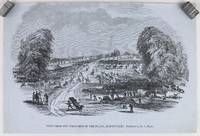
18502853N.p. possibly Marysville: R.A. Eddy 1850. Very good. Single folded quarto sheet on blue wove paper with a large engraved street scene on one page a later pencil drawing of a floral embellishment on an interior page with the remainder blank. Slightly trimmed with minor loss to sky section minor creasing and dust soiling a handful of short repaired closed edge tears. An unusually obscure Gold Rush-era pictorial letter sheet featuring a detailed scene of a crowded Marysville plaza before the city caught fire on August 30 1851. The work was produced by Marysville bookseller and stationer R.A. Eddy and depicts a busy scene in Marysville with horses wagons and people carrying bundles in the foreground and the buildings of the frontier town in the background. The buildings are identified from right to left as follows: Stage Yuba House Magnolia El Dorado Exchange Eddy Book the publisher Sites Jones Shafer St. Louis Hotel Bartlett. This scene was also issued under a slightly different title View from the North Side of the Plaza Marysville. Both titles appear to be very rare with one copy of the alternate title in OCLC at Yale and two others per Baird at the British Library and in a private collection; the only two copies of the present work we could locate reside in a scrapbook at the Fine Arts Museums of San Francisco and in the de Young Collection at the Society of California Pioneers.<br /> Baird 280a. Clifford 290. R.A. Eddy unknown
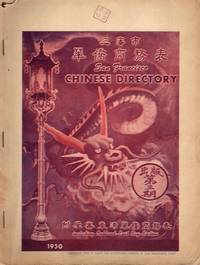
195012932San Francisco: Jimmy Lum Advertising Service 1950. 108pp. Original pictorial wrappers stapled with a length of string tied through a small punch hole at top left. Moderate toning edges corners and spine ends a bit scuffed. Internally clean. Good plus. A rare and highly informative Chinese American directory for San Francisco Oakland and the East Bay published in the summer of 1950 the Index is dated July 1950. The work presents commercial advertisements organized alphabetically from "Appliance" to "Venetian Blind" dealers interspersed with listings of Chinese businesses and residences organized by street. The ads range from short two or three line listings to elaborate illustrated quarter and half-page ads. Additionally pages 24 and 25 are comprised of a map of Chinatown and the main part of the directory is followed by separate sections for Oakland the East Bay section. The directory also includes occasional ads for itself touting the work as "the most effective form of business and professional advertising medium to reach the largest numbers of Chinese in the City and Bay Area throughout the year." The directory also includes more than one ad for the publisher Jimmy Lum's Advertising Service. OCLC reports copies of the 1950 edition at Stanford the Bancroft and Yale. Jimmy Lum Advertising Service unknown
188231379San Francisco: B. F. Alley 1882. xi 509 48pp. plus woodcut frontispiece and eleven other woodcut portraits. Later half calf and contemporary sheep gilt morocco spine label edges sprinkled brown. Ownership inscription on front endpaper recto scattered manuscript notations in pencil several on portraits. Final contents page tipped in.<br/> <br/>A rare history of Tuolumne County California covering a variety of topics.<br/> <br/>It recounts the foundation of its towns by miners arriving from the East in the summer of 1848 at the beginning of the California Gold Rush and contains a chronology of important events and a section of biographies for significant county figures. The volume also provides lurid accounts of various crimes committed including lynchings robberies and murders as well as of natural disasters and mining accidents. A significant portion of the book is dedicated to the county's mining history and its geology as well as its the promotion of its agricultural resources. Includes a portrait and brief biography of Samuel Clemens Mark Twain who spent time around the mines in California as a reporter during the Civil War and apparently stayed in Tuolumne County during the winter of 1864-65 where he wrote "The Celebrated Jumping Frog of Calaveras County." "One of the rarest of all California histories. with only a few copies in existence" - Norris.<br/> <br/>Adams Six-Guns 2248; California Local History 15345; Cowan II p. 646; Howes l71 "b"; Norris Catalogue 3968. B. F. Alley unknown books
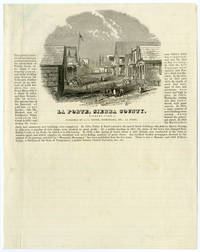
1858WRCAM44297La Porte Ca.: Published by J.C. Lester Bookseller etc. 1858. Pictorial letter sheet 9 3/4 x 7 3/4 inches on ruled white paper. Wood engraved illustration 3 3/4 x 5 inches. A slight bit of edge wear else fine. A scarce California pictorial letter sheet giving a view of the mining town of La Porte. The view shows the town's main street and several businesses are identified including Everts Wilson & Co. banking house; Lee & Ned's Pioneer Livery Stable; the Hotel de France; and the Union Hotel. A number of men women and children are shown in the street along with a miner carrying a pickaxe. The view of the town which carries an "AE" monogram is attributed to artist Alexander Edouart son of silhouettist Auguste Edouart. La Porte is located near the north bank of Rabbit Creek after which it had formerly been named on a ridge between the Yuba and Feather rivers at an altitude of 4500 feet. Mining began in La Porte around 1850 and continued throughout the decade. A printed description and history of the town surrounds the image the two occupying the upper half of the whole sheet. Baird locates a total of only four copies of this view of La Porte. BAIRD CALIFORNIA'S PICTORIAL LETTER SHEETS 129. CLIFFORD LETTER SHEET COLLECTION 136. Published by J.C. Lester, Bookseller, etc. unknown books
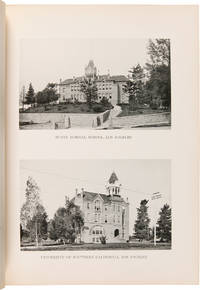
1900WRCAM55762San Francisco & Chicago: California Photogravure Co. 1900. Twelve parts. 24pp. plus 130 photogravures on 109 leaves. Folio. Original green cloth-backed textured burgundy leatherette wrappers foredges reinforced with same green cloth gilt title on front wrapper. Minor wear to upper or lower edges of a few volumes. Occasional light offsetting to margins images not affected. Bindings very good; plates near fine. A wonderful complete set of the "Art Work" series for Southern California with many striking views from Santa Barbara to San Diego and from the beaches to the Inland Empire. It is a marvelous record of Los Angeles and numerous small communities during an important period in the area's development. <br> <br> Like many sets in this series the majority of plates depict recently constructed civic buildings such as schools churches hospitals etc. as well as landscaped public spaces and expanding agricultural scenes. Although citrus farming was already a major industry and immigration was booming these scenes show Southern California "before": before the movie industry the freeways etc. Notable in this collection are lovely photogravure images of the State Normal School Los Angeles in 1919 it became the southern branch of the University of California; the College of Liberal Arts building "Old College" at the University of Southern California; the A.K. Smiley Public Library in Redlands; the Los Angeles County Court House the first building built as a courthouse in L.A.; and shots of several streets in and around downtown Los Angeles including tree-lined Sunset Boulevard in Hollywood - then still a dirt road. A brief text authored and signed in facsimile by Lou V. Chapin promotes Southern California as a land happily blending a modern and industrialized region with lush parks and gardens abundant agriculture and long beaches but it's the exquisite images that close the deal. <br> <br> This set has only appeared once at auction in recent years and is scarce in the trade. OCLC lists seventeen copies the majority held by California institutions. A fantastic visual record of California's "Southland" on the cusp of a boom in growth. OCLC 20876322 13326640. California Photogravure Co. hardcover books
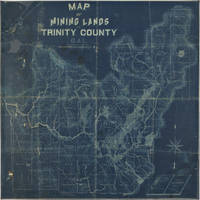
1890WRCAM54816Weaverville Trinity County Ca 1890. Blueprint map 33 1/2 x 33 inches. Old folds a handful of small areas of loss on the left side and along folds minor staining. Good plus. Framed under plexiglass. An exceedingly rare blueprint map enumerating the mining prospects in Trinity County California in the late 19th century. Located in northwestern California between the towns of Eurkea and Redding Trinity County is better known as a logging region rather than for its mining. This map is revealing of the high level of mining activity in the county at the time. It shows rivers creeks lakes mountain ranges and other topographical features and is laid out in a grid pattern with lines delineating wagon roads trails and county boundaries. The reference key at bottom indicates places on the map where one can find auriferous gravel land containing gold-bearing quartz cinnabar and coal. Mining-related locations specifically identified on the map include the Hawkins Bar Mine the Golden Chest Quartz Mines the La Grange Mine the largest hydraulic mine in the county Musser Hill Mines Bullychoop Quartz Mines and others. A California court ruling known as the Sawyer Decision of 1884 aimed to protect California public lands and waterways from mining debris caused by hydraulic blasting of entire mountains. Judge Lorenzo Sawyer's ruling is sometimes referred to as California's first environmental law and it forced miners to look at alternatives for unearthing valuable minerals. Dredging gravel beds became a commonplace practice and the current map shows the way to numerous locations where miners might try their luck at this newest method. <br> <br> The map was compiled by Henry L. Lowden U.S. Deputy Mineral Surveyor and civil engineer and John F. Johnson topographical engineer. It is perhaps a precursor to what Vogdes calls the first map of Trinity County also compiled by Lowden and Johnson and published in 1894 as OFFICIAL MAP OF TRINITY COUNTY CALIFORNIA. Mining in the Trinity County region began slowly in the 1850s but was most active between 1880 and the late 1950s when over two million ounces of gold were produced mostly from placer mines. <br> <br> Rare with no copies in OCLC. unknown books
196470400Milano: Grafica Uno 1964. Perfetto Mint. Acquatinta e rilievo metallico dalla cartella ''Struttura grafica'' con testi di Michel Tapié";" e Berto Morucchio Milano 1964 aquatint and print from metallic relief. cm 46x67 foglio 50x70. Perfetto Mint. Tiratura 70 XXX es. numerati. Upiglio Libri e Stampe Patani 1986 Patani Osvaldo Atelier Upiglio 1962 - 1985. Torino Allemandi 1986. Grafica Uno, unknown
1963c230727k057xbvkPersien - Indonesien - Hongkong, Oktober/November 1963. Insgesamt 81 meist großformatige Original-Fotografien (ca. 16 x 21,5 - 22 x 19 cm, einige kleinerformatig), alle rückseitig von Stiege eigenhändig oder maschinenschriftlich bezeichnet (Darstellung / Anlaß), teilweise datiert (Monat / Jahr) und signiert (''Foto: Stiege''); einige gedruckte Beilagen (Zeitungsartikel Stieges zur Reise). - Lose in Fotoecken montiert und mit handschriftlichen Zwischentiteln - in rotem wattierten Kunstleder-Fotoalbum der Zeit; 4to.(ca. 25 x 25 x 5 cm; ca. 2,5 kg.).
1967c230727k058xbvkSüdkorea - Thailand - Malaysia - Nepal - Afghanistan, März 1967. Insgesamt 92 fast ausschließlich großformatige Original-Fotografien (ca. 16 x 21,5 - 22 x 19 cm, wenige kleinerformatig), alle rückseitig von Stiege eigenhändig bezeichnet (Darstellung / Anlaß), datiert (Monat / Jahr) und signiert (''Foto: Stiege''); einige gedruckte Beilagen. - 'Südkorea' lose beiliegend, die folgenden Stationen/Länder chronologisch - lose in Fotoecken montiert und mit handschriftlichen Zwischentiteln - in grünem wattierten Kunstleder-Fotoalbum der Zeit; 4to.(ca. 25 x 25 x 5 cm; ca. 2,5 kg.).
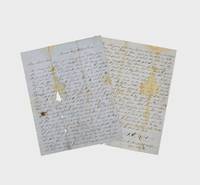
1851376875Nevada City CA 1851. 3pp. folded sheet blue paper. Usual folds some staining two sheets separated small hole affecting a few letters. 3pp. folded sheet blue paper. Writing in 1851 from Nevada City at the time California's most important mining town in the leading gold mining county this letter written by L. O. Hart to his aunt and uncle opens with the familiar prose on not having received letters and fearful that his previous letter not receive before turning to his life in the mines: "My health at present is none of the best but I live in hopes. I have not done any work of moment for 5 or 6 week past and for a week past I have been confined to my cabin though today I feel better by considerable. We have had no rain yet though for weeks it has been predicted that it will rain next week. If anything the weather is warmer than last August for we cannot keep our butter from melting put it where we will and fix it how we may." The letter continues by discussing costs of commodies: "California has much improved in living since I have been here. Now one can enjoy some of the luxuries of home and better preserve his health. Provisions are considerable cheaper than they were one year ago. Then it cost $1.50 cents per day to live upon pork beans and potatoes but now our cost daily is not far from 75 cts and we have flour potatoes butter pork tea coffee and chocolate and fresh beef once a day broought to us at 20 cts per lb. Potatoes sell from 8 to 12 dollars per bushel. Clothing is actually sold lower here than at home. Boots & shoes sell for 2 & 3 dollars per pair."<br /> <br /> The letter continues on Monday morning extolling the virtues of the weather and fauna of California though critical and rascist concerning the region's Native Americans: ". Now that I am somewhat used to I think this climate is unsurpassable. We have an atmosphere healthy clear dry & transparent. Persons can talk 1/2 a mile apart with ease & from the tops of hills we can see what appear to be snow capped mountains some 25 or 30 miles distant but which are in reality 3 & 4 times that distance from us. We never have either frost or dew & from April until December it is but seldom that a cloud can be seen but the whole summer long a clear sun hot dry & parching generally speaking all are very healthy. The only killing disease of the country being the Erysipelas which generally proves fatal . The wild game of the country consists of wolves black bears grizzly bears wildcats deer squirrels turtle doves wild ducks & geese elks & Indians of which the latter is by far the most despicable looking quadruped I ever saw. They are thieving revengful lazy specimens of humanity. At present they are all around us but are perfectly quiet."<br /> <br /> The letter closes with an update on his successes and failures in the mines: "I have made about two thousand dollars this summer and out of that have lost twelve hundred so that I have for my summers work about eight hundred doll. I should not have said work for it has been all speculating &c. It takes a litter experience to handle all of the ropes & I can plainly see where I missed it but 'live and learn' I've got to. So I take it all as a matter of course & try again. And I am going to keep trying until I get $10000 doll then I shall come home sure . Tell all the cousins I'll bring them home something shiney one of these days . unknown