[California]Biblio.com

8 985 résultats
188376195Los Angeles: Atwood & Ferguson 1883. Hardcover. Good. A rare survivor not in Quebedeaux this early directory was published just two years after the Los Angeles Times began publication and a year prior to the arrival of cultural crusader Charles F. Lummis following his famous tramp across the continent. It also precedes the mid-1880s boom that initiated the transformation of the small town of just over 11000 people or about 33000 countywide into a thriving metropolis. Numerous notable residents are listed including Horace Bell author of Reminiscences of a Ranger 1881 and Elizabeth A. Follansbee Southern California's first female physican. Aspects of the city's cultural diversity are evident as well either overtly with individuals identified as "colored" or in the case of the Asian American population by omission. Notably the directory includes an advertisement for F.H. Rogers' Solar Art Gallery at 624 San Fernando Street which features an original albumen photograph.<br /> <br /> Octavo: 352 p. with numerous advertisements. Original printed paper-covered boards over a brown cloth spine with gilt titles. Some occasional smudging with a tiny stain to the fore-edge. The ink stamp of Leon F. Moss a Los Angeles attorney and former judge of the Los Angeles Superior Court appears on the front pastedown and both the front and rear panel. Some general shelfwear and toning to the boards with a bit of scuffing and soiling to the front panel and loss of the gilt stamping along the spine. Housed in custom clamshell box with marbled paper lining and a gilt-stamped green morocco spine label. Scarce OCLC locates only five holdings: Azusa Pacific University Fresno County Free Library San Joaquin Valley Library Santa Rosa Junior College and the University of California Los Angeles. Atwood & Ferguson hardcover
1961ZB394410Blackwell Publishers 1961-1999. volumes 1-38; lacks volume 25. 1961-1999. partly bound library markings textually clean & tight PRICE IS FOR THE LOT. - If you are reading this this item is actually physically in our stock and ready for shipment once ordered. We are not bookjackers. Buyer is responsible for any additional duties taxes or fees required by recipient's country. Photos available upon request. Blackwell Publishers unknown
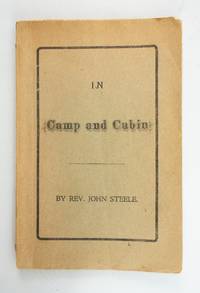
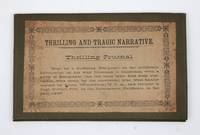
1901ST20777Lodi Wisconsin: J. Steele 1901. FIRST EDITION. 232 x 155 mm. 9 1/8 x 6". 81 pp. <br/> Original green faded to brown printed paper wrappers. Housed in a fine modern caramel-colored morocco clamshell box with gilt lettering on spine. Inside front wrapper with ink signature of M. R. Skinner; occasional pencil underlining in the text. Howes S-924; Graff 3964; Streeter 3027; Wagner-Camp 244 note. Top inch of spine chipped away a little fraying to edges first three leaves with overall browning minor corner creases but QUITE AN EXCELLENT COPY of a very fragile item clean and fresh internally with the insubstantial binding entirely intact against all odds.<br/> <br/> Based on the author's diaries written between September 1850 and July 1853 this work as the introduction tells us lays out events "just as they happened" being "ludicrous solemn serious tragic inexpressibly sad but always interesting." Kurutz calls the book a "detailed and important account of mining life" and notes that Steele "provided important information on mining techniques and laws while laboring in the Coloma District and on the Yuba and Feather rivers." This account includes some fascinating stories about the many hardships and dangers experienced by the author and his associates including nearly constant fatigue and hunger dreadful weather conditions and dicey encounters with desperados dishonest miners and disgruntled frontier men of commerce. John Steele 1832-1905 was only 18 years old when he left his home in Wisconsin for the gold fields of California. After three and a half years of adventuring he returned to the Midwest where he pursued a career in teaching. Steele also volunteered for the Union army during the Civil War and spent the last 30 years of his life as a minister in the Methodist Episcopal Church. The present work was privately printed by the author in a small number of copies and is as expected quite rare on the market now. Besides the present one RBH lists just two other copies sold since 1981 and as of this writing no other dealer seems to be offering one. Furthermore our copy is a remarkably well-preserved survival with its delicate wrappers and text in condition as attractive as one could hope to find. J. Steele unknown
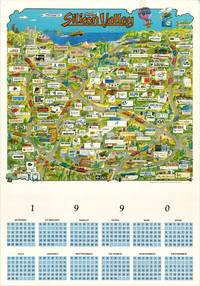
12909San Jose CA: Gist & Erdmann Inc. / Panoramic Map Productions 1989. Color printed map on sturdy glossy paper 39 x 26.75 inches. Small piece of old cellophane tape in the upper margin tiny puncture in image area near top-middle portion of the map lightly wrinkled previously rolled. Overall in very good condition. A rare and charming 1989 pictorial cartoon map and calendar of Silicon Valley illustrated by Pham Bach Phi one of at least three such works produced by the artist during the tech boom of the late 1980s and early 1990s. Copyrighted and published as a joint venture between Gist & Erdmann Inc. and Panoramic Map Productions the view employs an inviting almost pastoral aesthetic that deliberately downplays the burgeoning urban sprawl brought on by the explosion of the computer industry. By depicting major freeways as rustic roads and rendering corporate headquarters in a modest commercial style the artist fosters a small-town atmosphere in a region that was at the time undergoing a radical industrial transformation.<br /> <br /> The poster is populated with company logos and vignettes that celebrate a local economy rapidly centralizing around the technology sector. Notable names include Oracle IBM Apple and Hewlett-Packard practically a "Who's Who" of the era's digital vanguard. The bottom portion of the work is printed with a calendar for the upcoming year of 1990 underscoring the item's original purpose as a functional office product in itself. The year 1990 like most years since the '70s marked the dawn of the digital era in Silicon Valley highlighted by Tim Berners-Lee installation of the first World Wide Web server on a NeXT computer -- Steve Jobs' post-Apple venture -- at CERN. The year also saw the launch of LambdaMOO at Xerox PARC the inaugural Photoshop Invitational in Mountain View and key early developments in 3D graphics and networking that set the stage for the dot-com boom and current computer technologies. Gist & Erdmann, Inc. / Panoramic Map Productions unknown
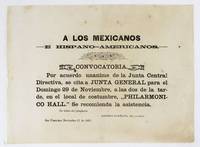
18635596San Francisco: La Voz de Mexico 1863. Very good. Broadside 7.75 x 10.75 inches. Central vertical fold minor creasing light tanning and scattered foxing. A very rare broadside calling a combined meeting of the juntas patrióticas of San Francisco community organizations of Californios and Mexican expatriates convened to support Benito Juarez against the French in the war with Napoleon III. The text announces a meeting at San Francisco’s Philharmonic Hall on Sunday November 29 1863 at 2p.m. Juntas patrióticas like this grew out of a tradition of Latino volunteer organizations in California originally started in 1825 to organize celebrations for Mexican independence. Established in many towns over the following years they continued to promote Mexican culture and traditions after California was annexed by the United States. This largely apolitical role changed however in the face of the twin threats of the Civil War and the French Intervention in Mexico:<br /> <br /> "Despite a time lag of four to eight weeks the newspapers carried stories about the French incursion into Mexico. California's Latinos learned about the landing of the Triple Alliance in Veracruz to collect debts contracted by previous administrations the agreement of Soledad in which President Benito Juarez pled national bankruptcy and asked for an extension the withdrawal of the English and Spanish forces on the strength of Juarez's promises and the menacing French presence continuing after the Spaniards and English had departed. In May 1862 events took a serious turn when the French broke off diplomatic relations with Mexico complaining of 'outrages of which the victims have been French subjects' living in Mexico.<br /> <br /> "But then on May 5 1862 there was a sudden flash of hope -- the outnumbered ragtag Mexican army repelled the seemingly inexorable French advance at Puebla sending the French troops victors of Crimea Sebastopol and the Italian campaign reeling back to Orizaba to lick their wounds. When the news reached California the Spanish-language headlines were enthusiastic: 'Hurrah for Mexico!! Hurrah for independence!!.' For California's Latinos U.S. citizens and immigrants alike this news was a bracing tonic. Suddenly they were part of a force to be reckoned with. Their peers at Puebla had taken a daring stance and had emerged victorious against the odds. Spontaneously Latino residents of the gold country town of Columbia in Tuolumne County celebrated 'our triumph against the French' by firing artillery salutes singing patriotic songs and toasting Mexico's success. Dozens of cities responded and dozens of juntas were formed in the next few months to raise funds to help repel the French invaders from Mexico" – Hayes-Bautista.<br /> <br /> Funneled through a Junta Central Directiva headquartered in San Francisco juntas across California and Nevada raised funds which were sent across the border to the Republican government usually in excess of $1000 every two weeks. This flyer was printed by one such junta known as the Sociedad Patriótica Mexicana and informs its members that the Junta Central Directiva has called a general meeting of all the local juntas on November 29 1863. This was a particularly dark time for the Mexican government in exile – the French had occupied Mexico City in June officially proclaimed the Second Mexican Empire in July and Maximilian was offered the throne at the start of October. This document was most likely printed by La Voz de Méjico a tri-weekly Spanish-language paper centered in San Francisco which became the unofficial organ of the regional juntas. A pencil note on the verso of this copy reads "Mass meeting called to contradict the lies of paper's enemies and newspaper reports this is what I referred to in my 2 notation." A rare piece of ephemera evidencing the active social and political role played by Mexican-American community organizations in the late-19th century. We locate only two recorded copies held by the Bancroft Library and UC Santa Barbara.<br /> David E. Hayes-Bautista et al. "Empowerment Expansion and Engagement: Las Juntas Patrióticas in California 1848-1869" in California History Vol. 85 No. 1 2007 pp.4-23. [La Voz de Mexico?] unknown
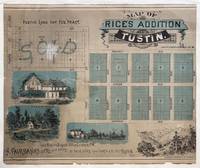
18875454Los Angeles: Los Angeles Lithographic Co 1887. Still very good. Illustrated lithograph map 20 x 24 inches. Trimmed along the left edge and borderline at the right. A few minor tears backed with rice paper. An exceedingly scarce lithograph promotional map for a late-19th-century subdivision in central Orange County California. The "Rice tract" depicted on this land development map was comprised of 194 lots for homes bounded by Prospect Avenue and Vineyard avenues and First Street and Preble Avenue in the town of Tustin east of Santa Ana. Until its proposed development the property was owned by James S. Rice 1846-1903 and his wife Cora who headed one of the pioneering families of Orange County. Rice moved his family there in 1877 and began ranching by working for his brother-in-law James Irvine who purchased the Rancho San Joaquin from José Antonio Andres Sepúlveda in 1864.<br /> <br /> In 1878 Rice purchased a small tract of land in the village of Tustin. He planted Valencia orange trees and Muscat grapes and a few years later he purchased an additional tract of fifty acres and expanded his agricultural operations. In the California real estate boom of 1886–87 he sold off all but twelve acres of his land for development at $4000 per acre allowing him to build a three-story home on his remaining property. His wife was a socialite who hosted numerous performing artists in their Tustin home including Helena Modjeska. The house was demolished in the late 1920s. The vignettes on the map show the future Tustin Hotel a three-story Victorian frame building with forty guest rooms that was built in 1888. Razed in 1914 it was designed by George Preble a Tustin builder who also designed Rice’s home. Scarce one copy is recorded in OCLC at U.C. Irvine which holds the Rice family papers. Los Angeles Lithographic Co unknown
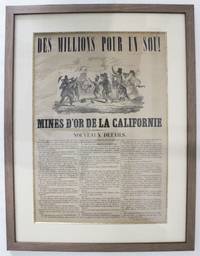
18495043Paris: Typ. Schneider Rue d'Erfurth 1 1849. Very good. Broadside approximately 18 x 13 inches. Matted and framed. A pair of short closed tears repaired at lower edge. Even toning and light creasing. Contemporary manuscript annotation under caption title. A wonderful illustrated faux news broadside published in Paris as gold fever coursed through Europe in 1849. The headline promises "nouveaux détails" of the gold mines in California but the text is in fact a humorous description and light-hearted admonishment of the multitudes thoughtlessly giving up their livelihoods for the hardscrabble life of a gold digger in the California wilderness. The first section runs through a litany of types who are abandoning their lives for adventure and advises them not to consider the difficulties of the journey:<br /> <br /> "En route pour les mines d'or de la Californie! Partez! Il n'est pas néccessaire que vous preniez de lourds baggages : une cassette et une bonne pioche vous suffriont. Ne vous laissez pas décourager par la peur d'une navigation de cinq mois. elle sera peut-être périlleuse. mais le résultat est si consolant : de l'or!. toujours de l'or!. Qu'importent la colique et les fièvres doublées d'un mal de mer brutal. de l'or!. toujours de l'or!. Qu'importe d'être noir ou jaune en mourant du moment qu'on se repose dans un linceul d'or pour l'éternité! Partez!"<br /> <br /> The remainder of the text somewhat sardonically describes life in California and warns prospective travelers not long for the comforts of home but rather to concentrate on their sought-after riches:<br /> <br /> "Par example ne vous attendez pas à jouir de toutes les douceurs de la vie. Vous n'y trouverez ni biftecks au beurre d'anchois ni dinde truffées; car les aliments y sont rares. Mais les racines y sont en grande abondance. Vous vivrez un peu à la manière des anachorètes pour un temps. seulement vous déterrerez de l'or. ce qu'ils ne faisaient pas que l'on sache."<br /> <br /> The illustration which occupies approximately the top third of the broadside depicts men and women from all walks of life carrying pickaxes on their shoulders and racing for a ship about to depart. The image carries the printed signature of "B. Netter;" a contemporary manuscript note under the caption identifies the publication date as February 17 1849. The Bibliothèque Nationale de France estimates that as many as 40000 French men and women made their way to California between 1848 and 1856. The present broadside is an excellent document of California gold fever in France and the pervasive interest in gold rush news in Europe during the mid-19th century. Rare we locate just four copies at Berkeley UCSD California Historical Society and the BNF. Typ. Schneider, Rue d'Erfurth, 1 unknown
1915366779West Hoboken NJ: Privately published by Albert A. Bieber . C. Reining Printer 1915. First separate edition. One of 65 signed copies. Printed on pink paper folding into publisher's pink wrappers the rear wrapper signed by Bieber. Unfolds to 13-1/4x8-1/4 inches. Stitched into publisher's green cloth with printed label on the upper cover. First separate edition. One of 65 signed copies. Printed on pink paper folding into publisher's pink wrappers the rear wrapper signed by Bieber. Unfolds to 13-1/4x8-1/4 inches. Among the treasures at the Bancroft Library is the original diary of Patrick Breen one of few survivors of the infamous Donner Party the group of California pioneers trapped in the Sierra Nevada mountains in the winter of 1846-47 who resorted to cannibalism to survive. Of the 87 people who entered the Wasatch Mountains only 48 survived. <br /> <br /> Much of the present day knowledge of the Donner Party is known from the Breen diary which was originally recovered by rescuer George McKinstry Jr. The news of the Party was an instant sensation and evidently seeking to capitalize on the notoriety McKinstry published extracts from the diary in several newspapers. In 1871 the McKinstry gave the diary to Hubert H. Bancroft. <br /> <br /> The present item rarely found in its original wrappers and binding was published by bookseller Albert A. Bieber and stated as the first separate edition of any party of the diary. It comprises chilling extracts from Nov. 20 1846 to March 1 1847. Privately published by Albert A. Bieber ... C. Reining, Printer unknown
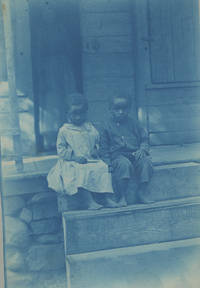
1880List1314Northern California 1880. 4to one album in burgundy cloth the other oblong brown pebbled cloth. Seventy-one sepia-toned and cyanotype photographs most measuring 6 ½ x 4 ½ inches. Near fine with some light wear to albums photographs very good or better with very good contrast some showing a hint of fading. A very early pair of vernacular photograph albums centering on the experiences of a wealthy family in San Francisco Monterey and the surrounding areas in the late 1880s. The bulk of the images show the family and their unidentified circle in domestic scenes with the vernacular architecture and landscapes of the Bay Area on full display. Other images show landmarks including Golden Gate Park the Francis Scott Key monument various views of the first Hotel del Monte in Monterey which would burn in 1887 dating the photographs to the period prior to the fire. The album also includes photographs of African American families. <br /> <br /> The image quality is generally quite strong and the photographer was either a professional assembling the album which includes many portraits of family and presumed friends for themselves or the work of a highly skilled amateur. The Initials on the front pastedown are “M.J.R.†though this could be a later owner. The albums were from the estate of the muralist Clara Fargo Thomas who was a resident of New York and could possibly have been from one of her family members though we are unable to glean much detail from the contents. The few annotations offer little clues one just reading “5/11/89 - Golden Gate Park†and another identifying a house as 509 Webster St. in San Francisco though the typical Victorian architecture and sloped street of the house suggest it could have just been a photograph of San Francisco’s unique architecture. <br /> <br /> The photographs of the people give insight into the lives of the new wealthy class of San Francisco residents of the late 19th century with others interestingly showing rural scenes and people. The photographer also had an eye for the flora of the region which is displayed throughout. It is unclear what the relationship of the African-American subjects was to the photographer and why they appear in the album. Overall a compelling group of images and the earliest example of vernacular photograph albums of California images we can find in the trade. unknown
78628An advertising poster for the Mount Lowe Railway Southern California's iconic funicular which closed permanently in 1938. The railway opened on July 4 1893 and consisted of nearly seven miles of track starting in Altadena California to Mount Echo where a 70-room Victorian hotel the Echo Mountain House once stood. The hotel and subsequent replacements were destroyed by natural disasters and in 1938 a flood washed most everything off the mountainside.<br /> <br /> This poster features a hand-colored photographic image and is mounted on chipboard. It measures approximately 18" x 39 1/2" and was likely hanging at a railway station. It appears to be circa 1925 as the Tavern's name changed that year from Ye Alpine Tavern to Mount Lowe Tavern. The Tavern burned down in 1936 and was never rebuilt. There is a light tide mark along the lower edge of the panel with shallow chipping and loss to the corners not affecting the printed area.<br /> <br /> This is a rare survivor with no known holdings in special collections or private hands. It was acquired from a longtime collector of Mount Lowe material who prized it in his personal collection for more than 30 years. unknown
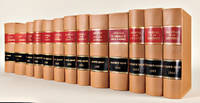
1864WRCAM17621San Jose i.e. New York session 1 New York session 2 San Francisco session 4 & Sacramento sessions 5-15 1864. Thirty-nine volumes. Various bindings of contemporary sheep and later cloth red and black leather labels. Condition ranges from rather rough to very fine many with contemporary and later ownership inscriptions including those of Joseph W. Walkup and the Placer HERALD. Second volume of appendix for thirteenth session has the titlepage in facsimile. A good run of these foundation California legal works including the following: <br> <br> 1st Session Journal of Legislature 1850; 2nd Session Journal of Legislature 1851; 4th Session Journal of Assembly 1853; 5th Session Journal of Assembly 1854; 5th Session Journal of Senate 1854; 6th Session Appendix to Assembly Journal 1855; 6th Session Journal of Senate 1855; 7th Session Journal of Assembly 1856; 7th Session Appendix to Assembly Journal 1856; 7th Session Journal of Senate 1856; 7th Session Appendix to Senate Journal 1856; 8th Session Journal of Assembly 1857; 8th Session Appendix to Assembly Journal 1857; 8th Session Journal of Senate 1857; 8th Session Appendix to Senate Journal 1857; 9th Session Journal of Assembly 1858; 9th Session Journal of Senate 1858; 9th Session Appendix to Senate Journal 1858; 10th Session Journal of Assembly 1859; 10th Session Appendix to Assembly Journal 1859; 10th Session Journal of Senate 1859; 11th Session Journal of Assembly 1860; 11th Session Journal of Senate 1860; 11th Session Appendix to Senate Journal 1860; 12th Session Journal of Assembly 1861; 12th Session Appendix to Assembly Journal 1861; 12th Session Journal of Senate 1861; 12th Session Appendix to Senate Journal 1861; 13th Session Journal of Assembly 1862; 13th Session Journal of Senate 1862; 13th Session two-volume appendix to Journals of Senate and Assembly 1862; 14th Session Journal of Assembly 1863; 14th Session Journal of Senate 1863; 14th Session single- volume appendix to Journals of Senate and Assembly 1863; 15th Session Journal of Assembly 1864; 15th Session Journal of Senate 1864; 15th Session single-volume appendix to Journals of Senate and Assembly 1864. <br> <br> Many of these volumes are quite hard to come by. An almost complete run such as this would be well nigh impossible to assemble. GREENWOOD 167 ref. WAGNER CALIFORNIA IMPRINTS 148. hardcover books
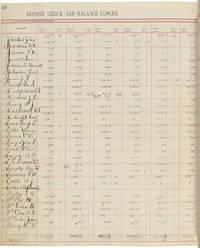
1890WRCAM55054Elsinore Ca 1890. Eighty numbered sections of six pages each comprised of leaves with folding flaps interleaved with narrower leaves totaling 480pp. Folio ledger. Half tan morocco and calf boards spine gilt with raised bands. Somewhat rubbed and worn corners bumped some staining to boards. Inner hinges reinforced. Occasional ink spills throughout fingerprints and occasional toning to lower corners of most pages no loss of text. Very good. Ink blotter with the name of "S.A. Stewart / Agent/Elsinore / Cal." laid in. This is an early ledger from the first bank established in Elsinore California and one of the first banks in southern California. The Exchange Bank of Elsinore was founded in 1887 by Franklin H. Heald one of the three investors who established the town of Elsinore. The city was officially incorporated the following year as the seventy-third city in California originally Elsinore was in San Diego County but the city became part of Riverside County upon its creation in 1893. The Bank of Elsinore was founded soon after and in 1890 the two banks merged to become the Consolidated Bank of Elsinore making this possibly the last ledger of the original Exchange Bank. <br> <br> This ledger tracks the funds of some of the more prominent southern California businesses and individuals of the time including Machado & Co. owned by descendents of José Agustin Machado who held Mexican land grants throughout Alta California including the Ranchos of La Ballona Santa Laguna and Santa Rosa. Also featured in the ledger is Horace McPhee publisher of the SANTA PAULA CHRONICLE W.G. McVicar owner of one of the early clay companies in southern California S.A. Stewart the agent named on the blotter mentioned above and later president of the Consolidated Bank of Elsinore several businesses and churches the local Masonic Lodge the Santa Rosa Cattle Company the Ladies Aid Society the TRANSCRIPT newspaper and the aforementioned Bank of Elsinore. Among the most significant customers of the bank was the Equality Colony part of the Southern California Colony Association founded by John W. North and others to cultivate grapes and semi-tropical fruits in the region which subsequently kicked off a new "gold rush" as horticulturalists and investors flocked to the area to be part of the new and rapidly growing citrus industry. <br> <br> This extensive banking ledger is a vital financial record of economic agricultural and population growth in southern California in the late 19th century. hardcover books
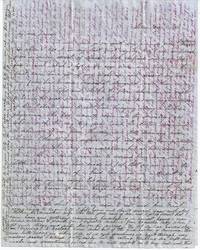
1850020857Portland OR and San Francisco: H. K. Hines and J. D. Hammond 1850 and 1899. First Edition. Letter. The letter in Near Fine condition with normal folds from mailing; the writing in red ink a little difficult to read but legible. The book is Very Good with some edgewear. A closely-written 4-page letter on one sheet of paper 15-1/2" x 9-7/8" folded in half and written on all 4 pages of neat script in black ink with another 2 pages of content overwritten vertically in red ink. Written by the wife of the Rev. Francis S. Hoyt a Methodist minister previously of the New Jersey Conference and first president of Willamette University in Salem Oregon to her parents in Cincinnati Ohio. Writing from Salem on 10 December 1850 Mrs. Hoyt describes their steamer trip from the Isthmus of Panama north along the Pacific Coast with stops at Acapulco Mexico and San Diego Monterey and San Francisco California and on to their new home. She notes that the steamer she was on was the first to "bear the news of the admission of California as a State" to the people of San Francisco. A sign was draped from the side of the ship announcing the news as it sailed along the bay front firing a 100-gun salute from its cannon the noise upsetting Mrs. Hoyt. She vividly describes the city with its summer dust and winter mud its rich gambling houses and houses of ill repute and the many miners down from the hills to "lose all they have earned and are obliged to go back to the mines again." She describes the gambling houses: "the rooms are fitted up beautifully with large mirrors and paintings and every thing to look pretty and then an orchestra of fine music that plays all the time. Frank looked into one for a little time and said he never saw such piles of money as was there." She did not note if the good reverend checked out the brothels. On one page of the letter she has drawn a small map showing their route from the Pacific to Portland and on to Salem. Her husband's life as an educator in Salem is reported in the book that comes with the letter beginning on page 431 which mentions that the steamer reached Oregon in late October 1850 "landing at Portland then a rustic hamlet of some twenty or thirty habitations and a few places of business." The book is INSCRIBED by the author on the front endpaper "To Rowland Abram Waltz/Very Truly Yours/H. K. Hines/Portland OR/June 21st 1901." In addition it is inscribed "Dr. F. S. Hoyt/with compliments of/Mr. & Mrs. Sam Gill/Portland Oregon/June 26-/1911." A fascinating letter with first-hand glimpses of life in early San Francisco and Oregon. <br/><br/> H. K. Hines and J. D. Hammond unknown
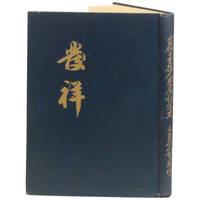
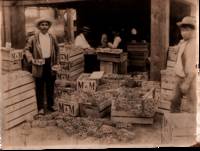
1922362523San Pedro CA: Nanka Mie Kenjinkai Southern California Mie Prefectural Society 1922. First Edition. Hardcover. Near fine. A very scarce Japanese-American history and Who's Who printed in Los Angeles in the Taisho era.<br /> <br /> Many Japanese immigrants to the US participated in organizations centered around their family's native prefecture. This book was published by the Mie Prefectural Association an organization of Japanese immigrants from the central southern coast of Japan. Not surprisingly given their coastal origins a chapter of this book is devoted to fishing. Immigrants from Mie prefecture were also very active in agriculture particularly growing nursery plants and cut flowers. The book includes a fold-out panoramic halftone of the Japanese produce market in Los Angeles.<br /> <br /> About two-thirds of the book is devoted to biographies of residents and their families; more so than other similar books the accompanying photographs often include entire families and not just the male head of household.<br /> <br /> Not in OCLC which records only modern facsimiles or A Buried Past or any other bibliography.<br /> <br /> 56 184 pages. First edition first printing. A near fine copy with minor wear to the publisher's cloth. Errata slip tipped to the rear free endpaper. Nanka Mie Kenjinkai [Southern California Mie Prefectural Society] hardcover
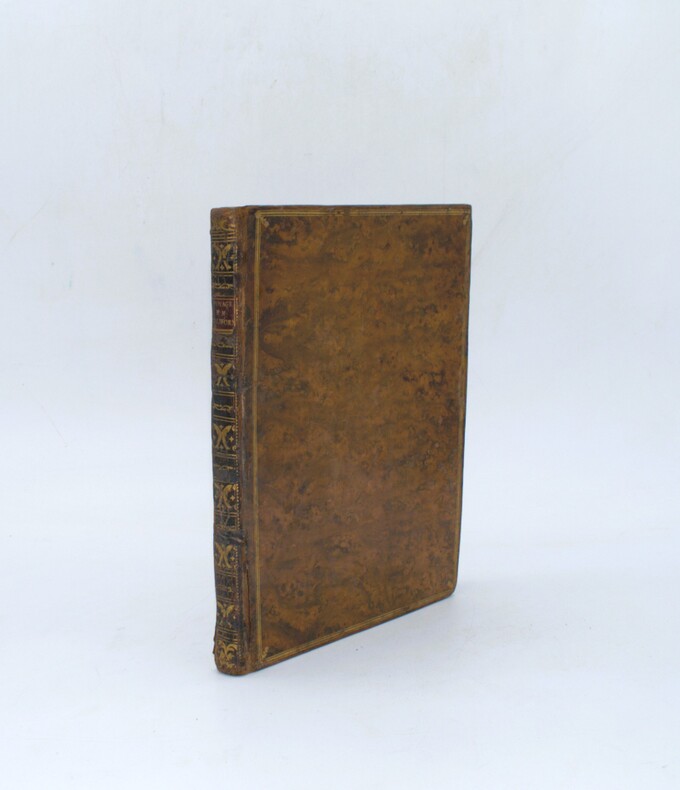
1772PHO-2432Paris, Charles-Antoine Jombert, 1772. In-4 (25,5x20cm), 2ff.-170 pp.-1f., Veau marbré époque, dos lisse orné avec pièce de titre en maroquin rouge, triples filets aux plats avec fleurs en écoinçons, tranches marbrées bleues. Dos frotté, début de fentes, petit trou de ver au dernier plat, petit travail de ver en marge, mouillure par intermittence. Complet avec 1 grand plan, 1 tableau dépliant et 3 planches hors texte.
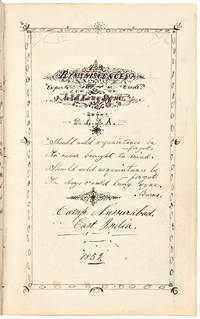
1860WRCAM39351Camp Nusseerabad India. 1860. 121pp. of manuscript text about 15500 total words. Original three-quarter calf and marbled boards. Boards edgeworn and lightly rubbed. Internally quite clean neat and legible. Very good. An interesting unpublished manuscript this is a novel in the form of an autobiography purportedly written by an American-born soldier in the British Army stationed in India in the late 1850s and early 1860s. The author describes his youth and early adulthood culminating with an account of his adventures hunting grizzlies in Gold Rush-era California. The chapter on Grizzly hunting in California called "Westward Ho" is copied with a few small adaptations from an article that appeared in the November 1857 issue of HARPER'S NEW MONTHLY MAGAZINE called "The Grizzly Bear of California." The remainder of the text develops several themes over the course of the work including the author's strained relationship with his wealthy father his youthful disillusionment with a career as a lawyer his friendship with a charming rogue named "Twadle" and his unsuccessful pursuit of love. The work also gently lampoons the character of the idle rich. It is unknown whether these other portions of the manuscript are also adapted from other published works or whether they are the product of the author's own imagination. Either way this manuscript is a very interesting example of mid-19th- century imaginative fiction and literary adaptation and worthy of further study. <br> <br> According to prefatory material this text was written in 1859-60 by Douglas D. Lindsay who identifies himself as a member of Company 7 of Her Majesty's 83rd Regiment stationed in East India at "Camp Nusseerabad." On a preliminary page he writes: <br> <br> "These 'Reminiscences of Auld Lang Syne' were written and presented by the author to his friend and gossip Thomas Smith of Her Majesty's 83rd Regiment and who in times to come as he glances over these pages will recall to mind the writer and 'wish him well wherever fate may have led him'; and he in turn will often think of his quondam friend while far at sea or in the deep piney woods of his native land." <br> <br> In several instances in the text Lindsay disrupts the narrative to offer asides to Smith providing a sort of post-modern authorial commentary on the proceedings. In a letter at the end of the text dated July 23 1860 Lindsay promises Smith that he will write a second volume "in which I propose giving you a few more passages from my experience in America - North - West and South intermixt with some jottings about the sea slavers smugglers etc. etc." It is not known whether "Lindsay" ever wrote this second volume. <br> <br> In the prefatory chapter Lindsay gives a sketch of his early life claiming to have been born "of a very ancient family who are said to be descended in right line from the Prodigal Son." He writes that he did not have a good relationship with his father and most of the assistance in his life was given to him by his deceased mother's brother. Lindsay says he eventually went to "the law school of old Y." later revealed to be Yale from which he graduated with a lofty idea of the law and jurisprudence. These beliefs were quickly deflated when he moved to the unnamed state's capitol city and set to work as a lawyer. Finding himself quickly in debt and unhappy he quit the law and moved back home. The next chapter in the book is entitled "A Screw Loose" and begins with Lindsay arguing with his father and being kicked out of the house. He departs leaving behind him most of his expensive wardrobe and ventures out in search of a friend named Twadle: <br> <br> "A young literary gentleman who was continually occupying the handsomest apartments he could find which he invariably vacated after a month of luxury. He was of a sanguine temperament and I will do him the justice to say that he always intended at the time of taking his rooms to pay for them. But so many extraordinary and unforeseen circumstances intervened between the day of his induction and pay-day that when that period arrived he regularly found himself in a state of unprecedented pecuniary depletion." <br> <br> Twadle was living in New York at the time and he and Lindsay decide to have a meal at Delmonico's. Of course they do not have enough money to pay the bill but Lindsay is rescued by his ever-helpful uncle who just happened to be dining there that evening. His uncle then takes Lindsay to his home welcomes him as a part of the family and gives him a job in his engineering firm. In the next chapter titled "Love Struck by Lightening" Lindsay describes his landlady's attempts to introduce him to eligible young women and his courtship with Sophia Walter daughter of a former governor. The romance fails when Lindsay discovers that his love has false teeth which horrifies him. <br> <br> The penultimate chapter comprising forty- one pages of the manuscript entitled "Westward Ho" is set in California during the Gold Rush era and is largely copied or adapted from a HARPER'S article of November 1857 called "The Grizzly Bear of California." Large portions of the manuscript are copied verbatim from the published article while in other places Lindsay makes adaptations or particularizes the story to himself. For example he mentions a "Hindoo Bear" in one passage and changes the name of the Grizzly hunter from "Colin Preston" in the published article to "Nathan Walker" in his manuscript. He also intersperses original passages which add to the story among the copied text. <br> <br> The section begins with Lindsay and a friend leaving Manhattan aboard a steamer bound for Chagres and then crossing the Isthmus of Panama. Lindsay then goes up the coast to Acapulco where he "secured passage in a crazy old polacca rigged schooner which was bound direct to San Francisco." The schooner is wrecked off the California coast with Lindsay as the only survivor. Next comes a long discussion of the California Grizzly and the "coastal range" in which it dwells followed by a recounting of Lindsay's providential escape from the shipwreck. He is rescued by a bear hunter called "Nathan Walker" "Colin Preston" in the original HARPER'S story a native of Arkansas who is described at great length. The rest of the chapter is filled with tales of Walker's bear- hunting exploits discussions of the nature of the Grizzly and the recollection of bear hunts in which the author participated with Walker often at great risk to his own life. <br> <br> In the final chapter comprising twelve pages and called "The Man in the Drab Coat" Lindsay tells a story of meeting an old Yale classmate of his in the Russian River gold diggings. His friend Robert had been quite successful in the mines saving some $5000 but was gravely ill and soon died. Lindsay promises him that he will collect all his money and deliver it to Robert's mother in the East. On his way home Lindsay stops in New Orleans and loses all of his own money in the gambling halls and leaves the city saddled with debt. Back in Troy New York he considers drawing on his friend Robert's money using it as a gambling stake to win back the money he lost in New Orleans. Late one night cold and seemingly hallucinating he is visited by a devilish figure "the man in the drab coat" who so frightens Lindsay that he resolves to give all Robert's money to his family as he had promised. <br> <br> An interesting work of adaptive and imaginative fiction meriting further research. hardcover books
1890List2833Shasta County and Siskiyou County 1890. Fifteen photographs approximately 4 ½ x 7 ½ inches. Each mounted on heavy cardboard backing approximately 5 ½ x 8 ½ inches which is mounted on heavy cardboard of approximately 8 x 10 ½ inches. Unknown if photographs are stamped verso due to mounting. Some with recent captions on the largest mount; some captions likely incorrect see description. Fine contrast overall fine condition. Raper James Waters 1856–1937 was a professional photographer from Sacramento California. He was first active as a photographer in Gold Hill Nevada in the 1880s. Following this he returned to California and had studios in Berkeley and San Francisco between the late 1880s and mid-1920s. Offered here is a collection of fifteen of Waters’ photographs from around Mount Shasta likely from the late 1880s or 1890s.<br /> <br /> The photographs are mainly from places in Siskiyou County where Mount Shasta is located including shots of the towns of Sisson now Mount Shasta and Dunsmuir Sisson and Dunsmuir are on the Siskiyou Trail an ancient Native American footpath running from the San Francisco area to Portland Oregon. The Central Pacific Railroad Company completed a train line along the Siskiyou Trail in 1887; one shot from an unknown location shows railroad tracks rounding a curve among felled trees. Just outside of Dunsmuir is the Shasta Springs resort mislabeled here as Shasta Bottling Works famous for its springwater – the fountains of water in the photograph are from pressurized pipes coming from the springs.<br /> <br /> Other captioned photographs show Castle Crags hikers summiting Mount Shasta Mossbrae Falls and Castle Lake mislabeled as Crystal Lake. Photographs also show campers with their tent small houses a canoe on a lake and snowy winter scenes. Overall a striking set of photographs. unknown
1883WRCAM51913Oakland: Paolo Sioli 1883. 8272pp. plus forty-nine plates including illustrated titlepage fourteen of them affixed to full-sheet sheets the rest printed on the full-sheet. Quarto. Original half pebbled leather and cloth boards stamped in gilt and blind neatly recased spine gilt edges marbled. Spine leather rubbed and faded. Two ownership inscription on front flyleaf recto. Occasional small stains and dust soiling but generally clean internally. Very good. The first history of this California county which contains the site of Sutter's Mill where James Marshall discovered gold in 1848 sparking the California Gold Rush. The text includes a long history of the county from the Spanish period through the Mexican- American War and the discovery of gold. The mining industry is thoroughly treated as are internal improvements immigration town histories criminal activities Indian troubles secret societies and much more. The text also contains biographies of prominent citizens many of whom are featured in the accompanying plates as are several prominent homes and farms. Little is known of publisher and compiler Paolo Sioli who does not appear to have produced any other books. This work is scarce and is patterned on the better known California county histories published by Thompson & West and others. Not in Cowan. An important visual and historical record of this county. HOWES E87 "b." ROCQ 1754. Paolo Sioli hardcover books
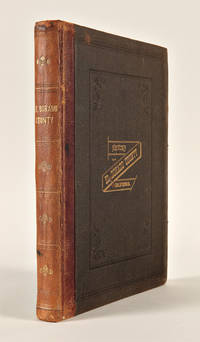
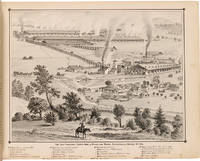
1880WRCAM55696Oakland: Thompson & West 1880. 234pp. including colored "Map of California Nevada Utah and Arizona" plus eighty-three full-page or double-page lithographs the first included as part of the pagination. Oblong quarto. Original half sheep and green cloth stamped in blind and gilt spine gilt. Hinges reinforced corners neatly repaired front and rear end leaves with some neat tissue repairs at the edges. Titlepage and two contents leaves with a mended vertical tear not affecting text. Final text leaf with a small tear in the outer margin not affecting text. Very good. A magnificent illustrated history of Nevada County California. The wonderful lithographs ably show how in just thirty years the area that had been a rough and tumble center of gold rush activity was transformed into a lovely group of communities in the Sierra Nevada foothills. The illustrations show private residences with neatly tended yards and gardens courthouses and other public buildings hotels newspaper offices mining companies banks foundries factories general stores breweries jewelers druggists lumber yards liveries mines and much more. Two of the lithographs relate to the Donner Party disaster which occurred nearby and other plates give historic representations of the area. One interesting plate shows Louis Siebert's Vineyard & Soda Works while the double-page illustrations include views of the Providence Gold & Silver Mining Company; the Idaho Quartz Mine; St. Patrick's Church & Mt. Saint Mary's Convent in Grass Valley; and Bird's Eye Canyon. Most of the illustrations are of locations in the largest cities in the county - Nevada City and Grass Valley - though the smaller towns of Truckee You Bet Rough & Ready North San Juan Sweetland Cherokee and Lake City are also represented. The text includes a long and detailed history of the county with information on gold mining the Donner Party biographical information on John Sutter and other leading men of the area etc. <br> <br> These atlases are often found in very rough condition usually lacking plates. The present copy is complete and in very good condition and provides an important visual and historical record of growth and community building in rural northern California in the late 19th century. Scarce and very desirable. COWAN p. 452. HOWES N60 "b." ROCQ 5957. NORRIS CATALOGUE 2834 "very rare". Thompson & West hardcover books
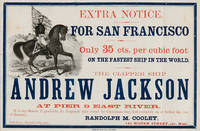
1861WRCAM55613New York: Nesbitt and Co. 1861. Illustrated handbill 6 1/4 x 9 1/2 inches sight printed in red blue and black. In fine condition. Matted and framed. A rare and attractive handbill advertising the services of the Andrew Jackson a clipper ship bound for San Francisco in late 1861. This is a large handbill much larger than the typical clipper ship card and has a wonderful image of Andrew Jackson astride his horse with the American flag behind. The illustration of Jackson was drawn by George F. Nesbitt who also printed this handbill. <br> <br> The Andrew Jackson was a 1679 ton medium clipper built in Mystic in 1855. She was a fast sailer but contrary to what the handbill would imply she didn't set any records on any of her passages. At the time of the voyage advertised here December 16 1861 she was helmed by a Captain Johnson. It is interesting that this voyage to California was scheduled at a time when naval action in the Civil War was ramping up: the USS Constitution arrived at Ship Island at the mouth of the Mississippi River carrying the 26th Massachusetts Regiment to New Orleans; Great Britain began its embargo on U.S. exports; and the naval blockade of the Confederate coast was beginning to show results. Despite the turmoil of the war the handbill states that the ship would depart "by Christmas day but certainly on or before the 1st of January." The clipper ship Andrew Jackson was sold to the British in 1863 and was lost in the Gaspar Straits in 1868. A rare survival. Nesbitt and Co. unknown books
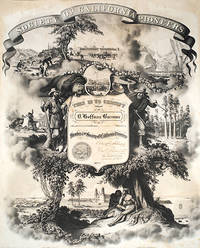
201828063San Francisco: Nahl Bros. Lith. L. Nagel Print Sept. 20th 1859 2018. Peters California on Stone 175; Morland L. Stevens Charles Christian Nahl Artist of the Gold Rush #80. Some wear to the paper at the edges affecting the caption title banner but not the pictorial images; light foxing; very good example. Broadside 66 x 51 cm lithograph on India paper backed with a heavier stock of paper at an early stage. ¶ A rare example of the grand certificate of membership in the Society of California Pioneers the first organization of its kind west of the Mississippi. The Society was founded in 1850 with a membership restricted to those who had arrived in California prior to January 1 1850. In 1858 the Society contracted the Nahl Brothers artists and lithographers to design and print this lavish pictorial certificate. Below the caption title banner are iconic and romantic California scenes in vignettes arranged in a manner similar to a mural depicting miners panning for gold Sutter's Fort Yosemite Valley a vaquero roping a steer a grove of giant sequoias a ship entering the Golden Gate a hunter a grizzly bear etc. In the lower part of the multifaceted image are three native California Indians a man woman and child sitting at the base of a tree with expressions of sad resignation on their faces at the events unfolding in the scenes above a subtle and undoubtedly intentional representation by Charles Nahl. This is the earliest version of a certificate of membership in the Society and an early example of that version being number 73 dated September 20 1859 signed by Alexander Abell and William R. Wheaton president and secretary of the Society. <br/><br/> San Francisco: Nahl Bros. Lith., L. Nagel Print, Sept. 20th 1859 unknown books
190655705Del Monte CA & Detroit MI: Detroit Publishing Co. 1906. One large panoramic photocrom sized 14.25 x 42.5 in. mounted behind original 22 x 50 in. mat with original 27.5 x 55 in. quarter-sawn oak frame w/ original engraved brass plaque sized 1 x 4.5 in affixed to lower fore-edge retaining original glass. A superb example of this large photochrom panorama of the historic Gothic Revival Hotel Del Monte after it had been rebuilt in 1888 following a tragic fire. Charles Crocker and other members of the “Big Four†who had founded the Central Pacific and completed the transcontinental railroad formed the Pacific Improvement Co. in 1880 to develop the lavish Hotel Del Monte leisure resort immediately attracting thousands of annual visitors. The beauties of Monterey Bay groves of pine oak & cedar with well laid out roads were all designed to feed into the splendid hotel. The main building shown here in the image was 385 feet long by 115 feet wide with two deep wings and four stories with a tall tower containing choice suite with extended views of the countryside. The amenities included bars bowling alleys smoking rooms in detached buildings stables carriage houses ponds fountains and beautifully landscaped grounds. Occasionally mistaken for hand-coloured photographs these stunning images were created by a photolithographic process by which black and white negatives are applied to multiple lithographic stones and colours are added one stone at a time often requiring up to 19 different stones for these vividly coloured images. Jackson 1843-1942 was a noted artist and Western photographer who joined the company by selling his entire stock of 1000s of negatives to the Detroit Photographic Co. in 1897 providing the core images enabling the company to produce millions of images from postcards up to the large panoramas. In 1903 after the resignation of Edwin Husher Jackson took over the supervising and publishing of the images as well as supervising a crew of forty artisans and a dozen traveling salesman. See: Alan Michelson Pacific Improvement Company Hotel Del Monte #1 Monterey CA Pacific Coast Architecture Database 2018; Library of Congress Hotel Del Monte Detroit Publishing Co. No. 50228 Copyright Dec. 1906; Cynthia Read Miller & Rosalie Ehrlich Detroit Publishing Company Collection The Henry Ford 2001. Detroit Publishing Co., unknown
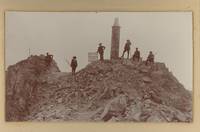
1910List2960Southern California 1910. Ten photographs measuring 8 x 10 inches and smaller with most measuring 5 x 7 inches. Brown Brothers stamps and manuscript captions verso; some with editorial overpainting; some mounted on heavy cardstock. Marginal damage with some tears and corners missing; very good. Japanese immigration to the US began at a large scale following the midcentury loosening of Japan’s emigration laws and the US’s 1882 Chinese Exclusion Act. Most Japanese immigrants entered through the west coast especially San Francisco Portland and Seattle and settled in central and southern California.<br /> <br /> Offered here are ten photographs of Japanese immigrants and laborers in California likely taken between 1900 and 1910 as one is dated 1903. Their work is mainly agricultural though one photograph possibly depicts miners: four men holding sledgehammers stand on a mountainside. Two show newly-arriving immigrants; in one women are lined up to receive a vaccine. Interestingly three of the photographs include women subjects—prior to the 1907 Gentlemen’s Agreement the Japanese population in some California counties had gender ratios of over 100 men to one woman and some simply had no female Japanese residents at all.1 One photograph that shows a woman at work in a cranberry field is identified as having been taken in Moneta California and the caption states that the cranberry farm was “leased by Japsâ€. Moneta actually had the least skewed gender ratio of any Japanese-American settlement at the time in part because its Issei residents were relatively economically better off and as the caption suggests could afford to lease or buy farmland.1<br /> <br /> Of interest to historians of Japanese immigration to California and the Japanese-American labor force around the turn of the century.<br /> <br /> 1 Lane Ryo Hirabayashi & George Tanaka “The Issei Community in Moneta and the Gardena Valley 1900–1920†Southern California Quarterly 70 no 2 Summer 1988: 127–158. unknown
1865List2438Camp Low 1865. Original partially printed document 26cm x 77cm. Printed on both sides of the sheet completed in manuscript. Darkening at folds from old tape repairs; partial splits to folds and extremities; complete and quite Good. Docketed verso signed in ink by Lieutenant Morgan Owen. Lists twelve enlisted soldiers most with Spanish surnames two with French surnames. Fine. The formation of the California Native Cavalry in 1863 marked a significant chapter in the state's history. Comprising primarily Mexican-American individuals colloquially referred to as "native" Californians the California Native Cavalry unit was formed 1863. Initially commanded by Maj. Andreas Pico a distinguished hero from the Mexican-American War and later under Salvador Vallejo the regiment drew its ranks from diverse backgrounds. Recruitment efforts began with vaqueros from southern California expanding to include individuals from San José and San Francisco. The unit boasted a varied composition encompassing not only Mexican-Americans but also Chilenos California and Yaqui Indians and even French legionnaires.<br /> Company "B" a contingent largely recruited from the northern part of the state is reflected in the existing muster roll. The company assembled at Camp Low near San Juan Bautista in 1865 making a striking entrance into the town. Described as "gay and gallant Spanish lancaroes" the cavalrymen presented a formidable sight with lances in hand and flags flying leaving a lasting impression on the townspeople who had never before encountered soldiers."The gay and gallant Spanish lancaroes sic came dashing through the town with the lances in their hand a flag flying from each of them. I assure you that they presented a war like appearance the people here had never seen a soldier in their lives – Yes Sir!." letter Maj. Michael O'Brien to Gov. Frederick Low January 1865; quoted in Prezelski "Lives of the Californio Lancers: the First Battalion of Native California Cavalry" in Journal of Arizona History v.40 no.1 Spring 1999. <br /> Under the command of Capt. Porfirio Jimeno Company B swiftly engaged in a critical mission: dismantling the notorious Mason-Henry Gang that had terrorized the San Juan region in the preceding months. Despite successfully wounding John Mason in early April 1865 the gang persisted for another month until Mason met his demise at the hands of a miner he sought to kidnap.<br /> However Company B faced challenges including low morale and a high rate of desertions with over 40 men leaving the company in 1865 alone. Transferred to Tubac Arizona Territory to confront the Apaches the company encountered further desertions along the way. The muster roll listing only twelve soldiers alongside Capt. Porfirio Jimeno reflects this tumultuous period. Overall the muster roll provides scarce documentation of the role of Mexican-Americans in the Civil War with few other examples in the trade or institutionally. unknown
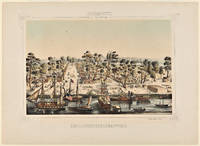
1851WRCAM31449Berlin: J. Hesse 1851. Handcolored lithographic print 19 1/2 x 14 1/2 inches. Minute browning and edge wear in margins. Color bright and clean. Very good. Archival matting and protected with mylar sheet. Variant issue without priority of this delightful early view of Sacramento showing the city inland from the harbor complete with bustling streets and wharf. In the harbor are two ships flying American flags one steamer and what is presumably a Mexican vessel. One large building facing the water is adorned with an elephant across the upper portion of its facade. The elephant figured prominently in the gold rush mythos. Those who said they "saw the elephant" meant that they had been there and seen the big show as in "went to the circus and saw the elephant". Thus an early example of California billboard advertising. The print was most likely extracted from the German MAGAZIN IN BERLIN. and has an unrelated image on the verso. Reps locates only four copies. A rare California view. REPS VIEWS &VIEWMAKERS 218. J. Hesse unknown books