8 985 résultats
186329955Sacramento: Printed by A. Badlam 1863. 8vo. 8 5/8 x 5 1/2 inches. 21-142pp plus 26pp of preliminary ads printed on yellow red and green paper and additional ad in the rear complete. Publisher's roan-backed boards with advertisements on both covers and endpapers worn<br/> <br/>An early Sacramento business directory published in California during the Civil War.<br/> <br/>An invaluable source of information from the period with advertisements for a wide-range of businesses including shippers wine merchants surgeons dentists and druggists printers and bookbinders photographers grocers hardware dealers and more. Besides the alphabetical directory the work includes a brief history of Sacramento as well as information on the state county and city offices local institutions as well as post offices and stage routes. Scarce with only five examples cited by OCLC with only one being outside of California.<br/> <br/>Rocq 6528. Printed by A. Badlam unknown books
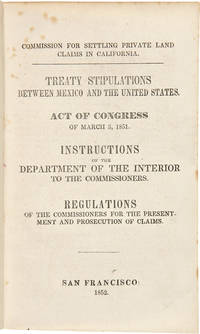
1852WRCAM46581San Francisco 1852. 20pp. Modern paper boards gilt leather label. Three bookplates on front endpapers. A touch of light foxing and a faint vertical crease. Very good. One of the bookplates on the present copy is that of the noted Vermont collector Hall Park McCullough. A seminal collection of documents under which California land claims were considered and one of the earliest and rarest San Francisco imprints on that issue. California came under American control during the Mexican- American War and attained statehood in 1850. One of the most vexing legal questions in the 19th-century history of the state was the status of lands that had been granted by the former Spanish and Mexican governors. These "ranchos" at times amounted to thousands of acres and questions of their ownership were quite contentious despite the provisions of the Treaty of Guadalupe Hidalgo to respect all Mexican land titles. This volume contains the text of the pertinent articles from the Treaty of Guadalupe Hidalgo the text of the 1851 Congressional Act establishing a Commission to investigate the cases the instructions to the Commissioners and the regulations under which they operated. <br> <br> "This is the foundation document under the terms of which all California land claims were first adjudicated" - Streeter. "One of the earliest local publications with reference to Mexican land claims" - Cowan. Greenwood locates eleven copies including the Streeter copy. <br> <br> An incredibly rare early California statehood tract. Only two copies have appeared at auction since the Streeter sale in 1968. COWAN p.375. GREENWOOD 362. STREETER SALE 2726. NORRIS CATALOGUE 1996. COHEN 9587. OCLC 191282311. hardcover books
19623185Éditions Cercle d'Art, Paris 1962. Un volume in-folio (390 x 330 mm) relié sous cartonnage toilé illustré, dans l'étui de l'éditeur décoré de deux compositions en couleur de Picasso. - 45 LINOGRAVURES DE PABLO PICASSO EN PLANCHES HORS-TEXTE réalisées d’après les linogravures originales. - PREMIER TIRAGE. Édition originale française, le texte de W. Boeck est traduit par Jacques Chavy. Remarquable publication d'art. Très bel exemplaire en parfait état. Infimes imperfections à l'étui, en excellent état. Très recherché.-- ENGLISH DESCRIPTION : 1 volume oblong folio in the original slipcase. Introduction by W. Boeck. Illustrated with 45 colour plates engraved and remarkably printed on one side only after the original linocuts by Pablo Picasso (approx. 13" x 15"). A state of the art production by Cercle d'Art in 1962. 1st printing. In perfect condition and complete. The decorated slipcase is in excellent condition. Scarce in this condition.
186738094Nevada i.e. Nevada City California: Daily Gazette Book and Job Office 1867. 8vo. vi 6 424pp. Tipped-in ad slip between pages 184 and 185. Contemporary purple morocco<br/> <br/>Provenance: E.G. Waite of Gregory & Waite Grocers Nevada City bookplate name in gilt on upper cover<br/> <br/>The first Nevada County directory the first history of the county as a whole and the first book printed in Nevada County.<br/> <br/>First edition of this "notable compendium of early source material similar in import to the county histories of Thompson and West" Wheat. The work also includes sketches of the towns and mining camps a directory of the residents including their occupations as well as statistics of mining and other resources and a plethora of fascinating advertisements. Bean's history and directory is quite scarce and contains a great wealth of early material on this vitally important mining region. A substantial essay is given over to mining gold from quartz deposits which as the author notes has been the subject of numerous false starts. "Bean's history and directory is by far the best-known of all California directories. One of the great 'standard' county histories it is in the minds of many collectors dealers historians and libraries one of the most valuable - content wise - of all directories published in the United States" Quebedeaux.<br/> <br/>Cowan II p 170; Graff 219; Howes B-278; Wheat Books 13; Quebedeaux 36; Streeter Sale 2913. Daily Gazette Book and Job Office unknown books
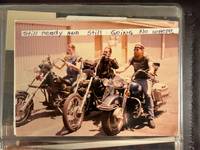
212731970. Biker Subculture Southern California biker community photo albums documenting motorcycle culture during the 1970s and 1980s a period when custom chopper building club rides and regional motorcycle gatherings characterized a flourishing biker subculture in the post Vietnam era. The photographs record a network of riders with heavily customized motorcycles participating in social gatherings and long distance desert rides across Southern California and neighboring states. Images emphasize the culture of the biker scene including extensively modified Harley Davidson Panhead and Shovelhead engines elongated front forks tall sissy bars and individualized paintwork that reflected the craftsmanship and identity of their owners. Named individuals appear repeatedly including riders identified in captions as "Horney" and "Fin' Flower of Carson" suggesting a tightly knit group whose members documented both travel and everyday social life.<br /> <br /> Two brown faux leather photograph albums containing 317 color photographs inserted in plastic sleeves. Images measure approximately 4 x 4 inches or 3.5 x 5 inches with approximately thirty wallet size reprints interspersed among the full size photographs and three loose photographs present in one album. The albums measure approximately 9.25 x 13 inches. The photographs depict custom motorcycles group rides desert landscapes roadside stops garage repair scenes and social gatherings including birthdays and informal parties. Several motorcycles appear repeatedly including a customized Harley Davidson Panhead referred to in captions as "Horney's Pan" often photographed in desert settings during group rides. The archive also includes images of vintage American automobiles such as a black Lincoln Continental referred to in captions as the "Incognito Car." Women appear frequently within the gatherings and rides participating in social events and group outings alongside male riders.<br /> <br /> The photographs document the culture surrounding American motorcycle clubs during a period when biker identity was taking shape across the American West. Southern California was a major center of motorcycle customization during the 1970s with communities forming around garages where riders modified engines frames and bodywork to produce personalized machines. Recurring captions and identifiable individuals suggest a cohesive social network whose activities combined a love of bike mechanics travel and community. Minor edge wear to album covers light toning to photographs and occasional creasing to sleeve inserts. Photographs generally well preserved with strong color overall very good condition. A substantial photographic record of Southern California motorcycle clubs during the late twentieth century. unknown
In 4° (22x17 cm); (24 compresa antiporta incisa), 504, (100) pp. e 45 c. di tav. fuori testo (delle quali 3 tavole fuori testo e 42 c. di tav. geografiche più volte ripiegate). Legatura coeva in piena pergamena rigida con titolo impresso in oro al dorso. Tagli leggermente spruzzati. Titolo impresso in oro entro cornice dorata al dorso. Qualche fioritura sparsa dovuta alla qualità della carta utilizzata per questa edizione e tipica di tutti gli esemplari ma nel nostro esemplare molto meno marcate del solito, sempre leggeri e senza pagine brunite. Nel complesso esemplare in buone-ottime condizioni di conservazione. Quarta edizione, completa della celebre mappa dell'America che presenta la California ancora come un'isola, della più importante opera geografica del seicento, considerata la prima vera opera di geografia moderna. Questa quarta edizione, rispetto alla precedente del 1667, presenta due carte in più. L'opera presentata rappresenta il capolavoro del celeberrimo storico e geografo tedesco, Filippo Cluverio (nome italianizzato di Philipp Clüver o Klüver, Danzica, 1580 – Leida, 31 dicembre 1622) considerato il fondatore della geografia storica moderna. Nato a Danzica nel 1580, allora provincia della Polonia, viaggiò fin da piccolo attraverso la Germania e la Polonia, imparando anche la lingua polacca e risiedendo per un certo periodo presso la corte di Sigismondo III Vasa re di Polonia. In questi anni il padre lo introduce agli studi scientifici. Iniziati gli studi giuridici a Leida. Pur seguendo gli studi giuridici, ben presto si appassionò alla geografia e alla storia imparata attraverso l'insegnamento di Giuseppe Giusto Scaligero, comprendendo come le due discipline fossero profondamente legate. Nei primi anni a Leida gli studi di Philipp furono sostenuti dal padre che era Münzmeister di Danzica ma una volta che il figlio decise di seguire le proprie passioni per la geografia e la storia, il padre gli tagliò i fondi. Lasciata Leida, il giovane Cluver viaggiò attraverso l'Ungheria fino alla Boemia dove si arruolò nell'esercito e dove rimase per diversi anni prestando il servizio militare. E' di questi anni una sua traduzione della difesa del barone Popel Lobkowitz incarcerato in seguito al conflitto religioso fra protestanti e cattolici. Questo scritto gli creò problemi una volta rientrato a Leida quando le autorità imperiali gli comminarono alcune sanzioni che però riuscì ad evitare grazie all'intervento di alcuni suoi influenti amici nell'Università di Leida che riuscirono anche, nel 1616 a fargli riconoscere una pensione regolare dalla stessa Università che gli assegnò anche diversi compiti presso la sua biblioteca, sfruttando le conoscenze antiquarie di Cluver. La sua opera è considerata di basilare importanza per gli studi storici e geografici in quanto essa rappresenta il primo studio generale della geografia dell'antichità fino ai suoi giorni, basato non solo su fonti letterarie classiche, ma e questo è stato il suo contributo principale, integrato da ampi viaggi e ispezioni locali per cercare conferma nelle fonti antiche, non più prese come autorità assolute. La sua prima opera, uscita nel 1611, fu un dotto studio riguardanti le parti inferiori del Reno e dei suoi abitanti tribali in epoca romana dal titolo “Commentarius de tribes Rheni alveis, et ostiis; item. De Quinque populis quondam accolis; scilicet de Toxandris, Batavis, Caninefatibus, Frisiis, ac Marsacis”. A lui si devono anche altre opere storico-geografiche come “Germaniae antiquae libri tres di Clüver” (Leida, 1616) che riprende studi di Tacito e da altri autori latini, un volume sulle antichità della Sicilia, con note sulla Sardegna e la Corsica dal titolo “Sicilia Antiqua cum minoribus insulis”, pubblicato a Leida da Louis Elsevier nel 1619. La sua “Introductio in universam geographiam”in sei parte, venne pubblicata per la prima volta, solo postuma nel 1624 ed è considerata la prima opera geografica moderna completa, divenendo uno dei manuale geografici standard per tutto il seicento ed il settecento. Clüver fu anche prolifico scrittore di argomenti matematici e teologici. È ricordato da collezionisti e storici della cartografia, anche per la sua edizione della “Geographia” di Tolomeo (basata sull'edizione di Mercatore del 1578) e per atlanti in miniatura ristampati per gran parte del XVII secolo. Molte delle sue mappe furono incise per lui da Petrus Bertius. Quarta edizione, non comune e ancor meno meno comune, completa ed in queste buone condizioni di conservazione. Rif. Bibl.: IT\ICCU\BVEE\038333.
1823PHO-2335Paris, Ponthieu, Lesage, Gide fils, 1823. 2 volumes in-8, xlix, [1]. 344 ; [4], 407 pp., relié demi basane époque, dos lisse orné avec pièce de titre et tomaison, coiffes abimées, petits manques au dos, coins usés, frottements, manque la mappemonde Chadenat, n°1196. - Forbes, n°569. - Sabin, n°73149.
1880List2834Sears Township California 1880. 10 ½ x 16 inch ledger seventy-five pages. Staining and damage to corners not affecting legibility. Very good to excellent. A ledger of the Sears Township assessor documenting assessment of property values. Sears Township does not appear to exist anymore but a November 1891 census bulletin lists a Sears Township in Sierra County with a population of 400 in 1890 and 585 in 1880. This is likely the same Sears Township as many of the property locations in the ledger are within present-day Sierra County such as Scales St. Louis Howland Flat and others. A later pencil marking on the first page attributes the ledger to Plumas county; this is probably incorrect. The properties include homes businesses and mining claims – most are the latter. <br /> <br /> Chinese immigrants played a significant role in the California gold rush and the ledger indicates the presence of a number of Chinese people in the area particularly in the town of Scales – enough of a presence that according to the ledger Scales had a “Chinatown.†This is given as the location of Ah Toy’s house and a more precise location for Scales’ Chinatown could be found from the ledger’s description of Ah Toy’s residence. Many individuals listed under “Ah†owned property in Scales: Toy Hung Fook and Fon owned houses Tong owned a meat market and Chung owned a warehouse. In addition Hopsing Chung is listed as owning a storehouse in Scales and the first page notes the Ah Wok Mining Company’s claim in Council Hill. Note the possibility that those listed as “Ah†are not one family; “Ah†is not necessarily a surname but can be a sort of nickname-generating prefix similar to “cousin†or “uncle/auntie†that often ended up appended to Chinese immigrant’s names.<br /> <br /> Of interest as a detailed record of the former properties and residents of some of California’s mining ghost towns. unknown
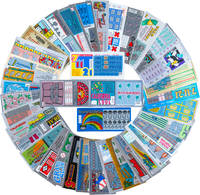
997California: California State Lottery Commission 1990. A complete and continuous unbroken run from the first 5 years of the California lottery a total of 40 tickets games 1 to 40 #26 is a proof. Each ticket is unscratched. Fine condition as new alluringly printed in glowing colors the silver coatings are unblemished. Rare. Though individual used scratched tickets are sometimes available we have seen only a couple of unused tickets from this vintage for sale in the last 35 years and we know of no one else offering a complete set. The lottery is adventure and romance finally reduced to their level of minimum effort and repute—hey you never know.<br /> <br /> Scratch-off lottery tickets embody a complex social phenomenon within contemporary society. They represent the commodification of hope where the state sanctions and profits from selling the possibility of economic transformation to citizens particularly those in vulnerable financial positions.<br /> <br /> These tickets function as symbols of pseudo-democratized wealth in a system of increasing inequality. The lottery mythology suggests anyone can instantly transcend economic barriers through pure chance while statistically serving as a regressive taxation mechanism.<br /> <br /> The scratch-off format specifically reduces risk-taking to its most minimal form—a momentary act requiring neither skill nor meaningful engagement. This mirrors broader social trends of simulating adventure rather than pursuing authentic experiences with genuine stakes and potential personal growth.<br /> <br /> Lottery tickets exist in a unique temporal space of perpetual potential until scratched creating a liminal experience that suspends the player between worthlessness and potentially life-changing value. This liminality captures how modern capitalism monetizes the space between aspiration and reality converting dreams into revenue while rarely delivering on its implicit promise. California State Lottery Commission unknown
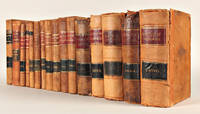
1866WRCAM17607New York San Francisco & Sacramento 1866. Sixteen volumes. Contemporary legal sheep leather labels. Some volumes with tender or almost detached hinges. Contemporary and later ownership inscriptions including those of Walter Norris of Salinas Lucas F. Smith of Santa Cruz Victor L. Hicks Wright & Wright of San Francisco and Fred V. Wood of Oakland. Overall a very good set. A complete run of the first editions of the statutes of California during her formative years. As the third and fourth volumes are very rare it is extremely difficult to find a consecutive run of these early laws. At this early stage of California legal printing any given state printer was not kept for long. Those represented herein are as follows: J. Winchester first volume; Eugene Casserly State Printer second volume; G.K. Fitch & V.E. Geiger Co. State Printers third volume; George Kerr State Printer fourth volume; B.B. Redding State Printers fifth and sixth volumes; James Allen State Printer seventh and eighth volumes; James O'Meara State Printer ninth and tenth volumes; Charles T. Botts State Printer eleventh and twelfth volumes; Benj. P. Avery State Printer thirteenth and fourteenth volumes; O.M. Clayes State Printer fifteenth and sixteenth volumes. <br> <br> There is an interesting note to the printing history of the statutes. According to Wagner the Governor refused to acknowledge Casserly as state printer at the end of the 1851 session and instead appointed G.K. Fitch to the position. Fitch turned over all state printing copy to be done in New York. Casserly brought the matter to court and won back his position as state printer whereupon the already printed statutes were sold to him in a compromise agreement. Casserly then proceeded to have new titlepages added to the statutes that had been printed in New York and added errata slips and an index. All subsequent laws were printed in California. COWAN p.610 ref. GREENWOOD 167 ref. WAGNER CALIFORNIA IMPRINTS 147 149 150 ref. hardcover books
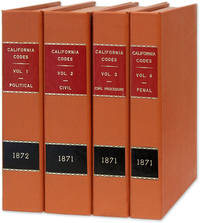
1872688091872. Sacramento 1871-1872. 4 Vols. Sacramento 1871-1872. 4 Vols. California's Field-Based Codes of 1872 California. Haymond Creed 1836-1893. Burch John C. 1826-1885. Lindley Charles. Revised Laws of the State of California: In Four Codes: Political Civil Civil Procedure And Penal. Volume I: Sacramento: T.A. Springer State Printer 1872; Volume II-IV: Sacramento: D.W. Gelwicks State Printer 1871. Four volumes. Complete set. Lacking the 2 tables one of consanguinity the other a schematic overview of the civil code. Octavo 8-3/4" x 5-1/2". Contemporary three-quarter law calf over marbled boards raised bands and red and black lettering pieces to spines. Some rubbing and a few minor scuffs to boards heavier rubbing to extremities with wear to spine ends and corners boards detached a few endleaves detached and lightly edgeworn card-pocket residue to front pastedown of Volume I. Light to moderate toning a few early owner signatures to front endleaves of Volumes I and II later library stamps to title pages other library marks to versos. Volumes housed in recent buckram clamshell cases with red and black lettering pieces. $3000. First edition Volume I was published last. Volume I: Political Code; Volume II: Civil Code; Volume III: Code of Civil Procedure; Volume IV: Penal Code. Based on David Dudley Field's New York Field Codes these volumes comprise the proposed code of laws for the state of California. The codes were adopted in 1872. The Political Code is no longer in force but the other three remain the fundamental basis of California law. Babbitt Hand-List of Legislation Sessions and Session Laws 25. unknown books
Incisione in rame (mm. 497x570) su doppio foglio con bellissima colorazione coeva, verso velato da finissimo foglio di carta Giappone. Bella e rara carta nautica -tratta dal celebre atlante di De Witt ''Orbis Maritimus ofte Zee Atlas"- che raffigura l'Oceano Pacifico, la California, il Giappone, la Nuova Guinea e la Nuova Zelanda. La particolarità di questa carta è la rappresentazione della California come isola, a testimonianza della differente concezione geografica nel 1600 rispetto ad oggi. Inoltre, rispetto ad altre mappe del Mar del Zur (Oceano Pacifico), questo esemplare si estende ad Ovest della costa californiana fino al Giappone. In basso a destra un grande e decorativo cartiglio raffigurante Nettuno su un carro sovrastato dal ritratto di Magellano entro medaglione. L'abile rinforzo con carta Giappone evita il deperimento da acidità ai verdi e marroni; quindi l'esemplare si presenta in ottimo stato, anche grazie alla splendida coloritura del cartiglio. "Frederick de Wit deve essere considerato uno dei più importanti editori di mappe della seconda metà del XVII secolo. La maggior parte delle sue mappe sono di ottima qualità, sono caratterizzate da un'incisione chiara e bella, dall'attualità e ricchezza dell'immagine cartografica nonché dall'equilibrio delle decorazioni cartografiche". (Lexikon der Kartographie II, p. 899), Koeman M. Wit 1, 27. Koeman, Atlantes Neerlandici, IV, pp.191 e 518-519. Shirley 444. Putnam, Early sea charts, 75. [AMERICA e OCEANIA]. .
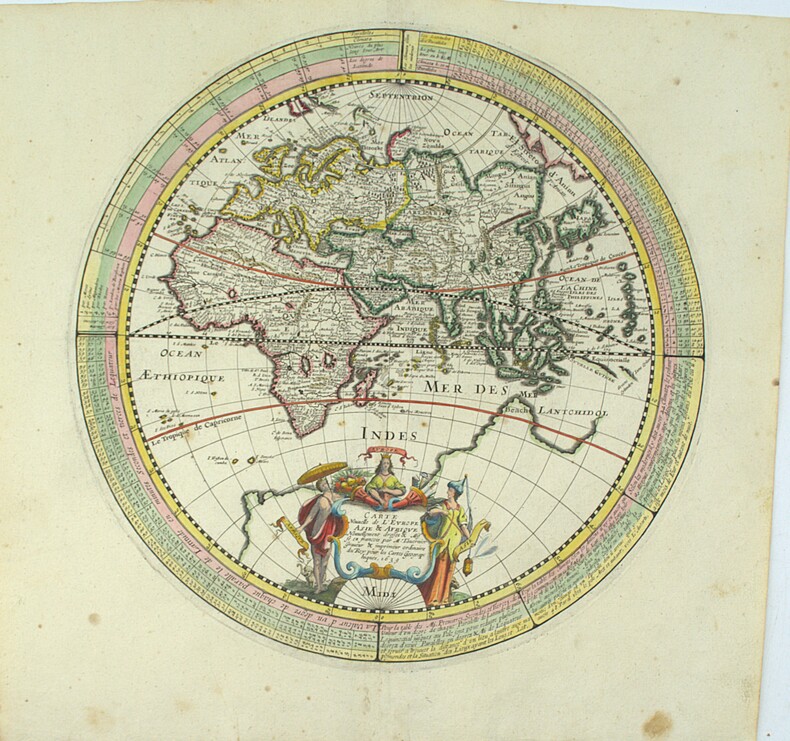
1639PHO-2225Paris, Melchior Tavernier, 1639, 37 x 35 cm, cuvette 30 x 30 cm. Gravure sur cuivre, en couleurs, renforcé au milieu PAIRE COMPLÈTE ET RARE
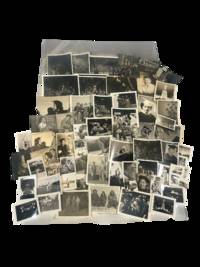
1937226661937. Japanese-American California Japanese American family photograph archive a mid-twentieth-century record of Japanese American community life in California before and after the wartime incarceration of people of Japanese ancestry under Executive Order 9066 during the Second World War. The photographs mostly date between 1937 and 1940 with a few dated 1952 and 1953 preserving decades in the lives of one family navigating forced removal wartime confinement and postwar resettlement. Captions identify "Sayoko" "Sayo" "Miyoshi" and a young boy named "Kenny" creating a generational thread between prewar Japanese American life in California internment and re-acclimation to civilian life after World War II. One photograph bears a wartime military postal censorship stamp reading "Passed by Army Examiner" indicating that at least one image circulated through military screening systems used to monitor correspondence connected to wartime detention camps or military service.<br /> <br /> Archive of over sixty black and white snapshot and studio photographs depicting members of a Japanese American family associated with California between the late 1930s and early 1950s. The images include studio portraits graduation photographs informal domestic scenes travel photographs and family group portraits. Several photographs depict recognizable locations in San Francisco and Los Angeles and one studio portrait bears a photography studio stamp from Oakland suggesting family connections across both Northern and Southern California. A signed graduation portrait dated 1937 identifies a young woman as "Sayoko" while photographs from the early 1950s show a young boy identified as "Kenny" with inscriptions referencing "Sayo" likely the same individual seen in earlier images suggesting the transition from young adulthood to motherhood across the intervening wartime decade. Additional images depict a recurring young Japanese American man in glasses and formal attire a young woman identified as "Miyoshi" couples photographed aboard boats likely operating as local ferries and extended family gatherings in domestic and social settings. Several larger format photographs show women performing traditional Japanese dance in kimono within a landscaped Japanese garden while another image shows a man with two sons posed before a United States Air Force B-36 Peacemaker bomber placing that photograph in the postwar period. Photographs measure approximately 1 x 1 inches to 5 x 7 inches with most around 3 x 4 inches.<br /> <br /> Japanese American communities in California during the late 1930s maintained extensive family educational and social networks centered in cities such as San Francisco Oakland and Los Angeles. After the attack on Pearl Harbor in December 1941 the federal government forcibly removed more than 120000 individuals of Japanese ancestry from the West Coast and confined them in inland detention centers administered by the War Relocation Authority. Personal mail entering and leaving the camps was subject to military censorship and photographs were sometimes stamped with inspection marks such as "Passed by Army Examiner." The presence of such a mark in this archive situates the photographs within the surveillance structures surrounding wartime incarceration and suggests that family communication continued through monitored correspondence. The continuity of portraits spanning youth education wartime absence and postwar family life provides a visual sequence documenting how Japanese American families maintained kinship networks and memory across the disruption of forced relocation and confinement. Minor edge wear and occasional corner creasing to several photographs; overall good to very good condition. A cohesive photographic record documenting Japanese American family continuity across one of the most consequential decades in twentieth century West Coast Asian American history. unknown
186329955Sacramento: Printed by A. Badlam 1863. 8vo. 8 13/16 x 5 5/8 inches. 26 iv 25-142 3 pp. Publisher's calf-backed printed paper boards. Preliminary ads printed on yellow red and green paper<br/> <br/> An early Sacramento business directory published in California during the Civil War.<br/> <br/> An invaluable source of information from the period with advertisements for a wide-range of businesses including shippers wine merchants surgeons dentists and druggists printers and bookbinders photographers grocers hardware dealers and more. Besides the alphabetical directory the work includes a brief history of Sacramento as well as information on the state county and city offices local institutions as well as post offices and stage routes. With a few pencil annotations by an early resident of Sacramento about the people and places mentioned in the text. Rare with only five examples cited by OCLC with only one being outside of California.<br/> <br/> Rocq 6528. Not in Cowan. Printed by A. Badlam unknown
1921List3318California and Oregon 1921. 160 total items. Description of Pacific Coast Outlaws 32pp 8vo in cloth wraps; wraps excellent with some staining; contents very good to excellent with some water damage. Thirteen copies found on OCLC. Two business cards one with manuscript notes; 106 letters dating 1906 to 1911; twenty-two mailers circulars shareholder solicitations etc.; twenty-eight pieces of miscellaneous accounting records; and one Trinity Gold Dredging Company map measuring approximately 14 x 28 inches. Overall excellent. Harry N. Morse 1835–1912 was born in New York and came to San Francisco in 1849 seeking gold. After several odd jobs he became a deputy provost marshal in Oakland in 1862 was elected Sheriff of Alameda County in 1863 and held this office for fourteen years before establishing his private detective service in San Francisco. Morse is known for the arrests and killings of numerous California outlaws many of which Shinn’s booklet treats in great detail though with a focus on the Mexican-American contingent to the neglect of some of Morse’s more notable successes such as his role in the capture of Black Bart.<br /> <br /> The majority of the items in this archive concern Morse’s late-career foray back into gold mining first in Lewiston California and then in Applegate Oregon. John Marchand was Morse’s foreman in Lewiston and generally writes to him about the failures of their Lewiston enterprise. Many of the difficulties are attributed to troubles with a steam shovel though the claim itself turns out to be a dud. Marchand informs Morse near the end of their correspondence:<br /> <br /> “Things here I’m sorry to say have gone from bad to ‘very bad’. Y’day I got down to ‘bed-rock’ uncovered a piece 46 by 10 ft and increadible as it may read there was not 30¢ in there some pans in fact you could not get a color.†August 10 1906<br /> <br /> Morse then invests in a claim in Applegate Oregon with more success. The main setback in Applegate is that his mine is repeatedly sabotaged. His foreman E.B. Hawkins explains:<br /> <br /> “I realise things from this end must appear perhaps irregular or peculiar On or about the 17†of May the mine was dynamited I did not write you at that time because I thought I could catch up the ground in two or three days. It took nearer 20 and another thing you had sickness and later death in your family so I did not write about that first offence at all On June 17†we found the Star mine dynamited again good and plenty not less than 10 lbs of powder had been used for the job. They blew the h__l out of things blew the top off of the shaft and the gallows frame awry. I am almost certain I would have succeeded had I had only natures elements to contend with. I don’t know what in h__l will happen on the 17†of July This anarchy is beyond me. On the 17†of May I fired the distasteful element paying them off and I have fired the 17†of June element paying them off – I borrowed $50.00 from Jno. Pernoll to pay them there was 3 of them had not been working longâ€. June 19 1907<br /> <br /> Hawkins soon identifies the culprits:<br /> <br /> “On June 27†Jim Rock Sr. and Dick Rock came to me and offered to square the damages done at the star mine saying that if the mine was blasted their two boys were in on it On July 2†Dick Rock came to me and said his son Roy had confessed saying there were four in it namely Harry Gething Chas Brown Young Jimmy Rock and Roy Rock Dicks son They had all been working at the star. On July 4†Roy Rock confirmed to me same as above saying Harry Gething was leader and young Jimmy Rock was helper that they had a jig of whiskey on the ground that night Jimmy Rock furnished the whiskey Strange to say that every time I have gotten ready to take a certain good block of ore out of the star the mine has been blasted I propose to take that block of ore out if I live and can get grub while doing it†July 6 1907<br /> <br /> Hawkins has a few other confrontations with workers though none this severe and his letters are mainly providing Morse with in-depth updates on the status of the mine including many of Hawkins’ diagrams. The Star mine is never a roaring success and the pair consider trying cyanide mining—â€the salvation of southern Oregon†1908—and gravel mining in British Columbia.<br /> <br /> Of interest to historians of the post-Gold Rush west especially gold mining therein. unknown
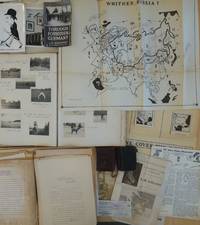
1950List2425Europe and California 1950. Includes two small diaries from 1901 and 1917 with sporadic entries a large photo album measuring 14 x 11 with appx. 400 small photographs from 1906-1909 attached to album pages most measuring 3 x 2 as well as a few larger format images laid in. With 100 plus pages of typed pages including retained correspondence story ideas and various other manuscripts. With eleven maps produced for his “Of Men and Maps†series including five copies of a large map entitled “Whither Russia†in varied states and in large sizes up to 30 by 36 inches and a handful of small ephemeral pieces. Generally near fine condition with the exception of the album which is missing its rear board and has some pages loose and torn. Very Good. J.M. de Beaufort a war correspondent for the London Daily Telegraph and New York American during World War I recounted his wartime adventures in the 1917 book "Behind the German Veil: A Record of a Journalistic War Pilgrimage." Originally arriving in Chicago in 1909 he married a steel magnate's daughter and pursued a career in show business. However by 1912 he had gone through a divorce and transitioned to newspaper work earning the moniker of the "Dude Reporter." Originally born in the Netherlands as Jacques Albert Uilenbroek he was thought to be a deserter. He spent the latter part of his life in the United States apparently jailed in San Francisco for a stint in the 1920s and eventually settled in Los Angeles. <br /> Offered here is an interesting smattering of material from the life of the mysterious De Beaufort which bookends his most unusual career and life with a large visual photographic record of his life in Europe as a young man and over a hundred pages of manuscript material from late in his life with a highlight being several maps in draft form for an apparently unpublished project called “Of Men and Maps.†As a group the material shows the work of an ex-con artist and war correspondent trying to regain his form while living in Los Angeles. He was still writing as a “Special Correspondent†at this point though the title seems to have been fully honorary. Also included are two small pocket journals with sporadic notations from his life in Europe in 1900 and in 1917. In its entirety the group gives an interesting visual and manuscript record of a literary fraudulent and imaginative transatlantic life and intellect. <br /> The cartographic highlight of the group is several iterations of a large map called “Whither Russia†in varied forms which show an interesting interpretation of the sphere of influence of the USSR and its growth from 1939 to 1946. Also included are two drafts of a map of Operation Market-Garden in the Netherlands in 1944 an unidentifed tactical map of a military battlefield a map called “Middle East Jackpot†showing the division of territory between the Allied and Axis powers a map called “Dawn’s Early Light some reproduced small format maps from the De Beaufort’s and a small map called “Gifts from Yalta.†De Beaufort was working on these maps for a column called “Of Men Maps and Memories†that was published in the East Los Angeles Tribune. He also sent the columns out in newsletter form from his address at 1635 N. Ogden Drive in Los Angeles. <br /> The collection of manuscripts drafts and retained correspondence tackle a range of subjects perhaps most interestingly those detailing De Beaufort’s creative process - drafts of stories lists of ideas for stories and letters. His over the top style is on display in a lot of the writings some of which are of unknown origin and purpose. The documents contain correspondence between De Beaufort and Edwin Pauley the oil man and presidential advisor. In one untitled essay he asks himself the question “What has been your most thrilling experience†and his reply is “ Silly questions. Who or at least what newspaperman of some 25 turbulent years standing - and falling - could answer such a question. A reporter’s life has a thousand thrills. There was that rainy day in Marcy 1915 in the fortress of Loetzen when I stood face to face with Hindenburg. Hm yes that was quite a thrill…†De Beaufort was entrenched in the Los Angeles journalistic scene at this point and the documents show the degree to which he relied on his former glories to attempt various career revitalizations endeavors. <br /> The album of photographs from 1906-1909 over 400 in total give a visual record of the young Uilenbroek’s life in Europe. The star of the collection is his bulldog Bob who travels throughout Europe with him and eventually comes to America by 1907. Mary who we presume to be his future wife is featured heavily in the images. It is unclear whether he was working at this point the images show affluent young people and their dog in varied cities and are purely of a personal nature. Other photographs laid in are relics from his war correspondent period. The loose photographs and ephemera are a mix of portraits from different periods from his life including two pictures of Sydney Turing Barlow Lawson one signed by his widow. The journals are sporadically filled and hard to decipher though one legible passage says “drinking all day.â€<br /> Overall the group gives evidence of this intriguing life and is the only extant group of material relating to Beaufort to our knowledge with the exception of a single journal from his time in Belgium during WWI that was sold at Bonhams and is still available in the trade as of this writing. unknown
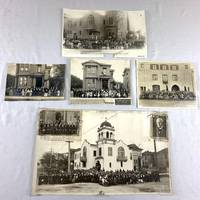
4750Oakland 1986. Good. Seven substantial photographs measuring between 6 x 9 inches and 7.5 x 36.75 inches plus approximately four linear inches of programs newspapers additional photographs holograph notes financial records and more. Varying levels of wear soiling chipping and repairs to the photographs. A rare collection of substantial images picturing members of the Oakland Japanese Methodist Episcopal Church in the early-to-mid 20th century first at what appears to be a converted home in the city and later at their larger more traditional church on West 10th St with an additional image of an outing to Piedmont. The incarceration of Japanese Americans during WWII led to the temporary closure of the church. During this time one of its halls was used to store the possessions of incarcerated Japanese and Japanese American citizens; after the war it served as a hostel for returning members. In 1967 the church sold the land and moved at the invitation of Lake Park Methodist Church to the latter's premises and in 1968 the two churches formally merged. The second portion of the archive relates to the Lake Park Methodist Church both before and after this merger. The photographs present here depicting the earlier years of the Japanese Methodist Episcopal Church are as follows in chronological order:<br /> <br /> 1 Oakland Japanese M.E. Church. Sept. 30 1917 caption title. 7.5 x 9.5 inches. A handsome black-and-white group photograph outside the church captioned in the plate in English. The wooden sign for the church is mounted above the entrance and reads "Japanese M.E. Church." An American flag flies above the sign. Evidence of construction paper adhesion to verso; clear tape to upper corner; light soiling.<br /> <br /> 2 Methodist Ministers' Conference caption title in pencil on verso. 6 x 9 inches. Similar setting to the photograph above this black-and-white group photograph features a group of almost forty ministers of the Methodist Church most of whom are not Japanese American but apparently met in conference at the Japanese Methodist Episcopal Church in Oakland circa 1917 though a pencil note on the verso reads "1912". Formerly mounted with tape remnants to verso and one corner some creasing a few short closed tears.<br /> <br /> 3 Japanese Methodist Episcopal Church of Oakland. Dedicated Feb. 24th 1918 caption title. 12 x 20 inches. A substantial black-and-white group photograph outside the church featuring a couple hundred members presumable posed for the church building's dedication. Two newspaper clippings of ministers of the church are taped to the upper corners small semicircle of loss and tape to middle of bottom margin tape to corners and verso. <br /> <br /> 4 Uncaptioned Panoramic Photograph Featuring Church Members in 1925. Tsuji Studios stamp on verso and embossed blind stamp in lower margin. 7.5 x 36.75 inches. Pictures the church membership of over a hundred Japanese American men women and children in the midst of the Roaring Twenties. Heavy dampstaining and damage to left side obscuring about five inches of the image. Accompanied by another example of the same photograph also with Tsuji Studios stamps this copy with damage to the right side. This second example has an ink inscription in Japanese on verso and a computer-printed date taped to the bottom margin and reading "1925." The chipping on each side of the two photographs obscure some of the subjects but taken together these two images record all of the information contained in the photograph.<br /> <br /> 5 Church Outdoor Ceremony at the Piedmont Hills caption title in Japanese. 8 x 32 inches. A striking sepia-toned panoramic photograph capturing an outdoor excursion to the Piedmont hills in 1927 four captions in the negative printed in Japanese. Tsuji Photo Studio stamp on verso along with a short manuscript caption in pencil in Japanese. Light marginal staining; toning.<br /> <br /> 6 Farewell Ceremony for Pastor Arima and His Family. January 8 1933 caption title in Japanese. Tsuji Photo Studio. 7.75 x 9.5 inches. Handsome sepia-toned group photograph of a farewell gathering for Pastor Arima and his family in early 1933 captioned in the plate in Japanese. An ink inscription on the verso confirms the caption in the negative and reads "Farewell photograph taken on January 8 1933 prior to the departure of Rev. Arima & family to Japan." Rough patch to lower corner and lower edge likely from tape removal slightly affecting the extremities of the image.<br /> <br /> 7 Final Service at the West 10th Methodist Sanctuary. Feb. 5 1967 caption title. Utsumi Studio. 8.5 x 14 inches. An informative black-and-white group photograph depicting the congregation at the West 10th Methodist Church location after it was sold in 1967. Small chip and closed tear to bottom margin affecting part of caption tape to verso.<br /> <br /> The later portion of the archive documents church life and activities at Lake Park Methodist Church the vast majority of which emanates from prior to the merger of the two churches. This earlier material includes a notebook of board meeting notes from 1967 numerous typed board meeting agendas from the 1960s two issues of the Lake Park Methodist Church newsletter called Spotlite church programs and fliers a few Methodist newspapers such as the United Methodist and Lake District Reporter and numerous photographs picturing Anglo-American members of the church. The post-merger material includes a dual-language newsletter and calendar for October 1972 listing the minister as George Uyemura a folder of financial records from the Lake Park United Methodist Church School from 1969-70 and two newsletters from November 1968.<br /> <br /> An important record of Japanese American religious life in Oakland before during and after the collective trauma of WWII incarceration as well as a peek into the development of a particular California Methodist Church later in the century. unknown
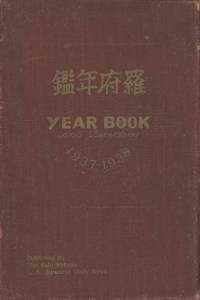
1937List3229Los Angeles California: The Rafu Shimpo / L.A. Japanese Daily News 1937. appx 90 485 pp. Limp cloth. With illustrations in color and black and white. Near Fine condition with some light wear to covers. A very scarce directory of the Japanese-American community with a focus on Los Angeles but also covering other areas of California including Terminal Island and San Pedro and San Francisco and other states such as Utah and Washington published by the Rafu Shimpo. The directory lists the physical addresses and phone numbers of the residents. The first ninety or so unpaginated pages show photographs of prominent businesses and residents and also include advertisements for Japanese-American businesses. Togo Tanaka an editor at the paper lobbied unsuccessfully for the paper’s continuation in the event of a war with Japan. He was eventually sent to Manzanar and the paper ceased publication in 1942. It would resume operations in 1946 due to the efforts of Akira Komai the son of owner Toyosaku Komai who stealthily hid the Japanese type under the floorboards of the office and paid the rent for the duration of the conflict. The directory continued until 1941. This issue presumably published in 1937 was the first in the series.<br /> <br /> Yokoi Iris September 19 1993 "LITTLE TOKYO - Extra! Extra! Rafu Shimpo Is 90" The Los Angeles Times. The Rafu Shimpo / L.A. Japanese Daily News unknown
1920259670Los Angeles 1920. 156 original photographs most 3-1/2 x 5-1/2 inches mounted on black album leaves. 1 vols. Oblong 4to. Original black pebbled leather album. Some toning of photographs. Very good. 156 original photographs most 3-1/2 x 5-1/2 inches mounted on black album leaves. 1 vols. Oblong 4to. A very good and representative photograph album from the home of Zane Grey documenting some of the best selling author's outdoor trips including sailfish off Catalina Island California a trip to the grand Canyon and a pack trip into the hills of Arizona after wild turkey. Provenance: Estate of Zane Grey unknown books
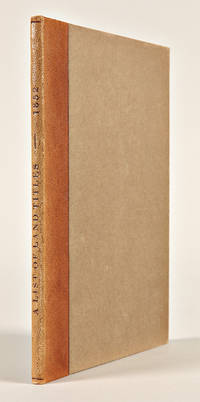
1852WRCAM46585San Francisco: Monson Whitton & Co. 1852. 43pp. Modern half calf and plain paper boards. Text lightly age-toned. Extensive early pencil notes see below. Very good. The Thomas W. Streeter copy with his bookplate on the front pastedown and his pencil notes on the front free endpaper. A very significant publication indicating that from the earliest days the United States government would contest the validity of claims to land in California that had been granted before statehood. <br> <br> California came under American control during the Mexican-American War and attained statehood in 1850. One of the most vexing legal questions in the 19th-century history of the state was the status of lands that had been granted by the former Spanish and Mexican governors. These "ranchos" at times amounted to thousands of acres and questions of their ownership were quite contentious despite the provisions of the Treaty of Guadalupe Hidalgo to respect all Mexican land titles. In 1851 the U.S. Congress created a three-person commission to consider the validity of land claims each of which would ultimately be challenged by the U.S. government. The list of land title cases at the end of this volume the first to have been printed shows that 247 cases were presented to the courts in the year after the Commission was created. "This pamphlet states the first official acts of the land commissioners. The list of land claims at the end gives the names of the attorneys on which a former owner has penciled in many instances the final action of the commissioners" - Streeter. Of the three original commissioners Harry I. Thornton was a frequent upholder of the validity of the claims against the interests of the U.S. government and was removed from the Commission in 1853. <br> <br> Not in Cohen or Sabin. This copy was bought at the Streeter sale for $300 in 1968 by Warren Howell who asked $1000 for it shortly thereafter. He sold it to a private California collector from whom the Reese Company acquired it. STREETER SALE 2725 this copy. COWAN p.374. GREENWOOD 364. Monson, Whitton & Co. hardcover books
1906200281906. Mexico Photography Vernacular photograph album documenting daily life labor and civic culture in Mexico and California 1906-1908 with substantial visual material from the late Porfirian era preceding the Mexican Revolution. The album records markets religious architecture rural labor and public spectacle across central Mexico alongside views of communities in the American South and Southern California. More than half of the photographs were made in Mexico and depict scenes in Mexico City Puebla Villa de Guadalupe Chapultepec and Guadalajara. <br /> <br /> Oblong large 8vo album in black cloth boards containing 179 silver gelatin and sepia photographs 1906-1908. Photographs measure approximately 3 x 3.5 inches to 5 x 9.5 inches. Subjects include vendors at flower markets rural families gathered outside stone dwellings laborers in straw sombreros working with pack donkeys to transport goods women selling fruit beneath shaded trees and a candid image captioned "Returning from market" showing a vendor walking with a crate strapped to his back. A bullfight before a full stadium documents a major form of popular entertainment. The photographs offer a record of the working economies religious practices and public gatherings that structured everyday Mexican life in the years immediately before the upheavals of 1910. Compiled as a personal album the sequence opens in Spartanburg South Carolina with street scenes and images of African American performers that document the social landscape of the Jim Crow South and includes intervening views from Atlanta Montgomery New Orleans and San Antonio before the album settles into its substantial Mexican content. Images mounted directly to album leaves with detailed contemporary manuscript captions. Nine larger-format photographs present panoramic views of Puebla and Villa de Guadalupe emphasizing the agricultural landscape and small-scale urban settlement that surrounded these communities. Architectural studies include the Mexico City Metropolitan Cathedral and an ornate café in Chapultepec with horse-drawn carriages and formally dressed patrons. California images from Redlands Santa Monica and Pasadena depict coastal landscapes mission-style and clay-roofed structures stone pathways ranch settings and equestrian travel documenting regional built environments and the lifeways of established Californian communities prior to large-scale suburban and automobile-driven development.<br /> The album records everyday labor commerce religious life and leisure in central Mexico during the final years of Porfirio Díaz's regime alongside monumental civic and religious architecture. Manuscript captions anchor the photographs to specific places in Mexico and the American West. Minor spine and edge wear to boards; some pages with slight warping; light fading to a small number of images; photographs generally clear and well preserved. Overall very good condition. A substantial early twentieth-century album documenting Mexican and Southern Californian life immediately prior to revolutionary and metropolitan change. unknown
1811PHO-1656Paris, F. Schoell, 1811 ; 5 vol. in-8, relié veau raciné, dos lisse orné, pièces de titre et de tomaison rouge, tranches marbrées, illustré d’un plan dépliant et d’une grande carte par Poirson. Édition originale au format in-octavo, conforme à celle in-4 de 1811, 2ff-iii-456, 2ff-520pp-1ff, 2ff-419pp ,2ff-564pp-1ff . Rongés avec manques de cuir, épidermures, intérieur frais.
1926321837Modoc County California 1926. 107 photographs most 3-1/4 x 5-1/4 inches but others ranging from 2-3/4 x 2 inches to 10 x 8 inches mounted to eleven card-stock leaves. About one-third of the photographs with manuscript captions in the lower margin or typed captions in the image. 1 vols. Oblong 11 x 14 inches. Contemporary three-quarter leather and patterned paper photo album string-tied. Boards quite rubbed and worn. The photographs in quite nice condition. Very good overall. 107 photographs most 3-1/4 x 5-1/4 inches but others ranging from 2-3/4 x 2 inches to 10 x 8 inches mounted to eleven card-stock leaves. About one-third of the photographs with manuscript captions in the lower margin or typed captions in the image. 1 vols. Oblong 11 x 14 inches. An evocative portrait of deer hunting and other outdoor activities in northern California in the mid-1920s. Many of the activities depicted took place in Modoc County in the far northeast of the state while other camps were made in Shasta National Forest. The album bears the ownership signature of Dr. John H. Brunings on the front pastedown. In a newspaper clipping affixed to one of the album leaves Brunings of San Francisco is identified as a "well known sportsman." Among those depicted in the album is a favored hunting partner of Bruning's Dr. L.N. Briones also of San Francisco.<br /> Much of the album depicts hunters in the field with numerous recent kills and trophies showing the deer field-dressed in place hanging from trees and camp poles draped over car hoods or horses or antlers affixed to other camp structures or car hoods 45 total photographs; duck hunters with daily kills some showing dozens 12; the deer hunters in the field or in camp 17; hunters in the field with a beautiful setter and shotguns 9; a hunter with recently killed rabbits 1; views of the hunting grounds in the Modoc County mountains 7; miscellaneous images of Dr. Brunings mostly with friends in the outdoors 13; Brunings in the U.S. Navy in China 1; view of main street in Adin California 1; and an image of a "pinto" deer a buck with distinct white patches killed by Brunings near Gualala California 1 photograph the 10 x 8 print.<br /> Typed captions appear either in the image or in the margins of twenty photographs mostly from Happy Camp and Horse Springs nineteen others have ink captions in the margins. The captions note locations as well as the names of many of those depicted. unknown
1927316594Oakland 1927. 28 gelatin silver photographs backed with canvas with a detailed typed caption on verso. 1 vols. Oblong 8vo. Ring-bound flexible leather boards. Some wear and crude repairs toning and minor wear to photographs. Very good. In a folding cloth box gilt leather spine label. 28 gelatin silver photographs backed with canvas with a detailed typed caption on verso. 1 vols. Oblong 8vo. An unusual album featuring boats and canoes manufactured by the King Boat Company of California. Many of the photographs are dated 1927 and the album serves not only as a visual catalogue of various boats available from the King Boat Company but also as a document of water travel in Alaska California and the Pacific Northwest in the 1920s.<br /> The canvas backing on the first and last images bears the inkstamped name of F.R. Frederick a distributor based in Boston. Whether this album was prepared by Frederick or by the King Boat Company is unclear. What is clear is that these are very interesting images of various King Boat Company boats and canoes in use.<br /> Nine are identified as having been photographed by "Lewis R. Freeman Noted Explorer and Writer for National Geographic Magazine on Thousand Mile Canadian Trip. Summer of 1927" a tenth is an image of Freeman with an Arrow Boat.<br /> Freeman a noted traveler explorer and writer published over twenty books on his travels. Other images reveal "Arrow Model on Heart Lakes in the High Sierra - 11500 Feet Elevation. Colonel H.G. Thompson at the Oars"; "Boat owned by T. Wherry Taxidermist Victoria B.C. was built in 1893 and in service for over 34 years up to November 1927 on display in King Boat Company Factory Oakland California"; a couple images of canoes loaded on pack horses; several of Henry W. Partridge "Noted Packer" navigating the Salmon River in Idaho; images of boats in Alaska and the Yukon; and several others of boats on shore in use as shelters or otherwise employed. unknown