8 986 résultats
22102551-nnew. unknown
56888237-75Independent Publisher. Used - Very Good. Former library copy. Pages intact with possible writing/highlighting. Binding strong with minor wear. Dust jackets/supplements may not be included. Includes library markings. Stock photo provided. Product includes identifying sticker. Better World Books: Buy Books. Do Good. Independent Publisher unknown
2003Q-0972229108California Dept. of Fish and G 2003-01-01. Hardcover. New. In shrink wrap. Looks like an interesting title! California Dept. of Fish and G hardcover
1867PHO-807Paris , Belin , 1867 , grand in-4 (33x25) , contenant 76 cartes coloriées,relié demi-cuir époque , couverture défraîchie mais solide .P2-6A
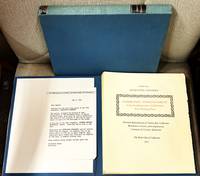
195283010The Book Club of California 1952. 12 pamphlets complete. Very Good condition in a Very Good condition original slipcse. The Book Club of California unknown
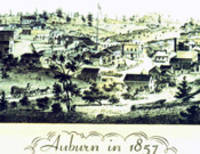
15-8145San Francisco CA: Book Club of California 1934. 4to. Oblong. 4 pp. French-Fold Sheet Deckled Edge Very Good. Facsimile reproduction of a 1857 lithograph a view of Auburn. One of 500. San Francisco, CA: Book Club of California, 1934. unknown
Copertina illustrata a colori in fascicolo originale completo de "La Domenica del Corriere" del 1/10/1961
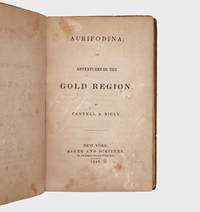
1849378089New York: Baker and Scribner 1849. First edition. 1034pp. 12mo. Contemporary drab paper boards a bit worn and stained. Text block toned. Contemporary Terre-Haute Indiana bookseller ticket on the front endpaper A. Child. First edition. 1034pp. 12mo. The first edition of what is generally regarded as the first American novel relating to the California Gold Rush written by Peck under the pseudonym Cantell A. Bigly Can tell a big lie.<br /> <br /> Aurifodina however is of further interest as science fiction for its utilization of the lost race motif. Soon after making his fortune in the known gold fields the protagonist treks east attempting to reach Santa Fe but instead comes upon the valley of Aurifodina. Therein live a highly civilized people and gold is as common as mud and steel is the great rarity. The major portion of the narrative is occupied with contrasting the superior ways of the enlightened Aurifodinians with those of the outside world. The protagonist marries and lives a contented life until one day while he is ascending in an observation balloon an anchor line breaks and he is carried east until he is finally downed near the Big Licks of Kentucky. As much as he wishes to return to Aurifodina the prospect of an overland trek is too great for him and he consoles himself with putting down his narrative for the enlightenment of others. Wright I:2030; Cowan p.477; Baird & Greenwood 1995; Kurutz 490a Baker and Scribner unknown
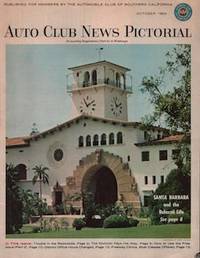
69-7877California USA: Automobile Club of Southern California AAA 1964. 4to. 16 pp. Stapled Wraps. Very Good. B&W and Color Plates. California, USA: Automobile Club of Southern California (AAA), 1964 paperback
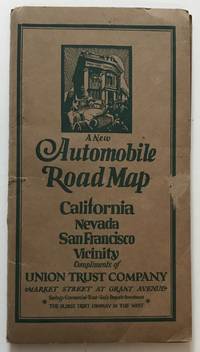
1922952San Francisco: Union Trust Company 1922. About very good. Folding map 34 x 26 inches. Original printed wrappers. Closed from head of front wrap near gutter; a couple of scuff marks on front and rear. Map fine. An interesting and scarce promotional for a San Francisco financial firm comprising two road maps one of California and Nevada and the other of the Bay Area. The two-sided map was issued in 1922 by Rand McNally but here has had advertising for the Union Trust Company added to its legend and had been tipped into wrappers promoting the firm. In addition to providing a detailed outline of roads in the two western states and around the San Francisco Bay the verso of the map also prints a text describing the banking services of Union Trust a synopsis of the 1921 California Motor Vehicle Act and Bay ferry time tables as well as a list of incorporated towns found on the map and their populations. The Union Trust Building still stands at the intersection of Market Grant and O'Farrell in downtown San Francisco as advertised by the present map although the company was bought out by Wells Fargo the year after this promotional was published. We locate two copies of the regular issue of this map in the Rand McNally collection at the Newberry and at Northern Arizona University and no copies of this production. Union Trust Company unknown books
ria9781138744509_inpPaperback / softback. New. New Book; Fast Shipping from UK; Not signed; Not First Edition; Blending a history of the Methicillin-Resistant Staphylococcus Aureus MRSA bacterium with auto-ethnographic writing Autobiography of a Disease documents in experimental form the experience of extended life-threatening illness in co paperback
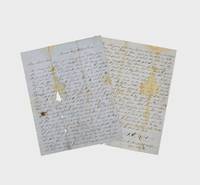
1851376875Nevada City CA 1851. 3pp. folded sheet blue paper. Usual folds some staining two sheets separated small hole affecting a few letters. 3pp. folded sheet blue paper. Writing in 1851 from Nevada City at the time California's most important mining town in the leading gold mining county this letter written by L. O. Hart to his aunt and uncle opens with the familiar prose on not having received letters and fearful that his previous letter not receive before turning to his life in the mines: "My health at present is none of the best but I live in hopes. I have not done any work of moment for 5 or 6 week past and for a week past I have been confined to my cabin though today I feel better by considerable. We have had no rain yet though for weeks it has been predicted that it will rain next week. If anything the weather is warmer than last August for we cannot keep our butter from melting put it where we will and fix it how we may." The letter continues by discussing costs of commodies: "California has much improved in living since I have been here. Now one can enjoy some of the luxuries of home and better preserve his health. Provisions are considerable cheaper than they were one year ago. Then it cost $1.50 cents per day to live upon pork beans and potatoes but now our cost daily is not far from 75 cts and we have flour potatoes butter pork tea coffee and chocolate and fresh beef once a day broought to us at 20 cts per lb. Potatoes sell from 8 to 12 dollars per bushel. Clothing is actually sold lower here than at home. Boots & shoes sell for 2 & 3 dollars per pair."<br /> <br /> The letter continues on Monday morning extolling the virtues of the weather and fauna of California though critical and rascist concerning the region's Native Americans: ". Now that I am somewhat used to I think this climate is unsurpassable. We have an atmosphere healthy clear dry & transparent. Persons can talk 1/2 a mile apart with ease & from the tops of hills we can see what appear to be snow capped mountains some 25 or 30 miles distant but which are in reality 3 & 4 times that distance from us. We never have either frost or dew & from April until December it is but seldom that a cloud can be seen but the whole summer long a clear sun hot dry & parching generally speaking all are very healthy. The only killing disease of the country being the Erysipelas which generally proves fatal . The wild game of the country consists of wolves black bears grizzly bears wildcats deer squirrels turtle doves wild ducks & geese elks & Indians of which the latter is by far the most despicable looking quadruped I ever saw. They are thieving revengful lazy specimens of humanity. At present they are all around us but are perfectly quiet."<br /> <br /> The letter closes with an update on his successes and failures in the mines: "I have made about two thousand dollars this summer and out of that have lost twelve hundred so that I have for my summers work about eight hundred doll. I should not have said work for it has been all speculating &c. It takes a litter experience to handle all of the ropes & I can plainly see where I missed it but 'live and learn' I've got to. So I take it all as a matter of course & try again. And I am going to keep trying until I get $10000 doll then I shall come home sure . Tell all the cousins I'll bring them home something shiney one of these days . unknown
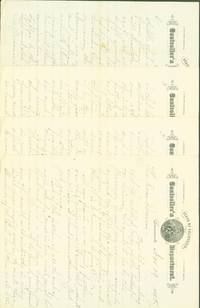
18852866391885. Trade Paperback. 4 page letter. J. P. Dunn was Controller State of California 1883-1891. Edward C. Marshall was the Attorney General of California from 1883-1887. Autograph letter signed 4-pages on Controller's Department State of California letterhead dated Nov. 19 1885 from 'Clark.' Letter is responding to a request from Dunn who is in San Francisco for a copy of 'the Kentucky tax decision.' The letter continues with praise for the success of Dunn's efforts 'to make the Monarchs of the Rail bend their necks to the just yoke of the State.Stay right at San Francisc until no stone is left unturned against any possible act being done to render this triumph futile.' Letter continues to praise Dunn and criticize 'Marshall' 'in which his own action and lack of action to save the interests of the State he is sworn to protect writes the word damnable in red letters over his official name' and continues 'the lousy coin that corrupted his official palm was a prize more valuable in price to him than pure life and spotless character.' And 'he now harvests in callous-heartedness the sheaves of disgrace the waving fields from which he might have reaped honor and renown'.'The Governor is enjoying the victory hugely.' Excellent content. About 525 words.<br> paperback
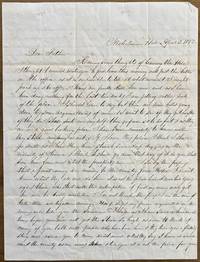
18524789Mokilomni Hill Ca: April 3 1852. Very good. 2pp. plus integral address leaf. Quarto on a folded folio sheet. Old fold lines minor wear. In a highly legible script. An interesting letter from a disillusioned fortune-seeker in Calaveras County advising his father not to come west as all the easy pickings are gone. He writes "Times are pretty dull here now and as I have been doing nothing for the last two weeks I am getting rather sick of the place. I should leave today but there are some holes going down by some acquaintance of mine & I want to see if they get anything. If they do I shall sink one myself they go from 50 to 60 feet & as they are in a good looking place I have some curiosity to know whether they strike anything or not. If I leave this place I think I shall go south as I hear they have struck some deep diggings in the vicinity of Sonora & think I shall go down that way. I see by the papers that a great many are coming to the country from Boston. I do not know what they all will do here it is not the place here it was two years ago & those who start with the anticipation of finding money easily got here will be badly mistaken. April 3 unknown
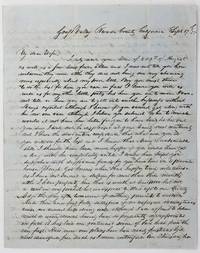
18554791Grass Valley Ca: September 17 1855. Very good. 4pp. on a folded folio sheet. Old fold lines minor wear. An intimate letter from a gold seeker in Nevada County California. Theodore Shaw writes to his wife about mixed luck in California a terrible fire his concern for their children and his great anxiety about the future. He writes in part: "I have property here that is worth at least $1000 but not a cent in my pocket but we expect to start up to our quartz ledge the day after tomorrow if nothing prevents to errect a mill up there. And now our plans have been nearly frustrated by a most dreadful fire such as I never witnessed. On Thursday last about 11 o'clock p.m. an alarm of fire was heard and by about half past 12 some 350 stores dwellings and buildings were consumed with a large portion of their contents our hotel included. . The entire business part of the town is in ruins.we have been sleeping under an old shed in the suburbs. This fire has injured us in this way several who had taken stock in our company have lost their means still we intend going on in a smaller way. We had formed a company with a Capital Stock of $50000 divided into 50 shares of $1000 each. Do you know Lydia I have more anxiety about your health than anything else as I know you work hard; only think what would happen to our dear children if anything serious should happen to your health and I away here in California. September 17 unknown
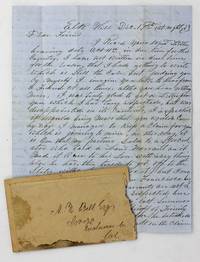
18534788Elk Hill Ca: December 17 1853. Very good. 3pp. on a folded folio sheet. Old folds light wear and soiling. With original mailing envelope. An informative letter sent from a miner in Gold Rush-era California to a friend in Tuolumne County primarily concerning a mining claim but also providing many interesting local details. The author writes "I managed to keep a claim for you which is joining to mine in this way it is one that my partner sold to a speculator who laid a land warrant on it." He discusses the process of the land warrants and how he made the man title the claim properly in San Francisco. "This claim was jumped last summer by W.H. Dixon first sheriff of Trinity City who died the day before he intended to occupy the house he built on the claim. He shot himself accidentally and never spoke." The author immediately stepped in and nabbed it for his friend but it was short-lived. "The claim is cheap at $2000 as soon as I made it known that I should not administer it was jumped by 3 in one day before 9 o'clock. So much for your not coming as I told you I could not keep them off any longer and you would not come if I had." He further mentions that he is digging potatoes which he deems the finest in the world discusses issues with the crop and further talks about new arrivals in the area. December 17 unknown
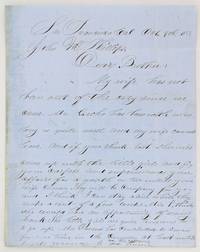
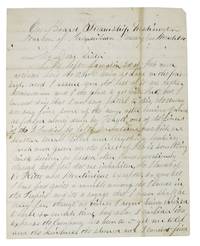
18522473San Francisco: October 4 1852. Very good. 2pp. with integral address leaf. Old folds mild staining and soiling three-inch closed tear to address leaf. An interesting letter documenting the family side of the California Gold Rush in which a San Francisco man writes to his brother offering to send his wife and daughters to Placerville as helpers. Interestingly at first Phillips addresses the letter to his brother in Ohio then scratches it out and writes in "Cal;" this most likely indicates the Phillipses hailed from Ohio and trekked to California along with scores of others in hopes of untold riches in the California gold fields. In his letter Phillips writes that his wife who has long been in San Francisco looking after a sick friend can now leave as he is better "And if you think best she will come up with the little girls and fix your carpets and superintend your affairs for a month or two untill your wife comes." The formerly sick friend Mr. Gardner could also accompany them apparently as "He is coming up to P. and he wants you to give him work for a short time. Mr. G. is a good sailsman sic having been in the dry goods business." While not overtly concerned with gold mining the correspondence is nevertheless interesting for providing details on family routines during the Gold Rush era when numerous families uprooted their lives and moved not only to places like San Francisco and Placerville but between such locations during the years of speculation. A nice example of history from below particularly notable for its domestic implications during the time of the great California Gold Rush. October 4 unknown
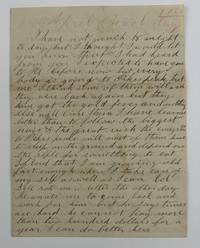
18604105Missouri: April 1 1860. Very good. 4pp. on a single folded sheet. Original mailing folds minor toning. An informative letter written by Charles H. Cram in Missouri to a friend in New England dated "April Fools Day 1860" in red pencil at the top of the first page. Cram mentions hoop skirts Pike's Peak and slavery while trying to decide whether to continue westward during the latter years of the California Gold Rush. Cram's letter reads in part: "Everybody is going to Pikes Peak but me. I think some of them will wish they were back again but they have got the gold fever and nothing else will cure them. I have learned better than to follow the biggest nois and the great rush. The emigrants to Pikes Peake will most of them will have to sleep on the ground and depend on the rifle for something to eat. I may start for Santa Fe about the first of June. I can git 15 dollars a month to drive a teem to Santa Fe. If I do cross the plains I shall go to California but if I have good health I shall stay here though I do not like to live in a slave state."<br /> <br /> In another portion of his letter Cram addresses his correspondent's question of whether slaves and freedpersons wore hoop skirts in Missouri. Cram writes: "You wanted to know if niggers wore hoops. Some do and some don't some slaves in broadcloth and silk and some go nearly naked. Slaves have there stent to do so much & if they do more they are payed for it. Most of them have a piece of ground that they call their own. What time they get they work on it. That is how they git their fine cloths. There is not a nigger in Missouri that works as hard as I do but I have consolation that I can work only when I am a mind to. You tell Albert not to start out among strangers as I did for he will find the people different in the country from them in New England."<br /> <br /> Cram then speaks to the emigrant populations he encounters out west as well as the agricultural bounty and animal life of Missouri: "The greatest difficulty I had was to learn the French and German language. I have been for weeks where I could not understand a word but now I can understand anything that comes along. But now for something else. The peach trees are in flower and the woods look green. Cattle and horses pick their living here the year round. I have not seen a barn in the country. The way to feed a horse is to tie him up to a tree and throw him a few ears of corn on the ground. I cannot rite to day much for there is half a dozen in the room talking about pikes peak or some young lady and how many negroes her father owns etc."<br /> <br /> Cram ends his letter with some advice for his friends back east: "Tell Mr. Bosworth that if he can rais $500 that he had better go to Cansas Kansas and go to farming. If you can persuade Andrew Marshall to go west it will be a good lesson for him."<br /> <br /> A mid-19th century manuscript letter with informative observations on the clothing of slaves and with notable observations of western life in Missouri. April 1 unknown
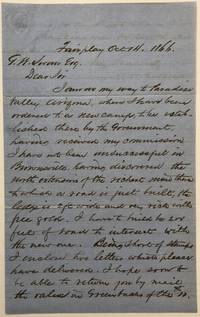
1866587Fairplay Ca 1866. Very good. 2pp. on a small bifolium. Previously folded. Light creasing and dust soiling. A brief but interesting letter about developments in the Brownsville mining district of California southeast of Oroville in 1866: "I am on my way to Paradise Valley Arizona where I have been ordered to a new camp to be established there by the government having received my commission. I have not been unsuccessful in Brownsville having discovered the north extension of the richest mine there to which a road is just built. The ledge is 2ft wide and very rich with free gold. I have to build 200 feet of road to intersect with the new one." The recipient G.W. Swan was a geologist who made several contributions to the early collections of the State Museum of California. The writer M.H. Kolloch resists identification but was clearly a colleague of Swan either a fellow geologist or a mine surveyor or engineer. unknown books
1851476391851. Now housed in an archival mylar sleeve. Age-toning especially along fold-line. Penmanship clear & easily read. Bifolium i.e. 4 pages of lined paper 23 lines per page ~ 10 words per line ~ 900 words. 9-3/4" x 7-5/8" <br/><br/>While no year is written on the ALs itself we posit 1851 as the Maritime Heritage website shows the only visit to San Francisco by the Washington was July 21 1851 arriving from Baltimore per a newspaper entry in the Daily Alta. That said per a online perpetual calender March 14th came on a Tuesday in 1852 not 1851. We lean towards 1851 as the actual year this letter was written. And this historic letter is replete with interesting content written by a man bound for the promised land of California. Chamberlin is from Boston writing a newsy letter his sister posted from the Harbor of Pernambuco Brazil March 14 where the ship in taking on supplies including coal. He describes the voyage thus far the expense of the company that sent him and the trip ahead around the Horn expecting to arrive in California in about 30 days. He describes conditions aboard the ship the places he has visited the people he has met in Brazil his own experiences with the heat and fever and more. Letters from this era are apprearing ever more infrequently on the market. unknown books
185246494Vassalboro Maine 1852. Now housed in an archival mylar sleeve. Fold lines. Age-toning along some exterior folds. Red sealing wax remnants. Penciled "Grandma Keith" above address. Very Good. Biofolium of blue paper with 2-1/3 pages of manuscript writing containing 2 letters 53 8 lines ~660 100 words respectively. One panel hand addressed to South Braintree Mass with stamped No. Vassalboro ME postmark Mar 15 & "Paid 3" circular stamp. Unfolded: 9-3/4" x 7-5/8". Folded: 3" x 4-3/8" <br/><br/>Ms Keith begins as most mothers do. relating her regrets for not writing sooner followed by health news of divers relations. Page 2 starts with the news that "There is a great many men in this region gone to California it is thought Maine must suffer a good deal in consequence of so many of her Citizens going to that Country the loss of the men is not all the State is injured by having so much money carried out of it. Since the sufferings of those gone there have been made known & likewise how small the chance of making money enough to fetch them back even many who were calculating to go have given it up at least for the present." The second letter by Keith to affirm to Miss Marcy that she wishes good relations between the two of them expressing appreciation of the "complimentary manner in which you mentioned my son." An intimate look at the allure of California's the 1850s myth tempered with the reality relayed back by some of those who succumbed. unknown books
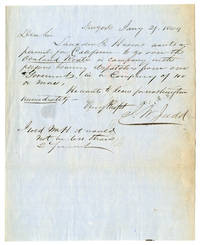
1849WRCAM49949New York 1849. 1p. of a bifolium docketed on verso of second bifolium leaf. Mailing folds slight edge discoloration else fine. An intriguing note regarding life insurance for a forty-niner traveling to California in 1849 with Henry Webb and John Woodhouse Audubon. The note reads: "Langdon H. Havens wants a life insurance permit for California to go over the Overland Route in company with persons bearing dispatches from our Government in a Company of 100 or more. He wants to leave for Washington immediately." Perhaps the twenty-six-year- old Haven sometimes spelled Havens originally intended to join a safe government- sponsored expedition from Washington but he was in fact among the 100 Forty-Niners who embarked on a famously ill-fated overland expedition led by Army Colonel Henry Webb with John Woodhouse Audubon son of the famous ornithologist as his second in command which left New York on February 8. <br> <br> The company proceeded by ship train stagecoach and riverboat to New Orleans and from there by steamer across the Gulf of Mexico to the mouth of the Rio Grande where they arrived on March 13 - an odd overland route dictated by Webb a veteran of the Mexican-American War. There disaster struck. A dozen men died of cholera the company's money was stolen and leadership conflict led Webb to leave the company with a dozen followers. Some of the remaining stalwarts including Haven followed Audubon onward trekking for seven months through Mexico and Arizona the survivors finally reaching San Diego in November. Some then took a boat to San Francisco; others continued overland to the gold fields. As meticulously recorded by Audubon a naturalist and painter in his own right the entire venture has gone down in history as "one of the most poorly-planned" Forty-Niner expeditions "on record." Haven though nearly dying en route was one of the fortunate few who "made it to California." An appealing note dated in the famous year of the California Gold Rush that eerily anticipates the dangers inherent in overland travel in America in the 19th century. unknown books
63-6670Los Angeles CA: Pacific Coast Development Bureau 1914. Letter-Sized Page Signatures & Stamps on Pacific Coast Development Bureau Letterhead Good with perforations some toning & creasing. Provenance: Letters and Autographs from a Who's Who in California 1914 - 1917 to the author Ellis A. Davis regarding Davis' Commercial Encyclopedia of the Pacific Southwest California Nevada Utah Arizona. Sold by Cherokee Book Shop to Frederick Ruffner Jr. the founder of Gale Research Detroit. Los Angeles, CA: Pacific Coast Development Bureau, [1914]. unknown
193275158Los Angeles: Automobile Club of Southern California 1932. Original ACSC folding map printed on one side only but for the title panel. 35 x 9 1/2 inches. Very good. Automobile Club of Southern California unknown
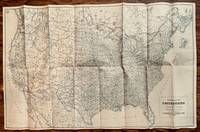
538San Francisco: Automobile Club of Southern California n.d. 32 1/4 x 20 1/2 inches. Very good condition. This is an attractive map providing a skeletal framework for highway information. The country lays out with federal highway numbering. As such it is stark in its usefulness in navigating multiple transcontinental routes. Automobile Club of Southern California unknown