1 546 résultats
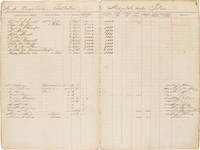
1870WRCAM56244New Orleans 1870. 128pp. Folio. Contemporary three-quarter calf and black pebbled cloth boards gilt leather label on front board. Most cloth on front board and calf on spine and lower outer corner of front board perished rear board worn and scuffed. Front board almost completely detached textblock tender in some places. Minor occasional foxing and spotting to text. Overall good condition. A rare surviving ledger from Reconstruction- era New Orleans containing tax assessment records for the Eighth Assessment District in 1869 and 1870. Most of the properties listed herein are in the heart of New Orleans including the French Quarter. The ledger is labeled "No. 1" on the front board and indicates it was kept by a tax assessor named Charles Lewis though the entries are made by at least two different hands. The text is comprised of ledger entries organized by squares within the city of New Orleans listing the streets bounding each particular square and containing the taxable entities in each square. For example Square 12 bounded by Ursulines Ave. Gallatin St. Hospital and Peters St. lists entries for eleven residential "taxable persons" their lot numbers measurements and real estate value in both 1869 and 1870. There are also eleven separate entries locations lot numbers and amounts of commercial capital for various businesses in Square 12; the businesses are specified in the "Remarks" column and include coffee houses liquor stores feed stores and a vegetable wholesaler. A couple of the squares are entirely residential in nature. <br> <br> The remainder of the ledger continues in the same manner relating important information on the residential and commercial makeup of New Orleans just after the Civil War with the last few pages reporting personal property brought forward from other ledgers and a recapitulation of each square. In total the ledger reports names of property owners real estate values commercial capital amounts and types of businesses for almost 1300 residents and businesses in Reconstruction New Orleans providing a rich foundation for further research. The front pastedown bears an attractive label from John W. Madden Stationer Printer and Blankbook Manufacturer at 73 Camp Street in New Orleans. hardcover books
180428737Paris: Ballard 1804. viii 18 31-176pp. plus folding table. Library label on front cover from Shwartz Historical Library. Minor rubbing and edge wear. Bookplate on front pastedown. Loss to portions of thirteen leaves affecting some text reinforced with tape dust-soiling to titlepage dampstaining to some leaves toward the end of the text. Lacking pp.19-30. Later 19th-century marbled wrappers.<br/> <br/> An extraordinarily rare account of travels in Louisiana the Mississippi Valley and the Illinois-Ohio country especially interesting in that the travels practically coincide with the Louisiana Purchase: a battered copy of a great rarity.<br/> <br/> An extraordinarily rare account of travels in Louisiana the Mississippi Valley and the Illinois-Ohio country especially interesting in that the travels practically coincide with the Louisiana Purchase. The work has been attributed to either Wante or G. Boucher de la Richardiere. "The author - whoever he was - travelled extensively throughout the lower Mississippi Valley" Howes. "There is also much on the Illinois-Ohio country but the body of the work has to do with the Louisiana Cession" Eberstadt. Incomplete but quite rare as Howes accorded it a "b" rating. The great Simon Shwartz library of Louisiana material had a copy sold for $15 in 1926 in blue morocco with an inked name on the titlepage. This is perhaps an additional Shwartz copy not auctioned at the time. The only other copy we can find any record of selling is the one listed by the Eberstadts in 1953.<br/> <br/> Eberstadt 132:412; Howes W87 "b."; Sabin 101246; Shwartz Sale 622. Ballard unknown
180729335Wien, Anton Doll, 1807. II, 363 S., 2 Bl., 1 gef. Kupfertafel, 1 mehrf. gefaltete Karte von Missouri Marmorierter Pappband der Zeit mit vergold. Rückentitel, 8°
199722760Louisiana Museum of Modern Art 1997. Hardcover. Used: Acceptable. Hardback no D/J in fair condition pages clean but cover shows some wear.The New Carlsberg Foundation's gifts to Louisiana 1988 - 1997. In English and Danish. Louisiana Museum of Modern Art hardcover
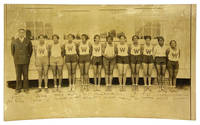
193114390Minden LA 1931. Very Good. Minden LA: 1931. Original black and white photograph 15.5x25.5cm. depicting the girls' basketball team alongside their coach Mr. Russ each player identified in ink manuscript along bottom of image. Photograph slightly curled with very small flaw at bottom of image else Very Good overall. Misidentifying manuscript label mounted to verso identifying the team in "Shreveport LA / Circa 1947 / Washington ".<br /> <br /> The label is a red herring misdating and misplacing the photograph sixteen years late and thirty miles west. The center player holds a basketball dated '31 nineteen years before Booker T. Washington High School was founded. The school almost certainly is Webster High School in Minden Louisiana thirty miles east. The building in the background and the women's slightly mismatching uniforms conform to those depicted in W.L.G. Abney's 1950s booklet "The History of Webster High School." Indeed the simple whitewashed wooden structure sitting on a brick pile foundation appears to be either the back of the dormitory or the newly-completed library the ground still unpaved dirt. <br /> <br /> The story of the founding of Webster High School less than ten years earlier in 1922 displays the dedication and financial burden of a Black community in the heart of the Jim Crow South. According to Abney's history a Colored Board of Trustees comprised of members of the community first set out to find a suitable site for a new school settling on a piece of land "owned and occupied as a home by one of Minden's colored citizens Mr. Henry Harris who was perfectly happy there and had no desire to sell." Abney glosses over the displacement of Harris but the site was secured and approved by the White Parish board "with the understanding that the colored people themselves would have to make substantial financial contribution if they were to secure this site because no money had been budgeted for the cause at that time." Indeed by 1931 the list of state-sponsored schools in Louisiana for White and Black students was sixty-eight to four. Webster was not one of those four schools. <br /> <br /> As Abney's history delineates however the money was raised by the community through the leadership and outreach of the Colored Board of Trustees and by 1931 a library had been erected and numerous sports teams active. The date is also significant as it coincides with the founding of two of the first all-Black all-women's professional basketball clubs the Philadelphia Tribune Girls and the Chicago Romas. Perhaps these pioneering teams inspired the formation of Webster High School's girls' basketball team. In any case the members listed are as follows: Coach Mr. Russ Tena Lowery Hazel Garrett Willie Stewart B. Green M. Ford Bran Watson M. Gafford E. McCorey Ella B. Gafford Lorscie Henry and Louella Ruffin. unknown
190840737Washington D.C.: Published by the United States Coast and Geodetic Survey 1908. Large folding nautical chart printed on heavy paper stock. Colored. A rare original coastal survey of the Gulf coasts of Florida Alabama Mississippi and Louisiana including the Keys Fort Myers Sarasota Tampa Panama City Destin Pensacola Gulf Shores Mobile Biloxi Gulfport New Orleans and the Mississippi Delta.<br/> <br/> Established by President Thomas Jefferson in 1807 as the Survey of the Coast the U.S. Coast and Geodetic Survey was the United States' first civilian scientific agency. This agency has followed its mission to survey the U.S. coastline create nautical charts of the coast and help increase maritime safety since its founding and has often played fascinating roles in significant chapters of U.S. history. It served in all theaters of the Civil War in the service of the Union Army and Navy pioneered acoustic exploration in the wake of the sinking of the Titanic and during WWI it worked to detect enemy submarines. In addition this agency worked to survey and produce detailed maps and renderings of the U.S. coast. These nautical survey maps commonly referred to as "T-sheets" provide fascinating insights into the history of the United States coastline which has and will continue to shift. These maps are the most important data source for understanding the physical and ecological characteristics of the U.S. shoreline. The present map is a highly detailed and accurate sea chart of the coasts Florida Alabama Mississippi and Louisiana along the Gulf of Mexico and an important historical view of the developing states. Published by the United States Coast and Geodetic Survey unknown
192041171Washington D.C.: Published by the United States Coast and Geodetic Survey 1920. Large folding nautical chart printed on heavy paper stock. Colored. A rare original coastal survey of New Orleans area and includes Lake Maurepas Lake Pontchartrain and the city of New Orleans with mentions of Audubon Park and the Cotton Exchange.<br/> <br/> Established by President Thomas Jefferson in 1807 as the Survey of the Coast the U.S. Coast and Geodetic Survey was the United States' first civilian scientific agency. This agency has followed its mission to survey the U.S. coastline create nautical charts of the coast and help increase maritime safety since its founding and has often played fascinating roles in significant chapters of U.S. history. It served in all theaters of the Civil War in the service of the Union Army and Navy pioneered acoustic exploration in the wake of the sinking of the Titanic and during WWI it worked to detect enemy submarines. In addition this agency worked to survey and produce detailed maps and renderings of the U.S. coast. These nautical survey maps commonly referred to as "T-sheets" provide fascinating insights into the history of the United States coastline which has and will continue to shift. These maps are the most important data source for understanding the physical and ecological characteristics of the U.S. shoreline. The present map of the Louisiana coastline is notable for the inclusion of New Orleans featuring Audubon Park neighborhood Carrollton and the Cotton Exchange which was demolished and rebuilt in this period. It is a highly detailed and accurate sea chart of New Orleans and neighboring lakes and an important historical view of the developing Louisiana. Published by the United States Coast and Geodetic Survey unknown
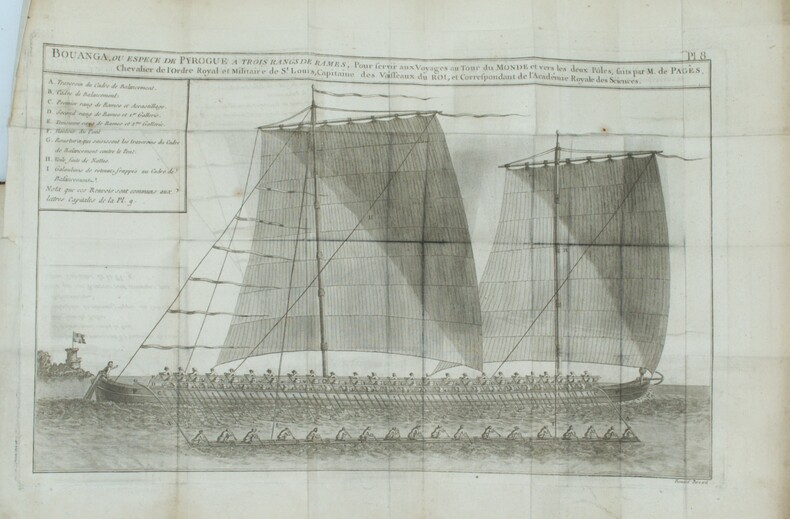
176147666Imprimerie Royale Cuir Paris 1761
192041197Washington D.C.: Published by the United States Coast and Geodetic Survey 1920. Large folding nautical chart printed on heavy paper stock. Colored. A rare original coastal survey of Gulf Coast of Texas and Louisiana including Galveston Beaumont Sabine Lake Marsh Island Barrier Islands New Orleans Lake Pontchartrain and the Mississippi River.<br/> <br/> Established by President Thomas Jefferson in 1807 as the Survey of the Coast the U.S. Coast and Geodetic Survey was the United States' first civilian scientific agency. This agency has followed its mission to survey the U.S. coastline create nautical charts of the coast and help increase maritime safety since its founding and has often played fascinating roles in significant chapters of U.S. history. It served in all theaters of the Civil War in the service of the Union Army and Navy pioneered acoustic exploration in the wake of the sinking of the Titanic and during WWI it worked to detect enemy submarines. In addition this agency worked to survey and produce detailed maps and renderings of the U.S. coast. These nautical survey maps commonly referred to as "T-sheets" provide fascinating insights into the history of the United States coastline which has and will continue to shift. These maps are the most important data source for understanding the physical and ecological characteristics of the U.S. shoreline. The present map is starts with the city of Beaumont and the state border with Louisiana at Sabine Lake and Pass and covers the coastline until the Mississippi River past New Orleans. In the bottom left corner an enlarged map of Galveston is included. This map is a highly detailed and accurate sea chart of the Gulf Coasts of Texas and Louisiana and is an important historical view of the developing states along the Gulf of Mexico. Published by the United States Coast and Geodetic Survey unknown
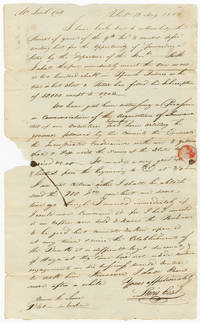
1804WRCAM56593Philadelphia 1804. 1p. autograph letter signed on a folio sheet with address panel and docketing on verso. Remains of wax seal. Old folds with small separations starting a most folds no loss of text one-inch seal tear to left margin no text affected else very good. A friendly and informative letter from Philadelphia merchant Lewis Cist to his brother Jacob Cist prominent naturalist and coal entrepreneur. In between updates on various investments he and his brother are involved in with an individual named Ritter and money he owes Jacob Lewis recounts: "We have just been watching a procession in commemoration of the acquisition of Louisiana. All of our volunteers infantry foot horse artillery the governor followed by the councils the Cincinnati the Incorporated Cordwainers with an 8 gallon shoe & flags with the names of the states.obscured.&c. It made a very good appearance & lasted from the beginning to end abt. 3/4 hours." Popular opinion on the Louisiana Purchase was mixed and so the government was keen to promote the country's profound expansion along with great potential of Meriwether Lewis and William Clark's Corps of Discovery Expedition which launched from Camp Dubois just two days after the date on this letter. <br> <br> Jacob Cist 1783-1823 was born in Philadelphia son of printer Charles Cist. A man of varied interests and activities Jacob starting by working in his father's printing establishment which was then the official government printer for John Adams' administration. In 1800 as the capital moved from Philadelphia to Washington his father opened a new printing house in Washington D.C. and Jacob became manager as well as acquiring a clerkship in the U.S. Post Office. From there he was appointed the first postmaster of Wilkes-Barre in 1808 as well as co-founding the Wilkes-Barre Bridge Company and Luzerne County Agricultural Society and serving as Luzerne County treasurer. The Cist family was already involved in coal and he inherited shares in the Lehigh Coal Mine Company. In time he became a leading advocate for the commercial production of anthracite coal as well as inventing and patenting an anthracite heating stove since anthracite was difficult to ignite in existing stoves. This was helped in part by coal shortages during the War of 1812 as British blockades prevented the shipment of Virginia bituminous coal to Philadelphia. Jacob was also a avid naturalist and geologist. As an early contributor to the AMERICAN JOURNAL OF SCIENCE AND ARTS the longest-running scientific journal in the U.S. he began a correspondence with Adolphe Brongniart an important French paleontologist. Jacob's letters pamphlets maps specimens drawings and watercolors both promoted his commercial coal-mining interests and helped establish correlations between American and European coal deposits through their fossils. Jacob's papers are now at the Academy of Natural Sciences of Drexel University. <br> <br> Lewis Cist d.1806 was a merchant and investor and may have gone on to equally diverse and distinguished achievement had he not died suddenly in 1806 on a voyage back to Philadelphia. Probate records note that he had not created a will; existing paperwork on the settlement of his estate was administered by Jacob Ritter possibly the same Ritter mentioned in this letter and signed by his mother Mary. Cist Lewis. Files No. 159-224 Book K p.253 1806. Philadelphia Pennsylvania Register of Wills. Jacob Cist correspondence and documents 1794- 1829. ANSP-Coll-0152. Academy of Natural Sciences of Drexel University. unknown books
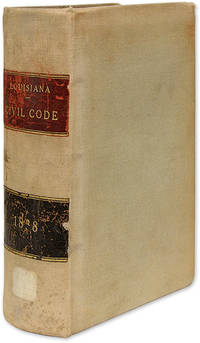
1838700031838. The First Annotated Louisiana Civil Code Louisiana. Upton Wheelock S. Annotator. Jenning Needler R. Annotator. Civil Code of the State of Louisiana; With Annotations. New Orleans: E. Johns & Co. 1838. xl xl 536 536 v 48 pp. French translation on facing pages. Octavo 10" x 6-1/2". Later library cloth red and black lettering pieces to spine endpapers renewed. Light soiling and shelfwear light wear to lettering pieces front free endpapaer lacking following endleaf partially detached. Light toning to text faint library stamps and a few minor library markings to preliminaries. $950. First edition. In 1822 Derbigny Livingston and Lislet were commissioned to revise the 1808 compilation of territorial laws. The result of their effort was the Civil Code of 1825. Upton and Jennings's edition of that code is significant because it was the first to include annotations. Actually printed in Philadelphia by T.K. & P.G. Collins this book was also issued in two single-language editions one in English and one in French. Some libraries list these two books as Volumes I and II. Babbitt Hand-List of Legislative Sessions and Session Laws 138. Jumonville Bibliography of New Orleans Imprints 1014. unknown books
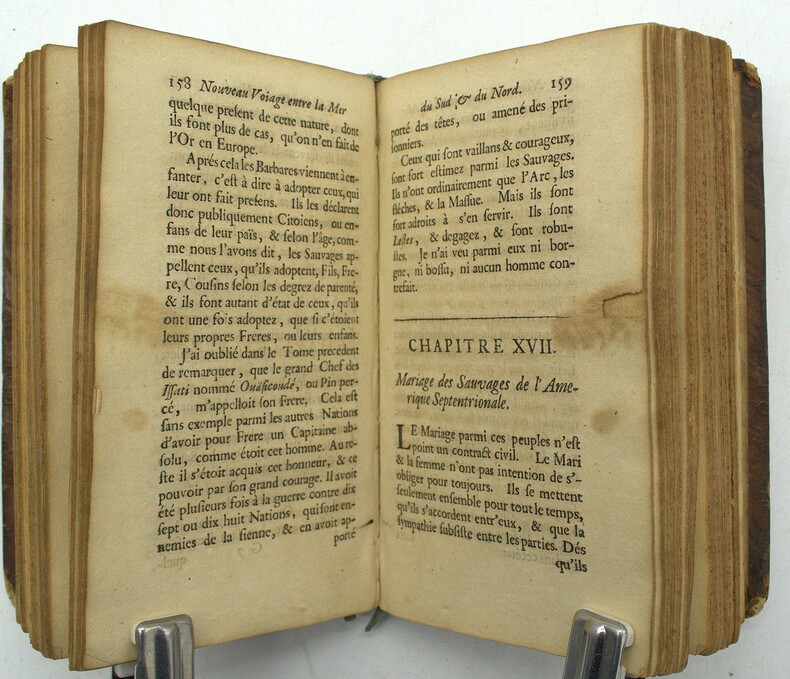
1698PHO-1936Utrecht, Antoine Schouten, 1698. In-12, (35) ff. de titre, épitre, préface et table, 389 pp., veau fauve granité, armes dorées au centre des plats, dos à nerfs orné, pièce de titre maroquin rouge, tranches mouchetées (Reliure de l'époque) ; frottements, coiffes absentes avec petits manques aux caissons, coins élimés, ors du 1er plat ternis, petit manque de papier sans atteinte au texte à un feuillet (pp. 159/160). Exemplaire relié SANS les 3 figures h.-t. et la carte. Exemplaire aux armes d’Usson de Bonac
19116289Crowley La: Rice Association of America; Signal Print. Co 1911. Stapled booklet 14.5 x 9 cm. 20 pages. Illustrated wrapper. Date of publication from external sources. Evident FIRST EDITION. A promotional recipe booklet encouraging the use of rice. An earlier publication titled Creole Mammy Rice Recipes was published by the Rice Association circa 1909. That work is known in a single copy at Kansas State. The dating of the two booklets is possible by comparing the tenures of various officers of the Rice Association. Creole Mammy Rice Recipes was published while Henri Gueydan was President while this booklet was issued after George Hathaway of Jennings L. ascended to the post. ~ Recipes include Rice Waffles Rice Fritters Rice Gumbo Soup Red Beans & Rice a famous Creole combination Rice Croquettes Rice Jambalaya a Daube with Rice and Rice Custard. Cooking hints recommend the use of garlic and the preference for lard over butter. “The Rice Association Crowley La. has issued a little booklet of rice recipes “Creole Mammy Rice Recipes.†In this book are given many ways of preparing rice as a hearty food instead of in desserts. Southerners use rice as Northerners use bread. Rice is served three times a day on Southern tables. Creole recipes are given for it is generally understood that the old “mammies†could turn out a dish of rice in such a delicate state of perfection that no French chef could approach them. In most ways these rice dishes could be used by vegetarians leaving out the meat additions and substituting oil or butter for the lard which is so much used in the South. The price of this booklet is two cents. Send for it and learn about rice.†The Vegetarian Magazine volume 13 page 46. The booklet weighs in on the nutritional value of rice at several points perhaps most notable in a section on the “Effect of Rice on Japanese.†Illustrated wrapper depicting a young girl nestled amongst rice branches and “on top of the worldâ€. A bit of light rubbing to wrappers; small adhesion mark to top of rear wrapper panel. Very good. Unrecorded. OCLC locates no copies; not in Brown or Uhler. Rice Association of America; Signal Print. Co unknown
19106626New Orleans; New York: The Board of Trade; Printed by H. R. Elliot & Co. Printers and Embossers 1910. Stapled booklet 10.25 x 15.25 cm. 14 unnumbered leaves; printed text decorated with red borders on rectos only. Cover title: Recipes for Cooking Rice. Author information inferred from external evidence. Printer from rear panel of wrappers. ~ Evident FIRST EDITION. A promotional publication designed “to create a greater interest†in a foodstuff that had yet to become a staple in many parts of the United States. With a dozen recipes including Gumbo Soup Jambalaya Belle Calas fritters Rice Pudding Riz au Lait. ~ The phrase “Louisiana Rice Exhibit†can be found in reference to displays in the agricultural halls of world’s fairs – the World’s Columbian Exposition Chicago 1893 for instance as well as the Louisiana Purchase Exposition St. Louis 1904 – but in the event the phrase is better understood not as an installation but as a program. The New Orleans Board of Trade had indeed exploited opportunities to educate the public by such means cf A. C. Cantley “Rice Display by Louisiana at World's Fair of 1904†The Planter and Sugar Manufacturer 32 no. 7 February 13 1904 page 121 but it would have been highly unlikely for booklets such as How to Cook Rice to have been produced specifically for them without bearing any mark of the association. Moreover Louisiana Rice Exhibits so-named were also staged at parish fairs livestock shows even horse races. Their visual aspect was meant to entrance and amuse. “The New Orleans Board of Trade made a very splendid exhibit†a trade paper reported “at the National Farm and Livestock Show with a display of all the products it handles with the centerpiece a working model of a rice mill†“Current Rice News Notes†The Rice Journal and Southern Farmer 19 no. 12 December 1916 page 33. ~ Founded in 1880 the Board itself coordinated among many other activities rice shipments from mills in Louisiana and to a smaller extent from eastern Texas and Arkansas too. In this case their printing contract with H. R. Elliot & Co. places the publication later than the Chicago Exposition as this form of name was not in use until after 1900 “The Manufacturing Stationer†Walden’s Stationer and Printer 31 Spring 1909 page 16. The date of issue proposed here rests on reports that the Board of Trade distributed booklets in or perhaps slightly before 1910 a note for example from the American Poultry World recorded that recipes from the Louisiana Rice Exhibit of New Orleans had been received 1 no. 5 March 1910 pages 354-355. ~ Interior clean and bright. Stapled in ivory wrappers with gilt illustration of rice plants overseen by a pelican in honor of the Pelican State. Near fine. OCLC locates four copies; Uhler 252; New Orleans Culinary History Group page 152; not in Bitting Brown or Cagle. [The Board of Trade; Printed by] H. R. Elliot & Co., Printers and Embossers paperback
19116877Crowley La: The Association; Printed by Signal Printing Co 1911. Small booklet 14.75 x 9 cm. 20 pages. Illustration. Printer from page 1. Date range of publication determined from internal and external evidence. Cover title: The World Food Rice: Eaten By All Peoples Adapted to All Climes. ~ Evident FIRST EDITION. An attractive collection of recipes from Cajun Country or Acadiana as it has been dubbed since the 1960s intended for distribution by mail upon request and designed to promote the consumption of rice. A memento too of a particular feat of capitalist engineering leading to the emergence of a state-of-the-art agricultural industry. Includes hints for boiling and seasoning and testimony regarding nutrition supplied by the United States Department of Agriculture. Among the twenty entries: Rice Gumbo Soup Red Beans and Rice Rice Jambalaya Daube with Rice Rice Waffles Rice Custard. ~ The so-called Rice Belt along the Gulf assumed its profile during the era when risiculture in the Carolinas and Georgia was declining above all in the decades following the Civil War. Most of the rice long cultivated on plantations of the South Atlantic had been for export to the United Kingdom and northern Europe – rice had never been a staple of the American diet – but competition there from developing Asian markets devastated the South Atlantic trade. Meanwhile a number of planters in the Gulf discerned cost advantages to shifting focus from sugar cane to rice. And in a fateful coincidence by the mid-1880s the entire region began to attract the attention of agronomists and entrepreneurs from the Midwest a significant number of them from or educated in Iowa looking to invest in the sparsely populated coastal prairie and especially in the southwestern third of Louisiana that is the twenty or so parishes inhabited chiefly by francophone Acadians. ~ But their project would need to include an expansion of the domestic market. Cooperative arrangements between corporate land speculators settlement recruiters and commercial promoters virtually invented a new industry out of whole cloth uniting the interests of farmers millers and the burgeoning railroads the overview on which this outline leans is that by Peter Coclanis “White Rice: The Midwestern Origins of the Modern Rice Industry in the United States†Rice: Global Networks and New Histories edited by Francesca Bray et al. New York: Cambridge University Press 2015 pages 291-317. A Few Rice Recipes is but one document then of a coordinated regime of marketing pamphlets newspaper notices farm-show exhibits and sightseeing tours designed to advertise the benefits of rice consumption beyond the immediate orbit of Cajun Country. Not only did initiatives of largely Midwestern origin succeed in transforming the economy of southwestern Louisiana but they also attracted government-funded support in the guise of experimental agriculture stations – evident here in quotations from reports by the Department of Agriculture. The Rice Association of America finally was one of the trade cooperatives organized in the 1890s by Seaman Knapp 1833-1911 a native of New York who had moved to Iowa in his youth to farm and to promote the interests of large-tract agriculture. Soon enough it would spawn the Rice Millers’ Association which remains one of the oldest United States agribusiness trade groups in continuous operation. ~ Among the Iowans Knapp lured to Louisiana was the president of the Association whose name heads the list of officers on page 1 of A Few Rice Recipes George Hathaway 1853-1935. He was elected in April 1910 but the span of months for the booklet’s appearance in print can be narrowed: a quotation from the September 1910 issue of the national newspaper Leslie’s Weekly occupies page 2; and the untimely death of Henry Kahn a vice-president listed on page 1 was reported in newspaper notices to have occurred on 16 March 1911. ~ In stapled wrappers with an illustration on the front panel depicting a girl nestled amongst rice culms and perched atop a globe showing the rice belt at its center. A bit of light rubbing to the wrappers; a small adhesion mark to the top of the rear panel otherwise very good. Unrecorded. OCLC locates no copies; not in Brown Cagle or Uhler. [The Association; Printed by] Signal Printing Co hardcover
192041166Washington D.C.: Published by the United States Coast and Geodetic Survey 1920. Large folding nautical chart printed on heavy paper stock. Colored. A rare original coastal survey of the Texas-Louisiana border area along the Sabine Lake and Pass into the Gulf of Mexico encompassing a portion of the Golden Triangle Area including Port Arthur and Sabine Lake.<br/> <br/> Established by President Thomas Jefferson in 1807 as the Survey of the Coast the U.S. Coast and Geodetic Survey was the United States' first civilian scientific agency. This agency has followed its mission to survey the U.S. coastline create nautical charts of the coast and help increase maritime safety since its founding and has often played fascinating roles in significant chapters of U.S. history. It served in all theaters of the Civil War in the service of the Union Army and Navy pioneered acoustic exploration in the wake of the sinking of the Titanic and during WWI it worked to detect enemy submarines. In addition this agency worked to survey and produce detailed maps and renderings of the U.S. coast. These nautical survey maps commonly referred to as "T-sheets" provide fascinating insights into the history of the United States coastline which has and will continue to shift. These maps are the most important data source for understanding the physical and ecological characteristics of the U.S. shoreline. The present map of the Texas-Louisiana coastline is notable for the inclusion of railroad founder Arthur Stillwell's Experimental Farm outside of Port Arthur on Lake Stillwell. It is a highly detailed and accurate sea chart of the southernmost border region between Texas and Louisiana and an important historical view of the developing states. Published by the United States Coast and Geodetic Survey unknown
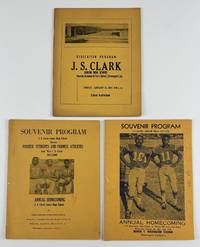
19694640Shreveport La 1969. Very good. Three programs: 48; 32; 306pp. each bound in yellow wrappers stapled. Mostly minor wear some dust-soiling a few stray ink marks one ownership signature. Overall a nice group. A trio of souvenir programs memorializing various events at Shreveport's J.S. Clark Junior High School beginning in the Jim Crow years and ending at the close of the 1960s. The earliest program was issued at the dedication ceremony for the new school in 1959. It features the speakers for the day including J.S. Clark himself group photographs of the faculty and various staff departments a list of patrons and more. The preponderance of the work is comprised of advertisements for local businesses and congratulatory messages from community members. Laid into this program is a printed letter from the day of the dedication with further information about the school. The second and third programs present here were issued to celebrate the school's annual homecoming both in October in 1967 and 1969 respectively. Each program is illustrated on the front cover with a photograph of football players. Each program contains information and sometimes images of the school its faculty the football team the Homecoming court and more with team rosters. As with the earlier dedication ceremony program these works contain numerous advertisements and well wishes from the larger community. The abundance of advertisements within these three programs provides a valuable source for studying the population of commercial and private supporters of the Black community in midcentury Shreveport. Also the programs are important as representations of the slow process of school desegregation in Louisiana specifically Shreveport. The school system in Shreveport did not fully integrate until after the Alexander v. Holmes County case in 1969 in which integration was ordered by the Supreme Court immediately no longer with "all deliberate speed. unknown
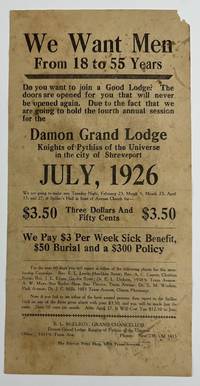
19265509Shreveport: The Service Print Shop July 1926. Good. Broadside 12 x 6 inches. Old folds small chip to upper corner noticeable soiling and staining. An unrecorded broadside advertising a membership drive for the Damon Grand Lodge of the Knights of Pythias of the Universe in Shreveport Louisiana in the midst of the Roaring Twenties. The text asks "Do you want to join a Good Lodge" before asserting that this present membership drive is a unique opportunity: "The doors are opened for you that will never be opened again." The text then relays the price for membership $3.50 and then fifty cents per month and details some of the potential benefits of joining the Knights: "We Pay $3 Per Week Sick Benefit $50 Burial and a $300 Policy." The broadside is signed in type at the bottom by B.L. McElroy Grand Chancellor of the Damon Grand Lodge. Interestingly the Damon Lodge was located 10511/2 Texas Avenue in Shreveport; the present broadside was printed by the Service Print Shop on the same street at 1009 Texas Avenue. As such the print shop was most likely a Black-owned-and-operated enterprise. Another interesting note -- near the bottom several individuals are named as contacts for prospective new members mainly pastors and doctors; most of these men also reside or work on Texas Avenue. A decidedly ephemeral and hyper-local advertisement for a Shreveport lodge of the Knights of Pythias with no copies in OCLC or anywhere we could think to check. The Service Print Shop, July unknown
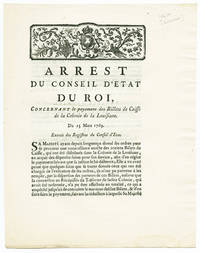
1769WRCAM34675Paris 1769. 3pp. Quarto on a folded folio sheet. Light dampstaining in bottom corner; three small worm holes in upper corner not affecting text. Near fine. A series of articles governing the settlement of certain French accounts left over from France's possession of Louisiana after the turnover of the territory to Spain in 1763. Wroth locates only the copy at the John Carter Brown Library; OCLC adds no more. Rare. MAGGS FRENCH COLONISATION OF AMERICA 571 this copy. WROTH ACTS OF FRENCH COLONIAL ADMINISTRATION 1790. unknown books
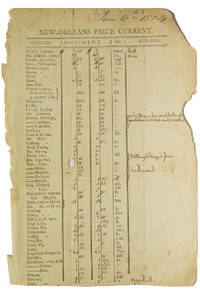
1804319786New Orleans 1804. 2p. partly-printed handbill with holograph additions. Folio. Lower margin trimmed close chips at edges. 2p. partly-printed handbill with holograph additions. Folio. A very early item accomplished by an American merchant in New Orleans just a year after the Louisiana Purchase. The handbill alphabetically lists approx. 80 commodities from Beef to Wines with a range of their prices accomplished in manuscript. The early owner of the present document has also included some manuscript notes on the trading; e.g. "dull" "rather falling in price" and "in demand."<br/><br/>Although several later New Orleans commercial newspapers would carry the above title we find no record of this handbill from years immediately following the Louisiana Purchase. unknown books
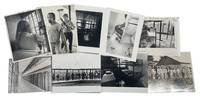
1930209001930. Prison & Incarceration Angola Prison Documentary Press Photograph Archive Depicting Inmate Living Conditions and Institutional Control at Louisiana State Penitentiary 1930-1976Former plantation Angola prison press photographs documenting Louisiana State Penitentiary the former Angola plantation turned state prison one of the most historically significant and controversial carceral institutions in the United States. Established on the grounds of a former slave plantation along the Mississippi River Angola developed into the largest maximum-security prison in the United States and became widely known during the twentieth century for forced agricultural labor racial segregation and persistent investigations into prison conditions. Photographs in this archive record inmate life security practices and the physical structure of the prison during the mid-twentieth century including images produced during the period when prison reform and incarceration policy became subjects of national debate.<br /> <br /> Archive of nine silver gelatin press photographs dating from 1930-1976 documenting the Angola prison complex and its inmates. Most photographs measure approximately 6 x 9 inches to 8 x 10 inches. Images include views of cell interiors with bunk beds and barred doors prisoners standing or moving through institutional corridors and groups of inmates assembled outdoors within the prison grounds. One photograph from 1973 shows a Black inmate seated on an upper bunk reading a book inside a crowded cell. Another 1973 image shows an unnamed Black prisoner wearing a bandana while looking outward through barred windows. A 1975 press photograph depicts a guard scanning Black inmate Kenny Johnston with a metal detector following a federal court order requiring the prison to adopt new security procedures. A 1976 image shows Black and white prisoners walking along a railway path within the prison yard dressed in everyday work clothing. The earliest photograph dated 1930 shows a group of white businessmen standing outside a wooden structure near a large stack of boxes reportedly constructed by prison labor. Several photographs retain original press captions or news articles attached verso including commentary on prison reform calling for a shift away from large centralized maximum-security institutions toward smaller community-based correctional facilities.<br /> <br /> Louisiana State Penitentiary at Angola emerged during the twentieth century as one of the most widely studied American prisons because of its origins as a former plantation and its long association with forced agricultural labor performed by incarcerated men. Convicts were historically housed in buildings originally constructed for enslaved people and compelled to work the surrounding fields. Public scrutiny intensified during the twentieth century as journalists courts and reform advocates documented violence racial inequality and inadequate living conditions inside the prison. By the 1970s the period represented most strongly in this archive the American criminal justice system faced growing calls for reform as federal courts intervened in prison administration and journalists published investigations into inmate treatment and overcrowding. Minor editorial markings and light edge wear consistent with press handling; overall condition very good. A cohesive documentary archive illustrating the lived environment of incarceration at one of the most historically consequential prisons in the United States. unknown
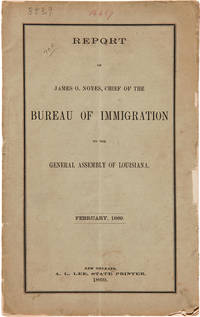
1869WRCAM55594New Orleans: A.L. Lee State Printer 1869. 30pp. Original printed wrappers. Soft vertical crease throughout wrappers somewhat chipped mild soiling. Small stain to upper corner of titlepage and following leaf otherwise text evenly toned. Withal a very good copy. A scarce and interesting report that is tantamount to a Reconstruction-era promotional for the state of Louisiana with commentary on emancipated African Americans in the state. The dramatic social revolution caused by the Civil War Emancipation and Reconstruction is reflected in the present work. After the Civil War Confederate nationalistic passions had not cooled sufficiently to encourage settlement in Louisiana. In fact immigration seemed to be headed the other way with "an emigration of thousands of our best citizens to the North" according to the report. <br> <br> Now however "an era of good feeling seems to be at hand." A diversifying society an abundance of crops and respect for "the political opinions" of northern immigrants are all bringing positive changes to Louisiana. Emphasizing the necessity of peaceful race relations Immigration Bureau Chief James Noyes counsels the former plantation owners "Never did any one people under the sun owe a greater debt of gratitude to another than do the property owners of Louisiana to the blacks just released from the hardships of slavery.The wonderful progress they have already made is the best possibly augury for their future." The wrapper title reads REPORT OF JAMES O. NOYES CHIEF OF THE BUREAU OF IMMIGRATION TO THE GENERAL ASSEMBLY OF LOUISIANA. <br> <br> Quite uncommon with OCLC recording just nine physical copies - seven under the title on the titlepage and two under the wrapper title. OCLC 82805252 10640135 82805252. A.L. Lee, State Printer unknown books
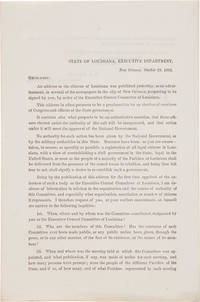
1863WRCAM55510New Orleans 1863. 2pp. printed on a folded quarto sheet. Faintest toning at bottom edge else fine. An interesting New Orleans imprint encapsulating the tensions between Northern political forces and indigenous conservative political actors during the brief Free State movement in Confederate Louisiana. Here George F. Shepley military governor of Louisiana from 1862 to 1864 rebukes Conservative Unionists H.H. Pugh E. Ames and J.Q.A. Fellows of the "Executive Central Committee of Louisiana." They had issued what "in effect purports to be a proclamation for an election of members of Congress and officers of the State government." Shepley pronounces such a proclamation void writing that "no authority for such action has been given by the National Government or by the military authorities in this State." Further Shepley demands the organizers of the committee answer a series of questions about the who what when where and why's of the committee's existence. <br> <br> The Executive Central Committee in Louisiana was a conservative organization that sought to re-institute the original American Constitution in Louisiana mainly to restore slavery and lobbied Abraham Lincoln on the matter in the summer of 1863. Of course Lincoln did not comply siding with the more radical Free State Committee and insisting on a new constitutional convention for Louisiana followed by new elections before Congress met in early December. The present document surely came about as a reaction to efforts by the Executive Central Committee to get their way before a new Constitution based on eventual Reconstruction the Emancipation Proclamation and new elections could be drafted and approved. Lincoln's efforts at a new constitution and elections for Louisiana continued into 1864 and came to fruition for a brief time with new elections in late February and a new constitution ratified by public vote in September. This new political landscape for Louisiana was short-lived however as the U.S. Congress refused to seat the Louisiana delegation in December 1864. <br> <br> Not in Jumonville or Thompson and with no copies in OCLC. An illuminating entry in the brief Free State movement in Louisiana during the Civil War. unknown books
1782PHO-1554Moutard, Paris, 1782. 2 vol. in-8 de 432 pp. et 272 pp. illustré de 10 planches dépliantes, relié plein basane époque, dos lisse avec titre et tomaison (reliures différentes), frottements, coins et coiffes usés, bord des planches usé.
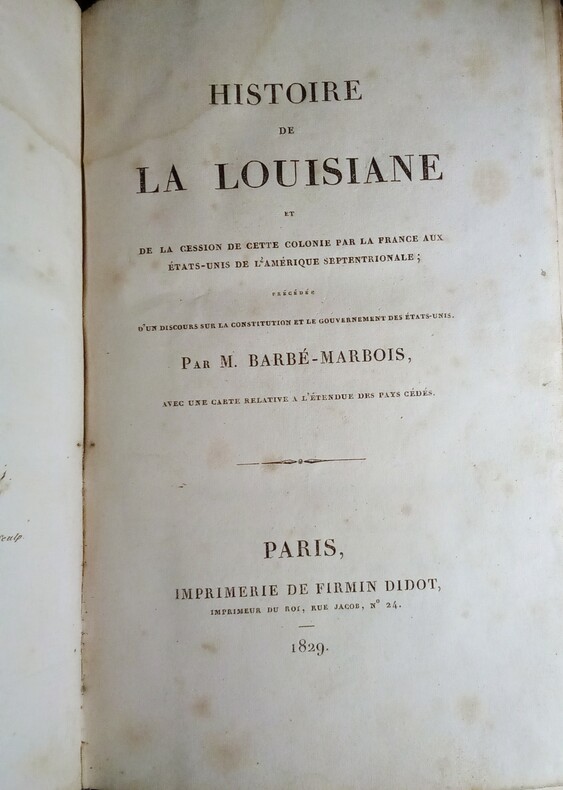
1839WOC-2068Avec la Carte Générale des Etats-Unis pour servir à l'Histoire de la Louisiane 1829, dépliante relative à l'étendue des Pays cedés avec les limites en couleurs d'époque et un portrait de l'auteur en frontispice. Paris, Firmin Didot, 1829. In-8 (22x3,5x13cm) relié plein cartonnage vert d'époque, dos à faux nerfs dorés et titre doré. 2ff de notes au Dauphin + 285pp. Quelques mouillures transparentes dans toutes marges de l'ensemble du livre.