1 546 résultats
41797Paris Chez F. Buisson, Libraire 1807 in 8 (20,5x12,5) 3 volumes reliures demi basane marron (XXe), dos lisses ornés de filets dorés. Tome 1: XII et 346 pages, petit trou de ver sur l'extrémité de la marge latérale externe des pages 193 à 232. Tome 2: 511 pages, avec une grande carte gravée dépliante in fine: CARTE DES DEUX FLORIDES ET DE LA LOUISIANE INFERIEURE. Tome 3: XII et 551 pages, avec une planche dépliante: Renvois des différentes parties de la maison ou la dame Saint-Julien a été assassinée . Voyages dans l'intérieur de la Louisiane, de la Floride occidentale, et dans les isles de la Martinique et de Saint-Domingue, pendant les années 1802, 1803, 1804, 1805 et 1806; contenant de nouvelles observations sur l'histoire naturelle, la géographie, les moeurs, l'agriculture, le commerce, l'industrie et les maladies de ces Contrées, particulièrement sur la fièvre jaune, et les moyens de la prèvenir en outre, contenant ce qui s'est passé de plus intéresssant, relativement à l'établissement des Anglo-Américains à la Louisiane; suivis de la flore louisianaise; avec une carte nouvelle, gravée en taille-douce. Charles César Robin, 1750-1794. Bel exemplaire ( Photographies sur demande / We can send pictures of this book on simple request )
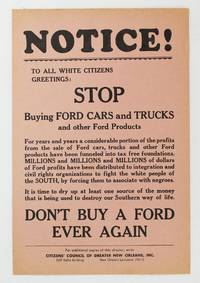
19606351New Orleans 1960. Near fine. Broadside 9 x 6 inches. Minor toning. Broadside urging the white citizens of New Orleans to stop buying Ford cars claiming Ford profits "have been distributed to integration and civil rights organizations" to the detriment of white folks "by forcing them to associate with negroes." The broadside declaims "It is time to dry up at least one source of the money that is being used to destroy our Southern way of life. Don't ever buy a Ford again." The Citizens' Council of Greater New Orleans lobbied for boycotts on several companies that they felt were encouraging Southern society into integration. unknown
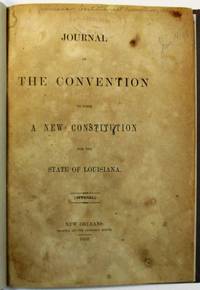
185236379New Orleans: Printed at the Crescent Office 1852. 100pp. Toned with some foxing light rubberstamp on title page. Upper blank corners of last two leaves renewed couple of small holes in last leaf affecting about five letters. Good in modern boards.<br /> <br /> The new Constitution mandated that "the Legislature shall apportion the representation among the several parishes and election districts on the basis of the total population. A representative number shall be fixed and each parish and election district shall have as many Representatives as its aggregate population shall entitle it to." This meant that in apportioning representatives slaves would be counted in determining the "total population" even though the franchise was limited to adult white males. The legislative deck was thus stacked in favor of election districts with large slaveholding plantations; and the interests of that segment of the State would dominate governmental councils.<br /> This provision created significant opposition to the proposed Constitution which was adopted by the narrowest of margins. Many called it "anti-republican" arguing that it reflected "a calculated effort to reduce the political power of regions where the black population remained sparse" Hyde Pistols and Politics 70 LSU Press: 1996.<br /> The Journal records the Convention's daily proceedings during July 1852 and prints the proposed Constitution. <br /> Jumonville 2151. Thompson 1300. Cohen 3106. Not in Harv. Law Cat. or Marke. Printed at the Crescent Office unknown
192041175Washington D.C.: Published by the United States Coast and Geodetic Survey 1920. Large folding nautical chart printed on heavy paper stock. Colored. A rare original coastal survey of the end of the Mississippi River as it splits into passes of the Bird's Foot Delta into the Gulf of Mexico.<br/> <br/> Established by President Thomas Jefferson in 1807 as the Survey of the Coast the U.S. Coast and Geodetic Survey was the United States' first civilian scientific agency. This agency has followed its mission to survey the U.S. coastline create nautical charts of the coast and help increase maritime safety since its founding and has often played fascinating roles in significant chapters of U.S. history. It served in all theaters of the Civil War in the service of the Union Army and Navy pioneered acoustic exploration in the wake of the sinking of the Titanic and during WWI it worked to detect enemy submarines. In addition this agency worked to survey and produce detailed maps and renderings of the U.S. coast. These nautical survey maps commonly referred to as "T-sheets" provide fascinating insights into the history of the United States coastline which has and will continue to shift. These maps are the most important data source for understanding the physical and ecological characteristics of the U.S. shoreline. The present map of the Louisiana coastline is notable for the inclusion of the Bird's Foot Delta the mouth of the Mississipi River as it splits into smaller passes. This map is fascinating because this is the youngest lobe of the Mississippi Delta and has seen notable changes in the past 100 years. This map is a highly detailed and accurate sea chart of the Mississippi River and an important historical view of the developing Louisiana. Published by the United States Coast and Geodetic Survey unknown
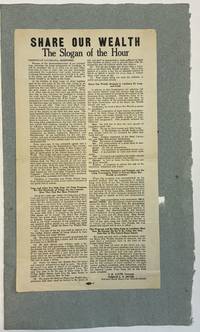
193640262Baton Rouge 1936. Folio broadside 9-3/8" x 17-1/8." Printed in two columns union bug at the bottom margin several type sizes and styles. Mounted at the upper blank verso on pale blue paper. Fine.<br /> <br /> O.K. Allen became Louisiana's governor in 1932 when Huey Long resigned the office to become a U.S. Senator. "Allen was considered a political stooge for former governor Long. His brother Earl Long once joked that a leaf blew into Allen's office one day and that he signed it thinking it was legislation from Long" Wikipedia. Gerald L.K. Smith "began his career as a leader of the populist Share the Wealth movement during the Great Depression. . . He was a preeminent antisemite and a white supremacist" Wikipedia.<br /> This broadside supports Allen's campaign to win the Democratic nomination for U.S. Senate. Huey Long's 1936 assassination had rendered the seat vacant. The broadside announces the unbreakable partnership "between the Louisiana Democratic Association of which O.K. Allen is the Head and the Share Our Wealth Society of which Gerald L.K. Smith is the Head." They have vowed to carry on the work of "our late beloved Senator Long." Allen died a week before the election.<br /> Not located on OCLC as of July 2024. unknown
1808WRCAM31953New Orleans: Bradford & Anderson 1808. viii1451pp. Dbd. Many leaves and signatures loose. Moderate browning. Contemporary ownership signature and stamp on titlepage. Good. An early printing of session laws from the Territory of Orleans admitted to the Union four years later as Louisiana. Printed in both English and French. A rare New Orleans imprint. OCLC locates only five copies. JUMONVILLE 173. FOOTE p.4. McMURTRIE NEW ORLEANS 131. SHAW & SHOEMAKER 15813. THOMPSON 1083. MACDONALD CHECKLIST OF SESSION LAWS p.70. OCLC 24446395. Bradford & Anderson unknown books
1868700681868. Louisiana's Reconstruction-Era Constitution Louisiana. Constitution Adopted by the State Constitutional Convention of the State of Louisiana March 7 1868. Printed by the New Orleans Republiean sic In Accordance with a Resolution of the Constitutional Convention Adopted March 7th 1868. New Orleans: Printed at the Republican Office 1868. 22 pp. Octavo 9-1/2" x 5-1/2". Stab-stitched pamphlet in plain wrappers bound into to later library cloth. Some soiling light shelfwear. Moderate toning and light foxing to text faint dampstaining to margins of a few leaves library stamps and marks to title page and its verso. $750. Louisiana's 1868 constitution instituted the criteria necessary for readmission to the Union. It eradicated the Black Codes of 1865 removed property qualifications for holding office and disenfranchised former Confederates. Indicating support for the Fourteenth Amendment which would be ratified on July 9 1868 the constitution granted full citizenship to African-American men with equal civil and political rights. It also banned segregated public schools and segregated accommodations on public transportation. This constitution was the First in Louisiana's history to include a bill of rights. These rights were severely diminished in Louisiana's 1879 constitution which followed the end of Reconstruction. Babbitt Hand-List of Legislative Sessions and Session Laws 152. unknown books
185236379New Orleans: Printed at the Crescent Office 1852. 100pp. Toned with some foxing light rubberstamp on title page. Upper blank corners of last two leaves renewed couple of small holes in last leaf affecting about five letters. Good in modern boards.<br/><br/> The new Constitution mandated that "the Legislature shall apportion the representation among the several parishes and election districts on the basis of the total population. A representative number shall be fixed and each parish and election district shall have as many Representatives as its aggregate population shall entitle it to." This meant that in apportioning representatives slaves would be counted in determining the "total population" even though the franchise was limited to adult white males. The legislative deck was thus stacked in favor of election districts with large slaveholding plantations; and the interests of that segment of the State would dominate governmental councils.<br/> This provision created significant opposition to the proposed Constitution which was adopted by the narrowest of margins. Many called it "anti-republican" arguing that it reflected "a calculated effort to reduce the political power of regions where the black population remained sparse" Hyde Pistols and Politics 70 LSU Press: 1996.<br/> The Journal records the Convention's daily proceedings during July 1852 and prints the proposed Constitution. <br/>Jumonville 2151. Thompson 1300. Cohen 3106. Not in Harv. Law Cat. or Marke. Printed at the Crescent Office unknown books
1768122974à Paris, chez Le Jay 1768 2 parties en 1 volume. In-12 18 x 10 cm. Reliure de l’époque veau havane, dos lisse orné de double filets dorés, pièces de titre et de tomaison maroquin grenat et noir, XX-244-264 pp., notes en bas de page, bandeaux, table, catalogue libraire in fine. Accrocs en pied et en tête de dos, coins émoussés et frottés, intérieur frais.
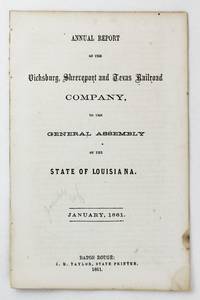
18616313Baton Rouge: J.M. Taylor 1861. About very good. 7pp. Disbound. Minor edge wear small dampstains at lower right corner. Minor tanning and faint foxing. Scarce report for the Vicksburg Shreveport and Texas Railroad issued in the same month that Louisiana seceded from the United States. This edition details the construction completed up to January 1861 and encourages the state legislature to continue funding the project given the context of secession -- "Event are beginning to justify the policy of the State in extending aid to the full extent of Constitutional ability to the various railroads with its boundaries. As a means of military defense this road is of great importance to the state. If any emergency should make it necessary to concentrate a body of armed men in any of the parishes on the Mississippi the citizen-soldiers from the more populous upland parishes may be carried over it from Monroe in a few hours." OCLC notes several institutions with small runs of this report but most seem to lack this January 1861 issue. J.M. Taylor unknown
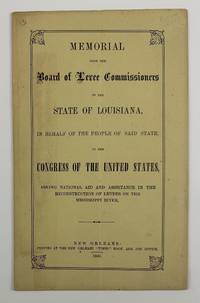
18663572New Orleans 1866. Very good. 12pp. Original printed wrappers sewn. Minimal soiling light edge wear to wrappers. Vertical center crease throughout. Light even toning to text otherwise very clean. A scarce work issued by the Reconstruction government of the state of Louisiana seeking funds from the United States Congress to make repairs to the Mississippi River levees "together with its tributaries the Arkansas and Red rivers." The Board of Levee Commissioners was seeking federal aid because the state of Louisiana had become so impoverished by the end of the Civil War stating here that "The State crippled as she is in her resources is still making herculean efforts to protect her citizens." Before the war argues the Board the state as well as the proprietors of the lands along the Mississippi River were able to maintain the levees albeit "at an immense outlay of labor and money" but "at a time of general prosperity when labor was abundant and cheap." In other words slave labor was formerly employed to maintain the levees and now that the people of Louisiana can no longer use slaves the state wants make the federal government pay literally. One passage in the work even discusses in detail the impact of slaves and free persons of color who have abandoned thirteen parishes which are now "almost altogether desolated." The report cites census and crop yield data to make the point that without this practically free labor force as well as the cotton sugar molasses and corn they produced the labor and economic impact on Louisiana of taking away a free labor force was onerous.<br /> <br /> Works by the Board of Levee Commissioners are rather rare in institutions with just eight copies of the present work in OCLC at LSU Tulane the University of Alabama the Library of Congress the Minnesota Historical Society Library Duke the Rutherford B. Hayes Presidential Center and UT-Austin. unknown
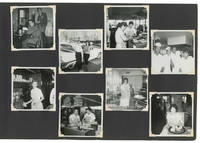
196328031New Orleans 1963. Very Good -. New Orleans: ca. 1960-1965. Large oblong quarto 27x41cm.; brown gilt-tooled leatherette bound with leather strap; 47ll. to which are mounted 311 photographic snapshots nearly all black and white and measuring 8.5x8.5cm. Album a bit scuffed at extremities joints significantly cracked from use and poor quality of leatherette leaves a bit thumbed along fore-edge margins a number of photographs apparently removed though otherwise Good to Very Good contents that remain mostly in fine condition.<br /> <br /> Extensive though sadly uncaptioned personal photo album of a young white woman in New Orleans in the early to mid-1960s documenting her social family and work life date based on shots time-stamped 1963 and 1964. What we have gathered from the contents the compiler worked at least briefly as a server at a diner whose staff was mixed-race though still separated by position: the servers all appear to be white while the grill cooks and kitchen staff are Black. <br /> <br /> Of special note are the compiler's frequent trips to the Pontchartrain Beach amusement park in New Orleans a popular destination in the 1960s though the park was sold and its rides disbursed in the 1980s due to declining attendance. This album however beautifully captures its heyday including shots of the rides carnival games swimming pool tiki bar and a perennial favorite an oversized head inside of which our compiler loved to pose. <br /> <br /> The compiler as well as being a dog-lover was evidently a serious party-goer and additional snapshot vignettes capture various couples making out at a New Year's party or dressed up for Halloween. <br /> <br /> An excellent record of white New Orleans working class life marking the advent of the Swinging Sixties. unknown
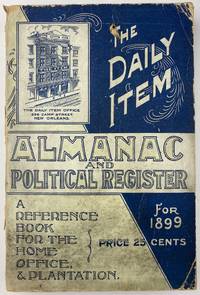
18991837New Orleans: The Daily Item 1899. About very good. 600pp. Original printed pictorial wrappers. Extremities worn covers rubbed and lightly soiled. Some slight worming heavier at front of text. Light tanning and wear. A rare New Orleans almanac full of facts and figures on a wide array of subjects ranging from Queen Victoria's income to information on the Texas petroleum industry. With numerous advertisements for businesses across the country including a woodcut depicting the publisher's premises. The publication appears to have been rather short-lived appearing from 1897 to 1900. An interesting and eclectic volume designed to be an all-purpose ready reference for the average man. OCLC locates four serial holdings for this title all in the South. The Daily Item unknown books
189578199New Orleans: Louisiana Historical Society. Very Good. 1895. Hardcover. Ex-library in 10 volumes in 5 bound in maroon library buckram measuring 8 3/4 x 6 inches - bright contents with several illustrations. . Louisiana Historical Society hardcover
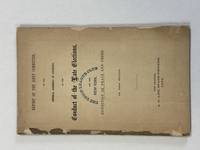
186841040New Orleans LA: A.L. Lee State Printer 1868. 68pp. Stitched without wrappers. Old rubberstamp of Union League Club New York. A few shallow blank extremity chips. Good. <br /> <br /> During the election year 1868 "White gangs roamed New Orleans intimidating blacks and breaking up Republican meetings" Foner Reconstruction 342. Other Parishes experienced the same story; in St. Landry a mob "invaded the plantations killing as many as 200 blacks.Unable to hold meetings and fearful that attempts to bring out their vote would only result in further massacres Georgia and Louisiana Republicans abandoned the Presidential campaign" Id. <br /> The Republican Party controlled Louisiana's General Assembly. Its Report is a frightening picture of violent resistance to Reconstruction describing "a state of lawlessness terrorism and crime that is unparalleled in any civilized country." Not only are the "desperate and infamous characters" who directly perpetrate the violence responsible; blameworthy also is "that large and respectable class of the people of the State. . . who refrain studiously from any efforts to restrain or bring them to justice." The Report is a detailed Parish-by-Parish examination of atrocities. <br /> FIRST EDITION. Thompson 1226. A.L. Lee, State Printer unknown
187636046Washington DC: Smithsonian Institution. Collins Printer Philadelphia 1876. First Edition. Hardcover. Good. Folio. 1 x 171 pages 1 page blank. Illustrated. Custom half leather binding with green morocco leather corners and spine. Raised bands gilt decorations and gilt lettered title on the spine. Reddish marbled end sheets. Top edge gilt. Original outer printed wraps preserved. Leather is rubbed and scuffed head and base of the spine and on the corner edges. Light edge wear to the boards. Interior contents clean. <br /> <br /> This copy has a one page letter dated October 19 1870 pasted on the right front flyleaf. The letter written on a Liverpool Hotel letterhead was addressed "My Dear Brother" and signed by Joseph Jones. Contents of the letter relate to Joseph Jones visit in Liverpool. Armorial bookplate of Charles C. Jones Jr. located on the front paste down. Charles C. Jones Jr. was a Georgia historian and author. Smithsonian Institution. Collins, Printer, Philadelphia hardcover
1853WRCAM31934New Orleans: J.L. Sollée 1853. 44pp. Original printed wrappers. Minute wear to wrappers. Internally clean. Very good. A rare New Orleans printing of DON JUAN. with the text printed in English and French. OCLC locates only two copies and Jumonville adds one more. JUMONVILLE 2268. OCLC 24437616. J.L. Sollée unknown books
1828WRCAM31957New Orleans: Benjamin Levy 1828. First volume only of two. iv688pp. Contemporary plain boards rebacked in period style. Original spine remnants laid in. Faint dampstain in upper margin throughout. Overall internally clean. Contemporary ownership signature on rear board later ownership signature on front free endpaper later ownership stamp on front board. Overall very good partially unopened and untrimmed. The first volume only of this comprehensive listing of the laws of Louisiana from 1804 to 1828. Also issued in French the same year. Scarce. COHEN 5664. SABIN 42228. AMERICAN IMPRINTS 38099. JUMONVILLE 629. FOOTE p.179. KORN 130. Benjamin Levy hardcover books
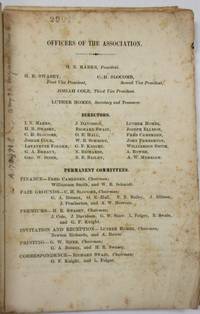
186737280New Orleans: Printed at the Commercial Bulletin Job Office 1867. 60 25- advertisements 3 blanks pp. Original printed yellow wrappers some extremity chipping. Originally stitched now loosened. Illustration on rear wrapper: 'Front Entrance Gentilly Road. Several institutional stamps scattered foxing and dusting. The final 25 pages are advertisements from various commercial enterprises mostly from New Orleans. Good.<br /> <br /> The Report announces Louisiana's entry into the post-War New South displaying its "improvements" in agriculture and the "Mechanic Arts." The advertisements alone demonstrate impressively Louisiana's determined recovery from the War. <br /> Officers Directors and Committee Members are listed after the title page. The Fair's President was the merchant I.N. Marks. "As indicated by his name ISAAC N. MARKS is of Hebrew descent and is a distinguished representative of his highly favored race but contrary to the usual customs of that people he has adopted the Christian faith. This change in his creed is due to the independent manner of thought which has characterized him from his boyhood and has ever made him master of his personality in the domain of both his sentiments and business. Mr. Marks is a native of South Carolina having been born at Charleston on the 5th of May 1817. At the age of nineteen he came to New Orleans and linked his career with that of his adopted city then lacking much of the greatness and grandeur which to-day places her a queen among cities" online 'Genealogy Trails History Group Orleans Parish <br /> The pamphlet records Louisiana's first Fair after the War's end in late November 1866. An essay explains its establishment and inauguration in late November 1866. "The mellow light of an Indian Summer's sun shone down." The various exhibits are listed followed by Marks's Address lamenting the "long and disastrous war leaving in its desolated path ruin upon every side; agriculture paralyzed; commerce languishing; a well-regulated labor system grown venerable in its usefulness and its humane tendencies suddenly and violently destroyed." Other Addresses call for immigration manufactures agricultural improvements and modernization.<br /> Not in Thompson which records later fairs of this Association. OCLC 24446596 1- Historic New Orleans Collection as of December 2020 but not collating the 25-page advertisement section. Printed at the Commercial Bulletin Job Office unknown
186737280New Orleans: Printed at the Commercial Bulletin Job Office 1867. 60 25- advertisements 3 blanks pp. Original printed yellow wrappers some extremity chipping. Originally stitched now loosened. Illustration on rear wrapper: 'Front Entrance Gentilly Road. Several institutional stamps scattered foxing and dusting. The final 25 pages are advertisements from various commercial enterprises mostly from New Orleans. Good.<br/><br/> The Report announces Louisiana's entry into the post-War New South displaying its "improvements" in agriculture and the "Mechanic Arts." The advertisements alone demonstrate impressively Louisiana's determined recovery from the War. <br/> Officers Directors and Committee Members are listed after the title page. The Fair's President was the merchant I.N. Marks. "As indicated by his name ISAAC N. MARKS is of Hebrew descent and is a distinguished representative of his highly favored race but contrary to the usual customs of that people he has adopted the Christian faith. This change in his creed is due to the independent manner of thought which has characterized him from his boyhood and has ever made him master of his personality in the domain of both his sentiments and business. Mr. Marks is a native of South Carolina having been born at Charleston on the 5th of May 1817. At the age of nineteen he came to New Orleans and linked his career with that of his adopted city then lacking much of the greatness and grandeur which to-day places her a queen among cities" online 'Genealogy Trails History Group Orleans Parish <br/> The pamphlet records Louisiana's first Fair after the War's end in late November 1866. An essay explains its establishment and inauguration in late November 1866. "The mellow light of an Indian Summer's sun shone down." The various exhibits are listed followed by Marks's Address lamenting the "long and disastrous war leaving in its desolated path ruin upon every side; agriculture paralyzed; commerce languishing; a well-regulated labor system grown venerable in its usefulness and its humane tendencies suddenly and violently destroyed." Other Addresses call for immigration manufactures agricultural improvements and modernization.<br/>Not in Thompson which records later fairs of this Association. OCLC 24446596 1- Historic New Orleans Collection as of December 2020 but not collating the 25-page advertisement section. Printed at the Commercial Bulletin Job Office unknown books
Interessante raffigurazione di buona parte orientale degli Stati Uniti. Si trovano raffigurati i territori di New Jersey, Delaware, Maryland, Virginie, Caroline, Georgie, Floride e Louisiane.Il titolo è iscritto in decorativo cartiglio nell'angolo in basso a destra.Coloritura confinale coeva all'acquerello. Alcuni segni del tempo che non compromettono l'ottimale stato di conservazione generale della carta.
192041177Washington D.C.: Published by the United States Coast and Geodetic Survey 1920. Large folding nautical chart printed on heavy paper stock. Colored. A rare original coastal survey of Mississippi River area around the city of New Orleans.<br/> <br/> Established by President Thomas Jefferson in 1807 as the Survey of the Coast the U.S. Coast and Geodetic Survey was the United States' first civilian scientific agency. This agency has followed its mission to survey the U.S. coastline create nautical charts of the coast and help increase maritime safety since its founding and has often played fascinating roles in significant chapters of U.S. history. It served in all theaters of the Civil War in the service of the Union Army and Navy pioneered acoustic exploration in the wake of the sinking of the Titanic and during WWI it worked to detect enemy submarines. In addition this agency worked to survey and produce detailed maps and renderings of the U.S. coast. These nautical survey maps commonly referred to as "T-sheets" provide fascinating insights into the history of the United States coastline which has and will continue to shift. These maps are the most important data source for understanding the physical and ecological characteristics of the U.S. shoreline. The present map of the Louisiana coastline is notable for the inclusion of the city of New Orleans including mention of City Park and Carrollton. The map tracks the Mississippi southward to Grand Prairie. The map is a highly detailed and accurate sea chart of the New Orleans area along the Mississippi and an important historical view of developing Louisiana. Published by the United States Coast and Geodetic Survey unknown
192041170Washington D.C.: Published by the United States Coast and Geodetic Survey 1920. Large folding nautical chart printed on heavy paper stock. Colored. A rare original coastal survey of the southern Louisiana coast and includes Pecan Island Vermilion Bay and Marsh Island.<br/> <br/> Established by President Thomas Jefferson in 1807 as the Survey of the Coast the U.S. Coast and Geodetic Survey was the United States' first civilian scientific agency. This agency has followed its mission to survey the U.S. coastline create nautical charts of the coast and help increase maritime safety since its founding and has often played fascinating roles in significant chapters of U.S. history. It served in all theaters of the Civil War in the service of the Union Army and Navy pioneered acoustic exploration in the wake of the sinking of the Titanic and during WWI it worked to detect enemy submarines. In addition this agency worked to survey and produce detailed maps and renderings of the U.S. coast. These nautical survey maps commonly referred to as "T-sheets" provide fascinating insights into the history of the United States coastline which has and will continue to shift. These maps are the most important data source for understanding the physical and ecological characteristics of the U.S. shoreline. The present map of the Louisiana coastline is notable for the inclusion of Marsh Island which was deeded to the state in 1920 the year this map was produced. It is a highly detailed and accurate sea chart of the Vermilion Bay and an important historical view of the developing Louisiana. Published by the United States Coast and Geodetic Survey unknown
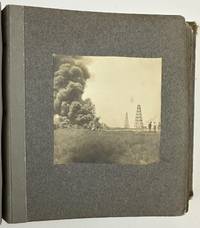
19033176Various locations in Louisiana 1903. About very good. Twelve leaves illustrated with twenty silver gelatin photographs. Contemporary gray cloth photograph album string-tied front cover stamped in gilt "The Kodak Book." Noticeable soiling and rubbing to boards edges worn. Two photographs detached mild wear to a few pictures but overall nice condition. A charming collection of vernacular images of southern Louisiana in the first few years of the 20th century taken by local resident May Hill Wilkinson. Wilkinson has signed the inside front cover in pencil "Mrs. C A Wilkinson May Hill Lake Charles and Jennings." Additionally manuscript notes on the inside front cover a couple of slips inside the album and on the verso of one of the loose photographs also indicate Wilkinson's authorship of the pictures per her daughter Lyllis who indicates the pictures were taken before she was born in Jennings in 1904. Wilkinson's photographs mostly depict scenes on the waters of Lake Charles and Lake Arthur but also include a handful of scenes in the wooded areas around Jennings.<br /> <br /> A particularly striking photograph captures an oil field fire in Evangeline Louisiana according to a later note from Lyllis opposite the photo; Evangeline is only six miles from Jennings and was the site of the first oil strike in Louisiana in September 1901. Wilkinson's photograph captures a billowing cloud of smoke at left with men and oil derricks visible to the right. This is likely one of the earliest vernacular photographs of the Evangeline Oil Field which would bring untold riches to the people of Jennings. A nice mixture of images from a time and place rarely seen in vernacular photographs. unknown
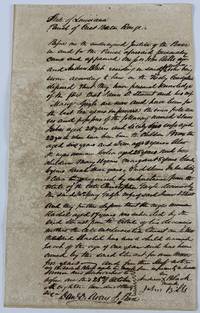
183613107East Baton Rouge Parish LA: October 25 1836. 1p. on a single folded sheet integral blank docketed on verso. Old folds moderate toning and foxing short closed tear along one fold line a few small instances of ink burn. Overall good condition. An interesting document of legal testimony involving numerous named slaves in Louisiana in 1836 ranging in age from one year to almost thirty years of age and including seven children. According to the docketing the document is effectively a "Title to Slaves." The deponents were two local citizens John Bills and Andrew Black who had "personal knowledge of the fact that James D. Stuart and his wife Mary Gayle are now and have been for the last ten years & upwards the bona fide owners and possessors of the following named slaves: Juba Aged 25 and Sicily his wife aged 22 to whom have been born the children Braxton aged six years and Dan aged 3 years. Also the negro woman Celia aged 28 years and her children Mary 11 years Margaret 8 years Charley 6 years Sarah three years which slaves Juba Sicily & Celia were acquired by inheritance from the estate of Christopher Gayle. And they further depose that the negro woman Rachel aged 17 years was inherited by the said Stuart from the estate of his deceased mother.and that the said Rachel has now a child named Jacob of the age of one year." The document is signed by Black Bills and the Justice of the Peace Daniel D. Avery. Documents involving slave inheritance of and subsequent ownership by not one but both members of a marriage are exceedingly rare. October 25 unknown