AFGHANISTAN - SECOND ANGLO-AFGHAN WARBiblio.com
Substantial dossier of government papers from the archive of Reginald Baliol Brett private secretary to the secretary of state for India including the manuscript draft of General Gordon's suppressed letter on the withdrawal from Kandahar.
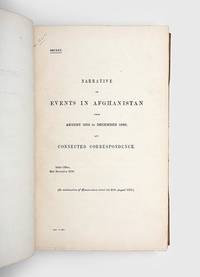
1878166983London & Simla: 1878-82. Confidential India Office archive revealing British decision-making in the final phase of the Second Anglo-Afghan War An exceptional archive of confidential India Office and Government of India papers this collection offers an unusually detailed view of the diplomatic and bureaucratic manoeuvring that accompanied the final stages of the Second Anglo-Afghan War and the negotiation of Britain's withdrawal. Bringing together Foreign Department memoranda from Simla Cabinet papers printed at the Foreign Office and India Office material that seldom survives outside official files it reconstructs policy formation across two administrations and two continents. Running through the papers is the early career of Reginald Baliol Brett later 2nd Viscount Esher who became private secretary to Lord Hartington in 1878. As Hartington and the new Liberal government sought to reverse Lord Lytton's "forward" policy and disengage from Afghanistan the India Office and the Government of India frequently disagreed over strategy intelligence and the limits of influence. The archive captures these tensions vividly and shows Brett learning to operate as an assertive intermediary whose probing questionnaires marginalia and attempts to synthesize rival views already marked him out as a rising - and at times unsettling - force within the department. The documentary foundation of the dossier lies in A. W. Moore's two major surveys of Afghan affairs annotated by Brett and widely regarded as the most authoritative India Office narratives of the conflict. These are complemented by a sequence of extremely restricted Simla-printed papers and a run of Cabinet memoranda from Thomas Harrison's private press together charting the shift from aggressive frontier ambition to the more pragmatic Liberal policy of withdrawal and the recognition of Abdur Rahman as Amir. High-level submissions by Hartington Ripon and Evelyn Baring illuminate the arguments over the retention of Kandahar and Pishin while the "Aide-Mémoire" on negotiations with Abdur Rahman documents the decisive recalibration of British aims. Other materials probe the immediate crises of the war: memoranda assessing Yakub Khan's responsibility for the Kabul Residency attack; correspondence among Griffin Stewart and Lyall on the deteriorating northern situation; and the substantial "Very Confidential" dossier of Russian correspondence between General von Kaufmann and Shere Ali which exposes the diplomatic pressures of the "Great Game". Operational detail appears in the viceroy's secret telegrams of early 1880 field reports from Kandahar and Kabul Wilson's military sketch of the campaign and manuscript troop returns. Among the most revealing personal items is General Charles Gordon's autograph draft of a letter to The Times opposing the retention of Kandahar heavily revised and ultimately suppressed by Brett who feared it would damage Gordon's standing. His decision and later grief at Gordon's death lend an unexpected human dimension to a collection otherwise dominated by official policy and statecraft. Only a handful of the documents can be traced in institutional collections and few survive in private hands. Gathered here in a coherent sequence with close associations they provide a rare high-resolution record of how British officials interpreted the war navigated clashing doctrines and personalities and ultimately engineered their exit from Afghanistan. A full list of the contents is available on request. Folio 339 x 215 mm comprising 37 printed and manuscript items: full listing with titles paginations and outline content given in the note. Contemporary light olive brown diagonal zigzag-grain cloth boards rebacked and cornered in brownish orange morocco in the mid-20th century red morocco label original moderate bluish green endpapers retained matching linen hinges. Esher armorial bookplate. Cloth starting to lift a little from the edges of spine; contents variably browned margins a little fragile in places with a few consequent chips and splits one title page torn across and neatly repaired with archival tape: overall very good. James Lees-Milne The Enigmatic Edwardian: The Life of Reginald 2nd Viscount Esher 1986. hardcover
Peter Harrington · Royaume-Uni20 000,00 £GB≈ 22 836,00 €