11 476 résultats
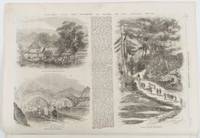
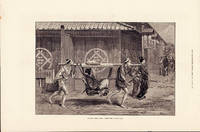
1872188280London.: The Illustrated London News. November 21872. Black and white wood engraving printed on a single newspaper leaf 19.4 x 29 cms image; 27.5 x 41.8 cms sheet related text on the verso very good condition. Wood engraving prepared for The Illustrated London News depicting a Japanese woman being carried in a kago through the streets of Yokohama. The illustration is by French artist Felix Elie Regamey who along with his brother Frederic contributed to The Illustrated London News together with other illustrated newspapers. Felix noted in the text to the illustration printed on the verso of the leaf that: "The kago is the vehicle we travel in when exhausted with much walking. The position as you see is not an easy one to a man whose limbs are not supple; but a good deal of ground is got over.It takes an hour to recover the use of the legs after sitting in a kago for a short time--but one does recover." <br> <br>In 1876 Felix travelled to Japan with the French industrialist and collector Émile Guimet meeting the Japanese artist Kawanabe Kyosai their resulting sketches of each other as well as an account of the journey were published as "Promenades japonaises" Japanese Promenades; 1878 1880. . The Illustrated London News unknown
1861177172London.: The Illustrated London News. Saturday October 261861. Single issue lacks the separately published Supplement four full-page engravings several half-page 24 pp pp 415-438 disbound from a larger compilation original stab holes light foxing very good condition. Includes news of the return of the British consul George Staunton Morrison and a cameo engraving of him following the fatal storming of the British legation in Edo by samurai of the Mito clan in July 1861. An unrelated and contrasting full-page engraving of Matchlockmen at Omura and three other views of a mountain pass and hot springs in Takiwa and the Megane bridge in Isahaya accompany a tranquil travelogue "A ride through Kiusiu Japan". <br> <br>Preparations for the London International Exhibtion of 1862 are included with a full-page engraving and presentation of colours to the London Rifle Volunteer Brigade with a full-page engraving. <br> <br>The final page with three engravings is given to coverage of the American Civil War and the advance of "Federalists" on Munson's Hill. . The Illustrated London News. unknown
191044085Kobe: Tamamura Photographic Studio / T. Takagi N.d. ca 1910. Oblong octavo 18cm x 26cm. Original silk-covered boards bouond with red silk cord; 19 colored collotype plates. Gift inscription from an N.L. Thacker on verso of title page dated 1914; child's ownership inscription on verso of final plate "Ermy Tharp Novato Cal" dated 1936. Rubbing and wear to board edges; internally clean and sound - a Very Good copy with all plates present. An attractive Meiji Era souvenir album with subtly hand-tinted collotype plates depicting a traditional Japanese wedding ceremony. One of several editions produced between 1906 and 1920; per the excellent bibliography of Tamamura's souvenir albums at ours would appear to be the Third Edition of 1910. Tamamura Photographic Studio / T. Takagi unknown
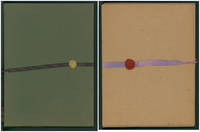
199238078Midori no Yakata 1992. First Edition. Printed wrappers. Edition limited to 20 numbered copies; this set is #16. Printed on watercolor paper with glassine dustwrappers. Comes in cardboard boxes with silk ribbon. Each volume contains five engraved bookplates protected by tissue paper. Volume I is in near fine condition with some light scattered foxing throughout. Volume 2 is in fine condition. Boxes show light wear. ; Octavo. Midori no Yakata unknown
1880613<p>Manuscript 12pp. of gouache paintings on fine cloth pages calligraphic labels in Japanese next to each specimen tipped into a modern binding with a gilt appliqué border 150 x 230mm c.1880</p><p>This album contains illustrations of moths butterflies dragonflies a spider a stag beetle a lady bird a wasp lizards frogs and toads cicadas grasshoppers hornets a cockroach a centipede and the full life cycle of a silkworm executed by a skilled artist in gouache.</p><p>This was produced during the Meiji period an important time for Japanese art. In 1868 the restoration of imperial rule in Japan brough the Edo shogunate to an end and marked the start of the Meiji era which would last until the death of Emperor Meiji in 1912. During this brief period Japan transformed itself from an isolated feudal nation to a world power. The historic skills of Japan's traditional arts played a vital part in the struggle to compete in international markets.</p><p>The masterpieces of Meiji art in a unique style blending the best of traditional design with prevailing international taste are unrivalled in the quality of their craftsmanship and were avidly sought by Western collectors. The blending of styles can be seen in this album of illustrations which were most likely produced for export. The addition of the european-style gilt border exemplifies this.</p> hardcover
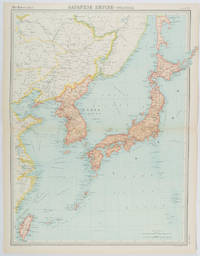
1922215880Edinburgh.: John Bartholomew & Son Ltd. 1922. Large double page map 54.2 x 43 cms map original fold some edge toning and to the fold but in very good condition. Large map prepared as plate 65 for “The Times Survey Atlas of the World” in 1922 and was prepared at the Edinburgh Geographical Institute under the direction of J G Bartholomew. The map shows Japan's territory inclusive of Korea southern Sakhalin and Taiwan. . John Bartholomew & Son Ltd. unknown
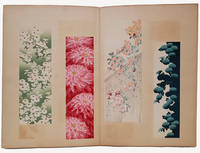
35048Hardcover. Early to mid-1900s. An attractive Japanese leporello. Patterned paper covered boards decorated endpapers. Measures roughly 22.8 x 33.8 cm 9 x 13". Includes sixty-four color woodcuts of chrysanthemum patterns. One fold repaired light wear to edges. A very good copy. ; Quarto. hardcover
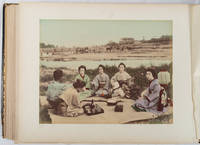
1890215089Japan. Circa 1890s. 50 hand-tinted albumen prints 30 captioned with studio stock references mounted on thick gilt-edged card leaves19.5 x 25 cms in an album 27.5 x 35 cms; elaborately lacquered boards scuffed and chipped inlaid with mother of pearl with loss over quarter calf renewed bevelled edges gilt dentelles endpapers gilt-flecked some fading and spotting to the images and toning to the margins of the card leaves but a very good handsomely bound collection.<P> Beautiful studio album containing a collection of 50 hand coloured photos of Japan with a splendid lacquered and decorated cover. The photos were commercially produced images which were sold to foreign visitors who had the studio place photographs in an album of their choice. This album is unusually interesting because unlike many where photographs were more randomly placed the images have been selected and arranged geographically beginning in Tokyo and moving southwards: Nikko Yokohama Miyanoshita & Hakone Lake Mount Fuji Kyoto Osaka Kobe and Nagasaki. <br> <br>There are fine images and portraits of geisha including an uncaptioned image of geisha seated possibly by the Kamo River in Kyoto entertaining a male guest. A lute is placed on the rice mat together with a tray of beer. One of the geisha is looking straight to camera a striking composition. Another uncaptioned in the Kyoto group is likely to be in Arashiyama shows a sandalled figure on a mountain path overlooking the leisure boating below. <br>There are also images of pagoda fishing rice planting street vendors and markets. <br> <br>More than half the photographs appear to be from the studio of the Yokohama based photographer Tamamura Kozaburo c.1856-192 who at his height was described as "the best photographer in Yokohama". As Terry Bennett has attested Tamamura's business strategy of selling souvenir albums of views and costumes to foreigners became a "winning formula". see Terry Bennett "Early Japanese Images" Tuttle 1996 and "Photography in Japan 1853-1912" Tuttle 2006<P> <b>When referring to this item please quote stockid 215089</b> . hardcover
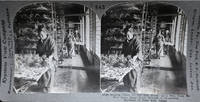
1904220039Meadville Pennsylvania.: Keystone View Company. circa1904. A pair of stereographs mounted on studio card 9 x 17.7 cms each with the studio's imprint catalogue number and caption and on the verso printed explanatory notes in English the thick backing card a little bowed the inked stamp of the Narragansett Rhode Island Library Association to the verso of one card the images with sharp definition and minimal age toning in very good clean condition. Unusual images showing two stages in the manufacture of silk and in particular the labour of women. Each of the stereographs are captioned and show women making silk worm nests and the other women tending new American looms in in one of the largest silk weaving plants in Kiryu with suited male overseers in the middleground. . Keystone View Company. unknown
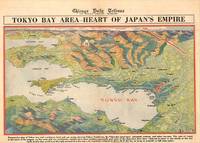
1945209335Chicago.: Chicago Daily Tribune. 28 July1945. Colour bird's eye view map 22.4 x 39.3 cms on a newspaper leaf trimmed to a half sheet 29.8 x 41.6 cms including caption slight toning at an old central fold the map in very good condition. <br>Unrelated black and white photographic illustrations on the verso "Pre-flight Trainers used in Chicago to give ground instruction to would-be pilots" and "New rekindled Montauk Light Long Island N.Y." Map published in the Chicago Daily Tribune days before the bombing of Hiroshima on August 61945. <br>"Perspective map of Tokyo bay and contiguous land and sea areas showing Tokyo Yokohama the Yokosuka naval base industrial sections and other features .In this map north is at the right instead of at the top - an expedient adopted to show all of the bay as large as possible in half page space." caption . Chicago Daily Tribune. unknown
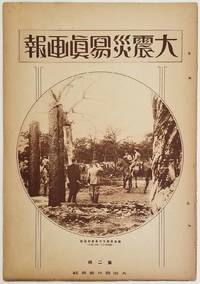
1923211461大阪. Osaka.: 大阪朝日新聞社. Osaka Asahi Shinbunsha. Taisho 12 1923. Japanese magazine special edition devoted to the Kanto earthquake sepia-print photographs and illustrations throughout 31 numbered pages 38 x 26.5cm covers loosening 4 punched holes to the inner margin presumably from being bound washi repairs to spine paper age-toned with occasional foxing and chipping. Depicts scenes of destruction and renewal rescue and recovery efforts with commentary in Japanese. An uncommon and wide-ranging contemporary visual coverage including an areal photo of the devasting effects of the earthquake. The front cover features a scene the Crown Prince inspects the devastation Some historical illustrations of large scale earthquake during Edo period are included. The last two pages features full-page advertisements for insurance companies. <br> <br>The event known in Japanese as 関東大震災 Kantō Daishinsai occurred on the September 1st 1923. The damage caused by the magnitude 8 earthquake killed in total over 100000 people and sparked a tsunami and fire tornados. In Tokyo alone the devastation was such that it took two full days to extinguish the blaze that devastated the city. The total repair cost is estimated in today's terms to have conservatively cost in excess of AUD$14 billion. . 大阪朝日新聞社. [Osaka Asahi Shinbunsha]. unknown
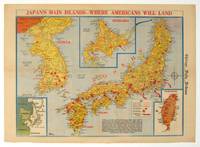
1945208877Chicago.: Chicago Daily Tribune. August1945. Printed colour pictorial map on a single newspaper leaf 37 x 52 cms; 43 x 59.5 cms sheet three inset maps archivally laid down on linen very good condition. Full page map published in the "Chicago Daily Tribune" after the bombing of Hiroshima and Nagasaki prior to occupation by US and Allied forces in September 1945. "This is a new map of the main islands of Japan where American occupational troops will land and establish their military rule." map text The legend notes "Places bombed by U.S. Air Forces with a red circle" and "Cities bombed by Atomic Bomb" with a red star. The main map shows the Japanese islands of Honshu Shikoku and Kyushu with the Korean peninsula. Inset maps show Hokkaido Formosa and a general map of the area. . Chicago Daily Tribune. unknown
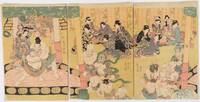
1860218670東京. Tokyo. circa1860s. Three colour woodblock prints a triptych panels loose each approx 38.5 x 25.4cms Japanese text artist's signature publisher's seal and date in the outer margin of the centre and right-hand panels and in the inner margin of the left-hand panel slivers of paper tape strengthening the top margin to the verso of each print pin-holes to the corners from previous display with loss to the lower right corners and the inner corner of the left-hand panel paper a little dusty and soiled but overall in good condition. Wonderful satirical woodblocks with muted tonings possibly from the composition for "Sumo wrestling match of Seven Lucky Gods" replacing the gods with actors as aging sumo wrestlers surrounded by onlooking geisha and fellow actors in masks and costume. <br> <br>From the collection of the late John Caiger lecturer in Asian studies ANU. . unknown
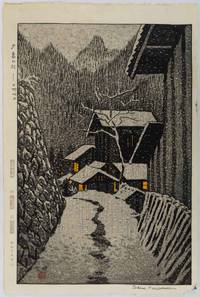
1958218327京都. Kyoto.: 芸艸堂. Unsodo. Showa 33 1958. Colour woodblock print 40.8 x 27 cms including margins published by Unsodo in 1958 the title Unsodo publisher's seal printer's seal carver's seal left margin Unsodo 'Gei' watermark Kasamatsu's signature and red seal lower left and signed in alphabet lower right kento cut due to the printing process lower right sheet a little dusty and creased but the image in very good condition. Kasamatsu Shiro 1898 – 1991 was an active member of the Shin-hanga New Wood Block movement and had a very long and successful career. After the Pacific War his style evolved embracing western techniques and this 1958 print showcases his later work. Minakami in Gunma Prefecture is located in the mountainous area north of Tokyo and is known for its hot springs. The print depicts a wintery dusk scene in the village with falling snow against the glow of house lights. <br> <br>From the collection of the late John Caiger 1930-2022 lecturer in Asian studies ANU. . 芸艸堂. [Unsodo]. unknown
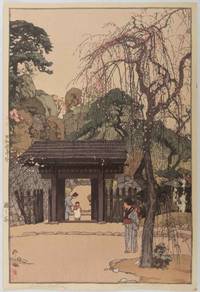
1935218323Japan.: Self published. 1935. Colour woodblock print 39 x 26.5cms including margins signed in ink with seal Hiroshi pencil signature Hiroshi Yoshida and the jizuri seal faded in the top left-hand margin margins a little toned and two small patches of paper abrasion removing surface colour in the lower right of the image but overall in good condition. Atmospheric woodblock print with delicate tonings the colour of the sky echoing the pink plum blossom of early spring a small child attended by their mother in costume waits at the gateway while a baby sitter looks on; a late career work by the great Hiroshi Yoshida 1876-1950. <br> <br>From the collection of the late John Caiger 1930-2022 lecturer in Asian studies ANU. . Self published. unknown
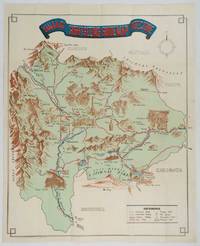
1930206841Kofu.: Onkodo Printing Co. circa1930s. Colour pictorial map 70.2 x 56 cms; 75.5 x 59.5 cms sheet light wear along the inner margin some soft creases from folding short split at center fold; in very good clean condition. An appealing and decorative map of Yamanashi Prefecture which while a process print has the attractive soft look of a lithograph adorned with vignettes of key attractions landmarks such as Mt. Fuji and industry such as silk and wine. The legend lists Railways 'Footing' Roads Hot Springs Hotels and National Parks. A scarce and attractive English language map for the tourist market. . Onkodo Printing Co., unknown
193055073Osaka Japan: The Osaka Municipal Office Printed by the Toppan Printing Co. 1930. 12mo. 5 1 89 1 4 pp. Photo illustrations throughout 1 large folding colour map. Colour-illustrated woodblock print wraparound cover art softcovers slight shelfwear very slight rubbing NF copy. First edition of this scarce development promotion work for Osaka Japan touting the tremendous advances in the port city through the opening decades of the 20th century. Photos and text explore the food markets museums foreign trade statistics port facilities public transportation tourist spots beaches and industries. The Osaka Municipal Office, [Printed by the Toppan Printing Co.], paperback
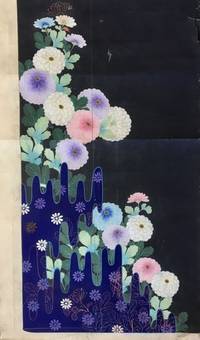
181956897Kyoto Japan: Marubeni Shoten Design Dept. Keimeikai Textile & Dyeing Studio Tanioka Shoten Design Dept. ca. 1918-1945. Folio. 61 original hand-painted inked and pencil designs with a few on a lightly toned but quality semi-translucent paper the majority on thick paper stock and still others with two pieces carefully pasted together with contiguous designs sized from 9 x 15 in. up to 19.25 x 38.5 in. with 13 of the pieces larger the larger size a number of them sized 18 x 32 in. and many in the 14.25 x 15.5 in. size colour painted; the majority feature the design studio chop or crest at lower corners throughout many w/ annotations in margins several w/ change orders neatly annotated or even the title of the design and still many others w/ Roman numeric inventory codes in margins as well two still retaining original small silk samples many with creasing or minor tears & edgewear or creasing to fore-edges a few w/ small & large closed tears while others show some creasing and thumbing from continued use still an exceptional group of manuscripts. This superb archive of 61 original hand-painted kimono designs furnishes an exceptional visual array of Taisho- and early Showa-era Japanese motifs and styles. A number of the designs evoke traditional Japanese Ukiyo-e woodblock prints with deep vivid colours and well rendered illustrations. Many of these designs incorporate floral patterns including Kiku Chrysanthemum Botan Mon Peony Pattern Manju Kiku Marigolds Japanese Irises Morning Glory Cockscomb Ivy Dahlias and many other botanical motifs. In addition there are many illustrating ornately embroidered designs austere bamboo mushrooms and intriguing landscapes some with a small portion fully painted in with brilliant colouring while the outline of the kimono fills out the drawing. Two of the designs still features their original small attached silk kimono sample more reminiscent of Western Design houses which often attached their chosen fabric samples to their clothing designs. A few of the designs are executed on translucent thin paper for the kimono draper to transfer the design to white silk or other fabrics via some type of carbon paper process. Another of the designs has been executed on a stunning silver metallic paper with palm or bamboo leaf fronds executed in vivid blues & browns. Some feature a nearly surrealist quality while several others include illustrations of doves or chickens. Two of the designs incorporate Art Deco representations of Chinese Junks and Japanese sailing vessels typical of the 1930’s prior to World War II. In the Taisho Era a new era opened for textile designers working with Kyoto drapers and department stores with many having trained at new art colleges and then working in the design studios of Marubeni Keimeikai Textile & Dyeing Studio and others. The Tachiki Artist design studio designs on thin translucent paper include one with designer stamp of character embedded within a skull. Some appear to have two different date stamps for the Marubeni Shoten Design and some are unsigned or stamped. The Taisho- and Showa-era kimonos featured brighter colours more groundbreaking designs as Japan’s designers embraced traditional dress and transformed it into a new garment equally appealing to the “Moga†or brazen “Modern Girl.†The designer notes include instructions to “leave a little more space between the fans;†“Drop the little fan crest;†“too much white bush clover†on the pine cones and even that Matsuo Taishichi had ordered a design for “clothes for paying a visit for a young person.†The Marubeni Shoten originated with Chubei Itho who began in 1858 as a salesman for linen cloth and by 1872 had opened his drapery store Benchu in Senba Osaka. By 1918 Chubei Itoh had expanded the business into Osaka and deciced to merge with Itochu Shoten Ltd. becoming Marubeni Shoten with their own drapers shops and many contracts with department stores. Later by the mid-1950s Marubeni merged with the company that operated the Takashimaya Dept. Store Chain all the while preserving their design studio and artists. See: Yuko Fukatsu-Fukuoka The Evolution of Yuzen-dyeing Techniques and Designs After the Meiji Restoration 2004; Arisa Shinko Tomikawa Hand Painted Kyo Yuzen Atelier “Arisa†A Brief Introduction 2020; Annie Van Asche Japanese Kimono Fashion of the Early Twentieth Century Textile Society of America Symposium Proceedings 2000; Our History Our Roots Marubeni Corporation 2020. Marubeni Shoten Design Dept., Keimeikai Textile & Dyeing Studio, Tanioka Shoten Design Dept., hardcover
186261091Edo: Tsutaya Yoshizo 1862. Two parts in one vol. 12mo. 4.7 x 6 in. 40 pp. With two colour ukiyo-e woodblock prints colour-tinted woodblock prints woodblock illustrations throughout. Colour-woodblock ukioyo-e illustrated softcovers 1862 publisher’s ads for Tsutaya Yoshizo on rear pastedown for the Spring of 1862 including many other vols. in Ryutei Tanehiko’s series minor shelfwear slight rubbing NF copy. First edition thus of this installment in the very popular series of illustrated novels issued by Ryutei Tanehiko 1783-1842 considered one of the 10 principal authors of gesaku -- popular illustrated fiction of the late Edo. By the mid-19th-Century he was virtually a household name and yet despite his celebrity and wide circulation of this many different productions all are quite scarce and even individual parts such as this tend to be uncommon. The splendid woodcuts were designed by Utagawa Kunisada II 1823-1880 who took the name Kunisada II in 1850-51 after marrying Kunisada’s daughter and focused on actors portraits of beautiful geishas along with erotica but his popularity waned in the Meiji period. Worldcat locates 1 copy of this individual part DLC; See: Andrew Lawrence Markus The Willow in Autumn: Ryutei Tanehiko 1783-1842 1992. Tsutaya Yoshizo, paperback
193757209Portland OR: Beatrice T. Stevens June 23 1937. Tall 8vo. 6.25 x 10.25 in. 4 pp unpaginated. ALS written entirely in blue ink cursive manuscript minor age toning some slight wear still VG from the library of Mrs. Roy S. Fern Gladys Small Gage 1893-1960 whose husband was a Lewiston Hardware merchant and later real estate developer and both were members of the Congregational Church. Fern Gage was an active organizer and member of both the Women’s International League for Peace and Freedom and the Fellowship of Reconciliation. This uncommon letter reveals the intense public relations campaign nourished and sustained by the Board of Tourist Industries of the Imperial Japanese Railways between Japan and America. It also shows the intense efforts by civic-minded women in the U.S. who were teachers professors and students along with those active in the Women’s International League for Peace & Freedom such as Fern Gage. Stevens 1894-1972 explains to Mrs. Gage that she has “always had a keen yearning to go to the Orient.†She explains how she inaugurated the International Club at the Girl’s Polytechnic organized International Banquets at Commerce High Clinton High School; led a group of girls to dine on “Japanese Sukiyaki at the Tokio House on Fourth Ave. a Chinese banquet at Hung Fan Low; a Jewish Kosher meal at B’nai Brith. . . as well as a Dixie dinner prepared by the mothers of one of our Colored members at the East Side Y.W.C.A. with local Negro leaders and musicians.†Furthermore she explains that she believes these events “of dining in the atmosphere of the nationality in question impresses upon the students as I think you will agree an idea of tolerance and aids in understanding more than any amount of merely reading.†Stevens would teach at Clinton High School until her retirement and although unable to sail to Japan in the Fall of 1937 did succeed in a European trip with teachers in 1949 to post-War Europe in 1949. Beatrice T. Stevens, unknown
151960917Nikko Japan: n.p. possibly T. Hasegawa Publisher’s ca. 1915-1917. Oblong folio. 14.5 x 10.25 in. 24 pp unpaginated. brown bifolium leaves w/ slits cut into corners backing paper within the created pouch and 24 silver gelatin printed-out-paper hand-painted watercolour photographs a few w/ captions w/in the negative all printed on the special medium thickness gelatin printing-out-paper also no bleed-through from the nicely executed water-colouring. Contemporary beige-coloured rough raw padded silk post-binder punch-sewn at gutter margin w/ golden silk braid minor wear & fraying to upper & lower fore-edges wear to corners some scuffing occasional minor tears to brown paper fore-edges still a VG- exemplar from the library of Caroline Augusta Gray Kamm 1840-1932 noted socialite and philanthropist in Portland built home for poor women & girls with the YWCA and was daughter of PNW pioneer William H. Gray 1810-1889 who traveled to the Lapwai Mission in Lewiston ID in 1836 where he was the Nez Perce secular agent and subsequently later married Jacob Kamm 1823-1912 pioneering Oregon industrialist and entrepreneur. An exceptional Taisho-era souvenir album composed of nicely watercolour-painted gelatin printing-out-paper photographs allowing the artist to achieve an ethereal and mystical effect in the images almost as if there is frequently a mist overlaying the scene. These are definitely not photomechanical collotype or gravure process images and the softness achieved in the production indicates these were developed as glass-plate negative contact prints exposed to strong sunlight on an exceptional medium weight thickness matte-finish paper. This series of images capture the road to the Nikko Toshogu Shrine; the famed Five-Storied Pagoda located at the entrance; one wing of the Tokugawa Ieyasu Temple; the iconic Three Wise Monkeys on the inside of the shrine once part of what was originally 8 monkeys on the unpainted wooden sacred stable in front of the Yomoeimon. Also included here are photos capturing the splendid Yomeimon Gate famed for its glittering impact with more than 240000 pieces of gold leaf the Sukibei Wall at the Toshogu Shrine the Nikko Station at the Shrine and the interior of the Nikko Temple. One of the exceptional photos included here is that of the Jiun-ji Temple of the 74 Narabi Jizo Statues along the road to the Kanmangafuchi Abyss along with nicely executed photos of the Kegon Falls and Lake Chuzenji. Although unidentified by photographer’s imprint within negative or on verso of inserted images these types of souvenir photographs could be purchased from souvenir and stationery stands in Nikko Kyoto or other tourist spots from 1885 until after World War I. See: Worswick & Morris Japan: Photographs 1854-1905 1979 and Dower Century of Japanese Photography 1980. n.p., possibly T. Hasegawa Publisher’s, unknown
196054271Tokyo Japan: Kokusai Bunka Shikokai 1960. Two thick vols. Folio. 10.5 x 13.75 in. xliii 3 255 1; xxii 257-546 pp. Titles printed in red & black. Tipped-in colour frontisp. both vols. 104 tipped-in colour plates 428 collotypes. Uniformly bound in gray silk gilt lettering stamped on front covers spines slight shelfwear w/ d.j.s. minor shelfwear rubbing preserving original heavy glassine d.j.s. as well NF/NF set. First edition of this splendid set which established Yashiro’s methods for studying Japanese and Asian arts using photographs to closely compare and study the styles of artists. The photography plate-making and collotype printing were executed by the Benrido Press in Kyoto and the set was printed on special paper designed by the Misubishi Paper Mill Co. for this set by blending the graceful softness of Japanese papers with the need for print clarity. Kokusai Bunka Shikokai, unknown
195751267Chapel Hill: Univ. of North Carolina Press 1957. 8vo. ix 3 260 pp. Red cloth black lettering w/ d.j. cover art by Madia slight shelfwear very small closed tear front cover still NF/VG copy. First edition 3rd printing of this memoir of a Tennessee woman marrying a Japanese diplomat before World War II interned at Hot Springs and White Sulphur Springs with the Japanese diplomatic corps the horror and deprivation of living through the War in Japan and finally returning to Tennessee afterwards. This memoir was later made into the 1961 MGM film Bridge to the Sun starring Carroll Baker James Shigeta James Yagi Tetsuro Tamba and Sean Garrison. Their daughter Mariko Terasaki Miller would go on to become an advocate for civil rights internationalism and was appointed Honorary Consul-General of Japan. Univ. of North Carolina Press, hardcover
193556504Tokyo: Nichibei Medal Company 1935. 4to. 7.4 x 10.1 in. 8 pp unpaginated. Five colour-plates w/ metallic inks added self-printed colour-illustrated softcovers minor dustsoiling edgewear still VG copy w/ small double-sided photographic advertising brochure for ornamental metal belt buckles and cufflinks. First edition of this exceedingly scarce and beautifully printed catalogue filled with armorial pins stick pin designs Japanese house crests heraldic blazons promotional pieces for baseball clubs and more. In addition there are two plates devoted to Japanese house banners flags and ceremonial bunting. No copies located in Worldcat. Nichibei Medal Company, paperback
192854545Yokohama Japan: The Municipal Harbour Bureau of Yokohama 1928. 8vo. 2 52 pp. With four large folding photo plates 8 large folding maps 1 in colour. Gray-blue publisher’s cloth gilt lettering stamped on front cover very minor shelfwear slight bumping to couple corners w/ original glassine d.j. minor chipping edgewear creasing NF/VG- copy w/ 23 x 17 in. blueprint map “Plan of Yokohama Harbour†laid-in and business card of K. Nakamura of the Nakamura Granite Co. which was one of the suppliers for piers and reclamation material during the expansion of Yokohama Harbour during the 1920s. First edition thus of this expanded and revised work tracing the history and development of Yokohama Harbor following the Great Kanto Earthquake in Sept. 1923. The panoramic printed photos include views of the southern inner harbor the northern inner harbor and the Great Pier as well as one of the Quays for accepting ships. The improvements and amenities as of the end of 1928 are detailed in the fourth chapter describing the breakwaters wharves quays pier unloading places for lighters dry docks the improved lumber basin wireless telegraphy office the coal station Export Silk Fabric Inspection office as well as the Warehouse for Explosives. Of special interest are the large folding maps encompassing reproductions of an Edo-period map of Yokohama and other villages view of Yokohama harbor in 1863 survey map of Yokohama in 1890 the reclaimed lands reclamation plans and more. After the Great Kanto Earthquake the port was hastily reconstructed and by the publishing of this report had largely returned to its’ pre-quake condition as well as adding facilities and the Takashima and Yamanouchi piers. Worldcat locates 4 copies Illinois Linda Hall Navy Dept. Library National Diet. The Municipal Harbour Bureau of Yokohama, hardcover