11 476 résultats
19512110502150400226Japan Chemical Fibers Association 1951. Soft Cover. Fine. Number of books: 2 Japan Chemical Fibers Association paperback
19612091502135500449Not Available 1961. Soft Cover. Fine. Number of pages: 46 horizontal pages Size: 25 x 35 cm Not Available paperback
19742091502135500776Not Available 1974. Soft Cover. Fine. Number of pages: 463 pages 291 pages Size: 21 x 29 cm Not Available paperback
19902091502135700588Rinsen Bookstore Sogakusha 1990. Soft Cover. Fine. The book is in fine condition. Rinsen Bookstore Sogakusha paperback
19692111902154610200Japan Shogo Federation 1969. Soft Cover. Fine. The book is in fine condition. Japan Shogo Federation paperback
20042080202103700011Japan Book Center 2004. Soft Cover. Fine. Size: 22cm A5 Japan Book Center paperback
2080202103700255Japan Business Report N.A. Soft Cover. Fine. Page number: 2939p Size: 22cm A5 Japan Business Report paperback
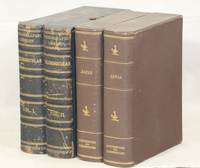
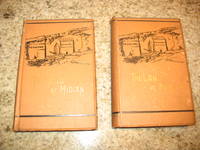
1879031199London: C. Kegan Paul & Co. 1879. 1st Edition 1st Printing. Hardcover. Very Good. Color And B/W Illustrations. Xxviii 338 Pp. ; Vii 311 Large Folding Map 32 Pp Catalog Dated 9/78 First Issue Point. Peach Cloth Gilt Lettering Illustrations And Rules Embossed In Black Slate Black Endpapers. Armorial Bookplates Of Bibliotheca Lindesiana With Small Labels Beneath Annotated In Pencil "Earl Of Crawford / 59/E"; Binders Ticket "Bound By Burn & Co." On Rear Pastedown Of Vol. I. First 96 Pp Of Vol I Neatly Opened With A Very Few Lightly Penciled In Marginal Words/Notes/Questions Rest Of Vol I And All Of Volume Ii Unopened And Fresh. Endpapers Immaculate And Unfaded Hinges Tight One Signature Beginning P 97 Of Volume I Is Detached But Present Old Gutta Percha Binding Glue I Think But Easily Reinserted In Any Case. Bindings With Light Wear All Gilt Still Brilliant Spine Cloth A Little Darkened A Little Wear And Edge Fraying At Tops And Bottoms Of Spines- Mostly At Tops- Without Loss Of Height. <br/> <br/> C. Kegan Paul & Co. hardcover
19812110502151001121Shingakusha 1981. Soft Cover. Fine. Number of books: 7 Shingakusha paperback
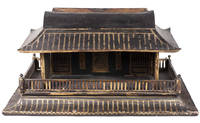
1868E5EF121ITPKJJapan 1868. Ca. 30 x 61 x 39.5 cm. Large model of a Japanese teahouse made from wooden panels painted in black and gold. Large handmade model of a Japanese teahouse probably dating to the late 1890s. It has been beautifully painted in black and gold. The teahouse is open on the front to show the interior walls which have been decorated with painted folding screens and a decorative wall hanging of a landscape flanked by two banners with text. The outside of the walls has been painted with decorations of a bamboo plant closely resembling lacquerwork. The model further features typical Japanese architectural elements such as a sloped overhanging roof a raised floor and an engawa veranda.The edges are scuffed with some cracks in the paints and a few losses a few cracks in the wood at the bottom a small loss of wood at the very top part of the plinth inside is detached or missing the gold paint is fading the back wall is somewhat loose but the structural integrity of the model is still fully intact. unknown
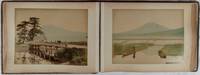
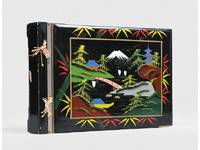
1890164158Japan. 1890s. 46 albumen photographs some handcoloured 34 captioned with studio stock references approx. 20 x 25.5 cms on 23 gilt-edged leaves in an attractive pictorial lacquer album 27 x 26 cms spine renewed and hinges professionally secured some fading and spotting to the images and toning to the margins of the card leaves lacquer a little chipped the images in good condition.<P> Large album containing prints of professionally-taken images of Japan from the 1890s. The Images show the landscapes of Nagasaki Kobe HakoneYokohama Nikko and Lake Chuzenji street scenes in Tokyo Nagoya Castle views of Mt. Fuji from various angles images of Japanese junks and of women preparing dinner. <br>A number of these are well-known images by famous photographers of the day including "Fuji from Kashiwabara" by Enami Tamotsu who opened his photographic business in 1892 "Front of Fall Hakone" by Kajima Seibei 1866-1924 and "Mississipy Bay" a bay near Yokohama by Kusakabe Kimbei 1841-1932. There are also some black-and-white photos of travellers in unidentified landscapes. <br> <br>From the collection of the late Arthur Hacker MBE.<P> <b>When referring to this item please quote stockid 164158</b> . unknown
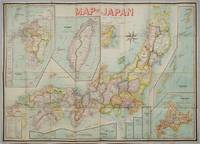
1906197908Kobe Japan.: Fuku-In-Kwan. 1906. Printed colour folding map on two conjoined sheets laid down 73.8 x 10⁵ cms foxing on verso not affecting map single pinhole in each corner scant spotting small fold splits no loss a few soft fold creases but in good condition. Very rare striking map of Japan published for the Western market. <br> <br>Created under the direction of Takachika Okishio featuring 10 inset maps: Chishima Kurile Islands Hokushu Hokkaido Ogasawara-Jima Bonin Islands Hachijo-Shima Ioshima Okinawa Saki-Shima Kyushu Saikaido Taiwan Formosa and Eastern Asia. The insets of Taiwan and Kyushu are the largest and centrally positioned. A Glossary and Explanation of Signs is printed at the foot of the map which list Towns Railway Stations Boundaries of Prefectures Notable Places Hot Springs Water-falls rapids Volcanoes Light-Houses Gold Silver and Coal-Oil fields. The Japanese Government Railway series of Travellers' Maps of Japan appear to have been modelled after this design. . Fuku-In-Kwan. unknown
189056329Yamada Village Japan: n.p. ca. 1890. 4to. 7.5 x 11 in. 354 pp index maps & sections separately paginated. entirely in original manuscript with over 250 plat and section maps many double-page some folding many w/ additions tipped-in or laid-in as supplemental overlays and many w/ additional manuscript annotations most hand-coloured throughout. Original beige limp boards punch-sewn at gutter margin title in manuscript on front cover some scuffing wear occasional internal worming mildly affecting some maps still a VG- exemplar. An extraordinary Meiji-era manuscript real estate plat map atlas for the Yamada Village and environs of the Keta District in present-day northern Hyogo Prefecture. Traditionally ruled over by descendants of the Miwabe-no-Atai clan this real estate atlas volume encompasses hundreds of plat maps tied to outline maps with the plats all numbered and many colour-coded with colour coding to the opening index. The creator of this map atlas appears to have been commissioned by local land agents following the economic expansion after the opening of the Hyogo Harbor in 1867 for foreign trade while quickly became one of the largest trading ports in Japan. The Tajima province is perhaps best known as the birthplace of Kobe Beef or Tajima Wagyu traditionally compact working cattle with a calm nature but which quickly came into high demand as Kobe Beef in the late 1880s as the large foreign trading and tourist community desired beef and the Tajima cattle were especially desired. This also contributed to a rising demand for land in which to raise the Tajima Wagyu cattle and land prices. At the same time the nearby coast also began slowly developing a small tourist trade and coastal resorts. The map sections include No. 5 -- Kitakami no machi; No. 11 -- Sampo no matsu; No. 12 - Shita takimiya; No. 13 - Okawahara; No. 14 - Takimiya; No. 30 - Kita shitaya as well as No. 36 - Kawahara. In April 1896 the Keta District was dissolved and merged into the Kinosaki District along with the Mikumi District and became the Hyogo Prefecture anchored by the city of Kobe. The additional supplemental pieces tipped-in others laid-in and the many add-ons to the folding map with many bearing annotations indicate that this was a meticulously maintained working document for Meiji land agents. We have been unable to locate any similar manuscript or printed real estate atlases for this era and geographical location. See: Mochizuki Kotaro Japan To-Day: A Souvenir of the Anglo-Japanese Exhibition Held in London 1910 Special Number of the “Japan Financial and Economic Monthly;†Mike Buchanan Hyogo Prefecture Tajima Wagyu History Australian Wagyu Forum 2018; Masanobu Suzuki Development and Dispersal Process of Ancient Japanese Clans 2003. [n.p.], hardcover
19852110502151003212Daiichishobo 1985. Soft Cover. Fine. Number of books: 20 Daiichishobo paperback
19392092902143300063Not Available 1939. Soft Cover. Fine. The book is in fine condition. Not Available paperback
19342092902144200405Japan Bibliographic Society 1934. Soft Cover. Fine. The book is in fine condition. Japan Bibliographic Society paperback
19752090502126803360Maruzen 1975. Soft Cover. Fine. Number of books: 36 Maruzen paperback
19782090502126803254Not Available 1978. Soft Cover. Fine. Volume: 23 Not Available paperback
20102080402107100513elementary school 2010. Soft Cover. Fine. Number of books: 56 elementary school paperback
20042110502151100424Not Available 2004. Soft Cover. Fine. Number of books: 50 Not Available paperback
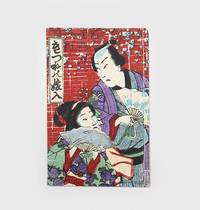
1885159113Tokyo: Tsutsumi Kichibee 1885. A classic Japanese fairy tale A charming Meiji-era edition of this famous children's tale following two young foxes from their first meeting through to their marriage ceremony. This type of literature experienced a resurgence in popularity during the 1880s as Western notions of childhood entered Japan growing a market for age-appropriate stories with an instructional element. This is part of Tsutsumi Kichibee's ten-volume fairy tale series. Other stories include The Tongue-Cut Sparrow The Quarrel of the Monkey and the Crab and The Old Man who made the Flowers Blossom. Duodecimo. Colour woodblock illustrations throughout; text in Japanese. Original colour printed wrappers renewed white thread fukuro-toji stitching mica decorations on front wrapper. A little rubbed some ink marks internally: a very good copy. unknown
1952187135Japan and United States: c.1952-57. For the Japanese African Americans were both powerful occupiers and fellow second class citizens A thought-provoking album that offers an insight into the Afro-Japanese cultural exchange during the Allied Occupation. Shearer was a Black US serviceman with Fleet Aircraft Service Squadron 120 stationed at Iwakuni 40 km southwest of Hiroshima. His album includes images of the Japanese countryside and people fellow personnel his Japanese wife Hisako and family back home in the States. Shearer 1935-1999 born in Madison Kentucky grew up in Cincinnati spending his later years in California he is buried in Fort Rosecrans National Cemetery. His ownership inscription gives his rank as ADJ2 or Aviation Machinist's Mate jet engine mechanic. From around 1954 his unit FASron-120 supported the US fleet's airborne capabilities. A few shots show him in uniform driving that workhorse of the US military the 2½ ton 6x6 truck adapted as a tanker. Some of the early shots show him with Hisako and a fellow serviceman with his Japanese girlfriend. One image pictures the latter clutching a jazz album: George Shearing's Latin Escapade 1957 reflecting the fact that "postwar Japan embraced the music of its former enemy" Van Nguyen. "The postwar period includes some of the richest chapters in the story of Afro-Japanese cultural exchange. The culmination of the Pacific War and the onset of the Allied Occupation of Japan made for heady times in the encounters between African Americans and Japanese people Postwar African Americans enlisted in droves in search of a better life on the other side of the Pacific and the Occupation saw both the genuine empathy and the messy disillusionment that comes with the lived experience of cross-cultural exchange. For the Japanese African Americans were both powerful occupiers and fellow second class citizens 'beneath' white soldiers in the world racial order" Bridges pp. 16-17. Landscape quarto 255 x 342 mm. With 75 gelatin silver photographs landscape or portrait 80 x 115 to 255 x 200 mm corner mounted on recto of 22 black thick paper leaves some captioned in pen on the image pencil numbers on verso 7 signed by Shearer tissue guards removed; comprising 34 shots of scenery and people 18 of Shearer with friends 10 of service life 7 of his family in America 5 others; and a 10 x 8 publicity shot by the Murray Korman studio of singer Clyde McPhatter 1932-1972. Original black lacquer music box album orange and white thread binding metal hinges front board painted with Japanese scene in colour rear board with feet and winding key silver speckled endpapers. Music box non-functional scratched and chipped at extremities especially spine and front board lower corner photographs bright a few slightly creased: a very good example. Will Bridges Playing in the Shadows: Fictions of Race and Blackness in Postwar Japanese Literature 2020; Dean Van Nguyen "'Society was volatile. That spirit was in our music': how Japan created its own jazz" The Guardian 12 Jan. 2002. unknown
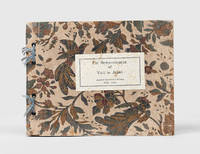
1928165432Tokyo: Japanese Government Railways c.1928. Seeing Japan by Rail A delightful souvenir album commemorating the visit of some Western guests to Japan at the invitation of the state railway including views of the country's rapidly developing mass transport infrastructure and the tourist locations it served. While the identities of members of the touring party are unknown many of the locations they visited can be readily discerned. The album pictures the railway line near Mount Fuji Tokyo train station the Toshogu Shrine at Nikko and the Kegon Falls. One photograph shows the party learning out of the windows of a first-class carriage while in another they pose outside the famous Fujiya Hotel run by H. S. K. Shozo Yamaguchi 1882-1944. A loosely inserted photograph of the Kegon Falls is inscribed and dated 18 May 1928 on the verso. Landscape quarto. With 20 silver gelatin photographs each c. 110 x 150 mm and mounted on card leaf. Original decorative limp cloth blue silk musubi toji binding front cover with printed and gold-flecked title label brown card leaves with decorative cloth backstrip. Covers lightly foxed and rubbed with a few small stains a little wear to extremities blue silk faded in places photographs well-preserved old tidemarks and skinning at foot of couple of leaves images unaffected. A very good example. hardcover
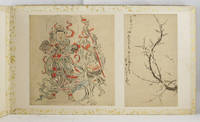
188033455Japan: No publisher ca. 1880. An Album of copies of Literati Paintings. Illustrated with 56 Literati Paintings mounted on 25 double-sided accordion-fold boards some with woodblock colour some finished in colour by hand the illustrations mounted with gilt-speckled borders. Oblong folio the album 28 3/4 x 17 1/2 cm. the paintings 22 x 13 1/2 cm. the upper cover of the album with original padded silk brocade and paper label. The album includes 7 'Poetry Competition paintings and poems from the '100 Famous Poems' an 8th century Heian period compilation. A very pleasing example well preserved with minor rubbing to the extremities the mountings and illustrations all in fine condition. A FINE EXAMPLE. THE JAPANESE ART OF BUNJIN-GA WAS INTRODUCED IN THE 17TH CENTURY FROM CHINA'S SOUTHERN SCHOOL OF PAINTING. This occurred during the Ming dynasty through the 'Painting Manual of the Mustard Seed Garden' although that in itself was based on Song and Yuan dynasty landscape painting; and the poetry of the Japanese literati painting was in the style of Classical Chinese poetry termed Kanbun in Japan.<br> Literati painting in Japan is generally referred to as Bunjinga literati painting; Ch. Wen ren hua or Nanga Southern School painting; Ch. nan zong hua both terms borrowed from China. Wen ren hua refers to the status of artists who belonged to the scholar-gentleman class. Nan zong hua was coined by the Chinese painter and theorist Dong Qichang b. 1555–d. 1636 who used it to describe art by literati ostensibly amateurs whose paintings were indebted to their mastery of calligraphy expressed their inner feelings and sought to capture the spiritual essence of their subjects. Japanese Literati Painting and Calligraphy<br>P. J. Graham F. L. Chance.<br> No publisher hardcover
1904000013623New York: Underwood & Underwood Publishers / Keystone View Co 1904. Stereograph Photographs. Near Fine. Stereograph photographs mounted on stiff brown paper board printed in black. Each card measures 18 cm x 9 cm each photograph measures 8 cm x 8 cm. Two photographs mounted on each card. Each card states "Underwood & Underwood Publishers" with various cities listed and then at the opposite end of the card the words "Works and Studios Arlington N.J. / Westwood N.J." printed. Captions in English on the recto a long caption in English on the verso of each card these long captions taken from From Notes of Travel No. 8 published by Underwood & Underwood. Below the long captions on the verso of each card there are short captions printed in English French German Spanish Swedish and Russian. Each card numbered 1 to 100. 99 out of the 100 photographs called-for are present. The photographs are housed in a brown cloth case lined with grey linen gold lettering and rules on one side of the case. Offered with these stereograph photographs is a Telebinocular Stereoscope a black binocular-type device with a holder for a stereograph card that is adjustable. When a card is placed in the stereoscope the device gives the photograph an intended three-dimensional appearance. The stereoscope is housed in a navy cloth case lined on the inside with black cloth the case lettered and ruled in gold. The photographs offered here show a myriad of views of Japanese culture and values. Highlights include steamships in Yokohama rickshaws Meiji-era clothing family life views of Japanese schools and schoolchildren millet and barley farming a Buddha statue in Kakamura Mt. Fuji views of Kobe Hiroshima Nagasaki and so much more. The photographs are brilliant and clear and are a wonderful record of life in Japan at the turn of the twentieth century. The photographs are nearly Fine the cloth case has just a touch of rubbing. The stereoscope case has more noticeable rubbing but is overall sharp. Underwood & Underwood Publishers / Keystone View Co unknown