11 476 résultats
2080202103700083Japan Book Center N.A. Soft Cover. Fine. Size: 26cm B5 Japan Book Center paperback
19982083002116300064Kaneko shobo 1998. Soft Cover. Fine. The book is in fine condition. Kaneko shobo paperback
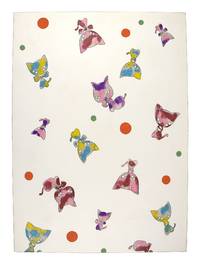
194033730Suzuka Japan et al. 1940. Very Good . Suzuka Japan: n.d. ca. 1940-1960. Nineteen original hand-stenciled designs ca 48x35cm; thirteen examples with rubber-stamp from two different craft shops the remaining six unattributed. Light wear and soil else a Very Good to Near Fine collection.<br /> <br /> Colorful multi-decade sampling of designs for the Japanese casual summertime cotton kimono known as yukata. The designs were almost certainly designed for children's outfits decorated as they are with baby birds puppies ducklings circus elephants bunnies musical instruments and teddy bears. The ten earliest examples all hail from the same shop and all use the same color scheme of navy blue slate blue and orange-brown. Later examples expand the color palate to much more vibrant and neon colors. One design in particular of a small child in a red bunny costume anticipates both the manga and the Hello Kitty aesthetic that became a global phenomenon beginning in the 1970s and 1980s. unknown
1824027252London: Richard Priestley 1824. 2nd Edition 1st Printing. Hardcover. Very Good. Maps and Plates. Xv 409; Iii 341; Iii 392 Pp With Half Titles In Volumes 2 And 3. A Complete Set In Original Brown Cloth Spines Over Gray Boards With Original Paper Spine Labels 4.7 Cm Tall Volume Numbers In Arabic Numerals Also Known With Taller Spine Labels With Roman Numerals Priority Unknown. Taylor's Corrected Second Edition Adding His Notes Which Were Omitted From The First Printing. Worn With Some Fraying At Corners Volume 1 With Cracked Front Joint Along Which Is A 2 1/2" X 1/4" Loss Of Spine Cloth Not Affecting The Labels. Bookplates Of Francis Davies Of Pershore With Rampant Lion And Motto "Lucem Spero" No Other Names Or Marks. Per Wikipedia General Sir Francis John Davies Kcb Kcmg Kcvo 1864 - 1948 Was A Senior British Army Officer Who Commanded The 8Th Division During The First World War. Davies Was Born In London The Son Of Lieutenant General Henry Fanshawe Davies And His Wife Ellen Christine Alexandra Hankey. His Grandfather Was General Francis John Davies Brother And Heir Of Thomas Henry Hastings Davies Mp For Worcester And His Great-Grandfather Was Admiral Of The Fleet Sir Thomas Byam Martin. The Family Seat Was Elmley Castle Pershore Worcestershire. His Younger Brother Was Major General Henry Rodolph Davies. He Was Educated At Eton College. In October 1899 He Served As A Daag Responsible For Intelligence At Army Headquarters In South Africa And As Acting Commissioner Of Police For Johannesburg In 1900. In 1902 He Was Temporarily Employed In The Intelligence Department Until He Became Deputy Assistant Quartermaster General Daqmg At The War Office On 7 September 1902. Two Years Later He Was Appointed Assistant Director Of Military Operations In 1904 He Was Made General Officer Commanding Goc Of The 1St Guards Brigade. He Then Took Over As Brigadier General General Staff Bggs Of Aldershot Command. He Was Promoted To Major General In May 1913 And In October Of That Year Became Director Of Staff Duties At The War Office. In October 1914 Davies Was Appointed As Goc Of The 8Th Division. The Division Along With Its Goc Was Soon Sent To The Western Front. Towards The End Of July Davies Was Posted Away From The Fighting In France And Belgium To Take Over The Command Of Viii Corps Then Heavily Engaged In The Gallipoli Campaign. Davies Promoted To The Temporary Rank Of Lieutenant-General30 Took Over As Its Goc On 8 August . He Brought With Valuable Combat Experience And It Is Said " Over The Five Months Of His Tenure His Ideas And Energy Were The Catalyst For A Myriad Of Tactical And Systematic Improvements Which Greatly Improved The Fighting Efficiency Of His Force Allowing His Troops To Achieve Tactical Superiority Over The Enemy Facing Them". In The Aftermath Of The Evacuation Of British And Allied Forces From Gallipoli In January 1916 Davies Was Moved On To Being Goc Of Ix Corps. Davies Was In Command Only Until June When He Returned To The United Kingdom To Serve As Military Secretary At The War Office. He Held This Post Until After The End Of The War.His Rank Of Lieutenant General Became Substantive In January 1917. Later That Year Davies Was Appointed General Officer Commanding-In-Chief Goc-In-C Of Scottish Command In June 1919. After Being Promoted To The Rank Of Full General In July 1921And After Serving As Lieutenant Of The Tower Of London Which He Had Been Appointed To In June 192335 He Retired From The Army In April 1926. He Had Been Appointed An Aide-De-Camp General To King George V In April 1922. <br/> <br/> Richard Priestley hardcover
19812090202120100199Not Available 1981. Soft Cover. Fine. Number of books: 12 Not Available paperback
19812090202120300199Not Available 1981. Soft Cover. Fine. Number of books: 12 Not Available paperback
19862110502150906233University of Tokyo Press 1986. Soft Cover. Fine. Number of books: 10 University of Tokyo Press paperback
19802091202133203011University of Tokyo Press 1980. Soft Cover. Fine. Number of books: 12 books in total University of Tokyo Press paperback
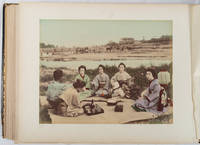
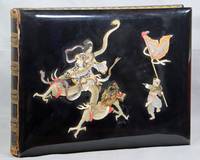
1890215089Japan. Circa 1890s. 50 hand-tinted albumen prints 30 captioned with studio stock references mounted on thick gilt-edged card leaves19.5 x 25 cms in an album 27.5 x 35 cms; elaborately lacquered boards scuffed and chipped inlaid with mother of pearl with loss over quarter calf renewed bevelled edges gilt dentelles endpapers gilt-flecked some fading and spotting to the images and toning to the margins of the card leaves but a very good handsomely bound collection.<P> Beautiful studio album containing a collection of 50 hand coloured photos of Japan with a splendid lacquered and decorated cover. The photos were commercially produced images which were sold to foreign visitors who had the studio place photographs in an album of their choice. This album is unusually interesting because unlike many where photographs were more randomly placed the images have been selected and arranged geographically beginning in Tokyo and moving southwards: Nikko Yokohama Miyanoshita & Hakone Lake Mount Fuji Kyoto Osaka Kobe and Nagasaki. <br> <br>There are fine images and portraits of geisha including an uncaptioned image of geisha seated possibly by the Kamo River in Kyoto entertaining a male guest. A lute is placed on the rice mat together with a tray of beer. One of the geisha is looking straight to camera a striking composition. Another uncaptioned in the Kyoto group is likely to be in Arashiyama shows a sandalled figure on a mountain path overlooking the leisure boating below. <br>There are also images of pagoda fishing rice planting street vendors and markets. <br> <br>More than half the photographs appear to be from the studio of the Yokohama based photographer Tamamura Kozaburo c.1856-192 who at his height was described as "the best photographer in Yokohama". As Terry Bennett has attested Tamamura's business strategy of selling souvenir albums of views and costumes to foreigners became a "winning formula". see Terry Bennett "Early Japanese Images" Tuttle 1996 and "Photography in Japan 1853-1912" Tuttle 2006<P> <b>When referring to this item please quote stockid 215089</b> . hardcover
19852110502150907678University of Tokyo Press 1985. Soft Cover. Fine. Number of books: 25 University of Tokyo Press paperback
19732091202133100495Hara shobo 1973. Soft Cover. Fine. Volume: 1 Hara shobo paperback
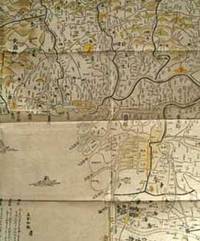
1748826931748. MAP - JAPAN. SETTSU NO KUNI MEISHO. Kyoto Kimura Juyodo Kan'en Gannen 1748. A handcolored woodblock printed map of Settsu provice containing the area of Osaka castle etc. 117.3 X 129.1 cm folds into heavy paper covers of approximately 27.7 x 18.9 cm. The original title slip is gone replaced by a handbrushed label: "Osaka no Kuni" "Carte Baie d'Osacca". Lovely and interesting map found at Beans main volume p.22 1748.1. Condition is very good printed on very strong and supple paper. For a detaiuled illustration see the record at UBC's website for the Beans copy: http://angel.library.ubc.ca/cdm4/item_viewer.phpCISOROOT=%2Ftokugawa& CISOPTR=286&DMSCALE=50&DMWIDTH=600&DMHEIGHT=600&DMMODE=viewer&DMFULL=0 &DMX=75&DMY=44&DMTEXT=&DMTHUMB=1&REC=2&DMROTATE=0&x=266&y=296 Our copy has different hand-coloring. The Beans copy hand-colors the harbor ours hand-colors the land primarily. From the collection of Roger Keyes. unknown
1890000012919n.p.: n.p. 1890. Hardcover. Good. Oblong 8vo. 27.5 cm x 38 cm. 50 hand-colored albumen photographs on double-sided stiff cardstock leaves. All tissue guards present. Black lacquered boards with beautiful raised decorations carved and painted on bone on the front board: a woman wearing a kimono riding a dragon and a child waving a flag the rear board with decorations stamped in orange and gold; the spine in five compartments gilt decorations and rules on the spine; all edges gilt. Binding is sewn cloth. White endpapers and pastedowns. Most photographs with a caption in the corner. Photographs measure 19 cm x 25.5 cm. The photographs depict landscapes of Nagasaki a statue of Buddha temples street life in Japan Kioto Tokyo women playing instruments clothing and porcelain shops and so much more. A stunning album of daily life in Japan at the end of the nineteenth century. The front board nearly detached from the spine but holding to the binding on the front gutter cloth. A few photographs may have had their red color touched up but it is difficult to tell. n.p. hardcover
1920216411920. Japan OccupationWWII Primary-source photo album of United States military governance during the occupation of Japan with particular emphasis on the enforcement of legal authority and the administration of war crimes proceedings under Allied control. Centered on the career of General Charles Sabin Ferrin in his capacity as Provost Marshal of Tokyo the album captures the institutional frameworks through which U.S. forces maintained order supervised political transition and participated in the International Military Tribunal for the Far East IMTFE. The collection includes images of high-ranking military and political figures official proceedings connected to the war crimes trials and formal and informal interactions with Japanese leadership situating Ferrin's role within broader systems of occupation-era administration legal oversight and diplomatic engagement.<br /> <br /> The album contains 85 black-and-white silver gelatin photographs varying in size from 2.5" x 2.5" to 6" x 4.25" mounted in a clothbound album measuring approximately 7" x 5". The images begin in the United States depicting early domestic life before shifting focus to Ferrin's stationing in China from 1919 into the 1920s and later to his critical role in postwar Japan where he engaged with Japanese political and military officials at the highest levels. The China-era photographs include striking scenes of the U.S. Army's presence in Tientsin Tianjin as indicated by labeled photographs of "U.S. Army Buildings Tientsin" designed by architect Albert Benz. Other images capture American cavalrymen of the 15th Infantry Regiment on horseback lined up in disciplined formation labeled "1921 Tientsin China 15th Infantry U.S.A." The album also contains personal family moments such as a uniformed soldier cradling a small child on horseback annotated "1918 Russell" and an image of two children dressed formally on a walkway inscribed "Aug 26 1919 leaving for China." Additionally candid moments in Tientsin show a young child riding in a rickshaw pulled by a Chinese laborer and another with a Chinese woman identified as an "Ama" caring for the family's child at a beach in Chinwangtao Qinhuangdao in July 1921. <br /> By the late 1940s the album shifts focus to Ferrin's tenure as Provost Marshal of Tokyo a role that placed him at the center of postwar military governance and legal oversight. Several photographs depict U.S. military officials dining and meeting with Japanese political figures. One particularly notable photograph shows Ferrin standing beside a dignitary identified as "Prince Takamatsu Hirohito's younger brother." Other images depict high-ranking officers including Admiral James O. Richardson testifying at the International Military Tribunal for the Far East IMTFE with a caption stating: "Admiral James O. Richardson Commander-in-Chief United States Fleet testifies on the witness stand at the International Military Tribunal for the Far East during the Pearl Harbor phase of the trials of the 27 accused Japanese war criminals." A separate image shows troops of the 720 MP Battalion executing a right-dress formation in front of the War Ministry Building in Tokyo on October 13 1947. The presence of these high-ranking officials alongside candid social and formal meetings with Japanese elites underscores Ferrin's prominent role in enforcing law and order during the American occupation and his involvement in overseeing war crimes proceedings. The album is in very good condition overall. A rare and historically significant visual chronicle of General Charles Sabin Ferrin's career across pivotal moments in 20th-century history with firsthand images of U.S. military presence in China the occupation of Japan and high-level engagements with political and military leadership. unknown
19702090502126801266Japan Broadcasting Publishing Association 1970. Soft Cover. Fine. Number of pages: 78 pages Size: B5 size Number of books: 7 separate volumes Japan Broadcasting Publishing Association paperback
192485112Hakubunkan 1924. Fine. Hakubunkan 1924 19.50 x 11 cm broché Work published by the Japanese Ministry of Railways admirably illustrated with 130 double-page color illustrations by Hatsusaburo Yoshida: 2 decorating the pastedowns traditional Japanese animated scenes 26 views and 104 bird's-eye view landscape maps. Numerous black maps including a large one at the end of the Japanese railways which is detached. Pale green cloth covers. Smooth spine with title. Boards printed in black with a sample of Japanese fabric a cartouche for the title. Cardboard slipcase repeating the board motifs in black. Small lacks to slipcase rubbing and corners bumped. Fine condition of the collection with occasional light foxing. A paper lack to the pastedowns at the end of the volume. Some pages with fine manuscript notes in ink. Celebrated as the Hiroshige of the Taisho era Yoshida 1884-1955 was a painter and cartographer. His bird's-eye view maps and views are enhanced by multiple colors and changes of season and weather. A major retrospective of his works took place in Japan at the Sakai Museum in 1999. Hakubunkan hardcover
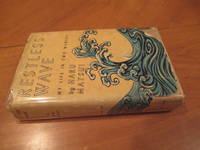
1940049441New York City Ny: Modern Age Books 1940. 1st Edition 1st Printing. Hardcover. Near Fine/Fair. 252 Pp. Beige Cloth. First Printing. Inscribed By The Author To Leftist Social Artist William Gropper And His Wife "To Sophie And Bill With Love And Best Wishes From The Author/ Aya". Book Lightly Used Dust Jacket Priced $2.50 Worn Browned And Chipped. Ayako Ishigaki Ishigaki Ayako 1903 - 1996 Was An Issei Journalist Activist And Feminist Who Was Among The First Japanese American Women To Publish A Memoir In English. She Was Born Tanaka Ayako In Tokyo Japan In 1903 The Daughter Of A College Professor. During The 1920S She Became Active In Politics. While In The United States She Became Friends With Writers Pearl S. Buck Helen Kuo And Agnes Smedley And Artist Yasuo Kuniyoshi. Tanaka First Came To The United States In 1926 Accompanying Her Sister Whose Husband A Diplomat Was Posted To Washington D.C. Soon After She Moved To New York City Where She Audited Courses At Columbia University. In New York She Met The Painter Eitaro Ishigaki Whom She Would Marry In 1931. Following The Japanese Invasion Of Manchuria In 1931 Ishigaki Became Outspoken In Protesting The Japanese Military Aggression In China And Reported On Japan For The Left-Wing Magazine The New Masses. Her Articles Emphasized The Negative Impact Of Imperialism And Industrialism On Japanese Workers Particularly Women. During This Time She Adopted The Pseudonym Haru Matsui To Protect Her Family In Japan From Possible Retaliation For Her Activism. In The Spring Of 1937 She Moved To Los Angeles Where She Contributed A Biweekly Column To The Japanese American Newspaper Rafu Shimpo Writing Under The Pen Name May Tanaka. This Column Focused On Daily Life While Incorporating Feminist And Antiwar Commentary. She Returned To New York Later That Year. In 1938 She Went On A Lecture Tour With The Modern Dancer And Left-Wing Militant Si-Lan Chen. During One Of Her Lectures She Was Invited To Write A Book By A Representative Of The Progressive Publishers Modern Age Books. Ishigaki's Memoir Restless Wave: A Life In Two Worlds Published As Haru Matsui In January 1940 And Was Widely Reviewed In Publications Such As The New Yorker And The New Republic. While Framed As A Memoir And Generally Following The Arc Of Her Life Restless Wave Also Simplifies Some Elements Of Her Biography And Later In Life She Described It As A "Novelistic Semi-Autobiographical Text. While Restless Wave Gained Critical And Popular Acclaim In The U.S. Its Strong Critiques Of Japanese Society And Militarism Also Brought Ayako Negative Attention From The Japanese Government. The Book's Publication Also Led To A Friendship Between Ayako And The American Author Pearl S. Buck Who Reviewed Restless Wave Positively And Invited Ayako To Contribute To Asia Magazine. After The Outbreak Of War Between The U.S. And Japan In 1941 Ayako And Eitaro Were Forced To Register As Enemy Aliens. Although They Were Not Incarcerated Due To Their Residence On The East Coast They Were Subject To Curfews And Random Searches And Lost Their Jobs. In 1942 She Began Working For The Office Of War Information. In The Late 1940S As The Cold War Took Hold And Anti-Communism Became Dominant In The U.S. Ayako And Eitaro Were Placed Under Government Surveillance Due To Their Left-Wing Activism. In 1951 Eitaro Was Arrested And Deported By The American Government And Ayako Returned To Japan With Him. Following Her Return To Japan Ayako Continued To Work Extensively As A Journalist Lecturer And Translator. In 1955 She Published An Article With The Title "Shufu To Iu Dai-In Shokugyö-Ron" 'Housewife: The Second Profession' In Which She Called For Japanese Housewives To Seek Fulfillment In Work Beyond The Home Which Set Off A Major Discussion In Japanese Media Termed The 'Housewife Debate'. She Continued To Write Prolifically Throughout Her Life Eventually Publishing Around Thirty Books In Japanese And Becoming A Television Commentator. <br/> <br/> Modern Age Books hardcover
19862083002117400851University of Tokyo Press 1986. Soft Cover. Fine. Number of books: 10 University of Tokyo Press paperback
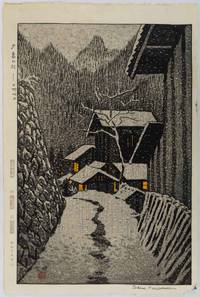
1958218327京都. Kyoto.: 芸艸堂. Unsodo. Showa 33 1958. Colour woodblock print 40.8 x 27 cms including margins published by Unsodo in 1958 the title Unsodo publisher's seal printer's seal carver's seal left margin Unsodo 'Gei' watermark Kasamatsu's signature and red seal lower left and signed in alphabet lower right kento cut due to the printing process lower right sheet a little dusty and creased but the image in very good condition. Kasamatsu Shiro 1898 – 1991 was an active member of the Shin-hanga New Wood Block movement and had a very long and successful career. After the Pacific War his style evolved embracing western techniques and this 1958 print showcases his later work. Minakami in Gunma Prefecture is located in the mountainous area north of Tokyo and is known for its hot springs. The print depicts a wintery dusk scene in the village with falling snow against the glow of house lights. <br> <br>From the collection of the late John Caiger 1930-2022 lecturer in Asian studies ANU. . 芸艸堂. [Unsodo]. unknown
19932090202118101399Gakuseisha 1993. Soft Cover. Fine. The book is in fine condition. Gakuseisha paperback
18842091202133212089Hobunkan 1884. Soft Cover. Fine. Number of books: 70 books in total Hobunkan paperback
19742110502150900760Japan Senba Corporation 1974. Soft Cover. Fine. Number of books: 17 Japan Senba Corporation paperback
19962091202133101175Japan Broadcasting Publishing Association 1996. Soft Cover. Fine. Number of books: 2 Japan Broadcasting Publishing Association paperback
19542111902160600304Japan Art Sword Preservation Association 1954. Soft Cover. Fine. Size: 26x37 cm Japan Art Sword Preservation Association paperback
19872083002116300303Not Available 1987. Soft Cover. Fine. The book is in fine condition. Not Available paperback