11 476 résultats
19742110502151102695Japan Art Sword Preservation Association 1974. Soft Cover. Fine. Number of books: 2 Japan Art Sword Preservation Association paperback
19792110502151102694Japan Art Sword Preservation Association 1979. Soft Cover. Fine. Number of books: 2 Japan Art Sword Preservation Association paperback
1914015436London: John Murray 1914. First Edition . Green Cloth. Near Fine. 114 Pp 4 Pp Catalogue At End Without Ad For "Salma" At Bottom Of Last Page. Smooth Green Cloth Title On Spine Reads From Bottom To Top. First Edition. One Of The Author's Own Copies From Her Daughter's Library With Loose Two Page Publicity Brochure For The Author With Quotations From The Press. A Clean Solid Copy With Light Rubbing At Corners No Fraying Or Marks. <br/> <br/> John Murray hardcover
19832110502151000984University of Tokyo Press 1983. Soft Cover. Fine. Number of books: 6 University of Tokyo Press paperback
1713aaum 1900. Blattmaße: ca. 40 cm x 285 cm alle Blätter mit Schriftzeichen oben links im Motiv 1 Blatt mit Stempel unten rechts im Motiv teils gering randfleckig. unknown
4696JAPAN. Diary. January 14 1950 to late 1954. Various places Philadelphia Japan Fort Meade. A lengthy diary of an American officer Lieutenant Louis T. Holtz who was stationed in Japan during the Korean War. It was written on dozens of sheets of loose-leaf notebook pages and it contains many black and white photographs with captions as well as newspaper and magazine cutouts and brochures from places he visited. The diary begins on January 14 1950 in Philadelphia and he discuses seeing shows and such but notes that All in all this constituted a very enjoyable ten days of leave prior to going overseas. Sometimes I wish I could stay at home and live a normal routine life like everyone else. Other times I find myself eager to goAlmost two years ago who could forecast a war in Korea and the manner in which it would rip everyones life to shreds He writes on January 2 1951 from Kurume Japan: perhaps 10 years from now it the diary will be of interest if any of our civilization remains in 1961I collapsed 28 June and spent 3 weeks in the hospital with excessive fatigueI am the Officer-in-charge of the Kurume Office with an area of jurisdiction of approximately 1000 square miles. In April 1951 he mentions I am very busy in my position as OIC Officer In Charge. Its a full 7-day-a-week jobThe Korean mess has everyone guessing as to eh future of the Far Eastbeing the senior official in an area of jurisdiction of nearly 10000 square miles with dozens of mayors and police chiefs constantly catching my every word as official. The next couple dozen pages contain black and white photographs of protests in Japan and Holtzs commentary about the images including When people get hurt propaganda fills the air. The winner: the Kremlin always! Demonstrations take planning and people. You can always be sure the plans were framed in red and the spectators sprinkled liberally with dye-hard communist stooges Demonstrations & rallies are usually fantastically well organized. And as often as not they can be unbelievably orderly and But orderly or violent you can always be sure there is a professional communist keeping the sheep in line or arousing them to maximum fury. In September 1951 Holtz writes from Sapporro life in the Armed Services has been a miserable one because of one bad experience after anotherKurume was one of the most pleasant and enjoyable assignments I ever held. The 45th was without doubt the most bitter and least enjoyable. I gave up so much for so little. Holtz was in Californias Camp Stoneman in November 1951: with all the hundreds of officers here not particularly anxious to go overseas and with several actually fighting the assignment I was amazed to find that someone eager to return is sidetracked so abruptly. He was back in Japan by December and then wrote a lengthy entry entitled The Korean Story starting with Combat precautions make it mandatory that no diaries or personal papers be kept where they may fall into enemy hands and he spends the next seven pages describing his experiences in the Korean War. Holtz wrote in part: Things had not gone well at all with Trubotas unit prior to August 1951. After my arrival working results proved very satisfactoryThree other officers has also joined up in the interim between leaving Sapporo and going to KoreaWhen oriented in Tokyo they were told that the 45th Detachment would remain in Sapporo and they had already alerted their families to start to prepare to join them overseasI had to fight Trubota in order to be able to fight the enemy. In one occasion I was reprimanded for going to a forward observation post and not being personally available to answer the telephone at my CP and the section finishes with a photograph of the USS Marine Lynx the ship that brought him home. The diary continues with his being stationed at Marylands Fort Meade. There are photographs of the mansion he occupied in Kyushu Japanese women at the beach his fellow soldiers after a bowling tournament etc. There are Samples of United Nations propaganda leaflets dropped on North Korean positions early in the Korean conflict that show Truman and MacArthur a December 7 1950 letter signed by the mayor of Kurume City Japan. The condition is fine to very fine. unknown
190072742Boston: Knight & Miller ca. 1900. First edition. Oblong octavo in landscape format. 10 stiff leaves bearing 10 original hand-colored albumen photographs tipped-in and all with printed captions. Photographs measure 5 1/2 x 3 1/2 inches. Leaves bound to stubs. Japanese-style except it opens in the Western manner gilt rose and beige brocade cloth with red string tie printed paper cover label. House in the original box with a printed label on one of the sides. Box top with split side joints. Inside front cover with charming Arts & Crafts bookplate of Alice Rosamond Kendall and a pencil presentation to her dated 1902. Book and albumens in beautiful condition. This remarkably scarce little album is almost entirely devoted to rice farming and silk cultivation in Japan. The photographer was likely Tamamura Kozacuro. "Regarded as an originator of "Yokohama shashin" for tourists Tamamura Kozaburo opened his first studio in Tokyo in 1874 and then moved to Yokohama in 1883. For the next 30 years he became one of the most successful and popular commercial photographers in Japan by selling souvenir photograph albums to foreigners and taking profitable commissions from various organizations. He received many awards for his photography before his son Tamamura Kihei took over the business in 1916" Widener Library. The captions are as follows: Ploughing a rice field; Planting rice before Osan Temple Yokohama; Cultivating rice field; Harvesting the rice crop; Farmers threshing rice; Farmer pounding rice; Sorting silkworms; Weighing kuwa leaves for feeding silkworms; Cultivating silkworms; Farmers wearing rain-coats. These coats are made of straw. Knight & Miller hardcover
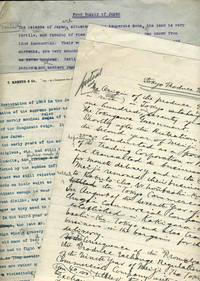
190922896Japan 1909. Very good condition. Three annotated manuscripts pertaining to major changes in Japanese society following the Meiji restoration and the embrace of western ideas and products in a period when the government was committed to learning from the West. <br /> <br /> Two of the manuscripts have a distinct post war perspective of coming to terms with the need to strengthen food supply independence with one of the documents comparing the amounts of cereals comestibles & beverages imported before 1892-1893 and after 1897-1898 the China Japan war and imported before 1903 and after 1906 the Russo-Japanese war see No. 1 below. The other manuscript makes a post war reference to the fact that T. Kameya's grocery business actually benefited from the last two wars: "the two wars . have actually given a given a great impetus to the food and drink stuff business" see No. 2 below.<br /> <br /> Includes the following manuscripts all annotated in pencil by an editor more fluent in English than the original author. By association with another manuscript the author of these manuscripts is possibly Kahe Otani President of the Yokohama Chamber of Commerce who is recorded Annual Report of the Chamber of Commerce of San Francisco 1900 as making a speech at the Pacific Union Club in San Francisco on the subject of Japan - US trade relations.<br /> <br /> 1. "Food Supply in Japan" letter or address 3pp which discusses the Japanese climate and the introduction of foreign clothing and food "What will be the effect of the change of food-taking diet comprising both animal food as well as vegetables and fish upon the Japanese people both mentally and physically is a problem worthy of investigation". Also discusses the cultivation of land list of imports of cereals comestibles and beverages for 1892 - 1906; items imported for the fiscal year 1909; the demand for beef and the cultivation of rice in the southern US "the time will not be far distant when we shall be able to get a cheaper supply of our staple food from the other side of the earth". Typed/mimeographed 8 1/2 x 11".<br /> <br /> 2. T. Kameya & Co. Tokyo letterhead typed letter 2pp concerning Japanese history in the new Meiji Era the founding of the foreign wine and grocery company by Mr. Kameya the advent of business with Europe and the US the construction of the shop on Ginza Street and a list of US and European companies represented in Japan by T. Kameya. The early part of this letter describes the initial resistance of people to the "sudden influx of western civilization: "The samurai class was still reluctant to obey the law prohibiting them to carry swords on their waist as they used to do; while the general people were obstinate enough to wear top-knots on their heads. In short they had a great dislike nay an undescribable sic hate for anything foreign or "savage" as they used to call it". Typed/mimeographed 9 x 11 1/2".<br /> <br /> 3. "Tokyo Produce Exchange" handwritten letter 3pp discusses the produce exchange primarily rice in Tokyo the history of the exchange referring to events in the second 16th 20th and 41st "year of Meiji" and its products including corn silk threads salt artificial manure cotton cotton yarn cotton thread etc. Records the capital on hand at various times in the exchange's history. Also includes terms of business and a list of Board of Directors and Auditors. Handwritten on lined paper 9 x 13 1/2" hardcover
194662526Tokyo Japan: American Forces Pacific General Headquarters United States Army Nippon Map Co. Nihon Chizu Kabushiki Kaisha Feb. 1946. Oblong double atlas folio map printed on recto in 5 colours sized 30.25 x 41.75 in. including margins title panel w pictorial map for when folded showing “Bombed-out Areas†in miniature large regional map printed in green minor age toning some minor thumbing shelfwear rubbing a couple very slight closed tears at fold creases still a VG bright copy. First edition of this startling map prepared from a Japanese Tokyo City map revealing the tremendous extent of damage created during the B-29 bomber bombing campaigns by the Allies in 1945 including Feb. 24-25 when 174 bombers dropped incendiary bombs destroying 1.5 square miles of the city and 28000 buildings; March 9-10 when 279 bombers destroyed 267000 buildings over 41 square miles; as well as the massive air raids of April 26 with 464 B-29 Bombers attacking urban areas south of the Imperial Palace and May 24 when another 520 bombers attacked leaving swathes of the city in ruins. The splashes of yellow-gold vividly portray the bombed portions and green lines the fire breaks created from demolishing swathes of houses office buildings and apartments in the city to stop the fires burning. These maps were released solely for occupation and reconstruction forces of the Allies after Japan’s surrender and were not intended “For sale or distribution.†Worldcat locates 7 copies U of CO U of GA U of Chicago Harvard U of MN U of WI NL Australia. American Forces Pacific, General Headquarters, United States Army, Nippon Map Co. [Nihon Chizu Kabushiki Kaisha], unknown
19461717761946. JAPAN. Le Costume. 33pp. Folio. Illustrated wrappers. NP.Tokyo 1946. A remarkable Japanese publication showcasing Western style clothes and accessories published shortly after the end of the war and presumably aimed at the occupiers. Not listed on OCLC. hardcover
20212081502111906825Shanghai Ancient Book Publishing House 2021. Soft Cover. Fine. The book is in fine condition. Shanghai Ancient Book Publishing House paperback
19362111902158501807Gifu Branch of Japan Seamen's Election 1936. Soft Cover. Fine. Number of pages: 82p. Size: 19cm Gifu Branch of Japan Seamen's Election paperback
19692092902144201488University of Tokyo Press 1969. Soft Cover. Fine. The book is in fine condition. University of Tokyo Press paperback
19682090202122800092Not Available 1968. Soft Cover. Fine. Volume: 1 Not Available paperback
19762083002117402880Mako-sha 1976. Soft Cover. Fine. Number of books: 6 books Mako-sha paperback
19982092902137701806Gogatsu shobo 1998. Soft Cover. Fine. The book is in fine condition. Gogatsu shobo paperback
19602082702114900033Iwanamishoten 1960. Soft Cover. Fine. Size: 22x16cm Iwanamishoten paperback
19942080502106915970Doyu-kan 1994. Soft Cover. Fine. The book is in fine condition. Doyu-kan paperback
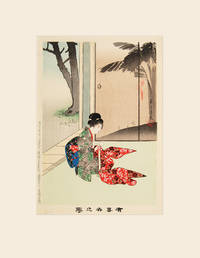
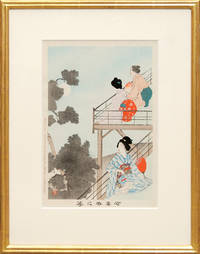
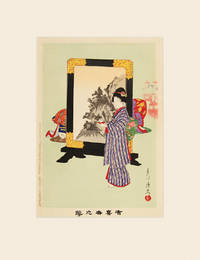
192057843c.1920. Original Japanese woodblock prints. Vibrantly coloured print of young geishas in traditional costumes. Woodblock. Mounted size: 37 x 48cm Original colour. Very good condition. Trace of red colour offseting. unknown
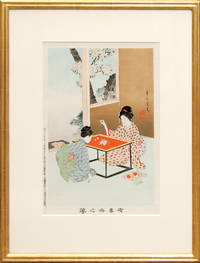
192057923c.1920. Original Japanese woodblock prints. Vibrantly coloured print of young geishas in traditional costumes. Woodblock. Fine condition. Original colour. Size: 23 x 33 cm. 9 x 13 inches unknown
192057925c.1920. Original Japanese woodblock prints. Vibrantly coloured print of young geishas in traditional costumes. Woodblock. Fine condition. Original colour. Size: 23 x 33 cm. 9 x 13 inches unknown
192057841c.1920. Original Japanese woodblock prints. Vibrantly coloured print of young geishas in traditional costumes. Woodblock. Mounted size: 37 x 48cm Original colour. Very good condition. Trace of red colour offseting. unknown
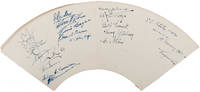
19302212541930-1940s. Two concertina-bound autograph books. <br> <br>Fan-shaped concertina-bound autograph book 13 x 20cm widest point 30 thick cream leaves with approx 160 manuscript autographs gilt-flecked endpapers gold-patterned brocade cover with a linen label all edges gilt enclosed in a linen fan-shaped sleeve with toggle closures and paper label binder's stamp to the inside cover; the linen worn and faded and the album split at two openings but in very good condition. <br> <br>Small concertina-bound autograph book 12 x 9cm approx 25 thick paper leaves 5 red temple stamps and 4 pencilled autographs sable silk-covered boards chipped paper label in very good condition. Two autograph books dating from 1933-1940 which belonged to the Australian Japan expert author and broadcaster George Caiger 1903-1991. In 1930 after teaching in England and Australia Caiger moved to Japan where he taught English at Musashi Koto Gakko a private school in Tokyo and later also lectured at the Peers' School in Tokyo. Caiger wrote numerous essays and books on Japan and developed friendships with some leading figures in Japanese society and politics. He returned to Australia in 1940 and later became an intelligence officer and translator for the Australian military during World War II before joining the Australian Broadcasting Corporation. <br> <br>His beautiful fan-shaped Japanese autograph book contains a collection of signatures messages and some ink sketches. The earliest of these date to 1933-1934 and include farewell messages from friends written in May 1934 when Caiger and his wife Margaret returned for a short period to Australia. Others date from 1939-1940 and include farewells from the time when the Caigers left Japan for good in late 1939. An interesting set of signatures on the last page includes the annotation "SS Atuta Maru 00.01am 1st January 1940 Arafura Sea" clearly written as passengers celebrated a rather uncertain New Year on their voyage home from Japan. There are also two charming ink sketches - one of Mt. Fuji - drawn by a friend named Y. Nakatsuka shortly before the Caigers' departure from Japan. Autographs include those of Australian diplomat H. R. Sawbridge and Christian missionary Clarence Gillett who later worked with Japanese internees in the US during WWII. <br> <br>A second smaller concertina-folded autograph book is mostly blank but contains a few pencilled-in names on the first page and some souvenir ink-stamps including one labelled "Daibustu Nara 1.1.33" in the rear. <br> <br>Fascinating autograph realia from the Imperial Japanese period collected by a well-known Australian broadcaster. . hardcover
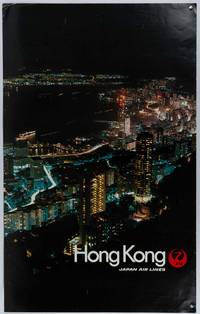
1978207772Japan.: Japan Air Lines. July1978. Vintage colour photographic poster 99.3 x 62.5cm creases to upper corners and some soft creases to the surface and edgewear otherwise very good condition. A dramatic view of Hong Kong at night looking down from the mid-levels on Hong Kong island across to Kowloon. . Japan Air Lines. unknown
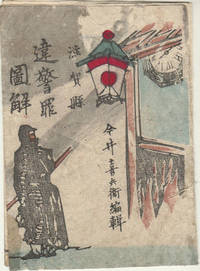
1518170899今井喜兵衛. Imai Kichibē. Meiji 15 1882. Woodblock Japanese printed booklet containing 3 folded leaves. Text accompanied by small handcoloured illustrations showing the minor criminal offences described above. 7 x 3cm section of loss upper section of colour woodblock upper cover stain lower cover upper cover and first two leaves lacks lower cover but contents are complete neatly rethreaded. Still an attractive copy of a fascinating and scarce item. A fascinating insight into crime and punishment in 1880s Japan this little booklet provides colour-illustrated explanations of minor crimes with details of the punishments which apply to them in Shiga Prefecture. It appears to have been designed for distribution to the public - perhaps to shops small businesses etc. From it we learn amongst other things that you could be imprisoned for between 3 and 10 days or fined a sum between 1 and 1.95 yen for giving lodging to a foreigner without recording their address properly. A sentence of 2 to 5 days imprisonment or a fine applied to people who sold raw fugu highly poisonous without proper treatment sold the meat of diseased animals offered photos or woodblock prints of the Emperor and Empress for sale or cremated the dead without official permission or in a place other than the officially approved cremation sites while a sentence of between 1 and 12 days applied to crimes which included flying paper kites near overhead telegraph lines. . 今井喜兵衛. [Imai Kichibē]. unknown