[UTAGAWA, YOSHITORA]. 歌川芳虎.Biblio.com
24 761 résultats
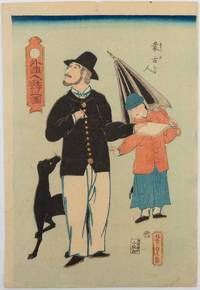
1862220053Japan.: 山田屋庄次郎. Yamada Shōjirō. Bunkyu 1 1862. Colour woodblock print 37.2 x 25.3 cms the sheet a little age-toned a spot of browning at the foot and a pinhole in the upper margin but the image unaffected very good condition. This colour woodblock print by Utagawa Yoshitora is an excellent example of Yokohama-e Yokohama Prints which were very popular in Japan after the country was opened in the mid-19th century. Yokohama was one of the trading ports with the outside world and many foreigners were residing in the area. The Yokohama-e was very similar to the Nagasaki-e Nagasaki Prints and depicted people and cultures which were foreign to the Japanese. Utagawa Yoshitora was active between the end of Edo Period to the mid-Meiji Period and produced numerous Nishiki-e prints including Yokohama-e in his career. He was regarded as one of the top Nishiki-e artists around that time. <br> <br>In this print a Western man is strolling outside with his dog and a Mongolian boy who carries an umbrella for him. The man is observing something in the distance and about to jot down something in his notebook with a pen which he holds in his right hand. Behind him his young attendant plays with the dog unobserved by his pre-occupied master. . 山田屋庄次郎. [Yamada Shōjirō]. unknown
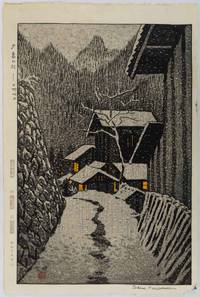
1958218327京都. Kyoto.: 芸艸堂. Unsodo. Showa 33 1958. Colour woodblock print 40.8 x 27 cms including margins published by Unsodo in 1958 the title Unsodo publisher's seal printer's seal carver's seal left margin Unsodo 'Gei' watermark Kasamatsu's signature and red seal lower left and signed in alphabet lower right kento cut due to the printing process lower right sheet a little dusty and creased but the image in very good condition. Kasamatsu Shiro 1898 – 1991 was an active member of the Shin-hanga New Wood Block movement and had a very long and successful career. After the Pacific War his style evolved embracing western techniques and this 1958 print showcases his later work. Minakami in Gunma Prefecture is located in the mountainous area north of Tokyo and is known for its hot springs. The print depicts a wintery dusk scene in the village with falling snow against the glow of house lights. <br> <br>From the collection of the late John Caiger 1930-2022 lecturer in Asian studies ANU. . 芸艸堂. [Unsodo]. unknown
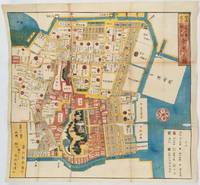
1857193964Tokyo.: Owariya Seishichi . Ansei 4:1857. Folding colour woodblock print map 45.7 x 50cm; 50 x 52cm sheet the legend shows: crest = feudal lord's main residence; black square = retired lord's residence; black dot= lord's warehouse blue = rivers; yellow = roads and bridges; green = forested areas; grey = homes of townspeople extensive worming with some minor loss to the map principally at the folds backed on the verso with archival washi. Although damaged nevertheless a scarce map with good colour and clarity. The publisher Owariya produced 31 folded maps of districts in Edo between 1850-65 called Owariya ban kiri-e zu. This is the area of and around the very important Zojoji Temple the main temple of the Pure Land sect of Buddhism. The map covers the central Tokyo area where residences of major daimyos were located as they are marked with their family crests and names. Presently Tokyo Tower and many embassies are located in the area. . Owariya Seishichi (?) unknown
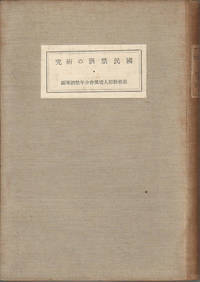
1924164278Fujin Shinpōsha. 婦人新報社. Taisho 13 1924. 440pp browned throughout with a little staining at foot of some pages some pencilling lower board stained cloth spine browned. 10.7 cm x 19 cm This book was based on a series of lectures held in commemoration of the enforcement of the Underage Drinking Prohibition. The contents include "Prohibition of Alcohol" "Liquor and Crime" "Culture and Prohibition" "Prohibition as Humanitarian" "Reason for Submission of Underage Prohibition" "Prohibition Movement in Japan" "Progress of Civilization and Prohibition Law" "Workers and Liquor" "Buddhism and Liquor" “Prohibition from a Medical View Point” “Efficiency and Sake” and “Prohibition from a Legal Stand Point”. . Fujin Shinpōsha].* 婦人新報社 hardcover
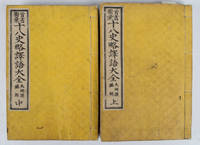
1518165201大阪.Osaka.: 明善堂. Meizendō. 明治15 1882. Volumes 1 and 2 only lacks volume 3. Map in text showing Chinese ancient battlefield of Fei River in 383 A.D. black and white illustrations original yellow embossed card covers four hole Japanese stab binding double leaves in oriental style paper title labels laid down upper covers. Covers a little marked and lightly worn at edges otherwise very good. Vol 1: 75 leaves; Vol 2: 76 leaves. Text in Chinese with Japanese translation. 17.8 x 12.1cm. Accompanying the Chinese text these volumes provide Japanese translations and some illustrations for words and terms which appeared in the 18 histories. . 明善堂. [Meizendō]. unknown
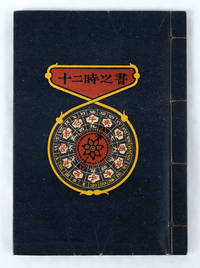
1719160736Tokyo.: 私刊豆本. Limited edition of 300 signed copies. Showa 17 1942. 15 folded leaves delightfully illustrated with colour lithographs showing Japanese clocks and other time pieces by well-known artist and author Takeo Takei. Japanese four hole stab string binding pictorial covers. A little very light wear. Very good. Influential Japanese artist Takeo Takei 1894 -1983 is probably best known for his children's book illustrations but his work was far from limited to this genre. His work is regarded as having three distinct areas: Douga or illustrations for children Hanga or woodblock prints and Kanpon books of various materials. This stunning petite book was his eighth book. . 私刊豆本. unknown
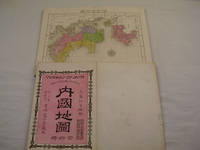
1518136414Bunkyu-do. Circa Meiji 11.5 1878. 2 volumes of a 4 volume atlas of Japan. Volume I: 4pp district list 22 double page copper engraved maps of Kinai Kyoto-Osaka region and Tokaido Tokyo-Kanto region 2 double page in colour 19 double page in black and white and one double page featuring 3 maps of island groups. Volume III: 27 double page maps 3 in colour and 24 in black and white map of the San'indo northern Chugoku region; San'yodo southern Chugoku region and Nankaid Chugoku region Shikoku. Relief shown by hachures. Printed on folded double leaves. Bound accordion style patterned paper covered boards. 26 x 17cm. Very nice clean volumes. Japanese text with Romanised titles on most maps and Romanised title on title page. The orientation of the maps vary. This atlas is surprisingly scarce. OCLC shows only one copy and even odd volumes are not often seen. A very nice example of late 19th century Japanese cartography. . Bunkyu-do. hardcover
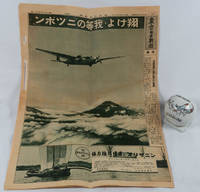
1937219986東京. Tokyo.: 大阪毎日新聞社. Ōsaka Mainichi Shinbunsha. 1937 -1939. Porcelain ash tray illustrated with a colour map 12 x 13cm with accompanying folded newpaper sheet map black and white photographic illustrations 4pp. 54.5 x 39cm A striking pair of items reflecting Japan’s aviation ambitions on the eve of the Pacific War. <br> <br>By the late 1930s Japan had developed advanced aircraft capable of long-distance flight achievements that were widely celebrated and closely followed by the press. The globe-shaped ashtray commemorates the highly publicised 1937 Tokyo–London flight of the modified military aircraft Kamikaze sponsored by Asahi Shimbun. The flight captured the public imagination and was reported as a major national success. <br> <br>The ashtray is attractively decorated with an image of the aircraft together with its route from Japan to Britain and the precisely recorded flying time of 94 hours 17 minutes and 56 seconds. <br> <br>In response the rival Mainichi Shimbun sponsored an even more ambitious venture: a round-the-world flight by the aircraft Nippon. The accompanying four-page newspaper supplement promotes the undertaking with photographic illustrations including a dramatic front-page image of the aircraft flying over Mount Fuji and a detailed projected route map. Period advertisements featuring Western military aircraft add further visual and historical interest. <br> <br>Thenewspaper conveys a clear sense of competitive ambition expressing the hope that this flight would surpass earlier records. With a crew of seven Nippon completed its journey in approximately two months. However the outbreak of World War II in Europe shortly after departure forced the cancellation of planned stops in London and Paris although Berlin and Rome were successfully visited. <br> <br>Together these pieces offer a vivid insight into the intersection of aviation media rivalry and national aspiration in late 1930s Japan. . [大阪毎日新聞社]. [Ōsaka Mainichi Shinbunsha]. unknown
215188Japan. Early Meiji. Black and white woodblock print 33 x 45.8cm few small stains a few small holes neatly repaired. A lively and attractive image. This fun-filled woodblock print is an advertisement for a visiting American circus to Japan in the early Meiji period most likely around the 1870s. The main attraction is the equestrian feats but other acrobatic entertainments including trapeze and clown acts are also featured. Seventeen American names with six others are listed in the left bottom corner. Western circuses such as Risley Circus and Chiarini Circus were very popular in Japan during the Meiji period. . unknown
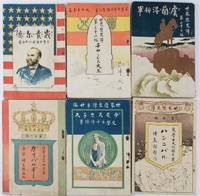
1902164495Hakubunkan. 博文館. 1902. 6 volumes from a series of 35 each standing on its own. Black and white illustrations pagination various with all well over 100 pages in length. Original coloured pictorial wrappers chipped with a little loss on spines some staining around staples good copies. A series of biographies of famous figures in world history aimed at a Japanese juvenile audience. These illustrated volumes are biographies of Demosthenes no 2 of the series Hannibal no. 5 Garibaldi no. 11 President Garfield no. 19 General Grant no. 29 and King Charles XII of Sweden no. 34. The books by Japanese authors give an interesting insight into the European and American figures who were regarded as historically significant and as moral exemplars in the Meiji Era. The series was published at a time when Japanese education was still strongly influenced by western models although a new wave of more nationalist education was just beginning to take hold. President James Garfield for example is rather surprisingly perhaps described as having been not merely a US President but also one of the great figures of modern times 'in terms of his opinions an ideal hero of civilization'. Reflecting the intended audience this and some other works in the series devote a lot of space to the childhood and early lives of their subjects emphasising their diligence hard work idealism and patriotism. . [Hakubunkan]. 博文館 unknown
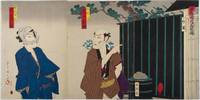
1892218409東京. Tokyo.: 福田熊治良. Fukuda Kumajiro. Meiji 25 1892. Three colour woodblock prints a triptych panels loose each 24 x 35.4cm Japanese text in red identifying the actors and in yellow identifying the roles in the upper left of two panels and program title in the top right of the third panel further text within in a red fish-shape in the lower right of the third panel some offsetting of red ink on the first panel but not affecting the main image slivers of affixing tape to the verso of each print some surface wear and abrasion mainly to the verso but the three images in very good bright condition. Dramatic depiction of the famous Kabuki actors Onoe Kikugorō V 1844-1903 as Yosaburô and Onoe Matsusuke IV 1843-1928 playing the role of Kômori Yasu in the 1892 staging of "Yowa Nasake Ukina no Yokogushi" commonly called "Kirare Yosa". <br> <br>Images such as these were collected by Kabuki fans of the day who bought woodblocks of their favourite actors and then had the prints made up into albums so that they could be enjoyed much in the way poster books and other fan memorabilia of famous movie stars is enjoyed today. <br> <br>The artist Toyohara Kunichika 1835-1900 was acclaimed as one of "The Three Greats of Meiji Ukiyo-e". Many stories surround him including his boast that he had moved 100 times which appears unlikely but this claim combined with his hard drinking womanising lifestyle and overall "live for the day" attitude all contributed to his colourful reputation. His work was very popular during his lifetime with his use of bright imported chemical dyes and his technique of focussing the image on the actors face combining to make up his individual style. see 'Time Present and Time Past: Images of a Forgotten Master' by Amy Reigle Newland. <br> <br>From the collection of the late John Caiger lecturer in Asian studies ANU. . 福田熊治良. [Fukuda Kumajiro]. unknown
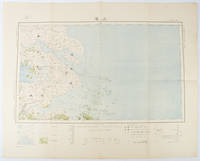
1519173266Tokyo.: 大日本帝國陸地測量部. Dainihon Teikoku Rikuchi Sokuryōbu. Taisho 15. 1926. Folding colour Japanese map of Shanghai and coastal areas of Jiangsu and Zhejiang Provinces. Scale 1:100000 embossed stamp lower right corner. Legend lower edge showing different landforms on the left section forests deserts wildlands plateaus rivers and lakes middle section showing various facilities such as post offices telecommunication offices temples ancestral halls ancient battle ground mines military fortifications submarine communications cables city walls and gates etc. right section showing different sizes of cities towns and villages and administrative boundaries. <br> <br>Occasional foxing along edges and folds ink annotation in Kanji on reverse good copy. Text in Japanese. Sheet measures 45.2 x 57.7cm. This very detailed map was originally surveyed by the Land Survey Department Empire of Japan in Taisho 7 1918. This revised edition features the railway line connecting Hangzhou - Jiashan - Shanghai - Suzhou - Wuxi. . 大日本帝國陸地測量部. [Dainihon Teikoku Rikuchi Sokuryōbu]. unknown
19482111902160500303Not Available 1948. Soft Cover. Fine. Number of pages: 6 volumes total thickness 1 cm Not Available paperback
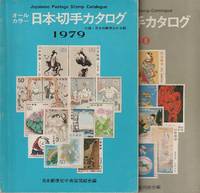
1979219083Tokyo. 1979-1980. Two volumes. 1979 volume: 127pp. 1980 volume: 136pp. Both volumes: Profuse colour photographic plates. 21 x 15cm. Text in Japanese. Spine head trifle bumped original wrappers a little rubbed a very good set. . unknown
20022090202120100662Chuokoronsha 2002. Soft Cover. Fine. Volume: 1 Chuokoronsha paperback
20022090202120300661Chuokoronsha 2002. Soft Cover. Fine. Volume: 1 Chuokoronsha paperback
197586660ABLeipzig, Koehler & Amelang 1975. Zwei Bände (vollständig). 13,5 x 22 cm. 257, (3) u. 209, (3) S. mit zahlr. Tafeln, 1 gefalt. Karte, farb. illustr. OPappbde. (minim. angestoßen). Sonst sehr gutes Exemplar. Zwei Bände (vollständig). farb. illustr. OPappbde. (minim. angestoßen). Sonst sehr gutes Exemplar.
193891677ABJena, Diederichs 1938. 339, (5) S. mit Frontispizabbildung, OHlwd. mit farb. gemustertem Überzugspapier u. goldgepr. Rücken (ein Gelenk mit kl. Fehlstelle). Insgesamt gutes Exemplar. DEA. OHlwd. mit farb. gemustertem Überzugspapier u. goldgepr. Rücken (ein Gelenk mit kl. Fehlstelle). Insgesamt gutes Exemplar. DEA.
200296080Tübingen, Konkursbuchverlag, 2002. 152 S. 21 cm. Illustr. Orig.-Klappenbroschur.
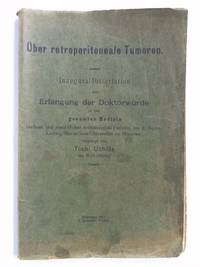
1k7235Schaeffer München 1912. 46 S. broschiert Name auf Titel/etwas randfleckig. - Inaugural-Dissertation zur Erlangung der Doktorwürde in der gesamten Medizin verfasst und einer Hohen medizinischen Facultät der k. bayer. Ludwig-Maximilians-Universität zu München vorgelegt / Mit handsignierter Widmung auf Titel "Als Erinnerung von Japaner T. Uchida" - unknown
1912101612München, Verlag der Bayerischen Akademie der Wissenschaften, 1912. 29,5 cm. 16 S mit 14 Textabb. und 3 Tafeln. Orig.-Broschur, unaufgeschnitten.
194351725ABTokyo, Deutsche Gesellschaft für Natur- und Völkerkunde Ostasiens / Leipzig, Otto Harrassowitz, 1943. gr8° (24x16), (VI), 65 S., OKart (Brosch), gering berieben und angestaubt, fest und sauber, [= O.A.G. - Mitteilungen; XXXII Teil F : Gesellschaft für Natur- und Völkerkunde Ostasiens],
194316043ABTokyo, Deutsche Gesellschaft für Natur- und Völkerkunde Ostasiens, 1943. 65 S. OBrosch.
19342138604Sapporo: ohne Verlag 1934. Seiten 355-359, (5). Mit einer Bildtafel. Gr. 8° (22,5-25 cm) Orig.-Broschur. [Softcover / Paperback].
193621495Stuttgart. J. Engelhorns Nachf. Adolf Spemann. 1936. 45, (3) Seiten. Originalbroschur. (Geringere Gebrauchsspuren). 21x14 cm