4 751 résultats
36 vintage small format silver gelatin photographs, plus a photographic postcard of Faisal II as a boy. A small collection of highly accomplished amateur photos of inter-war Iraq. With a handful of exceptions, the photographs show the local population, often children, recorded with a sensitive and sympathetic eye. - Though there is no material evidence to support the attribution, they came from a collection of similar material said to belong to Christopher Warren, who worked as an Intelligence Officer in Iraq, Lebanon and Kuwait in the 1930s. Other photographs, offered for sale at the same time as these, show that he was active in those locations and was, at one point, based at Dar Al Qamar (Moon House), Karradat Mariam, Baghdad. - The many intimate and beautiful portraits would suggest the photographer spoke Arabic and understood enough about his subjects to foment the mutual comfort necessary for such candid images. Several show young people from both the city and the countryside: the sons of shop-owners at ease in the hustle and bustle of Baghdad and children gathering crops, hunting and playing reed flutes in the open expanse of the desert. Some, such as the portrait of a suited young man in a local boat, potentially imply a professional relationship. Viewed together, the images express a peacefulness far removed from the tensions of the interwar period, in which protests against British influence were common, even after the independence of the country in 1932. Only a photographic postcard, present with the images, reminds one of the broader historical context: a portrait of Faisal II, still a child but standing upright in military dress. - All photographs clearly removed from an album, with residual scraps of brown album paper to versos.
4to (150 x 206 mm). Arabic manuscript on paper. 102 (but: 99) numbered pages (pp. 75-77 skipped). Black and red ink, 15 lines, per extensum, with a few ink diagrams in the margins. Half leather over papered boards. A collection of six treatises on sections, chronology, and astronomy, indexed on a cover label and, in pencil, on the inside front cover. Text in black ink with extensive commentary in red throughout the margins. - Binding loosened, gutters reinforced. Paper browned and brittle, but on the whole well-preserved with only very minor edge chipping.
Large 8vo. (2), XII, 283, (3), XII, XXIII, (1) pp. Contemporary half cloth over buckram boards. Forming part of the fifth edition of this important government-issued series (incorporating revisions to 1929), this 12th volume records the treaties made with the countries on the fringes of the British Raj, most importantly those made with Burma, but also such entered into with Jammu and Kashmir in the northwest as well as with Sikkim and Assam in the northeast. The first of these recorded is a commercial arrangement with the King of Ava in 1795, and those that follow demonstrate the steady progress of English intervention with a Treaty "for the establishment of a Court at Mandalay" and various arrangements between the British and Chinese with regard to the Burmese frontier. - Edges somewhat rubbed, front hinge beginning to split, but still a good, well-preserved copy. Provenance: Foreign and Commonwealth Office stamp (Commonwealth Relations Offfice Library) to title-page and cancellation stamp to verso; "Council Reading Room" stamp to flyleaf with pencil note "Amendments made to to 25. 2. 35". OCLC 454612923.
Folio (245 x 362 mm). 6 vols. (12), LXXII, (4), 668, (1) pp. (4), 743, (1) pp. 793, (1) pp. (2), IV, 5-780 pp. (4), 708 pp. 824, (104) pp. Title printed in red and black. With 187 engraved plates (many folding) and 9 engravings in the text (showing maps, plans, views, costumes, flora, fauna, scenes, portraits etc., including 2 bound as frontispieces), as well as numerous woodcuts in the text (showing arms, seals, devices, coastal views, details, machinery etc.). Uniform full calf with red labels to spine (gilding oxydized). Third and best edition of this important and profusely illustrated collection of travel reports, compiled by the brothers Awnsham and John Churchill, based on Hakluyt and Purchas. It includes the accounts of Martin Baumgarten (Egypt, Arabia, Palestine, Syria), Thomas Roe, Philipp Balde and Johan Nieuhoff (East Indies, including a detailed account of the north-eastern coast of Arabia, with a description of pearl fishing in Bahrain and mentioning Julfar, Qatar, Sir Bani Yas, Dubai, Sharjah, Ajman, Ras al-Khaimah, Amalgavine, and other places of interest along the coastline), J. Gemelli Careri (Turkey, Persia, India), Nicholas Rolamb (Constantinople), John Barbot (West Africa, with a chapter on "Mahomet and his Alcoran"), as well as of Yemen and various journeys to China, Korea, Greenland, Iceland, Africa, North and South America (including Columbus). - "This is a very valuable collection, both for its range of coverage and for the fact that it gives the original accounts [...] The third edition is considered to be best because of its greater inclusiveness and its copious index" (Hill). Two further volumes were issued separately in 1745, republished in 1752. - The count of the illustrations is notoriously complicated: the "List of the Copper Plates" counts 305 illustrations and maps, of which as many as four are placed on a single plate, and some are placed within the text. Compared to this list, the present set lacks 52 illustrations, or ca. 20 plates, whereas the first volume contains 5 additional plates not called for in the List. Three of the maps (Africa, Asia, America) which the List announces for the first volume are in fact bound in volumes IV-VI. The introduction, a "History of Navigation from its Original to this time", is likely one of the final works of the philosopher John Locke, whose publisher and financial manager Awnsham Churchill had been (while the attribution has been called into question, the text was included in Locke's Complete Works). - Provenance: Byrdie McNeill, Mt. Edgecumbe, Alaska (her stamps). Bindings professionally repaired. Some browning; some edge defects, tears and paper flaws, but generally well-preserved. Cox, I, 10. Hill 295. Sabin 13017. Shirley G.CHUR-1d. Alden/L. 744/62. Borba de Moraes I, 158. Landwehr, VOC 260 (note). Cf. National Maritime Museum Cat. I, 33.
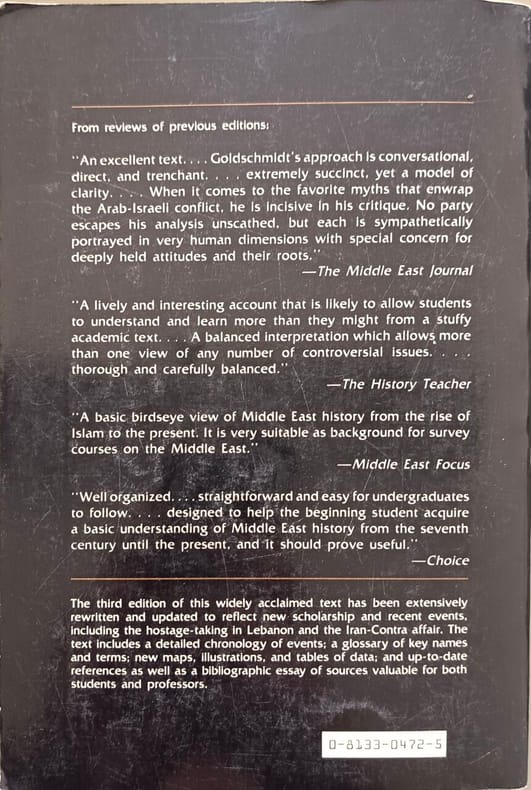
198716158Westview Press 1987 448 pages 15 2x2 8x22 4cm. 1987. Broché. 448 pages.
8vo. (2), 160 pp. With a portrait of Eduard Glaser, 8 numbered plates and 2 large folding maps. Later half cloth, with the original front wrapper mounted on the front board. First separate publication (offprint) of "an extremely important article" (Smith) on the geography of north-west Yemen, based on the results of the unpublished journals of Eduard Glaser, who explored a region that still had to be visited by any other European. It includes a history of exploration of the region, a biography of Glaser, a description of the expedition of his expeditions and two large maps of region (the second a version of the same map in Arabic). The article was originally published in the Bulletin de la Société Royale de Géographie d'Egypte XX. - A very good copy. Smith, The Yemens 40. Cf. Macro 2288.
Large 8vo. XI, (1), 71 (1) pp. - (Bound after): The Geographical Works of Sádik Isfaháni. Translated by J. C. from the Original Persian MSS. In the Collection of Sir William Ouseley, the Editor. Ibid., 1832. XIII, (1) ff., 152 pp. - (Bound with): A List of the Subscribers to the Oriental Translation Fund: With its Officers; and a Catalogue of the Works Published and Printing by the Fund. London: Gardiner and Son, 1832. 16 pp. Original dark green cloth boards with printed label on spine. With lithographed emblem of the Fund on title-page (offset onto preceding blank leaf). Bound with an added lilac-printed engraved leaf recording the copy's presentation to Lady Charlotte Guest, a subscriber to the Oriental Translation Fund. Lady Charlotte Elizabeth Guest (née Bertie, 1812-95), later Lady Charlotte Schreiber, was an English translator and business woman who taught herself Arabic, Hebrew, and Persian. After what may have been a brief flirtation with the future Prime Minister Benjamin Disraeli, she escaped her unhappy home life through marriage in 1833, which was, however, not a conventional one for her age. - With bookseller's ticket of Edward Purdy of Chancery Lane. Occasional insignificant foxing; on the whole a superb copy, contents clean and fresh.
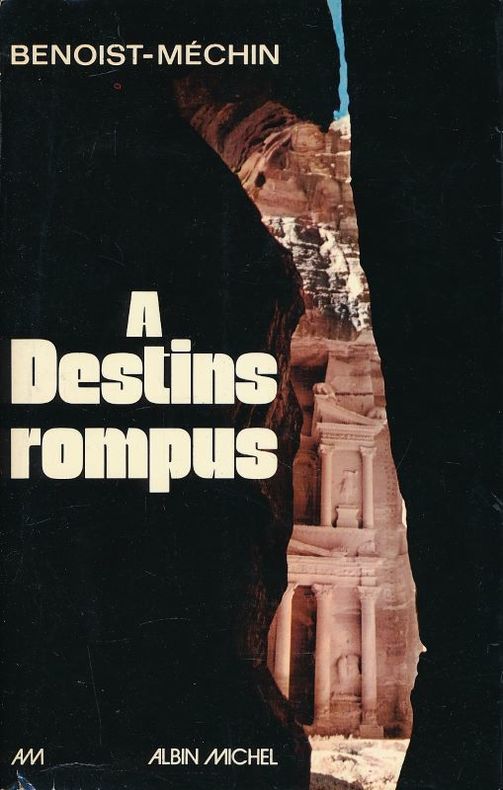
Albin Michel, 1974. In-8 broché, couverture illustrée à rabats de 350 pages. Bon état
1974151251Albin Michel Albin Michel, 1974. In-8 broché, couverture illustrée à rabats de 350 pages. Bon état
8vo. (2), VII, (1), 750, (2) pp. Publisher's blue boards. Reprint of this important "Cyclopaedia of the Doctrines, Rites, Ceremonies, and Customs, Together with the Technical and Theological Terms, of the Muhammadan Religion" (subtitle). - Largely well-preserved.
8vo. 2 vols. (4), IV, 150 pp. (2), 921, (1) pp. Modern green library cloth with gilt lettering to spine. First edition of this early Arabic and Persian dictionary, long considered one of the best of its kind (cf. Encyclopaedia Americana X, 39). Prepared by Joseph Barretto junior (d. 1825), a Calcutta merchant and banker. The Barrettos were a Portuguese family long established in India, producing two governors of the country. "Arabic, Persian, and Urdu printing in India really began in Calcutta under the East India Company from the 1780s onwards. Of the three languages, Persian was paramount to the Company's interests" (Ency. of Islam VI, 805). - Small hole to f. C2 of vol. 1 (affecting one word of the text); lower corner of final leaf of vol. 2 torn away (affecting one letter of text); some light foxing throughout (more so to initial and terminal leaves). Withdrawn from the Glasgow University Library with their bookplate and withdrawal stamp to pastedowns. Rare. Vater/Jülg 25 ("1805-06"). Graesse I, 298. Not in Zaunmüller or Kaul.
8vo. (6), 276, (2) pp. Early 20th century half leather with green buckram covers. First edition of Sen's English-Farsi dictionary, following a Farsi-English volume published in 1829. In 1841 Sen would produce a new edition, adding the pronunciation of the Persian words in transliteration. - Lightly browned throughout due to paper; a few edges reinforced. Old ownership "D. H. Crawley" (?) on title-page, and later ownership, dated 1957, of the linguist, National Socialist politician, and translator Martin Löpelmann (1891-1981). A good copy of a rare work. OCLC 85263053. Cf. Vater/Jülg 280.
Folio (275 x 407 mm). 2 vols. (4), XLVIII, (16) pp. 2144 (but: 2136: skipping 441-448) cols. (4) pp., XX cols., (6) pp., 2286 cols. 19th century English calf. First edition of the first Persian-Arabic-English dictionary, edited by the orientalist Sir John Richardson (1740/41-1795). The first volume includes a dissertation on the languages, literature and manners of Eastern nations. ''An excellent work. As the first vol. or Persian, Arabic and English part was published separately, many more copies were sold than of the second or English, Persian, and Arabic. A few broken sets of the first volume being left, the booksellers were led to reprint several deficient sheets, and so with the copies left on hand of the second vol. they made up some perfect sets. But these are easily known from the original'' (Clarke), as they are printed in London in 1800. - "On 12 November 1767 [Richardson] was proposed for the Society of Antiquaries of London as of Furnival's Inn. In London he pursued both the law and the study of Arabic and Persian. In his oriental interests Richardson was much influenced by another young man, William Jones, who was already coming to be regarded as a prodigy of learning in Asian languages. With the growth of British territorial power in India the potential market for a Persian dictionary had aroused the interest of London publishers and by 1770 Jones and Richardson were working on a new version of Franciscus Meninski's 'Thesaurus linguarum orientalium', first published in 1680-87. Progress was very slow, and Jones withdrew to concentrate on his legal career, leaving the field to Richardson. Thanks to his 'ingenuity and perseverance' (memorial of A. Hamilton and G. Nicol to East India Company, 6 Feb 1776, BL OIOC, E/1/60, no. 26), an abridged version of the original project eventually appeared in two volumes in 1777 and 1780 as A Dictionary, Persian, Arabic and English. Fundamentally revised by others, notably by Charles Wilkins in 1806 and 1810, the dictionary was to have a long life, but although the company took 150 sets, there were few other subscribers and Richardson got little reward for the huge effort he had expended on it" (Marshall). - Bindings rubbed and worn, inner hinges partly split, endpapers renewed. Some staining and marginal repairs to interior; larger tears to 5 leaves, staining to both titles, ownership inscriptions partly inked out; both titles showing central repaired clipping as well as marginal strenghtening and collector's stamp. A large part of both volumes shows worming to gutter; a few leaves with repairs. Zaunmüller 189. Vater/Jülg 25. Graesse VI, 113. Cf. Brunet IV, 1285 (later ed. only, 1806-1810). Clarke, John. (1806). The Bibliographical Miscellany - Supplement, vol. 1 (London, 1806) pp. 273-274; for Richardson: Marshall, "Richardson, John [styled Sir John Richardson, ninth baronet] (1740/41-1795), orientalist", in: ODNB (online ed.).
Large 8vo (170 x 255 mm). (2), VI, (2), VII-XXXVI, 639, 639a-h, 640-1110, (2) pp. With 15 (mostly folding) maps (many in colour) and numerous text ilustrations. Contemporary giltstamped cloth. Second, enlarged edition of this standard work, first published in 1866. An encyclopedic volume of over 1000 pages with a detailed index. The chapters include descriptions of the coasts and islands of the Cape Colony; coast of Kaffraria and Natal; Eastern Africa; Madagascar and the Mozambique Channel; the coast of Africa, between Cape Delgado and the Red Sea; the Red Sea, etc. - In particular, Findlay devotes much attention to the coasts of Arabia and onwards to the Arabian Gulf, providing rich detail about the port of Aden, navigating and anchoring around Ras Arah and Ghubbet Seylan, the population of Masirah Island, the climate of the Gulf and its threats to Western health, topography of the coastal settlements, information on the reefs and pearl banks, etc. The discussion of the Gulf ("Our acquaintance with the hydrography of the Persian Gulf is nearly perfect") includes intelligence on Sharjah ("Shargeh"), "the most important town on the coast", numbering 8,000 to 10,000 inhabitants, and on Dubai ("Debay"), "a large town of 5,000 or 6,000 inhabitants" standing "a little back from the shore" and "recognizable as being the last town on the coast, there being not a single date-tree or house from this all the way to Abu Thabi". The coast is described as "quite barren and uninhabited, throughout very low, with tufts of mangrove bush", and "so uniform in appearance that the smallest peculiarities are noted by the Arabs, and names given to them". Abu Dhabi ("Abothubbee") is noted as "the most populous town on the coast", containing "about 20,0000 inhabitants" and sending "600 boats to the pearl fishery. The chief is very friendly to the English. Cattle might be obtained here". - Binding rubbed; hinges split. Some foxing throughout as common; repeatedly annotated quite ungraciously by a 20th century hand in coloured ballpoint and broad felt-tip pen. A later edition (from Humphrey Winterton's library) commanded £720 at Sotheby's in 2003. Mill (Cat. of the RGS Library) 160. OCLC 217065553.
21420Tehran: Islamic Propagation Organization n.d. Paper bound16mo edition not stated 78pp. Letter/questionnaire from the International Relations Department of the Islamic Propagation Organization laid in at front. As new. 70 grams. All books in stock and available for immediate shipment from Winnipeg Manitoba. Tehran: Islamic Propagation Organization, n.d. unknown
8vo. 307 ff. Naskh calligraphy, 15 lines. Black ink on polished paper; borders in red and gold; sura headings in white ink on gilt; gilt discs for verse divisions. Double-page 'unwan on first two pages shows elaborate gilt ornamentation; colophon shows floral ornamentation in green and gilt. Coloured floral decoration to margins. Later cloth. Colophon in Arabic: "Finished Thursday afternoon 3 o'clock. The scribe is the son of Mehmed Halil Ibrahim, what is done is determined by Allah". - Provenance: acquired in Istanbul, Turkey, in the 1960s.
8vo (ca. 110 x 160 mm). Arabic manuscript on paper. 260 ff. with 3 double-page 'Unwan headpieces in colours and gilt. 17 lines in meticulous black ink Naskhi, text within black, blue and gilt rules, verse divisions marked by black-bordered gold discs, red orthoepic markers and diacritics, sura beginnings in red on gilt background, line separators in black and gilt, marginal medallions (Juz' and Hizb markers) in colours and gilt, marginalia in red. Contemporary lacquer binding, covers elaborately painted with floral designs on outsides and insides. Later black morocco spine with stamped title. Stored in contemporary giltstamped leather slipcase with flap. An exceptionally pretty early 19th century Qur'an manuscript probably written in the Pashtunistan or Balochistan region of British India. Occasional insignificant edge flaws or various instances of light browning, but generally a very clean and well-preserved example in a pretty floral lacquer binding (corners bumped, spine repaired in more recent times). Slipcase a little rubbed and worn along extremeties.
Watercolour over traces of pencil. 708 x 490 mm. Signed and dated by the artist. Matted.
Fine English Paperback. Pbo. Roy. 8vo. (24 x 17 cm). In English. 288 p. A guide book of Islamic cultural institutions.
8vo. (3)-708, (2) pp., XV pp. of plates. With four folding maps within pouch inside lower cover. 519, (3) pp., IX pp. of plates. Lacks the map, but with a different, supernumerary map within pouch inside lower cover. Modern (vol. 1) and original (vol. 2) blue cloth with giltstamped cover and spine titles (vol. 2 with closing fore-edge flap). Only edition of this rare, secret Naval Intelligence Handbook, compiled by D. G. Hogarth, Keeper of Antiquities at the Ashmolean Museum, Oxford (and close friend of T. E. Lawrence) for the British Admiralty's new Naval Intelligence Division, intended for the exclusive use of British officers operating on the Arabian Peninsula during the Great War. Although the information contained was classified as confidential, it could "in certain cases be communicated to persons in H.M. Service below the rank of commissioned officer", though officers exercising this power were warned to impart such data only with "due caution and reserve". As the introductory "Note" informs the reader, "The sources from which this work has been compiled include native information obtained since the outbreak of the war [...] Separate chapters are devoted to each of the great districts of Arabia [...] After the area of the territory under review has been defined, its physical character is described unter the subsections of Relief and Climate. Then follow social and political surveys of the district, the former usually arranged under the sub-headings of Population, Life and Appliances, Products and Trade, Currency, and Weights and Measurements, the latter describing the system of Government, Recent History, and Present Politics. The last section of such a chapter is purely geographical and is devoted to the Districts of the territory [...] In a composite chapter, such as that on the Gulf Coast, dealing with several independent territories, the same general arrangement, when practicable, has been followed for each area [...] The plates at the end of each volume have been chosen to illustrate the varieties of country which are characteristic of Arabia". The second volume is devoted "mainly to detailed routes, preceded by two chapters on methods of transport and lines of communication [...] Chapters have been incorporated on Meteorological Observations, Hygiene and Disease, and Vocabularies". All four maps of the first volume (Districts and Town; Orographical Features; Land Surface Features; Tribal Map) are present as called for; the "Key Map of Routes" in the second volume has been replaced by an orographical map of Palestine and Trans-Jordan (1933). While the first volume (I. D. 1128) has been rebound to style (lacking the half-title noting the confidential character of all information contained), the second volume (C. B. 405) is preserved in its original binding as issued, bearing also the copy number "Copy 117" in gilt on the upper cover. A Note of Confidentiality calls attention to "the penalties attaching to any infraction of the Offical Secrets Act". Stamps on flyleaf and pastedown trace its provenance to the Royal Central Asian Society, founded in 1901, and the book remained on the shelf of that Society's secretary when it was renamed the "Royal Society for Asian Affairs" in 1975. This ownership is cancelled in ballpoint, with a note "Sold to Mr. M. Graham" (i.e., Murray Graham, British collector and exploration agent in Arabia, d. 2008). Acquired from UK trade. OCLC 29922535, 775016994. Not in Macro.
8vo. 4 vols. (instead of 6). Vol. I: General. 360 pp., 3 colour folding maps at rear, tables. - Vol. II: Irak, The Lower Karun, and Luristan. 512 pp., 1 large folding plan and 1 folding map at rear pocket, 8 b/w photographic plates (spine slightly damaged, hinges weak, lacking title page). - Vol. III: General Mesopotamia with Southern Kurdistan and the Syrian Desert. 416 pp., 1 large folding map at rear (modern cloth, new endpapers, glossary, appendix, index). - Vol. IV: Corrections and additions to Volume IV. Northern Mesopotamia and Central Kurdistan. 166 pp. (library bookplate verso front cover, small stamp on title page). Vol. III in modern library cloth, the rest in original cloth. Prepared on behalf of the Admiralty and the War Office for official use only, this Handbook gives an account of conditions in Mesopotamia (Iraq) for the most part as they were before the First World War. These volumes cover the boundaries and physical features of Iraq, its minerals, climate, fauna, administration, transport, irrigation, religion and agriculture. The Naval Intelligence Division (NID) was the intelligence arm of the British Admiralty before the establishment of a unified Defence Intelligence Staff in 1965. It dealt with matters concerning British naval plans and the collection of naval intelligence.
4to. XVI, 144 pp. With 7 numbered plates (4 of which coloured) and several black and white illustrations in the text. Original full cloth with stamped falcon to front cover and stamped spine-title. First edition. - A standard work of modern falconry literature by one of the most renowned falconers of the 20th century, the British lawyer Mavrogordato (1905-87). This "excellent book" (Gallagher) is directed at a new generation of falconers choosing to work with the previously frowned-upon sparrowhawks instead of falcons, but also addresses experienced hawkers. It includes observations on the choice of a suitable bird, the treatment of eyasses, the falconer's equipment, and the calling-off of a bird, as well as the animals' diet and health. - The charming illustrations were carried out by the British artist George Edward Lodge (1860-1954), himself an authority on falconry. The plates show muskets and goshawks sitting or in flight; the text illustrations mainly display tools used by the falconer, including hoods, knots, and perches. - Title-page slightly foxed, otherwise in excellent condition. Gallagher, Falcon Fever 85. Oelgart 29B. OCLC 6399849.
277701. Soft Cover. Good. PB/Fair condition/40 pages - Discusses the teachings of Phra Ajaan Mun. AT927770 paperback
18074Moscow: USSR Academy of Sciences 1980. Paper bound first edition volume one of the series extensively referenced 218pp. Botto corner of rear cover is lightly fanned otherwise a tight and unmarked very good or better copy. 275 grams. All books in stock and available for immediate shipment from Winnipeg Manitoba. Moscow: USSR Academy of Sciences, 1980 unknown
No marks or inscriptions. No creasing to covers or to spine. A very clean very tight copy with bright unmarked boards, slight wrinkling to lower edge of early pages and no bumping to corners. 523pp. A history of parts of the Middle East compared to the accounts given in the Old Testament.