4 751 résultats
4to. VII, (1), 478 pp. Giltstamped dark blue cloth with spine title. First edition. - A nice solid copy of this useful reference book by the French orientalist and translator Huart, who spent several years as a student-dragoman for the French Ministry of Foreign Affairs in Damascus, followed by his appointment as Consul in Istanbul, before assuming a position as professor for Persian language at the Paris "École de langues orientales" in 1898. Translated from French by Mary Lloyd. As part of the 15-volume series "Short Histories of the Literatures of the World", edited by the literary historian Edmund Gosse and launched in 1898, it saw 8 reissues up to 1990. - Untrimmed, uncut copy. - A little fraying and scuffing to edges but remains a firm, clean copy.
4to. With 13 numbered lithographed plates (the first used as frontispiece), including 3 fully and 1 partially coloured by a contemporary hand, of which 2 highlighted in gold. Contemporary half calf, restored and rebacked with parts of the original backstrip laid down, with new tooling and title-label on spine, cloth sides, later endpapers. First edition of "the historic cornerstone of the study [of mummification] in English. For the time at which it appeared, the work was a monumental undertaking. Based on scholarly research and practical experience, Pettigrew's work was a summation of almost all that was known concerning Egyptian funerary practices. He compiled all the ancient sources and commented on them, as well as discussing many examples of mummified remains investigated by or known to him. The work is illustrated by [...] Georges Cruikshank (better known for his satirical drawings) that are the product of careful observation" (Peck). - With the bookplate of the British lawyer and politician Bernard John Seymour Coleridge, 2nd Baron Coleridge (1851-1927). Some foxing on the title-page and some spots and marginal waterstains on the plates, touching the last three illustrations, otherwise in good condition. Binding rebacked and restored. Brunet IV, 581. Gay 1565. W. H. Peck, "Mummies of ancient Egypt" in: Mummies, disease and ancient cultures (1998), p. 15.
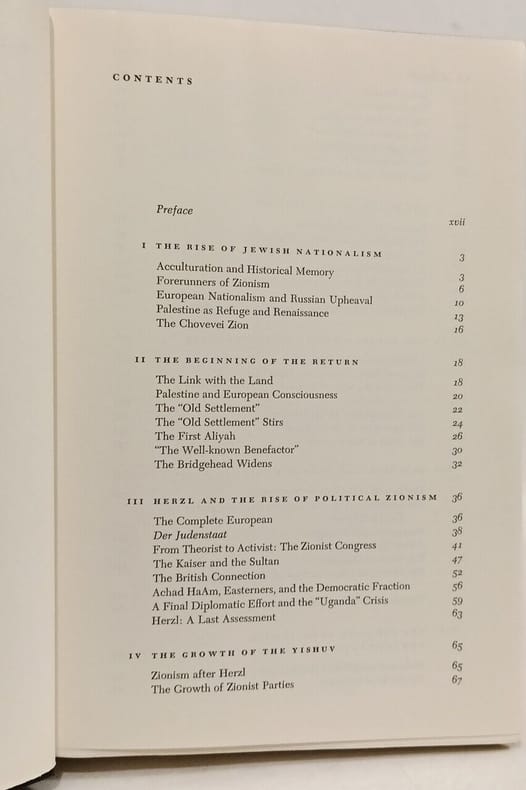
1976100147080Knopf 1976 17 018x5 334x24 13cm. 1976. Cartonné jaquette. Ouvrage historique majeur de Howard M. Sachar publié pour la première fois en 1976 qui retrace l'histoire d'Israël depuis l'émergence du sionisme jusqu'à l'époque contemporaine. Considéré comme une œuvre monumentale et précieuse pour comprendre le développement de ce pays jeune
4to (210 x 268 mm). XIV, 176 pp. With 2 colour-printed plates (one bound as a frontispiece) and 9 plates in monotone. Publisher's original blue cloth with gilt title to spine, upper cover stamped in gilt and blind. Top edge gilt. A history of Persian navigation and trade from the earliest times to the sixteenth century. First edition, on hand made paper, one of 250 signed copies (but number and signature erased). With a preface by Muhammad Iqbal. - The Indian scholar Hadi Hasan (1894-1963), a native of Hyderabad, was educated at Cambridge in geology, botany, and chemistry. "On his return to India he played an active role in the freedom movement against British rule and was praised for his work for independence by Mahatma Gandhi" (Encyclopedia Iranica). He subsequently completed a Ph.D. in Persian at the University of London before being "appointed professor and head of the Department of Persian at Aligarh Muslim University, a position he held until 1958" (ibid.). - Occasional insignificant fingerstains; slight paper flaw to title-page from erasure of the number. Binding rubbed and faded, extremeties a little bumped, but well-preserved on the whole. Wilson 88. Encyclopedia Iranica XI, 436f. OCLC 4517880.
3 vols., 8vo., with coloured frontispieces, numerous coloured plates, and many maps in the text; oatmeal boards, upper boards and backstrips elaborately blocked in gilt and blue, patterned endpapers, a near fine set in publisher's printed board slip-case, the case with two short splits at edges. The set comprises: Vol. I: The First Crusade and the Foundation of the Kingdom of Jerusalem (1951); Vol. II: The Kingdom of Jerusalem and the Frankish East 1100-1187 (1952); Vol. III: The Kingdom of Acre and the Later Crusades (1954).
3 vols., 8vo., with frontispieces, plates and maps in the text; brown cloth, gilt backs, a near fine set in unclipped dustwrapper, the whole housed in publisher's slip-case. Splendid set of the standard reference. The set comprises: Vol. I: The First Crusade and the Foundation of the Kingdom of Jerusalem; Vol. II: The Kingdom of Jerusalem and the Frankish East 1100-1187; Vol. III: The Kingdom of Acre and the Later Crusades.
Folio (ca. 210 x 330 mm). (8), 245 ff. (1), 246-481 ff. With numerous genealogical plates printed in red and green (of which 2 folding) in the 2nd volume. Original printed flexible boards with cloth-reinforced spine (vol. 2); vol. 1 bound in modern half calf with cloth covers, preserving original printed upper wrapper within. Rare history of the Emirate of Transjordan (today the Hashemite Kingdom of Jordan), then a British protectorate. Presentation copy from the author to Ahmed Salem el Sakrun of the Arab Legion and inscribed by him to "my friend Ahmed Effendi Hsein El Amawi as a remembrance, Amman 23.12.35" on inside of upper wrapper. - The second volume contains not only the first volume's index, but also an annotated directory of the tribes of the various districts of Transjordan, comprising extensive tables, genealogies, and introductory essays on each tribe. With a separate index to the tribes and a bibliography at the end of the volume. Major-General F. G. Peake (1886-1970), known to the Jordanians as "Peake Pasha", served under Lawrence of Arabia and formed the "Arab Legion", the territory's regular army, in the early 1920s. He was later appointed Major-General in the army of the Emirate of Transjordan. Upon his retirement in 1939 he was succeeded in his command by John Bagot Glubb. - Title of vol. 1 trimmed and mounted on blank leaf; some light spotting or soiling; final leaf a little stained, slight fraying to edges at beginning and end, original printed upper wrapper rubbed and stained, lacking lower outer corner. Spine of vol. 2 a little chipped, else fine. - Mimeographed typescript, printed on one side throughout. No copy in British Library. OCLC 29109691.
4to. 240 pp. With a map frontispiece and several black-and-white photographic illustrations. Contemporay full cloth with giltstamped spine-title. In printed dust jacket. First edition, rare. The "first comprehensive analysis" of the growing financial powers of the oil countries in the 1970s. The author examines OPEC's oil policy, the distribution of oil revenues in the Arabian Peninsula, the emergence of big Arab companies and major players of the Arab financial world, as well as issues of recycling and aid programmes. The work is enriched with photographs showing key personalities of Middle Eastern politics, including King Faisal bin Abdel-Aziz al Saud, King Khaled bin Abdel-Aziz al Saud, Sheikh Abdullah al Salem al Sabah, Sheikh Sabah al Salem al Sabah, and Prince Saud bin Faisal. - Dust jacket somewhat worn. A fine copy. OCLC 1158989003.
8vo. VII, (1), 272, 12 pp. With a folding hand-coloured map and a plate (view of Mount Ararat). Contemporary polished calf, spine gilt, rebacked retaining original spine. Marbled endpapers. First edition. - Rare travel report by the British lieutenant Thomas Lumsden, who journeyed from Meerut near Delhi down the Ganges to Calcutta, then onwards by boat to the Arabian Gulf and by land through Persia (Iran), the Caucasus, and southern Russia. A German translation appeared in the same year (and was republished in 1824). The author gives a detailed account of his voyage through the Gulf from Muskat to Bushire immediately after the British Navy's controversial 1819 campaign against Ras al-Khaimah, and notes approvingly the Arabs' kindness and hospitality toward their foreign guests ("which could hardly have been the case, had their detestation of Christians been in reality as great as the Koran tends to inspire"), as well as the entire absence of the cruel mistreatment of the sailors so common on European ships. - Plate slightly browned; a fine copy. Wilson 131. Salmaslian 135. Miansarov 3022 Lowndes 1413. Western Travellers in the Islamic World AR-2028. Cf. Griep/L. 840. Engelmann 124. Not in Macro.
In 4, pp. XIX + 176 + 138 + 181 + 9. M. pl. coeva. Spelature ai piatti e al d. Edizione originale di questa descrizione di viaggio dall'Europa a Zante, Cipro, Aleppo, Baghdad, Bassora fino a Goa e Bombay. Cox, I, 306.
Engraved map (43 x 53 cm), hand-coloured in outline. Rare chart of the southern coasts of Yemen and Oman, published in “The English Pilot... the Third Book”, engraved by Sutton Nichols. Tibbetts 177. Not in Al Ankary; Al-Qasimi.
The largest collection of its kind in private hands. 330 works in more than 1100 volumes. Mostly original or first editions. Published in Austin, Cairo, Chicago, Hildesheim, London, Marburg, Moscow, New York, Philadelphia, Riga, Tehran, Warsaw and other places in the years 1788 to 2011. Amassed over the last fifty years and covering four centuries of relevant material, the present collection spans all aspects of the history and development of the breeding of Arabian horses. It comprises within itself many books from the Le Vivier collection: fine press books of racing and thoroughbred literature produced by Eugene Connett's famous Derrydale press, as well as numerous important items from the library of Duke Maximilian in Bavaria (1808-88), himself a great enthusiast of Arabic horses. We here find the early Arabian Horse Registry of America Stud Books, and many items also bear presentation inscriptions from the authors (Carl Raswan, Gladys Brown Edwards, etc.). The common practice in such a specialized field, most of the publications here were issued for a very limited circulation in runs of 1,000 or fewer individually-numbered copies. - As a reference library for breeding the collection is unparalleled: almost any Arabian horse's forefathers will be found amongst the exhaustive stud books and breeding serials from the 18th to the 20th century, from Egypt, Australia, Iran, Spain, Russia, the USA, etc., often with accompanying photographs. Perhaps the most famous reference work is the Raswan Index, of which only 380 copies were printed (and many destroyed by a flood). Raswan became an expert on the Arabian breed through his lengthy trips to the desert, where he lived with the Bedouins and learned their language and customs. Several scarce early 20th century works also testify to the Western fascination with the Bedouin and desert roots of the Arabian horse: Homer Davenport's 'My Quest of the Arabian Horse' (1909) and Raswan's 'The Black Tents of Arabia: My Life Amongst the Bedouins' (1935). - Alongside modern surveys of the key centres of horse-breeding in the Arab world, the early Western classics are also found here in their scarce first editions. French and German authors are also well-represented, including the text and first French translation of the 'Hilyat al-fursân wa-shi'âr ash-shuj'ân', an abridgement of Ibn Hudhail's horse treatise, prepared around 1400. Finally, the owner's collection of notable catalogues and magazines paints a fascinating composite picture of the evolution, and heyday, of Arabian horse-breeding in the Arab world, Poland, America, and the United Kingdom. - Also contained in this magnificent collection are the classic reference works on Arabian and Anglo-Arabian racehorses and their breeding. These standard works and encompassing sets of specialised thoroughbred literature include not only the indispensable guides to horse pedigrees, the Racing Calendar, General Stud Book, Spanish, American and Australian Stud Books, Bloodstock Breeders' Review, and Prior's Register of Thoroughbred Stallions, in near-complete runs stretching back as far as the 18th century, but also British and international horseracing history, and several volumes of exquisite coloured plates. - The size and comprehensiveness of the present collection cannot be overstated; it is safe to say that it represents the largest private collection of its kind which has come up for sale in recent decades. Many of the items found here can be located in just a handful of public institutions worldwide. Such items come into the market so rarely (and have recently, like the Raswan Index and the AHRA Stud Books, commanded prices of five figures) that it would be impossible to build a comparable collection item-by-item; the volumes here represent a lifetime of serious dedication to the task. Yet the value of such a collection lies not simply in its impressive number of important publications, but in the vast amount of practical knowledge contained within. - Illustrated catalogue available upon request.
170 x 115 mm. Watercolour over pencil, heightened with white. Signed and dated. Matted.
92928aafCambridge, University Press, 1930, in-8vo, frontispiece + XXXI + 506 p., original clothbound.
575 x 425 mm. Colour lithograph, signed "Ibrahim K.". Mounted on styrofoam board. Bilingual safety poster in Arabic and English. - Traces of folds.
Small 4to. XVI, 192 pp. With photographic frontispiece, 11 photographic plates, and 9 illustrations in the text. Original full cloth with giltstamped falcon to cover and giltstamped spine-title. First edition. An authoritative textbook, one of two classics on falconry to appear in 1960 (the other being Jack Mavrogordato's "A Hawk for the Bush"). It discusses the choice of hawk for training with the necessary furniture and appliances, individual species used in falconry, their particular challenges in training and management, their handling when flown at quarry in the field, falcons' home life, their health and disease, as well as how to deal with lost hawks, and the moult. - With contributions by S. E. Allen and Jack Mavrogordato on game hawking and rook hawking. The impressive illustrations display various birds of prey, including lanners, sakers and peregrines, as well as merlins, kestrels, and goshawks, sometimes hooded or on perches. One photograph shows a young boy working with a kestrel. The other illustrations show the equipment typically used in the sport, including the falconers' knot, hoods, jesses, and bells. - Edges and endpapers slightly foxed. A single copy in auction records. Oelgart 31A. Cf. U.S. Air Force Academy Library, Special Bibliography Series 81, 590 (U.S. edition). OCLC 1079355522.
8vo (194 x 130 mm). Arabic manuscript on paper. 90 leaves, 15 lines per page written in more than one hand in cursive script with several words in red; numerous diagrams and tables. Contemporary limp red morocco. The three works comprise: - 1. "Al-Durr al-manthur fi'l-'amal bi-rub' al-dustur". A treatise on calculating time with the aid of the sine quadrant, for any region (GAL II, p. 218, 1, attributed by Brockelmann to Sibt al-Maridini's grandfather, the astronomer Abdallah ibn Khalil ibn Yusuf Jamaladdin al-Maridini al-Qahiri, d. 1406). - 2. "Raqa'iq al-haqa'iq fi hisab al-daraj wa'l daq'iq" ("Subtleties of Truths on Arithmetic of Degrees and Minutes"). Instructions for the calculation of celestial motions with the aid of minute proportions (GAL II, p. 217, 11). A commentary on a work by his teacher, the Egyptian mathematician and astronomer Shihab al-din Abu'l-'Abbas Ahmad ibn Rajab ibn Tibugha 'Ibn al-Majdi' (1365-1447), entitled "Kashf al-haqa'iq fi hisab al-daraj wa'l-daq'iq" ("Opening Truths on Arithmetic of Degrees and Minutes"). - 3. A commentary, "Risalah [al-Fathiyya (al-Shihabiyya)] fi'l-'amal al-jaybiyya" ("Treatise on [Fath al-Din (Shihab al-Din)]". Operations with the sine quadrant (GAL II, p. 216f., 7). - Sibt (Ibn Bint) al-Maridini (the Elder, 1423-1506) lived in Cairo and Damascus. He served as the muwaqqit (time-keeper) of the al-Azhar mosque in Cairo, and was a pupil of Ibn al-Majdi. His works are often conflated with those of his grandfather, and with those of his like-named son, who died in 1527 (GAL II, p. 468). - A few old repairs occasionally affecting letters; altogether very well preserved. Provenance: from the property of Dr. Eugene L. Vigil (b. 1941), of Lynden, Washington, USA. For Sibt al-Maridini see B. A. Rosenfeld & E. Ihsanoglu, Mathematicians, Astronomers & Other Scholars of Islamic Civilisation and their Works, Istanbul 2003, pp. 276f., no. 815, and pp. 293-298, no. 873.
Hand-coloured engraved map (scale: 70 miles to 1 inch). 692 x 668 mm, including fold-out section at right edge showing Ras al-Hadd. Matted. Exceedingly rare, large map of the Arabian Peninsula, based on surveys conducted under General F. R. Chesney (1789-1872), the explorer of the Euphrates and founder of the overland route to India. Drawn by W. H. F. Plate. This is a second, improved edition of a map that had previously appeared in 1847 under the simple title "Arabia" (kept at the British Library, referenced as IOR/X/3205 within the Qatar Digital Library). "Mesopotamia and its rivers are laid down from Surveys made during the Euphrates Expedition. The Red Sea, the Persian Gulf and the Southern Coast of Arabia are from those made by the Officers or the Indian Navy. The interior of the peninsula is from various sources, particularly materials furnished for the accompanying work by Aloys Sprenger M.D. and from documents obtained by Dr. Plate" (note). Finely preserved. No copy known outside the British Library. OCLC 556388606. Not in the Al-Qasimi Collection.
French bronze reliefs gilt, both preserved in their original frame. Each 43 x 39 x 4.5 cm. Showing two horses facing each other. Both bronze reliefs are very intricately detailed and mounted on a base of red velvet in two strictly contemporary frames of the French Empire period.
26 x 37 mm. 819, (5) pp. Original leather leather binding richly gilt with floral motifs, with leather clasp and cord with attached magnifying lens. All edges gilt. In original cardboard box. A charming miniature Quran in excellent condition, preserved in its original gilt binding and cardboard box. With richly decorated opening double page frontispiece. Fully vocalized text set in a frame, verse separators, sura headings and section markers in the margins printed in black throughout. These miniature Qurans were printed at the press of Hans Steinbrener since the early 1900s; with the new millennium, the shop closed down and ceased production. These miniature editions of the Holy Quran, with their elaborate gilt leather bindings and attached magnifying glass, count among the finest examples of their kind and as masterpieces of Bohemian printing and craftsmanship. "The firm advertised itself as the continent's largest producer of artistic bindings for prayer books and the largest publisher of prayer books [...] This publisher supplied a market ranging from Manila to New York" (Marija Dalbello, "Franz Josef's Time Machine: Images of Modernity in the Era of Mechanical Photoreproduction", in: Book History, Vol. 5 [2002], pp. 67-103). - Available colours: green, red, blue, brown, maroon. Gilt cover design, box design, and clasp design may vary. Coin shown for size comparison only.
556120Privately printed for the author by Udyama commercial Press, Nagpur, India, 1975. In-8, rel. demi-toile rouge sous jaquette ill., XVI-413 pp., texte anglais, notes et index.
8vo. IX, (1 blank), 349, (1) pp. With a photo of the author as a frontispiece, 6 plates and 1 folding map of the Arabian Peninsula. Blue cloth with gold lettering on front cover and spine, and blind-tooling on front cover. An account of the travels of an Englishman through Arabia, including an eye-witness account of the 1911 siege of Sana'a, the capital of Yemen. This siege was one of the last big events in the Yemeni-Ottoman conflicts, which started with the first Ottoman attempt to conquer Yemen in 1538. In 1911 a treaty was signed, with which Yemen became a vassal state of the Ottoman Empire until the country could take advantage of the Empire's collapse during and after WWI to reclaim its independence. - Wavell did not intend to include a description of his journey to the holy city of Mecca, but apart from his accounts of Yemen he admits in the preface that the present work breaks no new ground. The places he visited had already been described, possibly more extensively, by other explorers and travellers, but a journey to Mecca and Medina was still quite out of the ordinary for Europeans, and thus a description of his experiences was added to the work. It was first published in 1912 and the present copy was a part of the second impression of that edition, which appeared in 1913. An edited, smaller and thus cheaper second edition appeared posthumously in 1918. The chapters on Wavell's travels in Yemen had been removed and an introduction by Major Leonard Darwin, son of the naturalist Charles Darwin, had been added. - Arthur John Byng Wavell (1882-1916) was an English army officer and traveller who was educated and trained at the Royal Military college Sandhurst. He was a cousin of the decorated field marshal Archibald Percival Wavell, 1st Earl Wavell, who served in the Second Boer War, in other parts of Africa, and in India where he also served as the Viceroy. The author of the present work resigned his army commission in 1906 and went to Mombasa in British East Africa - modern Kenya - where he learnt Arabic and Swahili and where his desire to explore Arabia and even visit Mecca grew. After his travels in Arabia, described in "A Modern Pilgrim in Mecca", he returned to Africa. During the First World War he remained in Africa, where he founded a coastal defence force called the "Arab Rifles", active around Mombasa. Later he was sent to serve near the border of Kenya with Tanzania (then British East Africa and German East Africa), where he was killed in 1916 as a result of a German ambush. - Binding slightly rubbed, very slight foxing on the edges, some foxing on the first and last flyleaves. Small tear in the in the inner margin of the map, without affecting the map itself. Sharp folding lines in the plate of The Haram in Mecca (between pp. 152-152). With an ownership inscription: "R. S. Breene, 1 June, 1928" over the remnants of an erased inscription on the first flyleaf. Howgego IV, W13. Smith, The Yemens, 103. Cf. Macro 2266. Canton, From Cairo to Baghdad: British Travellers in Arabia, pp. 161-165. Sotheby's, The library of Robert Michael Burrell, 858 (other ed.).
556847London, Weidenfeld & Nicolson, 1962. In-12 cartonnage éditeur sous jaquette ill., XIV-298 pp., 40 ill. en noir h.-t., index.
4to. XII, 383, (1) pp. Folding engr. map frontispiece ("Map of a Route through the Regency of Tripoli and Kingdom of Fezzan"), 17 chromolithogr. plates drawn by Lyon and lithographed on stone by G. Harley or D. Dighton, M. Gauci, as well as a text illustration. Modern red cloth with gilt-stamped black spine labels. First edition of Lyon's account of his botched Timbuktu expedition, finely illustrated with 17 plates (created by M. Gauci and D. Dighton after Lyon's own drawings) showing the Arabian desert culture. - In 1818, G. F. Lyon (1795-1832) was sent with surgeon-explorer Joseph Ritchie by Sir John Barrow to find the course of the Niger River and the location of Timbuktu. A year later they had only got as far as Murzouk where they both fell ill. Ritchie never recovered and died, but Lyon survived and continued his travels. After a year he returned to Tripoli, the expedition having failed utterly. Upon return, he was promoted and in 1821 - the same year this book was published - given the command of HMS Hecla on his second attempt. Lyon was reputed to have a genuine informed interest in the culture and inhabitants of the lands he visited. Wearing Arab/Muslim dress and speaking fluent Arabic, he managed to blend in with the inhabitants of North Africa. "An important work. Lyon joined the British government scientific mission headed by Ritchie, taking place of Captain Frederick Marryat. They met at Tripoli in November 1818. Ritchie died in 1819 and Lyon took over command of the expedition. He returned to London in July, 1820. Shortly after that he joined Parry's arctic expedition. The fine plates illustrate mostly costumes, and are all after drawings by Lyon" (Blackmer). Fergus Fleming characterizes the relationship between Ritchie and Lyon, who was a "moustachioed extrovert aged twenty-two [...] Lyon was not, on the face of it, suited to African exploration". By his own confession, his main interests were "balls, riding, dining & making a fool of myself". - The plates include: Costume of Tripoli (2 types), Triumphal Arch - Tripoli, Arabs Exercising, The Castle of Bonjem, A Sand Wind on the Desert, Piper and Dancer - Tripoli, The Castle of Morzouk, Tuarick in a Shirt of Leather & Tuarick of Aghades, Tuaricks of Ghraat, Costume of Soudan, Negresses of Soudan, Tibboo Woman in Full Dress, Tibboo of Gatrone, A Tuarick on his Maherrie, camel Conveying a Bride to her husband, A Slave Kaffle. - Offsetting on title from map; map tears repaired. Altogether in very good condition. Blackmer 1044. Abbey Travel 304. Howgego II, L52 (p. 376). Henze III, 318. Lipperheide Ma 14 (note). Colas 1920. Hiler 556. Ibrahim-Hilmy I, 397. Lambert I, 147. Tooley 311. Fergus Fleming, Barrow's Boys: A Stirring Story of Daring, 2001, pp. 956. Brunet III, 1254. Graesse IV, 312.
8vo. 2 vols. XXXII, 400 pp. VII, (1), 320 pp. With a total of 8 folding maps and 11 plates as called for. Contemporary full calf with giltstamped red labels to gilt spine. Second London edition of this important work, first published in Edinburgh in 1727, "which remains to this day one of the most valuable first-hand histories of English merchant shipping in the Indian Ocean and East Indies" (Howgego). It covers "the whole of the Orient" (Hill) from Ethiopia to Japan and is very strong on India (some 20 chapters, not counting Bengal, which is described separately), but also includes an extensive section on the Arabian Peninsula: chapter IV "gives a little description of the coast of Arabia the Happy, from Mount Sinai to Mocha, with some observations on the religion, customs and laws"; chapter V "gives a description of the Immaum of Mocha's country, particularly its situation, laws, customs and commerce"; chapter VI "contains a description of Aden [...], also an account of the sea-coast of Arabia petraea, as far as Muskat and Bassora", chapter VII "treats of the kingdom and city of Muskat, and of their religious and civil customs [...] and a little account of the sea-coast of Arabia deserta, as far as Bassora", while chapter VIII "gives an account of Bassora City, and that part of Arabia deserta". Includes a rough, but apparently original map of the Gulf, showing "Barreen Island", "Cape Mussendon", and little detail along the Peninsula's northeastern coast in between save for a place labelled "Zoar", here not indicating Sohar in Oman but clearly referencing the area of the present-day Emirate of Sharjah (even Niebuhr's 1765 map still shows a town named "Seer" - Sir, Julfar - opposite the island of "Scharedsje"). The text mentions the region's trade in horses and pearls, stating, "There are no towns of note between Muskat and Bassora, but Zoar, and but very few inconsiderable villages; but there are two or three pretty convenient harbours for shipping. The southernmost is about 6 leagues to the southward of Cape Mosenden, called Courfacaun. It is almost like Muskat Harbour, but somewhat bigger, and has excellent fresh water from deep wells, about a quarter of a mile from the landing place. The village contains about twenty little houses; yet there are pretty good refreshments to be had there [...]". - In India, Gujarat and Bombay are covered particularly extensively, and the illustrations include not only a detailed coastline map of the subcontinent, but also several plates showing Ganesha, the elephant-headed god; a religious procession involving an elaborate wheeled scaffold from which men are hung; the temple of Jagannath; and the notorious "Juggernaut" car. - The Scottish captain Hamilton went to sea, in his own words "very young", in 1688, and travelled as far as the Barbary coast before basing himself in Surat and trading and travelling all over the Indian Ocean, "visiting, it is said, every port between the Cape and Canton" (Howgego). He made a reputation for himself as a foul-mouthed, resourceful and bold operator fending off Baluchi robbers, treacherous governors and Indian pirates. - Bindings professionally repaired. Light browning and occasional waterstaining; a few pencil annotations. Provenance: from the collection of the American diplomat Alexander Weddell (1876-1948) and his wife Virginia Chase Steedman Weddell (1874-1948); deaccessioned from the Virginia House Museum, Richmond (handwritten ownership "A. & V. Weddell, 1924, Calcutta" to flyleaves; bookplate to pastedowns). Alt-Japan 630. Howgego I, p. 477, H13. Cf. Macro 1115. Goldsmiths' 6522. Hanson 3724. Cordier, Indosinica 890. The Hill Collection of Pacific Voyages (2004) 765.