4 751 résultats
100.108Paris, Bernard Grasset, 1936. 14 x 19, 318 pp., broché, bon état (sauf couverture défraîchie).
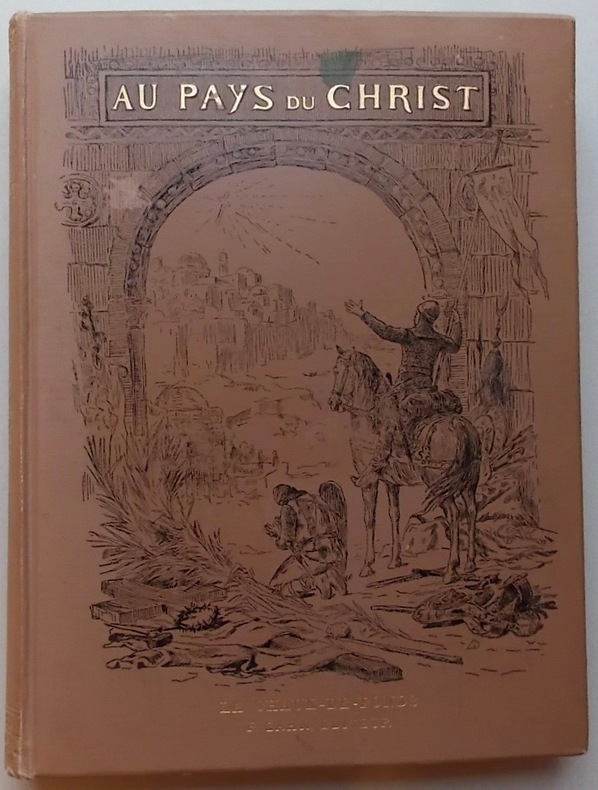
36443La Chaux-de-Fonds, Zahn, (1897) Gr.in-4°, XX-476p. Reliure pleine percaline illustrée d'éditeur, tête dorée.
Broch?. 295 pages. Couverture d?fra?chie.
Gr.In-4, XX-476p. Récit de voyage et de pélerinage fait en Egypte et à Jérusalem. Illustré de 112 compositions et vignettes dans le texte. Préface de M. Ernest Favre. Bel exemplaire.
Broch?. 318 pages. Couverture l?g?rement d?fra?chie.
Engraving with caption in German and Arabic. 39:45 cm. The Moroccan envoy Mohammed Ben Abdul visited Vienna in 1783 to seal a friendship treaty and trade agreement. He was welcomed at the Hofburg by Emperor Joseph II on February 28. The engraving depicts the reception, with the High Chamberlain Prince Orsini-Rosenberg leading the envoy (holding a writ in his hand) and his companions before the Emperor, who receives them standing. Next to the Emperor are the interpreter von Bihn, the Vice-Chancellor Graf Cobenzl, and another high state official. The publication of this engraving was announced in the "Wiener Zeitung" on 26 April 1783. - Very rare. Catalogue "Hieronymus Löschenkohl", Historisches Museum der Stadt Wien, 1959, no. 46a.
8vo. Pt. 1 (of 2) only. XXIV, 170 pp. With folding engraved map. Contemporary blue wrappers. Probably a pirated version of the first German edition (Hamburg, Villaume); translated from the English "Copies of original letters from the Army of General Bonaparte in Egypt". Also published in French ("Correspondence interceptée de Bonaparte et de son armée en Egypte"). The map shows the Nile delta from Giza to the Mediterranean estuary. - Untrimmed copy; some defects to spine. Ibrahim-Hilmy 245. Cf. Gay 1990. Not in Kainbacher.
515836Berlin, Wilhelm Hertz, 1899. In-8 rel. demi-toile brune modeste postérieure, étiquette de titre manuscrite au dos, couv. conservée et contrecollée au plat sup., 195 pp., index.
4to. (4), 74 pp. With 28 plates with 55 black-and-white photographic prints, as well as 1 plan of Burchhardt's itinerary on page 9. Original printed wrappers. First edition. Rare travelogue of Yemen, enriched with striking photographs. In Arabic and German parallel text. Prepared by Ahmed ibn Muhammad al-Garadi, the secretary, Arabic teacher and companion of the German explorer Hermann Burchardt (1857-1909), the book describes Burchardt's travels in the south of the Arabian Peninsula, where he was ambushed and killed by gunmen in December 1909. Containing "important ethnographical information on crafts and the Jewish population", the account also boasts a wealth of photographs "of great documentary value" (Speake), including city views and landmarks of Sanaa, Taizz, and Mocha, such as tower houses in Sanaa's old town, the Ashrafiya Mosque, the Grand Mosque in Mocha, and the ruined palace of Sultan Hasan, as well as pictures of local children, a group of Jews studying scripture in the synagogue, several men sitting around a water pipe, bedouins, farmers, and workers. The images impressively portray the destitution of the Yemenite population in the early 20th century. - In addition, the work includes annotations to the text of the travelogue, a list of examples of the Sanaa idiom, and an index prepared by the German orientalist Eugen Mittwoch, who also translated the Arabic text. Published as a festschrift for the Vierter Deutscher Orientalistentag in Hamburg. - A few edge flaws to wrappers professionally repaired. Lower right corner of first two leaves chipped, but interior very well preserved in general. Never seen at auction. Speake, Literature of Travel and Exploration III, 1305. OCLC 907363736.
4to (175 x 221 mm). (III)-XIIV, (15)-217, (1) pp. Text printed within elaborate coloured and gilt borders in the decorative orientalist style. Publisher's full cloth, sumptuously decorated and gilt, floral endpapers. All edges red. Silk divider. First edition of this German translation of Vazeh's poems. - Mirza Shafi Vazeh (1794-1852) was a classical Azerbaijani poet in both Persian and his native Caucasus language. Beginning in 1850, the German poet Friedrich von Bodenstedt (1819-92), who took oriental language lessons from him, published translations of Vazeh's poems. - Sumptuously produced in the oriental style by the renowned Viennese press of Ludwig Carl Zamarski. Lacks the half-title, otherwise perfect. OCLC 72064332.
8vo. XIV, (2), 80 pp. Original printed wrappers. First edition. The fables of Bidpai after the Turkish version by Anwari Souhaili in a German translation. Intended as a "handbook for prospective German orientalists", it contains the original text of the first fable of the "Humayun Nameh" in Ottoman Turkish script, a German translation as well as exhaustive philological and etymological material. The present edition was compiled and edited on the occasion of the centenary of the Vienna Oriental Academy by the Austrian orientalist and diplomat Eduard Adelburg (1804-56), himself a graduate of the Academy. - The title-page identifies this volume as an introduction to a much larger editorial project; however no further parts were published. - Binding somewhat loosened; front wrappers slightly creased. Occasional light foxing. Uncut copy. Kalemkiar 357. Chauvin II, p. 51, no. 75. OCLC 255154353.
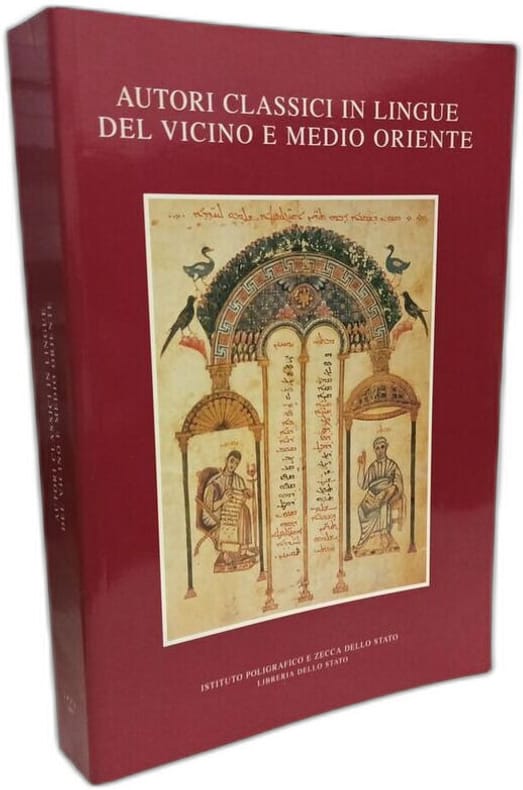
2001100144351Ist.Poligrafico e Zecca dello Stato- Archivi di Stato 2001 in8. 2001. Broché.
(Oblong) 8vo. 2 folding billets. With 2 autograph envelopes. To Mrs. Honeycutt in Tulsa, Oklahoma, signed by Velma, Tommy and Pam. A birthday card with good wishes: "Sorry you are not well. Hope you will feel better soon. I sent a check [...]". - With illustrations featuring a camel caravan and a flower bouquet. Margins slightly creased.
4 pp. on folded bifolium. On blue paper. 4to. Long, interesting and unpublished letter, closely written over four pages, to the French minister Gustav Armand Henri, Comte de Reiset (1821-1905). The twenty-five-year-old missionary, writing from the south-western tip of the Arabian peninsula, describes himself as "perdu au milieu des déserts et dont toute l'imagination est absorbée par l'étude des langues". The capucin friar travelled along the coast of the Red Sea, visiting Tor, Yambo, Medina and Jeddah; the settlements he encounters are wretched hamlets on the edge of the desert. "À Gedda les musulmans font voir le tombeau de notre grande mère Ève. Selon eux, nos premiers parens après leurs chutes vinrent faire pénitence de leurs fautes à La Mecque. Ève mourut à Gedda. La tête de notre première mère repose sur une montagne et ses deux pieds sur deux autres collines voisines et sur son nombril ils ont élevé une pyramide [...]". Léon writes that he feared he would end up eaten by the fish, but finally did arrive in Abyssinia after a 20-day voyage. He continues to describe a beautiful mountaineous landscape peopled by a few Bedouin tribes and evokes their hard life, the cry of the jackals, and the devastation of crops by soldiers and by apes. He states the price of wheat, horses, and farming animals, describes the mining of gold, silver and iron and summarizes the situation in Abyssinia, since the former empire was overthrown by "la lance du farouche Gallas". He describes the savage manners of a country at war: the enslavement of women and children, the emasculation of men, and the rampant diseases. He also explains how the country first seized by the Turks passed to France, and provides his minister with first-hand geopolitical intelligence: "L'Anglais travaille ce pays. Un consul britannique y rôde en tout sens. Mais les Anglais y sont détestés à cause de leur religion. Mais cependant que l'on y fasse attention. L'Abyssinie plutôt que de vouloir subir le joug turke se mettra à la disposition de la première puissance qui voudra l'exploiter. La Sardaigne a envoyé ici un ancien missionnaire pour déterminer Oubié ou un roi de l'Abyssinie à lui donner une partie de la côte pour y colliniser fiat lux [...]". - Léon des Avanchers, friend of the French explorer Antoine d'Abadie, was a missionary in Abyssinia, a geographer, cartographer and explorer of East Africa, and a correspondent of the Società Geografica Italiana. He is known to have bought many slaves to free them and was the founder of the first Catholic church in the Seychelles. - Some original corrections and insertions. Traces of original folds. Well-preserved.
4to. 3½ pp. on bifolium with integral address panel. A first-hand account of the sensational entry of Mohamed Reza Bey, the Persian ambassador who visited Paris for six months beginning 7 February 1715. Adressed to Monsieur de Gallice, councillor of the Parliament of Aix-en-Provence, for delivery to the Parliament's Advocate General, Gaspard de Gueidan (1688-1767), the letter describes the ambassador's arrival, his reception (which is likened to that of a Pope), and the craze he creates among the onlookers, who sing, dance, and stare at him as at a strange animal: "Souffrez, mon charmans magistrats, que je vous presente une morale que je ne sais guere [...] Vous sçavrez, mon cher seigneur, que tout Paris est devenu mamamouchi depuis l'arrivée du seigneur Mehemet Rizabeek en ce pays cy. Cet ambassadeur de Sophi s'est réjouï comme un Pape à nos dépens. Il y avait toujours cinq ou six cent carrosses du monde qui l'allaient voir, comme un animal rare; et Son Excellence Persanne a fait chanter et danser nos dames devant luy, comme des marionnettes qui ne venoient là que pour le divertir. Maintenant il occupe la cour aprez avoir amusé la ville et s'en être amusé. Car on veut le recevoir à son audience avec une magnificence extraordinaire. Le Roy a fait dresser un trone au bout de la grande gallerie. Sa Majesté aura pour huit millions de pierreries sur ses habits [...]; et toute la cour à proportion sera habillée de ce joly coup là. Jamais les marchands d'étoffes d'or et de galons ni les brodeurs n'ont été si occupés [...] Il est vray que le tout se fait à crédit. Mais les gens de qualité sçavent trop bien leurs privileges, pour s'aviser de déroger en payant leurs dettes; cela est du dernier bourgeois. Aussy je vous assure que jamais la cour n'a été autant de qualité [...] Il faut espérer qu'aprèz ce bel oiseau de Perse, il viendra quelque autre amusette au peuple de Paris [...] Je vous avoueray bonnement que j'ay eu la curiosité de voir son entrée dans Paris, afin de l'étudier. Heureusement, il fit une pluye continuelle ce jour là! De sorte que Son Excellence se mit presque en negligé et que Sa Magnificence fut des plus minces, et je trouvay que cela ne valoit pas la façon de ma curiosité. Je ne fut pas le seul pris pour dupes tout Paris y fut trompé [...]". - The ambassador Mohamed Reza Bey (Mehmet Riza Beg) had been chosen for the mission by the Shah of Persia, Sultan Husayn, and travelled with a grand entourage, as befitted the diplomat of a mighty empire. He was solemnly received in the Hall of Mirrors at Versailles on 19 February 1715 with one of the most lavish ceremonies of the final months of the reign of Louis XIV. During his stay he conducted negotiations towards establishing trade treaties between Persia and France, and conferred with the French on possible joint military operations against the Ottoman Empire. The ambassador's exotic personage inspired the French imagination to create a whole artistic and literary current, the most lasting product of which are Montesquieu's "Lettres Persanes" (1725). - The lawyer Pierre Lauthier, a celebrated orator in his day, was the son of the Aix-based medical writer Honoré Maria Lauthier. Although most bibliographies credit the latter with the biographical preface to Joseph de Tournefort's posthumously published "Voyage into the Levant" (simply signed "Lauthier"), it is not unlikely that Pierre, with his penchant for the exotic, is the actual author of the Life of that famous Aix-born botanist and Middle East traveller (cf. Wellcome III, 458). - Removed from a registry, with traces of mounting along the left edge of p. 1. Traces of oribial folds; slight edge defects, some from removal of the seal, but well preserved on the whole.
8vo. 2 pp. With autogr. envelope. Includes TDS by G. E. B. Bromley-Martin, of the Bank of Liverpool and Martin, London (dated 22 Dec. 1924). To Whitney H. Shepardson of New York, who had inquired as to how he might obtain a copy of the "Seven Pillars of Wisdom" when the book was finally published: "The Prophet has sent me on your letter, with instructions to deal with it: - and I'm puzzled. Really you know you are foolish to want a copy. It's a thirty guinea book, of which so many copies are being sold as will meet the printing bills (about 120 copies perhaps) with some off-prints of the unadorned text for the twenty or thirty fellows who shared the campaign with me. I can't give them 30-guinea presents: they can't buy 30-guinea books. So I want the subscribers to pay for my generosity in giving them free copies. The prime cost lies in the pictures (about 60, many in colour, at 10/- a print!) and the pictures are only an unjustifiable whim of mine. They have been done by British artists whom I liked, + who would work for me. Such a luxury book is for the idle rich. Mrs. Lamont is getting one. Huntingdon [!] + Pierpont Morgan aren't...! ... Do you feel justified in chucking away so much on an amateur production? The writing is pretentious, dull, hysterical, egotistical, + preternaturally long. No human being has ever been to the end of it [the 335,000 word ms.]. They return it, thumbed to about half way, with pretty speeches. So long as I hold it secret, the sight of it is a boast, so long it will be praised. Seriously, it isn't any earthly good. It costs as I have said, may be a year yet in printing, + is horrible in parts. Eleanor (beg her pardon, but that's her only possible name. The proper ones only indicate her wayward choice of parents etc.) would be sick over it. The thing will not be reprinted entire in my life-time: you suggest 'for a long time.' ... but the prospect isn't pleasing. There will be an American Edition, to secure copyright. Doubleday, probably. He has made a reasonable estimate. It would be printed at my expense, two copies for the Library of Congress, or whatever the show is, + eight for sale: + the sale price will be prohibitive, so that they will never sell, + the edition will never be exhausted, + no one may pirate! I suggest 10,000 dollars, but F.N.D. hasn't yet considered what is above-high-water-mark in U.S.A. Tell me, please, if you are knowing! If despite all faults (my most honest dissuasion puts people on sometimes!) you want a copy: then you'll have to send fifteen guineas, half price - E. will know the size of the extinct coin - to: Manager / Bank of Liverpool + Martins / 68 Lombard St. / London, E.C.3, payable to TE Lawrence, + 'Seven Pillars account'. Balance when you get the book. Let me strongly urge you not to. I have 90 subscribers, so there is no urgency - on the point of helping lame dogs! [...]". - When the book finally appeared in 1926, the cost of each copy to Lawrence was triple the selling price, and it was not until the fourth reprint of the 1927 abridgement "Revolt in the Desert" that his debts were paid off. As the included receipt shows, Shepardson was undeterred and duly transferred the £15. 15/- to Liverpool & Martins' (the last copy of the 1926 "Pillars" at auction commanded £30,000 at Sotheby's in 2009). - The U.S. businessman Whitney Hart Shepardson (1890-1966), educated at Colgate, Balliol (as a Rhodes Scholar), and Harvard, had served as aide to the State Department at the 1919 Paris Peace Conference, where he may have met Lawrence. Between 1925 and 1927 he served as director on J. D. Rockefeller's General Education Board. A leading O.S.S. operative in WWII, he was the first London head of Secret Intelligence and remained with the organization soon to become the C.I.A. until 1946.
4to. 1 p. To a Mr. Bain, apparently a bookseller: "I am unfortunate: I need one of my own rotten books - a Revolt in the Desert, any late edition. Can you find one cheap? Send me those Irish Memories, too, about which you sent me a chit ... and are there any of S. Sassoon's skits on Wolfe (Pinchbeck Lyre's) to be got? Any edition. I wanted two. There is also a book called 'Juan in America' which I must read. Nothing else, I hope [...]". - Traces of folds.
8vo. 2 pp. and 2 lines on bifolium. "Dear Lady Young I wonder if you (and His Ex.) are still there? Your letter to me sat at 2 Smith Square (Sir H. B. not knowing my whereabouts) till last night, when I called and collected it. I am sorry. Most of my addresses are like that. Would you be so good as to register / T. E. Shaw / Clouds Hill / Moreton / Dorset / as my likeliest spot, in future? It represents my cottage on the heath, which will be home after March when the RAF bring themselves, not reluctantly, to dispense with my help? I'm sorry not to have seen you. I wanted, while you were yet in Nyasa-land, to beg of His Ex. The rectangular skin of a small (1 sq. yard) lion, for my hearth-rug. But Ronald Storrs whom I saw at Southampton about a month ago told me you had been promoted to his province, and that there were no lions. Ronald was physically a very sick man. Mentally he was fighting hard to keep brisk… too hard for his health, I fear. The wreck of an old companion is too near a sight for sorrow, even. I hope Africa suits, after your trial of Asia and Europe. My respects to the Governor! Tell him I saw the fraudulent Abdulla, the other day. Exactly as he was, body & mind. Now, that's the way. / Yours sincerely TE Shaw / A poor letter: but I picture you again in Africa, and my squib spluttering in the void". - Between 1916 to 1918, Abdullah I of Jordan worked with the British guerrilla leader T. E. Lawrence (with whom he had actually never jarred), and played a key role as architect and planner of the Great Arab Revolt against Ottoman rule, leading guerrilla raids on garrisons. From 1921 until his assassination in 1951, Abdullah ruled Jordan, first as Emir under a British Mandate from 1921 to 1946, then as King of an independent nation from 1946 onwards.
4to. 6 pp. of 3 ff. With autograph envelope. To the English diplomat and army officer Christopher Palmer Rigby, Consul of Zanzibar from 1858 to 1861. Kirk raises his doubts about Sultan Majid bin Said's desire to end the slave trade, whilst already foreseeing that his successor-to-be Burghash bin Said would be more open to this aim. - Kirk expresses his hopes that in Zanzibar there will "soon be a more rigorous policy for suppression of [the] slave trade", noting that "this year the Arabs have had it all their own", as Britain was engaged in the Abyssinian Wars, and that "my experience of the Arabs is [...] they are all liars, but Suliman bin Ali the real Sultan and only man to go to if you wish anything done is decidedly no exception", discussing the poor health of Majid, Sultan of Zanzibar, and a school of thought that his expected successor, Burghash bin Said ("a very intelligent Liberal man, outspoken and quick"), would be more friendly with the English, expanding on the rivalry between various local factions within Zanzibar. - John Kirk, chief assistant to David Livingstone during his celebrated expedition from 1858 to 1863, was appointed vice-consul of Zanzibar in 1866, and in 1873 "persuaded the sultan of Zanzibar to sign an anti-slavery treaty, closing the island's slave markets, and providing protection for all liberated slaves" (ODNB). An incomplete transcription of this letter is reproduced in Russell, General Rigby, Zanzibar and the Slave Trade, 1935, pp. 301f.
Together with a lithographic portrait (315:243 mm). In Arabic to King Louis-Philippe I, requesting recruitment of men and horses. Together with an autograph translation signed by Joseph-Marie Jouannin, the king's interpreter of Arabic (Paris, 14 Feb. 1837).
4to. 1 p. on bifolium. In Arabic, to General Viala Charon, French governor in Algeria. Includes contemporary French translation.
Two and a half handwritten sides on 2 leaves. Signed "your most obedient humble servant Dr. Sprenger", and concerning various Arabic manuscripts which Sprenger is considering translating. The letter dates from Sprenger's relatively brief time in London (1836-43), and thus predates any of his published works. He decides that Ibn Kourdadbeh's 'Oriental Geography' (the earliest surviving Arabic book on administrative geography) is unsuitable as he can only locate one MS copy. Instead, he offers to produce a translation of Suyuti's famous 'History of the Caliphs', which he notes has been accounted the best of such histories by the Arab encylopaedist Haji Khalfa. Sprenger transcribes several names from English into Arabic for the benefit of his correspondent. - A well-preserved and early letter reflecting Sprenger's outstanding command of Arabic sources. The Austrian-born Sprenger became one of the most noted orientalists of the 19th century, producing a comprehensive 'Life of Mohammad from Original Sources' in 1851.
8vo. 8 pp. on 2 bifolia. To W. Cabell, regarding the potential independence of Muhammad Ali of Egypt and the British occupation of Kharg Island. - A fascinating letter, composed at a time of great tumult in the Near and Middle East. It relays news of important events and evidences the willingness of the British to use force to implement their policy in the region. Lieut. Col. Robert Taylor went to India as a cadet in 1803 and did not return to England for over forty years, serving as Political Resident at Basra (1819-21) and Baghdad (1821-43). His library was purchased by the British Library in 1860 and forms the bedrock of its Arabic-language collection. - Writing from Baghdad, Taylor addresses W. Cabell of the India Board Office in London. He first informs Cabell of two loads of missing post; one outgoing tranche "lost by dromedaries running away with the bags and throwing their riders", and the mail from India "robbed by a party of Wahabis". He then notes Ottoman alarm at "the threatened independence of Mohamed Ali", and comments at length on relations with Persia, which were extremely tense due to the ongoing siege of Herat by Qajar and Russian forces: "Our envoy [John McNeill] ... was not listened to; while the Russian [Count Simonich] & his staff conducted their approaches to the fortress which was expected to fall." In response, the British occupied Kharg Island with a "small force ... not exceeding 500 men", thereby threatening military intervention. Reporting that it had "instilled a wholesome fear into the Persians", Taylor advocates the use of gunboat diplomacy elsewhere "to produce similar effects". - Official correspondence relating to Persia and the Gulf region is rarely found outside of institutional archives such as the India Office Records. This example is interesting on a number of levels, not least for showing how Britain's aggression in the first decades of "The Great Game" manifested in the Gulf. - A few later pencil annotations in a different hand; pages a little dusty.
8vo. 1 p. To the council of the Omar Khayyam Club: "Please forgive my delay but the [...] paper was mislaid & I had forgotten the date of dinner. I shall be happy to attend alone, no guest [...]". - On headed paper.
8vo. 1 p. on bifolium. To his son-in-law Henry Bicknell, making arrangements to meet: "I have unfortunately accepted an invitation to dine with Lord Tenterden on Wednesday, had it been an other I would have endeavoured to get off - as it is I have done as you desired an pop'd Marochetti into the fire. With the exception of that and Saturday I am disengaged the rest of the week [...]". - In a postscript, he adds that "Turner called on Monday to say he would dine with you tomorrow having mistaken the day - he is to dine with your Governor [Henry Bicknell's father, the art collector Elhanan Bicknell] on Saturday". - Roberts enjoyed a close and warm relationship with his daughter and her husband, no doubt a compensation for his own unhappy marriage.