1 365 résultats
Very Good Turkish, Ottoman (1500-1928) Original quarter leather bdg. Slight wear on spine. Otherwise a very good copy. Cr. 8vo. (20 x 15 cm). In Ottoman script (Old Turkish with Arabic letters). 143 p. Extremely rare first Turkish edition of the legend of Hatem of Tai tribe, or "the tale of Hatemtai, or qissa-e Hatem-Tai" which was very popular in the Indian subcontinent, as well as the earliest printed separate form from the Arabian nights [Alf laila wa laila] in the Middle East. In Turkish literature, this story was printed nine times separately from the Arabian nights (1840, 1856, 1867, 1871, 1874, 1879, 1885, 1891, 1925). This is the very first edition of this book. Hatim al-Tai (?âtim bin Abd Allâh bin Sa'ad a't-Tâ'iyy; Hatim of the Tayy tribe; deceased 578), was the ruling prince and poet of the Tayy tribe of Arabia. Stories about his extreme generosity have made him an icon among Arabs up until today, as evident in the proverbial phrase "more generous than Hatim". His son was Adi ibn Hatim, who was a companion of the Islamic prophet Muhammad. Al-Tai lived in Ha'il in present-day Saudi Arabia and was mentioned in some Hadiths by Muhammad. He died in 578 AD and was buried in Tuwarin, Ha'il. His tomb is described in the Arabian Nights. He lived in the sixth century CE and was also mentioned in the Arabian Nights stories. The celebrated Persian poet Saadi, in his work Gulistan (1259 CE) wrote: "Hatim Tai no longer exists but his exalted name will remain famous for virtue to eternity. Distribute the tithe of your wealth in alms; for when the husbandman lops off the exuberant branches from the vine, it produces an increase of grapes". He is also mentioned in Saadi's Bostan (1257). According to legends in various books and stories, he was a famous personality in the region of Ta'i (present-day Ha'il) and is also a well-known figure in the rest of the Middle East as well as the Indian subcontinent, featuring in many books, films, and TV series in Arabic, Persian, Urdu, Turkish, Hindi and various other languages. The books on the story usually consist of a short introduction describing his ancestry and character and tell the seven episodes based on seven riddles, asked by a beautiful and rich woman named Husn Banu, who will marry only the person who is able to obtain answers to all seven of them. A king, who falls in love with her but is unable to find answers, tells the generous Hatemtai, whom he meets by chance, all about it. Hatim undertakes the quest to find the answers and help the king marry her. Özege 3639.; TBTK 8155.; Only one copy in the Library of Congress according to OCLC 951465696.
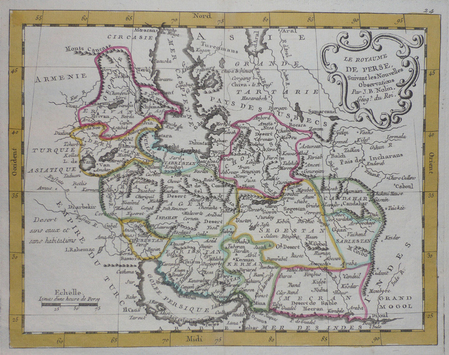
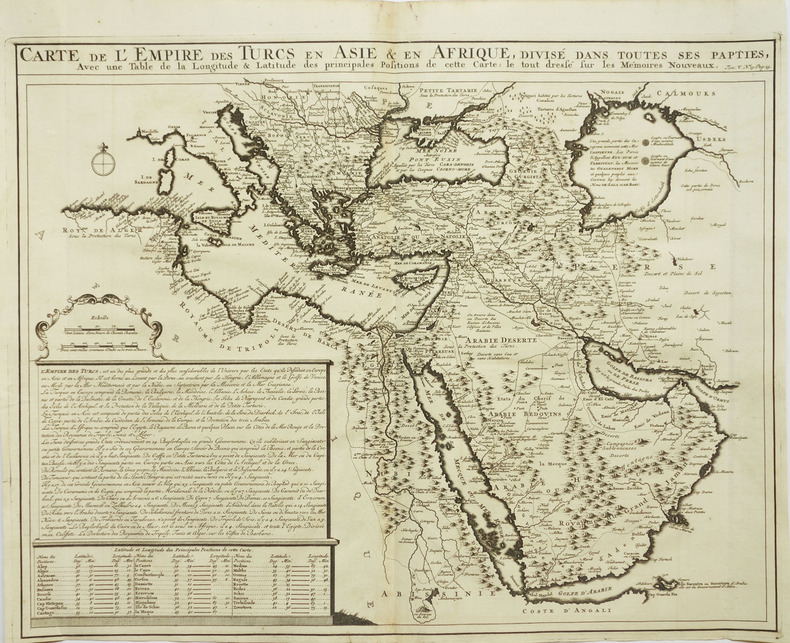
1720LBW-2043Amsterdam, circa 1720. 400 x 512 mm.
Very Good Turkish, Ottoman (1500-1928) Original Ottoman cloth bdg. Cr. 8vo. (20 x 14 cm). In Ottoman script (Old Turkish with Arabic letters). 293 p., 17 b/w plates and 1 folding map, and 1 folding linguistic table (including alphabets used in India such as Sanskrit, Brahmi, Devanagari and their pronunciations in Latin and Arabic alphabets). Slightly loosed spine, skillfully repaired a part of the spine, fading and chipped on the board's extremities, slight stains on the plates. Overall a good copy. Extremely rare (with a map and the plate at the end of the book) first edition of this eye-witness travel account of the Indo-Islamic culture during the British Raj in the late 19th century, by the Hamidian period Turkish ambassador and scholar Sirvanî (1831-1890), who had written and translated three geographical books as well. Sirvânî completed his travel memoirs on his return from India to Constantinople, where he was sent as an ambassador by Sultan Abdulhamid II between 1877-1879. The narrative of his journey begins with the landing in India from Constantinople by ferry. He describes the splendid and fascinating British Indian cities, regions, and buildings such as Bombay, Poona, Dakkan, Udaipur, Baroda, Ajmer, Jaipur, Amber Fortress, Allahabad, Benares, Calcutta, Jaipur, Lucknow, Agra, Alexandre, Delhi, Nepal, Racputana, Indor, Sind, Bundelkhand, Datia, Chatarpur, Bina, Mihr, Bihar, Bengal, Ceylon, Aligarh, Sirhind, Lahore, Kashmir, Dekkan, Orissa, Avrang, Bijapur, Malia, Khandesh, Gujarat, Hugli, Madras, Maisur, Jehlam, Sialkot, Rawalpindi, Nevshar, Mardan, Swat (now in Pakistan), Beloojistan, Peshawar, Afghanistan, Kabul, Ghazna, Kandahar, Herat, Badakhshan, etc. This first-hand travel account offers an invaluable insight into the customs of Indian peoples living in the region as well as the onomastics and ethnography of India and Afghanistan. He met Sayyid Ahmed Khan, who was the founder of the Aligarh University which was famous as the Aligarh School (founded in 1877) among the Indian people. The Aligarh Movement was the push to establish a modern system of education for the Muslim population of British India, during the later decades of the 19th century. The work includes a large chapter of Mecca, where Sirvânî stayed for a long time. He gives detailed information on the Islamic pilgrimage (Haj) and the Arabian Peninsula in this chapter. OCLC 19769728, 1030091889 (Six copies worldwide).; Ihsanoglu, pp. 269-270.; Özege 7654.; Karatay I, 268.; TBTK 1438.
Very Good Arabic Paperback. A slight chipping on spine, uncut. A very good copy. 4to. (28 x 20 cm). Text in Arabic with only bilingual title in English and Arabic on cover. 394, [2] p. Muhammad Abd-Allah Inan, (1896-1986), was an Egyptian historian known for his works on Andalusian history. Although Muhammed Abdullah Inan was one of the founders of the Socialist Party in 1921, he gave up his socialist views in the following years. He defended Arab nationalism in his early works and wrote articles criticizing the Ottoman administration in Egypt.
Very Good Turkish, Ottoman (1500-1928) Original full leather bdg. in Islamic style with a flap. Demy 8vo. (22 15 cm). In Ottoman script (Old Turkish with Arabic letters). 285 p. Rebacked to spine, slight wear on binding. Overall a good copy. Early Turkish edition of the book of parrot (or the book of Humayun), which is a 14th-century series of 52 stories, originally written in Persian, translated by Sari Abdullah Efendi (1584-1660), who was an Ottoman mystic poet and scholar. The adventure stories narrated by a parrot, night after night, for 52 successive nights, are moralistic stories to persuade his female owner Khojasta not to commit any adulterous act with any lover, in the absence of her husband. She is always on the point of leaving the house to meet her lover until the loyal parrot detains her with a fascinating story. The authorship of the text of the Tutinama is credited to Ziya'al-Din Nakhshabi or just Nakhshabi, an ethnic Persian physician and a Sufi saint who had migrated to Badayun, Uttar Pradesh in India in the 14th century, and wrote in the Persian language. He had translated and/or edited a classical Sanskrit version of the stories similar to Tutinama into Persian, around 1335 AD. It is conjectured that this small book of short stories, moralistic in theme, influenced Akbar during his formative years. It is also inferred that since Akbar had a harem (of women siblings, wives, and women servants), the moralistic stories had a specific orientation towards the control of women. The main narrator of the 52 stories of Tutinama is a parrot, who tells stories to his owner, a woman called Khojasta, in order to prevent her from committing any illicit affair while her husband (a merchant by the name Maimunis) is away on business. The merchant had gone on his business trip leaving behind his wife in the company of a mynah and a parrot. The wife strangles the mynah for advising her not to indulge in illicit affairs. The parrot, realizing the gravity of the situation, adopts a more indirect approach of narrating fascinating stories over the next fifty-two nights. The stories are narrated every successive night as an entertaining episode to keep Khojasta's attention and distract her from going out. The Persian text used was redacted in the 14th century AD from an earlier anthology 'Seventy Tales of the Parrot'in Sanskrit compiled under the title Sukasaptati (a part of katha literature) dated to the 12th century AD. In India, parrots (in light of their purported conversational abilities) are popular as storytellers in works of fiction. (Source: Wikipedia). Özege 21353., OCLC 165609299.
Very Good Turkish, Ottoman (1500-1928) Original wrappers. Foolscap 8vo. (17 x 12 cm). In Ottoman script (Old Turkish with Arabic letters). 152 p. Roumi: 1324 = Gregorian: 1906. Taken from a volume including multiple books. Spine is restored. A very good copy. First and only edition of this early and extensively rare book including a first-hand account of the topography and descriptions of Hejaz, Mecca, and other parts of Arabian Peninsula such as Taif and Yemen by Sadiq Sherif, who was the first person to take photographs of Mecca, Medina, and the Hajj in 1880 and 1881 as well. Sadiq Sherif was the grandson of Serif Abdulmuttalib, the Emîr of Mecca. This book written by Sherif was dedicated to 'the Progress and Union Society' [i.e. Ittihad ve Terakki Cemiyeti]. The book describes the way of administration and territorial division of Hejaz after giving some information of its geography, borders, tribes and natives, mountains, rivers, crops and products, and animals of this Ottoman 'vilâyat' [i.e. province]. Sherif gives detailed information on how and when the Ottoman Empire ruled Hejaz, the location of Mecca city, its borders, physical and social geography, crops in Mecca and around, its flora, fauna, demographic structure, 'nahiyes', Kâba's construction, and its history, sacred places around, Masjid-i Haram and other masjids, cemeteries, mountains, gifts by Ottoman caliphs to Kaba, 'Taif' area, people who were 'Emîr' of Mecca from the period of Mohammad, Wahhabism and its birth, etc. At the last, Sherif gives place to his personal letter (layihâ) including 49 articles. The letter was about the reforms that Hejaz needs and it was sent to the Ottoman 'sadâret' [i.e. prime ministry]. (Source: History of geographical literature during the Ottoman Empire, Edited by Ihsanoglu). Muhammad Sadiq Sherif Bey was the first person to take photographs of Mecca, Medina, and the Hajj in 1880 and 1881. Sadiq Bey trained as a military engineer after completing his studies in Cairo and at the École Polytechnique in Paris. It is not known when, or from whom, Sadiq Bey learned to take photographs but it was most probably through one of the resident photographers in Egypt. In 1861, prompted by the need to carry out more extensive military land surveys of the area between Wajh and Medina, Sadiq Bey made his first journey to Arabia. He took a camera along with his surveying equipment and took his very first photographs of Medina. In a series of articles published in the Egyptian Military Gazette in 1877, he refers to his early photography at Medina describing the use of a 'photographia'. Sadly, however, none of the photographs from this first journey has survived. In 1880 he was appointed as the treasurer of the Mahmal, the ornate cloth to cover the Ka'ba brought each year on a special litter to Mecca. He accompanied the Mahmal to Medina and Mecca from September 1880 until January 1881. Again equipped with his camera, he succeeded in producing the series of photographs that are now considered some of the earliest known photographs of the region, those of the Ka'ba, taken under great secrecy. Sadiq Bey published various accounts of his travels in Arabia in military journals, through the Emiry Grand Press in Cairo, but the 1880/81 series of photographs appear to have been issued separately for wider distribution through the Société Khédiviale de Géographie. The society's secretary, Dr. Frederic Bonola, advertised sets of photographs for sale. In January and April 1880 Sadiq Bey gave a talk and report to the society on his earlier 1861 expedition, and on 20 May 1881 he presented a report on his recent journey to Mecca; detailed accounts were published in the society's bulletins, numbers 9/10 and 12. (Source: Christie's). Özege 11888.; Karatay, TM II: 695.; MKAHTBK, II: 991.; OCLC 248374684 / 4082352.
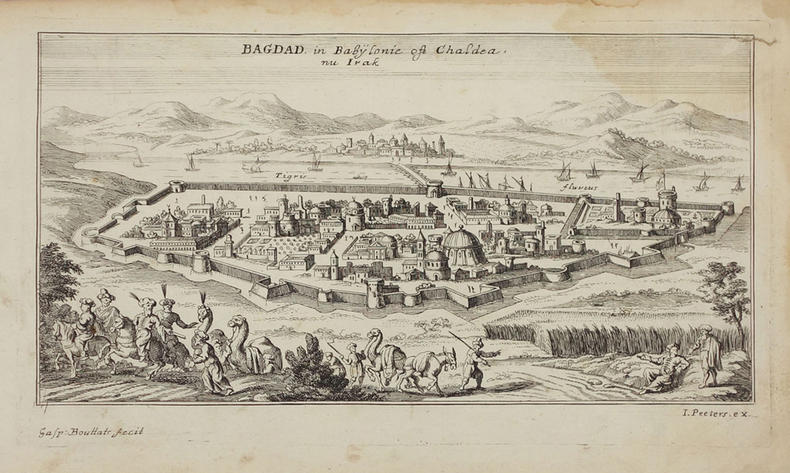
LBW02507[circa 1690]. 121 x 231 mm.
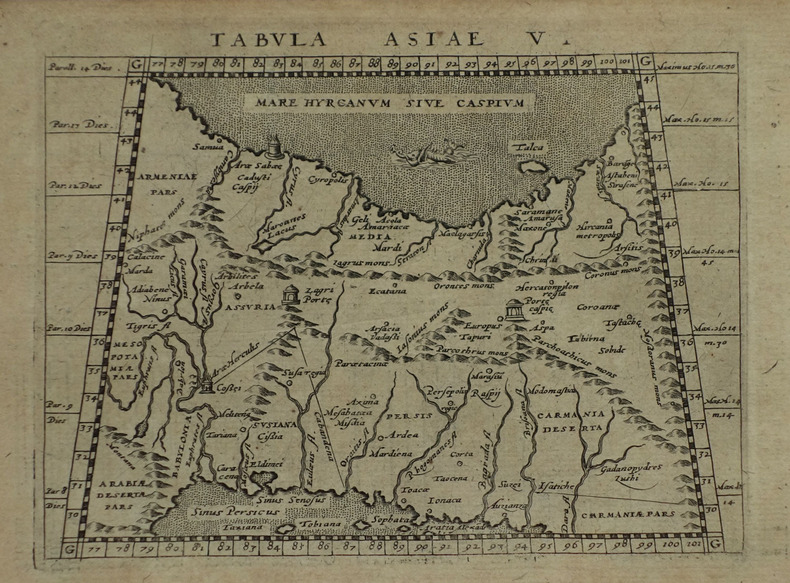
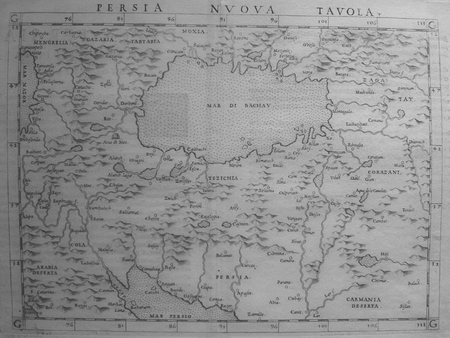
1617LBW-1923[Arnhem, Joannes Jansson, 1617]. 128 x 170 mm.
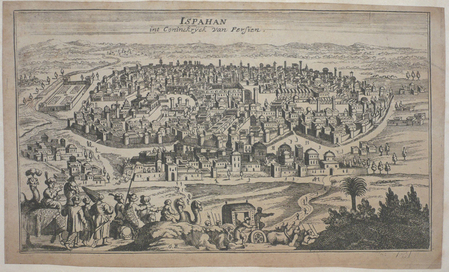
LBW045edcirca 1690 139 x 234 mm.
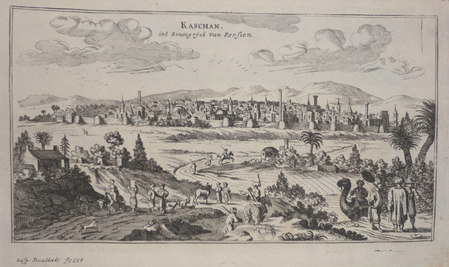
LBW02508circa 1690 127 x 236 mm.
1842LBW-8857London, F.G. Moon, 1842. 513 x 335 mm.
Steel-engraved map on ivory stock measuring 12.25 x 15.5 ins (approx. 31.25 x 39.0 cms) with engraved surface 8.75 x 11.75 ins (approx. 22.0 x 30.0 cms), coloured in outline; four coloured vignettes of Arab Women, Arab Men with horse, Camel and Palm, and Mount Sinai (illustrations by H. Warren; engraving by J. Rogers); decorative scroll frame incorporating title cartouche, a fine copy. Mounted ready for framing in double card mount (ivory over blue) with gilt frame border. Rapkin's map for Tallis was first issued c. 1856 and contains significantly more detail that that produced for the 'Illustrated Atlas' of 1851. Areas covered include Babylon, Basra, Cairo, Jerusalem, Oman, Persian Gulf, Red Sea and Suez. This high-quality facsimile accurately reflects thetones of the contemporary hand colouring and makes a most attractive map at a fraction of the cost of the original.
Very Good Arabic Paperback. Small 4to. (26 x 18 cm). Text is entirely in Arabic with bilingual title in English and Arabic on cover. 16 p. [Off-print] Research report on urbanism in Islam (Monograph Series No. 3):1) The social forces in the Arab-Syrian cities in the 19th century: The latest period of the Ottoman rule. 2) Stages in formation and development of the social forces in the Syrian cities in the present period. [COMPLETELY ARABIC]. Abdullah Hanna was born in the Syrian village of Deir Attiyah in 1932, and earned a PhD in history from the University of Leipzig in 1965. Blocked from Syrian academia due to his political leanings, Hanna instead became an instructor in Syrian secondary schools. He became a specialist on agrarian history and labour movements in Syria. His works, published in Arabic, include books on intellectual trends in Syria and Lebanon; the Syrian and Lebanese labour movements; anti-fascism in Syria and Lebanon; the agrarian question in Syria and Lebanon; and obstacles to the transition to capitalism. (Arab Center for Research & Policy Studies). Delivered at the Seminar Research Group D: Cities andstructures of power, October 15, 1988. Institute of Oriental and Occidental Studies, Kansai University.
1652LBW0418a1652 192 x 242 mm.
LBW0251acirca 1780 202 x 261 mm.
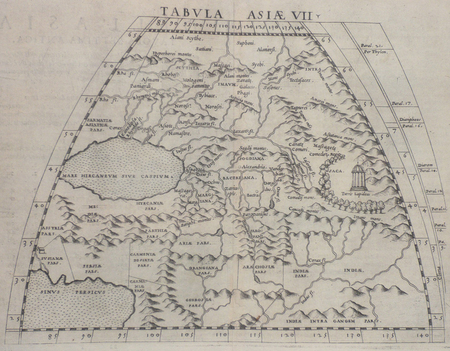
1561LBW0251d[Venise, 1561]. 183 x 246 mm.
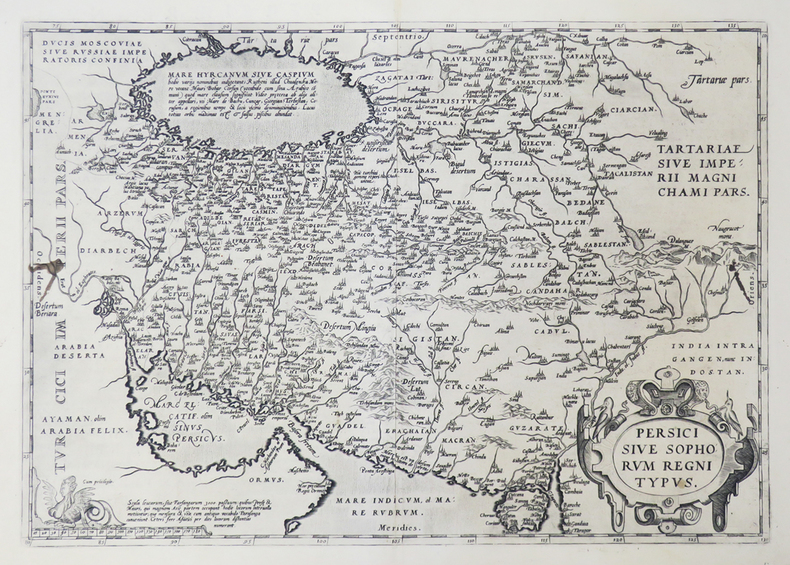
1592LBW0251e[Anvers, 1592]. 349 x 496 mm.
1561LBW02516[Venise, 1561]. 185 x 247 mm.
1373115Paris: Musée de l'Homme, Museum National d'Histoire Naturelle, 1971 in-4, nombreuses illustrations. Broché, très bon état. Sommaire: Robert GESSAIN, Un jeu des Ammassalimiut et d'ailleurs. Jeu eskimo? Diffusion? Convergence? - Françoise GIRARD, Statuette du Dieu Requin de Santa-Cruz. - Jacques DOURNES, Aspects de l'habitat et techniques de construction des Sre aux Jörai. - Claudine FAYEIN, La vie pastorale au Dhofar.
1373574Paris: Musée de l'Homme, Museum National d'Histoire Naturelle, 1973 in-4, nombreuses illustrations. Broché, bon état. Sommaire: Robert GESSAIN, Le tambour chez les Ammassalimiut (côte est du Groenland). - Claudie FAYEIN, Al Zorah, village de la Tihâma. - Marie-Claire BATAILLE, A propos d'une sculpture du Département d'Océanie. - Lucienne A. ROUBIN et Monique ROUSSEL de FONTANES, La nouvelle galerie publique de l'Europe. Remarques méthodologiques. - Ethnomusicologie.
1373107Paris: Musée de l'Homme, Museum National d'Histoire Naturelle, 1966 in-4, nombreuses illustrations. Broché. Bon état. Sommaire: Monni ADAMS, Tissus décorés de l'île de Sumba. - Jacques MILLOT, Inde et bétel (notes complémentaires). - Joseph CHELHOD, L'Orient arabe, un secteur délaissé de l'ethnographie française. - Monique ROUSSEL de FONTANES, L'affiquet, un accessoire de tricotage. - Robert GESSAIN, Sénégal Oriental 1965. - Guy de BEAUCHENE, Niger 1963, recherches archéologiques.
1373113Paris: Musée de l'Homme, Museum National d'Histoire Naturelle, 1969 in-4, nombreuses illustrations. Broché. Très bon état. Sommaire: Robert GESSAIN et Pau-Emile VICTOR, Le kayak des Ammassalimiut. Evolution technique. - Narimitsu MATSU-DAIRA, Le diable au Japon. - R.Z. UZAYZO et Joseph CHELHOD, L'amour et le mariage dans le désert. - Laurence DELABY, A propos des cannes chevalines du Musée de l'Homme. - Robert GESSAIN, Les missions du Musée: Sénégal oriental 1968.- Marie-Paule FERRY, Xylophones-sur-jambes chez les Bédik et les Bassari de Kédougou.
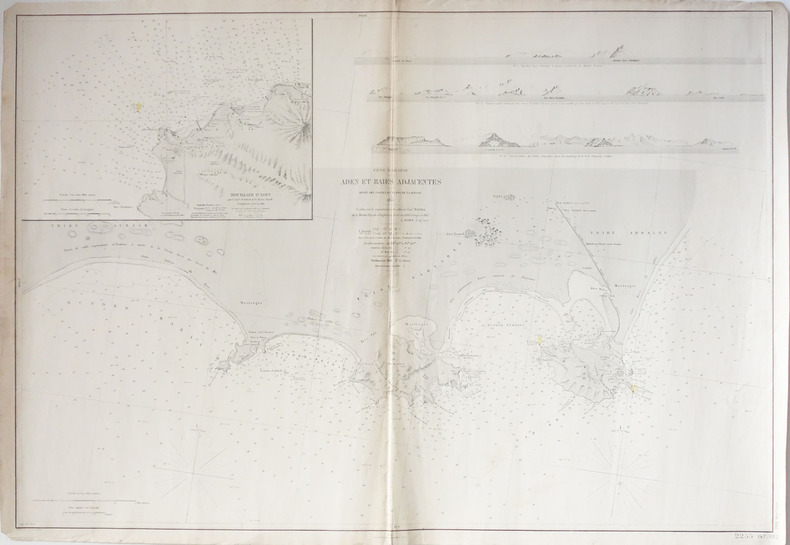
1872LBW-2421Paris, 1872. 611 x 892 mm.
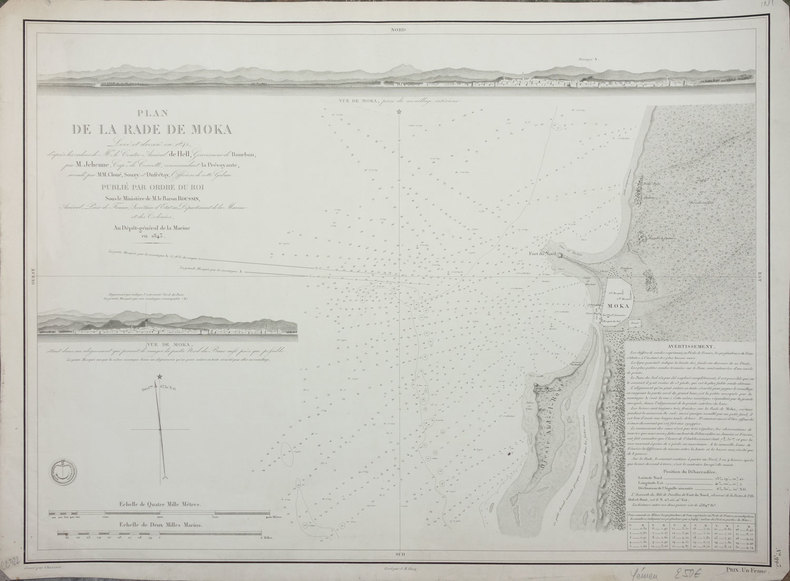
1843LBW-2412Paris, 1843. 427 x 577 mm.
Limited to 100 copies, [x], [28] pages, one of 9 signed copies, bound in hunter green cloth with gold blocking on front board, with a colour frontispiece of Richard F. Burton shortly after returning from India in the 1850's. This Bibliography examines and cites Burton's writings to various newspapers in India while he was stationed there in the 1840's. The author painstakingly examined Indian Newspapers from that time period and located over 100 articles written by Burton. Very little is known about Burton's formative years and his time in India, which makes this Bibliography very useful for the Burton Collector and scholar. A tremendous effort and welcome addition to the Burton genre.