1 288 résultats
2015X23671xGallery Books 2015. 1st Edition. Hardcover. Very Good/Very Good. 9x6x1. Signed by Authors. In Very Good Condition Hardcover 1St Edition With The #1 With A Dust Jacket. 2Nd Printing. Signed By The Author "Lebanon Levi" Stoltzfus" At The Title Page. Autographed Proclamation Sticker At The Front.- Specializing in academic collectible and historically significant providing the utmost quality and customer service satisfaction. For any questions feel free to email us. Gallery Books hardcover
7495MONTPELLIER, Imp. Causse & Castelnau - ss date (vers 1967) - In-8 - Broché - 1 portrait en NB - 34 pages - Bon état
MONTPELLIER, Imp. Causse & Castelnau - ss date (vers 1967) - In-8 - Broché - 1 portrait en NB - 34 pages - Bon état
0260532894.Ghardcover. Good. Access codes and supplements are not guaranteed with used items. May be an ex-library book. hardcover
0265050103.Gpaperback. Good. Access codes and supplements are not guaranteed with used items. May be an ex-library book. paperback
0366258176.Ghardcover. Good. Access codes and supplements are not guaranteed with used items. May be an ex-library book. hardcover
1527773930.Gpaperback. Good. Access codes and supplements are not guaranteed with used items. May be an ex-library book. paperback
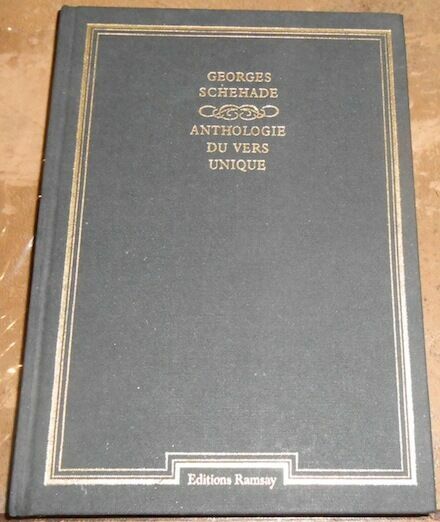
1977140241977. Paris Éditions Ramsay 1977 e.o. (pas de grand papier) - Cartonné 16 cm x 22 cm 219 pages 219 vers d'auteurs décédés allant de Aicard à Villon en passant par Breton et Mallarmé sortis de leurs poèmes sans références à leurs auteurs (il y a un index et une table des matières à la fin du volume) et choisis par Georges Schéhadé pour répondre aux roquettes qui tombaient sur Beyrouth - Etat neuf
plaquette in-8 de 32 pages agrafee. Excellent etat [CA29-5]
français Bikfaya (Liban), 1958. 2 vol. in-4 de 110 et 109 pp. + cartes h.t.; broché, couverture muette. Sommaire : L'arbre - Le sol et le climat - La plantation - La taille et l'entretien - La greffe - Le matériel - Le fruit et ses vriétés - Les ennemis de l'arbre fruitier - Récolte, conservation, expédition - Produits chimiques et minéraux. Ensemble dactylographié. Texte en français et en arabe. Exemplaire unique, en bon état.
2011LFA-126716101N° 491 (Septembre 2011) 82 pages, format 215 x 285 mm, illustré, broché couverture couleurs, bon état
1998LFA-126716105N° 342 (Février 1998) 82 pages, format 215 x 285 mm, illustré, broché couverture couleurs, bon état
1991LFA-126716121N° 270 (Juillet-août 1991) 86 pages, format 215 x 285 mm, illustré, broché couverture couleurs, bon état
1998LFA-126719691Hors-série N° 10H - 1998 : revue de 46 pages, format 215 x 285 mm, illustrée, brochée couverture couleurs, bon état
1991LFA-126740212N° 272 (Octobre 1991) : 78 pages, format 215 x 285 mm, illustré, broché couverture couleurs, bon état
1993LFA-126746901N° 287 (Février 1993) : revue de 78 pages, format 215 x 285 mm, illustrée, brochée couverture couleurs, bon état
1994LFA-126746912N° 299 (Mars 1994) : revue de 78 pages, format 215 x 285 mm, illustrée, brochée couverture couleurs, bon état
1995LFA-126746923N° 316 (Octobre 1995) : revue de 92 pages, format 215 x 285 mm, illustrée, brochée couverture couleurs, bon état
1995LFA-126746925N° 318 (Décembre 1995) : revue de 82 pages, format 215 x 285 mm, illustrée, brochée couverture couleurs, bon état
2000LFA-126746962N° 364 (Février 2000) : revue de 78 pages, format 215 x 285 mm, illustrée, brochée couverture couleurs, bon état
2006LFA-126747090N° 437 (Octobre 2006) : revue de 82 pages, format 215 x 285 mm, illustrée, brochée couverture couleurs, bon état
13600Revue mensuelle. N° 87 d'octobre 1975.Tres bon etat.
1975LFA-126740042N° 87 (Octobre 1975) : 84 pages, format 215 x 285 mm, illustré, broché couverture couleurs, bon état
1977LFA-126740052N° 104 (Mars 1977): 84 pages, format 215 x 285 mm, illustré, broché couverture couleurs, bon état
1983117010Maison de l'Orient 1983 Maison de l'Orient, Collection de la Maison de l'Orient Méditerranéen N°12, série archéologique 9, 1983, 501 p., broché. Dos insolé, quelques frottements en bordure de couverture, une petite signature sur le haut de la page de garde, bon état pour le reste.