JOURDAIN, AmableLivre Rare Book
4 537 résultats
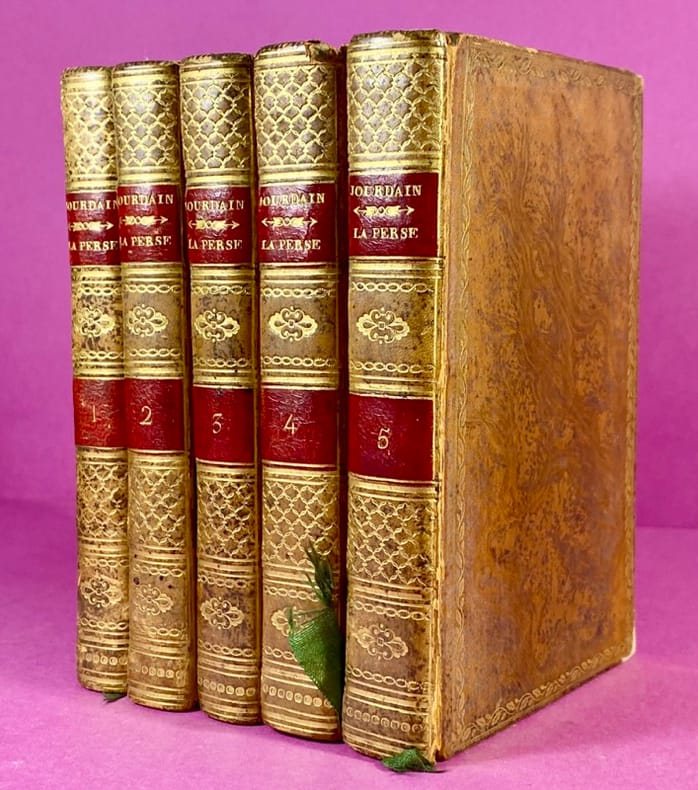
181418781814 Couverture rigide Paris, Chez Ferra et J.B. Imbert, 1814. 5 volumes in-16 (13,5 x 9 cm), Reliure de l'époque en plein veau raciné, dos lisses ornés de caissons et fleurons dorés, pièces de titre et de tomaison en maroquin rouge, roulettes dorées en encadrement des plats, tranches jaspées, quelques frottements aux charnières et aux coiffes, coins émoussés, petit manque à la coiffe du tome 2. Tome I : faux-titre, titre, frontispice, XV (1), 218 pages, 5 gravures dont 2 dépliantes ; tome 2 : faux-titre, titre, frontispice, 268 pages ; tome 3 : faux-titre, titre, frontispice, 225 pages (avec erreur de pagination lors de l'impression, en fin de volume), 6 gravures dont 2 dépliantes ; tome 4 : faux-titre, titre, frontispice, 290 pages, 14 gravures dont 2 dépliantes ; tome 5 : faux-titre, titre, frontispice, 327 (1) pages, 6 pages non chiffrées d'errata et de tables, 9 gravures. Soit un total de 39 gravures en noir incluant les 5 frontispices, intérieur légèrement jauni, rares rousseurs. Publié en 1814, cet ouvrage d'Amable Jourdain s'inscrit dans l'intérêt du 1er Empire pour la Perse de la dynastie Qajar. Jourdain, l'un des plus brillants orientalistes de sa génération et disciple de Silvestre de Sacy, a conçu ce "Tableau" comme une synthèse rigoureuse destinée à un public cultivé. À une époque où les voyages vers l'Orient restaient périlleux, ce livre a constitué l'une des sources d'information les plus fiables sur l'Empire perse. L'intérêt majeur de cette édition réside dans ses 39 planches. Contrairement à beaucoup d'ouvrages de l'époque qui utilisaient des gravures de fantaisie, Jourdain précise que ses illustrations sont fidèlement copiées d'après des peintures originales ramenées de Perse. Wilson, p. 113, Quérard, IV, p. 251. Bon exemplaire de cette édition originale.
Crown quarto. Pp. xxiv, 266. Hardcover, bound in full black cloth, old inscription on first flyleaf. In fine condition. An excellent copy, practically unused. ~ Second, completely revised and corrected edition. Collection Linguistique, XXXIV. Emile Benveniste (1902-76), French scholar, eminent Iranist, and one of the greatest linguists of his era. Old Persian was one of Benveniste's favored fields. In 1931 he published this new edition, revised and enlarged, of Meillet's "Grammaire du vieux--perse", a work rendered necessary by the progress of research. This book has remained a classic ever since. (-- Gilbert Lazard: Encyclopaedia Iranica).
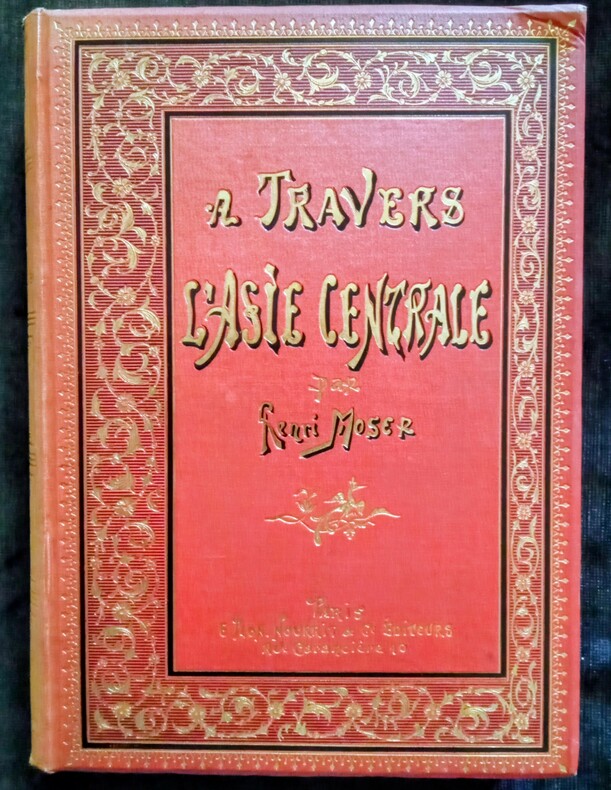
1885WOC-2216La Steppe Kirghize - Le Turkestan Russe - Boukhara - Khiva - Le Pays des Turcomans et la Perse. Impressions de voyage par Henri Moser. Ouvrage orné de plus de 170 gravures, dont 117 dessins de M. E. Van Muyden et de 16 héliotypies. Avec une grande carte itinéraire du voyage à travers l'Asie Centrale. Paris, Librairie Plon, E. Plon, Nourrit et Cie, Imprimeurs-Éditeurs, sans date (une note en préface à Charlottenfels, le 1er mai 1885). Petit in-4 (28x3,5x20cm) cartonnage éditeur rouge personnalisé par A. Lenègre Rel, plat supérieur dans un double encadrement, avec entre les deux des motifs dorés et lignes noires, titre, nom de l'auteur et maison d'édition or et noir, dos lisse avec des encadrements dorés et légèrement passé, plat inférieur dans un encadrement et les armes dorées au centre, tranches dorées, les plats biseautés et coiffe supérieur un peu faible. XI-463pp.
1842LBW-8857London, F.G. Moon, 1842. 513 x 335 mm.
42750Couverture souple rempliée. Non coupé.
1860PHO-1161à Paris , chez A. Franck , 1860 , grand in-8 (265x175 mm) ,477 pp, un portrait lithographié, relié demi cuir vert , dos lisse avec auteur et titre.
217 pages. Index. Black and white photos. "The author was given the go ahead to mastermind the overthrow of Mossadegh and return the Shah to the Peacock Throne... He explains in minute detail how he performed his mission." - dust jacket. Author is "The quiet American... the last person you would expect to be up to his neck in dirty tricks." - Kim Philby. Former library copy with usual markings. Dust jacket in protective mylar which has been affixed to boards. Binding intact. A sound reading copy. Book
378 pages plus advertisements. Index, 85 illustrations, map and appendicies. Tissue-protected frontis of author. Do you think Western malevolent intervention in the Middle East (i.e. George W. Bush in Iraq) is only a recent phenomenon? Guess again. "Only the pen of a Macaulay or the brush of a Verestchagin could adequately portray the rapidly shifting scenes attending the downfall of this ancient nation - scenes in which two powerful and presumably enlightened Christian countries played fast and loose with truth, honour, decency, and law; one, at least, hesitating not even at the most barborous cruelties to accomplish its political designs and to put Persia beyond hope of self-regeneration." - from Foreward. Rubber stamp upon copyright page suggests this copy may have once belonged to the British Public Service. Only other mark is library call letter written upon spine. Average wear. Binding a little fragile but still serviceable. Three yellow drops stain front board. Author penned this work after being sacked from the post of Treasurer-general of Persia in January 1912. Fascinating history. Book
New Persian Paperback. Roy. 8vo. (24 x 17 cm). In Persian with bilingual title in English and Persian on cover. 10 volumes set: ([22], 623 p.; 686 p.; 612 p.; 752 p.; 975 p.; 930 p.; 940 p.; 814 p.; 576 p.; 360 p.). Ancient book: The edition and interpretation of Shahname of Ferdowsi.= Nâme-e bastân: Namâyah guzârish beythâ. 10 volumes set.
2016x-0691642648Princeton University Press 2016. Hardcover. New. 756 pages. 10.00x7.00x2.60 inches. Princeton University Press hardcover
Publiées avec une introduction et des Notes par Charles Grolleau, un des 30 exemplaires sur papier du Japon (après 15 Chine) numérotés (n° 21), 1 vol. grand in-8 br. sous couv. rempliée, Charles Carrington, Paris, 1902, 158 pp. et 1 f. Bel exemplaire en parfait état du rare tirage sur Japon de cette traduction de 158 quatrains des Rubaiyat ! Français
New Arabic Original full crown leather bdg. Large roy. 8vo. (25 x 17 cm). In Arabic. 6 volumes set: ([63], 3555 p.). Tabaqât-e a'lâm al-Shî'a. Nuqabâ' al-Bashar fî al-Qarn al-Râbi' 'Ashar. 6 volumes set. Edited by Sayyid Muhammad Tabatabyi Behbahani. Tehrani was born on 11 Rabi?a I 1293/6 April 1876, into a mercantile family of Tehran that had strong religious interests; his father, ?âjj 'Ali, participated actively in the celebrated tobacco boycott of 1308/1891 and later wrote a book on the history of the movement. Aqa Bozorg received his initial education from private tutors in Tehran before proceeding to the ?atabat in 1315/1897. (1313/1895 in Rahnema-ye ketab, p. 525), where he spent the rest of his life, with the exception of four brief return visits to Iran and two short journeys to Syria, Egypt, and the ?ejaz. Among his teachers in Najaf were A?und Molla Mo?ammad-Ka?em ?orasani, Sayyed Mo?ammad-Ka?em Yazdi, Say?-al-sari?a E?fahani and ?ajji Mirza ?osayn Nuri. He was particularly close to the first of these, working as his amanuensis and assisting in the composition of his major work on feqh, al-Kefaya. On the death of ?orasani in 1329/1911, he left Najaf for Samarra to join the circle of Mirza Mo?ammad-Taqi Sirazi. He stayed there until 1354/1935, returning then to Najaf which remained his home until his death. While in Samarra, he conceived, and began to execute, the plan of a comprehensive bibliographical survey of all classes of literature produced by Shi?ite authors. His original intention was to refute a statement by the Christian Arab litterateur, Jorji Zaydan, belittling the Shi?ite contribution to Arabic letters. However, the survey that Aqa Bozorg produced, al-?ari?a ela ta?anif al-si?a, went far beyond this polemical purpose to become the main achievement of his career and a major contribution to Islamic scholarship. In al-?ari?a, the titles of all books written by Shi?ite authors are listed alphabetically, together with a brief indication of authorship and content, as well as place and date of publication in the case of printed works, and location in the case of manuscripts. Aqa Bozorg returned to Najaf in 1354/1935 and established a press (Ma?ba?at al-sa?ada) to print the first volume of al-?ari?a, but was soon obliged to sell it (see Rahnema-ye ketab, p. 526). Other arrangements were then made for the printing in Najaf of the second and third volumes, but all subsequent volumes-with the exception of the thirteenth and fourteenth-were published in Tehran. Twenty-two volumes have appeared to date; seven more await publication (For full bibliographical details concerning al-?ari?a, see ?akimi, pp. 543-45). Aqa Bozorg also compiled a biographical dictionary of Shi?ite scholars as a companion to al-?ari?a. The dictionary has the general title ?abaqat a?lam al-si?a, but each section, pertaining to the scholars of a given century, also has a separate title. Three sections have been published so far: Nawabe? al-rowwat fi rabe?at al-me?at (Beirut, 1390/1970), dealing with Shi?ite traditionists of the 4th Islamic century; al-Keram al-mobarrara fi'l-qarn al-?ale? ba?d al-?asara (Najaf, 1374-77/1954-57), on scholars of the 13th century; and Noqaba? al-basar fi'l-qarn al-rabe? ?asar (Najaf, 1373-88/1953-68), on scholars of the 14th century (?akimi, pp. 549-51). In addition to these multi-volume works, Aqa Bozorg wrote a number of less voluminous books, including a survey of some 600 biographers of Shi?ite traditionists, Mo?affa 'l-maqal fi mo?annefi al-rejal (Tehran, 1337 S./1958); a biography of Mirza ?asan Sirazi, Hadiyat al-razi ela 'l-mojadded al-Sirazi (Najaf, 1392/1972, Pers. tr., Mirza-ye Sirazi, Tehran, 1362/1983); a polemic against Sunni concept of ejtehad, Tawzi? al-rasad fi ta?ri? ?a?r al-ejtehad (unpublished); and a defense of the textual integrity of the Koran, al-Naqd al-la?if fi nafy al-ta?rif ?an al-Qor?an al-sarif (unpublished); and a brief biography of Shaikh Abu Ja?far ?usi (Zendagani-e Say? ?usi, Tehran, 1360 S.
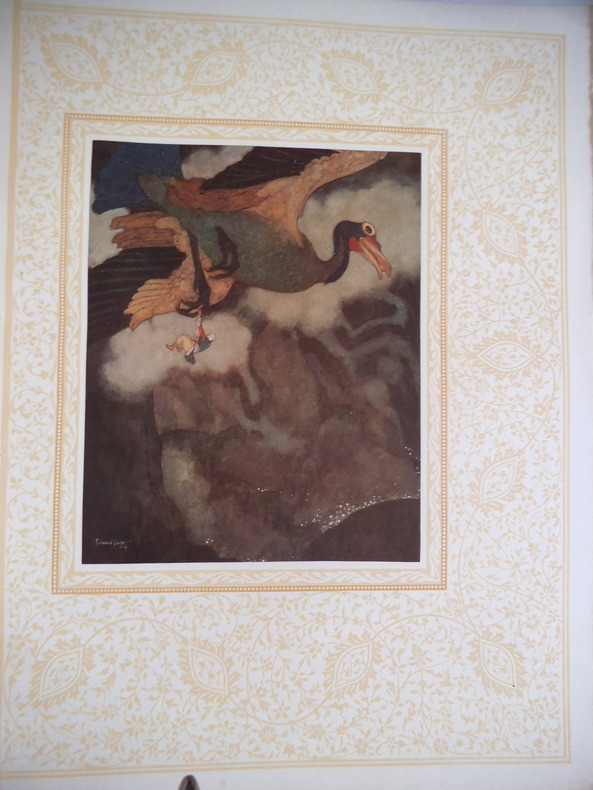
12763In 4 broché, couverture rempliée Faux-titre, justificatif de tirage, titre, 145 pages, illustrations en couleurs contrecollées d’Edmond DULAC, sous serpentes imprimées. Piazza éditeur 9 janvier 1919. Exemplaire n°172. (Un petit manque en pied, réparé) , sinon très bon exemplaire.
118651aafParis, Nepveu, Libraire, 1823, in-12° (14.5 x 9.5 cm), Notre ensemble contient 38 gravures dont 35 merveilleusement mises en couleur, l’ouvrage avec des rousseurs sur les pages de texte, les planches gravées, imprimées sur du papier de meilleure qualité, sont sans taches, pages non rognées. brochures originales illustrées. (Collation sur demande).
1890297571Berlin, Ernst Wasmuth, 1890. 6 Seiten Text.15 Tafeln Originalhalbleinen. Folio
1943144361943. Photograph archive Iran World War II circa 1943 documents the presence of American military personnel in southwestern Iran during the operation of the Allied supply route known as the Persian Corridor a critical logistical network used to transport materiel to the Soviet Union under Lend-Lease agreements. Concentrated in Andimeshk and Dezful in Khuzestan province the images record activity along a strategic rail and road corridor linking Tehran to the Persian Gulf where American and British forces coordinated the movement of supplies to support the Eastern Front. The photographs provide direct visual evidence of U.S. military operations in Iran a theater central to Allied logistics but comparatively underrepresented in visual archives of the war and support research into wartime infrastructure Middle Eastern geography and U.S. military presence outside primary combat zones.<br /> <br /> Archive consists of 44 black and white silver gelatin photographs most measuring approximately 3.5" x 2.5" depicting scenes in Andimeshk and Dezful Iran circa 1943. The images include architectural views desert and garden landscapes transportation corridors and interactions between American soldiers and local Iranian civilians. Several photographs document the built environment of the Zagros Mountain foothill region including rail lines and roadways integral to wartime supply movement. Additional views capture villages and urban spaces within Khuzestan with identifiable regional markers such as proximity to Shush and the Tehran-Ahvaz transit route. The grouping presents a coherent visual record of a specific geographic zone tied directly to Allied logistical operations.<br /> <br /> Taken during the height of Allied coordination in Iran following the 1941 Anglo-Soviet occupation these photographs situate American personnel within a broader multinational effort to sustain Soviet resistance against German advances. The region's long habitation history extending from ancient Persian and Sasanian periods contrasts with its wartime transformation into a modern supply corridor underscoring the layering of military infrastructure onto historically significant terrain. Visual documentation of Andimeshk and Dezful during this period remains comparatively scarce particularly in relation to U.S. personnel activity making the archive relevant for studies of global wartime mobility cross-cultural contact and the material realities of logistics-based warfare. Light edge wear and minor soiling; images generally clean and well-defined; overall in very good condition. unknown
1977141982Tehran, Soroush Press 1977 3 volumes. In-4 31 x 22 cm. Reliures éditeur toile bleue, XXX-895 pp. en pagination continue, notes, 310 figures, sommaire, table des figures - 257 planches, table des planches. Exemplaire en très bon état.
Very Good English Original wrappers. Cr. 8vo. (19,5 x 13,5 cm). In English, Persian, and Ottoman script (Old Turkish with Arabic letters). 26 p. Abû-Muhammad Muslih al-Dîn bin Abdallâh Shîrâzî, (1193-1292), Persian poet and prose writer, widely recognized as one of the greatest masters of the classical literary tradition. His influence is not limited to Persian literature. He also deeply affected Turkish and Urdu literature and the Western world (Encyclopadiae Iranica). Bostan [i.e. the Orchard] and Gulistan [i.e. the Rose Garden], his famous Works, were translated into many languages and commented. Pendname is one of Sa'dî's poetical works. In this ethical-based work, ethical values such as science, justice, consenting to fate, honesty, patience, generosity, modesty, and grace are praised. Bad habits such as talking to ignorant, cruelty, lie, arrogance, and stinginess are badly criticized. The Persian text of Sa'dî's Pendname, it's an English translation, and Ottoman Turkish translation in verse were printed together in the early 20th century. The work is about some moral characteristics that are seen as "acceptable and submissive" in societies and have been recited with the idea of benefiting people. (Source: A BOOK ON ETHICAL LITERATURE: SAADI'S PENDNAME, Melek Dikmen). Major William Henry Carmichael-Smyth, (1780-1861), was a British military officer in the service of the East India Company and an orientalist. In 1797, at the age of seventeen, he was commissioned into the Bengal Artillery. In 1803, the Second Anglo-Maratha War broke out, and he was present at the battles of Aligarh, Delhi, and Laswari. Carmichael-Smyth returned to India in 1810 as a captain and served in the Invasion of Java in 1811. Thereafter he returned to Bengal and went to Callinger as a field engineer where he was mentioned in dispatches for exemplary valor in 1812. He returned to England in 1820 and was elevated to Major in 1821. Not in Özege.; OCLC 50021435, 1065323294.
1743109471743 un volume, reliure demi-velin havane moucheté (binding half calfskin) ) in-seize (sextodecimo), dos long (spine without raised band) décoré or (gilt decoration) filets or (gilt line) - titre frappé or (gilt title) - pièce de titre sur fond rouge (label of title) avec filet or (label of title with gilt line), dos restauré (restauration ancienne mais propre), plats avec de légères épidermures (lights scratches on the covers), papier marbré aux plats (cover with marbled paper), toutes tranches lisses (all edges smoothes), gouttière rognée (fore-edge smooth), Ouvrage illustré d'un portrait gravé de Thamas Kouli-Kan en frontispice et d'une carte dépliante (folding map) hors-texte en noir représentant la Perse et les états du Mogol, (2) feuillets + 473 pages + (1) feuillet, 1743 Paris Briasson Editeur,
2016x-0691641323Princeton University Press 2016. Hardcover. New. 726 pages. 8.00x5.00x1.65 inches. Princeton University Press hardcover
4to hardcover, full leather, Broughton Publishing, AP Manuscripts, 2020 , 1113 pp. Good copy, facsimile of this beautiful manuscript written during the 15th century. With its "Certificate of Authenticity", numbered "14 of 100" : "this books is guaranteed to be a genuine original. It is facsimile base on the Quran from AD 1400-1500. This one-of-a-kind reproduction is the only numbered size format Quran, in genuine calf skin leather". Fac similé d'un très beau manuscrit timouride produit dans le nord de l'Inde durant le XVe siècle. Good copy (very small tears on first cover, otherwise a fine copy) Français
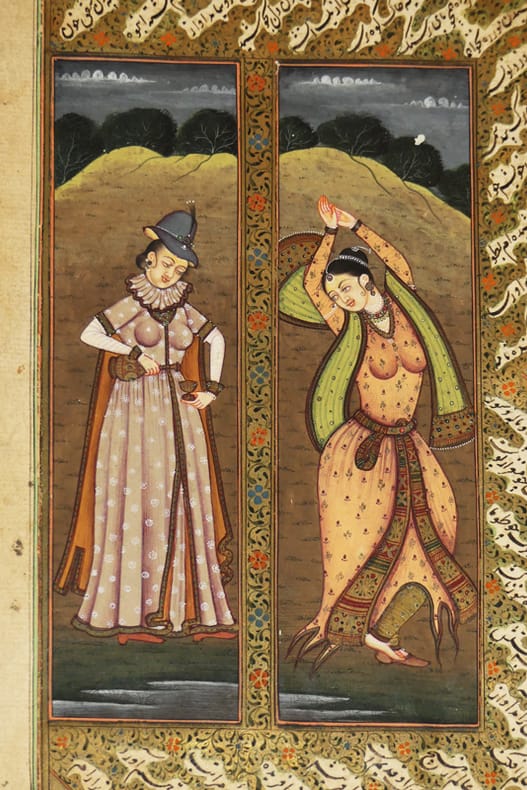
ec32Dessin Le Prince avec la danseuse (illustration 13,5 x 23 cm sur support 17 x 26 cm), sans lieu ni date. Fin XVIII° début XIX°. La qualité de dessin et de mise en couleur n'a rien de comparable avec les multiples copies et variantes récente. Miniature persane finement réalisée et détaillée, aux COULEURS VIVES et TRES FRAICHES ; illustration en très bel état. Livraison a domicile (La Poste) ou en Mondial Relay sur simple demande.
016438Artiste anonyme, Iran, portrait d'une femme qâjâr. Aquarelle et crayon, ca.1850, sur papier (20.5*14cm). L'aquarelle mesure 12*8cm. Portrait d'une femme, probablement dans une tenue de ville. Cette aquarelle est assez classique de la production Qâjâr qui s'exportait déjà au XIXe siècle. De nombreux albums d'aquarelles comme la nôtre furent achetés par les européens. Rappelons aussi qu'en 1848, une expédition scientifique française est reçue à Téhéran par Mohammad Shah, père de Nassereddine. Beau document. [370]
016440Artiste anonyme, Iran, portrait d'une femme qâjâr. Aquarelle et crayon, ca.1850, sur papier (24.5*17cm). L'aquarelle mesure 12*8cm. Portrait d'une femme, probablement dans une tenue de ville. Cette aquarelle est assez classique de la production Qâjâr qui s'exportait déjà au XIXe siècle. De nombreux albums d'aquarelles comme la nôtre furent achetés par les européens. Rappelons aussi qu'en 1848, une expédition scientifique française est reçue à Téhéran par Mohammad Shah, père de Nassereddine. Beau document. [370]
Two parts in one volume. Small octavo. Pp. vi, 47; 28. Hardcover, bound in contemporary quarter pebble-grain cloth and marbled boards, leather lettering-piece, gilt, cloth French corners, some spotting, else in a very good condition. Overall an excellent copy. ~ First edition. See Wilhelm Heinsius: Allgemeines Bücher-Lexikon, 1847-51 (Graz, 1963); Augustin Bonnetty: Annales de philosophie chrétienne (Paris 1854). Rare.