199 résultats
1839055027Kostantiniyye Constantinople - Istanbul: Takvîm-i Vekâyi. AH 1255 1839. Soft cover. Very Good. Original newspaper taken from a volume. Folio. 425 x 28 cm. In Ottoman script Old Turkish with Arabic letters. 5 p. Extremely rare early issue of this first official newspaper of the Ottoman Empire after the proclamation of Reform Tanzîmât in 1839 informed Daguerre's new and weird invention "photography" as it would be called in the 1850s to the Ottoman peoples and readers. The article reads: "It is the talk of the town steam engines have been able to run on rails in factories in recent years. Meanwhile a man carefully focused on his thoughts so much and the craft turned into a strange art and finally a coquettish mirror surface appeared. This skillful Frenchman named Daguerre drew the lines of objects by reflecting the sunlight with the methods of the different science of art he learned drew the contours of the objects and gave 20 years secretly and openly to the formation of this strange art. Finally he reached the goal and this event won the appreciation and admiration of everyone. This is to say the image of the object in the form of a large or small box free from light is pictured inside by passing through the glass in front of it. In order for the reflected picture to be captured on a surface some chemicals must be prepared. Daguerre has achieved this mix based on his experience. This substance applied on the plate is called iodine. After the plate is kept in the vapor of the iodine for a few minutes it is immediately placed in the dark box and the image passing through the window of the box is pictured for five minutes. Considering that some of the things that should be hidden are captured like this it will be understood what a valuable invention this is.". In the continuation of the article it is written that an Englishman named Talbot Henry Fox Talbot found the same thing with almost the same processes ! but Daguerre had taken pictures before. Takvim-i Vekâyi was the first fully Turkish-language newspaper. It was launched in 1831 by Sultan Mahmud II taking over from the Moniteur ottoman as the Official Gazette of the Ottoman Empire. With the beginning of the Tanzimat reform period Takvim-i Vekayi produced versions in multiple language editions. It ceased publication in 1878 resuming in 1891-2 before being closed again. It resumed in 1908 until around 1922. In the 1831-1878 period it published a total of 2119 issues - an average of slightly less than one a week. <br/> <br/> Takvîm-i Vekâyi., [AH 1255] paperback
1837055364Bulak Egypt: Bulaq Printing House / Matba'at Sâhib al-Sa'âdah al-Abadîyah. AH 1253 1837. 1st Edition . Leather. Very Good. 4to - over 9¾ - 12" tall. Contemporary quarter brown leather. Marbled boards. The title of the book is written at the bottom of the pages. Small 4to. 26 x 17 cm. In Ottoman script Old Turkish with Arabic letters. 20 1 blank page 17 2 blank pages 43 2 blank pages 131 2 blank pages 16 1 blank page 97 61 3 blank pages p. Fading and foxing on some pages and edges. Slight chippings on the boards' extremities. The front pastedown and the first blank page are glued. Overall a fresh copy in near fine condition. First edition of this remarkable collection of Vehbi's poems in Arabic Persian and Turkish including his "Lotfiyyah" posthumously printed in Bulaq Printing House as an early Bulaq imprint presented to Sultan Selim III written under his patronage in Istanbul besides other important Ottoman statesmen and clerics in the 18th century such as Shaikh al-Islam Esadefendizâde Mehmed Serif Efendi Râghib Pasha and Halil Hamîd Pasha. This book is one of the 259 Turkish books published from the establishment of the printing house in 1820 to 1851. The voluminous divan consists of six sections respectively titled Sebeb-i Telîf i.e. the reason for writing Farsî i.e. Persian Ibtidâ-yi Kasâîd i.e. Qasidahs Ibtidâ-yi Tevârîh i.e. Histories Ibtidâ-yi Gazeliyyât i.e. Ghazals Lütfiyye-i Vehbi i.e. Lotfiyyah. After the introductory part of the work there are Arabic odes and couplets respectively Persian divancha including a eulogy written for Sultan Mustafa III and other eulogies dates and ghazals under separate headings. Lotfiyyah is a verse book of 1181 couplets that the poet wrote for his son. The Bulaq or El-Amiriya Press is the first official and governmental printing press to be established in Egypt and functions according to an industrial printing basis causing not just a qualitative but also a quantitative and knowledgeable leap in science throughout the Arab region. It was established in 1820 by Muhammad Ali Pasha of Egypt and Sudan 1769-1849 and it was part of Muhammad Ali's inclusive development plans for the modernization of Egypt. Özege 4242.; Ipekten & Isen pp. 106.; OCLC 644318943 & 602407077. <br/> <br/> Bulaq Printing House / Matba'at Sâhib al-Sa'âdah al-Abadîyah., [AH 1253] hardcover
2012051782Tehran: Tahouri Publications 2012. Dust jacket. New/New. 8vo - over 7¾ - 9¾" tall. Original bdg. Dust wrapper. Roy. 8vo. 24 x 17 cm. In Persian and a short abstract in English. 2 volumes in 1 488 p. ills. Rouzname-ye Safar-e Sultan Murad IV be Iravan va Tabriz: The journal of Sultan Murad IV's campaignsof Yerevan and Tabri 1044-45 AH / 1635 AD. & Manzelname-ye Baghdad: The gazetteer of the Baghdad invasion 1048-49 AH/ 1638-39 AD. Edited and introductions by Yunus Zeyrek Halil Sahillioglu. Introduced annotated attachments and translated from original Ottoman TUrkish texts in Persian by Dr. Nasrollah Salehi.= Rûznâmah-'i safar-i Sultân Murâd-i chahârum bih Iravân va Tabrîz 1044-1045 H.Q. & Manzil'nâmah-'i Sultân Murâd-i chahârum bih Baghdâd 1048-1049 H.Q. Iran & Ottoman History Series 3. <br/> <br/> Tahouri Publications unknown
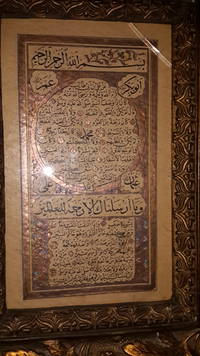
000043<p><strong>Rare miniature <em>Hilye</em></strong> by an Ottoman calligrapher originally from Bursa Turkey who later lived in Baghdad. Only one work by <strong>Süleyman Vehbi</strong> is recorded by İbnü'l-Emin Mahmud Kemal İnal <em>Son Hattatlar</em> p. 451 preserved in the Topkapı Palace Museum and dated <strong>1247 AH 1830 CE</strong>.</p><p>An additional example by the calligrapher's student <strong>Halil Şükrü</strong> is documented in <em>Türk Hattatları</em> by Şevket Rado p. 210. The present example displays a typical script consistent with other known works including the text and the signature of <strong>Süleyman el-Vehbi</strong>.</p><p><strong>Measurements:</strong> 14 × 9 cm smaller than the hand.</p>
1898055584Istanbul: Mahmud Bey Matbaasi. AH 1315 1898. 1st Edition . Leather. Very Good. 8vo - over 7¾ - 9¾" tall. In contemporary handsome 1/3 leather bdg. Raised five bands to the spine. The third and fourth compartments have a lettered gilt title and a personal name Fikri in Ottoman script. Other ones have decorated gilts. Cr. 8vo. 20 x 14 cm. In Ottoman script Old Turkish with Arabic letters. 359 p. First and only edition of Süleyman Tevfik's eyewitness travel account to Thessaly who participated in the Turco-Greco War in 1897 as a war correspondent in the Thessaly Front between April 27 - May 20 1897. The Greco-Turkish War of 1897 or the Ottoman-Greek War of 1897 also called the Thirty Days' War and known in Greece as the Black '97. It was a war fought between the Kingdom of Greece and the Ottoman Empire. Its immediate cause was the question over the status of the Ottoman province of Crete whose Greek majority had long desired union with Greece. Despite the Ottoman victory on the field an autonomous Cretan State under Ottoman suzerainty was established the following year because of the intervention of the Great Powers after the war with Prince George of Greece and Denmark as its first High Commissioner. This was the first war effort in which the military and political personnel of Greece were put to test in an official open war since the Greek War of Independence in 1821. For the Ottoman Empire this was also the first war effort in which the reorganized military personnel were put to the test. The Ottoman army was under the guidance of a German military mission led by Colmar Freiherr von der Goltz who had reorganized it after the defeat in the Russo-Turkish War 1877-1878. In Thessalian Front war was declared on 18 April when the Ottoman ambassador in Athens Asim Bey met with the Greek foreign minister announcing the cutting of diplomatic ties. Heavy fighting occurred between the 21-22 April outside the town of Tyrnavos but when the overwhelming Ottoman forces converged and pushed together the Greek general staff ordered a general withdrawal spreading panic among soldiers and civilians alike. Larissa fell on 27 April while the Greek front was being reorganized behind the strategic lines of Velestino in Farsala. Nevertheless a division was ordered to head for Velestino thus cutting Greek forces in two 60 km apart. Between 27 and 30 April under the command of Col. Konstantinos Smolenskis Greek forces checked and halted the Ottoman advance. On 5 May three Ottoman divisions attacked Farsala forcing an orderly withdrawal of Greek forces to Domokos while on the eve of those events Smolenskis withdrew from newly recaptured Velestino to Almyros. Volos fell into Ottoman hands on 8 May. At Domokos the Greeks assembled 40000 men in a strong defensive position joined by about 2000 Italian "Redshirt" volunteers under the command of Ricciotti Garibaldi son of Giuseppe Garibaldi. The Ottoman Empire had a total of about 70000 troops of whom about 45000 were directly engaged in the battle. On 16 May the attackers sent part of their army around the flank of the Greeks to cut off their line of retreat but it failed to arrive in time. The next day the rest of their army made a frontal assault. Both sides fought ferociously. The Ottomans were held at bay by the fire of the defending infantry until their left flank defeated the Greek right. The Ottoman formation broke through forcing a renewed withdrawal. Smolenskis was ordered to stand his ground at the Thermopylae passage but on 20 May a ceasefire went into effect. Özege 20762.; OCLC 65794449 / 775132812. <br/> <br/> Mahmud Bey Matbaasi., [AH 1315] hardcover
1882054004Istanbul: Mihran Matbaasi. AH 1299 1882. 1st Edition . Hardcover. Very Good. 8vo - over 7¾ - 9¾" tall. Paperback with original wrappers. Restored wrappers and spine masterfully. Roy. 8vo. 24 x 17 cm. In Ottoman script Turkish with Arabic letters. 171 1 p. Maps are missing. First and Only Edition of this early naval guide to the Mediterranean and Aegean Islands and shores prepared by Ottoman Admiral Süleyman Faik. Süleyman Faik 1845-1909 was a general after admiral and Chairman of the Turkish / Ottoman Navy General Staff divisional. A comprehensive early printed guide to the Cezâyir-i Bahr-i Sefid i.e. Ottoman Province of Archipelago including the Aegean shores the Archipelago the Dardanelles Rhodes Cyprus et alli. Only six copies in OCLC: 773143926 67075343.; Özege 16579.; Not in ATYB: Askerî Tarih Yayinlari Bibliyografyasi = Bibliography of Turkish History of Military Books. <br/> <br/> Mihran Matbaasi., [AH 1299] hardcover
1882054723Istanbul: Mihran Matbaasi. AH 1299 1882. 1st Edition . Hardcover. Very Good. 8vo - over 7¾ - 9¾" tall. Contemporary handsome quarter leather binding raised four bands and gilt lettering to spine. Roy. 8vo. 24 x 17 cm. In Ottoman script Old Turkish with Arabic letters. 171 1 p. 15 folded maps. First and only edition of this early naval guide to the Mediterranean and Aegean Islands and shores prepared by the Ottoman Admiral Süleyman Faik. A comprehensive early printed guide to the Cezâyir-i Bahr-i Sefid i.e. Ottoman Province of the Archipelago including the descriptions of all islands in the Archipelago such as Patmos Peraka Paros Delos Ipsara Acina Sekino Mikonos Bozcaada Tenedos Istanköy Kos Imroz Crete Anti Paros Alosis Islands with West and East of the Archipelago and Edremit Bay Doris Bay Rafti Port Aynaroz Bay; and Anatolian shores such as Izmir Smyrna Kusadasi Gallipoli. This rare book has 15 folded portolan maps of Marmaris Port Makri Port Naghos Port Karaagach Ptelea Evros in Greece Port Kakuve and Tertumos Ports portolan of Iskenderun Alexandrietta portolan of Lazkiye Al-Lazkiyya in Syria portolan of Avret Island and Trablus-Sam and portolan of Beirut and Sida. Süleyman Faik 1845-1909 was a general and afterwards an admiral and a Chairman of the Turkish / Ottoman Navy General Staff divisional. Only six copies in OCLC: 773143926 67075343.; Özege 16579.; Not in ATYB: Askerî Tarih Yayinlari Bibliyografyasi = Bibliography of Turkish History of Military Books. <br/> <br/> Mihran Matbaasi., [AH 1299] hardcover
1924054927N. p.: 20 July 1924 1924. No Binding. Very Good. Original autograph letter signed ALS by Ottoman princess 'Sükriye Serafeddin'. 175x145 cm. In Ottoman script Turkish with Arabic letters. 1 p. in four. Bifolium. The letter starts with 'Huve' and it has 12 lines. She mentions a letter that was sent by this unnamed recipient to 'Serafeddin' who is probably from the Ottoman dynasty. Sükriye Sultan was an Ottoman princess the daughter of the heir to the throne Sehzade Yusuf Izzeddin son of Sultan Abdulaziz and Leman Hanim. Sükriye Sultan was born on 24 February 1906 in Çamlica Palace. Her mother was Leman Hanim. She was the second child and eldest daughter born to her father and the eldest child of her mother. She had two younger siblings a brother Sehzade Mehmed Nizameddin two years younger than her and a sister Mihrisah Sultan ten years younger than her. She was the granddaughter of Abdulaziz and Dürrünev Kadin. <br/> <br/> 20 July 1924 unknown
1890055279Paris: Ek Tis Typographias "O Aesthir". ca. 1890 1890. 1st Edition . Soft cover. Very Good. 8vo - over 7¾ - 9¾" tall. Original wrappers. Demy 8vo. 21 x 14 cm. In Modern Greek. 244 p. Some stains on margins spine slightly loosened with minor marginal chippings on the pages. An untrimmed and unopened copy in good condition. First and only Greek edition of this rare medical book printed in Paris on physiology by Mavrogenis. He was one of the most influential professors of medicine at the Constantinople Medical School where he taught internal medicine. In this book Mavrogenis clearly presents the state of the art in physiology at the time distinguishes between physiology and psychology in terms of their methodologies and offers an accurate description of the contemporary views on the "Brain-Mind Problem" George Anogianakis Reflections of Western Thinking on Nineteenth Century Ottoman Thought: A Critique of the 'Hard-Problem' by Spyridon Mavrogenis a Nineteenth Century Physiologist. Spyridon Mavrogenis a prominent Phanariot Greek doctor played a key role in the medical field of the Ottoman Empire during the 19th century. He served as the personal physician to Sultan Abdul Hamid II. His lineage traced back to the Mavrogenis family who were of Venetian heritage. Mavrogenis's father passed away when he was young prompting him to live with his uncle Ioannis Mavrogenis in Vienna where his uncle served as the chargé d'affaires for the Ottoman mission. Mavrogenis initially studied at the Chalcis Commercial School and later attended medical studies in Vienna from 1835 to 1843. After completing his studies he worked as an auxiliary doctor in a city-owned hospital in Vienna. Returning to Constantinople in 1845 Mavrogenis served as a doctor at the Artillery Hospital and in 1848 became a professor at the Imperial Medical School. He initially taught hygiene and later pathology advocating for the use of French as the medium of instruction. In addition to his professional achievements Mavrogenis was involved in the cultural sphere hosting meetings of the Greek Literary Society at his home starting in 1861. OCLC locates only two copies 261976425 at Stanford University Lane Medical Library and Utrecht University Library both with 317 pages. However our presented copy has 244 pages with "Telos" i.e. Finish and is complete without missing pages. <br/> <br/> Ek Tis Typographias "O Aesthir"., [ca. 1890] paperback
22169St Petersburg Russia. 17 September 1884. 3pp. 4to. Bifolium. In good condition lightly aged with slight traces of glue from mount along inner edge of reverse of second leaf which is endorsed and carries pencil notes. Folded once. Signed by Thornton with the rest of the document in the hand of a secretary. The recipient is named as T. W Smyth Esq West Hartlepool Shipowners Society'. He writes with reference to a letter and telegram and states that he has been 'making constant representations to the Russian Acting Minister of the Interior with regard to the hardship and severity of the fourteen days quarantine imposed upon vessels arriving from Italy at Russian Ports of the Black Sea notwithstanding their having already performed ten days quarantine in Turkish waters'. None of Thornton's arguments have 'succeeded in inducing the Imperial Government to counterorder or relax this excessive quarantine' but the subject is 'still under the consideration of the Medical Board' and Thornton will not discontinue his 'efforts on behalf of British Shipping'. See Thornton's entry in the Oxford DNB. St Petersburg [Russia]. 17 September 1884. unknown
1895055453Istanbul: Ikdam Matbaasi. AH 1313 1895. 1st Edition . Leather. Very Good. 8vo - over 7¾ - 9¾" tall. Original handsome brown quarter leather binding with Ottoman lettered gilt to spine. Five raised bands to spine separated from each other with lined gilt. Slight stains on the title page. Else a fine copy. Roy. 8vo. 23 x 16 cm. In Ottoman script Old Turkish with Arabic letters. 99 p. Hegira: 1313 = Gregorian: 1895. Extremely rare first printed edition of this one of the earliest travel accounts of an Ottoman admiral's early expeditions to the Indian Ocean Arabian Sea Red Sea and Persian Gulf to counter Portuguese piracy and attacks on Muslim pilgrim ships which describes the lands he has seen during his voyage from India to Constantinople by Sidi Seydi Ali Reis 1498-1563 sent by Sultan Suleiman the Magnificent covering the years 1553-1556. During these naval wars after two marine battles against the Portuguese fleet and a great storm named The Elephant Typhoon Tufan-i Fil by the locals Reis' remaining six galleys drifted to India. The fleet was unserviceable resulting in his return home overland with 50 men. Reis then arrived at the royal court of the Mughal Emperor Humayun in Delhi where he met the future Mughal emperor Akbar who was twelve years old at the time. He returned to the Ottoman Land over Muslim states in South Asia; Afghanistan Central Asia and Iran. But he delayed his return because of the war between the Ottoman and the Safavid Empires in Iran. Finally following the treaty of Amasya in 1555 he was able to return home and present his book of this narrative journey to the Sultan in 1557. This work offers an extensive insight into the Muslim situation in 16th century South and Central Asia and the Middle East Islamic navigation and Turkish - Portuguese relations as well as Persian Afghan and Indian geography naval routes flora and fauna. Seydi Ali Reis formerly also written Sidi Ali Reis and Sidi Ali Ben Hossein was an Ottoman admiral and navigator. Known also as Katib-i Rumi Galatali or Sidi Ali Çelebi he commanded the left wing of the Ottoman fleet at the naval Battle of Preveza in 1538. He was later promoted to the rank of fleet admiral of the Ottoman fleet in the Indian Ocean and as such encountered the Portuguese forces based in the Indian city of Goa on several occasions in 1554. Seydi was able to unite several Muslim countries on the coast of the Arabian Sea such as the Makran Kingdom Gujarat Sultanate and Adal Sultanate against the Portuguese. He is famous today for his books of travel such as the Mir'ât ül Memâlik i.e. The Mirror of Countries and his books of navigation and astronomy such as the Mir'ât-i Kâinât Mirror of the Universe and the Kitâb ül Muhit: El Muhit fî Ilmi'l Eflâk ve'l Buhûr i.e. Book of the Regional Seas and the Science of Astronomy and Navigation which contain information on navigation techniques methods of determining direction calculating time using the compass information on stars sun and moon calendars wind and sea currents as well as portolan information regarding the ports harbours coastal settlements and islands in the various regions of the Ottoman Empire. His books are translated into numerous languages including English French Italian German Greek Arabic Persian Urdu Russian and Bengali and are considered among the finest literary works dating from the Ottoman period. "When Sultan Suleiman had taken up his winter residence in Aleppo I the author of these pages was appointed to the Admiralship of the Egyptian fleet and received instructions to fetch back to Egypt the ships 15 galleys which some time ago had been sent to Basrah on the Persian Gulf. But 'Man proposes God disposes.' I was unable to carry out my mission and as I realized the impossibility of returning by water I resolved to go back to Turkey by the overland route accompanied by a few tried and faithful Egyptian soldiers. I traveled through Gujarat Hind Sind Balkh Zabulistan Bedakhshan Khotlan Turan and Iran <br/> <br/> Ikdam Matbaasi., [AH 1313] hardcover
1981053241Istanbul: TC Istanbul Üniversitesi Edebiyat Fakültesi Bizans Sanati Tarihi Kürsüsü Letterhead 1981. No Binding. Fine. Original typescript letter signed by Semavi Eyice. Some autograph corrections as well by Eyice. 31x225 cm. In Turkish. Twenty lines. 7.5.1981 dated. He mentions Fatih Mosque in Silivri which transformed from an old Byzantine church. The letter includes very interesting information Silivri and Selimbria with its ancient name. For instance in the 1960s the district governor of Silivri sold the land of this church/mosque for five Turkish Lira per square meter. In addition to this he says that Silivri is a Turkish district were always destroyed its own historical artifacts. In the continuation of the letter he indicates that he adds to this sending an off-print including his article related to the Byzantine monuments in Thrace and containing mentioned church in Silivri. <br/> <br/> TC Istanbul Üniversitesi Edebiyat Fakültesi Bizans Sanati Tarihi Kürsüsü Letterhead unknown
049456Istanbul. Soft cover. Very Good. Original autograph letter signed as 'Sezai' by Samipasazade Sezai to Türkgeldi family. In Ottoman script. 4 p. last page has Ali Fuat Türkgeldi's autograph note on Samipasazade Sezai's death as: "Samipasazade Sezai Bey; 26 Nisan 1936 Pazar aksami saat dokuzu yirmi geçe 21:20 ölmüstür.". Sezai's letter starts as 'Pek muhterem kardesim'. Used blue ink with a fountain pen. Ali Fuat Türkgeldi 1867-1935 was an Ottoman historian and politician. He is the son of Celâl Bey the undersecretary of the Ministry of Interior and the son of Cemal Bey in the Reform period Tanzimat - Westernization period the director of Translation Chamber. Sezai Turkish realist storyteller novelist. He is the author of Sergüzest Adventure which is one of the first realistic novels of Turkish literature. Also he was pioneer of the modern short story in Turkish literature with Küçük seyler 'Little things' he wrote in 1892. Between 1885 and 1901 he lived in Istanbul this letter dated probably in that period and had a literary period. He was close friends with Abdülhak Hamit and Recaizade Ekrem. He met with Namik Kemal whom he met when he was 17-18. He did not produce many works like other Tanzimat writers; wrote one novel two small story books and travel memoirs. In 1888 he published a novel called Sergüzest A story about a Pasazade and his love story after which he became one of the first writers of Turkish literature after Semseddin Sami Namik Kemal and Ahmet Mithat Efendi. He translated Alphonse Daudet's 'Jak' into Turkish. For thinking that he was being held under 'surveillance' for his novel he went to Paris in 1901 and stayed there until the declaration of the Constitutional Monarchy in 1908. He met the Young Turks in Paris; He joined the Committee of Union and Progress and came to a respected place in the community in a short time. Upon the declaration of the Constitutional Monarchy he returned to Istanbul and was appointed as ambassador to Madrid. As WW 1 began he moved from Madrid to Switzerland where he stayed until the end of the war. His only novel Serguzest was the first novel in Turkish literature to deal entirely with captivity; the novel in which the system of concubinance and slavery was criticized was his most famous work. It was translated into French by Besim Ömer Pasha. e combined romance and realism in her writings. He combined romanticism and realism in his writings. He gave works with the motto of "l'art pour l'art". <br/> <br/> paperback
1934052617Ankara: T. B. M. M. Özel 1934. Soft cover. Very Good. Original autograph letter ALS signed 'Bilecik Saylavi Salih Bozok' with its original envelope. 21x15 cm. In Ottoman script. 2 p. Full. Letter includes 27 lines. Dated December 22 1934. Letterhead 'TBMM Özel' i.e. Turkish Grand National Assembly. Recipient is Salih Bey Sener who was lived in Kadiköy and Commandant Gendarme. Bozok was an officer of the Ottoman Army later the Turkish Army and a politician of the Republic of Turkey. He was the chief aide-de-camp of Mustafa Kemal Atatürk the founder of modern Turkey. Bozok was a close childhood and lifelong friend of Atatürk both having been born in 1881 in Salonica and having attended the Monastir Military High School together. On November 10 1938 upon witnessing the dead body of Atatürk in the latter's bedroom of Dolmabahçe Palace a distraught and stunned Bozok stepped outside and shot himself through the chest with a pistol. However the bullet narrowly missed his heart and Bozok did not succumb to his fatal wound until April 1941. Wikipedia. <br/> <br/> T. B. M. M. Özel paperback
2008024521Istanbul: Istanbul Fuar Merkezi = Istanbul Expo Center 2008. Dust jacket. New/New. 4to - over 9¾ - 12" tall. Original bdg. with original dust wrapper. 4to. 30 x 22 cm. 215 p. B/w and color ills. In Turkish. A heavy volume. =La Turquie a l'exposition universelle de 1867. As early as the Great Exhibition of 1851 in London replicas of parts of well-known buildings such as the Alhambra were displayed inside the main structure the Crystal Palace; separate pavilions for different nations outside the main exhibition hall were first built for the Paris Universal Exposition of 1867. By gathering architectural pieces from all over the world the fair grounds introduced the notion of an imaginary journey and created a new type of tourism en place. Architectural displays became indispensable at every fair setting the precedent for the "period room" and the "outdoor architectural museum.". <br/> <br/> Istanbul Fuar Merkezi = Istanbul Expo Center unknown
049718Istanbul: 1920's. No Binding. Very Good. Original b/w photograph of Salah Cimcoz and Musa Kazim Efendi with another 13 people in a community. They sit and look to camera. Cimcoz with his 'fez' and Musa Kâzim with his traditional 'qavuq'. Musa Kazim was shaikh-al-islam between 1910-1911 and his second time was between 1916-1918 during the World War I. Cimcoz graduated from Istanbul Law School. He was also a member of Union and Progress deputy of Meclis-i Mebusan Ottoman Parliament and owner 'Kalem' humorist periodical. Both these figures which are very important in terms of Turkey's history and last Ottoman period also were "150 personae non-gratae" and exiled to Malta in 1919. Extremely rare. <br/> <br/> 1920's unknown
2006053052Istanbul: Denizler Kitabevi 2006. 1st Edition . Dust jacket. New/New. 8vo - over 7¾ - 9¾" tall. Original bdg. Dust wrapper. Oblong folio. 23 x 33 cm. In English and Turkish. 207 p. B / w and color ills. The Bosphorus steamers of the Sirket-i Hayriye. = Sirket-i Hayriye'nin Bogaziçi vapurlari. The Bosphorus has always been a subject that occupied an extraordinary place both in the Turkish and in the World literatures. With its natural. <br/> <br/> Denizler Kitabevi unknown
1940050218New York: Rukiye Sabia Sultan 1940. Soft cover. Very Good. 4to - over 9¾ - 12" tall. Original color photograph hand-colored. 4to. 26 x 20 cm. A portrait. Signed and inscribed as 'To my dear uncle and mother Fatma Sultana New York August 1940'. Sabia Sultan was born on 2 April 1894 in her father's palace in Ortaköy. Her mother was Nazikeda Kadin daughter of Hasan Marshan and Fatma Horecan Aredba. She was the third daughter born to her father and mother. She had two sisters Fenire Sultan six years elder than her and Ulviye Sultan one year elder than her. When her father asecended the throne in 1918 Sabiha was still unmarried but had several admirers. Those who knew her always said that she was not like the other women of the Ottoman family. "Sabiha Sultan was different" said the Turkish poet Yahya Kemal. Her first suiter is thought to be Rauf Orbay. He was followed by Mahmud Kemal Pasha. Another was Fuad Bey of the Babanzade clan. Captain Safvet Arikan Lieutinant Suphi Bey from Damascus were other suitors but none of them were accepted. Her betrothal to Ahmad Shah Qajar the last ruling member of the Qajar dynasty and Mustafa Kemal Atatürk was forfeited in favor of her second cousin Sehzade Ömer Faruk thus missing her chance of becoming the first "First Lady" of the nascent Turkish Republic. Sabiha and Sehzade Ömer Faruk the son of Abdulmejid II the last Caliph of the Ottoman Caliphate and Sehsuvar Hanim were in love with each other. When Abdulmejid asked Sabiha's hand in marriage for his son Mehmed flatly refused as there was no such thing as a marriage between cousins. Sehsuvar Hanim the prince's mother called on Nazikeda and succeeded in convincing her. The marriage took place on 5 December 1919 in the pavilion of the sacred relics Topkapi Palace. The marriage was performed by Seyhülislam Hayrizade Ibrahim Efendi. Sabiha Sultan's deputy was Baskatip Ali Fuad Bey and Ömer Faruk's deputy was Ömer Yaver Pasha. The wedding reception took place four months later on 29 April 1920 at the Yildiz Palace. The couple were given the Nisantasi Palace as their residence. Fatma Neslisah Osmanoglu was a granddaughter of the last Ottoman Caliph Abdulmejid II and his first wife Sehsuvar Hanim and granddaughter of the last Ottoman Sultan Mehmed VI and his first wife Nazikeda Kadin. She was the daughter of Sehzade Ömer Faruk 1898-1969/1971 and his first wife and cousin Sabiha Sultan 1894-1971. Extremely rare. <br/> <br/> Rukiye Sabia Sultan paperback
052630Istanbul: Manuscript Letters and Album. No Binding. Very Good. Original 110 autograph letters ALS and several autograph postcards with almost all their original envelopes one signed cabinet photograph and one photograph album including Pertev Pasha's funeral photos which shows many famous politicians and soldiers beside his daughter Nevin Demirhan Bengisu and his wife Leman Demirhan. Various sizes. All material in Ottoman script. Most of letters addressed to his daughter Mrs. Nevin. His funeral album includes one newspaper clipping contains his short life six newspaper obituaries 20 b/w photos of his funeral and famous people attending the funeral one telegraph of condolences by Kazim Orbay 1886-1964 and his wife Mrs. Orbay. Sait Pertev Demirhan 1871-1964 was a Turkish soldier and politician. He is a graduate of Erkân-i Harbiye. He was an author intellectual Erkân-i Harbiye School teacher 6. Army chief of staff Harbiye Undersecretariat 3rd Army Chief of Staff 1st Corps and 4. Corps Commands Military Schools Inspector Member of History and Geography Councils Member of Military Appeals Court a deputy of Erzurum. He was the son of Yanyali Mustafa Pasha. He graduated from Harbiye as a staff captain 1892. In 1894 he was sent to Germany to advance his military education. After being a colonel he was appointed to the Staff School as a teacher 1904. He was sent to the Russian-Japanese War as an observer. So he written a book titled 'Japonlarin asil kuvveti: Japonlar niçin ve nasil yükseldi' i.e. The principal power of Japan: Why and how did Japan rise printed in 1937 in Turkish. He returned to Istanbul in 1906 and was promoted to "Pasha" and was appointed as the 6th Army Chief of Staff. He participated in the Balkan Wars 1912-1913 and was on the Caucasian front during the First World War. He was sent to Vienna as a military diplomat. Upon his return he moved to Anatolia to participate in the Turkish War of Independence. He died in Moda district of Kadiköy. A fine and rare collection. <br/> <br/> Manuscript Letters and Album unknown
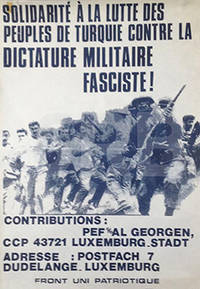
51-3768PEF- Front Uni Patriotique circa 1972. Silkscreen in blue. 60.5 x 43 cm."Solidarité à la lutte des peuples de Turquie contre la dictature militaire fasciste". : 605 x 43 cm fines coupures en bordure fines pliures./ PEF- Front Uni Patriotique, circa 1972 unknown
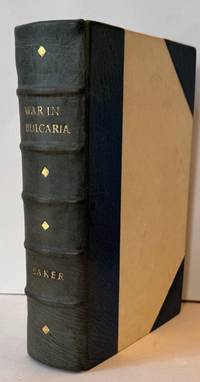
1879008227London : Crown Buildings 188 Fleet Street.: Sampson Low Marston Searle & Rivington 1879. 1st Edition . Hardcover. Very Good. 8vo - over 7¾ - 9¾" tall. In dark blue half morocco over cream paper boards c1988 a few small marks. Spine raised bands gilt tooling & title. Internally lacking title - supplied in facsimile 3 iv-xxxii 1 2-360 pp 3 maps large folding & coloured marbled endpapers & text block edges some faint edge browning. A clever binding by the previous owner. A rare item with only 2 copies at auction since 1895! none online! 217136 mm. <br/> <br/> Sampson Low, Marston, Searle, & Rivington, hardcover
0364201460.Ghardcover. Good. Access codes and supplements are not guaranteed with used items. May be an ex-library book. hardcover
162757025X.Gpaperback. Good. Access codes and supplements are not guaranteed with used items. May be an ex-library book. paperback
0464937655.Gpaperback. Good. Access codes and supplements are not guaranteed with used items. May be an ex-library book. paperback