[FRENCH INDIA - MANUSCRIPT].Biblio.com
12 033 résultats
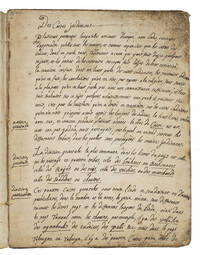
1743ABC_45492Karaikal 1743. Blue mottled stiff paper wrappers. 4to ca. 24 x 18.5 cm. Manuscript written in dark brown ink on beige laid paper. French manuscript written in Karaikal French India since 1739 which gives a detailed explanation of the Indian caste system: the author explains in the beginning of the text that the French people are ill-informed about it. To illustrate the Indian caste system the anonymous author tells lively anecdotes and makes comparisons with French social classes and parallels to biblical stories. The author not only describes the details of the four castes Brahmin Raj Vaisya and Sudra including their hierarchy and advantages the purpose of this social structure and the experience of those who lose their caste. He goes further speculates about the way different cultures criticize each others morals. He argues that all nations criticize each other in some way simply because the habits of cultures differ each with its own good reasons. He also wrote about the extent of superstition in the customs of Indian people for example the beliefs surrounding cows. He concludes that not all their customs are superstitious. The author clearly views Indian cultural practices with a certain gentleness.Somewhat worn at the extremities and spine slightly foxed on the front paste-down and a little dust soiled on the first page. Otherwise in good condition. unknown
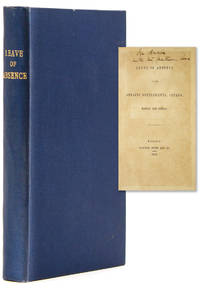
1859320421Calcutta: Thacker Spink & Co. printed by P.M. Craneburgh at the Bengal Military Orphan Press 1859. First edition. iv 244 viii pp. 8vo. Original blue ribbed cloth spine gilt bookplate to front pastedown of Sir Charles P. Hobhouse Bart. Bradford-on-Avon presentation inscription to title page. A fine copy. First edition. iv 244 viii pp. 8vo. Inscribed on the title page: "For Annie with the Author's love." This copy also formerly belonged to Sir Charles Parry Hobhouse 3rd Baronet of Westbury.<br /> <br /> A crisp copy recording the anonymous author's seven month's of exploring through South East Asia in 1851 and 1853. Departing 8 September 1851 the author who remains anonymous to this day spent four months travelling to Ceylon and Singapore before returning to Calcutta. In 1853 he set off again this time for a three month excursion to the Madras and Bombay Presidencies. There are vivid descriptions of Singapore Penang Malacca Madras Calcutta Bombay Bangalore and Candy as well as coffee plantations and Buddhist temples. The author spends quite some time travelling overland and describes an ascent of Pedro Tallagalla and Kilkamany and camping at Makoortie Peak. Despite the scarcity of this little book it did attract critical attention. A favourable notice appeared in the Calcutta Review which states that the author had "seen and noted down . as much as any one who had preceded or who has since followed him in the same track."<br /> <br /> The work concludes with an appendix in two parts the first being a table showing the route modes of transport ship rail bandy pony and the amount of time spent at each location. The second is titled "Hints for travellers" which concludes: "Travellers will find it wiser never to have coolies to their palanquins when they can procure bearers; never to go in palanquins when they can with safety from the sun ride; never ride down passes when they can walk and never to be discouraged by indifference or dissuaded by alarms from prosecuting any enterprise." There is nothing in the preface to explain the six year delay between the conclusion of his travel and the publication of the account.<br /> <br /> Exceedingly rare. No copies on OCLC or COPAC. The only other copy we know of is the Brooke-Hitching copy identically bound; the present copy is in superior condition. The Calcutta Review vol. 33. July-December 1859. Serampore: "Friend of India" Press 1859 pp. lxviii-lxxi Thacker, Spink & Co. (printed by P.M. Craneburgh at the [Bengal] Military Orphan Press) unknown
1859320421Calcutta: Thacker Spink & Co. printed by P.M. Craneburgh at the Bengal Military Orphan Press 1859. First edition. iv 244 viii pp. 8vo. Original blue ribbed cloth spine gilt bookplate to front pastedown of Sir Charles P. Hobhouse Bart. Bradford-on-Avon presentation inscription to title page. A fine copy. First edition. iv 244 viii pp. 8vo. Inscribed on the title page: "For Annie with the Author's love." This copy also formerly belonged to Sir Charles Parry Hobhouse 3rd Baronet of Westbury.<br/><br/>A crisp copy recording the anonymous author's seven month's of exploring through South East Asia in 1851 and 1853. Departing 8 September 1851 the author who remains anonymous to this day spent four months travelling to Ceylon and Singapore before returning to Calcutta. In 1853 he set off again this time for a three month excursion to the Madras and Bombay Presidencies. There are vivid descriptions of Singapore Penang Malacca Madras Calcutta Bombay Bangalore and Candy as well as coffee plantations and Buddhist temples. The author spends quite some time travelling overland and describes an ascent of Pedro Tallagalla and Kilkamany and camping at Makoortie Peak. Despite the scarcity of this little book it did attract critical attention. A favourable notice appeared in the Calcutta Review which states that the author had "seen and noted down . as much as any one who had preceded or who has since followed him in the same track."<br/><br/>The work concludes with an appendix in two parts the first being a table showing the route modes of transport ship rail bandy pony and the amount of time spent at each location. The second is titled "Hints for travellers" which concludes: "Travellers will find it wiser never to have coolies to their palanquins when they can procure bearers; never to go in palanquins when they can with safety from the sun ride; never ride down passes when they can walk and never to be discouraged by indifference or dissuaded by alarms from prosecuting any enterprise." There is nothing in the preface to explain the six year delay between the conclusion of his travel and the publication of the account.<br/><br/>Exceedingly rare. No copies on OCLC or COPAC. The only other copy we know of is the Brooke-Hitching copy identically bound;the present copy is in superior condition. The Calcutta Review vol. 33. July-December 1859. Serampore: "Friend of India" Press 1859 pp. lxviii-lxxi Thacker, Spink & Co. (printed by P.M. Craneburgh at the [Bengal] Military Orphan Press) unknown books
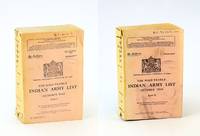
1943223j2732New Delhi India: The Manager of Publications India. Fair with No dust jacket as issued. 1943. First Edition. Paperback. An encyclopedic reference "detailing British and Indian officers including names ranks commissions promotions unit assignments and war services during WWII. Served as an official reference for appointments awards and casualties within the Indian Army." - Google AI. 2790 pages in two volumes. Interesting vintage advertisements. Few markings to covers. Above-average wear. Bindings intact. A rare example of this extraordinarily informative WWII reference. ; Sm 4to . The Manager of Publications, India paperback
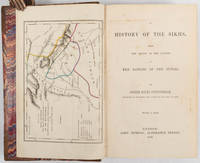
1849222747London.: John Murray. First Edition. 1849. Frontispiece map and one other folding map both hand-coloured in outline folding table xxxvi 425 3 pp; early half calf marbled boards 21.5 x 14 cms marbled endpapers spine blind-stamped in compartments and gilt-ruled red title label folding map with a sealed 4cm fold split at the head of one fold scant spotting and age-toning boards a trifle rubbed and scuffed neat inked previous owner's name to the front free endpaper and the pencilled name and address of bookseller R. D. Steedman paper abrasion to the verso of the front free endpaper a very good copy. <br> <br>Handsome armorial bookplate 'Erimus' to the front pastedown. First edition. Rare. <br>Joseph Davey Cunningham 1812-1851 wrote this landmark English work on the history of the Sikhs whilst serving as a Captain in the Bengal Engineers and the Political Agent to Bhopal. He had gathered extensive first-hand knowledge during eight years 1837–1845 of service as a political assistant on the Sikh frontier. The work gained notoriety for Cunningham's criticism of Sir Henry Hardinge's management of the Anglo-Sikh War. The subsequent disgrace led to his professional ruin and is reported to have hastened his early death at the age of 38. A second edition issued posthumously by the author's brother Peter Cunningham 1816–1869 a prominent British writer and critic softened its criticism of British policy. . John Murray. hardcover
In-8°, 135 pp, antiporta calcografica illustrata da L. Banzo, ai piatti legatura in pelle alle armi di papa Pio IX con stemma centrale entro doppia cornice riccamente decorata, titolo in oro al dorso, tagli in oro. Buona copia. Prima edizione. La vita di questo avventuroso missionario portoghese (João de Brito) viene descritta da padre Boero, gesuita che dedicò molta parte della sua vita alla compilazione delle biografie di martiri missionari con uno stile che travalica definitivamente l’agiografia barocca e trionfalista. I suoi lavori sono importanti anche per la descrizione dei luoghi in cui si svolge l’operato del padre missionario. João de Brito svolse il suo ministero in India, nella provincia del Marava, dove ritornò dopo esserne stato cacciato. Venuto in insanabile contrasto con il principe locale, subì il martirio a Oriyur il 4 febbraio 1693. Fu beatificato da Pio IX nel 1859 e canonizzato da Pio XII nel 1947. In-8 °, 135 pp, chalcographic frontispiece engraved by L. Banzo, calf covers with the coat of arms of Pope Pius IX with central coat of arms within a richly decorated double frame, gilt title on the back, gilt edges. Good copy. First edition. The life of this adventurous Portuguese missionary (João de Brito) is described by Father Boero, a Jesuit who devoted much of his life to compiling the biographies of missionary martyrs with a style that definitively goes beyond Baroque and triumphalist hagiography. His works are also important for the description of the places where the missionary father's work takes place. João de Brito carried out his ministry in India, in the province of Marava, where he returned after being expelled. Coming into irremediable conflict with the local prince, he suffered martyrdom in Oriyur on February 4, 1693. He was beatified by Pius IX in 1859 and canonized by Pius XII in 1947.
In folio (mm. 372x235), mz. pergamena antica con ang., titolo oro su tassello al dorso, tagli gialli, 20 cc.nn., 247 pp.num., con pregevole antiporta allegorica e ritratto di Zanoni, entrambi inc. in rame da Giuseppe de Benedictis su disegno di Domenico Maria Fratta; frontespizio in rosso e nero con incisa marca tipografica, ornato da una bella e grande iniziale e una testata, pure incisi in rame. Importante opera, introdotta da una dedica al Pontefice Benedetto XIV, da notizie biografiche dell’Autore, seguite da autorevoli testimonianze e notizie biografiche che riguardano il Padre Matteo da S. Giuseppe carmelitano scalzo, il cui Viridario orientale contribuì ad accrescere il merito di questa storia botanica. E’ un’opera magnificamente illustrata da 185 tavole, relative per lo più a rare specie del Malabar (India). Le descrizioni delle piante orientali provengono da un manoscritto intitolato: “Plantarum imaginesquae frater Matthaeus a S. Joseph extraxit ex libro Saladini Artafa in urbe Balsora Indiarum Orientalium..”. "Prima edizione latina", considerata la migliore. Fu in parte data in luce nel 1675 dallo Zanoni stesso con sole 80 tavole. Questa del 1742 fu curata, riordinata e ampliata dai nipoti dell’A. sui manoscritti originali di Giacomo e messa in latino da Gaetano Monti che l’arricchì di osservazioni e di illustrazioni. Cfr. Nissen, 2194, p. 203 - Pritzel, 10459 - Caldesi “Biblioteca Botanica”, 148. "Giacomo Zanoni nasce a Montecchio (Reggio Emilia), nel 1615. Rimasto presto orfano del padre, viene affidato alle cure di uno zio, il quale lo indirizza a seguire la professione paterna di speziale. Già da giovanissimo mostra un grande interesse per la botanica, e a vent’anni si trasferisce a Bologna per approfondirne lo studio. A Bologna esisteva dal 1568, fondato da Ulisse Aldrovandi, uno dei primi Orti botanici. Questa istituzione nasce per l’osservazione e studio delle piante officinali nel XVI secolo, con i primi esempi in Italia, a Padova e Pisa, e trova impulso dalla scoperta di nuove specie dal Nuovo Mondo. Nel 1642 Giacomo Zanoni, che a Bologna ha evidentemente dato prova delle sue doti, viene nominato Sovrintendente dell’Orto botanico, incarico che ricoprirà per 40 anni. Qui coltiva piante provenienti dai viaggi di esplorazione, crea un erbario.. pubblica nel 1675 un’opera che diviene una pietra miliare: l’Historia botanica, magnificamente illustrata. La fama derivatagli da quest’opera induce il Senato bolognese a concedere a lui e ai suoi discendenti la cittadinanza bolognese.. Muore a Bologna nel 1682" (v. Musei Civici di Reggio Emilia). Solo qualche lieve traccia d’uso altrimenti esemplare molto ben conservato.
1813222915London.: Edward Orme. 1813. 20 hand coloured aquatint plates 149pp x Index including the Half Title and List of Plates; contemporary half calf over marbled boards spine gilt-lettered in compartments marbled edges 28.2 x 22 cms the first plate a trifle spotted with a small chip from the bottom margin slight age-toning and minor spotting in very good condition. Scarce suite of finely hand coloured aquatints depicting domestic colonial life in British India: the Europeans at their leisure attended by Indian servants. Doyley's compositions are often quietly satirical: Plate IV "A Gentleman Dressing Attended by His Head-Bearer and Other Servants" shows a young man in his gown relaxed seated and reading while an Indian servant washes his feet another in the background pours his drink and yet another makes his bed all overseen by the "Head-Bearer". The artist Charles Doyley was illustrating and observing a world in which was an intimate participant he had been born in India into a family that had long served in India himself serving as a member of the Bengal Civil Service from 1797 to 1838. <br> <br>Abbey Travel 435; Tooley 185 . Edward Orme. hardcover
TK0040India: 19th century. Collection from various sources meaning clearly this group includes work from several different artists. Please view added illustrations online under this description. [19th century]. unknown
elala6164London: 1804. The second Anglo-Maratha War 1803-05 saw the British gain significant territories and influence including regions around Delhi and in present-day Gujarat falling into direct Company rule. The two rulers who fought the EIC were Daulat Rao Sindhia 1779-1827 and Raghuji Bhonsle II d. 1816. General Gerard Lake and General Arthur Wellesley commanded the EIC army. Included here are the texts of government dispatches government correspondence with the secret committee of the EIC agents ministers and military officers commanding in the field and correspondence and proceedings with the Maratha Princes of States. The plates include two maps of India by A.Arrowsmith and six plans showing General Lake’s encampment at Secundra Aug. 26 1803 the battle of Assye Sept. 23 1803 the attack on Perron's Camp before Allyghur Aug. 29 1803 the entrance into the fort on Sept. 4 the Battle of Delhi Sept. 11 1803 and the Battle of Laswaree November 1 1803. “At the Battle of Assaye on 23 September 1803 General Sir Arthur Wellesley 1769-1852 the future Duke of Wellington masterminded victory for the EIC over the Maratha army of Daulat Rao Sindhia head of the Gwalior state. The cause was greatly helped by Wellesley first steadily building up supplies and then bribing British and Anglo-Indian mercenary officers in the Marathas' employ not to fight. When the Marathas heard of this subterfuge they promptly dismissed all their European officers believing them all of suspect loyalty. The unfortunate consequence for the Marathas was that their army now had no command structure and was routed but not before their artillery had caused tremendous damage to the British. The costs for the EIC victory in this bloody battle were high with around one-third of its army killed or wounded. 6000 Maratha soldiers were killed at Assaye. The experienced British officers were all in agreement that the Maratha artillery was as well organized and deadly as that of any European army they had ever faced. There was some consolation for the human losses in the capture of 98 Maratha cannons. Wellesley then won another battle at Argaum aka Argaon in November 1803 but at the end of his career and even after defeating Napoleon Bonaparte at Waterloo in June 1815 Wellesley declared that his greatest ever military challenge had been at Assaye. On 1 November 1803 the EIC won another decisive victory at the Battle of Laswari this time with a force of 10000 men under the able command of General Gerard Lake 1744-1808 a veteran of the American War of Independence. Again the costs of victory were high with around 838 EIC troops killed or wounded. The EIC then took over Delhi and its surrounding territory. There were a few minor Maratha successes such as the defence of Bhurtpore aka Bharatpur against multiple British attacks in early 1805 but with the large losses in central India to Wellesley and in northern India to Lake the Maratha Confederacy was now but a shadow of its former self. The Hindu princes were largely obliged to follow EIC policies and put up with a permanent resident backed by sepoys EIC Indian troops. However there would be one more conflict to come in a doomed effort to regain the Marathas' lost independence.†Mark Cartwright The World History Encyc. folio. pp. xix 1 587. 2 folding hand-coloured maps & 6 folding partly hand-coloured plans. modern half calf a few minor marks on spine. elala6164 [London]: 1804 unknown
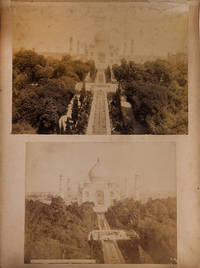
64137c. 1880s. . Landscape album 33 x 43 cm; 126 albumen prints app. from 7.5 x 7.2 cm to 22 x 27.5 cm some photographs with number and title in negative several with credit of Fry and Rahn Company in negative some light spotting some photographs faded; contemporary gilt ruled half black morocco spine joints professionally restored green pebbled cloth boards spine in five gilt compartments all edges gilt overall in very good condition.<br /> Photographic album depicting the diverse places and peoples of Northern India. Includes an extensive series presenting the prominent buildings of Agra - the Taj Mahal Tombs of I'tim d-ud-Daulah and Sheikh Salim Chisti and Fatehpur Sikri Palace - and Dehli - the Red Fort Jama Masjid and Mausoleum of Sufour Jung - from various viewpoints. <br /><br />The album's range of portraits documents India's social diversity featuring a mixture of Western colonists and Indian gentry cavalry and natives. This is highlighted in two extended series of images - one at outdoor festivities and the other presenting the erection of grand buildings by Indian workers overseen by colonists. Also included are thumbnails of Indian landscapes and curiously some engine blueprints and photographs.<br /> c. 1880s. hardcover
16574Paris, F. Bellizard et Cie, 1834 - 1836. 3 volumes in-8 de [4]-260-4; [8]-266-[2]; [6]-290-[2] pages. Plein maroquin bordeaux pour les deux premiers volumes et cerise pour le troisième, dos lisses décorés d'une grande composition dorée figurant un narguilé, des maracas, des perles, deux gazelles; plats richement ornés d'une composition dorée au centre, femme indienne assise en tailleur vêtue d'un sari, entourée d'une large composition, à froid sur les deux premiers volumes (bordeaux) et dorée pour le troisième volume (cerise); roulette aux coupes, large dentelle dorée intérieure, garde de papier gaufré blanc. Les reliures sont signées R. Muller, successeur de Thouvenin.
47257Christophle Lambin.Paris.1669.Seconde édition.In-8 en veau porphyre.152 pages.Frontispice du portrait d'Anne-Marie-Louise d'Orléans,Grande Mademoiselle, Duchesse de Montpensier. à Paris chez Boissevin..Belle reliure.Dos orné à 5 nerfs avec léger manque de cuir à la coiffe inférieure.Tranches rouges.Qques brunissures.
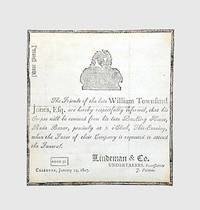
1807122432Calcutta: Star Press 24 January 1807. Haunting piece of Company-rule ephemera announcing the funeral of William Townsend Jones c.1757-1807 attorney on the council of the Supreme Court of Judicature at Fort William the highest court of British India from its foundation in 1774 until 1862. Jones's name is now usually connected with his indictment in December 1789 for flogging to death one Sheriut Allah the brother of his durwan gate-porter whom he suspected of stealing one of his dogs which was "an unlikely crime for a Muslim" Franklin. He was acquitted by the Supreme Court who concluded that Sheriut Allah had died by suicide by eating opium. The affair arose only two years after the impeachment of Warren Hastings in 1787 whose fall from grace had begun with a similar miscarriage of justice involving the execution of a native East India Company administrator Nandakumar. Jones is also a recurring character in the recently published diaries of Calcutta surveyor and builder Richard Blechynden 1759-1822 which reveal that he was also rumoured to have killed another of his servants his mater sweeper. The undertaker Peter Lindeman 1771-1856 of Scottish descent worked from premises at 144 Durrumtollah; from 1803 the Calcutta Missionaries held services in his house on Cossitollah Street until the completion of a new chapel at Lall Bazar in 1809 of which he became a trustee. Single sheet of laid paper 130 x 139 mm printed on one side. Mourning border motif of urn on an altar. Contemporary signature "T. R. R" on verso shaved; the leaf sometime removed from an album or mount adhesive markings and 3 strips of adhesive paper verso 3 faint creases from folding minute hole to one intersection of folds. In excellent condition. Franklin "Orientalist Jones": Sir William Jones Poet Lawyer and Linguist 1746-1794 pp. 300-1; Robb "Memory Place and British Memoirals in Early Calcutta" in Rashkow et al. eds Memory Identity and the Colonial Encounter in India online accessed 4/11/2017; see further Robb ed. Sex and Sensibility: Richard Blechynden's Calcutta Diaries 1791-1822 online. unknown
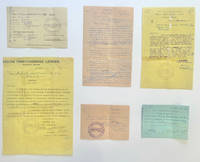
1943010675Kyaiklat Burma British India 1943. Handwritten. Very Good. Loose Leaf. 4to - over 9¾ - 12" tall. Correspondence from Chettiar in Tamil from IIL in English. 9 letters from Chettiar and IIL in manuscript and typescript; 10 pieces of correspondence from IIL on note cards with IIL letterhead; 1 IIL membership card for Chettiar. CONDITION: Overall Very Good old folds some splitting and tape repairs along folds of documents by IIL but Chettiar's letters largely free of wear or tear text legible throughout. All documents now housed in sleeves that are mounted onto backing but it remains easy to remove documents from enclosures. This collection contains English translations of Chettiar's letters presumably made by the previous owner who also wrote captions describing each piece of correspondence on their respective mounts. An evocative collection of correspondence document- ing an Indian nationalist organization's coercion of funds from a member of a prominent money-lending Burmese-Tamil family. These letters show the Indian Independence League's attempt to extort money from a wealthy man whom they had identified as being in a position to help "free India from bondage and for the maintenance of the Indian National Army." This was M.S.M. Somasundarum Chettiar a 63-year-old merchant who operated his business on Strand Road in Kyaiklat a town in the Pyapon District of Burma. A recent historical study by Suppiah and Raja on the Chettiar families of Burma suggests that Somasundaram was part of a "distinguished ethnic group comprising the business class among Malaysian Indian-Tamils" who made their fortunes by lending money to the Indian working class in Burma. The Chettiar ethnic group boasted "a centuries long tradition as an indigenous banking caste in South India" and thus due to a combination of "stringent business regulations during British colonialism in the Madras Presidency and economic opportunities in the newly opened British colonies in Southeast Asia" both the Indian working class in Burma and members of the Straits Settlement Chinese utilized "Chettiar agents in order to conduct bank transactions.in the middle of the nineteenth century." This reliance upon the Chettiar's services only increased by the turn of the twen- tieth century as the demand rose for rubber and tin made in Southeast Asia. As "local Chinese and Malays with only small and medium capital sources relied on loans from Chettiar agents to develop land plant rubber and open mines.Chettiar agents" became "known as the leading moneylenders" in late-colonial Burma. Somasundaram would thus have been part of a known community of capitalists "who accumulated capital for further expansion of their activities at the expense of the Indian working class." The Indian Independence League and the Indian National Army were closely intertwined movements during WWII both led by Subhas Chandra Bose and governed by the Azad Hind Provisional Government in Exile.They worked to unite the Indian diaspora in Southeast Asia to support the cause of independence and sought military support from Japan to facilitate an armed wing for their movement. Primary source documentation of the Azad Hind government's activities is scant institutionally. We locate a scrapbook created by a member of the Indian National Army held at the Institute of Social Research in the Netherlands and a letter from Subhas Chandra Bose asking for a loan from the Hikari Kikan of Syonan held by the National Library Board of Singapore. This would be the only comparable collection held in North America.A rich collection of correspondence highlighting the conflicting poles between Indian diasporic wealth and Indian nationalists' aspirations for the nation's self-rule listing credit Pico Banerjee Peek A Boo Rare Books & Ephemera . unknown
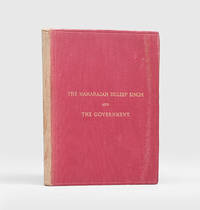
1884189408London: Printed by the Ballatyne Press "For Private Circulation" 1884. Duleep Singh reclaims his throne First and only edition privately issued of this controversial presentation of the maharajah's grievances against the British Government's claims to the Punjab. Decidedly uncommon around 14 copies traced institutionally just a couple at auction. An excellent copy of a fragile fugitive and highly desirable work here in a variant binding to the black skiver usually encountered. The child king Duleep Singh 1838-1893 Maharajah of Lahorewas carried into exile following defeat in the Second Anglo-Sikh War 1848-9 converting to Christianity in 1854 obtaining a royal audience and becoming "an immediate success" with the Queen and eventually settling in Elveden Suffolk with Bamba Müller his "part-Ethiopian part-German" ODNB wife who he had met in Cairo when returning from his mother's funeral in India; "Duleep Singh loved Elveden and rebuilt the church cottages and the school. His fame as a shooter of game was revived in the grounds of the great estate". However "amid European glamour the spirit that had tasted sovereignty was hibernating somewhere in the mind of Duleep Singh. Prompted initially by his mother then by his cousin Thakur Singh Sandhanwalia and finally by the supposed prophecies of the tenth Sikh guru Duleep Singh began a battle with the British government asserting the illegality of the annexation of the Punjab and demanded to be reinstated as maharajah. In 1886 he tried to return to India to place himself as the prophesied head of the Sikh people but was arrested at Aden. Here he was received back into the Sikh faith". From Paris he made himself the centre of various plots to overthrow British rule in the Punjab scheming with Russian and Irish revolutionaries to force the Khyber Pass but all of these conspiracies came to nothing. Increasingly dogged by ill health he sought a reconciliation with Victoria who "responded with a full pardon through the secretary of state on 1 August 1890". He died in Paris in 1893 and was carried back to his beloved Elveden and buried in the graveyard of St Andrew's and St Patrick's Church. The present work represents the historical groundwork to his campaign for reinstatement to the throne and was distributed solely to those who he felt could be of influence to that end. It was "compiled partly from historical sources and partly from private information and documents furnished" Preface by Duleep Singh himself and encompasses a sketch of the early history of the Punjab; a biographical narrative of the Maharajah; and an explanation "of the peculiar Relations in which the Maharajah stands towards the Government and the causes of the differences between them". Octavo. pp. viii 183. Original moderate red cloth over flexible boards title gilt to the front cover single fillet blind panel to both covers grey-blue decorative endpapers. Slightly rubbed the spine sunned; endpapers a little browned pale toning to the text-block else a very good copy. hardcover
2 Vols., small folio (305 x 190 mm), xxxiii, [3], 49-458; [4], 582, [2]pp., text in English and Persian, occasional marginal pencil notes, title page and terminal leaf to both volumes browned, staining to inner upper corner of leaves to start and end of volume two, later vellum-backed marbled boards, title in manuscript to spines. One of the most extensive Persian grammars written in English. "Matthew Lumsden (1777?1835), orientalist, was fifth son of John Lumsden of Cushnie, Aberdeenshire, and a cousin of Sir Harry Burnett Lumsden (1821?1896), army general. After education at King's College, Aberdeen, he went to India as assistant professor of Persian and Arabic in the College of Fort William, and in 1808 succeeded to the professorship. In 1812 he was appointed secretary to the Calcutta Madrasa, and superintended various translations of English works into Persian then in progress. From 1814 until 1817 he had charge of the East India Company's press at Calcutta, and in 1818 he became secretary to the stationery committee."?(Oxford DNB). Provenance: John L. Platts? signature in pencil to title page.
1775AMO-3759A Genève, chez les libraires associés, 1775 3 volume in-4 (26 x 20 cm) de (4)-IV-III-VIII-719, (4)-VIII-662 et (4)-VIII-658 pages. Portrait de l'auteur en frontispice du premier volume (dessiné par Cochin et gravé par L. Le Grand). Au tome I : 1 gravure hors-texte (livre I) + 1 grande carte repliée + 1 bandeau à l'eau-forte par Marillier + 1 gravure hors-texte (livre IV). Au tome II : 1 gravure hors-texte (livre VII) + 2 cartes repliées + 1 bandeau à l'eau-forte par Marillier + 1 gravure hors-texte (livre X). Au tome III : 1 gravure hors-texte (livre XIV) + 1 carte repliée + 1 bandeau à l'eau-forte par Marillier + 1 gravure hors-texte (livre XV) + 1 gravure hors-texte (livre XVIII). Soit 1 portrait, 7 gravures hors-texte (avant la lettre), 3 bandeaux et 4 cartes. Collationné complet. Reliure de l'époque plein veau caramel, dos à nerfs orné aux petits fers, pièce de titre de maroquin rouge, pièce de tomaison de maroquin olive. Reliures très décoratives et solides. Usures de surface sur les plats du premier et deuxième volume (épidermures stoppées), petits manques de cuir et petite galerie sans gravité, petites piqûres de vers en queue du dos du premier volume. Malgré ces quelques défauts l'ensemble reste très décoratif et parfaitement solide. Intérieur très frais. A noter une mouillure en marge intérieure des trois premiers feuillets du premier volume et les derniers feuillets du même volume avec mouillure marginale saine (à quelques feuillets seulement). Exemplaire relié à l'époque aux armes (en queue) d'un membre de la famille de Damas (?) ou d'Aubusson (?). Première édition au format in-quarto. Cette édition est bien complète en 3 volumes in-quarto (il n'y a pas d'atlas pour cette édition). Elle reprend le corpus de l'édition en 7 volumes in-8, avec les passages supprimés réintégrés ici au bas des pages sous forme de variantes. La première édition de ce magistral ouvrage a paru pour la première fois en 1770. "Véritable encyclopédie de l’anticolonialisme au XVIIIe siècle" ce texte entre dans la catégorie des "Voyages philosophiques" et représente un prétexte à des réflexions sur la "loi naturelle" et dénonce tout à la fois despotisme, cléricalisme, esclavage et colonialisme. L'ouvrage est toujours décrit par les commentateurs comme une « machine de guerre » contre le pouvoir en place. Pour la rédaction de cette encyclopédie Raynal eut recours à la collaboration de nombreux informateurs et collaborateurs écrivains tels que le Baron d'Holbach ou Diderot, à qui on attribue une part importante des textes. Interdite en 1772, l’Histoire des deux Indes sera à nouveau publiée par l’abbé Raynal dans une nouvelle édition en 1774 qui est immédiatement mise à l’Index par le clergé. C’est en 1780 qu’il publie sa troisième édition de l'Histoire des deux Indes, encore plus virulente que les deux précédentes et qu’il avoue implicitement comme étant de lui en y faisant graver son portrait en frontispice. Condamné par le Parlement de Paris, l’ouvrage est brûlé par le bourreau en place publique, ce qui lui assure un succès considérable. L’Histoire des deux Indes a également été l’occasion de la Lettre apologétique de l’abbé Raynal à Monsieur Grimm (1781) de Diderot (qui aurait écrit au moins un tiers de l'ouvrage, selon Grimm). Dans cette lettre Diderot écrit : « Raynal est un historien comme il n'y en a point encore eu, et tant mieux pour lui, et tant pis pour l'histoire. Si l'histoire avait, dès les premiers temps, saisi et traîné par les cheveux les tyrans civils et les tyrans religieux, je ne crois pas qu'il en fussent devenus meilleurs; mais ils en auraient été plus détestés, et leurs malheureux sujets en seraient peut-être devenus moins patients... Le livre que j'aime et que les rois et leurs courtisans détestent, c'est le livre qui fait naître des Brutus... » Dans notre exemplaire une note manuscrite de l'époque révolutionnaire indique : "Le Parlement de Paris proscrivit, le 25 mai 1781, l'Histoire philosophique de l'abbé Raynal, et ordonna que cet ouvrage fût brûlé. Il décréta même l'auteur de prise de corps. L'abbé Raynal se vit donc forcé de s'enfuir précipitamment de France. Le 15 août 1790, l'Assemblée nationale, sur la rédaction proposée par les députés Voidel et Maloüet, annula, comme contraire aux droits naturels et imprescriptibles de l'homme, le décret lancé par le Parlement de Paris contre l'abbé Raynal et son Histoire philosophique (v. Oeuvres d'André Chénier, 2e vol., p. 119)." (note manuscrite ancienne sur le faux-titre du premier volume). "It became a key text of the American Revolution, and Raynal became a correspondent of Franklin, Jefferson, and Adams." "Un des ouvrages clefs de la crise de l'Ancien Régime" (Michel Delon, in En Français dans le texte) "Celui qui abdique lâchement sa liberté, se voue au remords et à la plus grande misère qu’un être pensant et sensible puisse éprouver. S’il n’y a, sous le ciel, aucune puissance qui puisse changer mon organisation et m’abrutir, il n’y en a aucune qui puisse disposer de ma liberté. [...] L'esclavage est l'état d'un homme qui, par la force ou des conventions, a perdu la propriété de sa personne, et dont un maître peut disposer comme de la chose. [...] La liberté est la propriété de soi; on distingue trois sortes de libertés: la liberté naturelle, la liberté civile, la liberté politique; c'est-à-dire la liberté de l'homme, celle du citoyen et celle d'un peuple. [...] L'homme est aux prises avec la nature; sans cesse il la modifie, et sans cesse il est modifié. [...]." (extraits). Provenance : A. Leclerc, 1885 (étiquette). Armes dorées en queue des dos (mariage - non identifiées - non reconnu par O.H.R. qui les cite pourtant sous la planche n°888, figure n°3). Armoiries peut-être d'une ancienne famille de Bourgogne ? (provenance bourguignonne pour les volumes concernés). Par ailleurs O.H.R. les mentionne sur une Histoire de Bourgogne), peut-être les armes d'une branche de la famille de Damas (à la croix ancrée) ou d'Aubusson. Les présents volumes de Raynal ont été acquis également en Bourgogne ce qui laisserait supposer l'hypothèse "de Damas" plus pertinente. Références : A. Feugère, Bibliographie critique de l'abbé Raynal, 40 ; En français dans le texte, 166 ; Bel exemplaire relié aux armes à l'époque de cet ouvrage très important du Siècle des Lumières, dans son format le plus majestueux.
18434757Paris, imp. Bétrune et Plon pour Fortin, Masson et Cie & Langlois et Leclerq, 1843. 1843 2 parties en 1 fort vol. in-8° (250 x 176 mm) de : [3] ff. (faux titre, titre, hommage) ; III ; 134 pp. ; 107 pp. (dont table) ; [1] f. (titre deuxième partie) ; 27 planches dont 24 coloriées et 1 carte repliée. Demi-maroquin à coins noir dépoque, dos à cinq nerfs, pièce de titre de maroquin blond, plats recouverts de papier marbré. (Quelques feuillets fragiles).
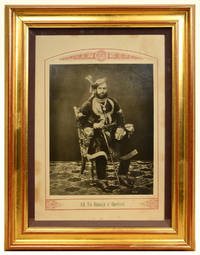
87916Waterlow 1903. . A collection of 6 portraits of princely rulers of India woodburytypes on original mounts with identifying captions within printed borders image size: 24.5 x 19.5cm.<br /> This group comprises the majority of the portraits published with text by Jehangir Sorabji under the title Princes and Chiefs of India. It includes the reigning rulers and sometimes the predecessor of the following states: Radhanpur; Charkhari; Wankaner; Gondal; Datia; Darbhanga; Sitamau and Virpur.<br /> Waterlow, [1903]. unknown
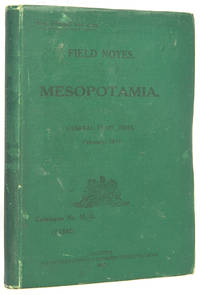
116512Calcutta Superintendent Government Printer India February 1917. . Second enlarged edition; 8vo 18 x 13 cm; folding lithographic map of Lower Mesopotamia in pocket 3 folding tables; early issue without the later published index pamphlet original green cloth wallet binding spine and upper panel lettered in black little wear to extremities a very good copy; 4 326 1pp.<br /> The second enlarged edition of this scarce intelligence guide produced for the British Indian Army operating in Mesopotamia Iraq and the Arabian peninsular during the First World War with the improved colour-printed lithograph map extending from Samarra in the North to Hafar al-Batin in the South and from the Wadi al-Khair in the West to Kuwait in the East as well as additional information on the Saudi family Nedj and Al Hasa.<br /><br />Designed for official use only the map and guide put particular emphasis on routes and rivers but also provides an interesting overview of the region's history and an assessment of its current political climate. Qatar and Kuwait which 'now flies a flag of its own' in the region both receive early mentions p.4.<br /><br />A glossary located to the rear provides helpful definitions of local words like 'Ghazi. A champion of Islam' and 'Qalib. A well with a wide mouth and very broad near the water. Men often descend into it to fill their water-skins'. Interestingly Arab is translated as 'A man of one of the Arab tribes but not necessarily a Bedouin. The plural Aarab denotes the people the nation. When applied to a Shaikh as "Zaid's Aarab" it means followers'.<br /> Calcutta, Superintendent Government Printer India, February, 1917. hardcover
43990Carte originale en couleurs avec encadrement doré fin 19ème.51 centimètres de longueur et 38 de hauteur avant marie-louise. Rare.Bon état malgré des marques de pliure au centre avec petits accros de papier sans gravité.
1677G96668Amsterdam, presso li Janssonio-Waesbergj [Janssonius van Waesberge] 1677 [16] + 200pp., illustrated with an additional engraved title and with 4 (of 5, lacking the pl. of the Vesuvius) folding plates and 4 plates out-of-text and with 19 illustrations in text (of which 7 full-page), woodcut ornament on title page, some ornamented initials, text in Italian, text clean and bright with only some occasional small stains and soiling, recent binding in fine condition (quarter-leather, spine with gilt title, marbled boards), 23cm., text in Italian, small inscription on title and in margin of p.[6], good condition, rare, [This is the first book about the famous Jesuit scholar Athanasius Kircher (Ghysen 1602 Rome 1680), in which Petrucci, a follower of Kircher, defends his views of the mirabilia, the marvels of nature and culture. The plates are taken from various of Kirchers works. The plates and illustrations show a.o. a map of South-Africa (folding), Speculum ustorium (folding, with 3 very small perforations), a funeral chamber (folding), obelisks (folding), 4 plates of Chinese flowers, some extraordinary creatures, etc. // Ref.: De Backer-Sommervogel IV col.1076-1077, Graesse V 241], G96668
[16] + 200pp., illustrated with an additional engraved title and with 4 (of 5, lacking the pl. of the Vesuvius) folding plates and 4 plates out-of-text and with 19 illustrations in text (of which 7 full-page), woodcut ornament on title page, some ornamented initials, text in Italian, text clean and bright with only some occasional small stains and soiling, recent binding in fine condition (quarter-leather, spine with gilt title, marbled boards), 23cm., text in Italian, small inscription on title and in margin of p.[6], good condition, rare, [This is the first book about the famous Jesuit scholar Athanasius Kircher (Ghysen 1602 – Rome 1680), in which Petrucci, a follower of Kircher, defends his views of the “mirabilia”, the marvels of nature and culture. The plates are taken from various of Kircher’s works. The plates and illustrations show a.o. a map of South-Africa (folding), Speculum ustorium (folding, with 3 very small perforations), a funeral chamber (folding), obelisks (folding), 4 plates of Chinese flowers, some extraordinary creatures, etc. // Ref.: De Backer-Sommervogel IV col.1076-1077, Graesse V 241], G96668
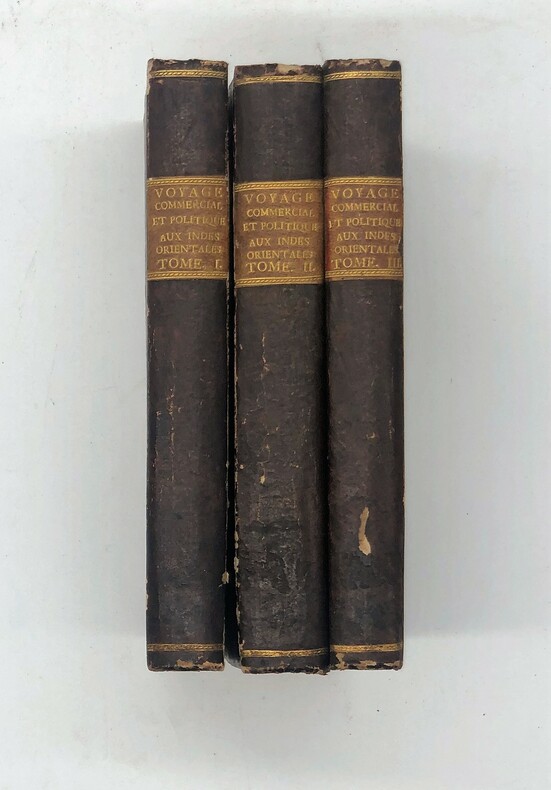
1810PHO-435Paris, Clament, 1810. 3 vol. In-8° (202 x 136 mm) TOME 1:301pp TOME 2 : [2], 390 pp. ; TOME 3 : 291 pp., avec 4 tableaux et 2 cartes dépliantes de Mentelle and Chanlaire (Chine et Inde) sur papier bleuté , contours coloriés , reliure époque , dos lisse avec pièce de titre et tomaison, petits manques.