12 033 résultats
in-8, pp. X, 457, elegante legatura in mezza pelle nocciola, dorso a nervi con filetti e titolo oro su tassello verdone. Completo del ritratto dell'a. in antiporta e di due 2 grandi carte geografiche incise su rame più volte ripieg. f.t. raffiguranti il sud-est dell'Asia. Prima edizione accresciuta e corretta e recante titolo lievemente modificato: l'opera apparve infatti a Londra nel 1791 e a Parigi l'anno seguente con titolo ''Recherches historiques sur la connoissance que les Anciens avoient de l'Inde''. Importante lavoro, uno tra i migliori sulla conoscenza dell'India a quel tempo. Ottimo esemplare.. .
167014709Schipper Amsterdam 1670 1 vol. In-4 de 7 ff.n.ch. 371 pp. 2 ff.n.ch. (table); basane brune de l'époque, dos à nerfs orné, pièce de titre, tranches rouges (coiffes usées, deux mors fendus, coins émoussés).
167333344London: Printed by the Author at his House in White-Friers 1673. First Edition. Illustrated throughout with 30 finely engraved copperplates generally a third of a folio page in size title page printed in red and black. Large Folio bound in contemporary calf. xii 253 15 A Table 1 pp. A well worn copy lacking the 5 map and the double-page or folding plates the text block and textual engravings all well preserved the paper crisp and unpressed some of the usual mellowing and evidence of age or use and old worm track to the bottom blank area of the leaves again not obtrusive the "Directions to the Binder" leaf not present at the end of the volume otherwise collated complete. FIRST EDITION. John Ogilby was a Scottish translator impresario publisher and cartographer. Ogilby established Ireland's first theatre in Werburgh Street Dublin and following the Restoration that country's first Theatre Royal. Ogilby played a significant part in arrangements for the coronation of King Charles II. Following the Great Fire of 1666 Ogilby's large-scale map of the City of London was founded on precise survey work and his Britannia is the first road atlas of England and Wales to be based on surveys and measurements and drawn to scale. <br> During the Great Fire of London in 1666 Ogilby's house in Shoe Lane together with its printing works and most of his stock was destroyed; he estimated he had lost Å3000. After the Great Fire the Corporation of London appointed Ogilby and his wife's grandson William Morgan as "sworn viewers" members of a group of four trustworthy gentlemen directed by Robert Hooke to plot disputed property in the city. Ogilby later made what he called "the most accurate Survey of the City of London and Libertyes therof that has ever been done". By 1668 he had a new house in Whitefriars and was ready to resume his printing and publishing work.<br> Ogilby's next major venture was a series of atlases of China Japan Africa Asia and America. The first of these was An Embassy from the East India Company of the United Provinces to the Grand Tartar Cham Emperor of China which was published in 1689. This book was substantially a translation of Johan Nieuhof's Dutch publication of the same name with English copies of the Dutch engravings. Ogilby's Africa appeared in 1670 and was followed in rapid succession by Atlas Japanennsis 1670 America 1671 Atlas Chinensis 1671 and Asia 1673. In 1671 in response to his proposal to make a detailed survey and atlas of Great Britain the King appointed Ogilby Royal Cosmographer. Thus at about the age of 70 and with the scientific advice of Robert Hooke58 Ogilby began work on Britannia the project for which he is best known among cartographers. Printed by the Author at his House in White-Friers unknown
Lisboa, Impressao Regia, 1805, 19 x 12 cm., cubiertas provisionales en papel moderno, 50 págs. + 1 hoja. (Obra rara publicada por primera vez en 1778 en Roma por la Propaganda Fide. El autor anónimo era posiblemente un jesuita que vivió en Roma después de su expulsión de Portugal. Marathi es una de las principales lenguas indo-arios que se hablan en la India occidental y central). First published in 1778 in Rome by the Propaganda Fide. The anonymous author was possibly a Jesuit living in Rome after his expulsion from Portugal. Marathi is one of the major Indo-Aryan languages spoken in Western and Central India.
Good Turkish, Ottoman (1500-1928) Original red cloth. Heavily faded and slight stains on the boards and spine, otherwise a good copy. Roy. 8vo. (24 x 17 cm). In Ottoman script (Old Turkish with Arabic letters). 208 p., 29 unnumbered woodcut plates of inhabitants, temples, and other mostly religious buildings, panoramic views. The very rare first edition of this richly illustrated travel account of the complete Indian subcontinent, offering invaluable insight and very detailed descriptions of the region, climates, religions, history, languages, and geography. This work in Ottoman script published in book form after it was serialized in "Sabah Newspaper" titled "Sabahin Kis Geceleri Eglencesi" [i.e. The Winter Nights Fun of Sabah] between 1899-1901. (Nadeem). Much of the detailed account of Mumbai is quoted from Coutteau's "Bombay Travelogue". OCLC 49369676.; Özege: 14449.; Ihsanoglu, pp. 410-411.
186421686Paris, Benjamin Duplat, 1864 ; in-8, maroquin bleu-marine, dos à nerfs à décor à froid, titre doré, double filet doré sur les coupes, dentelle dorée d’intérieur, tranches dorées (reliure de l’époque) ; XVO, 578 pp.
Paris, Dezauche succ. De l'Isle et Buache, 1781. (Parte incisa mm. 630 x 630). Bella carta geografica, in coloritura coeva, proveniente da Atlas géographique des quatre parties du monde par Guillaume De L'Isle et P. Buache.
1804204071London.: Edward Orme. Circa1804. Handcoloured aquatint engraving measuring 27.8 x 34cm. Sheet including platemark and generous margins measures 41.8 x 58.8cm. Very slight toning at the platemark but the plate in very bright clean condition. A beautifully executed aquatint from the series 'Picturesque Scenery in the Kingdom of Mysore' by James Hunter first published in 'A Brief History of Ancient and Modern India' by Francis William Blagdon in 1805 the engraving is dated on the plate June 4 1804. This may be from a subsequent edition see Abbey #425. . Edward Orme. unknown
1804204074London.: Edward Orme. 1804 but circa1834. Handcoloured aquatint engraving 29.6 x 37.5 cm platemark; 41.2 x 58.6 cm sheet very good clean condition. A beautifully executed aquatint from the series "Picturesque Scenery in the Kingdom of Mysore" by James Hunter first published in "A Brief History of Ancient and Modern India" by Francis William Blagdon in 1805 the engraving is dated on the plate June 4 1804. This copy is from a subsequent edition the sheet watermarked "Whatman Turkey Mill 1834" see Abbey 425. . Edward Orme. unknown
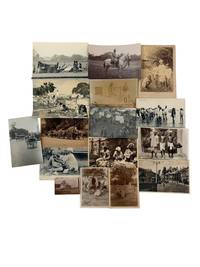
1890234981890. Colonial Indian labor photo archive depicting street work informal commerce transport labor and social hierarchy under British rule circa 1890s-1920s. British India depended on low-paid manual labor to move people goods food and raw materials through cities ports hill stations and military cantonments. The group contrasts workers seated on the ground with baskets tools tents carts and roadside goods against riders on horseback and passengers carried by rickshaw carriage and bullock cart. <br /> <br /> Photo archive of 16 silver gelatin photographs and black-and-white real photo postcards various sizes India circa 1890s-1920s. Marketplace sellers sit among baskets cloth tents and on the ground goods; families and workers gather beside tents and rough encampments; men pull or guide rickshaws carriages and ox-drawn carts through colonial streets. A mounted man sits formally on a white horse while views of Simla show pedestrians commercial buildings and hill-station streets associated with British administration and seasonal elite life. Additional scenes show an outdoor "Hindu barber" "Indian coolies" carrying large baskets men seated by stonework near a Gothic-style building children posed in white garments some hand written captions en verso identify locations or tasks.<br /> The archive records the everyday labor that supported colonial India before independence when caste landlessness debt and imperial wage economies shaped who carried cleaned hauled shaved sold and served. Ligh toning handling and edge wear; overall in very good condition. A late colonial documentation of Indian labor and social separation grounded in street work transport marketplace survival and the visible privileges of those being carried or served. unknown
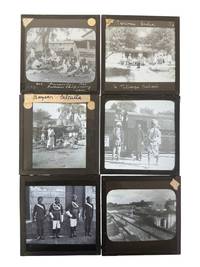
1900232871900. India glass lantern slide archive documenting class hierarchy dichotomy in British India with scenes of village labor bazaar exchange railway movement industrialization Sikhs and colonial cavalry circa 1900-20. Images clearly depict the class divid and Cast system; villagers and laborers are shown seated on bare ground in carpentry work men and goats occupy an unpaved settlement space Sikh men stand beside a railway carriage tied to imperial transport networks a factory scene introduces mechanized industry and a formal portrait of turbaned cavalry soldiers.<br /> Photo archive of 8 glass lantern slides 3.25" x 3.25" India circa 1900 to 1920. Several slides retain manuscript captions on the mounts including "Central India" "Village School" "Bazaar Calcutta" and "MV. parannis an Indian carpentry clas." "Parannis" is probably a misspelling or misreading of "Pariahs" a historical caste/community term used in colonial-era descriptions of South Indi The British largely preserved formalized and exploited the Indian caste system rather than dismantling it. Their relationship with caste was pragmatic: caste became a tool for administration taxation labor control military recruitment and social organization across British India. The "Village School" slide shows a line of children and adults posed before a low building under dense tree cover with one figure standing forward in the open yard. The carpentry slide shows a large group of Indian boys outdoors beneath a tree seated or crouched on the ground around planks and hand tools with timber laid across the foreground and simple structures behind. The Calcutta bazaar scene places vendors baskets and goods in an open market setting under palms while the village scene presents men in loose garments in what seems to be a cattle farm setting. One slide shows Sikh men beside a railway carriage one barefoot in the foreground and others gathered near the rail car doors linking Indian bodies to the movement of goods troops and passengers through the colonial rail system. Another slide presents four uniformed soldiers in turbans possibly the Madras cavalry posed formally with boots sashes and weapons before a masonry wall. The factory view shows smoking industrial works with long roofs tracks and an extended production yard further cementing colonial industrialization within the archive.<br /> <br /> British rule in India relied on linked systems of extraction transport discipline and military force and these slides place those systems beside the people who bore their unequal social effects. Railways expanded under colonial finance and administration to move troops raw materials and commercial goods; industrial sites grew beside older economies of hand labor and bazaar trade; Indian soldiers and cavalry units served within an army organized to secure imperial control; and rural schools workshops and village scenes expose the local social world that existed under those pressures rather than outside them. Light edge wear some mount loss to several slides; no cracks or chips. Overall very good condition. British colonialism widened India's class divide by concentrating wealth transport and military power in imperial systems while leaving many Indians in village labor and low paid market work. unknown
8vo., First Edition thus; original black cloth, upper board and backstrip lettered and ruled in yellow, yellow top (mildly faded) uncut, a near fine copy. Kirkpatrick records that 4000 copies were printed. SCARCE IN THIS CONDITION. Kirkpatrick A10b.
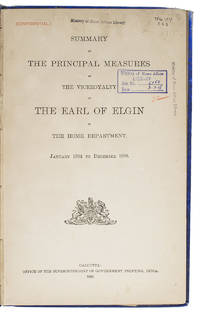
1898ABC_45361Calcutta: Office of the Superintendent of Government printing India 1898. Blind-stamped blue cloth title in gold on spine blue decorated endpapers. Folio. With armorial vignette on the title page. The official Summary always published at the end of a Viceroy-ship by the Office of the Superintendent of Government printing in Calcutta containing the narrative of proceedings of the Home Department in this case from January 1894 to December 1898 the time the 9th Earl of Elgin served in that function. The extensive contents pp. i-iv refers always to the pages in the appendices pp. 1-6156 ! not present.During his time as Viceroy famine broke out in India in which Elgin reportedly admitted that up to 4.5 million people died. Other estimates have put the death toll at 11 million people. His administration in India was otherwise notable for the Afridi frontier uprisings of 1897-1898.With the label of the Home Department Juridical Branche on the front board and a second label with the shelfmark and stamps of the Ministry of Home Affairs on the title page and elsewhere including a Confidential stamp. Head of both boards damaged and damp-stained front hinge worn front endpapers loose slightly browned throughout.l Bence-Jones Mark. The Viceroys of India London 1982. Office of the Superintendent of Government printing, India, hardcover
1768PHO-5562 VOLUMES EN 1
In 4, pp. XIX + 176 + 138 + 181 + 9. M. pl. coeva. Spelature ai piatti e al d. Edizione originale di questa descrizione di viaggio dall'Europa a Zante, Cipro, Aleppo, Baghdad, Bassora fino a Goa e Bombay. Cox, I, 306.
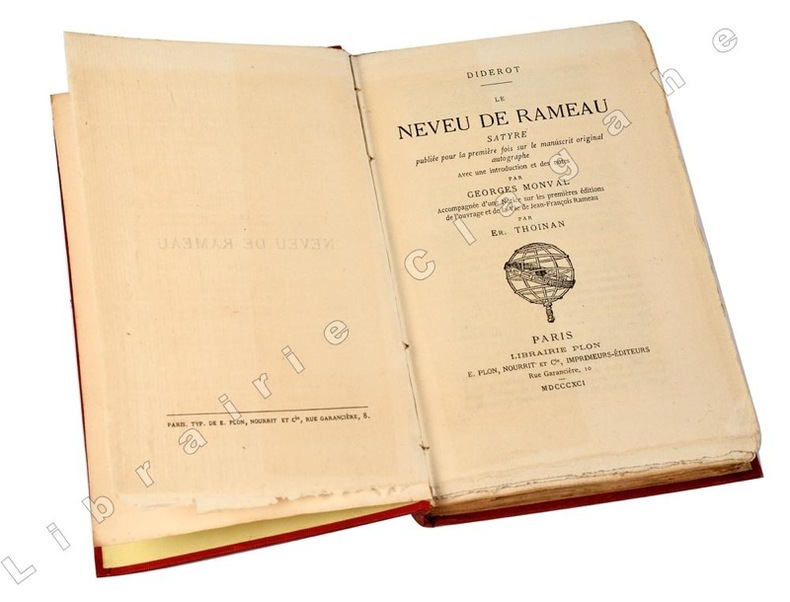
189120236Paris, Plon, Nourrit et Cie, 1891 ; in-16, percaline rouge de l’éditeur, décorée à la plaque, Bibliothèque Elzevirienne, titre, sphère armillaire et édition dorés au dos, non rogné (cartonnage de la Bibliothèque Elzévirienne) ; XXXII, 232 pp., [2] ff. de Table et nom d’imprimeur ; 2 fac-similés dépliants sur chine, de la première page du manuscrit holographe du Neveu de Rameau et de la page de manuscrit contenant le texte de la fin de la pièce.
18948790EBEdinburgh and London, W. & A. K. Johnston, 1894. 4°. 31,5 x 21,5 cm. 1 Karte, Titelblatt, [1] Blatt Vorwort, [1] Blatt Inhaltsverzeichnis, 38 Seiten, 15 Karten, 19 Seiten Index. Original-Leinenband mit goldgeprägtem Deckeltitel. [3 Warenabbildungen]
1778223135London.: Printed for John Nourse. 1778-1880. Third Edition"revised by the author" of Volume I; first edition of Volume II Part I only lacking Part II. Two volumes 23 maps plans or views of 36 most folding: iv 436pp xcvii Index iii Errata Errata in the Index Directions for the Binder to Place the Maps; ii 365pp contemporary calf boards re-backed boards scored and scuffed 28.3 x 22 cms several of the maps with small fold splits no loss some offsetting the folding views of Calcutta and Bengal particularly fine the large folding "General Map of Indostan" in the first volume heavily spotted affecting the facing leaf several old paper repairs and inked corrections in an early hand with the armorial bookplates of Joseph Cator a prominent merchant and administrator with the East India Company and of Peter Cator his son founder of the Cator Prize and of Bertie Peter Cator and of Kelham Hall a handsome example lacking the second part of Volume II in good condition. Foundational work written by Robert Orme an official and historiographer for the British East India Company EIC with a noteworthy family provenance. The text chronicles the geopolitical struggles and military conflicts that paved the way for British dominance over the Indian subcontinent. <br> <br>The Cator family built a legacy of immense wealth regional development and colonial influence spanning three generations. Joseph Cator 1733–1818 laid the financial foundations as a wealthy "nabob" and high-ranking East India Company official in Calcutta. His 1780 marriage to Diana Bertie daughter of Sir Albemarle Bertie successfully elevated the family into the British aristocracy allowing him to return to England and manage expanding Kent estates like Beckenham Place Park. His son Peter Cator 1796–1873 leveraged this land inheritance during the mid-19th-century railway boom. Alongside his brother Peter transformed these holdings into the upmarket Cator Estate across Blackheath and Beckenham while also working as a lawyer and establishing educational scripture prizes in Madras. This colonial and legal influence continued with his descendant Sir Ralph Bertie Peter Cator 1861–1945 who served the British Empire as a prominent colonial judge holding key judicial appointments as the First Judge of British East Africa and later in the High Court of Constantinople. . Printed for John Nourse. hardcover
10626-103657945XPaperback. New. Book Condition is in New Paperback Original Edition. Shipped Same Day. We do not ship APO and FPO. Will be dispatched fast. Please send me an email if you have any questions. 100% Satisfaction. paperback
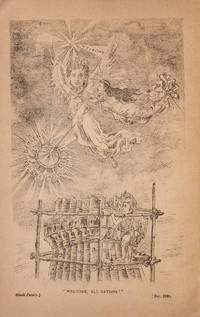
19038569<p>First edition of this rather extraordinary survey of Curzon's many appearances in caricature in Hindi Punch and other Indian comic papers where he often appears in Indian dress and frequently as various Hindu deities notably Ganesh. 'This unpretentious little book is offered as a humble souvenir of the Delhi Durbar: in its pages our popular Viceroy as representative in the great Coronation Durbar of the greatest monarch of modern times is the central figure. In a land of her-worship it is not to be marvelled that the energy versatility and strong personality of Lord Curzon added to his many loveable traits should lend themselves easily to the genius of the Indian artist for caricaturing' author's Preface.</p><p>Despite this warm introduction Curzon was subject to both approval and dissent through these images. The satire of British comic publications like Punch was enthusiastically appropriated by Indian artists - and India itself was frequently represented through the figure of Mr Punch - though their caricatures were also influenced by Indian artists such as Raja Ravi Varma. It is a fascinating fusion.</p><p>4to 248 × 158 mm pp. 2 2 48 4 adverts for Hindi Punch etc plus lithograph forntispiece numerous caricatures to text. Original lithographic boards. Slightly rubbed and soiled hinge cracked and backstrip rather crudely but effectively repaired with tape.</p> [Tatva-Vivechaka Press and lithographed at Ajinkya Art P. Works for] Babajee Sakharam & Co,
1900100865c. 1900. 54 diapositive glass lantern slides 3-1/4 x 4 and 3-1/4 x 3-1/4 inches six hand-colored bound at edges with gummed paper or metal frame some with manufacturer's printed label and manuscript caption; a few with hairline cracks. Housed in contemporary wooden box with lid. A varied collection of ethnographic and architectural scenes largely from Northern India with a few of Ceylon Sri Lanka tea production. Some of the locations include Darjeeling Mumbai Bombay Kakinada Elephanta Caves Mumbai Calcutta including many of the Hooghly River Dehli Sinla Ceylon Kashmir as well as one scene of European tourists scaling pyramids in Egypt. The collection appears to have been gathered from various sources with plates manufactured by T.H. McAllister New York William Garrison Reed Boston J. Moore Birmingham and William H. Rau Philadelphia. unknown
1724WRCAM40673Paris 1724. 7pp. Quarto. Very minor foxing. Contemporary inscription. Fine. A French royal decree "concerning the customs declarations to be made by the ships le Bourbon la Diane l'Argonaute & l'Athalante whose cargo included pepper wild cinnamon aloes rhubarb and cotton and muslin fabrics imported from the colonies" - Maggs. Wroth records only two copies at NYPL and the John Crerar Library; OCLC adds two more at Harvard and the John Carter Brown Library. Scarce. <br> <br> From the library of Cardinal Etienne Charles de Lomenie de Brienne 1727-1794 Minister of Louis XVI Archbishop of Toulouse and of Sens. A friend of Voltaire and a member of the Académie Française Brienne wielded significant power as as head of the Finance Ministry which earned him many enemies. He died in prison during the French Revolution despite having renounced Catholicism in 1793 presumably as an attempt to save his life. WROTH ACTS OF FRENCH ROYAL ADMINISTRATION 1066. MAGGS FRENCH COLONISATION OF AMERICA 300 this copy. OCLC 84632312. unknown books
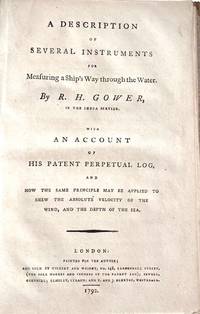
17921325<p><strong> NAUTICAL INSTRUMENTS</strong></p><p><strong>GOWER Richard Hall in the </strong><strong>India</strong><strong> Service. </strong><em> A Description of several instruments for Measuring a Ship's Way through the Water By.With an Account of his Patent Perpetual Log and how the same principle may be applied to shew the absolute velocity of the Wind and the depths of the Sea. </em>8vo modern cloth backed marbled boards half-title title 5-32 2 copper engraved plates. London: Printed for the Author 1792. </p><p>First Edition of author's rare first nautical work with the half-title. <strong>ESTC </strong>locates two copies in England BL & NMM and two copies in this country BA & NYPL. Gower fl. 1767-1833 a sea captain and naval architect "had been shocked by the low standard of navigation which he found in the convoy which took him to the East Indies.He devised a patent log part of the workmanship being entrusted to Alexander Grant and the sole rights of sale vested in Messrs Gilbert & Wright of 148 Leadenhall Street. He refers to "the indefatigable Mr. Stancliff' as cutting the scale on his optical instrument with his dividing machine. He then tried the instrument out with John Adams a mathematical teacher of Edmonton who has been identified as a reviser of textbooks for Mount and Page the chart-sellers."-Taylor <em>The Mathematical Practitioners of Hanoverian </em><em>England</em><em> 1714-1840 </em>#840. "In 1787 he devised an instrument which measured a vessel's way through the water with greater accuracy than had previously been possible."-<strong>O</strong><strong>DNB</strong><strong>.</strong> The followng year he wrote <em>A Treatise on the Theory and Practice of Seamanship </em>which long remained a standard work. We trace no copies at auction. 84574</p> The Author
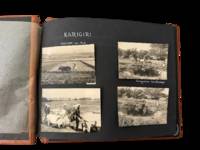
1961232281961. Southern India photo album documenting an international Christian missionary medical group around Vellore Karigiri Katpadi and Kanchipuram in 1961 many photographs captioned and identify individuals. The album showcases how missionary labor operated after the end of British rule through hospitals training schools religious ceremony and organized visits into village and temple spaces. Compiled by a French speaking participant within an international Christian medical network the album centers on institutions linked to Christian Medical College and Hospital Vellore where foreign and Indian personnel worked inside a system first developed under colonial era Protestant missions and then carried forward in postcolonial India through education nursing public health and evangelical presence.<br /> <br /> Photo archive of 110 Silver gelatin photographs mounted in a leather bound album most photos measure 3" x 4" album measures 9" x 12" Vellore Karigiri Katpadi Polambakkam and Kanchipuram Tamil Nadu dated by captions to 1961. Many identified individuals. Captioned pages identify "Vellore CMCH" "Christian Medical College and Hospital Vellore" and a "Soirée de remise du voile aux infirmières étudiantes de dernière année Sept. 61" showing large indoor assemblies of Indian nursing students in uniform at a veil ceremony for final year nurses. Other pages name hospital streets a guest house pavilion postman colleagues and an international group including participants identified by nationality including Argentina Belgium Venezuela Australia Thailand the United States England and South India. The album also moves beyond the hospital into the surrounding countryside and sacred landscape with rice cultivation and field irrigation at Karigiri village huts pastoral scenes cattle and goats potters fuel collection pigs and ducks a cyclist returning from Sunday mass the cathedral at Katpadi and multiple views of temples and priests at Kanchipuram. Handwritten French captions guide the viewer through these scenes including "inner courtyard of a temple" "Hindu priest explaining a point of his religion" "signing the temple guest book and giving the offering" and observations of sculpture yogis village labor and local children.<br /> The 19th to early 20th century saw an increase in Protestant missionary organizations in India with schools hospitals and women's medical training programs as response both to evangelical ambition and to colonial inequalities in health care access. By 1961 India was politically independent yet this album shows how missionary medicine still organized relations between Western visitors Indian Christian institutions and local Tamil communities. Overall very good condition. A strong record of postcolonial missionary medicine in southern India showing how colonial religious systems survived through healthcare education and cross cultural authority rather than formal imperial rule alone. unknown
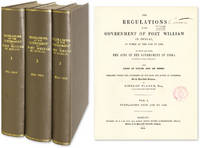
1854511391854. London: Printed by J.H. Cox 1854. 3 vols. London: Printed by J.H. Cox 1854. 3 vols. India. East India Company. Clarke Richard Compiler. The Regulations of the Government of Fort William in Bengal In Force at the End of 1853; To Which are Added the Acts of the Government of India in Force in that Presidency. With Lists of Titles and an Index. Prepared Under the Authority of the Hon. The Court of Directors of the East-India Company. London: Printed by J.H. Cox 1854. 3 volumes. Quarto 8-1/2" x 10-1/2". Recent cloth gilt titles to spines endpapers renewed. Brief annotations in a few places interior otherwise clean. Ex-library. Small inkstamps to title pages. $750. Only edition. With a detailed analytical digest. Established by a Royal Charter in 1600 the British East India Company was granted a 21-year monopoly on all trade in the East Indies. Based in a series of fortified manufacturing and trading centers most notably Fort William in Bengal Fort St. George in Madras and the Bombay Castle the company evolved from a commercial venture to one that virtually ruled India as it acquired governmental legal and military functions. It was dissolved in 1858. Produced as an official record these volumes are a compilation of all regulations from 1793 to 1853 in force at Fort William. OCLC locates 6 copies. Catalogue of the Library of the Harvard Law School I:395. unknown books