COLLECTIFMareMagnum

12 035 résultats
S. Rangarajan - Kasturi & Sons Ltd.. 1999-2004. Bon état. Couv. légèrement passée. Pliures. 201 numéros d'env. 16 pages chacun. Illustrés de nombreuses photos en noir et blanc. Numéros manquants: Vol. 25: n° 42-47; vol. 26: n° 1-4, 27-28; vol. 27: n° 2, 7, 14-15, 17, 22-26, 28-29, 31-33, 35, 39, 43-44, 48; vol. 29: n° 2, 4, 7, 11, 19, 28, 32; vol. 30: n° 7, 12-14. From the n° 41, vol. 25, Oct. 9 1999, to the n° 24, vol. 30, June 12 2004. Summary of the n° 41, vol. 25, Oct. 9 1999: 66 p.c. Turnout in last phase. Germany backs India on terrorism. Harshad Mehta sentenced to 5-year RO. PM releases CD on the Mahatma. Polls for 4 Bihar LS put off. Steering clear of naxal traps in A.P. A legend in her time (T.R. Rajakumari), etc. Summary of the n° 24, vol. 30, June 12 2004: Talks with Pakistan on nuclear issues. Supreme Court stops notification for Rajya Sabba elections. Film actor fires at producer, associate (Nandamuri Balakrishna). Help to settle Cauvery issue, Karunanidhi urges Manmohan, Sonia. Senior Congress leaders left out in Ministry expansion; Through a shrinking camera (Uma Mahadevan-Dasgupta takes a look at Mani Ratnam's latest film 'Yuva')...
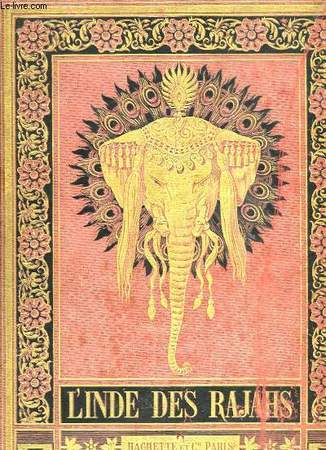
1877RO80052523HACHETTE et Cie. 2nde édition. 1877. In-Folio. Cartonnage d'éditeurs. Etat d'usage, Couv. défraîchie, Dos satisfaisant, Intérieur acceptable. 807 pages. Frontispice en noir et blanc, avec serpente. Nombreuses gravures sur bois, en noir et blanc, dans le texte et hors-texte. 6 planches de cartes en couleurs, hors-texte.Tranches dorés. Couleur de la couverture et du dos, légèrement fanée. Coiffes légèrement usées.. . . . Classification Dewey : 954-Asie du Sud, Inde
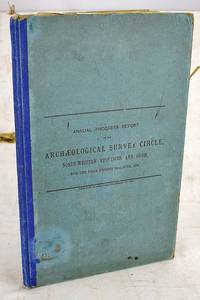
18932305250019Roorkee: Thomason College Press 1893. First Edition. Hardcover. Good. Plate book of Indian Archeology Bound in publisher's blue cloth-backed boards. Scattered foxing. 47 pp. folding lithographic plan of Fatehpur Sikri 6 large albumen print photographs 24 x 17 cm mounted 3 folding lithographic plates of frescoes. Roorkee: Thomason College Press hardcover
8vo., First Edition; handsomely bound in full dark red crushed morocco, sides with gilt frame border, back with raised bands, second and fourth compartments lettered and ruled in gilt, all other compartments tooled in gilt, gilt top, hand-made endpapers, ribbon marker, a most attractive copy ideal as a gift or for presentation. An elegant copy of Scott's twentieth century classic, set against the dying days of Raj.
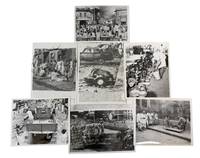
1943234951943. Indian famine crisis press archive depicting hunger relief work and public unrest from Bengal famine conditions through later food riots in independent India. The Bengal Famine of 1943 killed an estimated three million people and food scarcity remained politically volatile in India for decades afterward. Street demonstrations over grain rationing and hunger drew police deployments in multiple cities turning food access into a public order crisis as well as a humanitarian emergency.<br /> <br /> Photo archive of 7 silver gelatin press photographs mostly measuring 8" x 10" India 1943-1964. Crowds gather outside food distribution points children sit with metal bowls during feeding mounted police face demonstrators and uniformed officers move through dense street scenes. Press captions identify Calcutta famine conditions food rioters dispersed by police in Kerala fighting and fire in Lucknow and relief activity for famine victims. Typed captions identify "food rioters" being dispersed outside the Travancore state government house in Trivandrum Kerala where police and mounted officers filled the street after looting over food. Another caption describes Lucknow fighting in which "rioters set fire to about a six-block square" with crowds massed near burning buildings and shopfront signs. Calcutta scenes show famine victims clustered around relief vessels and feeding bowls with one caption stating that people had been "reduced to skin and bone" after food shortages. A street-side feeding scene shows children and adults crouched in rows with metal dishes receiving food from a man holding a large bucket.Verso stamps include Acme Newspictures NEA reference markings New York Bureau labels editor crop marks typed captions and publication dates.<br /> <br /> The group connects famine mortality postwar scarcity and street protest in India across a period when food distribution became a central test of colonial and postcolonial government authority. Press handling wear caption remnants crop marks corner creasing and scattered surface marks; overall in very good condition. A strong press group linking famine relief imagery with the public unrest that followed hunger into India's mid-century political life. unknown
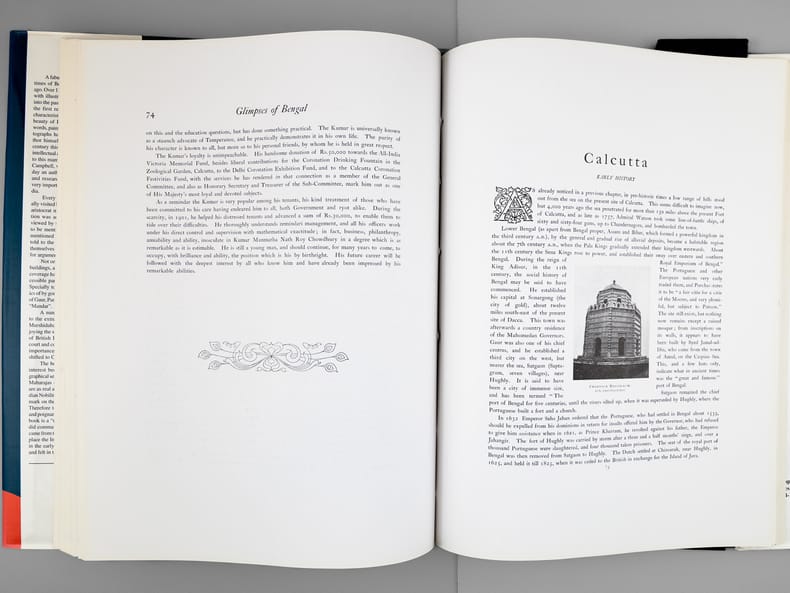
2003675122 folios vol. (43 x 34 cm), hardcover under dustjacket and plastic jacket, Sundeep Prakashan, New Delhi, 2003, 341 pp.
8vo, pp. cxxv + 4555 total: I: 541 pp.; II: 579 pp.; III: 627 pp; IV: 563 pp.; V: 575 pp.; VI: 576 pp.; VII: 573 pp.; VIII: 444 + lxxix pp., HardBound, Size 22cm ISBN: 817536226X please inquire on shipping for international orders. This extensive eight-volume work was first published between 1867 and 1877 by the linguist John Dowson (1820-81) from the manuscripts of the colonial administrator and scholar Sir Henry Miers Elliot (1808-53). Before his death, hoping to bolster British colonial ideology, Elliot had intended to evaluate scores of Arabic and Persian historians of India, believing that his translations would demonstrate the violence of the Muslim rulers and 'make our native subjects more sensible of the immense advantages accruing to them under the mildness and the equity of our rule'. The collection is therefore not only valuable for its translation into English of many important extracts of sources from the ninth century to the nineteenth, but it also serves as a fascinating example of the use of historiography as a colonial tool.
178858559Traduits de l'Anglois, & accompagnés de Notes sur l'Original, & de Cartes Géographiques, Seconde édition, 2 vol. in-8 reliure de l'époque pleine basane marbrée, dos lisse orné, filet doré d'encadrement en plats, toutes tranches dorées, Chez Regnault, A Londres, et se trouve à Paris, 1788, xxiv-486 pp. ; viij-414 pp. avec 2 cartes dépliantes (Carte de l'Inde pour servir aux voyages de Makintosh et Carte des deux routes servant aux anglois pour aller aux Indes, pour les voyages du Colonel J. Capper)
Traduits de l'Anglois, & accompagnés de Notes sur l'Original, & de Cartes Géographiques, Seconde édition, 2 vol. in-8 reliure de l'époque pleine basane marbrée, dos lisse orné, filet doré d'encadrement en plats, toutes tranches dorées, Chez Regnault, A Londres, et se trouve à Paris, 1788, xxiv-486 pp. ; viij-414 pp. avec 2 cartes dépliantes (Carte de l'Inde pour servir aux voyages de Makintosh et Carte des deux routes servant aux anglois pour aller aux Indes, pour les voyages du Colonel J. Capper) Exemplaire de la seconde édition française, bien complet des deux cartes dépliantes. Etat très satisfaisant (étiquette de cote aux dos en queue, deux premiers feuillets du tome second froissés avec petites mouill., petit travail de vers marginal n'affectant pas le texte dans le tome second, reliure frottée en plats avec épidermures, qq. ff. un peu faibles, très petits mq. en coiffes). Les ouvrages de Makintosh et du Colonel Capper ont en commun d'évoquer la situation dans les Indes britanniques, et de traiter chacun longuement de leurs pérégrinations, soit par le Cap de Bonne-Espérance et l'Ile Bourbon pour Makintosh, soit par voie de terre depuis l'Egypte pour Capper. On citera l'éditeur français qui écrit en préface : "Ceux qui voudront connaître la puissance des Anglais dans l'Inde ; l'avilissement de l'Empereur Mogol ; la dégradation des Nababs du Bengale, du Décan, du Carnate ; les vexations du Gouvernement Anglais ; la dévastation ; la dépopulation du pays de Rohillas ; la guerre destructive & déshonorante contre les Marattes, &c, &c, trouveront ici des détails infiniment instructifs & certains, que n'offrent aucuns voyageurs ou écrivains français". Français
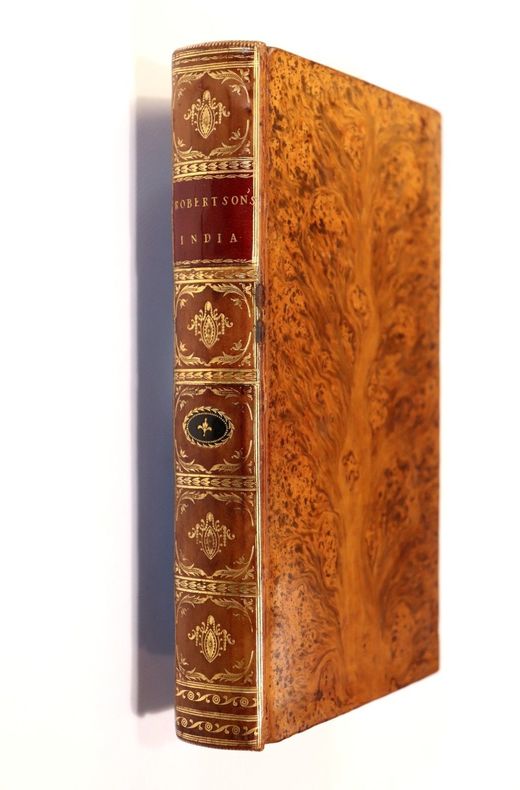
1794AMO-3005London, Printed for A. Straham and T. Cadell, and E. Balfour at Edinburgh, and sold by T. Cadell Jun. and W. Davies successors to Mr. Cadell, 1794 1 volume in-8 (22,5 x 14 cm) de VI-(1)-441-(21) pages. 2 grandes cartes géographiques dépliantes. Reliure de l'époque (vers 1800) veau raciné, dos lisses richement ornés, pièces de titre de maroquin rouge, pastille de maroquin noir mosaïquée avec fleurette dorée, tranches citron, roulette dorée sur les coupes. Reliure de très belle facture, probablement anglaise. Infimes frottements, sinon très fraîches reliures, intérieur également très frais imprimé sur beau papier, sans rousseurs notables. A noter une petite brûlure du cuir sur un mors (coulure acide) sans gravité. Texte en anglais. The Second edition La première édition de ce texte date de 1791 (même éditeur). 'In his sixty-eighth year the perusal of Major James Rennell's 'Memoir on the Map of Hindustan' (1793) set Robertson again to work, and within a year, encouraged by Gibbon, he brought out his 'Historical Disquisition concerning the Knowledge which the Antients had of India .' The book concluded with a wise hope that the account 'of the early and high civilisation of India, and of the wonderful progress of its inhabitants in elegant arts and useful science, may have some influence upon the behaviour of Europeans towards that people.' L'ouvrage est divisé en 4 sections plus un important appendice et des notes : Intercourse with India, from the earliest Times, until the Conquest of Egypt by the Romans. Intercourse with India, from the establishment of the Roman Dominion in Egypt, to the Conquest of that Kingdom by the Mahomedans. Intercourse with India, from the Conquest of Egypt by the Mahomedans, to the Discovery of the Passage by the Cape of Good Hope, and the Establishment of the Portugese Dominion in the East. General observations. Ces recherches historiques sur l'Inde ancienne sont estimées. Il s'agit du dernier ouvrage de l'auteur. On y trouve notamment un intéressant chapitre sur le commerce de la soie. La première traduction française date de 1792. Provenance : Ex libris gravé monogramme non identifié. Très bel exemplaire conservé dans sa première et très fine reliure en veau raciné
First edition, 4to (280 x 220 mm), [2], 213, [1]pp., folding map of Political India coloured in outline (lightly offset on to title page), nineteenth-century ownership inscription, re-cased, contemporary calf, rubbed, title on upper cover and spine. COPAC and OCLC locates 3 copies only, the British Library, King's College London and University of Manchester.
97 VEDUTE b.n. di antichi templi e "ruine" e sculture o scorci di città su cartoncino, di cui 40 di cm. 15x8,4. con vedute verticali, le altre di cm. 14,1x9.6 con vedute orizzontali; in calce le didascalie sull'appostio margine bianco, spesso specificanti l'epoca dei monumenti. 1-3) Agra. 4-5) Achmedabad. 6) Aihole. 7-8) Ajmere. 9-10) Allahabad, tra cui colonna di Asoka, l'unica con didascalia a penna anche al verso. 11) Banavasi. 12) Belagamve. 13) Benares, crematorio sul Gange, con persone sulla scalinata. 14) Bijapur. 15-16-17) Buddha Gaja. 18) Calcutta, tomba di Charnok. 19) Chandragiri. 20-21) Degamve. 22-29) Delhi, tra cui Kub-Minar con gruppo e 2 missionari. 30-31) Elephanta. 32-36) Fathpur Sikri (Goa; una con "casa del Beato Rodolfo Acquaviva figlio del Duca di Atri" martire gesuita del '500. 38) Gingi. 39) Grevalior. 40) Gulbarga. 41) Haksi. 42-45) Halebidu. 46-47) Haveri. 48-49) Hyderabad. 50) Jajpur. 51-52) Kanchivaram. 53) Kaneri (con 2 missionari). 54) Karkala idoli jaini. 55) Lakkundi. 56-58) Madura. 59) Mahabaleshvar. 60-61) Mahabalipuram. 62) Mohenjo-Daro. 63-64) Mudbidri. 65) Mysore. 66) Nalanda. 67-68) Rachol (chiesa dei Gesuiti). 69) Radihalli. 70-74) Sanchi. 75-76) Sarnath. 77) Sattara. 78-79) Satrunjaya. 80-81) Seringapatam. 82) Sikandra. 83) Sravana, colossale Gomatshwaia. 84) Tizuvannamalai. 85) Trichinopoly. 86) Ujjain, osservatorio astron. gesuitico. 87) Vellore. 97) Vijaynagara. Le belle nitide didascalie sono in italiano, indubbiamente a penna: una reca una correzione, una rimanda al retro; si intravedono le righine a matita su cui sono tracciati i caratteri, in alcune si vede il riflesso blu metallico dell'inchiostro. Le foto recano quasi tutte al verso delle cifre a matita. Parrebbero scattate durante un gran viaggio culturale di una comitiva di europei, tra cui due missionari (forse GESUITI, come rivelano alcuni riferimenti: Chesa a Goa, Osservatorio astronomico del '600 a Ujjain...) due dei quali appaiono in almeno 3 foto). Nitide e professionali, potrebbero far pensare a Federico PELITI (Carignano 1844-1914, pasticcere e fotografo in India dal 1869 al 1902), se non si limitassero a monumenti, La GEVAERT nacque nel 1890 come produttrice di carta per fotografie.
13384Paris, De l'Imprimerie de Couturier, "Délibéré à Paris, le 1er Février 1786". In-8 pas de couverture, seulement page de titre, 90 p. Bandeau en 1ère page. Page 27 : tableau dépliant recto-verso : Tableau De l'Importation en France des Marchandises de l'Inde, depuis & compris 1725, jusques & compris 1768 / Tableau De l'Importation en France des Marchandises de l'Inde, depuis & compris 1771, jusques & compris 1782. Bon état : le bas des 1ères et dern. pages est jauni, plutôt discrètement. Un échantillon de tissu (coton blanc) est conservé - depuis 1786 ?! - dans ce livre. Titre repris en 1ère page : Mémoire pour les Négocians faisant le commerce de toiles de coton, mousselines, toiles peintes, &c. dans les villes de Paris, Versailles, Lyon, Bordeaux, Rouen, Tours, Châlons-sur-Saone, Troies, Dijon, Besançon. Contre la nouvelle Compagnie des Indes.
1271.1aaf18ème, 26x43 cm, Vue (optique) des Magazins de la Compagnie des Indes à Pondichery (Inde française), de l’Amiraute et de la Maison du Gouverneur. Gravure coloriée. Passepartout (35x52.5)
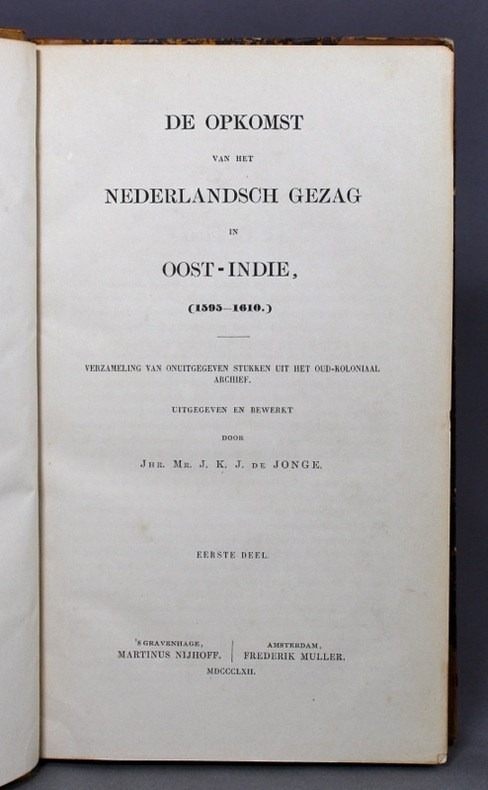
18628301's Gravenhage & Amsterdam, Martinus Nijhoff & Frederik Muller, 1862. 11 volumes in-8 de [2]-IX-294 / X-[2-errata]-537 / XIV-[2-errata]-400-[2] / XV-[2-errata]-CLIII-321 / XII-CXXXIII-293 / XI-CIX-221 / IX-[2-errata]-CLXXI-403-86 / X-CXLI-365 / X-CI-[2]-447 / VIII-LXXXV-439 et X-LXXXVII-503 pages, demi-veau moucheté à coins, dos lisses ornés de roulettes, tomaison et fleurons dorés, étiquette de titre en maroquin rouge, tranches marbrées. Coiffes, coins et dos un peu frottés, mais joli aspect général, intérieur frais, très rares rousseurs.
8vo., Second and Best Edition, half-title and title lightly spotted; handsomely bound in red full morocco, back gilt with raised bands lettered and tooled in gilt, uncut, a most attractive copy ideal as a gift or for presentation. Revised and corrected version of the first edition published earlier in the same year. THIS COPY WAS FORMERLY IN THE LIBRARY OF SIR REGINALD SPENCE WITH HIS FINE ENGRAVED ARMORIAL BOOKPLATE ON FRONT PASTE-DOWN. Sir Reginald Spence, prominent merchant, philanthropist and educationalist, spent much of his career in India. He was a prominent wine merchant (Master of the Worshipful Company of Distillers 1949-1950) and an eminent freemason (District Grand Master of Bombay and Northern India); the Reginald Spence Lodge was founded in his memory. A fervent educationalist, he co-founded Barnes School in Devlavi, one of the finest institutions of its type in Western India where a school house now bears his name. A NOTABLE ASSOCIATION COPY
8vo., First Edition thus; handsomely bound in full mid-brown crushed morocco, sides with gilt frame border, back with raised bands, second and fourth compartments lettered and ruled in gilt, all other compartments tooled in gilt, gilt top, hand-made endpapers, ribbon marker, an elegant copy ideal as a gift or for presentation. THE FIRST APPEARANCE OF THE 'AKBAR' SEQUENCE COMPLETE. The 'Akbar' sequence of novels has a relatively complicated history. The first two volumes, 'The Near and the Far' and 'Prince Jali', were first published in 1929 and 1931 respectively. They were then reissued, together with the third volume 'Rajah Amar', as a collected edition titled 'The Root and the Flower' (1934) by which name the trilogy thus far is generally known. This omnibus edition adds the fourth volume 'The Pool of Vishnu' (1940) presenting the sequence as a whole for the first time. 'The conversation between the Guru and Mobarek…is of the most urgent contemporary significance as well as one of the perennial debates of mankind' (Concise Camb. Hist. Eng. Lit.). VERY SCARCE.
SLIVCN-9781685077877NOVA SCIENCE PUBLISHERS INC (7/2022)
1894158922London: W.H. Allen & Co. 1894. LIII, 572; XV, 579 Seiten / Pages. Mit 2 Frontispizen, zahlreichen Faltkarten und Ansichten in den Texten sowie einer großen Faltkarte in Papiertasche auf dem hinteren Innendeckel des 2. Bandes / With 2 frontispieces, numerous folding maps and views of the texts, and a large folding map in a paper bag on the inside cover of the second volume. Gr. 8° (22,5-25 cm). Blaue Orig.-Leinenbände mit goldgeprägten Rückentiteln sowie goldenen heraldischen Supralibros auf den vorderen Buchdeckeln. [Hardcover / fest gebunden]. / Original blue cloth bindings with gilted titles to spines and gilted heraldic supralibros to front covers.
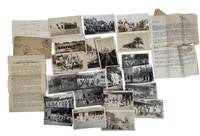
1940232161940. British India photo archive following an unidentified man likely a serviceman in Mhow and Mandu during World War II 1942-1943 preserving a localized record of colonial wartime life through mess scenes sport staff bungalows named companions imposed colonial social frameworks and visits to the major Islamic monuments of Mandu. The captions place the central figure in the company of "Carroll Sahib" Ken Davis and other men in uniform-style dress while repeated references to the "mess" weapon training staff and cantonment-like grounds situate the photographs within a British colonial wartime environment in central India. The group shows one participant moving between military or officer-adjacent daily life and the monumental landscape of Mandu at a moment when India remained a crucial base of Allied wartime activity.<br /> <br /> Photo archive of 43 silver gelatin photographs ranging from 2 x 3.5 to 2.5 x 2.5 inches Mhow and Mandu India 1942-1943. Most photographs bear substantial contemporary handwritten inscriptions on the versos often dated. Identifiable scenes include two men with tennis rackets outside a bungalow captioned as taken after tennis; a portrait inscribed "Me the Carroll Sahib & Ken Davis outside the Mess 25/12/42"; a group of eight men captioned "two scotsmen our four weapon training instructors the Carroll Sahib me outside the W/T staff bungalow 25/12/42"; men wearing garlands outside the mess; a sports or gymkhana ground with riders or runners in formation; tented grounds beside a large building; and a portrait of a man identified as "Machdo our bearer." The architectural and landscape views are closely tied to Mandu with captions naming the Jami Masjid Jahaz Mahal Rupmati's Pavilion Baz Bahadur's Palace mosque interiors courtyards pools lake views ravines and elevated plateaus. Several photographs show men posed on open parade or sports grounds in light uniform-style dress including group portraits outside the mess and the W/T staff bungalow with tennis rackets bicycles garlands and temporary tent lines indicating a social world organized around exercise communal dining and station routine. Other images turn to Mandu's built landscape in much greater detail with framed views of domed pavilions arcaded courtyards carved entrances long interior corridors water tanks and palace ruins seen from terraces lakesides and elevated lookouts. The landscape scenes broaden that record further including steep ravines river and waterfall views and plateau panoramas that place the serviceman's movements within the wider terrain of central India.<br /> <br /> During World War II Mhow remained an important cantonment in British India and these photographs place one serviceman within the daily social world of that station where tennis communal dining staff housing local attendants and holiday gatherings existed alongside travel to nearby historic sites. The Mandu views record the same hand moving through one of central India's best-known Sultanate monument complexes with captions naming the Jami Masjid Jahaz Mahal Rupmati's Pavilion Baz Bahadur's Palace and associated interiors courtyards pools and landscape features. Light general wear occasional silvering and minor handling marks; inscriptions strong and legible on most versos. The dense captioning and photographic record show British colonial India during World War II through the the personal lens colonial rank and language staff organization sport and leisure during wartime Indian attendants and movement through one of central India's historic architectural landscapes. unknown
18790009094London: John Murray 1879. First edition. Hardcover. Fine. 8vo; cxxvii 444 12 pages blue cloth <br/><br/>Burton's contributions occupy the first 190 pages. Also Prof. George Rolleston's lecture to the RGS an early ecology talk "The Modifications of the External Aspects of Organic Nature produced by Man's Interference". " I propose . to notice a few of the many alterations produced by disforesting in our own and other countries". John Murray hardcover
1941208861941. Archive of photographs and documents from the A.P. Mission City School in Ambala Punjab 1941-1942 documents girls' education within a missionary institution during the late colonial period and the Second World War. The material records classroom instruction extracurricular activity and community interaction alongside written accounts by an American missionary teacher Anita Gregson whose correspondence and annual report situate the school within wartime conditions and broader educational initiatives. The archive provides primary evidence of how girls' education was structured and experienced in northern India under British rule including literacy training vocational activity and the integration of local and missionary communities.<br /> <br /> Twenty two black and white and sepia photographs measuring approximately 2 x 3 to 3 x 5 inches many with handwritten or typed captions on verso likely by Anita Gregson; accompanied by one typed letter dated June 14 1942 and one annual report for the 1941-1942 school year. Photographs depict students in classroom settings including a "training class girl teaching a second grade nature study class" as well as scenes of recreation such as a badminton club for teachers and missionaries. Additional images show students engaged in craft work including one captioned "Achcheri. with her patch quilt" alongside views of village life in Punjab with oxen carts textile work and local architecture. Three photographs document refugees traveling toward Pakistan in the years following the Lahore Resolution. Gregson's letter references wartime uncertainty noting concerns about possible bombing in India while the annual report details financial strain fundraising efforts and adult literacy instruction for women.<br /> <br /> Created during a period of political tension and transition in British India when wartime mobilization coincided with growing nationalist movements and debates over independence the archive situates education within both imperial and local frameworks. The documentation of women's literacy and schooling aligns with broader efforts that contributed to gradual increases in female education prior to independence and the Partition of India. As a combined photographic and documentary record the material supports research into gender education colonial institutions and everyday life in wartime South Asia. Minor wear consistent with handling; manuscript and printed materials remain legible; overall very good condition. unknown
1941209861941. Gregson Anita. A.P. Mission City School archive 1941-1942 documenting girls' education missionary activity and community life in Ambala Punjab during World War II. This material records daily instruction social interaction and local conditions within a mission-run school for girls alongside written correspondence and institutional reporting that situate the school within wartime pressures and colonial India's educational landscape. The archive provides direct evidence of classroom practices gendered education and the integration of local families into school environments as well as the impact of global conflict on regional communities.<br /> <br /> Archive comprises 21 original black and white and sepia photographs one typed letter and one annual report. Photographs measuring approximately 2" x 3" to 3" x 5" frequently bear handwritten or typed captions on the verso likely by Anita Gregson identifying subjects and activities. Images show groups of schoolgirls engaged in classroom exercises and outdoor instruction including one scene of students constructing a ground map of India to illustrate agricultural production. Another photograph depicts a semicircle of young children seated outdoors during a lesson with their teacher identified as Miss Atmaran and a veiled mother observing her burkha partially drawn back. Additional images document craft instruction including girls weaving coconut palm leaves into fans and producing woven ties on frames. Musical activity is also present with students playing instruments. Beyond the school photographs depict village life in Punjab including oxen operating a water-drawing mechanism children gathered around a missionary playing a ukulele and a merchant carrying goods suspended from a yoke. The accompanying letter dated June 14 1942 from Gregson to a correspondent in New York references World War II noting international observances and local enlistment: "The young men in our Indian community are continuing to sign up for the army navy and air force." The annual report for the 1941-1942 school year details wartime financial strain fundraising efforts and instructional programs including an adult literacy course for women teaching reading writing and arithmetic.<br /> <br /> Created while India functioned as part of the British Empire during World War II these materials document the intersection of missionary education wartime mobilization and local social life. The inclusion of adult literacy instruction for women reflects ongoing efforts to expand female education under colonial conditions while the letter and report connect the school directly to global conflict and its local consequences. Light wear and minor fading to photographs; handling wear present. Letter on thin paper with tears and fragility consistent with wartime materials poor to fair condition; remaining materials overall very good condition. This archive provides a concentrated visual and textual record of girls' education and community experience in wartime Punjab. unknown
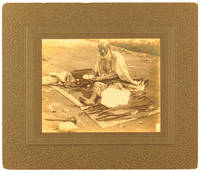
86940Plate sizes are 100 × 150 mm three and 75 × 105 mm or the reverse eight; all are captioned in ink eight on the verso of the mount three on the photograph itself. All depict scenes of rural life most of them identifying Serajgunge in East Bengal. Images include 'Native fisherman' 'Native cobbler at work' 'Hindu holy man with his disciple' 'Wayside umbrella mender' scenes of boat-building and jute preparation and one captioned 'The creature making his creator! Idol making'. Apart from a small light stain to one mount they are all in fine condition. 11 items. unknown