71 307 résultats
193249735Paris Les Centraux Bibliop 1932 In-4, en feuilles, couverture muette (embotage de l'diteur).Edition originale, illustre par Kuhn-Rgnier de 64 compositions en couleurs dans le texte, graves sur bois par Pierre Bouchet. Tirage unique limit 130 exemplaires numrots sur japon nacr. Exemplaire enrichi d'une aquarelle originale en couleurs non signe de l'artiste et non utilise, et d'une planche d'essai d'une gravure sur bois galement inutilise, rehausse l'aquarelle et accompagne d'un calque de travail.
190052956Elbeuf 1900. Fine. Elbeuf S.d Circa 1900 10.50 x 16.50 cm une feuille Original photograph of Maurice Blanchot seated at his desk before his library Original photograph of Maurice Blanchot smiling at his desk before his library. Contemporary silver print. Blanchot eluded the photographers and caricaturists of the literary press for a long time. Attempts at producing an image were both rare and minimalist throughout the years. In 1962 in Express a hand holds up a book at the bottom of the page; in 1979 in Libération a blank square in the middle of the page captioned only with Blanchots name and a quotation from lEntretien infini ""a vacuum of a universe: nothing that is visible nothing that is invisible C. Bident Maurice Blanchot. In 1986 at an exhibition of writers portraits he asked that his photo be replaced with a text noting his desire to appear as little as possible not for the exaltation of his books but to avoid the presence of an author who pretends to a separate existence. A photo taken without his knowledge in the parking lot of a supermarket was the only portrait of the writer until his friend Emmanuel Lévinas made public a few rare photos from their youth. That Blanchot did not oppose this act and the fact that it was done by his closest friend can be explained by what Bident calls l'espacement de l'inquiétude the distancing of worry the outdated nature of the portraits made public carry an echo of the delayed publication of L'Idylle Le Dernier Mot L'Arrêt de mort. Only a few photographs gathered in the centre pages of the issue of les Cahiers de l'Herne dedicated Maurice Blanchot complement these unique shots of the most secretive writer of the 20 th century. In his chapter on L'indisposition du secret The indisposition of the secret Christophe Bident devotes several pages to the almost complete absence of images of this invisible partner wondering about the intellectual and psychological motivations of the writer who was nonetheless aware of the inevitable revelation to come. Everything must become public. The secret must be broken. The obscure must enter into the day and make itself clear. That which cannot be said must nonetheless make itself heard. Quidquid latet apparebit everything that is hidden must appear Maurice Blanchot L'Espace littéraire. unknown
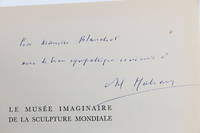
195479898Paris: Gallimard Galerie de La Pléiade 1954. Fine. Gallimard Galerie de La Pléiade Paris 1954 18 x 23.50 cm reliure de l'éditeur First edition one of the numbered copies the only printing. Richly illustrated. Publishers binding in full boards designed after Paul Bonets original model. Joints of the upper cover skillfully restored. Precious signed presentation inscription from André Malraux to Maurice Blanchot. Gallimard, Galerie de La Pléiade hardcover
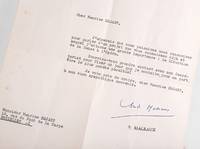
1969653521969. Fine. 29 janvier 1969 21 x 27 cm une feuille filigranée Guerimand Voiron Letter typed and signed from André Malraux to Maurice Béjart. One leaf headed by the Ministre d'Etat chargé des Affaires Culturelles Ministry of Culture bearing a stamp from 29 January 1969. André Malraux hopes to place choreographer Maurice Béjart in charge of the Ballet de l'Opéra in Paris. Béjart was at the time very well established in Brussels as part of his troop Ballet du XXe siècle performing at the Théâtre de la Monnaie led by his friend Maurice Huismans. Following a report by Jean Vilar to reform the Opéra in Paris Malraux takes the decision to call Béjart back to France: “J'aimerais que nous puissions nous rencontrer pour parler d'un projet que vous connaissez déjà et auquel j'attache une grande importance : la Direction de la Danse à l'Opéra” “I would like us to be able to meet to talk about a project that you already know and to which I attach a great significance: the Management of Dance at the Opéra.” Malraux's idea was to name Boulez and Jean Vilar alongside him thus forming a solid avant-garde resolutely oriented towards the future of the arts. The choreographer declined the offer and continued his creations in Belgium. He becomes no less an admirer of Malraux to whom he will dedicate fifteen years later a ballet using Beethoven's music which he entitled “Malraux ou la métamorphose des dieux.” This letter is the only testimony existing to Malraux's request to the choreographer which remained controversial. This nomination was not accepted by Béjart who stayed in Belgium for ten years before heading to Lausanne.  Provenance: Maurice Béjart's personal archives. unknown
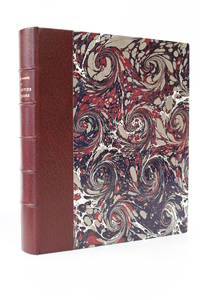
190353153Paris: Félix Juven 1903. Fine. Félix Juven Paris 1903 16 x 19 cm relié First edition one of 20 numbered copies on Japan paper the tirage de tête. Half maroon morocco over marbled paper boards by P. Goy & C. Vilaine spine in six compartments maroon paper pastedowns and endpapers covers preserved top edge gilt. A fine well-margined copy in a lovely binding. Félix Juven hardcover
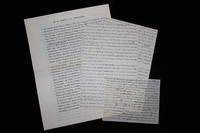
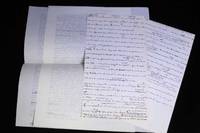
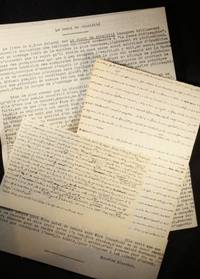
194344919s. l. Paris: S. n. Journal des débats 1943. Fine. S. n. Journal des débats s. l. Paris s. d. 1943 13.50 x 21 cm 4 1/2 pages in-8 Autograph manuscript by the author 4 and a half octavo pages published in the June 2 1943 issue of the Journal des Débats. Complete manuscript in very dense handwriting with numerous deletions corrections and additions. Literary chronicle published on the occasion of the publication of Servius et la fortune by Georges Dumézil. The complete typescript is included. By devoting his study to Dumézil's work on Servius Blanchot established a crucial milestone in the evolution of his own thought the passage from political conviction to literary engagement. This reflection on sovereignty indeed led the former Maurrassian to reorient his value system subjecting the prince's power to the people's benevolence: ""La louange des hommes est une divinité sous le patronage de laquelle se place le souverain choisi par la voix publique"" ""The praise of men is a divinity under whose patronage the sovereign chosen by public voice places himself"". Starting from this legitimation of the sovereign by the poet's word and his alienation by the ""puissance du blâme"" ""power of blame"" Blanchot evolved toward a magical power of speech first for the sovereign's use: ""son pouvoir royal . n'est réel que par la maîtrise qu'il a sur les mots"" ""his royal power . is real only through his mastery over words""; then ""dépassant toute forme d'échange. La poésie est par excellence ce qui est donné ce qui manifeste le don des dieux en assurant le crédit des hommes."" ""surpassing all forms of exchange. Poetry is par excellence what is given what manifests the gift of the gods while ensuring the credit of men."" Maurice Blanchot's position was now perfectly established: he did not sacrifice Politics for Letters he affirmed the predominance of the literary over the political and henceforth devoted his entire life ""to literature and to the silence that belongs to it"". Between April 1941 and August 1944 Maurice Blanchot published 173 articles on recently published books in the ""Chronicle of intellectual life"" of the Journal des Débats. In half a newspaper page approximately seven octavo pages the young author of ""Thomas l'obscur"" took his first steps in the field of literary criticism and thus inaugurated a theoretical work that he would later develop in his numerous essays from ""La Part du feu"" to ""L'Entretien infini"" and ""L'Écriture du désastre"". From the first articles Blanchot demonstrated an analytical acuity far exceeding the literary current events that motivated their writing. Oscillating between classics and moderns first-rate writers and minor novelists he established in his chronicles the foundations of critical thinking that would mark the second half of the 20th century. Transformed by writing and by war Blanchot broke through a thought exercised ""in the name of the other"" with the violent Maurrassian certainties of his youth. Not without paradox he then transformed literary criticism into a philosophical act of intellectual resistance to barbarism at the very heart of an ""openly Maréchaliste"" newspaper: ""Burning a book writing one are the two acts between which culture inscribes its contrary oscillations"" Le Livre In Journal des Débats January 20 1943. In 2007 the Cahiers de la NRF brought together under the direction of Christophe Bident all the literary chronicles not yet published in volumes with this pertinent analysis of Blanchot's critical work: ""novels poems essays give rise to a singular reflection ever more confident in its own rhetoric delivered more to the echo of the impossible or to the sirens of disappearance. . Not without contradictions or sidesteps and in the feverish certainty of a work that begins . these articles reveal the genealogy of a critic who transformed the occasion of the chronicle into the necessity of thought."" C. Bident. Autograph manuscripts by Maurice Blanchot are ext S. n.[ Journal des débats] unknown
194942834Paris: Gallimard 1949. Fine. Gallimard Paris 1949 14.50 x 21 cm broché First edition one of 13 numbered copies on pur fil paper the only large paper copies Spine very lightly sunned at head and foot not serious A very good and rare copy. Gallimard unknown
195952434Paris: Gallimard 1959. Fine. Gallimard Paris 1959 13.50 x 19.50 cm broché First edition an advance service de presse copy. A very handsome and moving autograph inscription from Maurice Blanchot to his sister : ""Pour ma chère Marguerite qui porte maintenant mot illisible le poids de mon affection. Maurice For my dear Marguerite who now bears illegible word the weight of my affection. Maurice."" A good copy. Gallimard unknown
194544924s. l. Paris: S. n. Paysage dimanche 1945. Fine. S. n. Paysage dimanche s. l. Paris s. d. 1945 11.50 x 22 cm 3 pages in-4 Autograph manuscript by the author 3 quarto pages published in issue 17 of October 7 1945 of the newspaper Le Paysage Dimanche. Complete manuscript in very dense handwriting with numerous deletions corrections and additions. Chronicle published on the occasion of the numerous studies on Giraudoux's work that appeared since his death in January 1944. The complete typescript is included. While the numerous references to his work in the articles of the Journal des Débats reveal Giraudoux's ascendancy over Blanchot the latter nevertheless manifests a clear desire to free himself from this paternity. Thus he removes from Faux-Pas numerous references to Giraudoux's work cf C. Bident M. B. De la chronique à la théorisation. This article published in 1945 is a unique testimony to the ambivalence of feelings toward an admired master who could no longer serve as a model for his disciple transformed by writing and war. ""Certes un auteur comme celui de Judith ne peut pas être un auteur de tout repos mais ce qu'il a créé est beau et ce beau n'est pas ""ce qui nous désespère"". Il est trop facile de voir que quoi qu'il veuille il ne va jamais jusqu'à compromettre en son art l'harmonie la compréhension la mesure. Comme une malédiction jetée sur la réalité inaccessible il formerait un monde entièrement faux Mais pas si faux: nous n'y perdons pas pied nous ne cessons de nous y reconnaitre et au contraire pour certains comme Sartre c'est celui de la banalité même des concepts de chaque jour."" ""Certainly an author like the one who wrote Judith cannot be a restful author but what he has created is beautiful and this beauty is not 'what drives us to despair'. It is too easy to see that whatever he may wish he never goes so far as to compromise in his art harmony understanding measure. Like a curse cast upon inaccessible reality would he form an entirely false world But not so false: we do not lose our footing there we never cease to recognize ourselves in it and on the contrary for some like Sartre it is that of the very banality of everyday concepts."" Between April 1941 and August 1944 Maurice Blanchot published 173 articles on recently published books in the ""Chronicle of intellectual life"" of the Journal des Débats. In half a newspaper page approximately seven octavo pages the young author of ""Thomas l'obscur"" took his first steps in the field of literary criticism and thus inaugurated a theoretical work that he would later develop in his numerous essays from ""La Part du feu"" to ""L'Entretien infini"" and ""L'Écriture du désastre"". From the first articles Blanchot demonstrated an analytical acuity far exceeding the literary current events that motivated their writing. Oscillating between classics and moderns first-rate writers and minor novelists he established in his chronicles the foundations of critical thinking that would mark the second half of the 20th century. Transformed by writing and by war Blanchot broke through a thought exercised ""in the name of the other"" with the violent Maurrassian certainties of his youth. Not without paradox he then transformed literary criticism into a philosophical act of intellectual resistance to barbarism at the very heart of an ""openly Maréchaliste"" newspaper: ""Burning a book writing one are the two acts between which culture inscribes its contrary oscillations"" Le Livre In Journal des Débats January 20 1943. In 2007 the Cahiers de la NRF brought together under the direction of Christophe Bident all the literary chronicles not yet published in volumes with this pertinent analysis of Blanchot's critical work: ""novels poems essays give rise to a singular reflection ever more confident in its own rhetoric delivered more to the echo of the impossible or to the sirens of disappearance. . Not without contradictions or sidesteps and in the feverish certainty of a S. n.[ Paysage dimanche] unknown
197352429Paris: Gallimard 1973. Fine. Gallimard Paris 1973 14 x 20.50 cm broché First edition an advance service de presse copy. Very handsome and moving autograph inscription signed by Maurice Blanchot to his sister on a calling card pasted to head of one endpaper: ""A ma chère Marg. Ce livre d'amitié et pour l'amitié plus à feuilleter qu'à lire peut-être avec ma grande affection. Maurice To my dear sister Marg. This book of friendship or book for friendship maybe more to leaf through than to read with great affection. Maurice."" A good copy. Gallimard unknown
194444939s. l. Paris: S. n. Journal des débats 1944. Fine. S. n. Journal des débats s. l. Paris s. d. 1944 13.50 x 21.50 cm 2 1/2 pages in-8 Autograph manuscript by the author of 2 and a half pages in-4 published in the March 2 1944 issue of Journal des Débats. Complete manuscript with very dense writing containing numerous strikethroughs corrections and additions. Literary chronicle published on the occasion of the publication in the new collection of Gallimard editions devoted to ""La Jeune Philosophie"" of the work ""Le souci de sincérité"" by Yvon Belaval. The complete typescript is included. Under Blanchot's pen philosophical criticism acquires its own autonomy which makes it impossible to distinguish between Belaval's original thought and the luminous interpretation that Maurice Blanchot offers of it in a few pages. « L'homme sincère veut rompre avec la solitude où l'ont enfermé à la fois la réflexion et la faiblesse. Il rêve d'un retour au ""nous"" primitif mais il se contente de le rêver : il s'enchante de ses scrupules il ne parle qu'à soi-même et ne parle que de soi il échoue et jouit de ses échecs. » ""The sincere man wants to break with the solitude in which both reflection and weakness have confined him. He dreams of a return to the primitive 'we' but he contents himself with dreaming it: he is enchanted by his scruples he speaks only to himself and speaks only of himself he fails and enjoys his failures."" No concern for sincerity therefore in Blanchot but a rigorous intellectual mechanism which does not fear to free itself from the limits of the text studied to deploy all its philosophical potential. Between April 1941 and August 1944 Maurice Blanchot published 173 articles on recently published books in the ""Chronique de la vie intellectuelle"" of Journal des Débats. In half a page of newspaper about seven octavo pages the young author of ""Thomas l'obscur"" takes his first steps in the field of literary criticism and thus inaugurates a theoretical work that he would later develop in his numerous essays from ""La Part du feu"" to ""L'Entretien infini"" and ""L'Écriture du désastre."" From the first articles Blanchot demonstrates an analytical acuity far exceeding the literary current events that motivate their writing. Oscillating between classics and moderns first-rate writers and minor novelists he establishes in his chronicles the foundations of a critical thought that would mark the second half of the twentieth century. Transformed by writing and by war Blanchot breaks through a thought exercised ""in the name of the other"" with the violent Maurrassian certainties of his youth. Not without paradox he then transforms literary criticism into a philosophical act of intellectual resistance to barbarism at the very heart of an ""openly Maréchaliste"" newspaper: ""To burn a book to write one these are the two acts between which culture inscribes its contrary oscillations"" Le Livre In Journal des Débats January 20 1943. In 2007 the Cahiers de la NRF brought together under the direction of Christophe Bident all the literary chronicles not yet published in volumes with this pertinent analysis of Blanchot's critical work: ""novels poems essays give rise to a singular reflection always more confident in its own rhetoric delivered more to the echo of the impossible or to the sirens of disappearance. . Not without contradictions or sidesteps and in the feverish certainty of a work that begins . these articles reveal the genealogy of a critic who transformed the occasion of the chronicle into the necessity of thought."" C. Bident. The autograph manuscripts of Maurice Blanchot are extremely rare. S. n.[ Journal des débats] unknown
198444456Paris: Le journal des débats 1984. Fine. Le journal des débats Paris Mars 1984 18.50 x 26.50 cm agrafé The first edition published in a small number of copies of which there were no deluxe copies of this offprint from Pierre Nora's review Le Débat. Precious signed autograph inscription from Maurice Blanchot to his sister "". for you this little reading and to help you regain courage"". Marguerite Blanchot renowned organist at Chalon cathedral remained all her life in the family home with her mother and aunt. ""She would gradually become for the family like the memory of origins."" Very close to Maurice she corresponded regularly with the writer who showed her great gratitude for her devotion to their invalid mother. While Blanchot's intense affection for his mother and sister shows through in his dedications we know almost nothing of their relationships. In the only biographical essay on Blanchot Christophe Bident reveals however: ""Marguerite Blanchot venerated her brother Maurice. Very proud of him . she attached great importance to his political ideas . She read extensively . They telephoned each other corresponded. At a distance they shared the same natural authority the same concern for discretion."" Blanchot indeed sent her numerous works from his library maintaining with her a continuous intellectual bond. As for Blanchot's passion for his mother it is in the margins of his work that we discover the most beautiful testimonies: ""Perhaps the power of the maternal figure borrows its radiance from the very power of fascination and one could say that if the Mother exerts this fascinating attraction it is because appearing when the child lives entirely under the gaze of fascination she concentrates in herself all the powers of enchantment"". Cultivating absolute discretion Blanchot pushed the art of self-effacement even into his manuscript dedications generally succinct and written almost systematically on cards attached to the rare works he offered to his close friends. In contrast in these precious inscriptions to his mother and sister Blanchot reveals himself in all his fragility and in the intimacy of this correspondence casts a personal glance on his work hitherto unknown. A small tear at the head of the spine. Le journal des débats unknown
194344960s. l. Paris: S. n. Journal des débats 1943. Fine. S. n. Journal des débats s. l. Paris s. d. 1943 13.50 x 21.50 cm 2 1/2 pages in-8 Autograph manuscript by the author of 2 and a half quarto pages published in the December 23 1943 issue of Journal des Débats. Complete manuscript in very dense handwriting with numerous deletions corrections and additions. The complete typescript is included. This article one of the rare pieces to appear on the journal's front page is an audacious critique of the traditionalist vision of Art which arguing for the necessary adequacy between Art and Truth condemns Modernity. With implacable intellectual rigor Blanchot demonstrates how this conception of ""authentic Art"" ""joins exactly that of the surrealists"" and cites one of the major principles of Surrealism as perfect demonstration of Hourticq's remarks. In a France obsessed with rejecting Degenerate Art Blanchot reveals the contradictions of traditionalists: ""they admit that art in general precedes science and it is in the name of past science . that they condemn new movements in art."" Blanchot under the guise of literary criticism once again questions his era: . It would still be good to research whether precisely modern science does not recognize itself in the ""deformed decomposed obsolete universe that art has made familiar to our eyes."" Between April 1941 and August 1944 Maurice Blanchot published in the ""Chronicle of intellectual life"" of Journal des Débats 173 articles on recently published books. In half a newspaper page approximately seven octavo pages the young author of ""Thomas l'obscur"" takes his first steps in the field of literary criticism and thus inaugurates a theoretical work that he will later develop in his numerous essays from ""La Part du feu"" to ""L'Entretien infini"" and ""L'Écriture du désastre"". From the first articles Blanchot demonstrates an analytical acuity far exceeding the literary current events that motivate their writing. Oscillating between classics and moderns first-rate writers and minor novelists he establishes in his chronicles the foundations of critical thinking that will mark the second half of the 20th century. Transformed by writing and by war Blanchot breaks through thinking exercised ""in the name of the other"" with the violent Maurrassian certainties of his youth. Not without paradox he then transforms literary criticism into a philosophical act of intellectual resistance to barbarity at the very heart of an ""openly Pétainist"" journal: ""To burn a book to write one are the two acts between which culture inscribes its contrary oscillations"" Le Livre In Journal des Débats January 20 1943. In 2007 the Cahiers de la NRF brought together under the direction of Christophe Bident all the literary chronicles not yet published in volumes with this pertinent analysis of Blanchot's critical work: ""novels poems essays give rise to singular reflection ever more confident in its own rhetoric delivered more to the echo of the impossible or to the sirens of disappearance. . Not without contradictions or sidesteps and in the feverish certainty of a work beginning . these articles reveal the genealogy of a critic who transformed the occasion of the chronicle into the necessity of thought."" C. Bident. Autograph manuscripts by Maurice Blanchot are extremely rare. S. n.[ Journal des débats] unknown
175863209à La Haye The Hague: Chez Pierre Gosse Junior 1758. Fine. Chez Pierre Gosse Junior à La Haye The Hague 1758 24 x 35 cm In-folio relié Second edition a reprint of the first folio edition published in 1756 by the same publisher. A rare edition illustrated with 40 plates including 4 folding and 16 double-page arms costumes plans manoeuvres. Large vignette with coat of arms on the title-page and 41 ornaments headpieces tailpieces. Title-page printed in red and black. At the end Supplement aux Reveries with its own title-page; this short addition spanning only a few pages contains the corrections made to the original. A two-volume quarto edition appeared in Paris in 1757. Bound in later full marbled brown calf; a skilful early 20th-century pastiche signed Saingy at foot. Spine with raised bands richly decorated gilt rolls at head and tail. Red morocco lettering-piece black morocco date-piece gilt. Rubbing to head- and tailcaps edges corners and lower board. Plate XXXIV has been refolded having been badly folded. An exceptionally fresh copy the paper only slightly toned. One leaf misbound among the preliminary pages. A handsome copy. A unique work in its field animated throughout by the spirit of its author one of the greatest generals of the eighteenth century. The Comte de Saxe reviews all the factors and elements required for the successful conduct of battle from uniforms and provisions to strategy in a style that is simple clear and intelligible. This is followed by a chapter on the propagation of the human race intended to counterbalance the art of destroying populations; here the author offers his reflections on demographic growth and the means of fostering it. The term ""rêveries"" refers not in the modern sense of idle fancies but in that of fulfilled hopes and secret thoughts. Chez Pierre Gosse Junior hardcover
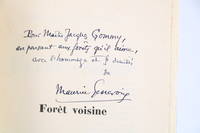
193389578Paris: Flammarion 1933. Fine. Flammarion Paris 1933 12.5 x 19 cm Broché First edition one of 10 numbered copies on Holland paper deluxe issue. Some minor foxing mostly at the beginning and end of the volume. Inscribed and signed by Maurice Genevoix to Jacques Gommy: "". en pensant aux forêts qu'il aime avec les hommages et les amitiés de Maurice Genevoix.""  Flammarion unknown
193420893Genève, Maurice Barraud & André Kundig, 1934. In-8 de [4]-135-[7] pages, couverture illustrée rempliée.
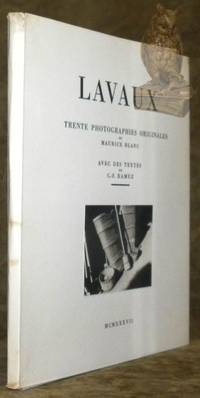
1937118490Lausanne : Librairie Centrale et Universitaire V. Porchet & Cie. 1937. 310x250mm. les photographies de Ã’LavauxÓ ont ÂŽtÂŽ prises avec un appareil Ikonta de Zeiss et tirÂŽes sur papier Ortho-brom de Gewaert collation effectuÂŽ: complet des trente photographies contrecollÂŽes les textes de Ramuz sont extraits de Passage du poÂte et pour une petite partie du Chants de notre Rh™ne en feuilles sous chemise rempliÂŽe imprimÂŽe en noir ornÂŽe d'une photographie n/b contrecollÂŽe. Un des 185 exemplaires sur papier vÂŽlin numÂŽrotÂŽ n.¡ 78 / 170 imprimÂŽ par Tell Geneux ma”tre imprimeur ˆ Lausanne. Petites dÂŽchirures sur le haut du dos de la chemise autrement trÂs bel exemplaire de cette belle ÂŽdition originale - rare et prÂŽcieuse difficile ˆ trouvÂŽ. Bringolf 30 in fine. 842 Librairie Centrale et Universitaire V. Porchet & Cie. unknown
1935000017<p>LONDON.: FABER AND FABER. 1935. 1st Edition 4th Printing. Hardcover. Very Good/Very Good. A very good plus copy that has been signed by Agatha Christie and Maurice Leblanc directly onto the title page. This detective anthology has 447 pages with short stories from 18 different detective authors. No inscriptions or loss. No foxing. Dated as 4th printing 1935 on the copyright page. First printing was 1930 Outer blue boards with gold lettering to the spine.Pushes to spine tips. The original and rare 1930's dust jacket shows a price of 3s 6d net on the front flap. Small loss to top of spine and closed tear at the base and at the top of the rear. Rubbing to ends and tips. An extremely rare copy and more so with the added benefit of being signed. <br /><br /></p> FABER AND FABER. hardcover
192747879Paris.: Les Editions d'Art Devambez. 1927. Loose as issued in original publisher's cream printed wrappers with titles to front cover and spine in black blue faux leather-backed marbled board chemise with title labels and matching slipcase. Large 8vo. 290 x 196 mm. Half-title with justification verso original colour etching by Chimot as frontispiece printed title and Magere's text illustrated with 17 original etching 9 full-page 'Table des Poèmes' 'Table des Illustrations' and final leaf with colophon and achevé d'imprimer; each of Chimot's etchings is present in two states: as published and in monochrome with remarques. 'Les Belles de Nuite' with additional suite and a signed original drawing by Chimot.From the edition limited to 446 numbered copies with this one of 75 on Japon Impérial with the etchings in two states 'état définitif' and 'état avec remarque' and with an original signed drawing by Chimot.Chimot's original drawing a head and shoulders portrait of a woman executed in pencil charcoal and with colour crayon highlights on a sheet of Arches is signed in pencil at lower right.Also included loosely inserted is an additional etching one of four issued only with the first 20 copies of the book. Les Editions d'Art Devambez. hardcover
19519888Cambridge MA: Addison-Wesley Press 1951. First edition 8vo. pp. 167 with 2 b/w photographic plates at the front label of Scientific Computing Service Limited London the British distributors pasted onto the title page brown publishers cloth; plain buff dustwrapper somewhat worn with hole clipped from the spine allowing the title to be read. Pencilled ownership signature of British mathematician Bryan Birch. Often described as the first textbook on computer programming. Book Addison-Wesley Press, hardcover
194244455Gallimard | Paris 1942 | 14.50 x 21 cm | broché
193486099Flammarion | Paris 1934 | 12 x 19 cm | broché
188856009La librairie illustrée | Paris 1888 | 11.50 x 18.50 cm | relié
188987670H. Launette & Cie | Paris 1889 | 22 x 32 cm | 2 volumes reliés
193571713Denoël & Steele | Paris 1935 | 14.50 x 23 cm | broché