289 résultats
182044807Paris Crochard 1820. No wrappers as extracted fron 'Annales de Chimie et de Physique' Volume 15 2e Series. Pp. 93-102. <br/><br/><em>First appearance of this importent paper in which Arago gives an account of his discovery of how iron and steel could be magnetized by the action of the voltaic current THE FIRST STEP TOWARDS THE ELECTRIC TELEGRAPH. "Arago . made several important contributions to electromagnetism on his own. On 20 September 1820 he announced the discovery of the temporary magnetization of soft iron by an electric current which suggested to Ampère a theory about the nature of magnetic "currents" and provided the technological key to the electric telegraph. Ampère calculated that the magnetic power could be multiplied by twisting the current-carrying wire into a helix and with Arago he carried out the first experiments on primitive solenoids. In his historical articles Arago was always careful to credit Ampère with the major share of this discovery which ultimately depended upon Ampère’s mathematical theory."DSB.Arago formed a close freinship with Fresnelwhose views on the nature of light he ardently supported. He assisted Fresnel in some of his most importent work and made original discoveries in the same field.Magie "A Source Book in Physics" p. 443 ff. </em> unknown
189847409Paris Gauthier-Villars 1898. 4to. No wrappers. In: "Comptes Rendus Hebdomadaires des Séances de L'Academie des Sciences" Tome 129 No 16. Pp. 567- 626. Entire issue offered. Debierne's paper: pp. 593-595. Paperquality rather poor a bit fragile. <br/><br/><em>First appearance of the paper in which Debierne announced his discovery of a new radioactive element found in uranium residues."In 1906 Professor Hahn discovered radioactinium between actinium an actinium X. Actinium emanation or "action" like radon is an inert gas was discovered independently by F. Giesel and André Debierne." Weeks "Discovery of the Elements" p. 307.Parkinson "Breakthroughs" 1899 C. </em> unknown
184259217Paris Bachelier 1842. 4to. No wrappers. In: "Comptes Rendus Hebdomadaires des Séances de L'Academie des Sciences" Tome 14 No. 10. Pp. 349- 378. Entire issue offered. Donné's paper: pp. 366-368. <br/><br/><em>First printing of the paper announcing the discovery of blood-platelets THE THIRD CORPUSCLES OF THE BLOOD. Platelets or thrombocytes or yellow blood cells are very small irregularly shaped clear cell fragments i.e. cells that do not have a nucleus containing DNA 2-3 µm in diameter which derive from fragmentation of precursor megakaryocytes. The average lifespan of a platelet is normally just 5 to 9 days. Platelets are a natural source of growth factors. They circulate in the blood of mammals and are involved in hemostasis leading to the formation of blood clots. Platelets release thread-like fibers to form these clots.Garrison & Morton 864. </em> unknown
188648205Paris Gauthier-Villars 1886. 4to. No wrappers. In: "Comptes Rendus hebdomadaires des Séances de L'Academie des Sciences" Tome 102 No 18. Pp. 991- 1041. Entire issue offered. The papers: pp. 1003-1004 a. 1005-1006. <br/><br/><em>First apperance of the papers in which Lecoc de Boisbaudran described how he separated Holmium into two kinds of earths and naming them."He accomplished this by fractional prepicitation first with ammonium hydroxide and then with a saturated solution of potassium sulfate and found that the constituents of pure holmium solutions precipitate in the folloeing order: terbium dysprosium holmium and erbium. Lecog de Boisbaudran never had an abundant supply of raw materials for his remarkable researches on the rare earths and he once confided to professor Urbain that most of his fractionations had been carried on on the marble slab of his fireplace."Weeks "Discovery of the Eelements".Parkinson "Breakthroughs" 1886 C. </em> unknown
184147143Paris Bachelier 1841. 4to. No wrappers. In: "Comptes Rendus Hebdomadaires des Séances de L'Academie des Sciences" Tome XIII No. 10. Pp. 487- 558. Entire issue offered. Matteucci's paper: pp. 540-41. <br/><br/><em>First appearance of a main paper in the history of electro-physiology."The discovery by Volta of means for producing galvanic currents led to the construction of a galvanometer for measuring currents and later to its refinement. In 1841 Matteucci presented. a paper which showed that a galvanometer indicates a curring flowing whenh it is connected from the surface of a muscle to a wound in the muscle a current that was later called the "current of injury" and also the "current of rest" since it flowed without observable muscular contraction. Johannes Müller showed tis paper to his brilliant pupil du Bois-reymond. Du Bois interest was caught at once. He published his first paper on "thierische Electricität" in 1843 and his two-volumes on the subject - soon to become the classic - in 1848-49."Boring "History of Experimental Psychology" p. 40. </em> unknown
188249173Paris: Gauthier-Villars 1882. 4to. No wrappers. In: "Comptes Rendus Hebdomadaires des Seances de l'Academie des Sciences" Vol 94 No 4 15 17. Pp. 149- 184 pp. 997-- 1068 a. pp. 1139- 1214. 3 entire issues offered. Poincare's papers: pp. 163-168 1038-1042 a. 1166-67. <br/><br/><em>First appearance in print of the discovery of the automorphic forms which Poincaré named Fuchsian functions."One of Poincaré's first discoveries in mathematics dating to the 1880s was automorphic forms. He named them Fuchsian functions after the mathematician Lazarus Fuchs because Fuchs was known for being a good teacher and had researched on differential equations and the theory of functions. Poincaré actually developed the concept of these functions as part of his doctoral thesis. Under Poincaré's definition an automorphic function is one which is analytic in its domain and is invariant under a discrete infinite group of linear fractional transformations. Automorphic functions then generalize both trigonometric and elliptic functions." Wikipedia. </em> unknown
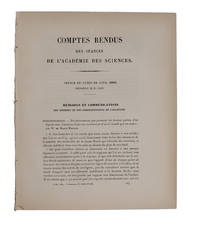
180645517Paris Chez Bernard 1806. No wrappers. Ectracts from "Annales de Chimie ou Recueil de Mémoires." Vol. 57. Pp. 131-174 a. pp. 225-272. With the titlepage to volume 57. <br/><br/><em>First appearance of a classic paper in which Proust describes his discovery of Grape.Sugar and the identificationof this with glucose. He investigated the varieties of sugar that occur in sweet vegetable juices distinguishing three kinds and he showed that the sugar in grapes of which he announced the existence to his classes at Madrid is identical with that obtained from honey by the Russian chemist J. T. Lowitz.Proust is famous for his work on the steadiness of composition of chemical compounds."In chemistry the law of definite proportions sometimes called Proust's Law states that a chemical compound always contains exactly the same proportion of elements by mass. An equivalent statement is the law of constant composition which states that all samples of a given chemical compound have the same elemental composition. For example oxygen makes up 8/9 of the mass of any sample of pure water while hydrogen makes up the remaining 1/9 of the mass. Along with the law of multiple proportions the law of definite proportions forms the basis of stoichiometry."Wikipedia. </em> unknown
183149631Paris Crochard 1831. No wrappers. In: "Annales de Chimie et de Physique Par MM. Gay-Lussac et Arago." tome 46 Cahier 1. Pp. 5-112. Entire issue offered. Sefström's paper: pp. 105-111. <br/><br/><em>First printing of the paper in which Sefström announced his discovery of a new element in iron from the Taberg mine in Småland. He named it Vanadium from the goddess Vanadis.Parkinson "Breakthroughs" 1831 C.The discovery and isolation of Vanadium has a long story to tell. In reality it was found by del Rio in 1801 he named it Erythronium but upon further study he decided that he was mistaken as his further studies showed that it was made up of a basic lead chromate. </em> unknown
185649036Paris Mallet-Bachelier 1856. 4to. No wrappers. In: "Comptes Rendus Hebdomadaires des Séances de L'Academie des Sciences" Tome 43 No 13. Pp. 637- 672. Entire issue offered. Vulpian's paper: pp. 663-665. <br/><br/><em>First appearance of the paper in which Vulpian described his discovery of adrenaline in the adrenal medulla. Vulpian established that the medulla synthesised a substance that was liberated into the blood circulation. This substance was later identified as adrenaline.Garrison & Morton No. 1141. </em> unknown
Adamson, Glenn, Meyers, ZIn Pristine Condition. unknown
189843857Berlin J.A. Barth 1898. No wrappers. In "Annalen der Physik" Neue Folge Band 65 No 5. Pp. 1-240. Entire issue offered No.5. Titlepage to vol. 65. Stamp on titlepage. Schmidt's paper: pp. 141-151 textillustr. A tear to inner lower corners of pp. 24-32. not affecting Schmidt's paper. Clean and fine. <br/><br/><em>First printing of Schmidt's full exposition in which he describes his discovery of the radioactivity of Thorium. Schmidt and Marie Curie independently demonstrated the radioactive quality but Schmidt's demonstration took place a few months before Curie's. The discovery was announced but not described in full in a short message published in "Verhandl. d. Phys. Gesellsch. zu Berlin 1898."Schmidt made his discovery while examining "many elements and compounds" in an effeort to determine whether any of the rays that were emitted bore a resemblance to those that Henri becquerel had found emerging from uranium and uranium compounds. He located only one such element thorium and immediately conducted absorption ionization reflection refradction and poklarization studies to determine the characteristics of its rays. Having combined a misinterpretation of Becquerel's with one of his own Schmidt concluded that thorium rays most resembled Röntgen rays - a conclusion that soon required revisoln in view of the researches of Marie Curie and Ernest Rutherford."DSB XII p. 191. </em> unknown
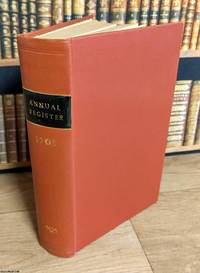
1793373234J. Dodsley London 1793. 5th Edition. Hardcover. Very Good Condition. 21 pages. This 1765 article published in The Annual Register provides a detailed account of John Harrison's groundbreaking work in solving the longitude problem at sea through the use of artificial time-keepers. Harrison an English clockmaker developed the marine chronometer a device that allowed sailors to accurately determine their longitude while at sea. His invention was crucial for safe navigation reducing the risk of ships becoming lost or wrecked due to miscalculations. The article outlines the proceedings and debates surrounding Harrison's work including his struggles with the Longitude Board which was reluctant to grant him the full 20000 prize promised under the 1714 Longitude Act. Despite proving the accuracy of his time-keepers Harrison faced political opposition and bureaucratic delays before finally receiving recognition for his achievements. Published at around the same time that Harrison's book of a similar title was published this contemporary 21 page account quotes Harrison extensively and represents the opinions and ideas regarding navigation from the perspective of the time. The whole volume extends to around 600 pages. Bound in modern but not recent brown buckram with a contrasting black leather lettering piece gilt title. Library label to the endpapers stamp on first blank and label to reverse of the title page. The first blank has a hand note stating "Given by Lt.Col. A.R. Hurst". Hurst has served with the Royal Field Artillery in the First World War. The whole volume is very clean with bright pages very firmly bound and in attractive condition. Size: 13.5 x 21 cms. Category: Antiquarian & Rare; Featured Items; Printed before 1800; Special Features. This item may require more postage than the rates shown for delivery outside the UK. If extra postage is required we will contact you before processing your order and you will be given the details and option to decline the extra cost. J. Dodsley hardcover
182949248Leipzig Johann Ambrosius Barth 1829. Without wrappers as issued in "Annalen der Physik und Chemie. Hrsg.von Poggendorff" Bd. 16 Siebentes Stück. 2 pp. 1 folded engraved plate. Entire issue offered with titlepage to volume 16. Berzelius's paper: pp. 387-415. Clean and fine. <br/><br/><em>First German printing - printed simultaneously with the English and Swedish version - of the paper in which Berzelius described his discovery of Thorium the first element after Uranium to be identified as such. In 1829 Jöns Jakob Berzelius of the Royal Karolinska Institute Stockholm extracted thorium from a rock specimen sent to him by an amateur mineralogist who had discovered it near Brevig and realised that it had not previously been reported. The mineral turned out to be thorium silicate and it is now known as thorite. Berzelius even produced a sample of metallic thorium by heating thorium fluoride with potassium and confirmed it as a new metal. He called the black mineral thorite in honor of the Scandinavian god Thor.Parkinson "Breakthroughs" 1829 C. </em> unknown
183248329Paris Crochard 1832. No wrappers. In: "Annales de Chimie et de Physique" 2e Series vol. 51 Cahier 4. Pp. 337-444 Entire issue offered. Faraday's letter: pp. 404-434 a. 1 engraved plate. Some brownspots. <br/><br/><em>First printing of Faraday's famous letter to Gay-Lussac in which he claim to be the discoverer of electro-magnetic induction analysed the results of the Italian philosophers pointing out their errors and defending himself from what he regarded as imputations on his character. The style of this letter is unexceptionable for Faraday could not write otherwise than as a gentleman; but the letter shows that had he willed it he could have hit hard. The letter was later translated into English and published in "Philosophical Magazine" in 1840 under the title "On Magneto-electric Induction"."In 1831 seemingly out of nowhere came the discovery of electromagnetic induction and the beginning of the experimental researches in electricity which were to lead Faraday to the discovery of the laws of electrochemistry specific inductive capacity the Faraday effect and the foundations of classical field theory." DSB. </em> unknown
177746614London W. Bowyer and J. Nichols 1777. 4to. Extracted from "Philosophical Transactions" Year 1777. Vol. 67 - Part I. Pp. 260-265. Clean and fine broadmargined. <br/><br/><em>First apperarance of this paper constituting the first reliable account of colour blindness.Usually Goethe or John Dalton - Huddart's case was cited in Dalton's paper of 1794 - is supposed to have discovered colourblindness. However the English oculist Joseph Huddart was the discoverer of this phenomenon. The first physiological explanation of it does come from Goethe.Garrison & Morton: 5832. </em> unknown
187947275Paris Gauthier-Villars 1879. 4to. No wrappers. In: "Comptes Rendus Hebdomadaires des Séances de L'Academie des Sciences" Tome 88 No 7. Pp. 313- 352. Entire issue offered. Boisbaudran's paper: pp. 322-324. <br/><br/><em>First apperance of the paper in which Boisbaudran revealed his discovery of a new earth that precipitated had a unique spectrum. De Boisbaudran named it samaria after the mineral from which it was derived. The mineral samarskite is named for a Russian mining engineer and Chief of Staff - Corps of Mining Engineers Colonel Vasili Evgrafovich Samarsky-Bykhovets."Samarium was discovered by French chemist Paul Émile Lecoq de Boisbaudran in 1879. He noticed in his research that impure didymium praseodymium and neodymium with other impurities seemed to contain more than just didymium based on spectroscopic work on various rare-earth minerals. When Lecoq de Boisbaudran added ammonium hydroxide to a concentrate prepared from the mineral samarskite he observed a precipitate that formed before the didymium Weeks and Leicester 1968 p. 685. Partington "Breakthroughs" 1879 C. </em> unknown
187848210Paris Gauthier-Villars 1878. 4to. No wrappers. In: "Comptes Rendus Hebdomadaires des Séances de L'Academie des Sciences" Tome 87 No 17. Pp. 570- 616. Entire issue offered. Marignac's paper: pp. 578-581. <br/><br/><em>First apperance of the paper relating Marignac's discovery of the rare earth Ytterbium Ytterbia."He began his study of the rare earths in 1840 when he was barely twenty-three years old. According to P.T. Cleve "Marignac's work on the rare earths is undoubtedly the most importent in this particular department of chemistry". In 1878 marignac heated some erbium nitrate obtained from gadolinite until it decomposed. When he extracted the resulting mass with water he obtained two oxides: a red one for which he retained the name Erbia and a colorless one which he named Ytterbia." Weeks "The Discovery of the Elements".Parkinson "Breakthroughs" 1878 C </em> unknown
183351493Paris Crochard 1833. Contemp. hcalf. Raised bands gilt spine with gilt lettering. A few scratches to spine. Stamps to verso of titlepage. In: "Annales de Chimie et de Physique Par MM. Gay-Lussac et Arago." Series 2 tome 53. Entire volume offered. 448 pp. Payen & Persoz's paper: pp. 73-92. Clean and fine. <br/><br/><em>First printing of a pioneering paper in industrial chemistry and microbiology being the discovery of the first Enzyme Diastase. It catalyses the breakdown of starch into maltose. </em> hardcover
180143599Halle Rengerschen Buchhandlung 1801. Without wrappers as published in "Annalen der Physik. Herausgegeben von Ludwig Wilhelm Gilbert" Bd. 7 Zweites Stück. The entire issue offered =Heft 2. Pp. 137-264 a. 2 folded engraved plates. Herschels papers: pp. 137-156. The plate depicts Herschel's experimental arrangements. <br/><br/><em>First appearance in German of Herschel's epochal announcement of his discovery of infrared light in 1800. This was the first time that a form of light beyond visible light had been detected. The paper offered is the German translation of the main parts of Herschel's paper "An Investigation of the Powers of Prismatic Colours to Heat and Illuminate Objects"."In 1800 he tested various portions of the sun's spectrum by thermometer to see if he could find interesting differences in the amount of heat the different colors delivered. He did but in a rather unexpected way for he found that the temperature rise was highest in no color at all at a spot beyond the red end of the spectrum. He concluded that the sunlight contained invisible light beyond the red. This is now called infrared radiation. The following year Ritter was to extend the visible spectrum in the other direction."Asimov.Parkinson "Breakthroughs" 1800 P. </em> unknown
187947273Paris Gauthier-Villars 1879. 4to. No wrappers. In: "Comptes Rendus Hebdomadaires des Séances de L'Academie des Sciences" Tome 88 No 12. Pp. 625- 676. Entire issue offered. Nilson's papers: pp. 642-645 a. 645-648. First leaf with a tear to right margin no loss of paper. <br/><br/><em>First apperance of the papers in which Nilson describes his discovery of a new element and its properties and naming it Scandium. It was the second new element found after Mendeleev's prediction of its existence as "Eka-Boron"."Mendeléeff had predicted that another element which he called eka-boron and which he said would have an atomic weight between 40 calcium and 48 titanium would some day be revealed. It was discovered in 1879 by Lars Fredrik Nilson. Nilson extracted 63 grams of the rare earth erbia from gadolinite and euxenite and converted it into the nitrate. Upon decomposing this salt by heat as Marignac had done he obtained some very pure ytterbia and to his great surprise an earth that was unknown to him.Upon thoroughly investigating this new earth he found that it contained an element whose properties concided almost exactly with those Mendeléef had predicted for ekaboron. Nilson called it scandium in honour of his fatherland."Weeks "Discovery of the Elements" pp. 219-20.Parkinson "Breakthroughs" 1879 C. </em> unknown
2019mon0003456552Discovery Education 2019T. paperback. Very Good. 0.6693 10.9055 8.5039. Discovery Education paperback
19946946Sao Paulo: Fundacao Quadrilátero do Descobrimento 1994. 1st ed. Paperback. Used; Like New. Small Folio bds 239 pp.dust jacket semi glossy stock maps color plates facsimiles bibl. Fundacao Quadrilátero do Descobrimento paperback
182643853Paris Crochard 1826. Without wrappers. In: "Annales de Chimie et de Physique par Gay-Lussac et Arago" tome 32 Sec. Series Cahier 4. Pp. 337-443 a. 1 fodled engraved plate. The entire issue offerd. Balard's paper: pp. 337-84. <br/><br/><em>First printing of Balard's famous memoire in which he records his discovery of the new element Bromine le brôme. While he was studying the flora of a salt marsh he notized a deposit of sodium saulfate which had crystallized out in a pan containing mother liquer from common salts. "In an attempt to find a use for the waste liquers he performed a number of experiments and notized that when certain reagents were added the mother liquer bacame brown. His investigation of this phenomenon.ked to the remarkable discovery.Weeks p. 264."The discovery of a new chemical element by a young and obscure provincial pharmacist caused a sensation in Paris. Balard's achievemnt was recognized by the Academie des Sciences and he was awarded a medal by the Royal Society of London."DSB I p. 416."The discovery of bromine is a very importent acquisition to chemistry and gives M. Balrad honorable rank inthe career of the sciences. We are of the opinion that this young chemist is every way worthy of the encouragement of the Academy and we have the honour to propose that his memoir shall be printed in the "Recueil des Savants Étrangers" The report from the French Academy signed by Vaugelin Thenard and Gay-Lussac. </em> unknown
179944095Halle Rengerschen Buchhandlung 1799 1800. Without wrappers extracted from "Annalen der Physik. Herausgegeben von Ludwig Wilhelm Gilbert" Bd. 2. p. 483 one page. and Bd. 6 pp. 105-115. Some scattered brownspots. <br/><br/><em>First German translation of Davy's announcement the announcement on 1 page of his discovery of the unusual anaesthetic effects of nitrous oxide which on being inhaled gave rise to a giddy intoxicated feeling. On announcing his discovery he says that he will publish a paper discribing the experiments with the gas later. This is the paper offered here also in the first German version. Both the announcement and the paper were issued in the "Annalen" the same year as they appeared in Nicholson's Journal.The gas was first synthesized by English natural philosopher and chemist Joseph Priestley in 1772 who called it phlogisticated nitrous air."Following Priestley's discovery Humphry Davy of the Pneumatic Institute in Bristol England experimented with the physiological properties of the gas such as its effects upon respiration. He even administered the gas to visitors to the institute and after watching the amusing effects on people who inhaled it coined the term 'laughing gas'! Davy even noted the anaesthetic effects of the gas: "As nitrous oxide in its extensive operation appears capable of destroying physical pain it may probably be used with advantage during surgical operations in which no great effusion of blood takes place".Wikipedia."Davy discovered the anaesthetic properties of nitrous oxide and suggested its use during surgiical operations a suggestion which was not turned to useful account until 1844."Garrison & Morton 5646 not mentioning the announcing of its discovery in 1799. </em> unknown
189844238London Taylor and Francis 1898 No wrappers. In "Proceedings of the Royal Society of London." Vol.63 Nos. 399-400 both issues offered. Pp. 373-480 a. 5 plates. Ransay & Travers' paper: pp. 405-408. <br/><br/><em>First appearance of the paper in which Ramsay and Travers announced their discovery of a new element which they named "krypton" meaning hidden."Dr. William Hampson presented them Ransay & Travers with about a liter of liquid air which they used not for liquefying the argon but for obstaining sufficient skill in manipulation so that they would not risk loosing their precious fifteen liter of argon.The residue left after most of the liquid air had boliled away consisted largly of oxygen and nitrogen which Ramsay and Travers temoved with red-hot copper and magnesium. .they then examined the twenty-five cibic centimeters of residual gas and when they found it to be inerst they immediately placedit in a Pl'ucker tube connected to and induction coil and observed its spectrum. There was a bright yelælow line with a greener tint than that of the helium line and a brilliant green line that did nor coincide with any line of argon helium mercury or hydrogen. They discoverede this gas on 30 May 1898 and named it 'krypton'.they found that it belonged between bromine and rubidium in the periodic table and so great was their excitement that the younger chemist almost forgot about his examination for doctor of sciwence which had been schedules for the next day."Weeks p. 267.Parkinson "Breakthroughs" 1898 C. </em> unknown