232 résultats
184447225(Paris, Bachelier), 1844. 4to. No wrappers. In ""Comptes rendus hebdomadaires des séances de l’Académie des sciences"", Vol. 19, No 14. Pp. (621-) 686. Entire issue offered. Balard's paper: pp. 634-641.
190047268(Paris, Gauthier-Villars), 1900. 4to. No wrappers. In: ""Comptes Rendus Hebdomadaires des Séances de L'Academie des Sciences"", Tome 130, No 20. Pp. (1285-) 1344. (Entire issue offered). Grignard's paper: pp. 1322-24. One leaf repaired in upper margin affecting the text on verso (but without loss of letters). Light browning, poor paperquality.
184748815(Paris, Bachelier),1847. 4to. No wrappers. In: ""Comptes Rendus Hebdomadaires des Séances de L'Academie des Sciences"", Tome XXIV, No. 7. Pp. (209-) 252. (Entire issue offered). Sobrero's paper: pp. 247-248. Clean and fine.
184447225Paris Bachelier 1844. 4to. No wrappers. In "Comptes rendus hebdomadaires des séances de l’Académie des sciences" Vol. 19 No 14. Pp. 621- 686. Entire issue offered. Balard's paper: pp. 634-641. <br/><br/><em>First appearance of an importent paper in pharmacology as Balard here described his discovery of amyl nitrite and its preparation.Sir Thomas Lauder Brunton a Scottish physician later famously pioneered the use of amyl nitrite to treat angina pectoris. Brunton reasoned that the pain and discomfort of angina could be reduced by administering amyl nitrite to dilate the coronary arteries of patients thus improving blood flow to the heart muscle.Garrison & Morton No 1859. </em> unknown
190047268Paris Gauthier-Villars 1900. 4to. No wrappers. In: "Comptes Rendus Hebdomadaires des Séances de L'Academie des Sciences" Tome 130 No 20. Pp. 1285- 1344. Entire issue offered. Grignard's paper: pp. 1322-24. One leaf repaired in upper margin affecting the text on verso but without loss of letters. Light browning poor paperquality. <br/><br/><em>First apperance of an importent paper in which Grignard revealed the "Grignard Reagent" an important means of preparing organic compounds from smaller precursor molecules. For this work Grignard was awarded the Nobel Prize in Chemistry in 1912 jointly with fellow Frenchman Paul Sabatier."A large number of general synthetic methods had been developed by the end of the nineteenth century. However one of the most versatile and importent was first described as the new century opened. This was the Grignard synthesis." Leicester "A Source book in Chemistry 1900-1950" where this paper is translated "Some New Organometallic Compounds of Magnesium and Their Application to the Synthesis ofAlchohols and Hydrocarbons"."Grignard treated magnesium turnings in anhydrous ether with methyl iodide at room temperature preparing what came to be known as the Grignard reagent which could be used for reaction with a ketone or an aldehyde without first being isolated. On hydrolyzing with dilute acid the corresponding tertiary or secondary alcohol was produced in much better yield than Barbier had been able to obtain. Grignard’s discovery was reported in a short paper at a meeting of the Académie des Sciences in May 1900 the paper offered." DSB. </em> unknown
184748815Paris Bachelier1847. 4to. No wrappers. In: "Comptes Rendus Hebdomadaires des Séances de L'Academie des Sciences" Tome XXIV No. 7. Pp. 209- 252. Entire issue offered. Sobrero's paper: pp. 247-248. Clean and fine. <br/><br/><em>First appearance of the paper in which Sobrero announced his discovery of nitroglycerin."When I think of all the victims killed during nitroglycerine explosions and the terrible havoc that has been wreaked which in all probability will continue to occur in the future I am almost ashamed to admit to be its discoverer." Sobrero"Nitroglycerin was synthesized by the chemist Ascagne Sobrero in the middle of the nineteenth century. When he tasted it as all good nineteenth century chemists did when they discovered a new compound it gave him what he called a migraine because of its vasodilatory effect which was later harnessed in the treatment of angina by William Murrell 1879 following the experience of a distinguished British clinician Lauder Brunton using amyl nitrite 1867 Later in the nineteenth century Alfred Nobel discovered how to stabilize nitroglycerin using kieselguhr diatomite clay; this led to highly successful industrial applications of dynamite and created the fortune that eventually funded the eponymous prizes. For medical purposes nitroglycerin was subsequently renamed glyceryl trinitrate to hide the fact that it was literally dynamite as well as metaphorically." </em> unknown
1868WOC-1135Illustré de 13 gravures hors-texte, de culs-de-lampe, des en-têtes, et d'une carte par MM. Tony Johannot, Eug. Lami, Francais et Daubigny. 4ème édition. Précédée d'une notice sur l'auteur par M. Jules. Janin et de l'inauguration de l'embranchement de Strasbourg à Kehl par M. Amedée Achard. Paris, Ernest Bourdin, éditeur & Librairie Hachette et Cie. 1868. In-8 relié demi bradel bleue, couverture conservée avec mention cinquième édition et aux armes de la ville. Quelques rousseurs assez fortes sur quelques pages. XVI,256 pp.
182044807(Paris, Crochard, 1820). No wrappers as extracted fron 'Annales de Chimie et de Physique', Volume 15 (2e Series). Pp. 93-102.
189847409(Paris, Gauthier-Villars), 1898. 4to. No wrappers. In: ""Comptes Rendus Hebdomadaires des Séances de L'Academie des Sciences"", Tome 129, No 16. Pp. (567-) 626. (Entire issue offered). Debierne's paper: pp. 593-595. Paperquality rather poor, a bit fragile.
184259217(Paris, Bachelier), 1842. 4to. No wrappers. In: ""Comptes Rendus Hebdomadaires des Séances de L'Academie des Sciences"", Tome 14, No. 10. Pp. (349-) 378. (Entire issue offered). Donné's paper: pp. 366-368.
188648205(Paris, Gauthier-Villars), 1886. 4to. No wrappers. In: ""Comptes Rendus hebdomadaires des Séances de L'Academie des Sciences"", Tome 102, No 18. Pp. (991-) 1041. (Entire issue offered). The papers: pp. 1003-1004 a. 1005-1006.
184147143(Paris, Bachelier), 1841. 4to. No wrappers. In: ""Comptes Rendus Hebdomadaires des Séances de L'Academie des Sciences"", Tome XIII, No. 10. Pp. (487-) 558. (Entire issue offered). Matteucci's paper: pp. 540-41.
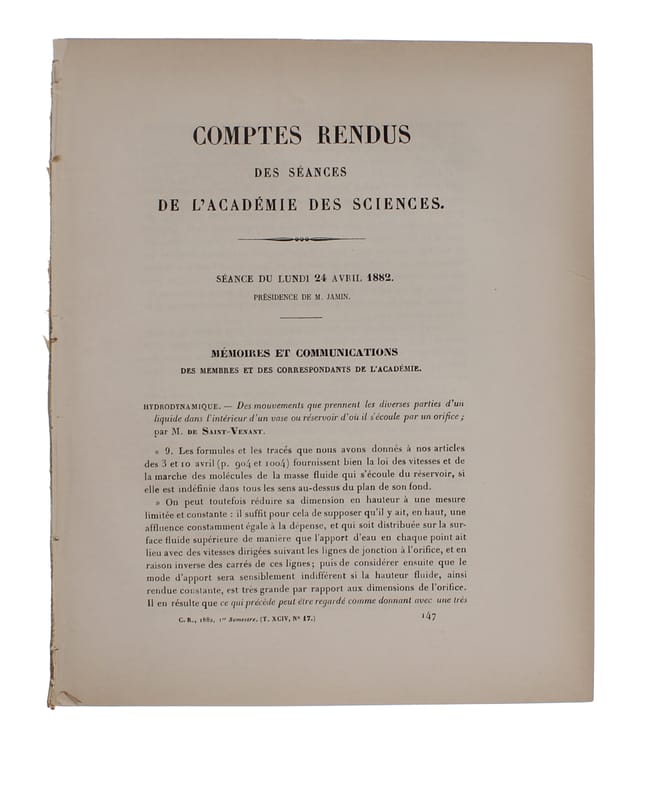
188249173(Paris: Gauthier-Villars), 1882. 4to. No wrappers. In: ""Comptes Rendus Hebdomadaires des Seances de l'Academie des Sciences"", Vol 94, No 4 + 15 + 17. Pp. (149-) 184, pp. (997--) 1068 a. pp. (1139-) 1214. (3 entire issues offered). Poincare's papers: pp. 163-168, 1038-1042 a. 1166-67.
183149631(Paris, Crochard, 1831). No wrappers. In: ""Annales de Chimie et de Physique, Par MM. Gay-Lussac et Arago."", tome 46, Cahier 1. Pp. 5-112. (Entire issue offered). Sefström's paper: pp. 105-111.
185649036(Paris, Mallet-Bachelier, 1856). 4to. No wrappers. In: ""Comptes Rendus Hebdomadaires des Séances de L'Academie des Sciences"", Tome 43, No 13. Pp. (637-) 672. (Entire issue offered). Vulpian's paper: pp. 663-665.
182044807Paris Crochard 1820. No wrappers as extracted fron 'Annales de Chimie et de Physique' Volume 15 2e Series. Pp. 93-102. <br/><br/><em>First appearance of this importent paper in which Arago gives an account of his discovery of how iron and steel could be magnetized by the action of the voltaic current THE FIRST STEP TOWARDS THE ELECTRIC TELEGRAPH. "Arago . made several important contributions to electromagnetism on his own. On 20 September 1820 he announced the discovery of the temporary magnetization of soft iron by an electric current which suggested to Ampère a theory about the nature of magnetic "currents" and provided the technological key to the electric telegraph. Ampère calculated that the magnetic power could be multiplied by twisting the current-carrying wire into a helix and with Arago he carried out the first experiments on primitive solenoids. In his historical articles Arago was always careful to credit Ampère with the major share of this discovery which ultimately depended upon Ampère’s mathematical theory."DSB.Arago formed a close freinship with Fresnelwhose views on the nature of light he ardently supported. He assisted Fresnel in some of his most importent work and made original discoveries in the same field.Magie "A Source Book in Physics" p. 443 ff. </em> unknown
189847409Paris Gauthier-Villars 1898. 4to. No wrappers. In: "Comptes Rendus Hebdomadaires des Séances de L'Academie des Sciences" Tome 129 No 16. Pp. 567- 626. Entire issue offered. Debierne's paper: pp. 593-595. Paperquality rather poor a bit fragile. <br/><br/><em>First appearance of the paper in which Debierne announced his discovery of a new radioactive element found in uranium residues."In 1906 Professor Hahn discovered radioactinium between actinium an actinium X. Actinium emanation or "action" like radon is an inert gas was discovered independently by F. Giesel and André Debierne." Weeks "Discovery of the Elements" p. 307.Parkinson "Breakthroughs" 1899 C. </em> unknown
184259217Paris Bachelier 1842. 4to. No wrappers. In: "Comptes Rendus Hebdomadaires des Séances de L'Academie des Sciences" Tome 14 No. 10. Pp. 349- 378. Entire issue offered. Donné's paper: pp. 366-368. <br/><br/><em>First printing of the paper announcing the discovery of blood-platelets THE THIRD CORPUSCLES OF THE BLOOD. Platelets or thrombocytes or yellow blood cells are very small irregularly shaped clear cell fragments i.e. cells that do not have a nucleus containing DNA 2-3 µm in diameter which derive from fragmentation of precursor megakaryocytes. The average lifespan of a platelet is normally just 5 to 9 days. Platelets are a natural source of growth factors. They circulate in the blood of mammals and are involved in hemostasis leading to the formation of blood clots. Platelets release thread-like fibers to form these clots.Garrison & Morton 864. </em> unknown
188648205Paris Gauthier-Villars 1886. 4to. No wrappers. In: "Comptes Rendus hebdomadaires des Séances de L'Academie des Sciences" Tome 102 No 18. Pp. 991- 1041. Entire issue offered. The papers: pp. 1003-1004 a. 1005-1006. <br/><br/><em>First apperance of the papers in which Lecoc de Boisbaudran described how he separated Holmium into two kinds of earths and naming them."He accomplished this by fractional prepicitation first with ammonium hydroxide and then with a saturated solution of potassium sulfate and found that the constituents of pure holmium solutions precipitate in the folloeing order: terbium dysprosium holmium and erbium. Lecog de Boisbaudran never had an abundant supply of raw materials for his remarkable researches on the rare earths and he once confided to professor Urbain that most of his fractionations had been carried on on the marble slab of his fireplace."Weeks "Discovery of the Eelements".Parkinson "Breakthroughs" 1886 C. </em> unknown
184147143Paris Bachelier 1841. 4to. No wrappers. In: "Comptes Rendus Hebdomadaires des Séances de L'Academie des Sciences" Tome XIII No. 10. Pp. 487- 558. Entire issue offered. Matteucci's paper: pp. 540-41. <br/><br/><em>First appearance of a main paper in the history of electro-physiology."The discovery by Volta of means for producing galvanic currents led to the construction of a galvanometer for measuring currents and later to its refinement. In 1841 Matteucci presented. a paper which showed that a galvanometer indicates a curring flowing whenh it is connected from the surface of a muscle to a wound in the muscle a current that was later called the "current of injury" and also the "current of rest" since it flowed without observable muscular contraction. Johannes Müller showed tis paper to his brilliant pupil du Bois-reymond. Du Bois interest was caught at once. He published his first paper on "thierische Electricität" in 1843 and his two-volumes on the subject - soon to become the classic - in 1848-49."Boring "History of Experimental Psychology" p. 40. </em> unknown
188249173Paris: Gauthier-Villars 1882. 4to. No wrappers. In: "Comptes Rendus Hebdomadaires des Seances de l'Academie des Sciences" Vol 94 No 4 15 17. Pp. 149- 184 pp. 997-- 1068 a. pp. 1139- 1214. 3 entire issues offered. Poincare's papers: pp. 163-168 1038-1042 a. 1166-67. <br/><br/><em>First appearance in print of the discovery of the automorphic forms which Poincaré named Fuchsian functions."One of Poincaré's first discoveries in mathematics dating to the 1880s was automorphic forms. He named them Fuchsian functions after the mathematician Lazarus Fuchs because Fuchs was known for being a good teacher and had researched on differential equations and the theory of functions. Poincaré actually developed the concept of these functions as part of his doctoral thesis. Under Poincaré's definition an automorphic function is one which is analytic in its domain and is invariant under a discrete infinite group of linear fractional transformations. Automorphic functions then generalize both trigonometric and elliptic functions." Wikipedia. </em> unknown
180645517Paris, Chez Bernard, 1806. No wrappers. Ectracts from ""Annales de Chimie ou Recueil de Mémoires.."" Vol. 57. Pp. 131-174 a. pp. 225-272. With the titlepage to volume 57.
180645517Paris Chez Bernard 1806. No wrappers. Ectracts from "Annales de Chimie ou Recueil de Mémoires." Vol. 57. Pp. 131-174 a. pp. 225-272. With the titlepage to volume 57. <br/><br/><em>First appearance of a classic paper in which Proust describes his discovery of Grape.Sugar and the identificationof this with glucose. He investigated the varieties of sugar that occur in sweet vegetable juices distinguishing three kinds and he showed that the sugar in grapes of which he announced the existence to his classes at Madrid is identical with that obtained from honey by the Russian chemist J. T. Lowitz.Proust is famous for his work on the steadiness of composition of chemical compounds."In chemistry the law of definite proportions sometimes called Proust's Law states that a chemical compound always contains exactly the same proportion of elements by mass. An equivalent statement is the law of constant composition which states that all samples of a given chemical compound have the same elemental composition. For example oxygen makes up 8/9 of the mass of any sample of pure water while hydrogen makes up the remaining 1/9 of the mass. Along with the law of multiple proportions the law of definite proportions forms the basis of stoichiometry."Wikipedia. </em> unknown
183149631Paris Crochard 1831. No wrappers. In: "Annales de Chimie et de Physique Par MM. Gay-Lussac et Arago." tome 46 Cahier 1. Pp. 5-112. Entire issue offered. Sefström's paper: pp. 105-111. <br/><br/><em>First printing of the paper in which Sefström announced his discovery of a new element in iron from the Taberg mine in Småland. He named it Vanadium from the goddess Vanadis.Parkinson "Breakthroughs" 1831 C.The discovery and isolation of Vanadium has a long story to tell. In reality it was found by del Rio in 1801 he named it Erythronium but upon further study he decided that he was mistaken as his further studies showed that it was made up of a basic lead chromate. </em> unknown
185649036Paris Mallet-Bachelier 1856. 4to. No wrappers. In: "Comptes Rendus Hebdomadaires des Séances de L'Academie des Sciences" Tome 43 No 13. Pp. 637- 672. Entire issue offered. Vulpian's paper: pp. 663-665. <br/><br/><em>First appearance of the paper in which Vulpian described his discovery of adrenaline in the adrenal medulla. Vulpian established that the medulla synthesised a substance that was liberated into the blood circulation. This substance was later identified as adrenaline.Garrison & Morton No. 1141. </em> unknown