"SCHMIDT, G.C. - THE DISCOVERY THAT THORIUM IS RADIOACTIVE.Livre Rare Book
STENDHALLivre Rare Book
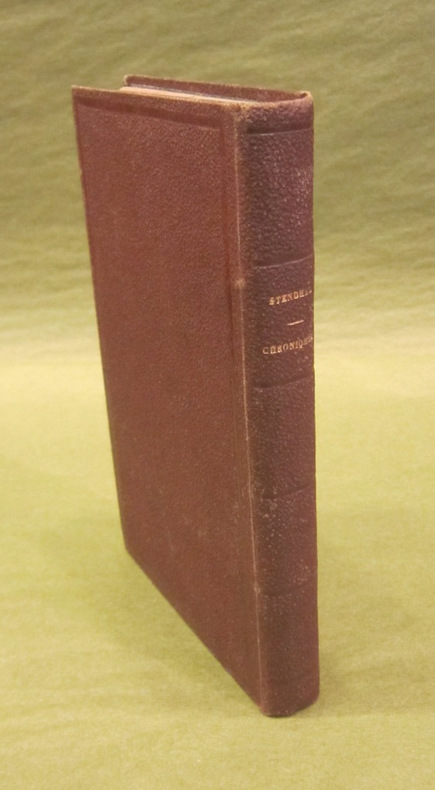
Henri Picard et Fils · Paris, France230,00 €
232 résultats
189843857Berlin, J.A. Barth, 1898. No wrappers. In ""Annalen der Physik"", Neue Folge Band 65, No 5. Pp. 1-240.. (Entire issue offered, No.5). Titlepage to vol. 65. Stamp on titlepage. Schmidt's paper: pp. 141-151, textillustr. A tear to inner lower corners of pp. 24-32. (not affecting Schmidt's paper). Clean and fine.
189843857Berlin J.A. Barth 1898. No wrappers. In "Annalen der Physik" Neue Folge Band 65 No 5. Pp. 1-240. Entire issue offered No.5. Titlepage to vol. 65. Stamp on titlepage. Schmidt's paper: pp. 141-151 textillustr. A tear to inner lower corners of pp. 24-32. not affecting Schmidt's paper. Clean and fine. <br/><br/><em>First printing of Schmidt's full exposition in which he describes his discovery of the radioactivity of Thorium. Schmidt and Marie Curie independently demonstrated the radioactive quality but Schmidt's demonstration took place a few months before Curie's. The discovery was announced but not described in full in a short message published in "Verhandl. d. Phys. Gesellsch. zu Berlin 1898."Schmidt made his discovery while examining "many elements and compounds" in an effeort to determine whether any of the rays that were emitted bore a resemblance to those that Henri becquerel had found emerging from uranium and uranium compounds. He located only one such element thorium and immediately conducted absorption ionization reflection refradction and poklarization studies to determine the characteristics of its rays. Having combined a misinterpretation of Becquerel's with one of his own Schmidt concluded that thorium rays most resembled Röntgen rays - a conclusion that soon required revisoln in view of the researches of Marie Curie and Ernest Rutherford."DSB XII p. 191. </em> unknown
182949248Leipzig, Johann Ambrosius Barth, 1829. Without wrappers as issued in ""Annalen der Physik und Chemie. Hrsg.von Poggendorff"", Bd. 16, Siebentes Stück. (2) + pp., 1 folded engraved plate. Entire issue offered with titlepage to volume 16. Berzelius's paper: pp. 387-415. Clean and fine.
183248329(Paris, Crochard, 1832). No wrappers. In: ""Annales de Chimie et de Physique"", 2e Series, vol. 51, Cahier 4. Pp. 337-444 (Entire issue offered). Faraday's letter: pp. 404-434 a. 1 engraved plate. Some brownspots.
187947275(Paris, Gauthier-Villars), 1879. 4to. No wrappers. In: ""Comptes Rendus Hebdomadaires des Séances de L'Academie des Sciences"", Tome 88, No 7. Pp. (313-) 352. (Entire issue offered). Boisbaudran's paper: pp. 322-324.
187848210(Paris, Gauthier-Villars), 1878. 4to. No wrappers. In: ""Comptes Rendus Hebdomadaires des Séances de L'Academie des Sciences"", Tome 87, No 17. Pp. (570-) 616. (Entire issue offered). Marignac's paper: pp. 578-581.
183351493Paris, Crochard, 1833. Contemp. hcalf. Raised bands, gilt spine with gilt lettering. A few scratches to spine. Stamps to verso of titlepage. In: ""Annales de Chimie et de Physique, Par MM. Gay-Lussac et Arago."", Series 2, tome 53. Entire volume offered. 448 pp. Payen & Persoz's paper: pp. 73-92. Clean and fine.
182949248Leipzig Johann Ambrosius Barth 1829. Without wrappers as issued in "Annalen der Physik und Chemie. Hrsg.von Poggendorff" Bd. 16 Siebentes Stück. 2 pp. 1 folded engraved plate. Entire issue offered with titlepage to volume 16. Berzelius's paper: pp. 387-415. Clean and fine. <br/><br/><em>First German printing - printed simultaneously with the English and Swedish version - of the paper in which Berzelius described his discovery of Thorium the first element after Uranium to be identified as such. In 1829 Jöns Jakob Berzelius of the Royal Karolinska Institute Stockholm extracted thorium from a rock specimen sent to him by an amateur mineralogist who had discovered it near Brevig and realised that it had not previously been reported. The mineral turned out to be thorium silicate and it is now known as thorite. Berzelius even produced a sample of metallic thorium by heating thorium fluoride with potassium and confirmed it as a new metal. He called the black mineral thorite in honor of the Scandinavian god Thor.Parkinson "Breakthroughs" 1829 C. </em> unknown
183248329Paris Crochard 1832. No wrappers. In: "Annales de Chimie et de Physique" 2e Series vol. 51 Cahier 4. Pp. 337-444 Entire issue offered. Faraday's letter: pp. 404-434 a. 1 engraved plate. Some brownspots. <br/><br/><em>First printing of Faraday's famous letter to Gay-Lussac in which he claim to be the discoverer of electro-magnetic induction analysed the results of the Italian philosophers pointing out their errors and defending himself from what he regarded as imputations on his character. The style of this letter is unexceptionable for Faraday could not write otherwise than as a gentleman; but the letter shows that had he willed it he could have hit hard. The letter was later translated into English and published in "Philosophical Magazine" in 1840 under the title "On Magneto-electric Induction"."In 1831 seemingly out of nowhere came the discovery of electromagnetic induction and the beginning of the experimental researches in electricity which were to lead Faraday to the discovery of the laws of electrochemistry specific inductive capacity the Faraday effect and the foundations of classical field theory." DSB. </em> unknown
187947275Paris Gauthier-Villars 1879. 4to. No wrappers. In: "Comptes Rendus Hebdomadaires des Séances de L'Academie des Sciences" Tome 88 No 7. Pp. 313- 352. Entire issue offered. Boisbaudran's paper: pp. 322-324. <br/><br/><em>First apperance of the paper in which Boisbaudran revealed his discovery of a new earth that precipitated had a unique spectrum. De Boisbaudran named it samaria after the mineral from which it was derived. The mineral samarskite is named for a Russian mining engineer and Chief of Staff - Corps of Mining Engineers Colonel Vasili Evgrafovich Samarsky-Bykhovets."Samarium was discovered by French chemist Paul Émile Lecoq de Boisbaudran in 1879. He noticed in his research that impure didymium praseodymium and neodymium with other impurities seemed to contain more than just didymium based on spectroscopic work on various rare-earth minerals. When Lecoq de Boisbaudran added ammonium hydroxide to a concentrate prepared from the mineral samarskite he observed a precipitate that formed before the didymium Weeks and Leicester 1968 p. 685. Partington "Breakthroughs" 1879 C. </em> unknown
187848210Paris Gauthier-Villars 1878. 4to. No wrappers. In: "Comptes Rendus Hebdomadaires des Séances de L'Academie des Sciences" Tome 87 No 17. Pp. 570- 616. Entire issue offered. Marignac's paper: pp. 578-581. <br/><br/><em>First apperance of the paper relating Marignac's discovery of the rare earth Ytterbium Ytterbia."He began his study of the rare earths in 1840 when he was barely twenty-three years old. According to P.T. Cleve "Marignac's work on the rare earths is undoubtedly the most importent in this particular department of chemistry". In 1878 marignac heated some erbium nitrate obtained from gadolinite until it decomposed. When he extracted the resulting mass with water he obtained two oxides: a red one for which he retained the name Erbia and a colorless one which he named Ytterbia." Weeks "The Discovery of the Elements".Parkinson "Breakthroughs" 1878 C </em> unknown
183351493Paris Crochard 1833. Contemp. hcalf. Raised bands gilt spine with gilt lettering. A few scratches to spine. Stamps to verso of titlepage. In: "Annales de Chimie et de Physique Par MM. Gay-Lussac et Arago." Series 2 tome 53. Entire volume offered. 448 pp. Payen & Persoz's paper: pp. 73-92. Clean and fine. <br/><br/><em>First printing of a pioneering paper in industrial chemistry and microbiology being the discovery of the first Enzyme Diastase. It catalyses the breakdown of starch into maltose. </em> hardcover
187947273(Paris, Gauthier-Villars), 1879. 4to. No wrappers. In: ""Comptes Rendus Hebdomadaires des Séances de L'Academie des Sciences"", Tome 88, No 12. Pp. (625-) 676. (Entire issue offered). Nilson's papers: pp. 642-645 a. 645-648. First leaf with a tear to right margin, no loss of paper.
180143599Halle, Rengerschen Buchhandlung, 1801. Without wrappers as published in ""Annalen der Physik. Herausgegeben von Ludwig Wilhelm Gilbert"", Bd. 7, Zweites Stück. The entire issue offered (=Heft 2). Pp. 137-264 a. 2 folded engraved plates. Herschels papers: pp. 137-156. The plate depicts Herschel's experimental arrangements.
180143599Halle Rengerschen Buchhandlung 1801. Without wrappers as published in "Annalen der Physik. Herausgegeben von Ludwig Wilhelm Gilbert" Bd. 7 Zweites Stück. The entire issue offered =Heft 2. Pp. 137-264 a. 2 folded engraved plates. Herschels papers: pp. 137-156. The plate depicts Herschel's experimental arrangements. <br/><br/><em>First appearance in German of Herschel's epochal announcement of his discovery of infrared light in 1800. This was the first time that a form of light beyond visible light had been detected. The paper offered is the German translation of the main parts of Herschel's paper "An Investigation of the Powers of Prismatic Colours to Heat and Illuminate Objects"."In 1800 he tested various portions of the sun's spectrum by thermometer to see if he could find interesting differences in the amount of heat the different colors delivered. He did but in a rather unexpected way for he found that the temperature rise was highest in no color at all at a spot beyond the red end of the spectrum. He concluded that the sunlight contained invisible light beyond the red. This is now called infrared radiation. The following year Ritter was to extend the visible spectrum in the other direction."Asimov.Parkinson "Breakthroughs" 1800 P. </em> unknown
187947273Paris Gauthier-Villars 1879. 4to. No wrappers. In: "Comptes Rendus Hebdomadaires des Séances de L'Academie des Sciences" Tome 88 No 12. Pp. 625- 676. Entire issue offered. Nilson's papers: pp. 642-645 a. 645-648. First leaf with a tear to right margin no loss of paper. <br/><br/><em>First apperance of the papers in which Nilson describes his discovery of a new element and its properties and naming it Scandium. It was the second new element found after Mendeleev's prediction of its existence as "Eka-Boron"."Mendeléeff had predicted that another element which he called eka-boron and which he said would have an atomic weight between 40 calcium and 48 titanium would some day be revealed. It was discovered in 1879 by Lars Fredrik Nilson. Nilson extracted 63 grams of the rare earth erbia from gadolinite and euxenite and converted it into the nitrate. Upon decomposing this salt by heat as Marignac had done he obtained some very pure ytterbia and to his great surprise an earth that was unknown to him.Upon thoroughly investigating this new earth he found that it contained an element whose properties concided almost exactly with those Mendeléef had predicted for ekaboron. Nilson called it scandium in honour of his fatherland."Weeks "Discovery of the Elements" pp. 219-20.Parkinson "Breakthroughs" 1879 C. </em> unknown
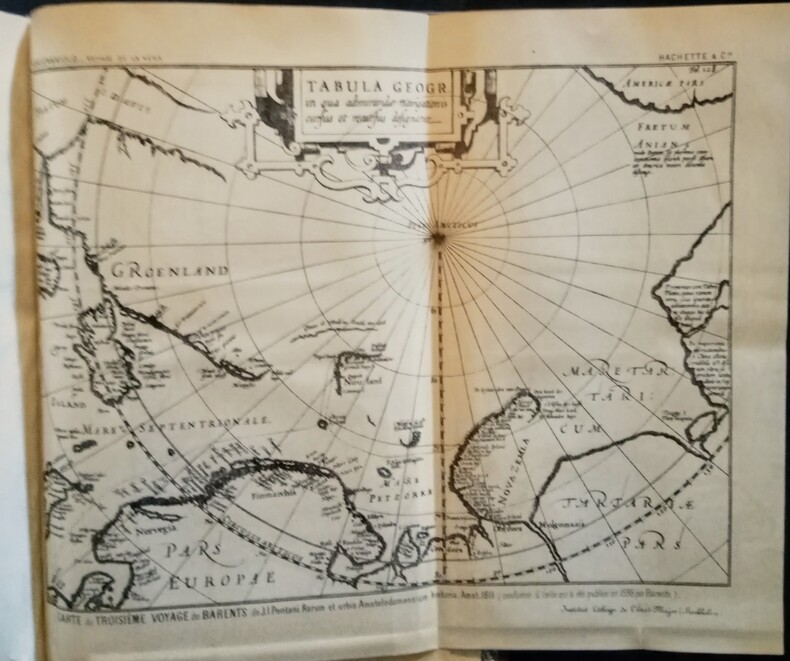
1883WOC-2661Accompagné d'un résumé des voyages précédemment effectués le Long des Côtes Septentrionales de l'Ancien Continent. Ouvrage traduit du Suédois avec l'autorisation de l'auteur par MM. Charles Rabot (Membre de la Société de Géographie de Paris) et Charles Lallemand (Ingénieur au Corps des Mines). Contenant 293 gravures sur bois, 3 gravures sur acier et 18 cartes. Paris, Librairie Hachettes et Cie, 1883-1885. 2 volumes in-4 (28,5x3,5x20cm) reliés demi chagrin brun à coins, dos petits nerfs ornés de caissons dorés, double filets sur les plats, têtes dorées (reliure d'époques). [2]ff. n. ch., IV,481pp. + [2]ff. n.ch., 278pp.
182643853(Paris, Crochard, 1826). Without wrappers. In: ""Annales de Chimie et de Physique, par Gay-Lussac et Arago"", tome 32, Sec. Series, Cahier 4. Pp. 337-443 a. 1 fodled engraved plate. (The entire issue offerd). Balard's paper: pp. 337-84.
189844238(London, Taylor and Francis, 1898) No wrappers. In ""Proceedings of the Royal Society of London."", Vol.63, Nos. 399-400 (both issues offered).. Pp. 373-480 a. 5 plates. Ransay & Travers' paper: pp. 405-408.
180442469(London, Bulwer and Co., 1804). 4to. Without wrappers as extracted from ""Philosophical Transactions of the Royal Society of London."" Year 1804-Part II. Pp. 419-430. Clean and fine.
182643853Paris Crochard 1826. Without wrappers. In: "Annales de Chimie et de Physique par Gay-Lussac et Arago" tome 32 Sec. Series Cahier 4. Pp. 337-443 a. 1 fodled engraved plate. The entire issue offerd. Balard's paper: pp. 337-84. <br/><br/><em>First printing of Balard's famous memoire in which he records his discovery of the new element Bromine le brôme. While he was studying the flora of a salt marsh he notized a deposit of sodium saulfate which had crystallized out in a pan containing mother liquer from common salts. "In an attempt to find a use for the waste liquers he performed a number of experiments and notized that when certain reagents were added the mother liquer bacame brown. His investigation of this phenomenon.ked to the remarkable discovery.Weeks p. 264."The discovery of a new chemical element by a young and obscure provincial pharmacist caused a sensation in Paris. Balard's achievemnt was recognized by the Academie des Sciences and he was awarded a medal by the Royal Society of London."DSB I p. 416."The discovery of bromine is a very importent acquisition to chemistry and gives M. Balrad honorable rank inthe career of the sciences. We are of the opinion that this young chemist is every way worthy of the encouragement of the Academy and we have the honour to propose that his memoir shall be printed in the "Recueil des Savants Étrangers" The report from the French Academy signed by Vaugelin Thenard and Gay-Lussac. </em> unknown
189844238London Taylor and Francis 1898 No wrappers. In "Proceedings of the Royal Society of London." Vol.63 Nos. 399-400 both issues offered. Pp. 373-480 a. 5 plates. Ransay & Travers' paper: pp. 405-408. <br/><br/><em>First appearance of the paper in which Ramsay and Travers announced their discovery of a new element which they named "krypton" meaning hidden."Dr. William Hampson presented them Ransay & Travers with about a liter of liquid air which they used not for liquefying the argon but for obstaining sufficient skill in manipulation so that they would not risk loosing their precious fifteen liter of argon.The residue left after most of the liquid air had boliled away consisted largly of oxygen and nitrogen which Ramsay and Travers temoved with red-hot copper and magnesium. .they then examined the twenty-five cibic centimeters of residual gas and when they found it to be inerst they immediately placedit in a Pl'ucker tube connected to and induction coil and observed its spectrum. There was a bright yelælow line with a greener tint than that of the helium line and a brilliant green line that did nor coincide with any line of argon helium mercury or hydrogen. They discoverede this gas on 30 May 1898 and named it 'krypton'.they found that it belonged between bromine and rubidium in the periodic table and so great was their excitement that the younger chemist almost forgot about his examination for doctor of sciwence which had been schedules for the next day."Weeks p. 267.Parkinson "Breakthroughs" 1898 C. </em> unknown
180545516Paris, Chez Bernard, AN XIII (1805). No wrappers. In: ""Annales de Chimie ou Recueil de Mémoires.."" Vol. 55, Cahier 2 (30 Thermidor an XIII). Pp. 113-224 (entire issue offered). Htitle to vol. 55 present. Robiquet's paper: pp. 152-171.
180545516Paris Chez Bernard AN XIII 1805. No wrappers. In: "Annales de Chimie ou Recueil de Mémoires." Vol. 55 Cahier 2 30 Thermidor an XIII. Pp. 113-224 entire issue offered. Htitle to vol. 55 present. Robiquet's paper: pp. 152-171. <br/><br/><em>First appearance of Robiquet's first chemical paper in which he relates his discovery of asparagine by analysis of asparagus juice the first amino acid to be discovered. The following year he made the first isolation of this amino acid together with Vaguelin. Pierre Jean Robiquet was a French chemist who laid founding work in identifying amino acids the fundamental bricks of proteins through recognizing the first of them asparagin in 1806 in the take up of the industry of industrial dyes with the identification of alizarin in 1826 and in the emergence of modern medications through the identification of codeine in 1832 a powerful molecule today of widespread use with analgesic and antidiarrheal properties. </em> unknown