1 815 résultats
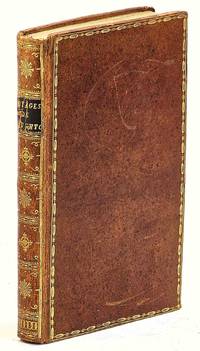
1797105650Paris: Chez Tavernier. 1797. 1st ed. An VI. Octavo full-leather binding with gilt-stamped decorations bands and title to spine gilt dec border to boards contemporary marbled endpapers pp viii 243 last page misprinted as 343. Three large folding engraved maps drawn up by Major James Rennell the leading British geographer of his time when Mungo Park returned from West Africa: all in very good condition. Spine rubbed minor scuffs to boards front free endpaper just starting to detach. Very good condition. First edition. Published in Paris in the revolutionary "An VI" 1797. Describes the explorations in the interior of Africa of Daniel Houghton 1740 - 1791 and Mungo Park 1771 - 1806. Daniel Houghton was sent by the African Association the Association for Promoting the Discovery of the Interior Parts of Africa; his instructions were to sail to the mouth of the Gambia navigate the river to the Barra Kunda falls and then to travel overland to the Hausa lands to the east. He was one of the first European explorers in the interior of Africa but after a successful visit in Bambouk territory he disappeared somewhere on his journey to Timbuctoo his last despatch being in July 1791. Mungo Park was then sent by the African Association and travelled more extensively in West Africa. He published the book "Travels in the interior districts of Africa" in 1799 i.e. this book precedes Park's publication. Uncommon. 1st Edition. Leather. Chez Tavernier hardcover
185547110Paris, Mallet-Bachelier, 1855 a. 1857. 4to. No wrappers. In: ""Comptes Rendus Hebdomadaires des Séances de L'Academie des Sciences"", Tome 41, No 13 and Tome 44, No 12 a. No. 26. Pp. 461-500, pp. 578-640 a. pp. 1293-1363 (3 entire issues offered). Bernard's papers: pp. 461-469, pp. 578-586 a. pp. 1325-1331. Some scattered brownspots to the first paper.
185048830(Paris, Bachelier),1850. 4to. No wrappers. In: ""Comptes Rendus Hebdomadaires des Séances de L'Academie des Sciences"", Tome XXXI, No. 17. With titlepage to vol. 31. Pp. (561-) 592. (Entire issue offered). Bernard's paper: pp. 571-574. Titlepage with a faint stamp to top and a stamp in lower margin.
192146992(London, Taylor and Francis), 1921. Blank wrapper. In: ""The London, Edinburgh, and Dublin Philosophical Magazine and Journal of Science"" Sixth Series, Vol.42, No. 252, December 1921. Pp. 873-1024, textillustr. a. 1 plate. (Entire issue offered). Chadwick & Bieler's paper: pp. 923-940, textillustr.
188047008Paris, Gauthier-Villars, 1880. 4to. No wrappers. In: ""Comptes Rendus Hebdomadaires des Séances de L'Academie des Sciences"", Tome 91, No 5 (entire issue offered). Pp. 251-310. The Curie's paper: pp. 294-295.
181042219(London, W. Bulmer and Co., 1810). 4to. No wrappers as extracted from ""Philosophical Transactions"" 1810 - Part I. Pp. 16-74 and 2 engraved plates showing Davy's electrochemical apparatus for decomposing substances. The plates dampstained. Text fine and clean.
181045887(London, W. Bulmer and Co., 1810). 4to. No wrappers as extracted from ""Philosophical Transactions"" 1810 - Part I. Pp. 16-74 and 2 engraved plates showing Davy's electrochemical apparatus for decomposing substances, Davy's versions of the Voltaic-pile.. Plates a bit brownspotted, otherwise clean and fine, wide-margined.
180950198Paris, Mad. Ve Barnard, 1809. Contemp. hcalf. Spine gilt. Wear to top of spine. A few scratches to binding. Small stamps on verso of titlepage.In: ""Annales de Chimie, ou Recueil de Mémoires concernant la Chemie"" Tome 70. 336 pp. (Entire volume offered). Davy's paper: pp. 189-254.
182543119(London, W. Nicol, 1825). 4to. No wrappers as extracted from ""Philosophical Transactions"" 1825 - Part II. Pp. 440-466. Clean and fine.
184242843(London, Richard and John E., Taylor, 1842.). 4to. No wrappers as extracted from ""Philosophical Transactions"" 1842 - Part II. Pp. 181-214 and one double-page folded engraved plate.
187547271(Paris, Gauthier-Villars), 1875. 4to. No wrappers. In: ""Comptes Rendus Hebdomadaires des Séances de L'Academie des Sciences"", Tome 81, No 12 and No 23. Pp. (485-) 508 a. (1065-) 1148. (2 entire issues offered). Boisbaudran's papers: pp. 493-495 a. pp. 1100-1105.
184847149(Paris, Bachelier), 1848. 4to. No wrappers. In: ""Comptes Rendus Hebdomadaires des Séances de L'Academie des Sciences"", Tome 26, No 21. Pp. (529-) 548. (Entire issue offered). Pasteur's paper: pp. 535-538.
184849456(Paris, Bachelier), 1848. 4to. No wrappers. In: ""Comptes Rendus Hebdomadaires des Séances de L'Academie des Sciences"", Tome 26, No 21. Pp. (529-) 548. (Entire issue offered). Pasteur's paper: pp. 535-538. Clean and fine.
189549284London, arrison and Sons, 1895. - (Paris, Gauthier-Villars), 1895. 8vo. and 4to. Later full cloth, gilt lettering to spine (Ramsay) and without wrappers (Cleve). In ""Proceedings of the Royal Society"" (Ramsay), Vol. 58. (Entire vol. offered). And in ""Comptes Rendus Hebdomadaires des Séances de L'Academie des Sciences"" (Cleve), Tome 120, No 15. Pp. (797-) 850. (Entire issue offered). Ramsay's papers: pp. 65-67 and pp. 81-89. - Cleve's paper: p. 834. Stamps tp edges and a few corners a bit bumped on vol. 58, otherwise clean and fine.
183643417(Leipzig, Johann Ambrosius Barth, 1836). Without wrappers. In ""Annalen der Physik und Chemie. Hrsg. von J.C. Poggendorff"", Band 38, No. 6 (= Zweyte Stück). Titlepage to Vol. 38. Pp. 241-450 a. 3 engraved plates.(Entire issue offered, Heft No. 6, Bd. 38). Schwann's paper: pp. 358-364. Clean and fine.
190051313(Paris, Gauthier-Villars, 1900). 4to. No wrappers. In: ""Comptes Rendus Hebdomadaires des Séances de L'Academie des Sciences"", Tome 130, No 15 a. No 18. Pp. (962-) 1044 a. pp. (1145-) 1220. Entire issues offered. Villard's papers: pp. 1010-1012 a. 1178-1182, textillustrations. Clean and fine.
185547110Paris Mallet-Bachelier 1855 a. 1857. 4to. No wrappers. In: "Comptes Rendus Hebdomadaires des Séances de L'Academie des Sciences" Tome 41 No 13 and Tome 44 No 12 a. No. 26. Pp. 461-500 pp. 578-640 a. pp. 1293-1363 3 entire issues offered. Bernard's papers: pp. 461-469 pp. 578-586 a. pp. 1325-1331. Some scattered brownspots to the first paper. <br/><br/><em>First printing of these two milestone-papers in physiology in which Bernard discovers and isolates glycogen from the liver shows that it is converted into blood glucose and discovers the process of gluconeogenesis. He further creates the concepts "experimental determination" and "local interieur"Bernard undertook the task of tracing out the various transformations of food stuffs within the animal organism beginning with the carbohydrates; and he not only found contrary to the accepted view that sugar was formed in the liver but he was also able to isolate a substance from the hepatic tissue which though not sugar was converted by fermentation into dextrose. He made a special study of its properties and called it "glycogen"."The culmination of Bernard's work on the glycogenic function of the liver. He invented the term "internal secretion" and can be said to have started the scientific investigation of the internal secretions although for 30 years the significance of his work was not generally realized. By his research on glycogene Bernard showed that the body not only can break down but can also build up complex chemical substances."Garrison & Morton .Claude Bernard 1813-78 was a key figure in French nineteenth-century science and one of the world's great physiologists. With good reason he has been called the ‘father of experimental medicine’.Garrison & Morton No. 1000 a. 999.1 </em> unknown
185048830Paris Bachelier1850. 4to. No wrappers. In: "Comptes Rendus Hebdomadaires des Séances de L'Academie des Sciences" Tome XXXI No. 17. With titlepage to vol. 31. Pp. 561- 592. Entire issue offered. Bernard's paper: pp. 571-574. Titlepage with a faint stamp to top and a stamp in lower margin. <br/><br/><em>First appearance of the first exposition of the glycogenic function of the liver - one of the greatest physiological discoveries of the 19th century. Bernard showed that the liver builds up complex substances including glycogen from the nutriment brought to it by the blood and that these are subsequently modified for distribution to the body.Dibner "Heralds of Science" No 131 - Horblit "One Hundred Books famous in Science" No. 11a here listing "Nouvelle Fonction du Foie" from 1853 but with the remark "The work appeared earlier in abbreviated form in the "Comptes rendus" the paper offered. - Exhibition of First Editions of Epochal Achievements in the History of Science Berkeley 1934. No 107. </em> unknown
192146992London Taylor and Francis 1921. Blank wrapper. In: "The London Edinburgh and Dublin Philosophical Magazine and Journal of Science" Sixth Series Vol.42 No. 252 December 1921. Pp. 873-1024 textillustr. a. 1 plate. Entire issue offered. Chadwick & Bieler's paper: pp. 923-940 textillustr. <br/><br/><em>First printingof this milestone paper in which the strong nuclear forces are mentioned for the first time."It was only in 1921 that Chadwick had first shown that at very small distances the interactions of alpha particles with the atomic nucleus did not follow exactly the inverse square law predicted from the repulsion of their positive electrical scharges. Chadwick concluded that his experiments showed that these nuclear forces are of "very great intensity". According to Pais this is THE FIRST PUBLISHED STATEMENT ABOUT THE EXISTENCE OF A STRONG NUCLEAR FORCE. This 'new force' interpretation was disputed untill well into 1920s."Hey & Walters."In any event Chadwick and Bieler's final conclusion avoid all reference to a possible electromagnetic cause for the deviations from the simple theory: "The present experiments do not seem to throw any light on the nature of the law of variation of the forces at the seat of an electric charge but merely show that the forces are of very great intensity. It is our task to find some field of force which will reproduce these effects." I consider this statement made in 1921 as marking the birth of the strong interaction."Pais in "Inward Bound" p. 240. </em> unknown
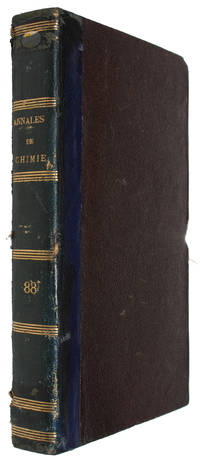
181343081Paris J. Klostermann 1813. Contemp. hcalf. Spine gilt. A few scratches to binding. In: "Annales de Chimie ou Recueil de Mémoires concernant la Chemie" Tome 88. - 336 pp. the entire volume offered. Pp. 304-310 311-318 319-321 a. 322-329. Scattered brownspots. <br/><br/><em>First printing of this paper announcing the discovery of Iodine. Courtois found this substance which he suspected to be a new element while burning algae in order to obtain sodium and potassium compounds. Although Courtois discovered the element in 1811 the announcement of it was not made until two years later after he had turned it over to Charles Desormés and Nicolas Clément."The first publication on iodine are somewhat confusing. Courtois's research is found in a paper attributed to him the paper offered but actually the work of Clément. was followed by an anonymous article the second paper offered. Gay-Lussac. who repeated and extended Courtios's work was responsible for this paper. Courtois himself published nothing. These two articles were immediately followed by short contributions of Gay-Lussac and Humphry Davy on the new element third and fourth paper offered. Gay-Lussacs views none too flattering to Davy on the history ofthe discovery of iodine appeared in his "Mémoire sur l'iode" 1814."DSB III p. 455. - Weeks "Discovery of the Elements" pp. 257-262.The volume contains further importent papers in chemistry Guyton de Morveau "Sur la chaux maigre" "Sur le dissolvant des pierres biliaires" an importent paper by Chevreul on animal fats "Recherches chimiques sur plusieurs corps gras et particulierement sur leurs combinaisons avec les alcalis" Berzelius's papers "Mémoires sur la compositions des fluides animaux" first edition in French Suite first edition Parmentier etc. etc. </em> unknown
181343081Paris, J. Klostermann, 1813. Contemp. hcalf. Spine gilt. A few scratches to binding. In: ""Annales de Chimie, ou Recueil de Mémoires concernant la Chemie"" Tome 88. - 336 pp. (the entire volume offered). Pp. 304-310, 311-318, 319-321 a. 322-329. Scattered brownspots.
188047008Paris Gauthier-Villars 1880. 4to. No wrappers. In: "Comptes Rendus Hebdomadaires des Séances de L'Academie des Sciences" Tome 91 No 5 entire issue offered. Pp. 251-310. The Curie's paper: pp. 294-295. <br/><br/><em>First apperance of the paper in which the two brothers announced their discovery of the Piezoelectric Effect as they observed how an electric potential appeared across crystals of quartza and of Rochelle salt when pressure was applied to them. The potential varied directly with the pressure and they named the phenomenon Piezoelectricity meaning "to press" Greek. Crystals with piezoelectric properties form an essential portion of sound-electronics devices such as microphones and record-players."The applications of piezoelectric crystals are innumerable; one of the most important is their use in frequency stabilization of oscillating electromagnetic cirasciots for radio broadcasting stations. They are used in most piezometers for measuring with great precision either very strong pressure variations such as those of a cannon at the moment of firing or very weak ones such as artery pulsations. These applications have led to the creation of a new industry the manufacture of large "mono" such as quartz obtained hydrothermally around 500°C. under high water pressures or crystals such as Rochelle salt obtained from aqueous solutions. These two substances were mentioned in the Curie brothers’ report announcing the discovery of piezoelectricity." DSB."The first experimental demonstration of a connection between macroscopic piezoelectric phenomena and crystallographic structure was published in 1880 by Pierre and Jacques Curie. Their experiment consisted of a conclusive measurement of surface charges appearing on specially prepared crystals tourmaline quartz topaz cane sugar and Rochelle salt among them which were subjected to mechanical stress. These results were a credit to the Curies' imagination and perseverance considering that they were obtained with nothing more than tinfoil glue wire magnets and a jeweler's saw." Piezo Systems Inc.Magee "A Source Book in Physics" p. 547 ff. </em> unknown
180950198Paris Mad. Ve Barnard 1809. Contemp. hcalf. Spine gilt. Wear to top of spine. A few scratches to binding. Small stamps on verso of titlepage.In: "Annales de Chimie ou Recueil de Mémoires concernant la Chemie" Tome 70. 336 pp. Entire volume offered. Davy's paper: pp. 189-254. <br/><br/><em>First edition in French the first English 1808 of this importent historical paper in chemistry in which Davy shows that electricity is capable of decomposing some alkalies isolating two new substances and discovering potassium and sodium. Neville in his Historical Chemical Library vol. I p.340 writes about this paper "ONE OF THE GREAT CLASSIC RESEARCHES IN CHEMISTRY in which Davy announced in this his second Bakterian lecture the isloation of metallic potassium and sodium by the electrolytic decomposition of their fused oxides.""He Davy began his own electrical experiments.The results were spectacular. On October 6 1807 the current passing through molten potash liberated a metal which Davy called potassium. The little globules of shining metal tore the water molecule apart as it eagerly recombined with oxygen and the liberated hydrogen burst into lavender flame. Davy danced about in a delirium of joy. A week later he isolated sodium from soda."Asimow. The paper offered here describes these discoveries."Humphry Davy was one of the most brilliant chemists of the early nineteenth century. His early study of nitrous oxide brought him his first reputation but his later and most importent investigations were devoted to electrochemistry. Following Galvani's experiments and the discovery of the voltaic pile interest in galvanic electricity had become widespread. The first electrolysis by means of the pile was carried out in 1800 by Nicholson and Carisle who obtained oxygen and hydrogen from water. Davy began to examine the chemical effects of electricity in 1800 and his numerous discoveries were presented in his Bakerian lecture to the Royal Society on November 20 1806. A Source Book in Chemistry p. 243. </em> unknown
181042219London W. Bulmer and Co. 1810. 4to. No wrappers as extracted from "Philosophical Transactions" 1810 - Part I. Pp. 16-74 and 2 engraved plates showing Davy's electrochemical apparatus for decomposing substances. The plates dampstained. Text fine and clean. <br/><br/><em>First appearence of this historical chemical paper Davy' fifth Bakerian Lecture in which he announced his discovery of hydrogen telluride."Mr. Davy having from the commencement of his electro-chemical researches communicated the several steps of his progress to the Society The Royal Society takes the present opportunity of reporting the results of his further inquiries under four principal heads. First on the nature of the metals of the fixed alkalis. Second on the nature of Hydrogen and composition of ammonia. Thirdly on the metals of the earth; and Fourthly he makes a comparison between the antiphlogistic doctrine and a modified phlogistic hypothesis."Abstract. He further gives arguments for considering potassium and sodium which he discovered in 1808 as a element."Humphry Davy was one of the most brilliant chemists of the early nineteenth century. His early study of nitrous oxide brought him his first reputation but his later and most importent investigations were devoted to electrochemistry. Following Galvani's experiments and the discovery of the voltaic pile interest in galvanic electricity had become widespread. The first electrolysis by means of the pile was carried out in 1800 by Nicholson and Carisle who obtained oxygen and hydrogen from water. Davy began to examine the chemical effects of electricity in 1800 and his numerous discoveries were presented in his Bakerian lectures." - Wheeler Gift: 2518. </em> unknown
181045887London W. Bulmer and Co. 1810. 4to. No wrappers as extracted from "Philosophical Transactions" 1810 - Part I. Pp. 16-74 and 2 engraved plates showing Davy's electrochemical apparatus for decomposing substances Davy's versions of the Voltaic-pile. Plates a bit brownspotted otherwise clean and fine wide-margined. <br/><br/><em>First appearence of this historical chemical paper Davy' fifth Bakerian Lecture in which he announced his discovery of hydrogen telluride."Mr. Davy having from the commencement of his electro-chemical researches communicated the several steps of his progress to the Society The Royal Society takes the present opportunity of reporting the results of his further inquiries under four principal heads. First on the nature of the metals of the fixed alkalis. Second on the nature of Hydrogen and composition of ammonia. Thirdly on the metals of the earth; and Fourthly he makes a comparison between the antiphlogistic doctrine and a modified phlogistic hypothesis."Abstract. He further gives arguments for considering potassium and sodium which he discovered in 1808 as a element."Humphry Davy was one of the most brilliant chemists of the early nineteenth century. His early study of nitrous oxide brought him his first reputation but his later and most importent investigations were devoted to electrochemistry. Following Galvani's experiments and the discovery of the voltaic pile interest in galvanic electricity had become widespread. The first electrolysis by means of the pile was carried out in 1800 by Nicholson and Carisle who obtained oxygen and hydrogen from water. Davy began to examine the chemical effects of electricity in 1800 and his numerous discoveries were presented in his Bakerian lectures." - Wheeler Gift: 2518.Also with William Hyde Wollaston "The Croonian Lecture. Read November 16 1809.On Muscular Action - On Sea-Sickness - On the salutary Effects of Riding and other Modes of Gestation. Pp. 1-15. </em> unknown