1 815 résultats
183247933Paris Crochard 1832. Contemp. hcalf. Spine gilt. Light wear along edges. Stamps to verso of titlepage. In: "Annales de Chimie et de Physique" 2e Series vol. 51. Entire volume offered. 448 pp. a. 1 folded engraved plate. Faraday's letter: pp. 404-434. Internally clean and fine. <br/><br/><em>First printing of Faraday's famous letter to Gay-Lussac in which he claim to be the discoverer of electro-magnetic induction analysed the results of the Italian philosophers pointing out their errors and defending himself from what he regarded as imputations on his character. The style of this letter is unexceptionable for Faraday could not write otherwise than as a gentleman; but the letter shows that had he willed it he could have hit hard. The letter was later translated into English and published in "Philosophical Magazine" in 1840 under the title "On Magneto-electric Induction"."In 1831 seemingly out of nowhere came the discovery of electromagnetic induction and the beginning of the experimental researches in electricity which were to lead Faraday to the discovery of the laws of electrochemistry specific inductive capacity the Faraday effect and the foundations of classical field theory." DSB. The volume contains further importent papers by AMPÈRE "Note sur une Experience de Hippolyte Pixii relative au Courant produit par la Rotation d'un aimant à l'aide dün appareil imagine par M. Hippolyte Pixii" WÖHLER et LIEBIG "recherches sur le Radical de l'Acide benzoique" and "Lettre de M. Berzelius sur le Benzoyle et l'Acide benzoique" papers by Strohmeyer Gay-Lussac Dutrochet Boussingault BERZELIUS "Sur le Bleu de Prusse et le Cyanoferrure de plomb" etc. etc. </em> unknown
180843299Paris Chez Mad. Ve. Bernard 1808 Contemp. hcalf. gilt spine. Some scratches to binding. Verso of titlepage and plates with small stamps.In: "Annales de Chimie" Vol. 68. - 358 pp. a. 3 engraved plates. The entire volume offered. Gay-Lussac's a. Thenard's paper: pp. 169-174. <br/><br/><em>First announcement of the results that they had obtaines by treating boric acid with potassium showing that acid is composed of a combustible substance and oxygen. "Before regarding their proof of the existance of a new element as complete Gay-Lussac and Thenard wished not only to decomposed boric acid but to recompose it. On November 30 of the same year they were able to state in the 'Annales de Chemie et de Physique" the paper offered that "the composition of boracid s no longer problematical. In fact said they "we decompose and we recompose this acid at will" Weeks "Discovery of the Elements" p. 160. - Parkinson "Breakthroughs" 1808 C. - Bunch 1808.The volume contains other importent paper Davy's famous paper on electrolysis in first French translations Gayton-Morveau"Description d'un hygrometre pour le gaz." d¨'Arcet "Observations sur la potasse et sur la soude préparées à l'alcool" etc. </em> unknown
183747418London Richard and John E. Taylor 1837. No wrappers. Extracted fron "Scientific Memoirs selected from The Transactions of Foreign Academies of Science and Learned Societies. Edited by Richard Taylor." Vol. I. Pp. 540-547. <br/><br/><em>Henry's milestone paper announcing his discovery of electrical self-induction. "Henry independently discovered electro-magnetic induction and in this paper announced his discovery of electric self-induction one of the prime properies of an electro-magnetic circuit. Henry was an eminent experimenter but was casual in publishing his findings with resulting lack of recognition of his contributions."Bern Dibner.Dibner "Heralds of Sciece" No.63.It was also printed the same year in "Transactions of the American Philosophical Society New Series Vol. 5". The paper was later printed in "Philosophical Magazine" 1840."The direction of Henry’s thought became somewhat apparent in his 1835 paper refers to the papers reading before the American Phil. Soc. febr. 6th 1835 on the action of a spiral conductor in increasing the intensity of galvanic currents. The paper started out as an affirmation of Henry’s priority in the discovery of self-induction. He then combined induction proper using Faraday’s findings and his own with selfinduction to show how these produce a pattern of repulsions yielding an increased effect in spirals. He specifically linked these “magneto-electrical†results to the principles of static induction developed by Cavendish and Poisson. This explanation was then applied to Savary’s report of changes of polarity when magnetic needles were placed at varying distances from a wire in which a current was being transmitted "Mémoire sur l’aimantation" in Annales de chimie et de physique 34 1827. That is currents appeared periodically in the air surrounding a current-bearing straight wire as a result of the actions of induction and self-induction." DSB.Wheeler Gift: 2724-2725a. </em> unknown
184342662London Richard and John E. Taylor 1843. 4to. No wrappers as extracted from "Philosophical Transactions" 1843 - Part I. Pp. 1-6. <br/><br/><em>First appearance of a pioneer-paper in the history of early photography as Herschel here for the first time describes his discovery of the iron printing process with ammonio-citrate of iron by both methods namely with blue lines on a white background and white lines on a blue ground. </em> unknown
186959086Paris Gauthier-Villars 1869. 4to. In: "Comptes Rendus Hebdomadaires des Séances de L'Academie des Sciences" Tome 68 No 7. Pp. 349- 408. Entire issue offered. Janssen's paper pp. 367-376. <br/><br/><em>First printing of the paper in which Janssen announced the discovery of a new element. On August 18 1868 Janssen managed to do just that. He became the first person to observe helium an element never before seen on Earth in the solar spectrum. At the time though Janssen didn’t know what he’d seen"just that it was something new""Helium the second most abundant element in the universe was discovered on the sun before it was found on the earth. Pierre-Jules-César Janssen a French astronomer noticed a yellow line in the sun's spectrum while studying a total solar eclipse in 1868. Sir Norman Lockyer an English astronomer realized that this line with a wavelength of 587.49 nanometers could not be produced by any element known at the time. It was hypothesized that a new element on the sun was responsible for this mysterious yellow emission. This unknown element was named helium by Lockyer." </em> unknown
181843871Paris Crochard 18181819. No wrappers. In: "Annales de Chimie et de Physique Par MM. Gay-Lussac et Arago." tome 8 Cahier 3 a. 10 Cahier 2 pp. 225-336 and pp. 129-240. Entire issues offered. Pelletier & Caventou's papers: pp. 323-324 tome 8 and pp. 142-176 tome 10. A few scattered brownspots. <br/><br/><em>First printing of these classic papers in chemistry in which the authors announced their discovery of Strychnine. This was the first alkali of vegetable origin to be discovered after morphine. This discovery and their discovery of chlorophyll brought them international fame. The first small paper contains the announcement of the discovery and the second long memoir contains the elaborate exposition of the discovery."Strychnine was only the second alkaloid to be extracted the first was morphine. Pelletier and Caventou wanted to name their new alkaloid vauqueline after Nicolas Vauquelin one of their associates who had refined the technique of ether extraction for use in isolating alkaloids. However the officers of the Académe des Sciences in Paris rejected the idea on the grounds that a respected scientist’s name should not be paired with a deadly poison. In addition to strychnine the pair isolated other important compounds from plants including caffeine chlorophyll and the anti-malaria drug quinine. Paul L. Burnham.Parkinson:"Breakthroughs" 1818 C. - Garrison & Morton: 1846.The first issue also contains their importent memoir "Examen chimique de la Cochenillee et de sa matière colorante" pp. 250-287 which describes how they obtained crotonic acid from croton oil and analyzed carmine in the cochineal. </em> unknown
180143492Halle Rengerschen Buchhandlung 1801. Without wrappers as published in "Annalen der Physik. Herausgegeben von Ludwig Wilhelm Gilbert" Bd. 7 Viertes Stück. The entire issue offered =Heft 4. Pp. 387-528. Ritter's announcement p. 525. With titlepage to volume 7. Clean and fine. Titlepage a bit shavedin inner margin. <br/><br/><em>First printing of Ritter's announcement of his discovery of ultraviolet light in a halfpage letter addressed to Gilbert's Annalen. With that discovery it became clear that visible light represents no more than a fraction of a continous spectrum.A year earlier in 1800 William Herschel discovered infrared light. This was the first time that a form of light beyond visible light had been detected. After hearing about Herschel's discovery of an invisible form of light beyond the red portion of the spectrum Ritter decided to conduct experiments to determine if invisible light existed beyond the violet end of the spectrum as well. He had heard that blue light caused a greater reaction in silver chloride than red light did. Ritter decided to measure the rate at which silver chloride reacted to the different colors of light. He directed sunlight through a glass prism to create a spectrum. He then placed silver chloride in each color of the spectrum and found that it showed little change in the red part of the spectrum but darkened toward the violet end of the spectrum. Johann Ritter then decided to place silver chloride in the area just beyond the violet end of the spectrum in a region where no sunlight was visible. To his amazement this region showed the most intense reaction of all. This showed for the first time that an invisible form of light existed beyond the violet end of the visible spectrum. This new type of light which Ritter called Chemical Rays later became known as ultraviolet light or ultraviolet radiation the word ultra means beyond. - Parkinson Breakthroughs: 1801 P. </em> unknown
183143365Paris Crochard 1831. No wrappers as extracted from "Annales de Chimie et de Physique" 2. Series Tome 48. Titlepage to vol. 48. Pp. 113-157. A few brownspots but fine. Small stamps on verso of titlepage. <br/><br/><em>First appearance of an importent paper in chemistry and medicine as it for the first time relates the finding of Chloroform which some years later was proved to have anaesthetic effects and was introduced in chirurgy in 1848 by Simpson.Justus von Liebig Souberain and Guthrie independently discovered Chloroform in 1831 but Souberain was the first to publish his results. - Garrison & Morton No. 1851. - Gedeon "Science and Technology in Medicine" 36.7. </em> unknown
18541171231854 A Paris, Garnier Frères, Libraires-éditeurs - 1854 - Sixième édition - 7 volumes in-4, demi basane marron; filets à froid au dos; titres, auteur et fleurons dorés - 611 + 649 + 691 + 667 + 773 + 631 pages pour les 6 volumes + 86 planches pour l'Atlas - Quelques illustrations en N&B hors texte + Quelques planches dépliantes à la fin du premier volume
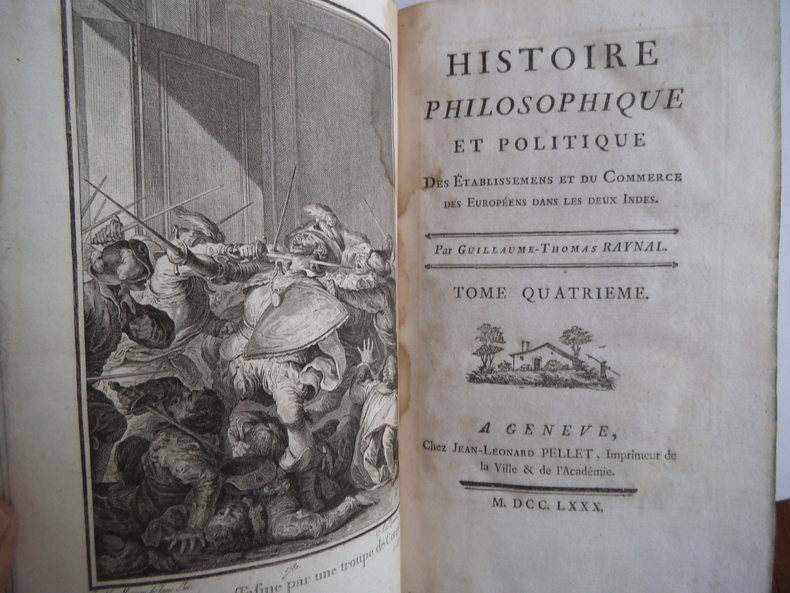
102369 tomes sur 10 en 9 volumes in 8 pleine cuir fauve raciné, pièce de titre cuir rouge, pièce de tomaison cuir vert, roulette, filets, fers dorés, triple filet doré encadrant les plats, roulette dorée sur coupes, tranches marbrées. Tome1 : faux-titre, portrait de l’auteur, en médaillon d’après COCHIN gravé par LARDY. Titre, XVI-532 pages. (Petite mouillure angle supérieur droit en début de volume) Tome 2 : faux-titre- 1 gravure en frontispice, titre, VIII, 582 pages. Tome 3 : faux-titre, 1 gravure en frontispice, titre, VIII, 580 pages(une pâle mouillure angle supérieur droit, en début de volume, une mouillure triangulaire en partie supérieure, aux dernières pages de table des matières. Tome 4 : faux titre, une gravure en frontispice, titre, VIII, 472 pages. Tome 5 faux-titre, une gravure en frontispice, titre, VII, 405 pages. Tome 6 : faux-titre, gravure en frontispice, titre, VII, 484 pages, pâle moulure en marge extérieure, plus apparente en fin de fin de volume. Tome7 : faux-titre, gravure en frontispice, titre, XVI, 558 pages. Tome 8 : faux-titre, gravure en frontispice, titre, II-538 pages. Pas de tome 9. Tome 10 : faux-titre, gravure en frontispice, titre, II, 538 pages. A Genève chez jean Léonard PELLET 1780. Les gravures en frontispice sont de MOREAU LE JEUNE. Troisième édition, la meilleure et la plus complète, le nombre de volume passe de 7 volumes auparavant, à 10 volumes. Belle édition sur beau papier.
75371aafBasel, C. Schultze, 1864, in-8vo, nach Angaben im Helveticat, (Kat. schweiz. Landesbibl. on-line): ohne die 12 kolorierten Lithogr. die dazugehören, Halbleder d. Zeit, Rückenvergoldung.
198447169London, Royal Society, 1984. Royal8vo. Full buckram, gilt lettering to spine.In: ""Proceedings of the Royal Society of London"", Series A, vol. 392. IV,478 pp. (Entire volume offered). Berry's paper: pp. 45-57. Clean and fine.
198447169London Royal Society 1984. Royal8vo. Full buckram gilt lettering to spine.In: "Proceedings of the Royal Society of London" Series A vol. 392. IV478 pp. Entire volume offered. Berry's paper: pp. 45-57. Clean and fine. <br/><br/><em>First printing of the paper in which Berry describes his discovery of the "Berry phase" a unifying concept in quantum mechanics."In 1983 Berry made the surprising discovery that a quantum system adiabatically transported round a closed circuit in the space of external parameters acquires besides the familiar dynamical phase a non-integrable phase depending only on the geometry of the circuit. This Berry phase which had been overlooked for more than half a century provides us a very deep insight on the geometric structure of quantum mechanics and gives rise to various observable effects. The concept of the Berry phase has now become a central unifying concept in quantum mechanics with applications in fields ranging from chemistry to condensed matter physics. In particular the Berry phase plays an important role in modern magnetism an allows to reach a deeper understanding of a broad range of phenomena such as the spin-orbit coupling the Aharonov-Bohm effect the quantum Hall effect the anomalous Hall effect the magnon dynamics the tunneling of magnetization in molecular magnets etc. Further in the light of the Berry phase a number of new phenomena can be predicted in ferromagnets with a textured magnetization or in semiconductors with spin-orbit coupling." Patrick Bruno. </em> hardcover
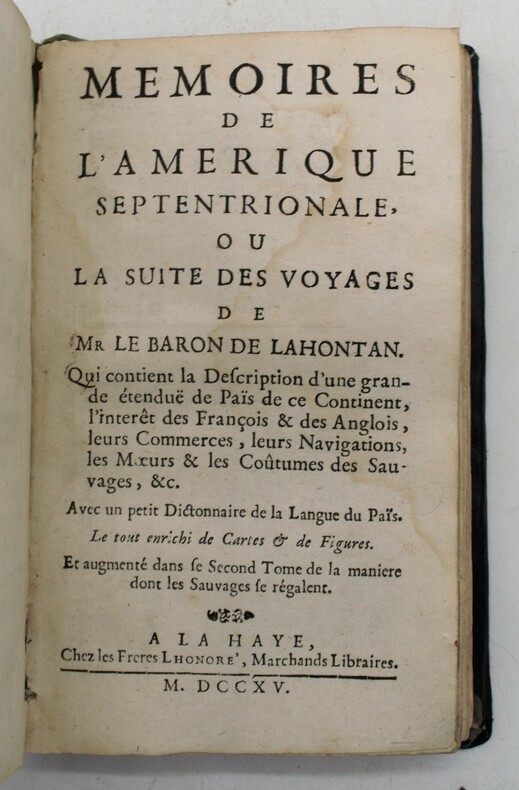
1715PHO-1389A La Haye : chez les frères L'Honoré, & compagnies, 1715 2 volumes in-12° (163x100 mm). 9ff-280-2ff-222-9ff., illustré d’un frontispice et 1 planche (sur 23), avec un dictionnaire de la langue des Algonkins et quelques mots de Hurons , reliure refaite , dos conservé avec ses manque , plats en cuir noir, coloriage sur la planche, ex-libris manuscrit sur la page de garde .
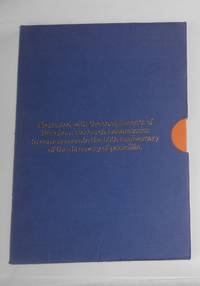
1979TN254373British Journal of Experimental Pathology / Beecham Research Laboratories London 1979. 1st Edition Thus. SOFTCOVER. Mde to commemorate the 50th anniversary of the discovery of penicillin and published by Beecham Research Laboratories in 1979. 4to in black printed orange card covers pages numbered 191 to 236 - a very nicely produced facsimile using well matched paper of the exact size of the complete issue for June 1929 which contains Flemings famous paper. Housed in a cloth backed thin card slip-case with single leaf insert on thick glossy paper with a brief history and time-line for penicillin. Fleming made his own limited edition reprint of the offprint in 1944 but this is the first reprint of the whole issue. __CONDITION : The journal and insert are AS NEW the slipcase is a little shelf rubbed and faintly sunned. Overall an excellent copy of this facsimile which has become almost as hard to find as the original. __NOTE. Depending on destination this item may require an extra payment for shipping insurance. If so orders made by card will be completed only after you have approved the extra cost. . __We always ship in PROTECTIVE CARD PARCELS British Journal of Experimental Pathology / Beecham Research Laboratories, London paperback
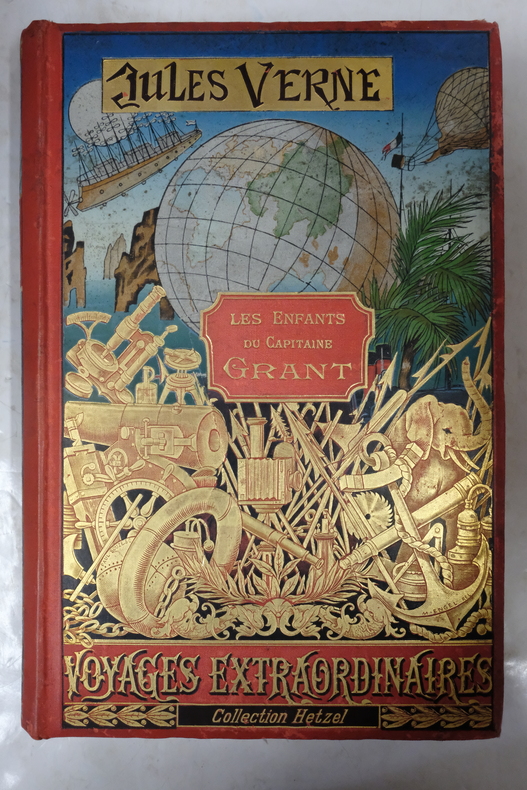
LIT9665MGrand in-8 , relié cartonnage dit à la "mappemonde" et au dos à l'ancre . Sans date environ 1897 . 620 pages. Bon état général. Tranches dorées. Couverture convenable, légères décolorations, intérieur satisfaisant, rousseurs quasi anodines.
1920003911Paris Editions de l'Effort Moderne, Léonce Rosenberg 1920 In-8 Agrafé Edition originale
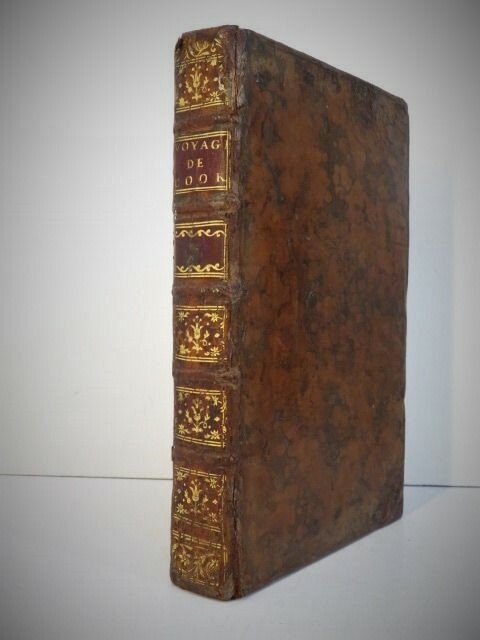
1782PHO-1839Paris, Chez Pissot père et fils, Chez Laporte, (1782) 1 volume in-octavo (20 x 12,7 cm) de X-508 pp., Reliure plein veau marbré d'époque, dos lisse orné avec pièce de titre, tranches rouges, illustré de la gravure de la mort de Cook, la carte est manquante, défauts à la reliure, mouillure en fin d’ouvrage.
1782PHO-717Paris ,Chez Pissot père et fils, Chez Laporte, (1782) 1 volume in-octavo (20 x 13 cm) de X-508 pp. Reliure plein veau marbré d'époque, dos à nerfs orné avec pièce de titre,la carte et le frontispice sont manquants.
1832LRB031003In-8° très bon état, reliure époque, dos long, roulette en tête et queue, coiffe de tête arasée, demi veau vert légèrement insolé. Rousseurs éparses XII-361 p. - 1 ff°
Volume I - 413 pages plus fold-out map. Volume II - 426 pages. Includes appendix on the physical geography of North America. Both volumes clean, bright and unmarked with lightest wear. Possibly unread. Excellent copy. Book
First edition, 8vo (215 x 135 mm), xi, [1], 320pp., without half-title, frontispiece of a large folding engraved chart (browned and offset onto title), one engraved map (also browned and offset), woodcut illustrs., in the text, cont. half calf, marbled boards, slightly rubbed otherwise and very good copy. "The journal of the first voyage commanded by William Edward Parry. On this expedition, Fisher was assistant surgeon aboard the Hecla. He gives an account of the voyage through Lancaster Sound to Melville Island in the western part of the Parry Archipelago, in sear of the Northwest Passage."?Hill. Hill, Pacific Voyages, 605 (second edition).
185847111Paris, Mallet-Bachelier, 1858. 4to. No wrappers. In: ""Comptes Rendus Hebdomadaires des Séances de L'Academie des Sciences"", Tome 47, No 6 a. No 10. Pp. (245-) 279 a. pp. (393-) 431 (entire issues offered). Bernard's papers: pp. (245-) 253 a. pp. (393) -400.
185847111Paris Mallet-Bachelier 1858. 4to. No wrappers. In: "Comptes Rendus Hebdomadaires des Séances de L'Academie des Sciences" Tome 47 No 6 a. No 10. Pp. 245- 279 a. pp. 393- 431 entire issues offered. Bernard's papers: pp. 245- 253 a. pp. 393 -400. <br/><br/><em>First appearance of these landmark papers in which Barnard explains his discovery of how the nerves controls the blood vessels. This is the "discovery of the vascoconstrictor and vasodilator nerves and description of their function of regulating the blood supply to the different parts of the body."Garrison & Morton No. 774."In 1858 the papers offered Bernard demonstrated the existence of vasodilator nerves by finding an increased blood flow through the submaxillary gland when the corda tympani is stimulated. He also observed that the venous blood became bright red. Since that time an enormous amount of research has been carried out on the vasomotor system."R.J.S. Mcdowall.Garrison & Morton No. 774. </em> unknown
180Un volume in 12 plein veau fauve raciné à nerfs,pièce de titrecuir rouge,fers,filets dorés,titre en noir et rouge.X.394 pages.Utrecht chez Guillaume Van poolsum 1706.sans le portrait en frontispice,et la carte. Petites restaurations,bon état d'ensemble.Peu courant Relation de l'origine du progrès et de la décadence de l'ordre Teutonique.Des révolutions qui sont arrivées en ce Pays jusqu'à notre temps,avec les guerres que les Polonais,les Suédois & les Moscovites ont eües ensemble pour cette province.On y décrit les duchez de Courlande et de Semigallie & la province de Pilten.Enfin on y trouve le voyage de l'auteur en Livonie,en Hollande l'an 1698 avec quelques remarques sur la Prusse,Brandebourg,Hanover, Hesse & plusieurs autres cours d'Allemagne.