1 815 résultats
183743739Leipzig, Johann Ambrosius Barth, 1837. Without wrappers as issued in ""Annalen der Physik und Chemie. Hrsg.von Poggendorff"", Bd. 41, Zweites Stück. (Entire issue No 6 offered). Titlepage to vol. 41. Pp. 225-448 a. 2 folded engraved plates. Wöhler & Liebig's papers: pp. 345-366, pp. 366-374 a. pp. 393-397. Clean and fine.
182659047Paris Crochard 1826. Contemp. hcloth. Gilt lettering on spine. In: "Annales de Chimie et de Physique par Gay-Lussac et Arago" tome 32. 448 pp. 3 folded engraved plates. Balard's paper: pp. 337-84. Entire volume offered with original memoirs by Savart Berzelius Humboldt Arago Poisson Liebig Dumas et al. <br/><br/><em>First printing of Balard's famous memoire in which he records his discovery of the new element Bromine le brôme. While he was studying the flora of a salt marsh he notized a deposit of sodium saulfate which had crystallized out in a pan containing mother liquer from common salts. "In an attempt to find a use for the waste liquers he performed a number of experiments and notized that when certain reagents were added the mother liquer bacame brown. His investigation of this phenomenon.ked to the remarkable discovery.Weeks p. 264. "The discovery of a new chemical element by a young and obscure provincial pharmacist caused a sensation in Paris. Balard's achievemnt was recognized by the Academie des Sciences and he was awarded a medal by the Royal Society of London."DSB I p. 416. "The discovery of bromine is a very importent acquisition to chemistry and gives M. Balrad honorable rank inthe career of the sciences. We are of the opinion that this young chemist is every way worthy of the encouragement of the Academy and we have the honour to propose that his memoir shall be printed in the "Recueil des Savants Étrangers" The report from the French Academy signed by Vaugelin Thenard and Gay-Lussac. </em> hardcover
187449327Leipzig Johann Ambrosius Barth 1874. 8vo. Contemp. hcalf. 5 raised bands gilt spine and gilt lettering to spine. A few scratches to spine. Small stamp on verso of first -and general- titlepage. In: "Annalen der Physik und Chemie. Hrsg. von J.C. Poggendorff" Sechste Reihe Bd. 3 = Poggendorff Bd. 153. X636 pp. 4 plates. Entire volume offered. Braun's paper: pp. 556-563. <br/><br/><em>First printing of Brown's importent paper in which he described his discovery of a semiconductor diode noting that electrical currents flows freely in only one direction at the contact between a metal point and a galena crystal."In 1874 Braun published the results of his research on mineral metal sulfides. He found that these crystals conducted electric currents in only one direction. This information was important in electrical research and in measuring another property of substances the electrical conductivity but Braun’s discovery did not have immediate practical application. In the early twentieth century the principle that Braun had discovered was employed in crystal radio receivers."DSB.The Nobel Prize in Physics 1909 was awarded jointly to Guglielmo Marconi and Karl Ferdinand Braun "in recognition of their contributions to the development of wireless telegraphy". </em> hardcover
181046377Paris J. Klostermann 1810. Contemp. hcalf. Spine gilt. Slightly rubbed. A few scratches to binding. Small stamps on verso of titlepage.In: "Annales de Chimie ou Recueil de Mémoires concernant la Chemie" Tome 75. 336 pp. a. 2 folded engraved plates. Some scattered brownspots. The papers: pp. 27-77 129-175 256-263 264-273 274-289 a. 290-316. <br/><br/><em>First French version of Davy's "The Bakerian Lecture for 1809. On some new Electrochemical Researches on various Objects particularly the metallic Bodies from the Alkalies and Earth and on some Combinations of Hydrogene. Read November 16 1809." together with the controversy papers by Davy and Gay-Lussac & Thenard."Mr. Davy having from the commencement of his electro-chemical researches communicated the several steps of his progress to the Society The Royal Society takes the present opportunity of reporting the results of his further inquiries under four principal heads. First on the nature of the metals of the fixed alkalis. Second on the nature of Hydrogen and composition of ammonia. Thirdly on the metals of the earth; and Fourthly he makes a comparison between the antiphlogistic doctrine and a modified phlogistic hypothesis."Abstract. He further gives arguments for considering potassium and sodium which he discovered in 1808 as a element.""Gay-Lussac had a slight rivalry between himself and the creation scientist Sir Humphry Davy. Davy was chemically preparing Potassium and Sodium through an electrical current and this made Gay-Lussac and Thénard envious of his success. They too decided to perform the same task but they had no battery at their disposal as Davy had so they had to form another way to chemically prepare the two elements. In 1808 they used a red-hot iron fused to potash the water-soluble form of a manufactured salt containing potassium to perform this task a method that Davy admitted had its advantageous qualities. Gay-Lussac and Thénard were successful in preparing Potassium and continued to make a full analysis of its chemical properties and began to use it for their own experiments. In 1809 Davy performed the same task using it to reduce Boron in Boracic acid." </em> unknown
190542829Leipzig S. Hirzel 1905. No wrappers. Issued in "Jahrbuch der Radioaktivität und Elekronik" 2. Bd. Heft 3. Hahn's paper: pp. 233-264. Enntire issue: pp. 233-262 = entire "Heft 3". Fine and clean. <br/><br/><em>First printing of this paper which is Hahn's Habilitation paper announcung his discovery of a new element in residues from a Ceylon mineral called Thorianite. He later showed that it is an intermediate disintegration product."Because the sample thorianite was small Ramsay proposed that Hahn confirm Marie Curie's determination of the atomic weight of radium by preparing it in some organic compounds thereby greatly increasing the total amount being examined and calculating the atomic weight from the measured molecular weights. Chance sometimes favors the unprepared mind and Hahn who familiarized himself with only the basic of radioactivity followed the prescribed separationss technique and found himself the discovere of a new radioelement: radiothorium. The explanation was that the material given him came from an ore which contained a large percentage of thorium in addition to the radium. Thus upon completion of the chemical procedure not all the activity was confined in the radium-containg fraction; indeed the nes subsyance in the remainder was several hundred thousand times more active than thorium and ultimately yielded the characteristic one.minute halflife of thorium emanation."DSB VI p. 15. - Weeks Discovery of the Elementsp. 308 ff. </em> unknown
187748136Paris Gauthier-Villars 1877. 4to. No wrappers. In: "Comptes Rendus Hebdomadaires des Séances de L'Academie des Sciences" Tome 85 No 3. Pp. 101- 168. Entire issue offered. Pasteur & Joubert's paper: pp. 101- 115. <br/><br/><em>First appearance of one of the founding papers in the realm of antibiotics being the discovery of "Vibrion septique" Cl. septicum the first pathogenic anaerobe to be found. "Pasteur and Joubert were probably the first to realize the practical implications of antibiosis. They noted the antagonism between Bacillus anthracis and other bacteria cultures in the paper offered"Garrison & Morton: No. 1932.1 and 2490. </em> unknown
183947232Paris Bachelier 1839. 4to. No wrappers. In: "Comptes Rendus Hebdomadaires des Séances de L'Academie des Sciences" Tome VIII No 13. Pp. 459- 504. Entire issue offered. Piria's paper: pp. 479-485. <br/><br/><em>First apperance of a main paper in pharmacology describing the discovery of Salicylic acid compound giving it the empirical formula C7H6O3. It is the most successful drug in history. A trillion tablets are consumed every year. Used to treat everything from headaches to heart disease from rheumatism to cancer - scientists are still struggling to understand all its qualities. But aspirin can truly claim the title of wonder drug.Raffaele Piria 20 August 1814 - 18 July 1865 an Italian chemist from Scilla who converted the substance Salicin into a sugar and a second component which on oxidation becomes salicylic acid a major component of an analgesic drug Aspirin acetylsalicylic acid.Garrison & Morton No 1857. </em> unknown
180343638Halle Rengerschen Buchhandlung 1803. Without wrappers as extracted from "Annalen der Physik. Herausgegeben von Ludwig Wilhelm Gilbert" Jahrgang 1802 Bd. 12 Zwölftes Stück. Pp. 409-416. Titlepage to vol. 12. <br/><br/><em>This is Ritter's first expositon of his discovery of ultraviolet light. It was announced the year before in a halfpage letter addressed to Gilbert's Annalen and printed in the Annalen. With that discovery it became clear that visible light represents no more than a fraction of a continous spectrum.A year earlier in 1800 William Herschel discovered infrared light. This was the first time that a form of light beyond visible light had been detected. After hearing about Herschel's discovery of an invisible form of light beyond the red portion of the spectrum Ritter decided to conduct experiments to determine if invisible light existed beyond the violet end of the spectrum as well. He had heard that blue light caused a greater reaction in silver chloride than red light did. Ritter decided to measure the rate at which silver chloride reacted to the different colors of light. He directed sunlight through a glass prism to create a spectrum. He then placed silver chloride in each color of the spectrum and found that it showed little change in the red part of the spectrum but darkened toward the violet end of the spectrum. Johann Ritter then decided to place silver chloride in the area just beyond the violet end of the spectrum in a region where no sunlight was visible. To his amazement this region showed the most intense reaction of all. This showed for the first time that an invisible form of light existed beyond the violet end of the visible spectrum. This new type of light which Ritter called Chemical Rays later became known as ultraviolet light or ultraviolet radiation the word ultra means beyond. </em> unknown
181943320Leipzig Johann Ambrosius Barth 1819. Without wrappers as issued in "Annalen der Physik. Hrsg. von Ludwig Wilhelm Gilbert" Bd. 60 Heft 2 = Jahrgang 1818 zehntes Stück. Pp. 113-218 a. 1 engraved plate map. The entire issue offered Heft 2. Stromeyer's paper pp. 193-210. Clean and fine. <br/><br/><em>First appearance of Strohmeyer's account of his discovery of Cadmium. The history of its discovery was very complicated as some other laid claim to its discovery.Stromeyer was inspector general of apothecaries in Hannover. "In 1817 fulfilling the duties of his office he came across an apothecary's shop in which a bottle labeled zinc oxide contained zinc carbonate. Following this up Stromeyer found himself interested in zinc carbonate which turned yellow on strong heating as though it contained iron as an impurity yet it contained no iron. He traced the yellow to an oxide not of zinc but of a hitherto unknown metal rather like it chemically. He named it cadmium for a zinc ore in which it is usually found accompanying the zinc."Asimov.Weeks "Discovery of the Elements" pp. 135-39. </em> unknown
182646031Leipzig Johann Ambrosius Barth 1826. Contemp. hcalf. Gilt spine. A few scratches to spine. In "Annalen der Physik und Chemie. Hrsg.von Poggendorff" Bd. 8. 10526 pp. and 3 folded engraved plates. Small stamps onverso of titlepage. Entire volume offered. Unverdorben's paper: pp. 253-265 397-410 477-487. Clean and fine. <br/><br/><em>First appearance of the paper in which Unverdorben describes the method by which he discovered Aniline which became so importent in the manufacture of dyes plastics and pharmaceuticals. "Aniline from the Portugese anil applied to indigo and derived from the Arabic an-nil the blue substance was first obtained by Unverdorben by heating indigo and was given the name 'crystalline'. In 1841 Carl Julius von Fritzsche 1807-71 an assistant to Mitscherlich and later a member of the Academy of Sciences in St. petersburg obtained the same compound from anthranilic acid which was produced by the action of caustioc alkalis on indigo and called it 'aniline'. in 1843 Hofmann showed that the three substances crystalline aniline and benzidam were identical with the base isolated from coal tar."Findlay "A Hundred years of Chemistry" p. 134.Parkinson "Breakthroughs" 1826 C.The volume contains other importent papers Antoine Jerome Balard "Ueber eine besondere Substanz im Meereswasser" in which he describes his discovery of the element BROMINE first German edition pp. 114-124 a. pp. 319-336. Parkinson "Breakthroughs" 1826 C. And Eilhard Mitscherlich "Ueber eine neue Klasse von Krystallformen" pp. 427-442. </em> unknown
190048207Paris Gauthier-Villars 1900. 4to. No wrappers. In: "Comptes Rendus Hebdomadaires des Séances de L'Academie des Sciences" Tome 130 No 15 a. No 18. Pp. 962- 1044 a. pp. 1145- 1220. Entire issues offered. Stamp on first pages. A few tears to margins. Poor paperquality fragile. Villard's papers: pp. 1010-1012 a. 1178-1182 textillustrations. <br/><br/><em>First apperance of Villard's two papers in which he announced and described the discovery of a new type of radiation more powerfull and penetrating than alpha-and beta rays. The new type of rays was named by Rutherford as gammarays."His Villardexperiments in radioactivity led to the unexpected discovery of gamma rays in 1900. Villard recognized them as being different from x rays because the gamma rays had a much greater penetrating depth. He had discovered they were emitted from radioactive substances and were not affected by electric or magnetic fields. These came to be called gamma rays by another scientist Ernest Rutherford. It wasn't until 1914 that Rutherford showed that they were a form of electromagnetic EM like light only with a much shorter wavelength than x rays. Now we know that gamma rays are a form of EM radiation similar to x rays. Gamma rays tend to have a higher energy and a shorter wavelength than x rays do. However the dividing line between these two forms of radiation is not clearly defined. Scientists typically apply the term gamma ray to EM radiation with energies above several hundred thousand electron volts." Hps - Healt Physics Society. - See Sigmund Brandt "The Harevst of a Century" Episode 6 p. 24 ff.The issues contains other importent papers HENRI BECQUEREL "Note sur la transmission du rayonnement du radium au travers des corps" pp. 979-984 and "Sur la transparance de l'aluminium pour le rayonnement du radium" pp. 1154-57. P. CURIE et G. SAGNAC "Électrisation négative des rayons secondaires produits au moyen des rayons de Röntgen" pp. 1013-1016. </em> unknown
183748086Paris Crochard et Comp. 1837. Orig. printed wrappers. No backstrip. In: "Annales de Chimie et de Physique Par MM. Gay-Lussac et Arago." tome 64 Cahier 2 Fevrier 1837. Pp. 113-224. Entire issue offered with printed wrappers. Wöhler a. Liebig's papers: pp. 185-209 a. pp. 209-217. <br/><br/><em>First appearance of this classic paper in organic chemistry in which Wöhler and Liebig showed how Amygdalin could be decomposed by a vegetable emulsion the first example of a glycoside. The papers were issued at the same time in "Annalen der Physik und Chemie"."The conclusions which you have drawn from the investigation of bitter-almond oil" wrote Berzelius to Liebig and Wöhler "are certainly the most importent which have so far been reached in the domain of vegetable chemistry and give promise of shedding an unexpected light over this part of the science.The facts which you have set forth inspire such reflections that they may be regarded as the dawn of a new day in vegetable chemistry."Berzelius-Wöhler Briefwechsel."During the years that Liebig was preoccupied with the ether theory and with organic acids he also carried out two importent investigations with Wöhler. In october 1836 Wöhler wrote that he had discovered a way to transform amygdalin to oil of bitter almonds and hydrocyanid acis by distilling it with manganese and sulfuric acid and he invited Liebig to join in pursuing the topic. Two days later he made a more remarkable discovery. It had occurred to him that perhaps thetransformation of amygdalin could be effected by the albumin in the almonds in a manner similar to the action of yeast in sugar.Wöhler suspected that the decomposition was an example of what Berzelius had recently defined as catalysis. Liebig and Wöhler then divided up the detailed examination of the properties and composition of amygdalin. They precipitated from the emulsion of almonds a substance which when dissolved retain its action. They named the active substance "emulsion". Its effectiveness in very small quantities confirmed that it acted like yeast."DSB VIII p. 342. </em> unknown
183743739Leipzig Johann Ambrosius Barth 1837. Without wrappers as issued in "Annalen der Physik und Chemie. Hrsg.von Poggendorff" Bd. 41 Zweites Stück. Entire issue No 6 offered. Titlepage to vol. 41. Pp. 225-448 a. 2 folded engraved plates. Wöhler & Liebig's papers: pp. 345-366 pp. 366-374 a. pp. 393-397. Clean and fine. <br/><br/><em>First appearance of this classic paper in organic chemistry in which Wöhler and Liebig showed how Amygdalin could be decomposed by a vegetable emulsion the first example of a glycoside."The conclusions which you have drawn from the investigation of bitter-almond oil" wrote Berzelius to Liebig and Wöhler "are certainly the most importent which have so far been reached in the domain of vegetable chemistry and give promise of shedding an unexpected light over this part of the science.The facts which you have set forth inspire such reflections that they may be regarded as the dawn of a new day in vegetable chemistry."Berzelius-Wöhler Briefwechsel."During the years that Liebig was preoccupied with the ether theory and with organic acids he also carried out two importent investigations with Wöhler. In october 1836 Wöhler wrote that he had discovered a way to transform amygdalin to oil of bitter almonds and hydrocyanid acis by distilling it with manganese and sulfuric acid and he invited Liebig to join in pursuing the topic. Two days later he made a more remarkable discovery. It had occurred to him that perhaps thetransformation of amygdalin could be effected by the albumin in the almonds in a manner similar to the action of yeast in sugar.Wöhler suspected that the decomposition was an example of what Berzelius had recently defined as catalysis. Liebig and Wöhler then divided up the detailed examination of the properties and composition of amygdalin. They precipitated from the emulsion of almonds a substance which when dissolved retain its action. They named the active substance "emulsion". Its effectiveness in very small quantities confirmed that it acted like yeast."DSB VIII p. 342. </em> unknown
185545031Paris Victor Masson 1855. 8vo. Without wrappers. In 'Annales de Chimie et de Physique' Series 3 tome 30 December-issue. With halftitle to vol. 30. Pp. 385-508 a. 1 plate. Entire issue offered. Wurtz's paper: pp. 443-506. <br/><br/><em>First appearance of the entire memoir in which Wurtz describes his outstanding discovery of Liebig’s prediction that there might be organic compounds analogous to ammonia and derivable from it by the replacement of hydrogen - the amines. The discovery was announced in 1849 and a small extract was printed in "Comptes rendu" 4 pp. The offered paper is the memoir in full.Wurtz is most noted for his investigation of glycols and for his discovery of the amines. The latter discovery in 1849 the paper offered was very significant at the time for ot suggested the possibility of a new type the ammonia type which helped to explain the behaviour of nitrogenous compounds. Leicester & Klickstein "A Source Book." pp. 362-63. - Parkinson "Breakthroughs" 1849 C.Charles Adolphe Wurtz was born at Strasbourg 1817. For many years he was Professor of Chemistry at the Ecole de Médicine and at Sorbonne in Paris. He was known not only for his researches in organic chemistry but also for his many literary works. He was editor of a Dictionnaire de Chemie Pure et Appliquée and after 1868 one of the editors of the Annalen der Chemie et de Physique. He died in Paris in 1884. </em> unknown
184947031Paris Bachelier 1849. 4to. No wrappers. In: "Comptes Rendus Hebdomadaires des Séances de L'Academie des Sciences" Tome 28 No 7. Pp. 189-240 entire issue offered. Wurtz's paper: pp. 223-226. <br/><br/><em>First appearance of the announcement of Wurtz's outstanding discovery of Liebig’s prediction that there might be organic compounds analogous to ammonia and derivable from it by the replacement of hydrogen - the amines. The entire memoir was not published in full until 1855 in 'Annales de Chimie et de Physique'.Wurtz is most noted for his investigation of glycols and for his discovery of the amines. The latter discovery in 1849 the paper offered was very significant at the time for ot suggested the possibility of a new type the ammonia type which helped to explain the behaviour of nitrogenous compounds. Leicester & Klickstein "A Source Book." pp. 362-63. - Parkinson "Breakthroughs" 1849 C. </em> unknown
104348Paris, Librairie de Gide Fils 1824, 210x135mm, 299pages, reliure cartonnage muet. Bon état, intérieur propre.
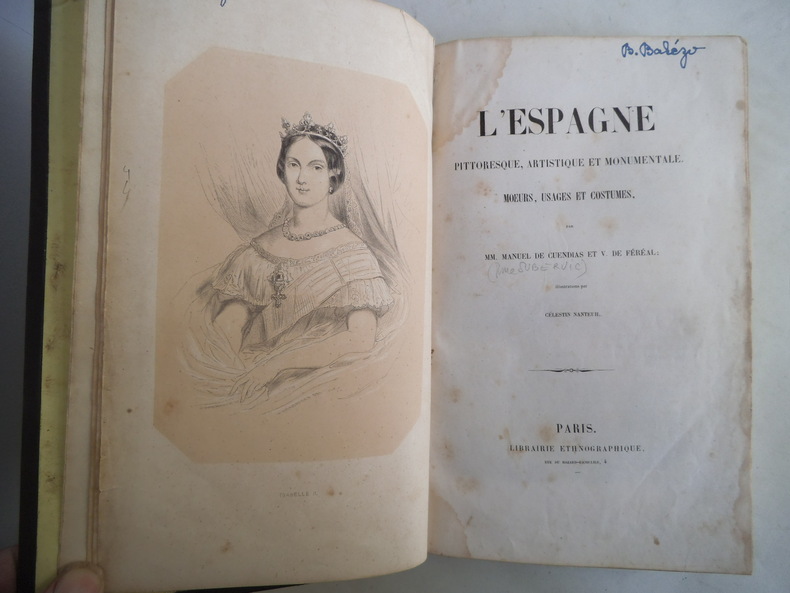
152In 8 reliure éditeur demi-cuir, titre et décor dorés en long au dos, plats percaline noire avec une grande plaque dorée animée sur premier plat petite plaque dorée sur le deuxième plat.Filets à froid en encadrement.faux-titre,frontispice (Isabelle II) titre,392 pages,deux feullets de table,chapitre et placement des gravures. Cinquante gravures hors texte de Célestin NANTEUIL,sous serpentes dont vingt cinq en couleurs gommées, cent bois dans le texte.Librairie ethnographique éditeur sans date. (1848)Edition originale (Vicaire volume II page 1074, Carteret volume III page 222)rousseurs habituelles. Une mouillure en tête s'amenuisant au fil des pages pour redevenir plus importante de la page 391 à la fin. Un vignette de collection a été collée sur la page de faux titre.
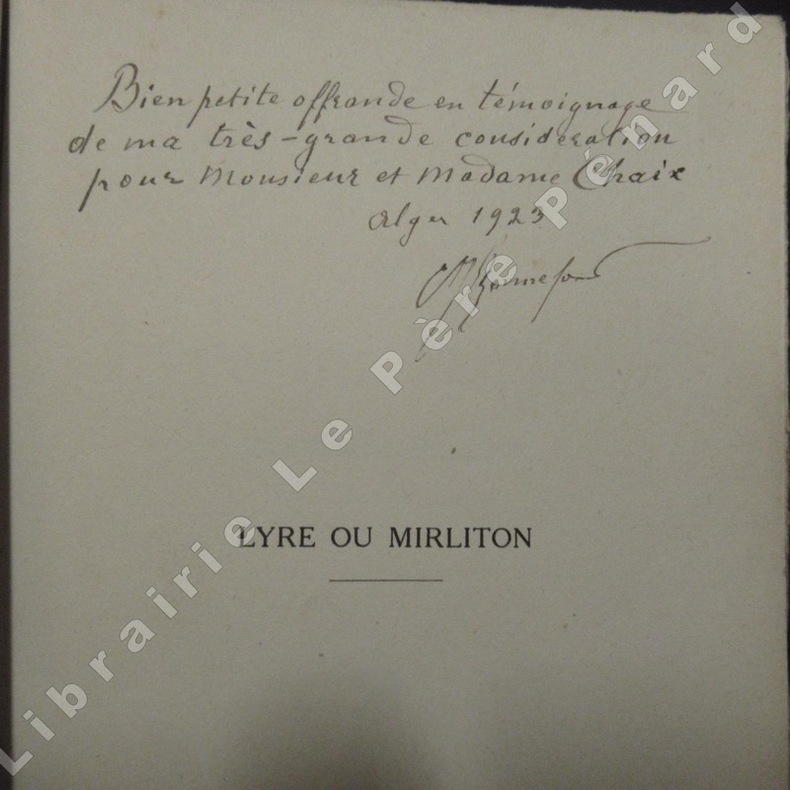
19221096411922 A Vienne, Chez Henri Martin, Imprimeur-Editeur - 1922 - In-12 (12,5 x 19cm environ), broché - 141 pages - Ouvrage rare - Envoi de l'auteur en page de titre, adressé à Monsieur et Madame Chaix (probablement Antonin Chaix)
295Six volumes in 8 demi-veau glacé fauve,fers dorés en long,titre doré,tranches marbrées,texte sur 2 colonnes. Contient la statistique et la description complète des 86 départements,orné de 740 vignettes et portraits gravés sur acier.de 86 cartes de départements.Par une société de gens de lettres,de géographes et d'artistes.sans la grande carte de France annoncée.Firmin Didot frères éditeur 1838.quelques charnières restaurées.Bon état d'ensemble.
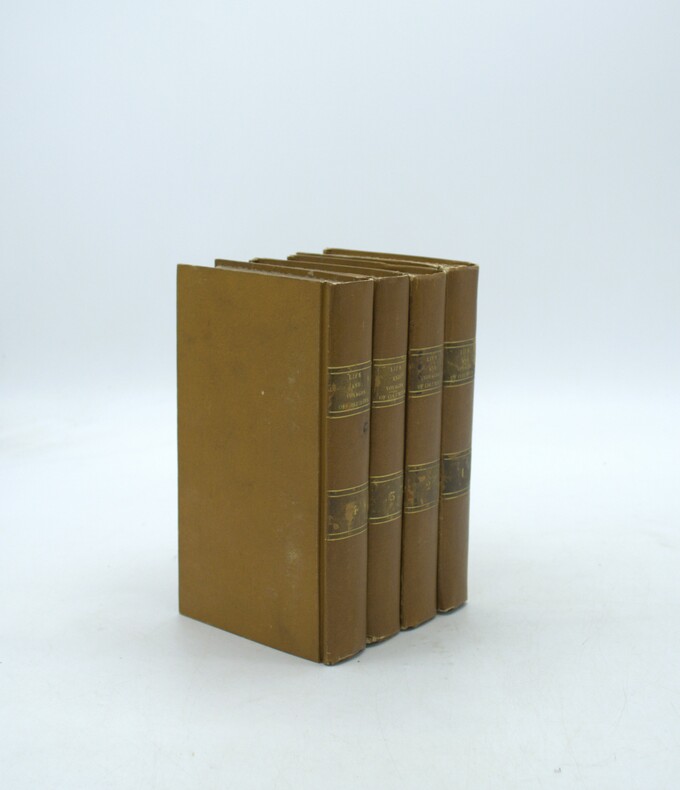
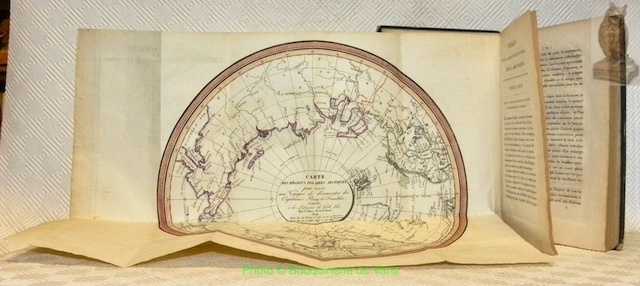
1828PHO-2111Paris, Baudry, 1828. 4 volumes in-8 (18,5 x 10,5 cm), reliés plein cartonnage d’époque, dos lisse avec pièces de titre et tomaison, quelques frottements aux pièces, coins légèrement usés, très peu de rousseurs. Illustré d’une carte dépliante en frontispice du premier volume.
723 pages including bibliography. Records the achievements of forty years of medical research, giving direct and easy access to over sixty of Dr. Best's original important research papers in the fields particularly of insulin, heparin, and choline. Opens with the early papers describing the discovery of insulin, and continues with those dealing with its preparation, extraction, physiologic effects and first clinical applications. Dr. Best has also looked back over the record as given in these papers and provided informative and informal bridges between them which place them in historical perspective. Contents clean, bright and unmarked. Negligible wear to book. Contains several colour plates and black and white illustrations. Price-clipped dust jacket now preserved in glossy new Brodart cover and shows light wear. A quality copy. Book
xl, 451, 4 [ads] pages. Two large colour fold-out maps of North American drainage basins by J.G. Bartholomew; Black and white photographic plates and diagrams. "In the following pages an attempt has been made to set forth in order the chief facts relating to the discovery and exploration of the northeastern part of the continent of North America." - Preface. Professionally rebacked using original cloth. Unmarked with average wear. Small tape repair to first fold-out map. Second fold-out map loose but present with minor loss to one corner. A sound copy. MORLEY [Ontario] p.7, MORLEY [Atlantic] p.3. Book
195 pages. Circa 1982. Chapters include: The First Inhabitants, The Parkland Beckons, Glidehurst District, The Search for Oil, Discovery, Atlantic No. 3, Birth of a Model Town, The Formative Years, Churches - A Part of the Plan, Schools, Recreational Facilities, Early Memories, Clubs and Organizations, Sports - a way of life, Special Celebrations, Devon in the Eighties, By Our Own Account. Many black and white photos. Front board nicely decorated with gilt. Clean and unmarked with light wear. Binding sound. A quality copy. Book
412 pages. Index. Many black and white illustrations. "This is the story of Sandon, from boom town to ghost town. It is the story of my life here - of the prospectors, creatures, and characters who have been my friends and companions." - from Introduction. Heavily worn. Binding intact. Please note that this is a paperback copy, despite what may appear elsewhere in this listing. Book
76 pages. Features: Lovely Franklin Arbuckle cover illustration of couple admiring winter view of Peyto Lake at Banff National Park; Nostalgic Canadian Pacific colour ad inside front cover features young lady looking forward to seeing Canada by train; One-page DeSoto ad features a maroon Custom; Pay-Off in Oil - Leduc, Alberta has been stampeded by roughnecks after the recent discovery of oil; Labor War is Civil War - article by Charles Luckman of Lever Brothers Company in the U.S.; Marigold Spring (fiction); E.K. Brown explains his Ontario - rich but repressed, powerful but timid, and disliked but loved by her own; Bell's Sweet Singers - Dr. Leslie Bell conducts the 60 lovely girls of the Ontario College of Education choir - article with nice photos; Divorce - a Racket and a Scandal; Excellent colour-photo Campbell's soup ad features attractive housweife in front of a wall of soup cans; Nice colour Waterman's Taperite pen ad; When the Crowd Roars - Ted Reeve conjours up the biggest thrills of 40 years in sport; Guardian of the Clock (fiction); Flying Railwayman - New head of CPR is W.M. Neal, who rose from office boy to President; Article on mosquitoes by Max Braithwaite; The Faraway Music Company (fiction); Wonderful one-page colour White Rose gas station ad shows vehicles lined up for service; Colour photo Caterpillar ad shows highway excavation in progress, with tarp protecting crawler operator from the cold; Nice back cover Coke ad features young lady with 'come hither' look gazing down from porch. Complete and unmarked with moderate wear. A well-preserved copy of this wonderful vintage issue. Book