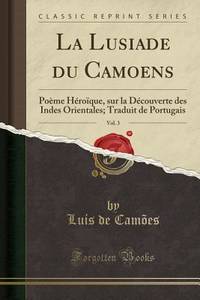
La Lusiade du Camoens Vol. 3
1390348695.Gpaperback. Good. Access codes and supplements are not guaranteed with used items. May be an ex-library book. paperback
Bonita · États-Unis57,44 $US≈ 48,60 €
289 résultats
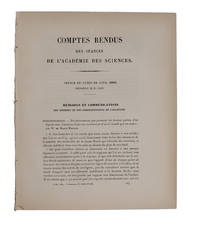
183947232Paris Bachelier 1839. 4to. No wrappers. In: "Comptes Rendus Hebdomadaires des Séances de L'Academie des Sciences" Tome VIII No 13. Pp. 459- 504. Entire issue offered. Piria's paper: pp. 479-485. <br/><br/><em>First apperance of a main paper in pharmacology describing the discovery of Salicylic acid compound giving it the empirical formula C7H6O3. It is the most successful drug in history. A trillion tablets are consumed every year. Used to treat everything from headaches to heart disease from rheumatism to cancer - scientists are still struggling to understand all its qualities. But aspirin can truly claim the title of wonder drug.Raffaele Piria 20 August 1814 - 18 July 1865 an Italian chemist from Scilla who converted the substance Salicin into a sugar and a second component which on oxidation becomes salicylic acid a major component of an analgesic drug Aspirin acetylsalicylic acid.Garrison & Morton No 1857. </em> unknown
185943325Leipzig Johann Ambrosius Barth 1859. Without wrappers as issued in "Annalen der Physik und Chemie. Hrsg.von Poggendorff" Bd. 107 Viertes Stück.= Heft No. 8 of 1859. The entire issue offered Heft 4 of vol. 107 with titlepage to vol. 107. Pp. 497-660. - Plücker's papers: pp. 497-539 a. 638-643. Clean and fine. <br/><br/><em>First printing of this milestone paper describing Plückers first observations on Cathode Rays which he called "the beautiful and mysterious green glow" and produced by discharges in tubes exhausted by means of the Geissler pump. These importent observations lead directly to Röntgens discovery of the Röntgen Rays."Cathode rays were first observed by Julius Plücker in 1859 the paper offered. They are rays which are found in the neighbourhood of the point of exit of an electrical current passing through a Geissler tube. These rays stimulated intense interest and experiment. William Crookes greatly improved these discharge tubes and intensified the degree of rarification of gases within them. The tubes in this form is known as Crookes tube. Crookes declared his conciction that the cathode rays represented matter in a fourth hitherto unobserved form.It was reserved for J.J. Thomson in 1908 to discover the true nature of the cathode rays."PMM no 386. </em> unknown
1390348695.Gpaperback. Good. Access codes and supplements are not guaranteed with used items. May be an ex-library book. paperback
188249173Paris: Gauthier-Villars 1882. 4to. No wrappers. In: "Comptes Rendus Hebdomadaires des Seances de l'Academie des Sciences" Vol 94 No 4 15 17. Pp. 149- 184 pp. 997-- 1068 a. pp. 1139- 1214. 3 entire issues offered. Poincare's papers: pp. 163-168 1038-1042 a. 1166-67. <br/><br/><em>First appearance in print of the discovery of the automorphic forms which Poincaré named Fuchsian functions."One of Poincaré's first discoveries in mathematics dating to the 1880s was automorphic forms. He named them Fuchsian functions after the mathematician Lazarus Fuchs because Fuchs was known for being a good teacher and had researched on differential equations and the theory of functions. Poincaré actually developed the concept of these functions as part of his doctoral thesis. Under Poincaré's definition an automorphic function is one which is analytic in its domain and is invariant under a discrete infinite group of linear fractional transformations. Automorphic functions then generalize both trigonometric and elliptic functions." Wikipedia. </em> unknown
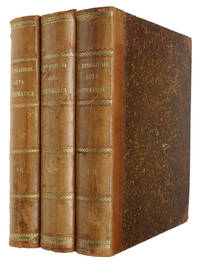
188460243Berlin Stockholm Paris F. & G. Beijer 1882-84. Large4to 272 x 230 mm. Three volumes uniformly bound in contemporary half calf with gilt lettering to spine. In "Acta Mathematica" volume 1-5. Light wear to extremities boards and spines with scratches. Stamp to verso of front board in all volumes. First three leaves in first volume detached otherwise internally fine and clean. Vol. I pp. 1-62; Pp. 193-294; Vol. II pp. 97-113; Vol. III. pp. 49-92; Vol. IV pp. 201-312; Vol. V pp. 209-278. <br/><br/><em>First publication of these groundbreaking papers which together constitute the discovery of Automorphic Functions. "Before he was thirty years of age Poincaré became world famous with his epoch-making discovery of the "automorphic functions" of one complex variable or as he called them the "fuchsian" and "kleinean" functions." DSB.These manuscripts written between 28 June and 20 December 1880 show in detail how Poincaré exploited a series of insights to arrive at his first major contribution to mathematics: the discovery of the automorphic functions. In particular the manuscripts corroborate Poincaré's introspective account of this discovery 1908 in which the real key to his discovery is given to be the recognition that the transformations he had used to define Fuchsian functions are identical with those of non-Euclidean geometry. See Walter Poincaré Jules Henri French mathematician and scientist.The idea was to come in an indirect way from the work of his doctoral thesis on differential equations. His results applied only to restricted classes of functions and Poincaré wanted to generalize these results but as a route towards this he looked for a class functions where solutions did not exist. This led him to functions he named Fuchsian functions after Lazarus Fuchs but were later named automorphic functions. First editions and first publications of these epochmaking papers representing the discovery of "automorphic functions" or as Poincaré himself called them the "Fuchsian" and "Kleinian" functions."By 1884 Poincaré published five major papers on automorphic functions in the first five volumes of the new Acta Mathematica. When the first of these was published in the first volume of the new Acta Mathematica Kronecker warned the editor Mittag-Leffler that this immature and obscure article would kill the journal. Guided by the theory of elliptic functions Poincarë invented a new class of automorphic functions. This class was obtained by considering the inverse function of the ratio of two linear independent solutions of an equation. Thus this entire class of linear diffrential equations is solved by the use of these new transcendental functions of Poincaré." Morris Kline.Poincaré explains how he discovered the Automorphic Functions: "For fifteen days I strove to prove that there could not be any functions like those I have since called Fuchsian functions I was then very ignorant; every day I seated myself at my work table stayed an hour or two tried a great number of combinations and reached no results. One evening contrary to my custom I drank black coffee and could not sleep. Ideas rose in crowds; I felt them collide until pairs interlocked so to speak making a stable combination. By the next morning I had established the existence of a Class of Fuchsian functions those which come from hypergeometric series; i had only to write out the results which took but a few hours.the transformations that I had used to define the Fuchsian functions were identical with those of Non-Euclidean geometry." </em> hardcover
C7-FYOP-ZXD2Discovery Channel University. VHS Tape. Good. 0x0x0. Good Discovery Channel University unknown
42294London. The Graphic. Sept 1875. overall 40x 58cm 15.3/4" x 23" engraved plate illustration fine condition. Ar. see Holland p279-280. [London]. The Graphic. Sept, 1875 unknown
180645517Paris Chez Bernard 1806. No wrappers. Ectracts from "Annales de Chimie ou Recueil de Mémoires." Vol. 57. Pp. 131-174 a. pp. 225-272. With the titlepage to volume 57. <br/><br/><em>First appearance of a classic paper in which Proust describes his discovery of Grape.Sugar and the identificationof this with glucose. He investigated the varieties of sugar that occur in sweet vegetable juices distinguishing three kinds and he showed that the sugar in grapes of which he announced the existence to his classes at Madrid is identical with that obtained from honey by the Russian chemist J. T. Lowitz.Proust is famous for his work on the steadiness of composition of chemical compounds."In chemistry the law of definite proportions sometimes called Proust's Law states that a chemical compound always contains exactly the same proportion of elements by mass. An equivalent statement is the law of constant composition which states that all samples of a given chemical compound have the same elemental composition. For example oxygen makes up 8/9 of the mass of any sample of pure water while hydrogen makes up the remaining 1/9 of the mass. Along with the law of multiple proportions the law of definite proportions forms the basis of stoichiometry."Wikipedia. </em> unknown
Adamson, Glenn, Meyers, ZIn Pristine Condition. unknown
1390332136.Gpaperback. Good. Access codes and supplements are not guaranteed with used items. May be an ex-library book. paperback
189549284London arrison and Sons 1895. - Paris Gauthier-Villars 1895. 8vo. and 4to. Later full cloth gilt lettering to spine Ramsay and without wrappers Cleve. In "Proceedings of the Royal Society" Ramsay Vol. 58. Entire vol. offered. And in "Comptes Rendus Hebdomadaires des Séances de L'Academie des Sciences" Cleve Tome 120 No 15. Pp. 797- 850. Entire issue offered. Ramsay's papers: pp. 65-67 and pp. 81-89. - Cleve's paper: p. 834. Stamps tp edges and a few corners a bit bumped on vol. 58 otherwise clean and fine. <br/><br/><em>First printing of both papers in which Ramsay and Cleve - independently - announced their discovery of Helium on the Earth. Although Ramsay announced the discovery of Helium before Cleve had completed his research the Swedish chemist was independent discoverer of the element.Helium was discovered in the sun already in 1868 by Jules Janssen and independently by Lockyer the same year. Janssen discovered helium in the sun when he observed a total eclipse in India by studying the spectra of the suns chromosphere and Lockyer also by spectroscopy found that the new line in the spectrum did not belong to any element then known and he named it Helium for the sun.In the same volume as Ramsays paper there are 5 papers by NORMAN LOCKYER dealing with the discovery of Helium on the earth examining Ramsay's and Cleve's findings.Parkinson "Breakthroughs" 1895. </em> hardcover
189844238London Taylor and Francis 1898 No wrappers. In "Proceedings of the Royal Society of London." Vol.63 Nos. 399-400 both issues offered. Pp. 373-480 a. 5 plates. Ransay & Travers' paper: pp. 405-408. <br/><br/><em>First appearance of the paper in which Ramsay and Travers announced their discovery of a new element which they named "krypton" meaning hidden."Dr. William Hampson presented them Ransay & Travers with about a liter of liquid air which they used not for liquefying the argon but for obstaining sufficient skill in manipulation so that they would not risk loosing their precious fifteen liter of argon.The residue left after most of the liquid air had boliled away consisted largly of oxygen and nitrogen which Ramsay and Travers temoved with red-hot copper and magnesium. .they then examined the twenty-five cibic centimeters of residual gas and when they found it to be inerst they immediately placedit in a Pl'ucker tube connected to and induction coil and observed its spectrum. There was a bright yelælow line with a greener tint than that of the helium line and a brilliant green line that did nor coincide with any line of argon helium mercury or hydrogen. They discoverede this gas on 30 May 1898 and named it 'krypton'.they found that it belonged between bromine and rubidium in the periodic table and so great was their excitement that the younger chemist almost forgot about his examination for doctor of sciwence which had been schedules for the next day."Weeks p. 267.Parkinson "Breakthroughs" 1898 C. </em> unknown
188247024Paris Gauthier-Villars 1882. 4to. No wrappers. In: "Comptes Rendus Hebdomadaires des Séances de L'Academie des Sciences" Tome 95 No 22 a. Tome 104 No 21 entire issues offered. Pp. 1017-1076 and pp. 1387-1462. Raoult's papers: pp. 1030-33 tome 95 and pp. 1430-1433 tome 104. <br/><br/><em>First appearance of Raoult's two importent papers in which described a method for finding the molecular weight of an organic compound by the determination of the lowering of the freezing point of water that resulted from dissolving that compound in water and the law governing the relation between solutes and vapor pressure."Then in 1882 F.-M. Raoult published his results on the effects of nondissociating organic solutes from which he deduced a general law controlling the lowering of freezing points the first paper offered. Four years later he extended this work to show the effect of solutes on vapor pressure the second paper offered. Having established the effect of nondissociating compounds he was in position to show that salts produced an eeffect which though anomalous could nevertheless be explained by the supposition that a dissolved molecule broke up into other molecules. This work was of great value in supplying a new method for determining molecular weights since the depression of freezing point and vapor pressure as well a the related rise in boiling point later discovered are proportional to the moleculat concentrations ofthe solutions; it was of equal value in supporting the ideas of van't Hoff on osmotic pressure. With the announcement of the dissociation theory of Arrhenius the anomalies were explained and the full significance of the generalizations of Raoult was recognized. Raoult published the formulations of his laws in the "Comptes Rendus" for 1882 and 1887 the papers offered" Leicester a. Klickstein "A Source Book in Chemistry" pp. 471 ff. </em> unknown
189542221London Harrison and Sons 1895. 4to. No wrappers as extracted from "Philosophical Transactions" Vol. 186 - I Series A. Pp. 187-241 a. 8 textillustrations apparatus. Fine and clean. <br/><br/><em>First printing of this importent paper in the history of chemistry Lord Rayleigh's most famous discovery announcing the discovery of this new gas the first finding of one of the rare gases inert gases having unusual properties and forming a distinct group in the periodic table and all with zero valency."The original paper in the "Philosophical Transactions" will undoubtly rank as a classic the investigation having been a particularly brilliant ine." Ernst von Meyer in History of Chemistry. For this discovery Lord Rayleigh and W. Ramsay received the Nobel Prize 1904.After having made several measuring of the densities of gases "Rayleigh came across a curious puzzle. With oxygen he always obtained the same density regardless of how the oxygen might be produced whether from one particular compound from a second compound or from the air. The situation was different with nitrogen. The nitrogen he obtained from air constantly showed a slightly higher density than the nitrogen he obtained from any of various compounds. Rayleigh could think of several ways in which the nitrogen obtained from air might be contaminated but none of the possibilities checked out experimentally. He was so frustrated that he went so far as to write to the journal "Nature" asking for suggestions. Ramsay a brilliant Scottish chemist asked permission to tackle the problem and received it. The upshot was that a new gas somewhat denser that nitrogen was discovered to exist in the atmosphere. It was named argon and it was the first of a series of rare gases of unusual properties whose existence had never been suspected."Asimow.Dibner Heralds of Science No. 50 - Neville Historical Chemical Library vol. II p.358. </em> unknown
189549207London Harrison and Sons 1895. 4to. Orig. full cloth. Gilt lettering to spine. Blindtooled covers. First corner a bit bumped. In "Philosophical Transactions" Vol. 186 - I Series A. XIV26024 pp. Entire volume offered. The paper: p. 187-241 a. 8 textillustrations apparatus. The title-page with faint brownspots. Otherwise internally clean and fine. <br/><br/><em>First printing of this importent paper in the history of chemistry Lord Rayleigh's most famous discovery announcing the discovery of this new gas the first finding of one of the rare gases inert gases having unusual properties and forming a distinct group in the periodic table and all with zero valency."The original paper in the "Philosophical Transactions" will undoubtly rank as a classic the investigation having been a particularly brilliant ine." Ernst von Meyer in History of Chemistry. For this discovery Lord Rayleigh and W. Ramsay received the Nobel Prize 1904. The volume also contains WILLIAM CROOKES "On the Spectra of Argon" OSBORNE REYNOLD "On the Dynamical Theory of Incompressible Viscous Fluids and the determination of the Criterion" KARL PEARSON "Contributions to the Mathematical Theory of Evolution. - II. Skew Variations in Homogenous Materials" etc.After having made several measuring of the densities of gases "Rayleigh came across a curious puzzle. With oxygen he always obtained the same density regardless of how the oxygen might be produced whether from one particular compound from a second compound or from the air. The situation was different with nitrogen. The nitrogen he obtained from air constantly showed a slightly higher density than the nitrogen he obtained from any of various compounds. Rayleigh could think of several ways in which the nitrogen obtained from air might be contaminated but none of the possibilities checked out experimentally. He was so frustrated that he went so far as to write to the journal "Nature" asking for suggestions. Ramsay a brilliant Scottish chemist asked permission to tackle the problem and received it. The upshot was that a new gas somewhat denser that nitrogen was discovered to exist in the atmosphere. It was named argon and it was the first of a series of rare gases of unusual properties whose existence had never been suspected."Asimow.Dibner Heralds of Science No. 50 - Neville Historical Chemical Library vol. II p.358. </em> hardcover
2007AME_9781588296726Humana Press 2007. 1st. Hardcover. New/New. Humana Press hardcover
180143492Halle Rengerschen Buchhandlung 1801. Without wrappers as published in "Annalen der Physik. Herausgegeben von Ludwig Wilhelm Gilbert" Bd. 7 Viertes Stück. The entire issue offered =Heft 4. Pp. 387-528. Ritter's announcement p. 525. With titlepage to volume 7. Clean and fine. Titlepage a bit shavedin inner margin. <br/><br/><em>First printing of Ritter's announcement of his discovery of ultraviolet light in a halfpage letter addressed to Gilbert's Annalen. With that discovery it became clear that visible light represents no more than a fraction of a continous spectrum.A year earlier in 1800 William Herschel discovered infrared light. This was the first time that a form of light beyond visible light had been detected. After hearing about Herschel's discovery of an invisible form of light beyond the red portion of the spectrum Ritter decided to conduct experiments to determine if invisible light existed beyond the violet end of the spectrum as well. He had heard that blue light caused a greater reaction in silver chloride than red light did. Ritter decided to measure the rate at which silver chloride reacted to the different colors of light. He directed sunlight through a glass prism to create a spectrum. He then placed silver chloride in each color of the spectrum and found that it showed little change in the red part of the spectrum but darkened toward the violet end of the spectrum. Johann Ritter then decided to place silver chloride in the area just beyond the violet end of the spectrum in a region where no sunlight was visible. To his amazement this region showed the most intense reaction of all. This showed for the first time that an invisible form of light existed beyond the violet end of the visible spectrum. This new type of light which Ritter called Chemical Rays later became known as ultraviolet light or ultraviolet radiation the word ultra means beyond. - Parkinson Breakthroughs: 1801 P. </em> unknown
180343638Halle Rengerschen Buchhandlung 1803. Without wrappers as extracted from "Annalen der Physik. Herausgegeben von Ludwig Wilhelm Gilbert" Jahrgang 1802 Bd. 12 Zwölftes Stück. Pp. 409-416. Titlepage to vol. 12. <br/><br/><em>This is Ritter's first expositon of his discovery of ultraviolet light. It was announced the year before in a halfpage letter addressed to Gilbert's Annalen and printed in the Annalen. With that discovery it became clear that visible light represents no more than a fraction of a continous spectrum.A year earlier in 1800 William Herschel discovered infrared light. This was the first time that a form of light beyond visible light had been detected. After hearing about Herschel's discovery of an invisible form of light beyond the red portion of the spectrum Ritter decided to conduct experiments to determine if invisible light existed beyond the violet end of the spectrum as well. He had heard that blue light caused a greater reaction in silver chloride than red light did. Ritter decided to measure the rate at which silver chloride reacted to the different colors of light. He directed sunlight through a glass prism to create a spectrum. He then placed silver chloride in each color of the spectrum and found that it showed little change in the red part of the spectrum but darkened toward the violet end of the spectrum. Johann Ritter then decided to place silver chloride in the area just beyond the violet end of the spectrum in a region where no sunlight was visible. To his amazement this region showed the most intense reaction of all. This showed for the first time that an invisible form of light existed beyond the violet end of the visible spectrum. This new type of light which Ritter called Chemical Rays later became known as ultraviolet light or ultraviolet radiation the word ultra means beyond. </em> unknown
180545516Paris Chez Bernard AN XIII 1805. No wrappers. In: "Annales de Chimie ou Recueil de Mémoires." Vol. 55 Cahier 2 30 Thermidor an XIII. Pp. 113-224 entire issue offered. Htitle to vol. 55 present. Robiquet's paper: pp. 152-171. <br/><br/><em>First appearance of Robiquet's first chemical paper in which he relates his discovery of asparagine by analysis of asparagus juice the first amino acid to be discovered. The following year he made the first isolation of this amino acid together with Vaguelin. Pierre Jean Robiquet was a French chemist who laid founding work in identifying amino acids the fundamental bricks of proteins through recognizing the first of them asparagin in 1806 in the take up of the industry of industrial dyes with the identification of alizarin in 1826 and in the emergence of modern medications through the identification of codeine in 1832 a powerful molecule today of widespread use with analgesic and antidiarrheal properties. </em> unknown
183445159Leipzig Johann Ambrosius Barth 1834. Without wrappers. Extracted from "Annalen der Physik und Chemie. Hrsg.von Poggendorff" Bd. 31 No 5. Pp. 65-80. <br/><br/><em>First printing of the paper in which Runge discloses his discovery of carbolic acid or phenol and how he prepared it by distilling coal.Parkinson "Breakthroughs" 1834 C. - Partington IV pp. 183-84. </em> unknown
ria9780891183945_inpPaperback / softback. New. New Book; Fast Shipping from UK; Not signed; Not First Edition; N/A paperback
191441545London 1914. No wrappers but stiched. All three papers contained in: "Philosophical Magazine" Sixth Series Vol. 27. No. 159. March 1914. The whole issue issue offered =no. 159: pp. 397-540 and 2 plates.Rutherford's paper.pp. 488-498. - Darwin's paper: pp. 499-506. - Bohr's paper: pp. 506-523. All clean and fine. <br/><br/><em>First edition and first printing of all three papers. Rutherford in this paper for the first time identifies the hydrogen nucleus and called it the 'positive electron'. He later called it 'the proton' . In his definitive paper of 1911 he estimated the radius of the nucleus a hundred thousand times smaller than that of an atom. Darwin in his paper offered here gave a more precise measure.In the first lines of the paper Rutherford outlines the content "The present paper and and the accompanying paper by Mr. C. Darwin the second paper offered here deal with certain points in connection with the "nucleus" theory of the atom which were purposely omitted in my first communication on that subject Phil. Mag. May 1911. A brief account is given of the later investigations which have been made to test the theory and of the deductions which can be drawn from them. At the same time a brief statement is given of recent observations on the passage of alpha particles through hydrogen which throw importent light on the dimensions of the nucleus." - Rutherford had studies alpha-particles intensely in the years before 1914 and proved quite conclusively that the individual particle was a helium atom with its electrons removed. The alpha particles were like the positive rays that had been discovered by Goldstein 1886 and now in 1914 the paper offered Rutherford suggested that the simplest positive rays must be those obtained from the hydrogen and that these must be the fundamentall positively-charged particle. He names it a 'positive electron'.Darwin in the paper offered "concluded from the known data:"No force proportional to some power of the distance other than the inverse square can give the dependence the Rutherford scattering cross section on the initial velocity" and he then calculated the distance of closest alpha-particle-nucleus approach.The paper by Niels Bohr relates to "The Stark effect". In 1913 appeared "an importent new discovery: when atomic hydrogen is exposed to a static electrical field its spectral lines split the amount of splitting being proportional to thefield strenght the linear Stark effect. After Rutherford read this news in "Nature" he at once wrote to Bohr:'I think it is rather up to you at the present time to write something on.electric effects.'" A. Pais. Bohrs paper on The Stark effect appeared in 1914 the paper offered here. - Rosenfeld. Niels Bohr' publications No. 10. </em> unknown
189843857Berlin J.A. Barth 1898. No wrappers. In "Annalen der Physik" Neue Folge Band 65 No 5. Pp. 1-240. Entire issue offered No.5. Titlepage to vol. 65. Stamp on titlepage. Schmidt's paper: pp. 141-151 textillustr. A tear to inner lower corners of pp. 24-32. not affecting Schmidt's paper. Clean and fine. <br/><br/><em>First printing of Schmidt's full exposition in which he describes his discovery of the radioactivity of Thorium. Schmidt and Marie Curie independently demonstrated the radioactive quality but Schmidt's demonstration took place a few months before Curie's. The discovery was announced but not described in full in a short message published in "Verhandl. d. Phys. Gesellsch. zu Berlin 1898."Schmidt made his discovery while examining "many elements and compounds" in an effeort to determine whether any of the rays that were emitted bore a resemblance to those that Henri becquerel had found emerging from uranium and uranium compounds. He located only one such element thorium and immediately conducted absorption ionization reflection refradction and poklarization studies to determine the characteristics of its rays. Having combined a misinterpretation of Becquerel's with one of his own Schmidt concluded that thorium rays most resembled Röntgen rays - a conclusion that soon required revisoln in view of the researches of Marie Curie and Ernest Rutherford."DSB XII p. 191. </em> unknown
183643417Leipzig Johann Ambrosius Barth 1836. Without wrappers. In "Annalen der Physik und Chemie. Hrsg. von J.C. Poggendorff" Band 38 No. 6 = Zweyte Stück. Titlepage to Vol. 38. Pp. 241-450 a. 3 engraved plates.Entire issue offered Heft No. 6 Bd. 38. Schwann's paper: pp. 358-364. Clean and fine. <br/><br/><em>First appearance of an importent paper in the history of biology in which Schwann describes his discovery and isolation of pepsin the substance in the stomach that aids digestion of eggwhite. It is the FIRST KNOWN ANIMAL ENZYME. The paper appeared at the same time in "Archiv für Anatomie Physiologie und Wissenschaftliches Medicin"Theodor Schwann 1810-1882 was a great German physiologist pathologist and experimenter. One of the founders of the cell doctrine and of the idea of the living nature of yeast. Born at Neuss near Düsseldorff. A catholic educated in the Jesuit Gymnasium in Cologne. Intended for the church but took to medicine. He was a pupil of Johannes Müller and a collegueand lifelong friend of J. Henle the anatomist. In Berlin Schwann was Johannes Müller's assistent for five years and it was then that he discovered pepsin in 1836 the paper offered.Parkinson "Breakthroughs" 1836 B.The issue contains other importent papers by Seebeck Matteucci Marchand G. Magnus "Ueber die Wirkung des Ankers auf Elektromagnete und Stahlmagnete" Schönbein J. Müller "Ueber die Structur und die chemischen Eigenschaften der thierischen Bestandtheile der Knorpel und Knochen" Nachtrag. Forchhammer "Der kopaische See und seine unterirdischen Abzugskanäle." with a map. </em> unknown
183149631Paris Crochard 1831. No wrappers. In: "Annales de Chimie et de Physique Par MM. Gay-Lussac et Arago." tome 46 Cahier 1. Pp. 5-112. Entire issue offered. Sefström's paper: pp. 105-111. <br/><br/><em>First printing of the paper in which Sefström announced his discovery of a new element in iron from the Taberg mine in Småland. He named it Vanadium from the goddess Vanadis.Parkinson "Breakthroughs" 1831 C.The discovery and isolation of Vanadium has a long story to tell. In reality it was found by del Rio in 1801 he named it Erythronium but upon further study he decided that he was mistaken as his further studies showed that it was made up of a basic lead chromate. </em> unknown