289 résultats
19442092902137303000Japanese art publication 1944. Soft Cover. Fine. Size: 26cm Japanese art publication paperback
184748815Paris Bachelier1847. 4to. No wrappers. In: "Comptes Rendus Hebdomadaires des Séances de L'Academie des Sciences" Tome XXIV No. 7. Pp. 209- 252. Entire issue offered. Sobrero's paper: pp. 247-248. Clean and fine. <br/><br/><em>First appearance of the paper in which Sobrero announced his discovery of nitroglycerin."When I think of all the victims killed during nitroglycerine explosions and the terrible havoc that has been wreaked which in all probability will continue to occur in the future I am almost ashamed to admit to be its discoverer." Sobrero"Nitroglycerin was synthesized by the chemist Ascagne Sobrero in the middle of the nineteenth century. When he tasted it as all good nineteenth century chemists did when they discovered a new compound it gave him what he called a migraine because of its vasodilatory effect which was later harnessed in the treatment of angina by William Murrell 1879 following the experience of a distinguished British clinician Lauder Brunton using amyl nitrite 1867 Later in the nineteenth century Alfred Nobel discovered how to stabilize nitroglycerin using kieselguhr diatomite clay; this led to highly successful industrial applications of dynamite and created the fortune that eventually funded the eponymous prizes. For medical purposes nitroglycerin was subsequently renamed glyceryl trinitrate to hide the fact that it was literally dynamite as well as metaphorically." </em> unknown
183149604Paris Crochard 1831. Contemp. hcloth. Some scattered brownspots. "Annales de Chimie et de Physique" 2. Series Tome 48. 448 pp. 1 engraved plate. Entire volume offered. Soubeiran's paper: pp. 113-157. Scattered brownspots. <br/><br/><em>First appearance of an importent paper in chemistry and medicine as it for the first time relates the finding of Chloroform which some years later was proved to have anaesthetic effects and was introduced in chirurgy in 1848 by Simpson.Justus von Liebig Souberain and Guthrie independently discovered Chloroform in 1831 but Souberain was the first to publish his results. Garrison & Morton No. 1851. - Gedeon "Science and Technology in Medicine" 36.7.The volume contains other notable papers by LIEBIG DUMAS DUTROCHET WÖHLER LECANU BECQUEREL etc. </em> hardcover
183143365Paris Crochard 1831. No wrappers as extracted from "Annales de Chimie et de Physique" 2. Series Tome 48. Titlepage to vol. 48. Pp. 113-157. A few brownspots but fine. Small stamps on verso of titlepage. <br/><br/><em>First appearance of an importent paper in chemistry and medicine as it for the first time relates the finding of Chloroform which some years later was proved to have anaesthetic effects and was introduced in chirurgy in 1848 by Simpson.Justus von Liebig Souberain and Guthrie independently discovered Chloroform in 1831 but Souberain was the first to publish his results. - Garrison & Morton No. 1851. - Gedeon "Science and Technology in Medicine" 36.7. </em> unknown
2090502113702419Not Available N.A. Soft Cover. Fine. The book is in fine condition. Not Available paperback
1980KOS02300819TBD 1980. Soft Cover. Fine. KOS02300819 TBD paperback
2005Q-1572931825Discovery House Publishers 2005-01-01. Paperback. New. New. In shrink wrap. Looks like an interesting title! Discovery House Publishers paperback

184245440Kjöbenhavn Bianco Luno 1842 a. 1845. 4to. Bound in one contemp. halfcalf spine gilt. A small tear to backhinge at lower compartment of spine. IV76 pp. and 3 double-page folded lithographed plates with many figs. XIV88 pp. and 2 double-apge lithographed plates with many figs. Light browning to the last leaves of the second work. <br/><br/><em>The scarce first edition of the work in which Steenstrup describes his discovery of the principle of 'ALTERNATION OF GENERATIONS'' sexual and asexual in plants and animals. "Steenstrup showed that certain animals produce offspring which never resemble them but which on the other hand bring forth progeny which return in form and nature to their grandparents or more distant ancestors." Garrison & Morton No 217. A German translation was published the same year and an English in 1845. Norman 2009 German translation. "The second major publication - the first dealing with geology - of 1842 was "Om Forplantning og Udvikling gjennem vexlende Generationsrækker." the work offered Steenstrup's comprehensive presentation of the form of reproduction that he called 'alternation of generations' that is the alternation of asexual and sexual reproduction or metagenesis. This phenomenon had previously been described by Chamisso but Steenstrup included a greater number of observations based on a significantly wider range of subjects and provided an importent chapter on its meaning. Steenstrup's growing reputation won him an appointment as professor of zoology at the University of Copenhagen where he tought from 1846 until 1885."DSB XII p. 9. </em> unknown
0260052701.Gpaperback. Good. Access codes and supplements are not guaranteed with used items. May be an ex-library book. paperback
181943320Leipzig Johann Ambrosius Barth 1819. Without wrappers as issued in "Annalen der Physik. Hrsg. von Ludwig Wilhelm Gilbert" Bd. 60 Heft 2 = Jahrgang 1818 zehntes Stück. Pp. 113-218 a. 1 engraved plate map. The entire issue offered Heft 2. Stromeyer's paper pp. 193-210. Clean and fine. <br/><br/><em>First appearance of Strohmeyer's account of his discovery of Cadmium. The history of its discovery was very complicated as some other laid claim to its discovery.Stromeyer was inspector general of apothecaries in Hannover. "In 1817 fulfilling the duties of his office he came across an apothecary's shop in which a bottle labeled zinc oxide contained zinc carbonate. Following this up Stromeyer found himself interested in zinc carbonate which turned yellow on strong heating as though it contained iron as an impurity yet it contained no iron. He traced the yellow to an oxide not of zinc but of a hitherto unknown metal rather like it chemically. He named it cadmium for a zinc ore in which it is usually found accompanying the zinc."Asimov.Weeks "Discovery of the Elements" pp. 135-39. </em> unknown
19532092902137304708Japan Arts and Crafts Company 1953. Soft Cover. Fine. Size: 21cm Japan Arts and Crafts Company paperback
2006260417008Teacher's Discovery 2006. hardcover. Used: Very Good. 11x8x2. Includes sealed CDROM. Clean and unmarked. Some minor cosmetic shelf wear. From a private collection. Very good condition. Comes from non smoking home. Teacher's Discovery hardcover
146275Teacher's Discovery. hardcover. Very Good. 11x8x2. Teacher's Discovery hardcover
19852090202118202648Fukutakeshoten 1985. Soft Cover. Fine. The book is in fine condition. Fukutakeshoten paperback
1331313716.Gpaperback. Good. Access codes and supplements are not guaranteed with used items. May be an ex-library book. paperback
1563319780.Gpaperback. Good. Access codes and supplements are not guaranteed with used items. May be an ex-library book. paperback
0260105244.Gpaperback. Good. Access codes and supplements are not guaranteed with used items. May be an ex-library book. paperback
19722110502150403194Kodansha 1972. Soft Cover. Fine. Volume: 1 Kodansha paperback
1856mon0000018903George Virtue and Co c. 1856. HardcoverLeatherSpineCorners. Like New. in x in x in. No DJ. Volume II only. Few pages with light foxing. No other marks in lightly read book. 36 b/w plates no foxing. Binding intact. Three-quarter leather over marbled boards with wear of leather. No publication date. George Virtue and Co hardcover
1145542Basic Books Inc 1959. 1st American edition. Hard cover. Very good/Very good. Jacket is worn and tanned on top edge but text and images are clear and bright. Cover is in great condition. Binding is tight. Inside is clean and unmarked. Basic Books, Inc unknown
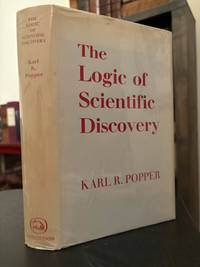
1959508<p><strong>Large Octavo. Publisher's cloth & dustwrapper. First edition first printing of one of the most significant works on the philosophy of science. The Logic of Scientific Discovery was originally published in Germany in 1934 and Popper rewrote and republished it in English in 1959 with the New York edition preceding this much rarer UK edition. A fine copy in an unclipped slightly worn and faded very good dust wrapper. Small inscription on the front pastedown of David Keyt 1930-2025 Professor Emeritus of Philosophy at Washington University Seattle. The book is mostly unopened and looks mostly unread. A very nice copy. Popper argues that science should adopt a methodology based on falsifiability because no number of experiments can ever prove a theory but a reproducible experiment or observation can refute one. According to Popper: "non-reproducible single occurrences are of no significance to science. Thus a few stray basic statements contradicting a theory will hardly induce us to reject it as falsified. We shall take it as falsified only if we discover a reproducible effect which refutes the theory". Popper argues that science should adopt a methodology based on "an asymmetry verifiability and falsifiability; an asymmetry which results from the logical form of universal statements. For these are never derivable from singular statements but can be contradicted by singular statements".</strong></p> Hutchinson hardcover
2000Q-0939979489Nada 2000-01-01. Hardcover. New. In shrink wrap. Looks like an interesting title! Nada hardcover
182646031Leipzig Johann Ambrosius Barth 1826. Contemp. hcalf. Gilt spine. A few scratches to spine. In "Annalen der Physik und Chemie. Hrsg.von Poggendorff" Bd. 8. 10526 pp. and 3 folded engraved plates. Small stamps onverso of titlepage. Entire volume offered. Unverdorben's paper: pp. 253-265 397-410 477-487. Clean and fine. <br/><br/><em>First appearance of the paper in which Unverdorben describes the method by which he discovered Aniline which became so importent in the manufacture of dyes plastics and pharmaceuticals. "Aniline from the Portugese anil applied to indigo and derived from the Arabic an-nil the blue substance was first obtained by Unverdorben by heating indigo and was given the name 'crystalline'. In 1841 Carl Julius von Fritzsche 1807-71 an assistant to Mitscherlich and later a member of the Academy of Sciences in St. petersburg obtained the same compound from anthranilic acid which was produced by the action of caustioc alkalis on indigo and called it 'aniline'. in 1843 Hofmann showed that the three substances crystalline aniline and benzidam were identical with the base isolated from coal tar."Findlay "A Hundred years of Chemistry" p. 134.Parkinson "Breakthroughs" 1826 C.The volume contains other importent papers Antoine Jerome Balard "Ueber eine besondere Substanz im Meereswasser" in which he describes his discovery of the element BROMINE first German edition pp. 114-124 a. pp. 319-336. Parkinson "Breakthroughs" 1826 C. And Eilhard Mitscherlich "Ueber eine neue Klasse von Krystallformen" pp. 427-442. </em> unknown
179843088Paris Fuchs et Guillaume An VIe. 1798. Contemp. hcalf. Spine gilt. Very slightly rubbed. Small stamps on verso of titlepage. In: "Annales de Chimie ou Recueil de Mémoires concernant la Chemie" Tome 26. - 340 pp. a. 1 engraved plate.the entire volume offered. Vauquelin's papers: pp. 155-169 pp. 170-177 a. pp. 259-265. Some brownspots to the first and last leaves otherwise fine and clean. <br/><br/><em>First printing of the papers in which Vauquelin describes and announces his discovery of Beryllium."The discovery of beryllium resulted from the Abbé Haüy's observation of the close similarity and probable identity of beryl and the emerald. At his suggestion Vauquelin made some very careful chemical analyses of these two minerals and found in 1798 that they are indeed identical and that they contain a new earth which he named glucina but which is now known as beryllia. The metal was isolated thirty years later by Wöhler and Bussy independently.At the suggestion of the editors of the "Annales de Chemie." he called the new earth 'glucina' meaning sweet." Weeks in "Discovery of the Elements" p. 153-54. - Parkinson "Breakthrough" 1798 C.The volume contains other importent papers in the history of chemistry Hassenfratz "De l'Areométrie" "Suite." 2 Paprs. Berthollet Chaptal Guyton Fourcroy Priestly first app. in French etc. </em> unknown
179843089Paris Fuchs et Guillaume An VIe. 1798. Contemp. hcalf. Spine gilt. Very slightly rubbed. Small stamps on verso of titlepage. In: "Annales de Chimie ou Recueil de Mémoires concernant la Chemie" Tome 25. - 3353 pp. 2 engraved folded plates and 1 folded table.the entire volume offered. Vauquelin's papers: pp. 21-32 a. pp. 194-204. Some brownspots to the first and last leaves otherwise fine and clean. <br/><br/><em>First printing of the papers in which Vauquelin describes and announces his discovery of Chromium. The first paper was simultaneously printed in Mem.de l'Institut. Because of its many coloured compounds Fourcroy and Haüy suggested the name 'chromium' for the new metal. Greek chroma-colour.In 1797 Vauquelin began his own studies of Siberian red lead. He was convinced that the mineral contained a new element. None of the elements then known could account for his results. He reported "a new metal possessing properties entirely unlike those of any other metal." A year later Vauquelin was able to isolate a small sample of the metal itself. He heated charcoal nearly pure carbon with a compound of chromium chromium trioxide Cr 2 O 3 . When the reaction was complete he found tiny metallic needles of chromium metal. DSB XIII p. 597 - Parkinson "Breakthrough" 1798 C.The volume contains other importent papers in the history of chemistry Guyton "Examen de quelques propriétés du Platine" a. "Examen de quelques critiques de la nomenclature de chimistes francais" Chaptal "Observations sur la fabrication de l'acétite de cuivre verd-de-gris etc. </em> unknown