DiscoveryBiblio.com
The North Pole
1331911052.Gpaperback. Good. Access codes and supplements are not guaranteed with used items. May be an ex-library book. paperback
Bonita · États-Unis58,64 $US≈ 49,62 €
289 résultats
1682206521-NDiscovery. hardcover. New. 0x0x0. BOOK IS IN NEW CONDITION. Discovery hardcover
2019mon0003456527Discovery 2019T. hardcover. Very Good. 0.8268 11.2992 8.7402. Discovery hardcover
1331911052.Gpaperback. Good. Access codes and supplements are not guaranteed with used items. May be an ex-library book. paperback
0260052701.Gpaperback. Good. Access codes and supplements are not guaranteed with used items. May be an ex-library book. paperback
1965332Beamsville Ontario: Discovery Women's Institute Printed by Rannie Publications 1965. First edition. Stapled Wraps. Unpaginated. pp. 64. 4to. Illustrated card covers. Profusely illustrated with maps black and white photographs portraits and illustrations. Lightest rubbing to the extremities contents clean and unmarked with tight sound binding; very good. Rare. A comprehensive local history of Discovery N.W.T. formerly a mining town with details on the Indigenous peoples of the region religious affiliations of the community and the institutions serving them schools libraries newspapers fraternal organizations etc. <br/><br/> [Discovery Women's Institute], Printed by Rannie Publications paperback
191441545London 1914. No wrappers but stiched. All three papers contained in: "Philosophical Magazine" Sixth Series Vol. 27. No. 159. March 1914. The whole issue issue offered =no. 159: pp. 397-540 and 2 plates.Rutherford's paper.pp. 488-498. - Darwin's paper: pp. 499-506. - Bohr's paper: pp. 506-523. All clean and fine. <br/><br/><em>First edition and first printing of all three papers. Rutherford in this paper for the first time identifies the hydrogen nucleus and called it the 'positive electron'. He later called it 'the proton' . In his definitive paper of 1911 he estimated the radius of the nucleus a hundred thousand times smaller than that of an atom. Darwin in his paper offered here gave a more precise measure.In the first lines of the paper Rutherford outlines the content "The present paper and and the accompanying paper by Mr. C. Darwin the second paper offered here deal with certain points in connection with the "nucleus" theory of the atom which were purposely omitted in my first communication on that subject Phil. Mag. May 1911. A brief account is given of the later investigations which have been made to test the theory and of the deductions which can be drawn from them. At the same time a brief statement is given of recent observations on the passage of alpha particles through hydrogen which throw importent light on the dimensions of the nucleus." - Rutherford had studies alpha-particles intensely in the years before 1914 and proved quite conclusively that the individual particle was a helium atom with its electrons removed. The alpha particles were like the positive rays that had been discovered by Goldstein 1886 and now in 1914 the paper offered Rutherford suggested that the simplest positive rays must be those obtained from the hydrogen and that these must be the fundamentall positively-charged particle. He names it a 'positive electron'.Darwin in the paper offered "concluded from the known data:"No force proportional to some power of the distance other than the inverse square can give the dependence the Rutherford scattering cross section on the initial velocity" and he then calculated the distance of closest alpha-particle-nucleus approach.The paper by Niels Bohr relates to "The Stark effect". In 1913 appeared "an importent new discovery: when atomic hydrogen is exposed to a static electrical field its spectral lines split the amount of splitting being proportional to thefield strenght the linear Stark effect. After Rutherford read this news in "Nature" he at once wrote to Bohr:'I think it is rather up to you at the present time to write something on.electric effects.'" A. Pais. Bohrs paper on The Stark effect appeared in 1914 the paper offered here. - Rosenfeld. Niels Bohr' publications No. 10. </em> unknown
0260105244.Gpaperback. Good. Access codes and supplements are not guaranteed with used items. May be an ex-library book. paperback
1587380161.Gpaperback. Good. Access codes and supplements are not guaranteed with used items. May be an ex-library book. paperback
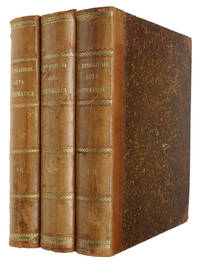
188460243Berlin Stockholm Paris F. & G. Beijer 1882-84. Large4to 272 x 230 mm. Three volumes uniformly bound in contemporary half calf with gilt lettering to spine. In "Acta Mathematica" volume 1-5. Light wear to extremities boards and spines with scratches. Stamp to verso of front board in all volumes. First three leaves in first volume detached otherwise internally fine and clean. Vol. I pp. 1-62; Pp. 193-294; Vol. II pp. 97-113; Vol. III. pp. 49-92; Vol. IV pp. 201-312; Vol. V pp. 209-278. <br/><br/><em>First publication of these groundbreaking papers which together constitute the discovery of Automorphic Functions. "Before he was thirty years of age Poincaré became world famous with his epoch-making discovery of the "automorphic functions" of one complex variable or as he called them the "fuchsian" and "kleinean" functions." DSB.These manuscripts written between 28 June and 20 December 1880 show in detail how Poincaré exploited a series of insights to arrive at his first major contribution to mathematics: the discovery of the automorphic functions. In particular the manuscripts corroborate Poincaré's introspective account of this discovery 1908 in which the real key to his discovery is given to be the recognition that the transformations he had used to define Fuchsian functions are identical with those of non-Euclidean geometry. See Walter Poincaré Jules Henri French mathematician and scientist.The idea was to come in an indirect way from the work of his doctoral thesis on differential equations. His results applied only to restricted classes of functions and Poincaré wanted to generalize these results but as a route towards this he looked for a class functions where solutions did not exist. This led him to functions he named Fuchsian functions after Lazarus Fuchs but were later named automorphic functions. First editions and first publications of these epochmaking papers representing the discovery of "automorphic functions" or as Poincaré himself called them the "Fuchsian" and "Kleinian" functions."By 1884 Poincaré published five major papers on automorphic functions in the first five volumes of the new Acta Mathematica. When the first of these was published in the first volume of the new Acta Mathematica Kronecker warned the editor Mittag-Leffler that this immature and obscure article would kill the journal. Guided by the theory of elliptic functions Poincarë invented a new class of automorphic functions. This class was obtained by considering the inverse function of the ratio of two linear independent solutions of an equation. Thus this entire class of linear diffrential equations is solved by the use of these new transcendental functions of Poincaré." Morris Kline.Poincaré explains how he discovered the Automorphic Functions: "For fifteen days I strove to prove that there could not be any functions like those I have since called Fuchsian functions I was then very ignorant; every day I seated myself at my work table stayed an hour or two tried a great number of combinations and reached no results. One evening contrary to my custom I drank black coffee and could not sleep. Ideas rose in crowds; I felt them collide until pairs interlocked so to speak making a stable combination. By the next morning I had established the existence of a Class of Fuchsian functions those which come from hypergeometric series; i had only to write out the results which took but a few hours.the transformations that I had used to define the Fuchsian functions were identical with those of Non-Euclidean geometry." </em> hardcover
19973486Alexandria VA : Time-Life Books; Tehabi Books 1997. 1997. Hardcover. Very Good/Very Good. 205 pp. : illustrated some in color color maps ; 26 cm. ; ISBN: 0783552610 LCCN: 97-16404 ; OCLC: 36727998 ; LC: G530.T6; Dewey: 910/.91634 ; "Unlike any other book ever published on the Titanic these pages magnificently present the combined efforts of hundreds of individuals through years of historical and scientific research study exploration and preservation."--dustjacket ; color photographic boards in printed glassine dustjacket ; a few tiny spots on dustjacket wear points on bottom of boards else VG/VG <br/> <br/> [Alexandria, VA] : Time-Life Books; Tehabi Books, 1997. hardcover
1333019912.Gpaperback. Good. Access codes and supplements are not guaranteed with used items. May be an ex-library book. paperback
B9781017994421Hardback. New. hardcover
A9781017994421Hardback. New. hardcover
2009Q-1572933666RBC Ministries 2009-01-01. Paperback. New. New. In shrink wrap. Looks like an interesting title! RBC Ministries paperback
183643417Leipzig Johann Ambrosius Barth 1836. Without wrappers. In "Annalen der Physik und Chemie. Hrsg. von J.C. Poggendorff" Band 38 No. 6 = Zweyte Stück. Titlepage to Vol. 38. Pp. 241-450 a. 3 engraved plates.Entire issue offered Heft No. 6 Bd. 38. Schwann's paper: pp. 358-364. Clean and fine. <br/><br/><em>First appearance of an importent paper in the history of biology in which Schwann describes his discovery and isolation of pepsin the substance in the stomach that aids digestion of eggwhite. It is the FIRST KNOWN ANIMAL ENZYME. The paper appeared at the same time in "Archiv für Anatomie Physiologie und Wissenschaftliches Medicin"Theodor Schwann 1810-1882 was a great German physiologist pathologist and experimenter. One of the founders of the cell doctrine and of the idea of the living nature of yeast. Born at Neuss near Düsseldorff. A catholic educated in the Jesuit Gymnasium in Cologne. Intended for the church but took to medicine. He was a pupil of Johannes Müller and a collegueand lifelong friend of J. Henle the anatomist. In Berlin Schwann was Johannes Müller's assistent for five years and it was then that he discovered pepsin in 1836 the paper offered.Parkinson "Breakthroughs" 1836 B.The issue contains other importent papers by Seebeck Matteucci Marchand G. Magnus "Ueber die Wirkung des Ankers auf Elektromagnete und Stahlmagnete" Schönbein J. Müller "Ueber die Structur und die chemischen Eigenschaften der thierischen Bestandtheile der Knorpel und Knochen" Nachtrag. Forchhammer "Der kopaische See und seine unterirdischen Abzugskanäle." with a map. </em> unknown
181943320Leipzig Johann Ambrosius Barth 1819. Without wrappers as issued in "Annalen der Physik. Hrsg. von Ludwig Wilhelm Gilbert" Bd. 60 Heft 2 = Jahrgang 1818 zehntes Stück. Pp. 113-218 a. 1 engraved plate map. The entire issue offered Heft 2. Stromeyer's paper pp. 193-210. Clean and fine. <br/><br/><em>First appearance of Strohmeyer's account of his discovery of Cadmium. The history of its discovery was very complicated as some other laid claim to its discovery.Stromeyer was inspector general of apothecaries in Hannover. "In 1817 fulfilling the duties of his office he came across an apothecary's shop in which a bottle labeled zinc oxide contained zinc carbonate. Following this up Stromeyer found himself interested in zinc carbonate which turned yellow on strong heating as though it contained iron as an impurity yet it contained no iron. He traced the yellow to an oxide not of zinc but of a hitherto unknown metal rather like it chemically. He named it cadmium for a zinc ore in which it is usually found accompanying the zinc."Asimov.Weeks "Discovery of the Elements" pp. 135-39. </em> unknown
182646031Leipzig Johann Ambrosius Barth 1826. Contemp. hcalf. Gilt spine. A few scratches to spine. In "Annalen der Physik und Chemie. Hrsg.von Poggendorff" Bd. 8. 10526 pp. and 3 folded engraved plates. Small stamps onverso of titlepage. Entire volume offered. Unverdorben's paper: pp. 253-265 397-410 477-487. Clean and fine. <br/><br/><em>First appearance of the paper in which Unverdorben describes the method by which he discovered Aniline which became so importent in the manufacture of dyes plastics and pharmaceuticals. "Aniline from the Portugese anil applied to indigo and derived from the Arabic an-nil the blue substance was first obtained by Unverdorben by heating indigo and was given the name 'crystalline'. In 1841 Carl Julius von Fritzsche 1807-71 an assistant to Mitscherlich and later a member of the Academy of Sciences in St. petersburg obtained the same compound from anthranilic acid which was produced by the action of caustioc alkalis on indigo and called it 'aniline'. in 1843 Hofmann showed that the three substances crystalline aniline and benzidam were identical with the base isolated from coal tar."Findlay "A Hundred years of Chemistry" p. 134.Parkinson "Breakthroughs" 1826 C.The volume contains other importent papers Antoine Jerome Balard "Ueber eine besondere Substanz im Meereswasser" in which he describes his discovery of the element BROMINE first German edition pp. 114-124 a. pp. 319-336. Parkinson "Breakthroughs" 1826 C. And Eilhard Mitscherlich "Ueber eine neue Klasse von Krystallformen" pp. 427-442. </em> unknown
186244063Leipzig Johann Ambrosius Barth 1862. Without wrappers as issued in "Annalen der Physik und Chemie. Hrsg. von J.C. Poggendorff" Vierte Reihe Bd. 27 117 Stück Zwei No. 10. The entire issue offered. Titlepage to vol. 27. Pp. 193-352 a. 1 engraved plate. Ångströms paper: pp. 290-302. <br/><br/><em>First appearance in German of Ångström's famous paper in which he announced the discovery of hydrogen in the atmosphere of the sun and in which he also confirmed the probable existence of of other elements there. The paper appeared in "Oefversigt af K. Vet. Acad. Förhandl." in 1861. The German paper here is expanded. At the same time it was translated into English and publishe as "On the Fraunhofer Lines Visible in the Solar Spectrum".Ångström was one of the early formulators of the science of modern spectroscopy; he wrote extensively on terrestrial magnetism the conduction of heat and especially spectroscopy. He published a monumental map of the normal solar spectrum that expressed the length of light waves in units of one ten-millionth of a millimeter a unit of length now known as the angstrom. He discovered that hydrogen is present in the sun's atmosphere and he was the first to examine the spectrum of the aurora borealis. </em> unknown
187449327Leipzig Johann Ambrosius Barth 1874. 8vo. Contemp. hcalf. 5 raised bands gilt spine and gilt lettering to spine. A few scratches to spine. Small stamp on verso of first -and general- titlepage. In: "Annalen der Physik und Chemie. Hrsg. von J.C. Poggendorff" Sechste Reihe Bd. 3 = Poggendorff Bd. 153. X636 pp. 4 plates. Entire volume offered. Braun's paper: pp. 556-563. <br/><br/><em>First printing of Brown's importent paper in which he described his discovery of a semiconductor diode noting that electrical currents flows freely in only one direction at the contact between a metal point and a galena crystal."In 1874 Braun published the results of his research on mineral metal sulfides. He found that these crystals conducted electric currents in only one direction. This information was important in electrical research and in measuring another property of substances the electrical conductivity but Braun’s discovery did not have immediate practical application. In the early twentieth century the principle that Braun had discovered was employed in crystal radio receivers."DSB.The Nobel Prize in Physics 1909 was awarded jointly to Guglielmo Marconi and Karl Ferdinand Braun "in recognition of their contributions to the development of wireless telegraphy". </em> hardcover
185943325Leipzig Johann Ambrosius Barth 1859. Without wrappers as issued in "Annalen der Physik und Chemie. Hrsg.von Poggendorff" Bd. 107 Viertes Stück.= Heft No. 8 of 1859. The entire issue offered Heft 4 of vol. 107 with titlepage to vol. 107. Pp. 497-660. - Plücker's papers: pp. 497-539 a. 638-643. Clean and fine. <br/><br/><em>First printing of this milestone paper describing Plückers first observations on Cathode Rays which he called "the beautiful and mysterious green glow" and produced by discharges in tubes exhausted by means of the Geissler pump. These importent observations lead directly to Röntgens discovery of the Röntgen Rays."Cathode rays were first observed by Julius Plücker in 1859 the paper offered. They are rays which are found in the neighbourhood of the point of exit of an electrical current passing through a Geissler tube. These rays stimulated intense interest and experiment. William Crookes greatly improved these discharge tubes and intensified the degree of rarification of gases within them. The tubes in this form is known as Crookes tube. Crookes declared his conciction that the cathode rays represented matter in a fourth hitherto unobserved form.It was reserved for J.J. Thomson in 1908 to discover the true nature of the cathode rays."PMM no 386. </em> unknown
189843857Berlin J.A. Barth 1898. No wrappers. In "Annalen der Physik" Neue Folge Band 65 No 5. Pp. 1-240. Entire issue offered No.5. Titlepage to vol. 65. Stamp on titlepage. Schmidt's paper: pp. 141-151 textillustr. A tear to inner lower corners of pp. 24-32. not affecting Schmidt's paper. Clean and fine. <br/><br/><em>First printing of Schmidt's full exposition in which he describes his discovery of the radioactivity of Thorium. Schmidt and Marie Curie independently demonstrated the radioactive quality but Schmidt's demonstration took place a few months before Curie's. The discovery was announced but not described in full in a short message published in "Verhandl. d. Phys. Gesellsch. zu Berlin 1898."Schmidt made his discovery while examining "many elements and compounds" in an effeort to determine whether any of the rays that were emitted bore a resemblance to those that Henri becquerel had found emerging from uranium and uranium compounds. He located only one such element thorium and immediately conducted absorption ionization reflection refradction and poklarization studies to determine the characteristics of its rays. Having combined a misinterpretation of Becquerel's with one of his own Schmidt concluded that thorium rays most resembled Röntgen rays - a conclusion that soon required revisoln in view of the researches of Marie Curie and Ernest Rutherford."DSB XII p. 191. </em> unknown
183743739Leipzig Johann Ambrosius Barth 1837. Without wrappers as issued in "Annalen der Physik und Chemie. Hrsg.von Poggendorff" Bd. 41 Zweites Stück. Entire issue No 6 offered. Titlepage to vol. 41. Pp. 225-448 a. 2 folded engraved plates. Wöhler & Liebig's papers: pp. 345-366 pp. 366-374 a. pp. 393-397. Clean and fine. <br/><br/><em>First appearance of this classic paper in organic chemistry in which Wöhler and Liebig showed how Amygdalin could be decomposed by a vegetable emulsion the first example of a glycoside."The conclusions which you have drawn from the investigation of bitter-almond oil" wrote Berzelius to Liebig and Wöhler "are certainly the most importent which have so far been reached in the domain of vegetable chemistry and give promise of shedding an unexpected light over this part of the science.The facts which you have set forth inspire such reflections that they may be regarded as the dawn of a new day in vegetable chemistry."Berzelius-Wöhler Briefwechsel."During the years that Liebig was preoccupied with the ether theory and with organic acids he also carried out two importent investigations with Wöhler. In october 1836 Wöhler wrote that he had discovered a way to transform amygdalin to oil of bitter almonds and hydrocyanid acis by distilling it with manganese and sulfuric acid and he invited Liebig to join in pursuing the topic. Two days later he made a more remarkable discovery. It had occurred to him that perhaps thetransformation of amygdalin could be effected by the albumin in the almonds in a manner similar to the action of yeast in sugar.Wöhler suspected that the decomposition was an example of what Berzelius had recently defined as catalysis. Liebig and Wöhler then divided up the detailed examination of the properties and composition of amygdalin. They precipitated from the emulsion of almonds a substance which when dissolved retain its action. They named the active substance "emulsion". Its effectiveness in very small quantities confirmed that it acted like yeast."DSB VIII p. 342. </em> unknown
183445159Leipzig Johann Ambrosius Barth 1834. Without wrappers. Extracted from "Annalen der Physik und Chemie. Hrsg.von Poggendorff" Bd. 31 No 5. Pp. 65-80. <br/><br/><em>First printing of the paper in which Runge discloses his discovery of carbolic acid or phenol and how he prepared it by distilling coal.Parkinson "Breakthroughs" 1834 C. - Partington IV pp. 183-84. </em> unknown
184244147Leipzig Johann Ambrosius Barth 1842. Without wrappers. In "Annalen der Physik und Chemie. Hrsg. von J.C. Poggendorff" Ergänzungsband 1 Stück 2. Pp. 193-384 a. 1 folded engraved plate. The entire issue offered. Henry's paper: pp. 282-312. <br/><br/><em>First German version of Henry's description of his discovery of self-induction. He missed the credit for the discovery of induction to Faraday but he had done the key experiment ahead of Faraday but Faraday was the first to publish. But he is credited for the discovery of self-induction 1832 and Faraday discovered it independently two years later 1834."In Henry's paper however he explained thet the electric current in a coil can induce another current not only in another coil but in itself. The actual current observed in the coil is then the combination of the original current and the induced current. This is called self induction."Isac Asimov.The issue contains further notable papers Michael Faraday's "Vierzehnte Reihe von Experimental-Untersuchungen über Elektricität" § 2o-22. Nos 1667-1748. Pp. 249-281. First German version. In this paper FARADAYamplifies his theory of electrostatic induction by making further use of the analogy with the induction of magnetism. Whittaker describes the paper as having "THE FUNDAMENTAL EQUATION OF ELECTROSTATICS" as modified in order to take into account the effect of the specific inductive capacity."Whittaker I pp.187-89. </em> unknown
193447071Paris Gauthier-Villars 1934. 4to. No wrappers. In: "Comptes Rendus Hebdomadaires des Séances de L'Academie des Sciences" Tome 198 No 3. Titlepage to vol. 198. Pp. 213- 292. Entire issue offered. The joint paper: pp. 254-256 a. 1 photographic illustration in the text. Titlepage with a stamp on verso 2 small tears and a tiny bit of upper right corner gone. Titlepage a bit browned. <br/><br/><em>First appearance of this seminal paper in which artificial radioactivity was announced for the first time. Curie and Joliot were awarded the Nobel Prize in Chemistry 1935 "in recognition of their synthesis of new radioactive elements"."Until this date 1934 atomic nuclei emitting radiation were found in nature: it was called the natural radioactivity. It had been known since Rutherford that this natural radioactivity changed a nucleus into an other one: for instance radium becomes finally lead after many radioactive decays. We could say that lead does not become gold but gold becomes lead! But. this change of matter was not under control. It was not possible to construct the desired chemical element as the alchemist dreamed. But Irene and Frederic Joliot-Curie made the dream become almost reality.""Another very important development in the early 1934 by the Joliot-Curies in connection with irradiation of aluminum by alpha particles. The two French scientists detected the production of the recently discovered positrons. . However they soon realized that the positron activity continued after the alpha source was removed and that they had in fact discovered positive beta radioactivity. The importance of the discovery of artificial radioactivity was immediately recognized and resulted in a Nobel Prize in chemistry to the Joliot-Curies in 1935. The new phenomenon immediately became widely employed in nuclear physics chemistry biology and medicine." Kragh Quantum Generations p. 187"These elegant experiments which provided the first chemical proof of induced transmutations and showed the possibility of artificially creating radioisotopes of known stable elements were repeated and extended in the major nuclear physics laboratories of various countries " DSB.Born on 12 September 1897 in Paris Irène Curie was the daughter of Pierre and Marie Curie. "During World War I she worked as a nurse helping her mother operate radiography equipment and then studied physics and mathematics at the Sorbonne gaining a doctorate for studying the range of alpha particles. She then went to work for her mother at the Radium Institute. There she met Frédéric Joliot whom she married in 1926. Frédéric Joliot was born on 19 March 1900 in Paris - He joined the Radium Institute in 1925 and obtained his PhD in 1930. Together the Joliot-Curies worked on radioactivity and the transmutation of the elements. Twice they just missed major discoveries: in 1932 when Chadwick beat them to the neutron and in 1933 when Anderson discovered the positron. However in 1934 whilst bombarding light elements with alpha particles the Joliot-Curies noticed that although proton production stopped when the alpha particle bombardment stopped another form of radiation continued. The alpha particles had produced an isotope of phosphorus not found in nature. This isotope was radioactive and was decaying through beta-decay" DSB. </em> unknown