232 résultats
184849456Paris Bachelier 1848. 4to. No wrappers. In: "Comptes Rendus Hebdomadaires des Séances de L'Academie des Sciences" Tome 26 No 21. Pp. 529- 548. Entire issue offered. Pasteur's paper: pp. 535-538. Clean and fine. <br/><br/><em>First appearance of the announcement of Pasteur's momentous and revolutionary discovery of "molecular assymetry" and founding the science of Polarimetry.The discovery was first announced by Pasteur in may 1848 by the printing of the preliminary report of only 4 short pages in order to establish priority the paper offered. A more full exposition was published the same year in "Annales de Chimie et de Physique" 3me Series - Tome XXIV."In 1848.Pasteur studied the crystals of tartrates one of the substances that exhibited the now-clockwise now-counterclockwise effect under the microscope and found that the xcrystasls were mirror images of the others. The two crystals resemmbled each other as a right-hand glove resembles a left-hand glove.This was a revolutionary discovery and it took some courage to announce it. A few years before the well-known chemist Mitscherlich had studies the same tartrate crystals and declared them all to be identical. Pasteur was only a twenty-sic-year-old unknown. neverthelless he announced his findings and went before Biot to repeat the separation ofthe crystals before the eyes of the aged authority in the field. Biot was convinced and Pasteur received the Rumford medal of the Royal Society for his work.Pasteur had thus founded the science of polarimetry in which the measurements of the manner in which the plane of polarized light was twisted could be used to help to determine the structure of organic substance to follow various chemical reactions and so on."Asimov. Leicester & Klickstein "A Source Book of Chemistry" p. 374-379. </em> unknown
184847149Paris Bachelier 1848. 4to. No wrappers. In: "Comptes Rendus Hebdomadaires des Séances de L'Academie des Sciences" Tome 26 No 21. Pp. 529- 548. Entire issue offered. Pasteur's paper: pp. 535-538. <br/><br/><em>First appearance of the announcement of Pasteur's momentous and revolutionary discovery of "molecular assymetry" and founding the science of Polarimetry.The discovery was first announced by Pasteur in may 1848 by the printing of the preliminary report of only 4 short pages in order to establish priority the paper offered. A more full exposition was published the same year in "Annales de Chimie et de Physique" 3me Series - Tome XXIV."In 1848.Pasteur studied the crystals of tartrates one of the substances that exhibited the now-clockwise now-counterclockwise effect under the microscope and found that the xcrystasls were mirror images of the others. The two crystals resemmbled each other as a right-hand glove resembles a left-hand glove.This was a revolutionary discovery and it took some courage to announce it. A few years before the well-known chemist Mitscherlich had studies the same tartrate crystals and declared them all to be identical. Pasteur was only a twenty-sic-year-old unknown. neverthelless he announced his findings and went before Biot to repeat the separation ofthe crystals before the eyes of the aged authority in the field. Biot was convinced and Pasteur received the Rumford medal of the Royal Society for his work.Pasteur had thus founded the science of polarimetry in which the measurements of the manner in which the plane of polarized light was twisted could be used to help to determine the structure of organic substance to follow various chemical reactions and so on."Asimov. Leicester & Klickstein "A Source Book of Chemistry" p. 374-379. </em> unknown
183351493Paris Crochard 1833. Contemp. hcalf. Raised bands gilt spine with gilt lettering. A few scratches to spine. Stamps to verso of titlepage. In: "Annales de Chimie et de Physique Par MM. Gay-Lussac et Arago." Series 2 tome 53. Entire volume offered. 448 pp. Payen & Persoz's paper: pp. 73-92. Clean and fine. <br/><br/><em>First printing of a pioneering paper in industrial chemistry and microbiology being the discovery of the first Enzyme Diastase. It catalyses the breakdown of starch into maltose. </em> hardcover
185545031Paris Victor Masson 1855. 8vo. Without wrappers. In 'Annales de Chimie et de Physique' Series 3 tome 30 December-issue. With halftitle to vol. 30. Pp. 385-508 a. 1 plate. Entire issue offered. Wurtz's paper: pp. 443-506. <br/><br/><em>First appearance of the entire memoir in which Wurtz describes his outstanding discovery of Liebig’s prediction that there might be organic compounds analogous to ammonia and derivable from it by the replacement of hydrogen - the amines. The discovery was announced in 1849 and a small extract was printed in "Comptes rendu" 4 pp. The offered paper is the memoir in full.Wurtz is most noted for his investigation of glycols and for his discovery of the amines. The latter discovery in 1849 the paper offered was very significant at the time for ot suggested the possibility of a new type the ammonia type which helped to explain the behaviour of nitrogenous compounds. Leicester & Klickstein "A Source Book." pp. 362-63. - Parkinson "Breakthroughs" 1849 C.Charles Adolphe Wurtz was born at Strasbourg 1817. For many years he was Professor of Chemistry at the Ecole de Médicine and at Sorbonne in Paris. He was known not only for his researches in organic chemistry but also for his many literary works. He was editor of a Dictionnaire de Chemie Pure et Appliquée and after 1868 one of the editors of the Annalen der Chemie et de Physique. He died in Paris in 1884. </em> unknown
182843318Leipzig, Johann Ambrosius Barth, 1828. Without wrappers as issued in ""Annalen der Physik und Chemie. Hrsg.von Poggendorff"", Bd. 14, Zweites Stück. (=Jahrgang 1828, zehntes Stück). Pp. 191-306 a. 3 engraved plates. (the entire issue offered (Heft 2) together with the titlepage to 14. Band). Brown's paper: pp. 294-313. Clean and fine. Small stamp on verso of titlepage.
182843318Leipzig Johann Ambrosius Barth 1828. Without wrappers as issued in "Annalen der Physik und Chemie. Hrsg.von Poggendorff" Bd. 14 Zweites Stück. =Jahrgang 1828 zehntes Stück. Pp. 191-306 a. 3 engraved plates. the entire issue offered Heft 2 together with the titlepage to 14. Band. Brown's paper: pp. 294-313. Clean and fine. Small stamp on verso of titlepage. <br/><br/><em>First appearance in German of this monumental paper in atomic theory and kinematics as it was the first evidence for atomism that was an observation rather than a deduction from abstract principles."In 1827 as he was viewing a suspension of pollen in Water under the microscope he noted that the individual grains were moving about irregularly. This he thought was the result of the life hidden within the pollen grains. However when he studied dye particles indubitably nin-livin suspended in water he found the same erratic motion. This has been called "Brownian motion" ever since and Brown could merely report on the observation. He had no explanation for it. Nor had anyone else until the development of the kinetic theory of gases by men such as Maxwell a generation later. It seemed plain. after Maxwell and especially after the work of Einstein and Perrin a half century after Maxwell that the Brownian Motion was actually a visible effect of the fact that water was composed of particles. It was the first evidence for atomism that was an observation rather than a deduction." Asimov.The issue contains other importent papers by C. Naumann G. Magnus Th. Saussure "Kohlensäuregas in der Atmosphäre" andothers.PMM: 290 the English paper from 1828 - Sparrow Milestones of Science No 31. - Magie "A Source Book in Physics p. 251-255. - Dibner Heralds of Science No 156. </em> unknown
180645517Paris, Chez Bernard, 1806. No wrappers. Ectracts from ""Annales de Chimie ou Recueil de Mémoires.."" Vol. 57. Pp. 131-174 a. pp. 225-272. With the titlepage to volume 57.
180645517Paris Chez Bernard 1806. No wrappers. Ectracts from "Annales de Chimie ou Recueil de Mémoires." Vol. 57. Pp. 131-174 a. pp. 225-272. With the titlepage to volume 57. <br/><br/><em>First appearance of a classic paper in which Proust describes his discovery of Grape.Sugar and the identificationof this with glucose. He investigated the varieties of sugar that occur in sweet vegetable juices distinguishing three kinds and he showed that the sugar in grapes of which he announced the existence to his classes at Madrid is identical with that obtained from honey by the Russian chemist J. T. Lowitz.Proust is famous for his work on the steadiness of composition of chemical compounds."In chemistry the law of definite proportions sometimes called Proust's Law states that a chemical compound always contains exactly the same proportion of elements by mass. An equivalent statement is the law of constant composition which states that all samples of a given chemical compound have the same elemental composition. For example oxygen makes up 8/9 of the mass of any sample of pure water while hydrogen makes up the remaining 1/9 of the mass. Along with the law of multiple proportions the law of definite proportions forms the basis of stoichiometry."Wikipedia. </em> unknown
1865VOEK0219aBln., Hempel 1865. Lex.-8°, XV, 784 S., mit 123 Abb. u. Karten, 1 farblithogr. Front., HLdr. d. Zt., berieben, Ecken etwas bestoß., Leder beschabt, kl. Loch am Rpckenschwanz, neue Vorsätze, schwach stockfleck., vereinzelt kl. Schmutzstellen. (= Der Erdball un d seine Naturwunder. 4. Bd.).
1894HIS58234MRelié en toile probablement d'origine, 500 pages, paru en 1894 ( date non indiquée ) chez Ernest Flammarion, livre en très bon état général, dos légèrement usé, l'intérieur est resté très frais malgré les quelques rousseurs dû à son ancienneté.
188247024(Paris, Gauthier-Villars), 1882. 4to. No wrappers. In: ""Comptes Rendus Hebdomadaires des Séances de L'Academie des Sciences"", Tome 95, No 22 a. Tome 104 No 21 (entire issues offered). Pp. 1017-1076 and pp. 1387-1462. Raoult's papers: pp. 1030-33 (tome 95) and pp. 1430-1433 (tome 104).
188247024Paris Gauthier-Villars 1882. 4to. No wrappers. In: "Comptes Rendus Hebdomadaires des Séances de L'Academie des Sciences" Tome 95 No 22 a. Tome 104 No 21 entire issues offered. Pp. 1017-1076 and pp. 1387-1462. Raoult's papers: pp. 1030-33 tome 95 and pp. 1430-1433 tome 104. <br/><br/><em>First appearance of Raoult's two importent papers in which described a method for finding the molecular weight of an organic compound by the determination of the lowering of the freezing point of water that resulted from dissolving that compound in water and the law governing the relation between solutes and vapor pressure."Then in 1882 F.-M. Raoult published his results on the effects of nondissociating organic solutes from which he deduced a general law controlling the lowering of freezing points the first paper offered. Four years later he extended this work to show the effect of solutes on vapor pressure the second paper offered. Having established the effect of nondissociating compounds he was in position to show that salts produced an eeffect which though anomalous could nevertheless be explained by the supposition that a dissolved molecule broke up into other molecules. This work was of great value in supplying a new method for determining molecular weights since the depression of freezing point and vapor pressure as well a the related rise in boiling point later discovered are proportional to the moleculat concentrations ofthe solutions; it was of equal value in supporting the ideas of van't Hoff on osmotic pressure. With the announcement of the dissociation theory of Arrhenius the anomalies were explained and the full significance of the generalizations of Raoult was recognized. Raoult published the formulations of his laws in the "Comptes Rendus" for 1882 and 1887 the papers offered" Leicester a. Klickstein "A Source Book in Chemistry" pp. 471 ff. </em> unknown
183248329Paris Crochard 1832. No wrappers. In: "Annales de Chimie et de Physique" 2e Series vol. 51 Cahier 4. Pp. 337-444 Entire issue offered. Faraday's letter: pp. 404-434 a. 1 engraved plate. Some brownspots. <br/><br/><em>First printing of Faraday's famous letter to Gay-Lussac in which he claim to be the discoverer of electro-magnetic induction analysed the results of the Italian philosophers pointing out their errors and defending himself from what he regarded as imputations on his character. The style of this letter is unexceptionable for Faraday could not write otherwise than as a gentleman; but the letter shows that had he willed it he could have hit hard. The letter was later translated into English and published in "Philosophical Magazine" in 1840 under the title "On Magneto-electric Induction"."In 1831 seemingly out of nowhere came the discovery of electromagnetic induction and the beginning of the experimental researches in electricity which were to lead Faraday to the discovery of the laws of electrochemistry specific inductive capacity the Faraday effect and the foundations of classical field theory." DSB. </em> unknown
183247933Paris Crochard 1832. Contemp. hcalf. Spine gilt. Light wear along edges. Stamps to verso of titlepage. In: "Annales de Chimie et de Physique" 2e Series vol. 51. Entire volume offered. 448 pp. a. 1 folded engraved plate. Faraday's letter: pp. 404-434. Internally clean and fine. <br/><br/><em>First printing of Faraday's famous letter to Gay-Lussac in which he claim to be the discoverer of electro-magnetic induction analysed the results of the Italian philosophers pointing out their errors and defending himself from what he regarded as imputations on his character. The style of this letter is unexceptionable for Faraday could not write otherwise than as a gentleman; but the letter shows that had he willed it he could have hit hard. The letter was later translated into English and published in "Philosophical Magazine" in 1840 under the title "On Magneto-electric Induction"."In 1831 seemingly out of nowhere came the discovery of electromagnetic induction and the beginning of the experimental researches in electricity which were to lead Faraday to the discovery of the laws of electrochemistry specific inductive capacity the Faraday effect and the foundations of classical field theory." DSB. The volume contains further importent papers by AMPÈRE "Note sur une Experience de Hippolyte Pixii relative au Courant produit par la Rotation d'un aimant à l'aide dün appareil imagine par M. Hippolyte Pixii" WÖHLER et LIEBIG "recherches sur le Radical de l'Acide benzoique" and "Lettre de M. Berzelius sur le Benzoyle et l'Acide benzoique" papers by Strohmeyer Gay-Lussac Dutrochet Boussingault BERZELIUS "Sur le Bleu de Prusse et le Cyanoferrure de plomb" etc. etc. </em> unknown
188225945Paris Ludovic Baschet 1882 in-4° avec cinq photogravures, 39 pp et le plan des ruines
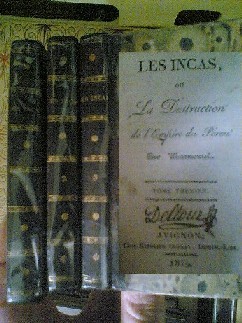
1819CCC0004bmb. edition Avignon chez hypolite Offray, 1819. Couverture rigide. État : Satisfaisant. 3 volumes In-12 (8 X 12.5 cm) Reliure demi chagrin, premier cahier du tome un cassé, état génaral correct, photos possibles
1865LFA00b6bUn ouvrage de 446 pages, format 240 x 160 mm, illustré, relié percaline noire dos à nerfs, publié en 1865 (troisième édition), Librairie Hachette (Paris)
1878WOC-15033 ème édition, contenant 244 vignettes, une carte des Environs de Paris et sept autres carte et plans. Paris, Librairie Hachette et Cie, 1878. In-8 (18x3x11cm) percaline noire éditeur estampée à froid, et légendes dorées, petites fentes sur les charnières. LIX,656pp. + 96pp de publicité.
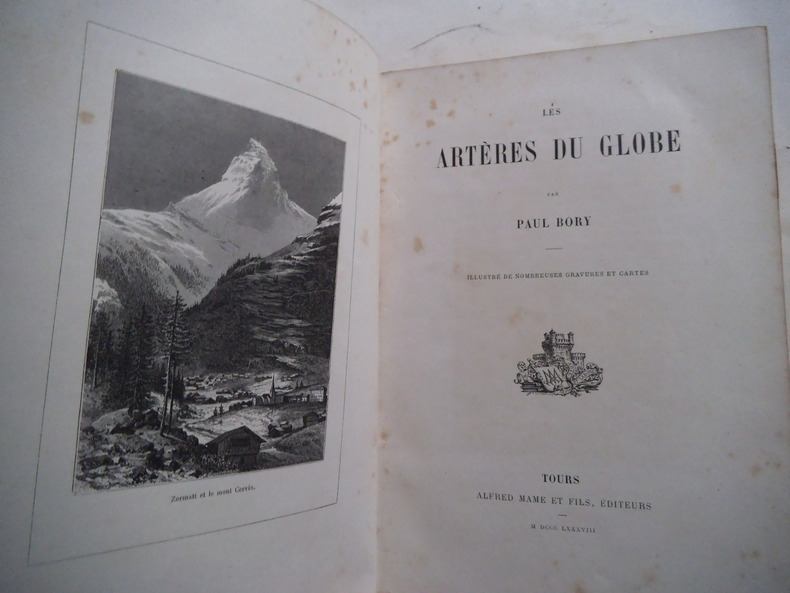
188875Un volume grand in 8 pleine toile rouge d'éditeur.Dos et plats décorés avec titre doré. faux-titre, frontispice ( Zermatt et le Cervin) titre, 399 pages, tranches dorées, illustrations dans le texte et hors texte, cartes. Mame 1888.rousseurs éparses habituelles, cartonnage frais
18801974Couverture rigide Librairie Hachette 1880 Paris 22,5x14 cm
1894103595Klincksieck 1894 Librairie C. Klincksieck, 1894, 424 p., broché, dos en mauvais état (restauré), des franges le long des plats, intérieur propre.
188287893Tours, Alfred Mame et fils, éditeurs 1882 Dixième édition. Reliure signée A. Robin Laroche sur Yon. Frontispice In-8 relié 21 cm sur 13. Demi reliure cuir vert glacé, dos lisse. Titre sous triples filets d’or.. 240 pages. Dos légérement insolé. Plats légérement frottés. Absence des couvertures d’origines. Brunissures. Bon état d’occasion.
1860WOC-548Nombreuses planches hors-texte sur bois en noir et blanc. Tours, Ad. Mame et Cie, Imprimerurs-Libraires, 1860. Grand in-8 (25x16cm) relié demi chagrin rouge, dos à faux-nerfs et très orné fleurons dorés, tranches dorées, coiffes avec éraflures, et traces de salissures sur les gardes de couleurs. 508pp. Sans rousseurs intérieur.
1868WOC-1135Illustré de 13 gravures hors-texte, de culs-de-lampe, des en-têtes, et d'une carte par MM. Tony Johannot, Eug. Lami, Francais et Daubigny. 4ème édition. Précédée d'une notice sur l'auteur par M. Jules. Janin et de l'inauguration de l'embranchement de Strasbourg à Kehl par M. Amedée Achard. Paris, Ernest Bourdin, éditeur & Librairie Hachette et Cie. 1868. In-8 relié demi bradel bleue, couverture conservée avec mention cinquième édition et aux armes de la ville. Quelques rousseurs assez fortes sur quelques pages. XVI,256 pp.
188648205(Paris, Gauthier-Villars), 1886. 4to. No wrappers. In: ""Comptes Rendus hebdomadaires des Séances de L'Academie des Sciences"", Tome 102, No 18. Pp. (991-) 1041. (Entire issue offered). The papers: pp. 1003-1004 a. 1005-1006.