[Western Australia] Russell, E NBiblio.com
3 315 résultats
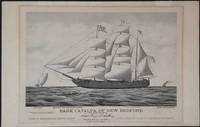
187623907Boston: Forbes Lith. Mfg. Co. 1876. First edition. This scarce tinted lithograph was issued to commemorate the escape of Irish political prisoners from Fremantle W.A. on April 17th 1876. The Fenians are shown rowing towards the bark which is under full sail. The Catalpa is flying a flag with the initials "J T R" - for John T Richardson the ship's agent. A pennant with the letter C the Fenian flag and the American flag are also flying. <br /> <br /> The police boat is in hot pursuit and the British steamship "Georgette" is steaming in from a distance. Among the Fenians freed in this effort was John Boyle O'Reilly who became a leading citizen in Boston and was later to edit the 'Boston Pilot'. <br /> <br /> Captain George Anthony an American whaling captain out of New Bedford Massachusetts recruited a crew for this mission and set sail for Western Australia where two Fenian agents John Breslin and Tom Desmond had already established themselves with aliases. With several delays the day for the escape was set for the 17th of April when most of the convict garrison was distracted by watching the Perth Yacht Club regatta.<br /> <br /> Captain Anthony who refused to surrender the escaped prisoners to the British later sold his story to Zephaniah W. Pease who published the account in 'The Catalpa Expedition'. See also Laubenstein 'The Emerald Whaler'.<br /> <br /> On its arrival in New York in August of 1876 the Catalpa was met with great crowds; jubilant celebrations were held in the US and Ireland.<br /> <br /> 17 x 13" on paper 22 x 14 1/4". For information on the artist E. N. Russell see Blasdale Artists of New Bedford pp 160-161; Kendall Prints 28; Ingalls 318. OCLC: 191908718 1 copy at the Boston Athenaeum. Trove 45254 at the Australian National Maritime Museum; and 57714676 at the State Library of Western Australia. Professionally deacidified. In very good condition. <br /> <br /> A rare print important for its depiction of an important Western Australian colonial event. Forbes Lith. Mfg. Co. unknown
32557Ninety-one numbers Volumes 23 and 24 were issued as one volume plus the separately issued paper envelopes of maps for Volumes 18 and 19 the second envelope is a little worn and stained; nine early numbers are bound as five volumes in publisher's half morocco and Volume 4 is bound in later binder's cloth; Volume 5 lacks the wrappers; those of Volume 10 are worn with a little loss with light stains to the front cover and the top corner of the title-leaf; the rear cover of the double issue is a little stained affecting slightly the top and bottom margins of the last ten leaves; a handful of volumes have trifling cover blemishes; all other volumes are in fine condition in the original wrappers. All subsequent issues are in print and can be supplied. A major repository of contemporary accounts of exploration frequently not published elsewhere with much on anthropology; complete sets are rarely offered for sale. unknown
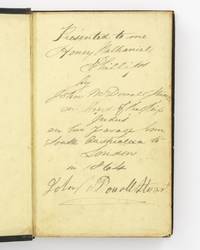
1860135299London: George E. Eyre and William Spottiswoode 1860. First Edition. Hardcover. Very Good. London George E. Eyre and William Spottiswoode 1860. 'Small pica 16mo' unpaginated. Original full morocco all edges gilt; leather a little rubbed at the extremities with a small glass-ring on the front cover; some foxing throughout; mild signs of age and use including a dried sprig of maidenhair fern loosely inserted at one opening; in very good condition. The front free endpaper is signed by John McDouall Stuart at the foot of the following inscription: 'Presented to me Henry Nathaniel Phillips by John McDouall Stuart on board of the Ship "Indus" on her pasage sic from South Australia to London in 1864'. <p>Written on the verso in another hand is '"Ask and it shall be given you". Matt 7th - 7.v'. The book has the contemporary blindstamp of the Adelaide booksellers W.C. Rigby 53 Hindley St Adelaide on the top corner of the rear free endpaper. We would like to think the book was purchased in Adelaide inscribed with a most apposite Biblical text and given to Stuart prior to his departure from Adelaide in late 1861 on his ultimately successful sixth expedition across the continent and back. However in many ways it was a Pyrrhic victory: 'Ill with scurvy and nearly blind Stuart had to be carried on a stretcher slung between two horses; recovering sufficiently to ride by the time they reached Mount Margaret on 26 November he pushed on with three of the party and arrived in Adelaide on 17 December 1862. On a public holiday on 21 January 1863 crowds lined the streets amid banners strung from buildings. He was awarded £2000 though allowed only the interest from it and his party received £1500 between them. <p>White-haired exhausted and nearly blind Stuart decided to visit his sister in Scotland and sailed in April 1864. He later went to London. His claims for a greater reward from the South Australian government led to another £1000 again with only the interest. His "Explorations in Australia. The Journals of John McDouall Stuart" was edited by W. Hardman and published in 1864. <p>He died of ramolissement and cerebral effusion on 5 June 1866 aged only 50 in London and was buried in the Kensal Green cemetery. He has remained a lonely and independent figure with a fierce pride. His reputation as a heavy drinker has led detractors to minimize his achievements even to the extent of doubting that he reached the Indian Ocean in 1862' 'Australian Dictionary of Biography'. Surprisingly apart from this singularly personal gift from Stuart Henry Nathaniel Phillips has left no other trace of his existence that we can find. George E. Eyre and William Spottiswoode hardcover
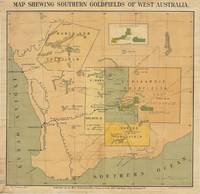
64089London: The West Australian Gold Fields Limited 29 St. Swithins Lane. Printers: Sir Joseph Causton & Sons Ltd. c.1895. Original colour-printed map overall 63 x 65 cm backed onto linen. Shows the Murchison Yilgarn Coolgardie and Dundas goldfields. With separate map of the Murchison goldfield with the addition of the Yalgoo goldfield on a separate slip 22 x 22 cm stating 'Whilst the map was in the press another goldfield - the Yalgoo - was proclaimed.and this slip has been prepared to show the new goldfield and the consequent subdivision of the Murchison field 30th March 1895'. Signs of old restored creases mainly to lower half and outer margins; the slip map browned and backed with archival tissue the top left corner clipped signs of old tears across the centre withal very good for such an ephemeral item. Shows the prospector's routes: Gregory 1846 Roe 1848 Dempster 1863 Giles 1875 Forest 1877 Lindsay 1891 Carnegie 1894 London: The West Australian Gold Fields Limited, 29 St. Swithins Lane. Printers: Sir Joseph Causton & Sons Ltd. [c.1895]. unknown
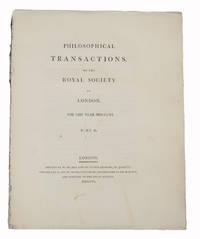
180645128London W. Bulmer and Co. 1806. 4to. No wrappers as extracted from "Philosophical Transactions" 1806 - Part II. Pp. 239-268. Having also the titlepage to the volume Part II 1806. A faint bit of soiling to outer right margin of the first 2 leaves otherwise clean and wide-margined. <br/><br/><em>First printing of this important paper relating Flinder's observations on the ship "Investigator" when exploring the coast of Australia. IN THE PAPER THE NAME "AUSTRALIA" APPEARS PROBABLY FOR THE FIRST TIME IN A SCIENTIFIC MEMOIR p. 247.The name Australia was popularised by Matthew Flinders who pushed for the name to be formally adopted as early as 1804. When preparing his manuscript and charts for his 1814 A Voyage to Terra Australis he was persuaded by his patron Sir Joseph Banks to use the term Terra Australis as this was the name most familiar to the public. Flinders did so but allowed himself the footnote:"Had I permitted myself any innovation on the original term it would have been to convert it to Australia; as being more agreeable to the ear and an assimilation to the names of the other great portions of the earth." In the paper offered he used the name "Australia" as early as 1806."Captain Matthew Flinders RN 16 March 1774 - 19 July 1814 was one of the most successful navigators and cartographers of his age. In a career that spanned just over twenty years he sailed with Captain William Bligh circumnavigated Australia and encouraged the use of that name for the continent which had previously been known as New Holland. He survived shipwreck and disaster only to be imprisoned for violating the terms of his scientific passport by changing ships and carrying prohibited papers. He identified and corrected the effect upon compass readings of iron components and equipment on board wooden ships and he wrote what may be the first work on early Australian exploration A Voyage to Terra Australis."Wikepedia </em> unknown
63186Gill's titles are 'Cradling Forest Creek 1852' 'The Claim Disputed' 'Mustering Cattle' 'Native Sneaking Emus' and 'The Bushranger Pursued'. Hamilton's titles in which the horse naturally enough features prominently are 'The Lost Bushman' 'The Found Bushman' 'Bushmen in Danger' 'Australian Bushmen' and 'The Bushman'. Unpublished but circa 1890 and based on original sketches from upwards of fifty years earlier. <p>The images are printed in brown ink on light brown arch-topped backgrounds printed surface 150 × 205 mm on uniform sheets of cream paper 200 × 275 mm. This set is in fine condition in a modern custom-made portfolio covered in brown cloth lettered in gilt on the front panel 'Scenes of Australian Country Life'. <p>The invaluable 'Dictionary of Australian Artists. Painters Sketchers Photographers and Engravers to 1870' edited by Joan Kerr has only this to say: 'MAY E.C. lithographer signed nine lithographs celebrating life in the bush and on the goldfields c.1855-60 ML. He may have been the May who was in partnership with George Walker q.v. at Melbourne in the early 1870s'. At least he appears on their radar . <p>We have established the following facts. Edgar Charles May 1867-1920 was born at North Adelaide on 27 May 1867; his name later appeared in the local Sands and McDougall's directories with his occupation listed as artist. One published example of his work not noted at all by Kerr and not attributed to May by Ferguson is '14 Views of Old Adelaide from Sketches in 1840-1849 by S.T. Gill F.R. Nixon S. Calvert and O. Korn' Adelaide E.S. Wigg 1890; oblong quarto 19 leaves all rectos blank comprising the gilt-pictorial title page signed in the image by E.C. May 14 full-page tinted lithographic views with tissue-guards the 3-page list of 181 subscribers and the key to plate 5 between plates 4 and 5'. This is Ferguson 9924e which is essentially the same item as Ferguson 9807 apart from the different publishers. We have inspected numerous copies of 9924e the Wigg version and the odd Galbraith one and it is clear that the original Galbraith imprint is masked by the gold blocking carrying the later Wigg imprint. The nature of the contents reworked material from well-known earlier artists the medium tinted lithographs printed in brown and the style of the work leave us in no doubt that May is responsible for all the material in '14 Views of Old Adelaide'. <p>We suggest that the ten lithographs offered here were prepared by him with the intention of putting out a companion volume to '14 Views of Old Adelaide'. The change of publisher after that book was printed leads us also to suggest that Galbraith or May or both lost money on the venture and who knows perhaps the Wigg issue was not a commercial success either. In any event one could see how enthusiasm for a sequel might be considerably diminished. All of these plates are rare; complete sets of them are exceptionally rare on the open market even Kerr's dictionary refers to only nine of them. Until now they have been poorly documented in the literature; fortunately some of them have survived to tell their own worthy tale. unknown
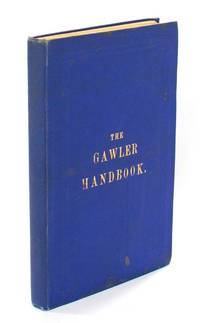
1880104852Adelaide: Goodfellow & Hele almost certainly the Author - James Dally was convinced 1880. First Edition. Hardcover. Very Good. Adelaide Goodfellow & Hele almost certainly the Author - James Dally was convinced 1880. Octavo 182 30 advertisements pages plus 6 lithographed plates of farm machinery by James Martin & Co. and 17 albumen paper carte-de-visite photographs individually mounted on tipped-in captioned leaves. Blind-decorated maroon cloth lettered in gilt on the front cover with a later gilt-lettered cloth title-label along the spine originally untitled; cloth a little flecked slightly sunned on the spine and a little rubbed and bumped at the extremities; some mounts lightly cockled as ever a production flaw; a few trifling signs of use; basically an excellent copy internally fine with the photographs in superb condition. A rare and desirable item attested to by the provenance of this copy: it has the armorial bookplate of Charles Glover on the pastedown and the blind-stamp of Sir Thomas Ramsay on the flyleaf 'T.M.R. Library of T.M. Ramsay'. Ferguson 11744; Holden 70. Holden's entry is more accurate and informative although the photographs may vary slightly between copies. The photograph facing page 16 in this copy is a portrait of Dr Nott rather than 'Frankel's Hotel' as called for in Holden facing page 17. Two other photographs are less-common variant images of the same subject: these are 'Fotheringham's Cordial Factory' facing page 57 and 'Stewart's Music Emporium' facing page 96. These variations notwithstanding two separate editions were produced: one in wrappers with advertisements on the verso of the front cover and on both sides of the rear cover without photographs but with the lithographs not noted by Ferguson; the other in gilt-lettered cloth without the cover advertisements containing 17 mounted photographs plus the lithographs. Both contain 30 pages of advertisements at the rear. <p>Rare in any state and in our view the version on offer is one of the more important and interesting photographically illustrated books produced in Australia. 'The handbook is illustrated with a number of views by Mr J. Taylor the local photographic artist representing the most important edifices and establishments in town' Holden quoting a contemporary review. The frontispiece is a portrait of John McKinlay 1819-1872; there are 14 pages devoted to him he married a Gawler woman in the early 1850s and was based in the town until his death. Justice is not done to the other photographs in describing them prosaically as 'the most important edifices and establishments in town'. Without exception signs of life and day-to-day activities flesh out the images and most of the businesses - butcher shop photographic studio cordial factory furnishing warehouse music emporium - feature well-stocked windows or yards and numerous staff members or customers. Holden reproduces two interesting ones including perhaps the best the butcher shop captioned merely 'Hodgson & Clements' but there are wonderful vignettes in many others. Not least of these are the horse-drawn tram in front of the 'Commercial Bank' and the ornate hearse outside 'F. Fowler's Furnishing Warehouse'. <p>While we are on the subject of death one chapter stands out. Among those to be expected say on 'Horticultural and Agricultural Progress. Gardens around Gawler' or 'The Humbug Society. Flam! Bam! Sham!' or 'The Streets - Number of Businesses - Description of Hotels' there is Chapter XI: 'The Neville and Adamson Tragedy'. Its thirteen pages describe in great detail the events surrounding the double suicide 'and its romantic accomplishment' of Neville and his partner Adamson. 'It is universally believed that Neville was the leading spirit in the suicide and so strong was Adamson's affection love friendship or whatever it may be termed for his companion that he consented to take that final leap in the dark in the wine cellar with him to visit that "bourne whence none return"'. Goodfellow & Hele [almost certainly the Author - James Dally was convinced] hardcover
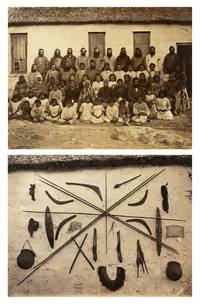
125425Original sepia-toned albumen paper photographs both 158 × 208 mm unmounted as issued; short sealed tear to the bottom corner of the photograph of weapons; essentially in fine condition. Captain Samuel White Sweet 1825-1886 sea captain surveyor and photographer: after he was censured when his ship ran aground in 1875 he 'retired from the sea opened a photographic studio in Adelaide and concentrated on landscapes. With his horse-drawn dark room he travelled through South Australia taking hundreds of skilful pictures of the outback stations and homesteads. The colony's foremost documentary photographer of the 1870s in the early 1880s he was one of the first to use the new dry-plate process' 'Australian Dictionary of Biography'. <p>'Point McLeay Mission was founded on the shores of Lake Alexandrina in 1859 by the Aborigines' Friends Association for the Aboriginal people of the Lower Lakes. George Taplin the Congregational minister was its first administrator. Following Government administration from 1916 Point McLeay was returned to the Ngarrindjeri people in 1974 and renamed Raukkan in 1982' State Library of South Australia. <p>The group portrait depicts 55 Indigenous men women and children posed in five rows in front of one of the thatch-roofed residential cottages at Point McLeay. 'Sweet Adelaide 463' is inscribed in the negative; 'Native Mission Station Ponindie sic' is written in pencil and in error on the verso. <p>The photograph of weapons and artefacts is inscribed 'Sweet Adelaide 462' in the negative and has an early caption in pencil on the verso 'Native Ornaments & Weapons'. The objects numbered 1 to 17 in the negative are displayed against a whitewashed wall of one of the cottages. <p>We have traced only one example of the latter photograph in Trove in the National Library of Australia and none of the group portrait. 'Captain Sweet's Colonial Imagination - The Ideals of Modernity in South Australian Views Photography 1866-1886' by Karen Magee a 2014 University of Adelaide doctoral thesis accessible online notes that Sweet visited Point McLeay in 1878 and 1880. She reproduces the latter photograph in her extensive catalogue see number 811 '"Ngarrindjeri weapons and hunting implements" 1878 Point McLeay. Private Collection' but does not record the group portrait. 2 items. unknown
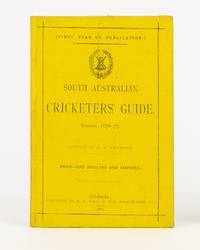
1877144575Adelaide: E.S. Wigg & Son 1877. First Edition. Hardcover. Near fine. Adelaide E.S. Wigg & Son 1877. Octavo vi 60 pages plus advertising on the outside rear cover. Original flush-cut yellow cloth with the full title page details repeated on the front cover with the addition of a vignette illustration and ruled border; first and last page tanned; later ownership details on the front pastedown with the name repeated on the dedication page; a near-fine copy. 'First Year of Publication' and rare especially in this condition. A second volume 'The South Australian Cricketers' Guide and Footballers' Companion. Season 1877-78' appeared the following year; a third and final volume 'The South Australian Cricketers' Guide. Season 1884-85' was published in 1885. <p>Padwick 3375. E.S. Wigg & Son hardcover
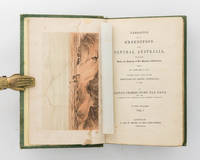
1849119606London: T. and W. Boone 1849. First Edition. Hardcover. London T. and W. Boone 1849 first edition slightly later issue. Octavo two volumes x iv 5-416 8 publisher's advertisements pages with 12 illustrations plus 8 plates 2 tinted 2 hand-coloured a folding map with rivers and Sturt's tracks in three colours and an advertising slip for Stokes tipped in after page x; and vi 308 92 4 prospectus for Siborne 8 publisher's advertisements pages with 6 illustrations plus 8 plates 2 hand-coloured and an advertising slip for Leichhardt tipped in on page 1. The woodcut illustrations on page 158 in the first volume and on pages 195 and 195 in the second volume are not noted in the plate list; the hand-coloured plates three of birds and one of Mus conditor 'The Building Rat' are from original artwork by John Gould and Henry Richter. Original blind-stamped green ribbed cloth the primary binding rebacked not professionally but more than adequately retaining the original backstrips and endpapers; cloth a little worn at the extremities stained and sunned on the spines with minor loss at the foot of the second one; the first volume has the front inner hinge reinforced the bottom corner of the free endpaper torn away slight loss near the foot of the front hinge the rear free endpaper removed and the rear pastedown stained; the second volume has slight loss to the restored front inner hinge and a few light stains to both endpapers; tidemarks to some plates not the hand-coloured ones and minor in all cases except the first frontispiece; brown stain to the bottom corner tips of some leaves in each volume most of them from pages 71-100 including a plate in the first volume and from pages 141-164 in the second volume but touching the text on one leaf only and rarely larger than a thumbnail elsewhere; short sealed tears to the leading margin of pages 27-52 in the appendix to the second volume; minimal signs of age and use including a partially erased word on one page and some words offset onto the last page of advertising in the first volume; overall a very decent set. Provenance: George Woodroofe Goyder with the pastedown of each volume inscribed in his hand 'Hill Side Cottage Medindie April 1858'. George Woodroofe Goyder 1826-1898 South Australia's surveyor-general for thirty-three years is best remembered for the eponymous Goyder's Line 'the line of demarcation between that portion of the country where the rainfall has extended and that where the drought prevails' a line of reliable rainfall that separates agricultural from pastoral lands. 'Goyder joined the Department of Lands as chief clerk in January 1853. In quick stages he rose from second assistant to assistant surveyor-general in January 1857. In April he took charge of an exploration to report on country north of pastoral settlement. He was amazed to find Lake Torrens full of fresh water and its flourishing eastern surroundings very different from the desert described by Edward Eyre in 1839. His exuberant report persuaded the surveyor-general Captain Sir Arthur Freeling to examine the area in September. No more rain had fallen but hot winds had killed the vegetation and turned the lake into a bed of mud. Freeling returned to criticize Goyder for mistaking flood for permanent water being misled by mirage and misconceiving the value of the northern country. Although Goyder had proved that Eyre's horseshoe of salt lakes was penetrable and thereby opened the way to further exploration he was too conscientious to ignore his blunder and in 1859 at his own request led survey parties to triangulate the country between Lakes Torrens and Eyre and to sink wells. When Freeling resigned Goyder was recalled from the north to become surveyor-general on 19 January 1861' 'Australian Dictionary of Biography'. <p>Goyder married in 1851; by 1856 the family with four children moved from rented accommodation in North Adelaide 'a short distance across the parklands to Medindie . into a "neat cottage" with six rooms a garden and a vineyard . Named Hillside the cottage was located on a private road now Hawkers Road close to Robe Terrace overlooking the parklands' Janis Sheldrick: 'Nature's Line. George Goyder - Surveyor Environmentalist Visionary' 2013. It is intriguing to discover that Goyder acquired a set of Sturt's account of his 1844-46 Central Australian expedition in search of an inland sea in April 1858 the year after his own expedition to Lake Torrens. 'The expedition started by following the Murray and Darling both to settle any doubt about the confluence of the two rivers and to avoid the "horseshoe" of Lake Torrens which had halted Eyre's progress a few years before' Wantrup and confounded Goyder himself in 1857. Wantrup 119 noting the point that distinguishes the first issue an inserted advertisement for Melville immediately following the text in the first volume: 'this leaf was suppressed shortly after publication of Sturt's book'. 2 items. T. and W. Boone hardcover
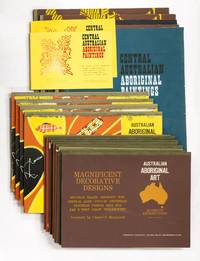
1967138977Melbourne: Newcraft Publicity 1967. First Edition. Paperback. Very Good. Melbourne Newcraft Publicity 1967 to 1969. Seventeen portfolios in various formats see below each containing a page or two of text and 5 colour serigraphs printed on card unless otherwise stated and interleaved with tissue-guards. Thick card covers with cloth spines; minor blemishes to some covers; minor damage to a bottom corner of portfolio B Volume 4 see below with loss of the corner-tip to the last three plates; overall the contents are in excellent condition. Two volumes are bound in portrait format; the others are presented in landscape format albeit with the spine along the top edge. The National Library of Australia catalogue states that this material was 'Available only in set of 24 portfolios at $310.00 . "Authentic reproductions ready for framing". Edition limited to 200 numbered copies' we have not traced the original source of this information. However we have incorporated below a number of pertinent details gleaned from Trove; in particular we found the relevant catalogue records provided by the State Library of Victoria to be the most informative. <p>A Magnificent Decorative Designs. Melville Island Abstract - Map Central Aust. - Pintubi Churingas - Victorian Possum Skin Rug - Far N. West Coast Phallocrypt 375 × 505 mm; #13/116. <p>B Australian Aboriginal Art. Primitive Traditional Decorative four volumes each 403 × 550 mm and all numbered #095; together with three larger-format volumes each approximately 550 × 795 mm respectively #1/086 #2/090 and unnumbered. The third volume without the subtitle 'Primitive Traditional Decorative' contains seven plates reproducing ones that appear in the smaller-format volumes; six are printed on paper the seventh is printed on the inside rear card cover. <p>C Cave Paintings of Arnhemland Volumes 1 2 3 and 5; each approximately 385 × 500 mm; all #126. The title of the fifth volume is 'Ceremonial Cave Paintings of Arnhemland "Amazing Anthropomorphic Figures"'. <p>D Central Australian Aboriginal Paintings. Brilliant Abstract Designs of the Pitjantjatjara two volumes bound portrait-format each 750 × 550 mm respectively #66 and #2/100. The first volume has a brown cover decorated in ochre and lettered in black; the second volume has a blue cover decorated in white and lettered in black. Both volumes contain seven plates. <p>E Magnificent Bark Paintings of Arnhemland and the Islands Volumes 1 2 and 4; each approximately 380 × 500 mm; respectively #1/126 #2/116 and #101. The title of the fourth volume is 'Magnificent Bark Paintings of Arnhemland'. <p>Offered together with three plates mounted as issued on thick card; these also appear in the volume of duplicated plates noted in B above. Also included are two copies of another Newcraft Publicity item 'Central Australian Aboriginal Paintings' by Winifred Hilliard wrappers oblong quarto with 7 colour plates; the second copy is numbered 153. Although the lengthy subtitles are different 'The Pitjantjatjara Abstracts. Designs in Vibrant Colours from Ancient Mythological and Totemic Motifs by Aboriginal Artists at Ernabella in the Musgrave Ranges' and 'Ancient Mythological and Totemic Motifs in Vibrant Colors by Finke River Aboriginal Artists' the contents are the same albeit in a different order and with minor variation to the introductory text. To complicate matters even more the same contents appear in the first very much larger-format volume in D above. <p>We have identified five portfolios not present in this run cross-referenced with the descriptions above: A Magnificent Decorative Designs. Volume 1 Churinga Patterns Ground and Rock Paintings; <p>C Cave Paintings of Arnhemland. Volume 4; E Magnificent Bark Paintings of Arnhemland. Volume 3: Oenpelli Portfolio; Australian Aboriginal Art: Bark Paintings - Angurugu Groote Eylandt Gulf of Carpentaria; and Australian Aboriginal Art: Decorated Shields of North Queensland. The SLV also identifies one related item we do not have: 'Australian Aboriginal Art' Melbourne Newcraft Publicity 1969. It is described as being a single volume 750 mm tall containing 'Colour prints on paper of items of aboriginal art miniaturised from the series of authentic reproductions of bark and cave paintings in the Newcraft collection of 23 portfolios'. 22 items. Newcraft Publicity paperback
17344They are drawn mainly on Adelaide banks and business houses in the 1860s and 1870s with payees generally in the Clare region including Clare Mintaro Spalding Yatina Watervale Auburn Rhynie Broughton and Bungaree. All are bank-stamped. Recognisable payees' signatures written on both sides of the notes include Benno Seppelt Albion Tolley George Wood and Philip Santo. Local well-known businesses represented include Simpson James Martin Faulding Wills William Morgan Fowler Harris Scarfe and Duncan Fraser. Offered together with 50 or more similar but lesser items from mainly the 1910s. Over 200 items. unknown
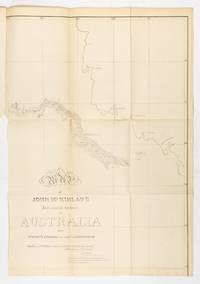
1862140416Adelaide: W.C. Cox Government Printer 1862. First Edition. Hardcover. Very Good. Adelaide W.C. Cox Government Printer 1862 first edition. Foolscap folio drop-title 56 pages plus 4 large folding maps respective maximum sheet sizes and printed surface areas are 754 × 545 mm and 739 × 521 mm; 757 × 545 mm and 724 × 520 mm; 756 × 542 mm and 730 × 517 mm; and 758 × 556 mm and 724 × 525 mm. Recent cloth lettered in gilt on the front cover; maps lightly foxed in a few spots with a few tiny tears expertly sealed and a few tiny chips to some top and leading edges; an excellent copy. South Australian Parliamentary Paper Number 12 of 1862. The earliest printing of McKinlay's journal of his Burke and Wills Relief Expedition and a rarity. 'The South Australian House of Assembly chose John McKinlay to lead the South Australian relief expedition in August 1861. Setting out from Kapunda with a well-equipped party he reached Cooper's Creek in October. From his depot at Lake Buchanan he made numerous excursions into the surrounding country and found what he believed to be the grave of one of the Burke party. Coming to the conclusion that all of Burke's men had died he sent back for instructions. When his instructions arrived he learned that Howitt had already discovered King and that Burke Wills and Gray were indeed dead. <p>McKinlay proceeded to examine the land to the north of Lake Eyre discovering much useful pastoral and grazing land. In December he set out for the Gulf of Carpentaria to rendezvous with the Northern Relief Expedition under Commander Norman. His crossing was made difficult by diminished stores and his position was critical in May 1862 when he arrived with his men at the Albert River where he expected to find relief only to discover that the "Victoria" had already sailed. Sensibly he decided to make for the Queensland coastal settlement at Port Denison 500 miles to the east. After a difficult trip of over three months McKinlay brought all his men into Port Denison by the end of August. <p>When he reached Adelaide in October 1862 McKinlay handed his journal to the South Australian Government. It was printed soon afterwards in the South Australian parliamentary papers. The text of his journal was later published for general distribution in the colonies by two Melbourne publishers' Wantrup. <p>Only the first public account published by Baillière in 1863 contained maps 'three large folding maps loose in a back endpocket' but it is 'virtually unprocurable in fine clean condition owing to the poor quality of the paper used' Wantrup. This first edition large-format parliamentary paper is far superior in every respect. McLaren 12963; Wantrup 2023 pages 317-18. W.C. Cox, Government Printer hardcover
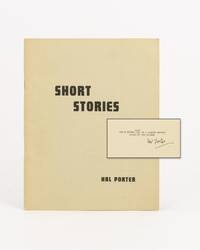
1942140203Adelaide: The Author 1942. First Edition. Paperback. Near fine. Adelaide The Author 1942. Quarto 63 pages. Saddle-stapled grey card covers lettered in black very slightly creased and marked with one trifling snag at the foot of the spine; edges slightly thumbed; a near-fine copy. Two typographical errors have been corrected in pencil by the author: on the dedication page it is now 'juvenilia' not 'juvenalia' at the end of the first line; and on page 55 'spoilation' is now 'spoliation'. However we note in passing that 'daguerrotype' in the line above got through unnoticed. Number 138 of an undated limited edition with the upper limit not stated numbered and signed by Hal Porter. This is a presentation copy of his first stand-alone work additionally inscribed and signed in ink at the head of the title page 'To dear Lucy Lockett with love and gratitude from Hal. 14 xii 1944'. The recipient Lucy Lockett Ayers 1886-1971 was a granddaughter of Sir Henry Ayers. <p>The revised edition of Porter's biography by Mary Lord 'Hal Porter - Man of Many Parts' 1993 states '"Short Stories" came out late in 1942 in a limited edition of 250 copies. Most if not all were numbered and signed then distributed randomly and recklessly by the author. The volume contained fourteen stories none of which had been published and one of which was the prize-winning "And from Madame's sic"' page 28. The precise details of the publication remain unclear. Lord's checklist indicates that the book was printed by the Adelaide 'Advertiser' and gives a date of '1942' but the very few perfunctory press notices relating to the book appear in April and May 1943 perhaps suggesting a later date of publication. Although copies are undoubtedly now extremely scarce whatever the truth of the matter this presentation inscription demonstrates that Porter still had copies to hand in December 1944. <p>The stories contained in this collection are 'The Room' 'And from Madame's .' 'The Two Bachelors' 'At Aunt Sophia's' 'No-one Knows!' 'Miss Rodda' 'Carnival Piece' 'Cafe Samovar' 'Scene: The Bend of a River' 'Otto Ruff' 'Gone Away' 'The White Rabbit' 'Miss Brockel' and '- And Nothing More'. <p>Loosely inserted is a typescript of a contemporary review of the book 1 page quarto with two of the six paragraphs struck out with pencil. We have been unable to determine whether or not it was published or if Lucy Lockett Ayers is the reviewer. 2 items. The Author paperback
1847048653London: T. & W. Boone 1847. xx 544pp frontispiece and 6 other b/w plates 1 folding 7 text illustrations 1 small advertisement bound in. Contempory marbled boards with leather spine. Spine rebacked retaining original spine several related clippings late 19th & early 20th century laid onto endpapers and rear blanks prev owner armorial bookplate on front pastedown name on verso of frontis narrow damp mark to margin of frontis not affecting image foxing to plates but text pages clean occasional pencilled notes. Minor rubbing to boards. Some black tape remains from old hinge repair but a proper repair has been performed. A nice copy of this scarce explorer's journal. The 3-sheet map issued separately is NOT present. First Edition. Hard Cover. Very Good. 8vo. T. & W. Boone Hardcover
1880104186Adelaide: Goodfellow & Hele almost certainly the author: James Dally was convinced 1880. First Edition. Hardcover. Very Good. Adelaide Goodfellow & Hele almost certainly the author: James Dally was convinced 1880. Octavo 182 30 advertisements pages plus 6 lithographed plates of farm machinery by James Martin & Co. and 17 albumen paper carte de visite photographs individually mounted on tipped-in captioned leaves. Blind-decorated blue cloth lettered in gilt on the front cover; cloth slightly rubbed and bumped at the extremities a little marked and bubbled and lightly sunned on the spine; some mounts lightly creased a production flaw; a few trifling signs of use; a very good copy but internally fine with the photographs in superb condition. Ferguson 11744; Holden 70. Holden's entry is more accurate and informative although the photographs may vary slightly between copies. The photograph facing page 17 in this copy is of the 'Gawler Institute' showing the Institute building and Town Hall rather than 'Frankel's Hotel' as called for in Holden. These variations notwithstanding two separate editions were produced: one in wrappers with advertisements on the verso of the front cover and on both sides of the rear cover without photographs but with the lithographs not noted by Ferguson; the other in gilt-lettered cloth without the cover advertisements containing 17 mounted photographs plus the lithographs. Both contain 30 pages of advertisements at the rear. Rare in any state and in our view the version on offer is one of the more important and interesting photographically illustrated books produced in Australia. <p>'The handbook is illustrated with a number of views by Mr J. Taylor the local photographic artist representing the most important edifices and establishments in town' Holden quoting a contemporary review. The frontispiece is a portrait of John McKinlay 1819-1872; there are 14 pages devoted to him he married a Gawler woman in the early 1850s and was based in the town until his death. Justice is not done to the other photographs in describing them prosaically as 'the most important edifices and establishments in town'. Without exception signs of life and day-to-day activities flesh out the images and most of the businesses - butcher shop photographic studio cordial factory furnishing warehouse music emporium - feature well-stocked windows or yards and numerous staff members or customers. Holden reproduces two interesting ones including perhaps the best the butcher shop captioned merely 'Hodgson & Clements' but there are wonderful vignettes in many others. <p>Not least of these are the horse-drawn tram in front of the 'Commercial Bank' and the ornate hearse outside 'F. Fowler's Furnishing Warehouse'. While we are on the subject of death one chapter stands out. Among those to be expected say on 'Horticultural and Agricultural Progress. Gardens around Gawler' or 'The Humbug Society. Flam! Bam! Sham!' or 'The Streets - Number of Businesses - Description of Hotels' there is Chapter XI: 'The Neville and Adamson Tragedy'. Its thirteen pages describe in great detail the events surrounding the double suicide 'and its romantic accomplishment' of Neville and his partner Adamson. 'It is universally believed that Neville was the leading spirit in the suicide and so strong was Adamson's affection love friendship or whatever it may be termed for his companion that he consented to take that final leap in the dark in the wine cellar with him to visit that "bourne whence none return"'. Provenance: J. Cluny Harkness Federal President of the Chamber of Manufactures in the 1950s according to Trove with his pictorial bookplate on the front pastedown. Goodfellow & Hele [almost certainly the author: James Dally was convinced] hardcover
186380169Adelaide: W.C. Cox Government Printer 1863. First Edition. Hardcover. Fine. Adelaide W.C. Cox Government Printer 1863. Octavo 54 pages plus a large folding map and an errata slip tipped in on the contents page; the map 890 × 650 mm is of the Northern Territory itself and shows the 'exploration tracks' of Stuart Sturt A.C. Gregory McKinlay and Leichardt sic. Contemporary full morocco with decorative gilt borders front and rear and the title in gilt on the front cover a most attractive colonial binding; extremities slightly rubbed; leather slightly dusty; the map has tiny holes nibbled by silverfish along the fold of two blank panels and short splits to four intersecting folds insignificant blemishes; a fine copy. 'On 16 July 1863 the Crown annexed to South Australia "until We think fit to make other disposition thereof the Territory now known as the Northern Territory"'. Responsibility was transferred to the Commonwealth on 1 January 1911. The book reprints the Letters Patent and the relevant Acts and Regulations 20 pages together with lengthy extracts from Earl's 'Handbook for Colonists in Tropical Australia' printed earlier the same year at the 'Pinang sic Gazette' Press in the Straits Settlement 22 pages. The last section 'Interior of the Country' 12 pages is largely extracted from the journal of Stuart and the report of Waterhouse naturalist to his expedition. Ferguson 13458 the wrappers here are not stiffened and the title page is also printed within a border. <p>Provenance: The Honorable Henry Ayers CMG with his armorial bookplate. Sir Henry Ayers 1821-1897 legislator and businessman was at the time South Australian Chief Secretary under whose command the 'Northern Territory Land Regulations' and 'Appointment of Officers' printed in the book were proclaimed. Ayers has underlined in ink six lines in the Northern Territory Act relating to land orders. W.C. Cox, Government Printer hardcover
1900108066Adelaide: Paris Nesbit to Number 15 then John Newton Wood 1900. First Edition. Hardcover. Fine. Adelaide Paris Nesbit to Number 15 then John Newton Wood 1900 and 1901. Foolscap folio 242 pages. Each issue drop-title as issued in contemporary flush-cut cloth-backed papered boards; cloth renewed; boards lightly worn at the extremities and a little marked; the contents are in fine condition. Number 32 the first one in Volume 2 is a different format - shorter and wider - and the leading margins are folded back 40 mm. 'The small religious newspaper "Morning" was founded in 1900 by the gifted but unbalanced lawyer Paris Nesbit. The newspaper was initially used largely as a vehicle for his personal views on religion and Adelaide society. Nesbit unashamedly stated that the newspaper was his own voice and would be run "as Christ would if He were subject to the present limitations of my faculties" . Nesbit and his family - in particular his sister Agnes Benham - were interested in the "new thought" movement of the 1890s with its socialism and sexual reform. Early issues of the newspaper contained items commenting on Nesbit's short stint in the Parkside Mental Asylum in 1898 which he felt had been politically motivated by his enemies including the premier Charles Kingston. Kingston as well as other political and church leaders were criticised in early issues of the newspaper as were various Adelaide lawyers. Nesbit felt particularly strongly about religious hypocrisy. Benham contributed book reviews and periodic articles mostly on religious topics during the early life of "Morning". Much attention was given by various contributors many writing under pseudonyms to Benham and Nesbit's views that ideal marriage relationships were based on intellectual and spiritual connection. After just four months Nesbit handed over the editorship of the newspaper to the printer John Newton Wood who steered the newspaper towards an interest in spiritualism and vegetarianism' SA Memory online. The final issue appeared in 1909. Paris Nesbit (to Number 15), then John Newton Wood hardcover
1914010886Sydney: Angus & Robertson 1914 First edition dated July 1914 from the publishers 31 page catalogue at the rear RARE and scarce in the wrapper May Gibbs earliest 'Gumnut' style illustrations The dust jacket has edge wear and chipping and some short tears the front fold in flap is missing both the pasted on illustrations with May Gibbs art are present and intact these pasted on paper plates are also present on the book cover and spine book is tidy with small ink inscription to fep dated 1918 very slight foxing to closed edges colour frontspiece and four other full page black and white plates all by May Gibbs. x 228pp 31pp publisher's catalogue decorated cloth. First Edition. Decorative Cloth. Very Good/Fair. Illus. by May Gibbs. 8vo - over 7 - 9 tall. Angus & Robertson hardcover
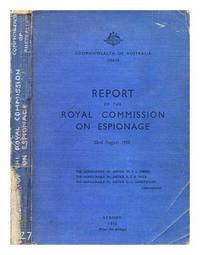
1955343835Sydney : A. H. Pettifer Govt. Printer for New South Wales 1955. Paperback edition. Softcover. Provenance: BBC copy. Near fine paperback copy; edges very slightly dust-dulled. Remains particularly well-preserved overall; tight bright clean and especially sharp-cornered. Physical description; v 483 pages : illustrations facsimiles ; 23 cm. Subjects; Diplomatic and consular service Soviet Australia. Espionage Soviet Australia. Espionage Australia. Espionage Russian Australia. Petrov Vladimir Mikha lovich 1907-1991. Sydney : A. H. Pettifer, Govt. Printer for New South Wales paperback
1843133575London: Printed by J.C. Hailes 1843. First Edition. Hardcover. Very Good. London Printed by J.C. Hailes 1843. Octavo 30 9 pages plus a folding map 'Plan of part of South Australia 1843' 216 × 171 mm and 2 folding survey plans 'Plan of the Two Special Surveys on the River Light 1843' 341 × 185 mm and 'Plan of the Special Survey on the River Murray 1843' 245 × 193 mm. Original blind-stamped cloth lettered in gilt on the front panel with the title later added in white ink along the spine; cloth a little sunned on the spine with light wear to the extremities; endpaper hinges cracked; residual paste along a strip at the top of the front free endpaper; occasional trifling spots of foxing; maps a little offset; nevertheless an excellent copy of an extremely rare publication relating to the early land surveys in South Australia. The first section comprises a 'Statement of the Proceedings of the Directors for the Information of the Proprietors' with the final unpaginated section consisting of a statement of accounts for the surveys of the River Light and the River Murray. This copy has the ownership signature dated 1855 of London corn factor John Burrows and contains noteworthy annotations and additional manuscript material relating to his family's land speculations in South Australia and New Zealand. John has neatly annotated both of the survey plans with details of the selections on the River Light and the River Murray owned by him and his mother Jane. These appear to have been inherited from his father Thomas and subsequently expanded in the 1860s. The rear endpapers contain detailed notes in another hand summarising the family's colonial landholdings and giving details of their agents in Adelaide and Wellington we suggest in the 1870s. A clipping from another document mounted on the rear pastedown gives similar information. Additional material comprises: <p>1. An autograph letter addressed to John Burrows from his Adelaide agent James Walsh dated 1872 regarding the lease of two blocks in the abortive township of Victoria 85 km north of Adelaide octavo; 2 pages of a bifolium affixed with sealing wax to the verso of the final page. The meagre rents received are demonstrative of Victoria's failure it is located approximately 12 km north of Kapunda and was soon eclipsed by that town after the discovery there of copper ore in 1842. A leaf from a later letter is similarly mounted inside the bifolium. <p>2. A loosely-inserted autograph letter addressed to Thomas Burrows from his agent Daniel Riddiford in Wellington dated 24 January 1841 regarding his selections in New Zealand quarto 1 page of a bifolium folded to form the cover stamped 'Ship Letter"; complete with the address panel postmark and wax seal. Riddiford was himself a pioneering runholder in Wairarapa and Hutt River. <p>3. A manuscript document outlining lands on the River Light and River Murray owned by C.J. Heath another absentee landowner and corn factor. We are unsure of the nature of his connection to John Burrows but they shared an Adelaide agent Joel Roberts see 'The South Australian Advertiser' for 27 May 1873. <p>4. A newspaper clipping with content relevant to the subject of the book with its source the South Australian 'Advertiser' 13 June 1878 written in ink in the margin by James Walsh. <p>Provenance: John Burrows as above; possibly James Walsh see above; later Charles R.J. Glover with his armorial bookplate on the pastedown. Charles Richmond John Glover 1870-1936 the first lord mayor of Adelaide public benefactor businessman and book collector; some 2787 lots of his books were sold by auction over five days in late 1970 and we know from long and unhappy experience that he is responsible for the lettering in white ink on the spine. His bookplate is mounted in the bottom left-hand corner of the front pastedown and the top right-hand corner of the plate was not glued down as it partially covers an earlier coat of arms possibly hand-drawn in black ink. It features Britannia extending a hand in greeting to an Indigenous man holding a spear with a rocky cliff and a kangaroo in the background. This image is based on the design of the emblem used on the South Australian flag between 1876 and 1904. <p>Ferguson 3706 citing a lengthy 1934 William Dawson and Sons Limited catalogue record for this particular copy. Printed by J.C. Hailes hardcover
184380073London: J.C. Hailes and S. Gilbert 1843. First Edition. Hardcover. Very Good. London J.C. Hailes and S. Gilbert 1843. Octavo 32 pages plus a small folding map 205 × 156 mm an engraving of Adelaide and 2 full-page lithographs: 'Farm of J. Barton Hack . Echiunga sic Springs Mount Barker' and two portraits on the one plate of Kertamaroo King John and Mogata his wife. Later half calf and cloth retaining the original pale yellow front wrapper lettered 'South Australia in 1842' and with numerous binder's blanks at the rear to make a more substantial object; covers slightly rubbed at the extremities and high spots; wrapper lightly stained and creased with the leading edge neatly reinforced presumably when the binding was done; first and last leaves lightly foxed with the last one lightly marked; trifling signs of handling; a very good copy. This copy contains the armorial bookplate of Henry Percival Moore and his pencilled ownership initials on an early binder's blank. Moore was the Colonial Manager for the South Australian Company from 1901 to 1929. Interestingly the lithographs are by George French Angas from the artwork of others 'a sketch by Col. Gawler' in the first instance and from drawings 'Model'd from life by Mrs Walker - cropped to Walk' in the second. There are some extracts from official reports and various statistics up to August 1842 but the book is comprised predominantly of first-hand accounts often in the form of lengthy quotes from letters from settlers. The passage of time puts things into perspective. There is a PS to Alexander Lorimer's letter: 'I have neglected to mention that vineyards are forming by many of the settlers'. The closely-printed two pages on Aborigines concludes with this paragraph: 'It is hoped that a conviction of the deep responsibility which we have incurred toward the aboriginal inhabitants of that beautiful country of which we have taken possession will render the minuteness of the preceding information not unacceptable'. Ferguson 3721 not mentioning Angas nor identifying the author. Susan Woodburn has recently alerted us to a paragraph in the 'Adelaide Observer' of 1 July 1843: 'The "South Australian News" of January last announces the publication of a pamphlet to be entitled "South Australia in 1842" not by "One who is going" but by "One who lived there four years". We understand it will contain a full true and particular account of the Colony and be embellished with views of Adelaide Mr Hack's Farm and the portraits of two natives King John and his wife. We suspect our friend David McLaren to be the author of the pamphlet'. David McLaren 1785-1850 arrived at Kingscote Kangaroo Island in April 1837 as the second colonial manager of the South Australian Company. He left Adelaide on his return to London in January 1841 'Australian Dictionary of Biography'. J.C. Hailes and S. Gilbert hardcover
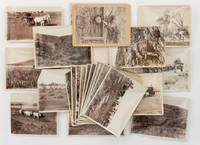
122043Original gelatin silver prints uniformly 122 × 165 mm but three have been trimmed a little all captioned in ink on the verso four are dated 1905. All prints are unmounted as produced; two have a short tear to one edge one of these and one other have a small piece missing from one or two corners; one is a little creased; two are a little marked; overall the condition is excellent. Yardea Station is a pastoral lease approximately 400 kilometres north-west of Adelaide; it was the first property taken up in the Gawler Ranges in the late 1850s. 'Lying on one of the main east-west corridors through the Ranges Yardea became the main postal depot during the late 1860s. A stone police station was erected in 1873 staffed by two police troopers who had been placed there a year earlier to keep order and to distribute rations to Aboriginal people who were increasingly attracted to Yardea. After the Yardea police were withdrawn in 1885 the building served as a post-office and telegraph station and then as a repeater station when a direct telegraph link to Western Australia was established in 1903. During the 1890s when most of the Gawler Ranges station leases including Yardea were abandoned due to a combination of high government charges drought and uncontrolled dingo numbers the building was still staffed by three telegraph station employees' Philip Jones in 'Naturally Disturbed' 2010 'an interdisciplinary collaboration between Sue Kneebone and Philip Jones. The exhibition engages with the complex history intersecting narratives and unexplained absences that relate to Yardea a pastoral property in the Gawler Ranges in South Australia once managed by Sue Kneebone's great-grandfather'. Elsewhere in her PhD thesis of the same name Sue Kneebone writes: 'In late 1903 at a time of high demand and high prices for sheep Yardea was taken up by James Grey Moseley with his station manager my great-grandfather Arthur Bailey . The Yardea lease . by then included Paney Yartoo and the old Pondana and Cacuppa stations'. A small number of these images have been located in the collection of the State Library of South Australia with some attributed to W.R. Evans who appears to have been on the staff of the Eucla Telegraph Station around this time. One of the present photographs is captioned 'A. Cole Post Master A. Bailey Manager Yardea'. Nearly all of the captions mention Yardea; Pondona Pondana and Paynea Paney are also noted. Pastoral pursuits are well-recorded: these include 'Mowing Crop' 'Hay-Stack' 'Stooking Hay' 'Hay Carting' all dated 1905 'Mustering Cattle' 'Bullock Team' 'Shearing' 'Wool Team' 'Woolly Sheep' and 'Horses'. There is also a fine image of a 'Camel Team en route for W.A. passing through Yardea'. Other scenes are 'Rock Hole Yardea' from above and below 'Dam Yardea Station' 'Stone Dam Paynea sic' and views of the Yardea Gorge Pondona Hills two views both with sheep 'Hills Gawler Ranges' and 'Deep Well Yardea' featuring a horseman and a stone hut. People are visible in seventeen of the photographs and in at least seven instances they are Indigenous men. Offered with a cabinet card photograph 145 × 105 mm mounted on plain card of the fresh grave site at Yardea of Sarah Cole wife of Alfred Cole. A notice of her death appeared in the Adelaide 'Chronicle' on Saturday 26 June 1897: 'COLE. On the 20th June at Yardea telegraph station Sarah Elizabeth Broughton née Garrett the dearly beloved wife of Alfred Cole and second daughter of C.J. and the late William Garrett late of Port Lincoln aged 33 years and 9 months'. She was the mother of six children. The presence of this poignant photograph in the collection suggests to us a Cole family provenance. 24 items. unknown
198538454The Fertility Society of Australia. New. 1985. Paperback. FREE UPGRADE to Courier/Priority Shipping Upon Request IN STOCK AND IMMEDIATELY AVAILABLE FOR SHIPMENT - PRISTINE Mild cover shelf wear; else flawless. 72 pages. -- with a bonus offer-- . The Fertility Society of Australia paperback
200692398Images Publishing Dist Ac. New. 2006. Hardcover. 1864700386 . FREE UPGRADE to Courier/Priority Shipping Upon Request - IN STOCK AND IMMEDIATELY AVAILABLE FOR SHIPMENT - Flawless copy brand new pristine never opened -- 216 pages; 400 color illustrations. Description: "Extensive reserach over a number of years pointed to the need for a comprehensive easy to follow guide to architectural details. Deatails in Architecture Volume Two depicts drawings and concept sketches alongside succinct summaries and a photograph of the finished Contained within these informative pages are designs from some of the world's leading architects of residential and commercial spaces." -- with a bonus offer-- . Images Publishing Dist Ac hardcover