FLINDERS, MatthewBiblio.com
3 315 résultats
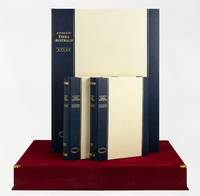
144538Adelaide: Government Printer 1989. Hardcover. Near fine. Adelaide Government Printer 1989 facsimile edition/ 1814. Large quarto two volumes of text plus the elephant folio atlas containing 18 charts and 10 plates; some relevant ephemera is loosely inserted. Half dark blue calf and cream cloth; cloth on the front cover of the atlas slightly marked in one small spot; a near-fine set in the near-fine dark red felt-covered wooden storage box lightly scuffed and marked. A superb production limited to only 500 numbered sets this set is number 131. The storage box is designed with a matching two-door lid opening at the centre and attached to the base with piano hinges. About a third of the edition was issued in these boxes as originally advertised; this set is one of them. <p>Apparently the successful tender was paid in full before the job was completed - not all the lids were supplied or fitted - and the box-maker was last seen heading for the hills overseas with the money and a big smile! The problem with the majority of the boxes was 'solved' by commissioning clear perspex lids which fitted snugly over the custom-made bases. Government Printer hardcover
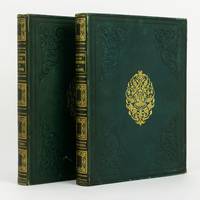
183987631London: Fisher Son & Co 1839. First Edition. Hardcover. Fair. London Fisher Son & Co. 1839 and 1840. Quarto two volumes iv xxxvi 84 pages plus a map 46 full-page plates including an unlisted plate facing page 54 'Ancient Archway of Cavern in the Balkan Mountains' and an engraved vignette title page; and iv 100 pages including the cumulative index plus a double-page map 48 full-page plates and an engraved vignette title page. Most plates have the original tissue-guards. Matching full dark green morocco the spines lettered and decorated in gilt in compartments all sides decorated in gilt and blind; all edges gilt; covers a little bumped and lightly worn at the corners; leather a little scuffed and marked; scattered foxing and minor signs of handling more so in the first volume which is inexpertly reinserted in its binding with a rear endpaper that would be greatly improved by removing and replacing it and a front free endpaper that appears to be original but salvaged from the rear and amateurishly lined with tissue; overall a decent set which certainly presents well on the shelf. Provenance: John Michael Skipper 1815-1883 artist solicitor and South Australian pioneer with his ownership initials on the engraved title page of the first volume and his signature and most interesting inscription of the front free endpaper of the second volume: 'J M. Skipper from Mrs. Thomas March 14th. 1841' his mother-in-law. <p>Skipper was born in Norwich the son of a solicitor; 'he was intended for the law but was more interested in art in which he was encouraged by his uncle. In 1833 he abandoned his studies to become a midshipman in the East India Co.'s "Sherbourne" bound for Calcutta. On his return deciding to migrate he arranged to be articled to Charles Mann the new South Australian advocate-general and sailed in the "Africaine" arriving at Holdfast Bay on 6 November 1836. He sketched scenes on the voyage and met Frances Amelia eldest daughter of Robert Thomas; he married her on 28 December 1839' 'Australian Dictionary of Biography'. <p>Accordingly these volumes not only date from the foundation years of British settlement in the colony they also come from two of the first settlers. They are offered together with a copy of 'The Diary and Letters of Mary Thomas 1836-1866. Being a Record of the Early Days of South Australia. Edited by Evan Kyffin Thomas' Adelaide 1925 revised and enlarged third edition/ 1915. It is an account of the Thomas family's journey to South Australia on the 'Africaine' in 1836 and the fascinating early years of colonization as described in Mary's letters to her brother in England. Her husband Robert was the first newspaper publisher in South Australia and important details of the practical difficulties involved in the printing business are included. <p>This is one of 300 unbound copies of the original 1925 edition discovered in the family attic in 1985; the entire cache has now been attractively bound in full reconstituted morocco. It comes in a slipcase with a fine copy of the first edition of a companion family volume 'Maisie. Her Life in her Letters from 1898 to 1902' edited by Joan Kyffin Willington Adelaide 1992. Each book in this 'collectors' duo' contains a numbered certificate of authenticity signed by Joan Kyffin Willington Maisie's granddaughter and Mary's great-great-granddaughter. 4 items. Fisher, Son & Co hardcover
0415246652New. Brand new and still unused unknown
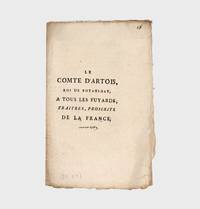
1789365069Paris 1789. 19 1pp. 8vo. Self-wrappers contemporary ink inscription on title "Aoust 1789. 19 1pp. 8vo. A rare satirical pamphlet written under the guise of the Count of Artois later King Charles X styled here as the 'King of Botany Bay'. The author through the voice of the count entreats all those who fled France during the Revolution and their supporters in France and England to join the future king of France in the penal colony of Botany Bay. He goes on to imply that these traitors to France are no better than the lowliest of English convicts being transported by the British government to what he considers 'a new country made especially for them' 'le vaste continent des Terres Australes leur offre un pays nouveau asyle fait pour eux.'. COPAC lists only two copies unknown
193025919Melbourne: Produced by Northfield Studios and J.E. Hackett 1930. Very good condition. Color lithograph travel poster depicting a mother koala with a cub clinging to her back in the top of a gum tree by the noted Australian illustrator James Northfield. Signed in the image at the lower right.<br /> <br /> Northfield 1887 - 1973 was the subject of the 2006 volume by the National Library of Australia Michelle Hetherington titled 'James Northfield and the Art of Selling Australia'. Northfield's work is prized for its draftsmanship & design and a distinctly Australian sense of color and light.<br /> <br /> Window card size 13 1/2 x 19 1/2". One small mark in margin only upper left corner left by old sticky tape. OCLC: 910601564 locates one copy only at the Library of Congress same image larger format. Trove 54841871 locates one copy at the National Library of Australia same image larger format. Produced by Northfield Studios and J.E. Hackett unknown
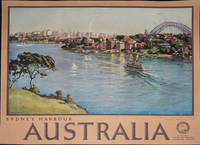
193518842Australian National Travel Association 1935. Very good overall. Travel poster illustrated by Sydney Harbour centered on the harbour with a ferry and sailboats with the Sydney Harbour Bridge in the top right background. A color lithograph 20 x 24.75" 50.8 x 62.25 cm. Further text; "Painting by Will Ashton R.0.I. W.T. Baker & Co Ltd. Engravers and printers. Australian National Travel Association." Crinkles and some light creases with a couple of light marks in the sky above the Bridge. Australian National Travel Association unknown
1845036628London: T. And W. Boone 1845. xi 243pp 7 engraved plates map. Or cloth boards decorated in blind titled in gilt with gilt kangaroos to base of spine. Cloth splitting along rear spine edge front board starting to separate at top hinges starting. Ex- Mines Department library with usual stamps etc quite heavy foxing to map plates and title page. Corners bumped. Text pages generally clean. Scarce early account of the early settlement of Moreton Bay and New South Wales from Port Macquarie north. A great deal on the Aborigines. First Edition. Hard Cover. Good. 8vo. Ex-Library. T. And W. Boone Hardcover
1941137250Sydney: 'Sydney Morning Herald' 1941. First Edition. Paperback. Very Good. Sydney 'Sydney Morning Herald' 1941 and 1942. Large quarto 84 to 88 pages each issue extensively illustrated in colour and black and white; bound-in in the first number is a small two-part perforated order-gift subscription form. Binder's cloth retaining the original colour-pictorial card covers with the rear cover now bound in immediately after the front cover in each case; cloth a little flecked; edges a little foxed; endpapers discoloured; light foxing to a few leaves adjacent to the boards; in excellent condition. The fourth and final series of 'Art in Australia' comprised only six quarterly numbers between March 1941 and August 1942. They were a marked departure in all respects from the previous 94 numbers of the journal which commenced publication in 1916: new editor new format new emphasis on international art. The editorial in the first issue spells this out succinctly: there will be 'a complete change in appearance and methods of production with a broadening of policy. In the past "Art in Australia" has been almost entirely devoted to the painting sculpture and architecture of this country. Luxurious productions from France England and other countries were available to inform the artist student and art-lover of the work and activities of the art world outside. But the barbarity unleashed in Europe is destroying much of the art of the past and present and has made it impossible for periodicals we prized so much to continue production. The countries of their origin have fallen under Hitler's yoke men responsible for their production - artists and writers - killed art galleries and elaborate printing and processing plants blown to bits. But Art cannot die and we in Australia can and will carry on our efforts to preserve encourage and foster the culture our enemies would destroy. In spite of paper shortages and many other difficulties "Art in Australia" will play its widened part by presenting the art of all countries all periods and all schools'. <p>Peter Bellew modelled its visual excellence and intellectual content on 'Verve' and 'under his stewardship the art historian and director of London's National Gallery Sir Kenneth Clark declared it "unquestionably the best art magazine being published today anywhere in the world"' Harding and Morgan: 'Modern Love - The Lives of John and Sunday Reed' 2015. Notwithstanding the end came without warning: Series 4 Number 6 August 1942 the last one published with a strong and parochial editorial about the 'Need for War Artists' contained no hint of its fate. 'Sydney Morning Herald' paperback
1842144203London: John Arrowsmith 1842. First Edition. Hardcover. Very Good. London John Arrowsmith Published 18 May 1842. A hand-coloured engraved map printed surface 402 × 551 mm external dimensions 446 × 591 mm cut into eight uniform panels mounted on linen as issued folding down to approximately 225 × 150 mm. When folded the two outside surfaces of linen are lined with plain purple textured cloth; a long sealed tear runs though the two top right-hand panels containing the printed title and a centimetre into the next-left panel but the only printed surface affected is the thin right-hand border: in spite of its length it is inoffensive and unobtrusive and may well be a production fault; in very good condition complete with the publisher's original slipcase in matching cloth lettered 'Wellington' in gilt on one thin side worn at the corners of the closed end and a little marked. John Arrowsmith 1790-1873 'was an important English cartographer especially for Australians. A member of a family of geographers his production focused on mapping British colonies around the world at a scale that surpassed that of any other contemporary map maker. Additionally he had access to the very latest despatches received at the Colonial Office and the British Admiralty which formed the source for many of his productions. His work covers the period 1832 to 1862'. <p>His lasting contribution is his 'London Atlas of Universal Geography' which went through at least eight editions between 1834 and 1858 Dorothy Prescott: 'Arrowsmith's Australian Maps' online resource. <p>We have previously sold uncut examples of this map on paper sourced from copies of the atlas. This cased example produced from the same plate used for the atlases shows the original allotments along the River Murray at Wellington and the upper entrance to Lake Alexandrina. This copy has three of these allotments additionally hand-coloured with initials added in black ink. They are blocks 8 blue FB 51 blue JB and 90 red FB. The two inset maps show the south-eastern portion of Australia and a 'Sketch of the Country between the Gulf of St. Vincent and the Great Bend of the River Murray shewing the Position of the Two Special Surveys of the Secondary Towns Association on the River Light'. <p>Tooley 115 b uncut version. John Arrowsmith hardcover
186780150Adelaide: David Gall 1867. First Edition. Hardcover. Very Good. Adelaide David Gall 1867. Duodecimo vi 82 52 'Chowla Advertiser' pages. Original flourescent green papered boards with expanded title page details repeated within a border on the front cover and with the contents listed on the rear; covers slightly marked and a little rubbed bumped and worn at the extremities with the hinges a little cracked; spine sunned lightly mottled and a little glue-stained; thin light tidemark to the top edge of the front endpaper; a very good copy of a scarce book rarely found with the spine intact and internally this copy is nothing short of fine. 'Storrie exhibits a keen sense of satire not only with regard to conventional tales whose perclivities are mercilessly ridiculed but also with regard to colonial society itself' Depasquale: A Critical History of South Australian Literature 1836-1930. Incidentally this is the first novel published in Adelaide. See Ferguson 16305 for confirmation of the Storrie/ McTavish connection. David Gall hardcover
185257668New York: Cornish Lamport & Co. Publishers 1852. First edition. Handcoloured folding map at front. iv 5-154 2 ads pp. 1 vols. 8vo. Brown blind-stamped cloth. Spine ends chipped else Fine. Ex-library stamps on map and title page card pockets removed. First edition. Handcoloured folding map at front. iv 5-154 2 ads pp. 1 vols. 8vo. Ferguson: "At this time the author was conducting an 'Australian Emigration Office' at 120 Wall Street New York." Ferguson 10892 2 copies P.L. N.S.W. Cornish, Lamport & Co., Publishers unknown
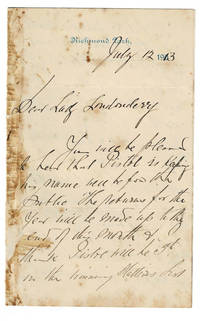
191397593Richmond Park South Australia: July 12 1913. 1913. Good. - Approximately 300 words penned on 4 sides of a folded sheet of creamy white paper with each page measuring 8 inches high by 5 inches wide. "Richmond Park" is printed at the top of the cover page. Aldridge has altered the partially printed date from "1903" to "1913". Started on the cover page Aldridge has continued his letter on the last page to then conclude on the inner 2 leaves. Signed "J.H. Aldridge" on the inner leaf. Once apparently mounted along the inner edge with glue or tape there are heavy stains with remnants of glue to the inner edge of the first and last page. There is a tiny tear along the fold with some light brown stains or foxing to all four pages. Good. <p>A RARE LETTER REPLETE WITH HORSE RACING ASSOCIATIONS. Aldridge writes to the Marchioness of Londonderry praising the horse he purchased from her and the Marquis of Londonderry. "You will be pleased to hear Pistol is keeping his name well before the public.I think Pistol will be 5th on the Winning.List in all Australia of course in this State 'South Australia' he is easily 1st.Londonderry by Pistol Antilles won the Broken Hill Cup a few days ago & the Chairman in presenting the cup to the winner referred to the fact that the horse got his name from his Breeder the Marchioness of Londonderry.Pistol is a most prolific father of winners & that is better than one good one & twenty duffers as some sires record. I believe there is only one sire in Australia which has produced more winners this year." He goes on to complain about the season as a whole mentions some "great loss" that she has had and he wishes the Marquis well and that "his illness worries will be settled ere long" Signed "J. H. Aldridge".<p>James Henry "Jim" Aldridge 1849-1929 was a popular and highly respected Australian sportsman. he began his career as a hotelier in Adelaide. He managed the Globe Hotel in Rundle Street a hotel that was popular with sportsmen. He later took charge of the Grand Hotel Broken Hill and the Gresham Hotel. In 1890 with the intent of establishing a stud farm he purchased at a Sydney sale the Stallion Carlyon. Carlyon was to be the lord of the harem so to speak. In addition he purchased a richly bred brood of a half-dozen mares. Sometime between 1888 and 1890 Aldridge purchased Richmond Park in South Australia from its original owner John Chambers. With the Chester horse Carlyon and the stud established Aldridge rapidly became well-known as a breeder. Carlyon and the thoroughbreds he sired at the Richmond Park stud farm made Aldridge's name famous throughout Australian racing circles. Although still able to perform as a stud Carlyon was badly injured in 1905. As it happened however in 1904 Aldridge had purchased Pistol the son of the famous English sire Carbine. Pistol was foaled in 1899 and arrived in South Australia as a five year old. He was purchased from the Marquis of Londonderry for the large sum of 1250 pounds. As a stud Pistol performed into his 26th year and sired winners of more than 641 races out of 1423 competitions. Up until Aldredge's death in 1829 the Pistol progeny had won approximately 200000 pounds in stake money. In atribute after his death the Chairman of the S.A.J.C. South Australian Jockey Club Whitmore Blake Carr "Doc Carr" wrote: "For years Mr. Aldridge has been one of the best widely known and most popular identities of the turf in South Australia and one to whom the sport owed much of its maintenance and stability. When he ran horses he did so for the pure love of the sport and the applause which always attended the success of his colours was a fine tribute by the racing public to the popularity of the owner. He was an exceptionally fine judge of a horse. The gratifying results which have been achieved at Richmond Park making it stand today so high in the list of studs in the Commonwealth was due to his sound judgment and ripe experience." Richmond Park, [South Australia]: July 12, 1913. unknown
2015ASAP-9781626991323Studium Press India Pvt. Ltd. 2015. New. Studium Press (India) Pvt. Ltd. unknown
2015ASAP-9781626991323Studium Press India Pvt. Ltd. 2015. New. Studium Press (India) Pvt. Ltd. unknown
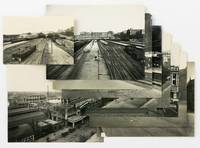
146428Very Good. Nine vintage gelatin silver prints eight approximately 220 × 285 mm one 138 × 206 mm all but two captioned or dated on the verso. Some prints with some residue on the verso from previous mounting; two with drawing pin-holes in some corners one of them with slight surface loss near a bottom corner the other with slight loss to a top corner; some with trifling chips or creases at the extremities; overall in excellent condition. The earliest image dated June 1926 shows the site on North Terrace before the commencement of construction; two show the station platforms in October 1926 and March 1927; two show the railway yards at the approach to the station one before construction one in December 1927; and four show the progressive construction of the western southern and eastern frontages of the station dated between April 1927 and March 1928. <p>An interesting observation by Paul McGuire appeared in 'The New Triad' Volume 2 Number 7 1 July 1928: 'The Railway Department also has been showing its superiority to mere prettiness too. A magnificent station is nearing completion and the Assembly hall has already revealed itself as a splendidly conceived piece far superior to anything of its kind in Australia. The walls are scarcely finished and they are already blotted with posters dodgers and various advertising signs. The architects themselves have protested but in this case too we will be pleasureably sic surprised if the official mind sees beyond its balance sheets'. <p>We have not identified the photographer or traced these particular images in institutional collections or elsewhere but they have the appearance of official photographs by a professional. 9 items. unknown
182580009London: William Darton 1825. First Edition. Hardcover. Very Good. London William Darton circa 1825. Octavo xii 64 pages plus 64 engraved portraits with tissue-guards. Early gilt-decorated half calf and marbled papered boards a little rubbed and bumped at the extremities; corners and the rear leading edge a little worn; 'Vol III' label missing from the spine; occasional scattered foxing and offsetting; a very good copy. Provenance: James Hurtle Fisher with his armorial bookplate on the pastedown and his signature in ink at the head of the engraved title page. Sir James Hurtle Fisher 1790-1875 'was one of the most important pioneers of South Australia' 'Australian Dictionary of Biography'. He commenced practice as a solicitor in London in 1816 and 'was drawn into the colonizing movement in 1835. He was selected as resident commissioner one of the most important offices under the South Australian Act . second only to the governor'. Fisher 'left England in July 1836 with the governor's party in the "Buffalo" arriving on 28 December 1836 at Holdfast Bay where the official oaths were administered a proclamation was read and a ceremony marked the beginning of settlement. In January 1837 Fisher erected his reed hut and Land Office near the survey camp of Colonel William Light at the north-western corner of the new capital site; the destruction of these temporary buildings by fire on 23 January 1839 caused both men serious loss. <p>Fisher had been allowed to draft his own instructions which were not shown to Governor Sir John Hindmarsh. Disputes between the two men over their respective powers had begun on the voyage and were soon revived in the new Council of Government and more violently outside and led in February 1837 to the Resident Magistrate's Court binding the participants over to keep the peace towards each other. The new governor George Gawler was appointed both governor and resident commissioner a radical departure from the principles on which the colony had been founded'. Fisher returned to his profession and became a leader of the South Australian Bar. In October 1840 he was elected first mayor of Adelaide; in 1860 he became the first resident South Australian to be knighted. The destructive fire referred to above is described in detail in the biography of Light Dutton and Elder 1991. <p>Light was living 'in the wood and reed surveyor's hut alongside Fisher's equally combustible house in the parklands on North Terrace. In his own account ". we discovered Fisher's house to be on fire. At the same time the breeze freshening up the destruction to both houses became inevitable. In less than ten minutes both houses were burnt to the ground mine catching fire at the roof by a lighted piece from Fisher's. We saved nothing of value"'. Accordingly personal mementoes such as this presumably brought by Fisher to South Australia on the 'Buffalo' must be of the utmost rarity. William Darton hardcover
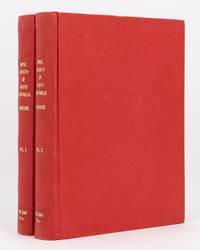
1900134834Adelaide: W.C. Rigby for the Royal Society of South Australia 1900. First Edition. Paperback. Very Good. Adelaide W.C. Rigby for the Royal Society of South Australia 1900 to 1913. Large quarto eight parts issued as and here bound in two volumes; full details of each part are listed below. Later binder's cloth retaining the original wrappers; cloth slightly scuffed and rubbed; both volumes a little bumped at the foot of the spines; small cancelled library stamp on each front wrapper 'College of Advanced Education Library Adelaide. 7 June 1973'; small light tidemark to the top inner corner of Volume I Part 3; minimal signs of age and use; in excellent condition. All four parts of the first volume are by STIRLING E.C. and A.H.C. ZIETZ: Fossil Remains of Lake Callabonna. An interesting note from the editor is printed on the verso of the front wrapper of the first part: 'For the purpose of presenting the descriptions of the "Fossil Remains ." in a more suitable form than is permitted by the size of the "Transactions" the Council has decided to publish in royal octavo a series of "Memoirs" . This issue is the first Fasciculus of the first Volume . of which other parts will appear as circumstances permit'. Individual subtitles are as follows. <p>Volume I Part 1. Description of the Manus and Pes of 'Diprotodon Australia' Owen. 1900. 40 pages plus 18 plates. <p>Volume 1 Part 2. Genyornis Newtoni. A New Genus and Species of Fossil Struthious Bird. and The Physical Features of Lake Callabonna. Circa 1900. iv 41-80 xv pages plus 7 pages of plates 3 of them folding. <p>Volume 1 Part 3. Description of the Vertebrae of Genyornis Newtoni. 1905. ii 81-110 pages plus 11 pages of plates. <p>Volume 1 Part 4. Description of Some Further Remains . 1913. vi 111-178 pages plus 23 pages of plates. Loosely inserted in the first part is a colour transparency of a watercolour illustration of a diprotodon. <p>Volume II Part 1. ETHERIDGE Robert: The Cretaceous Mollusca of South Australia and the Northern Territory. 1902. iv 54 pages plus 7 pages of plates and a publisher's slip tipped in at the first page 'The remainder of Vol. I of these Memoirs has been reserved for further descriptions of the "Fossil Remains of Lake Callabonna"'. <p>Volume II Part 2. TAYLOR T. Griffith: The Archaeocyathinae from the Cambrian of South Australia. An Account of the Morphology and Affinities of the Whole Class. Edited by Walter Howchin. 1910. vi 55-188 pages with 51 illustrations plus 15 pages of plates a large folding chart and a large 'Index Slip' tipped in at the contents page. <p>Volume II Part 3. MAWSON Douglas: Chiastolites from Bimbowrie South Australia . Edited by Walter Howchin. 1911. iv 189-210 pages with a map and 12 illustrations plus 11 pages of plates including one colour plate. <p>Volume II Part 4. MAWSON Douglas: Geological Investigations in the Broken Hill Area . Edited by Walter Howchin. 1912. viii 211-319 pages plus 26 pages of plates containing 81 plates and an illustration 5 pages of illustrations containing 3 maps and 4 sections and a very large folding colour geological map 525 × 680 mm 'Geological Sketch Map of the Olary-Broken Hill Area. In all instances each page of plates is accompanied by a leaf of text. The first part of the first volume and the first two parts of the second volume must be considered rare if our experience is any guide. 2 items. W.C. Rigby (for the Royal Society of South Australia) paperback
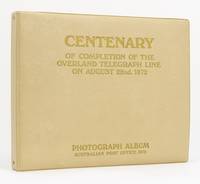
130931Melbourne: Australian Post Office 1972. First Edition. Hardcover. Fine. Melbourne Australian Post Office 1972. An oblong folio album approximately 300 × 390 mm containing 51 original gelatin silver photographs each approximately 165 × 200 mm mounted individually on both sides of 26 ring-bound card leaves most with captions printed on slips mounted below the plate. Original padded imitation leather aka vinyl lettered on the front cover; in fine condition inside and out. The photographs show the official centenary celebrations at Alice Springs on 22 August 1972 46 photographs including the reopening of the restored Old Telegraph Station and in Adelaide on 21 and 22 August 5 photographs. Dignitaries present include Sir Alan Hulme Postmaster General Sir Arthur Petfield Commissioner of the Overseas Telecommunications Commission and descendants of Sir Charles Todd and others who had worked on the construction of the line or in the telegraph station. Included in the latter and featured prominently in two photographs is an elderly Indigenous woman Mrs Amelia Kunoth an 'employee late 1800s'. <p>Offered together with a large-format commemorative publication with the same title as the album containing seven facsimiles of newspaper articles relating to the Overland Telegraph Line Australian Post Office 1972; folio; saddle-stapled overlapping wrappers; in excellent condition. <p>Bound in at the rear of the album is a booklet for the 'Alice Springs Telegraph Station National Park Northern Territory Reserves Board 1969; quarto; saddle-stapled colour pictorial wrappers; 24 pages; a little creased. 3 items. Australian Post Office hardcover
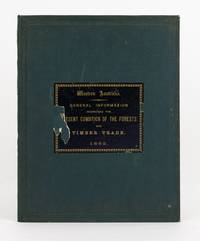
1882138714Perth: Richard Pether Government Printer 1882. First Edition. Hardcover. Very Good. Perth Richard Pether Government Printer 1882 and London L. Reeve & Co. 1879. Large quarto 28 pages last blank with several tables plus 2 tinted lithographs and 2 colour maps one folding 490 × 370 mm; and viii 30 pages plus 21 plates including 17 full-page uncoloured lithographs of eucalypts after drawings by R. Austen. Pebble-grain dark green cloth with a large title-label printed in gilt on black paper on the front cover; minor loss to the label removing two letters of one word; cloth a little marked with light wear to the extremities; small section 25 mm of the leading edge of the rear cover a little abraded; endpaper hinges neatly reinforced; light tidemarks to two small sections of the endpapers with a little foxing confined mainly to the inner surfaces of the free endpapers and the adjacent pages; one tear to the folding map expertly sealed; minimal loss to silverfish to the bottom margin of the small map; mild signs of age and use; a very good copy. The balance of the first title is 'with some remarks and suggestions on future conservation and management of the timber areas from various authorities. With a reprint of the regulations and laws in force for the renting or leasing of timbered lands'. <p>The introduction to the combined work compiled under the direction of Malcolm Fraser the WA Surveyor General has this to say: 'In compliance with your instructions and so far as the information and means at my command allowed I have collected in a general way such information about our timber Forests as was available to me and I have endeavoured to weave this together somewhat in a connected form. <p>By including the valuable Report on the Forest Resources of Western Australia by Baron Ferd. von Mueller it will be brought more prominently before the public than it has hitherto been. the drawings give a very fair idea of the character of the Jarrah and Karri forests'. Richard Pether, Government Printer hardcover
185480666Adelaide: printed and published at the 'Register' and 'Observer' Office 1854. First Edition. Paperback. Very Good. Adelaide printed and published at the 'Register' and 'Observer' Office 1854. Duodecimo xii 244 42 Directory 36 advertisements pages with the hand-coloured plate featuring nine 'Signals used at the West Terrace Flagstaff'. Flush-cut quarter cloth and printed card covers repeating the title page details on the front with advertisements on the rear; covers rubbed marked and lightly tidemarked with some simple arithmetic on the front cover and front free endpaper; extremities of the covers lightly worn; minimal expert restoration to the foot of the front joint; title written in ink on the spine; minor signs of age and use; essentially a very good copy with the contemporary ownership details of Joseph Grivell 1854 on the flyleaf and indistinctly on the front cover. His name does not appear in the directory suggesting he lived outside Adelaide see below. In the preface dated 10 January 1854 the compiler apologises for the lateness of the appearance of the almanack the delay being 'occasioned by the extreme difficulty in obtaining compositors' - presumably all off to the diggings. He also apologises for the 'total omission of the Country Directory' for various reasons so the 42-page directory covers only Adelaide and suburbs. <p>Most of the balance of the book is given over to the usual statistics regulations and lists of assorted office-bearers. However the farmers' and gardeners' calendar runs to 18 pages and there is a lengthy and important contribution by E.W. Andrews: 'Navigation of the Murray. Being extracts from a journal kept on board the "Lady Augusta" during Captain Cadell's exploratory voyage from the Goolwa to Ganawarra' 51 pages. Fellow-passengers James Allen and Arthur Kinloch published their independent accounts of this pioneering trip in book form in late 1853. In any event Andrews' account was reasonably hot off the press; his last journal entry was dated 15 October 1853 less than three months before this almanack delayed in publication appeared. Ferguson 9829f. printed and published at the 'Register' and 'Observer' Office paperback
1933040077Sydney: Angus & Robertson 1933. x 285pp glossary bw ills endpaper maps. Or brown 'art leather' front panel of jacket bound in as issued. Light toning to edges endpapers toned occasional light to moderate foxing. SIGNED and numbered #167by author on limitation page. One of the rarest Idriess items. Issued in an edition of only 200 copies shortly after the first print run. Seldom seen on the market. . Signed by Author. Signed Limited Edition. Hard Cover. Very Good/Bound in as issued. 8vo. Angus & Robertson Hardcover
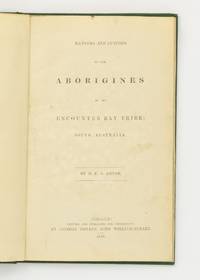
1846139553Adelaide: 'Printed and published for Government by George Dehane' 1846. First Edition. Hardcover. Very Good. Adelaide 'Printed and published for Government by George Dehane' 1846. Octavo ii 15 pages. Later green binder's cloth lettered in black along the spine; title leaf a little marked with a light abrasion near the gutter; a few minor spots and marks; a very good copy. Heinrich Edward August Meyer was a Lutheran missionary who arrived in Australia in 1840 and spent just over two years living with the Raminyeri tribe of the Encounter Bay area before publishing in 1843 'the first grammar and vocabulary on Ngarrindjeri "Vocabulary of the Language spoken by the Aborigines of the Encounter Bay Tribe South Australia". He lived at Encounter Bay until 1848 . Meyer was part of an Adelaide-based community of missionaries from the Dresden Missionary School which placed great emphasis on learning the language because it believed in the importance of communicating with the Aboriginal people in their own language . He also had continuing contact with other missionaries who were also involved in writing grammars such as Clamor Schurmann who had published a grammar of Kaurna the language to the North of Ngarrindjeri just before Meyer's arrival. This background as well as the assertion in his introduction to the 1843 grammar that the whole publication had been twice reviewed with different natives so that the meaning assigned to the words may be relied upon as correct . has resulted in a text that is considered to be a reliable reflection of the language at the time and a good grammar for its time' Corinne Bannister: 'A Longitudinal Study of Ngarrindjeri' online. <p>In this short but closely printed pamphlet Meyer in 'giving an account of these people . endeavours to trace the life of one from his birth upwards'. His extended period of living with the Encounter Bay people in these early years of white settlement adds authenticity to his detailed account of subjects such as hunting sorcery and burial customs. <p>Ferguson 4348; see also Ferguson 13095 WOODS J.D. editor: The Native Tribes of South Australia Adelaide Wigg 1879 which reprints this item; Greenway 6696. 'Printed and published for Government, by George Dehane' hardcover
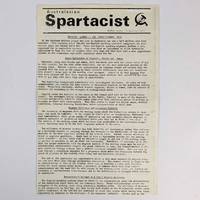
0034897Sydney and Melbourne: Spartacist League of Australia and New Zealand 1973-2011. Softcover Paperback. Very Good Condition. 43.5cm x 29cm. 236 volumes. Newsprint. A significant unbroken run of Australasian Spartacist: Organ of Revolutionary Marxism for the Rebirth of the Fourth International from No. 1 1973 through to No. 212 1986. Nos. 1 through 5 were published as mimeographed copies and here an original mimeograph of No. 3 together with 2 additional copies in facsimile and with Nos. 1 2 4 and 5 supplied as facsimiles in triplicate and also including the B versions of Nos. 2 and 5 the rest 6-212 as original tabloid newsprint except No. 125 and 136 supplied in facsimile. Also included is an original duplicate of No 143 and the original supplements for 7 June 1975 2 July 1975 24 June 1977 1 February 1980 8 September 1989 2 copies 2 September 1991 2 June 1993 December 1999 and November 2001 and A Spartacist Pamphlet: For a Workers Republic of Australia Part of a Socialist Asia! Sydney: Spartacist ANZ Publishing Co. 1998. In total Australasian Spartacist ran until No 240 2020 and in 2024 has re-emerged as Red Battler: Newspaper of the Spartacist League of Australia with 1 issue published to date. Old horizontal folds now having been stored flat for many years. Minor general wear and tanning a few issues around the 150s/160s with minor to moderate tanning to exterior. Occasional stamp of the New York Spartacist League. An extremely well preserved set of fragile newsprint. Category: Politics & Government; Inventory No: 0034897. BZDB407 Politics & Government; Unbranded Spartacist League of Australia and New Zealand Australasian Spartacist No. 1 - 212 1973-2011 Spartacist League of Australia and New Zealand paperback
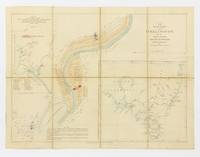
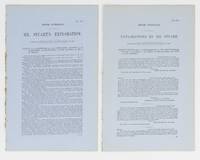
1858114206Adelaide: Government Printer 1858. Fine. Adelaide Government Printer 1858. Foolscap folio 8 pages last blank plus a large folding map 'Country explored by John McDouall Stuart. June to September 1858'; 600 × 510 mm with lakes and coastlines hand-coloured in outline; 'Richd Jno. Loveday Litho'. Drop-title; minimal residual glue to the spine and a few needle-holes to the inner margin previously bound now disbound; tiny sealed tear to the stub of the map; essentially a fine copy. South Australian Parliamentary Paper Number 119 of 1858. This is an account of Stuart's first independent expedition; he had previously travelled with Sturt's 1844-45 expedition into Central Australia. The party of three 'started out from the Northern Flinders Ranges in mid-May. They skirted the south end of Lake Torrens and then turned north and north-west until they reached the present site of Coober Pedy. They then followed a southerly course to Lake Gairdner passing it on the west side. After a strenuous march they arrived at Ceduna . By now the men had run out of provisions. They travelled along the coast to Streaky Bay and from there to the settled districts at Mount Arden in a state of semi-starvation' Feeken Feeken and Spate 1970. <p>Offered with South Australian Parliamentary Paper Number 114 of 1858 'Explorations of Mr Stuart. Correspondence relative to Explorations . to the North of Port Augusta and West of Lake Torrens' foolscap folio 2 pages. The paper reprints three letters each from Stuart and Francis Dutton Commissioner of Crown Lands and Immigration written between 27 October and 2 November 1858. McLaren 15449 not recording the map and 15448. The first paper was reprinted by the Victorian Government see McLaren 15457; not only was the text reset the map was newly lithographed and issued without additional hand-colouring. The visual comparisons between the two versions are striking. 2 items. Government Printer unknown
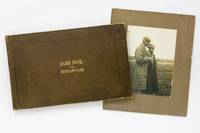
127784First Edition. Hardcover. Very Good. Oblong small folio 215 × 345 mm a bespoke shooters' register with each page ruled in blue with red columns headed 'Date' 'Place' 'No. of Guns' 'Names of Guns' 'Ducks' 'Swans' 'Plover' 'Stilts' 'Turkeys' 'Quail' 'Sand Piper' 'Hares' 'Rabbits' 'Snipe' blank 'Total' and 'Remarks'. The label of the manufacturer J.H. Sherring & Co. Adelaide is mounted on the front pastedown. On an early blank the following warning is written in ink: 'No shooter to have a drink after dinner until this book is entered up for the day. 9.11.97'. Full calf lettered in gilt on the front cover 'Game Book Buckland Park'; leather slightly marked and a little scuffed; in excellent condition. The gelatin silver portrait photograph 197 × 143 mm is on the original thick card mount 295 × 245 mm with the caption 'George V at Buckland Park' and the name of the photographer J. Gazard in white ink at the foot of the mount. Minor surface damage and creasing to the right-hand side of the mount; the photograph is in excellent condition. The Duke is pictured with Lord Richard Nevill private secretary to the Governor of South Australia. Buckland Park is a pastoral property near Port Gawler South Australia. George Frederick Ernest Albert The Duke of Cornwall and York and later King George V 1865-1936 was the second eldest son of King Edward VII who ascended the throne on Queen Victoria's death in January 1901. With the first Parliament of Australia set to open in early May the mourning King sent George now next in line to the throne to Australia as his representative. The Duke and his Duchess Mary 1867-1953 left England on 15 March aboard an Orient steamship specially chartered for the voyage. Two days after arriving in Melbourne on 9 May the royal couple drove through streets lined with cheering crowds to the Exhibition Building where the Duke declared the Parliament open before thousands of guests. 'The Duke and Duchess were kept busy with a program ranging from dinner and a University Commencement to the presentation of prizes to public schools. They also managed to visit briefly country Victoria. Nevertheless during their 10-day visit they still managed to fit in a day's shooting. The tour also included visits to other states New Zealand South Africa and Canada' Museums Victoria website. The official party made a short visit to South Australia 10-15 July not least to take up an invitation for another day's shooting . Alice Foster tells the story in the 'Salisbury and District Local History Newsletter' December 2019: 'Mr Leonard Browne the owner of Buckland Park and at the time in England invited the Royal party to a shooting excursion to his property. The Royal party consisted of HRH The Duke of Cornwall Prince Alexander of Teck Lord Wenlock Sir Charles Cust The Hon. Derek-Keppel Commodore Winsloe and Commander Faussett. On 3rd July 1901 a special meeting was held in the Salisbury Institute to make arrangements for welcoming their Royal Highnesses the Duke and Duchess of Cornwall who were to make a short stay on their journey to Buckland Park on Friday 12th July. There was a large attendance and Mr J.P. Swann was elected chairman on the motion of Dr E. Brookes seconded by the Rev. S. Moncrieff. It was decided to form a committee who were empowered to make the necessary arrangements. As Salisbury was the only town in South Australia to be visited by the Royal party there was great enthusiasm from the residents with suggestions for decorating the railway station. An orange arch consisting of branches blossoms and fruit would be formed and extended from the station gate to the spot where his Royal Highness's carriage would stand. The scholars of Salisbury and neighbouring schools would constitute a guard of honour to the Duke. The Royal train left North Terrace station a few minutes after 9 am driven by Mr Thomas Youll and sped swiftly on its way reaching Salisbury at 9.25 am. A crowd of townsfolk had assembled and church choirs and state school children united in singing the national anthem. The Hon. J. Stirling MLC drove His Royal Highness from Salisbury to Buckland Park arriving at 11 am. A good morning's sport was obtained in the swamps near the sea and luncheon was prepared in two marquees. A facsimile of the pigeongram sent by His Royal Highness follows: "We only got about 325 this should read 35 ducks this morning hope to get some peacocks this afternoon. G." . The special train left Salisbury at 6.08 pm and arrived in Adelaide at 6.20 pm' with all on board tired but happy. The game book saw little use with only the first three pages filled in. The first entry is dated 29 January 1898 and there are 20 separate entries in that year. There are ten parties in 1901 one in 1902 two in 1907 and the final one in 1936. However 1901 is the stellar year with numerous old South Australian names manning the guns: these include Baker Belt Hawker Jacob Matheson Phillipson Rounsevell and Stow. The names of the Duke's party are listed in a scribe's hand; only 40 peafowl were added to the aforementioned ducks and the remarks column has nothing remarkable to say 'One hour at ducks in morning only'. A fortnight later Messrs Hawker Phillipson Belt Belt Stow and Matheson had better luck bagging 41 ducks 2 stilts 1 avocet 1 sandpiper and 2 rabbits and reporting it was 'Cold & wet. Birds fairly plentiful but wary of new hides. Meat pies good'. 2 items. hardcover