UNION GEOGRAPHIQUE INTERNATIONALELivre Rare Book
Librairie et Cætera · Belin-Beliet, France22,50 €
5 782 résultats
19466825Washington DC: U.S. Department of State 1946-1947. fair. 47 maps cardboard covers 47 fold-out maps stain on fore-edge covers worn & scuffed: small tears creases ink name on front cover. Oversized volume measuring approximately 14.25" 36 cm by 20.5" 52.5 cm. This volume was an appendix to "Administrative Subdivisions of Japan " Department of State Publications 2749 Far Eastern Series 19. There is one map for each of the 47 subdivisions on Hokkaido Honshu Shikoku and Kyushu. U.S. Department of State unknown
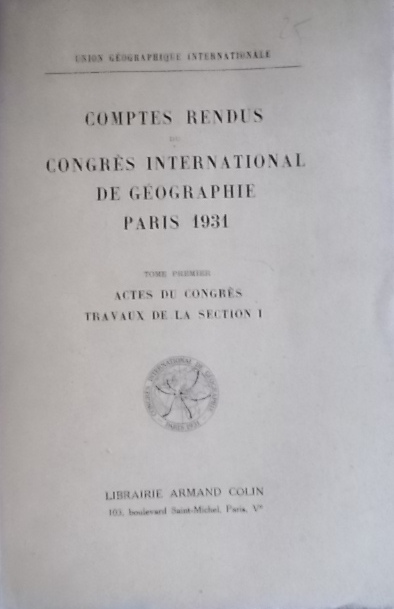
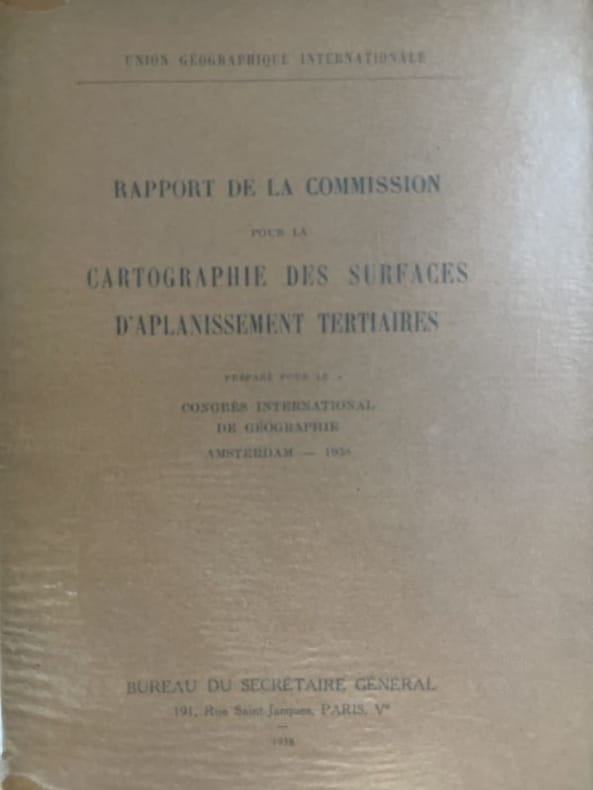
Paris 1938, In-8 broché, 94 pages. Cartes dépliantes. Trés bon état.
193295285Couverture souple. Broché. 360 pages.
1938177162Sans nom Paris, 1938. In-8 broché de 94 pages. Cartes dépliantes. Très bon état.
Very Good Turkish, Ottoman (1500-1928) Original chromo-lithograph map. Oblong: 63x95 cm. In Ottoman script (Turkish with Arabic letters). Folded. Chipped on extremities and slightly foxing. Otherwise a good map. Scale: 1:2.000.000. Detailed legends panel. This extremely rare huge map includes all railways, highways and other roads; Turkish borders with Iran, Russia, Greece, cities and their borders, printed shortly after the declaration of the republic in 1923. This is the first complete road map of the Republican period. The Ministry of Environment and Urban Planning is a government ministry office of the Republic of Turkey, responsible for the environment, public works, and urban planning in Turkey. The Ministry was formed in 1983 through the merger of the Ministry of Public Works (Turkish: Bayindirlik Bakanligi, formed 3 May 1920) and the Ministry of Development and Housing (Turkish: Imar ve Iskan Bakanligi, formed 1958). Antonio Zelic (Zellich) of Brela was one of many Dalmatians who left his homeland in pursuit of a better life during the 19th century. However, instead of going west, he set out toward the East, to the Ottoman imperial capital - Istanbul. Upon arrival in the city on the Bosphorus, Zelic found employment at the lithographic print house of Henri Cayol, the first of its kind in the Ottoman Empire. In 1869, Zelic opened his own lithographic print house called "Zellich and Sons" (A. Zellich et fils). His descendants continued his work with great success, and the Zellich Print House, now known as "Zellich Brothers" (Zellich frères), became one of the most renowned in the Empire. Zellich Brothers won recognition due to the high quality of their products, and, above all, the amazing beauty of their postcards and posters. Their crowning achievement was an order for the printing of the Ottoman Turkish Lira banknotes in 1914. Zellichs received many Ottoman and international awards, including medals conferred by the Pope, the Persian shah, and the Serbian king.". (Source: Documentary film "Zelic- Printers to the Empire", Levantineheritage). Extremely rare. Not in TBMM Library.; Not in OCLC.; Not in Turkish National Library.
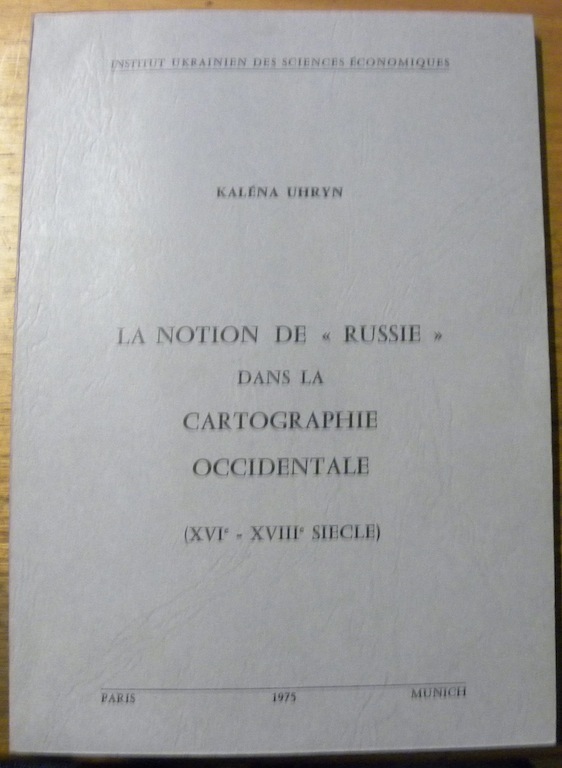
31501Paris - Münich, Institut Ukrainien des Sciences Economiques 1975, 240x170mm, 144pages, broché. Bel exemplaire.
1902183242Belgrad, 1902. Gr.-Fol. 10 farb.(teils gef.) Ktn. In OHlwd.-Mappe m. 3 Stoffschließen. Rücken angerissen. Vorderdeckel fleckig. 1 Karte m. Einriss. St. verso Tit.
ORD-10521montrant les ressources, produits, topographie et principales ressources régionales. Publiée par l'Office d'Information de Guerre des États-Unis. s.l.n.d. Grande carte couleurs (810 x 607mm) plusieurs fois repliée, comprenant un texte Quelques faits sur les États-Unis et 3 petites cartes: voies ferrées, routes aériennes, grandes routes nationales. Petits accident minimes aux coins de pliage sinon bon état de cette carte très décorative.
1979604440Gotha, Haack, 1979. M. zahlr. (teils farb.) Abb. 336 S. OLwd. m. Originalschutzumschlag (kl. Randläsuren) (Petermanns geogr. Mitteil. Erg.-H. 276).
(Codice GL/0055) In 16° 312 pp. Prima edizione italiana a cura di Alfredo Pollini. Con numerose foto su 14 tavole fuori testo e 54 figure nel testo. Brossura originale. Ottimo. ~~~ SPEDIZIONE IN ITALIA SEMPRE TRACCIATA
(Codice CU/6273) In 4° (cm 36,5) 408 pp. Grande volume illustrato con centinaia di foto in nero e a colori, molte cartine e tabelle. Legatura similpelle editoriale, titolo oro, sovraccoperta con strappetti riparati, astuccio usato. Volume in ottimo stato. ~~~ SPEDIZIONE IN ITALIA SEMPRE TRACCIATA
4to., First Edition, with a frontispiece, numerous coloured and monochrome photographs and maps throughout, and pictorial endpapers; grey cloth, backstrip lettered in silver, a very good, clean copy in unclipped dustwrapper.
New Turkish Paperback. Demy 8vo. (22 x 15 cm). In Turkish. 174 p., ills. Dünya haritasi ve cografya risalesi. Haci Ahmet was a purported Muslim cartographer linked to a 16th-century map of the world. Ahmet appended a commentary to the map, outlining his own life and an explanation for the creation of the map. But it is not clear whether Ahmet created the map, or whether he simply translated it into Turkish for use in the Ottoman world. Haci Ahmet appended a lengthy commentary to a 16th-century map of the world annotated in the Turkish language, known as The Ottoman Mappa Mundi of Haci Ahmet, amongst other titles, which opens with "Whoever wishes to know the true shape of the world, their minds shall be filled with light and their breast with joy.". The map is heart shaped, otherwise known as a "cordiform projection," a style that was popular in sixteenth century Europe, and the extant copy was printed from wooden blocks in Venice, Italy, in 1559. It was kept until the late 18th century in the archives of the Venetian Council of Ten. The map is now part of the Heritage Library in the Qatar National Library. Known as the "Mappamondo Haci Ahmet", the map outlines legends and place-names in Turkish, and it may be the first map in Turkish ever published for sale to an Ottoman audience. Whether the map is original, or was simply a translation into Turkish, it helps show how the people of the Ottoman Empire perceived themselves in relation to the wider world. Three small spheres appear below the main map at the bottom of the page - the central graphic represents Earth and a number of satellite planets, while the left and right depict constellations. Within the accompanying text of the map, Haci Ahmet explains that the map was created to share knowledge of the shape of the world, especially of the New World. Specifically, Ahmet points out that the classical philosophers, such as Plato and Socrates, did not know about the newly discovered continent, which he says shows that the world is round. He says that the New World demonstrates the "extent to which the Ottomans were participants in their own right in the process of physical expansion abroad and intellectual ferment at home that characterized the period of history commonly referred to as the Age of Exploration". Ahmet also assigns the Ottoman Empire's rulers and kingdoms to the celestial bodies represented in the lower quadrant of the map, a maneuver which has been interpreted as an effort to impose a hierarchical geopolitical system that preferences Ottoman rule above all other world powers. The map is considered unlikely to be original, and was probably translated into Turkish by Ahmet. The map has specific European characteristics, in that it includes the use of Western terms, suggesting Ahmet translated an older map into Turkish. In fact, throughout the map's accompanying text, Ahmet emphasizes translation, stating that he "translated it from the language and alphabet of the Europeans into that of the Muslims". A further argument made against Ahmet's authorship is that the "heart-shaped form of the map had already been used by earlier European cartographers". The map is "heart-shaped" and is constructed by a cordioform projection developed by 16th century cartographers and mathematicians including Johannes Werner (1468-1522), a German mathematician and geographer. The map has been tentatively linked to several other geographers, including Giovanni Battista Ramusio (1485-1557). It has also been argued that it shares similarities with a map by the French cartographer Orontius (1494-1555), published in 1534. Ahmet claimed the map was made for Ottoman princes, and some of the sons of Suleyman the Magnificent were interested in maps of the world and had looked to Venice for their production. This resulted in the development of Ottoman-Venetian relations, which offered "new interpretations of Venetian attitudes to the production of world maps for Ottoman clients".The map's printing in Venice hel
Roma, Ministero delle Finanze, 1936, 8vo brossura originale, pp. 4.
90924Paris, Seghers, 1979. "16 x 25, 269 pp., quelques illustrations en N/B, quelques dessins, reliure d'édition carton + jaquette, bon état (cachet d'ex-propriétaire; jaquette légèrement défraîchie)."
196845654Les Presses de l'Université Laval Couverture rigide illustrée Québec 1968
1970136630Wiesbaden, Suchier u. Englisch, o.J. (ca. 1970). Fol. M. zahlr. (meist farb.) Ktn. u. Abb. 200 S. OLwd. M. Rsign. St. a. Tit.
Bross., cm 24x21,5, pp 77, tavv. e ill. a col..
<br/> STATO: USATO, MOLTO BUONO.<br/> TITOLO: Tecnica cartografica. <br/> AUTORE: Traversi,Carlo.<br/> EDITORE: Istituto Geografico Militare<br/> DATA ED.: 1968,<br/>
Firenze, IGM, 1976, 8vo stralcio con copertina posticcia muta, pp. 325/351 con numerose illustrazioni e carte.. - !! ATTENZIONE !!: Con il termine estratto (o stralcio) intendiamo riferirci ad un fascicolo contenente un articolo, completo in se, sia che esso sia stato stampato a parte utilizzando la stessa composizione sia che provenga direttamente da una rivista. Le pagine sono indicate come "da/a", ad esempio: 229/231 significa che il testo è composto da tre pagine. Quando la rivista di provenienza non viene indicata é perché ci è sconosciuta. - !! ATTENTION !!: : NOT A BOOK : “extract” or “excerpt” means simply a few pages, original nonetheless, printed in a magazine. Pages are indicated as in "from” “to", for example: 229/231 means the text comprises three pages (229, 230 and 231). If the magazine that contained the pages is not mentioned, it is because it is unknown to us.
Firenze, 1957, 8vo stralcio con copertina posticcia muta, pp. 609/612 con 2 illustrazioni in nero e 2 a colori nel testo. - !! ATTENZIONE !!: Con il termine estratto (o stralcio) intendiamo riferirci ad un fascicolo contenente un articolo, completo in se, sia che esso sia stato stampato a parte utilizzando la stessa composizione sia che provenga direttamente da una rivista. Le pagine sono indicate come "da/a", ad esempio: 229/231 significa che il testo è composto da tre pagine. Quando la rivista di provenienza non viene indicata é perché ci è sconosciuta. - !! ATTENTION !!: : NOT A BOOK : “extract” or “excerpt” means simply a few pages, original nonetheless, printed in a magazine. Pages are indicated as in "from” “to", for example: 229/231 means the text comprises three pages (229, 230 and 231). If the magazine that contained the pages is not mentioned, it is because it is unknown to us.
Firenze, IGM, 1974, 8vo stralcio con copertina posticcia muta, pp. 639/648. - !! ATTENZIONE !!: Con il termine estratto (o stralcio) intendiamo riferirci ad un fascicolo contenente un articolo, completo in se, sia che esso sia stato stampato a parte utilizzando la stessa composizione sia che provenga direttamente da una rivista. Le pagine sono indicate come "da/a", ad esempio: 229/231 significa che il testo è composto da tre pagine. Quando la rivista di provenienza non viene indicata é perché ci è sconosciuta. - !! ATTENTION !!: : NOT A BOOK : “extract” or “excerpt” means simply a few pages, original nonetheless, printed in a magazine. Pages are indicated as in "from” “to", for example: 229/231 means the text comprises three pages (229, 230 and 231). If the magazine that contained the pages is not mentioned, it is because it is unknown to us.
Firenze, 1957, 8vo stralcio con copertina posticcia muta, pp. 389/392 con una carta a colori a pagina doppia nel testo. - !! ATTENZIONE !!: Con il termine estratto (o stralcio) intendiamo riferirci ad un fascicolo contenente un articolo, completo in se, sia che esso sia stato stampato a parte utilizzando la stessa composizione sia che provenga direttamente da una rivista. Le pagine sono indicate come "da/a", ad esempio: 229/231 significa che il testo è composto da tre pagine. Quando la rivista di provenienza non viene indicata é perché ci è sconosciuta. - !! ATTENTION !!: : NOT A BOOK : “extract” or “excerpt” means simply a few pages, original nonetheless, printed in a magazine. Pages are indicated as in "from” “to", for example: 229/231 means the text comprises three pages (229, 230 and 231). If the magazine that contained the pages is not mentioned, it is because it is unknown to us.