Gordon, Thomas [George Washington]Biblio.com
2 065 résultats
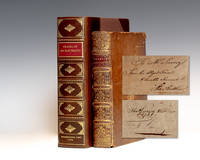
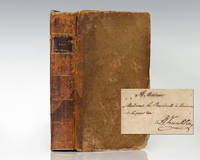
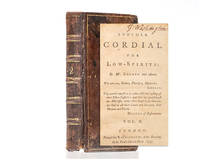
1751149416London: R. Griffiths 1751. From the library of George Washington of this compilation of political and religious essays regarding contemporary issues in Great Britain. Small octavo volume two bound in full contemporary brown calf with a gilt number two and ruling to the spine in six compartments within raised bands double gilt ruling to the front and rear panels turn-ins. From the library of George Washington with his ownership signature to the top right corner of the title page one of the earliest printed books owned by him in his youth. George Washington did not receive a classical education and never studied a foreign language beyond English. Unlike his older brothers who enjoyed more formal schooling he worked to educate himself independently frequently importing books from England to expand his knowledge. By 1783 a detailed catalog of his Mount Vernon library revealed an extensive collection that included both classical and contemporary literature as well as volumes on agriculture history and political thought. It eventually consisted of over 1200 titles countering John Adams' impression "that Washington was not a scholar is certain. That he was too illiterate unlearned unread for his station is equally past dispute." Thomas Gordon was a Scottish writer that was widely read by the American founding fathers greatly influencing their ideas of republicanism in the eighteenth century. "The bulk of the founding fathers' reading apart from history was concerned with political and legal tracts whose main focus was directed toward two subjects---liberty and property---and toward the social constitutional and legal institutions best adapted to the preservation of man's 'sacred' rights in regard to those subjects.there was little disagreement as to the indispensable 18th century writers: they are Charles Danenant John Trenchard Thomas Gordon Bolingbroke and James Burgh" Founding Fathers' Library. Gordon translated the classical authors including Tacitus Sallust and Cicero. Most notably he published Cato's Letters which were "Reprinted hundreds of times in colonial newspapers they were perhaps the most widely read source for arguments for freedom of the press and against arbitrary government power and taxation" Jacobson. The present volume contains essays such as "The True Picture of a Modern Tory" "A Vindication of the Quakers" and "The Creed of an Independent Whig." It is recorded in Lane Inventory of Washington's Library p. 490 as "an additional title not included on the original inventory". This is one of the earliest printed books from Washington's library. Based on the style of the signature it was likely signed near the time of publication when Washington was about twenty years old. The inscription’s upright and compact form featuring a shorter “s†than seen in later examples from the 1750s resembles the handwriting found in his early surveying documents though with less ornamentation than his typical ownership marks. After traveling to Barbados with his brother Lawrence in 1751 Washington assumed management of Mount Vernon following Lawrence’s death from tuberculosis in 1752. It is therefore probable that this book was among the first to enter his library at his newly inherited estate. In his will George Washington bequeathed his library to his nephew Bushrod Washington. The library remained largely intact at Mount Vernon which Bushrod also inherited until his own death in 1829 when it was divided between two of his nephews George Corbin Washington and John Augustine Washington. In 1848 George Corbin Washington sold some 350 books and 450 unbound pamphlets from his portion of the library to Henry Stevens who eventually placed it in the Boston Athenaeum where it remains today as the largest single collection of Washington's books. The part of the library that descended to John Augustine Washington was dispersed at various auction sales between 1876 and 1891 and the present volume has been traced to the 1876 sale of Washingtoniana. In very good condition. Housed in a maroon morocco solander case inside a full morocco clamshell box. As Commander-in-Chief of the Continental Army from 1775 to 1783 George Washington played a critical role in shaping the military and political outcomes of the American Revolutionary War. His leadership was marked not by tactical brilliance alone but by strategic endurance organizational discipline and an acute understanding of the symbolic and practical dimensions of command. Faced with chronic shortages of manpower supplies and financial support Washington focused on sustaining the army through long periods of adversity most notably during the winter encampment at Valley Forge. He emphasized professionalization working closely with figures like Baron von Steuben to impose standardized training and drill procedures. Washington’s decision to engage in a war of attrition rather than direct confrontation with the superior British forces reflected a broader political strategy aimed at maintaining colonial unity and prolonging resistance until foreign aid—particularly from France—could be secured. His leadership during the culminating siege of Yorktown in 1781 conducted in coordination with French forces marked a decisive turning point and demonstrated his ability to integrate diplomatic logistical and military considerations into a coherent wartime strategy. R. Griffiths hardcover
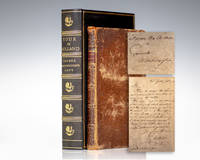
1769147283London: Printed for David Henry; and sold by Francis Newbery at the Corner of St. Paul's Church-Yard 1769. First complete edition of "the most important scientific book of eighteenth-century America" PMM inscribed by Benjamin Franklin to prominent Pennsylvania Quaker and merchant Thomas Livezey Jr. Quarto bound in full contemporary calf with elaborate gilt tooling to the spine in six compartments within raised gilt bands morocco spine label lettered in gilt gilt turn-ins. Illustrated with 7 copper-engraved plates 2 of which are folding. Presentation copy inscribed by Benjamin Franklin on the front free endpaper “To Mr. Livesy sic From his obliged Friend & humble Servant The Author.†With Thomas Livezey's ownership signature to the second free endpaper "Thomas Livezey Junior 1810." The recipient Thomas Livezey Jr. 1723-1790 was a member of the fourth generation of the prominent Pennsylvania Quaker Livezey family. His ancestor Thomas Livezey the elder 1627-1691 was among the earliest settlers of Pennsylvania; his land was a portion of William Penn's Pennsylvania colony and was granted to him directly by Penn in an early patent. Thomas Livezey Jr. established one of the largest flour mills in colonial British North America the Livezey Mill and rose to prominence as one of the major suppliers of high quality flour to the world during that era. Situated on Wissahickon Creek in Philadelphia the Livezey Mill was a major colonial operation provided flour both domestically and overseas and fed numerous armies throughout the eighteenth century including those fighting on both sides of the American Revolution. The mill was in continued operation for more than one hundred twenty-ï¬ve years until roughly 1874. Livezey was elected to the colony of Pennsylvania's legislative body the Pennsylvania Assembly in 1765. BenjamÃn Franklin had been elected to the Pennsylvania Assembly 14 years earlier in 1751 and in 1764 one year prior to Livezey's appointment Franklin was sent to London by the Pennsylvania Assembly as a colonial agent to protest against the political influence of the Penn family with whom the assembly was becoming increasingly frustrated. He remained there for five years striving to end the Penn family's prerogative to overturn legislation from the elected Assembly and their exemption from paying taxes on their land. His lack of influential allies in Whitehall led to the failure of this mission. Franklin and Livezey were warm acquaintances despite their differences. In late 1767 Livezey sent a case of wine he had made from wild grapes to Franklin in London writing “I heartely wish it may arive Safe and warm the hearts of Every one who tastes it with a Love for America. And would it Contribute towards bringing about a Change of Government but one month Sooner I would Gladly Send all I have.†In early 1768 Franklin thanked Livezey in a letter stating that he “shall apply this parcel as I did the last towards winning the hearts of the Friends of our Country and wellwishers to the Change of its Government.†PMM 199; Grolier 100 American Books 10; Dibner Heralds of Science 57. Presentation copies of this first collected edition are scarce. This is the only presentation copy to a known recipient to appear on the market over the course of the past century. In very good condition. Housed in custom three quarter morocco clamshell box. “Franklin’s most important scientific publication†Experiments and Observations contains detailed accounts of the founding father’s crucial kite and key experiment his work with Leiden jars lightning rods and charged clouds Norman 830. “The most dramatic result of Franklin’s researches was the proof that lightning is really an electrical phenomenon. Others had made such a suggestion before him— even Newton himself— but it was he who provided the experimental proof†PMM. “The lightning experiments caused Franklin’s name to become known throughout Europe to the public at large and not merely to men of science. Joseph Priestley in his History of Electricity characterized the experimental discovery that the lightning discharge is an electrical phenomenon as ‘the greatest perhaps since the time of Isaac Newton… Franklin’s achievement… marked the coming of age of electrical science and the full acceptance of the new field of specialization†DSB. Franklin’s theory encompassed static electricity lightning and stored charge paving the way for countless theoretical and technological innovations. Immanuel Kant referred to Franklin as the “new Prometheus†for he managed to steal the fire of heaven. The work brought Franklin international renown. He became the first American elected to membership in the Royal Society and he was awarded the Copley Medal the highest scientific honor of the day. Franklin edited the collected edition of his Experiments and Observations himself revising the text adding a number of his own philosophical letters and papers and publishing the complete notes on all of his experiments. Printed for David Henry; and sold by Francis Newbery, at the Corner of St. Paul's Church-Yard unknown
1790143919Printed at Worcester Massachusetts: Isaiah Thomas 1790. First edition presentation copy of a scarce volume from George Washington's library at Mount Vernon. Octavo bound in full contemporary sheep with pine gilt in six compartments within raised bands burgundy morocco spine label lettered in gilt type-ornament title-page vignette head and tailpieces. Presentation copy inscribed by the author to George Washington on the front pastedown "From the Author to General Washington" and further inscribed on the front free endpaper "New York Feb. 1798. Sir Please to accept this small production which has stole its way into the world. If it can beguile one moment of that anxiety which doubtless pervades your paternal mind in the present crisis of our affairs or will create a smile or amuse you for a single evening I shall put myself doubly compensated and am with profound respect & gratitude. Your fellow Citizen E. Watson." Elkanah Watson began his professional career working for businessman John Brown in Providence and during the American Revolution he represented the firm in Nantes. After the war he opened his own mercantile firm in London with fellow Freemason François Cossoul. In early 1782 the firm proposed to send to General Washington—likewise a Freemason—"elegant Masonic ornaments" in honor of his "glorious efforts in support of American liberty" Papers 23 January 1782; Early Access Document. Washington later graciously thanked his "Brothers": "The Masonick Ornamts which accompanied your Brotherly Address of the 23d of Jany last tho’ elegant in themselves were rendered more valuable by the flattering sentiments and affectionate manner in which they were presented. If my endeavours to avert the Evil with which this Country was threatned by a deliberate plan of Tyranny should be crowned with the success that is wished—the praise is due to the Grand Architect of the Universe; who did not see fit to suffer his superstructures and Justice to be subjected to the Ambition of the Princes of this World or to the rod of oppression in the hands of any power upon Earth" Papers 10 August 1782; Early Access Document. In January 1785 after returning to America from London Watson visited Mount Vernon delivering to George Washington a group of books from Granville Sharp as well as several letters from mutual acquaintances in London. Watson later wrote of the visit in his Men and Times of the Revolution: "I had feasted my imagination for several days of the near prospect of a visit to Mt. Vernon the seat of Washington. No pilgrim had ever approached Mecca with deeper enthusiasm. … I found him at table with Mrs. Washington and his private family and was received in the native dignity and with that urbanity so peculiarly combined in the character of a soldier and eminent private gentleman. He soon put me at ease by unbending in a free and affable conversation. … I found him kind and benignant in the domestic circle revered and beloved by all around him; agreeably social without ostentation; delighting in anecdote and adventures without assumption; his domestic arrangements harmonious and systematic. His servants seemed to watch his eye and to anticipate his every wish; hence a look was equivalent to a command. His servant Billy the faithful companion of his military career was always at his side. Smiling content animated and beamed on every countenance in his presence." Watson was particularly taken that Washington himself carried an evening cup of tea to his room. In 1789 Watson settled in Albany investing in land becoming an important advocate for canals in close association with Philip Schuyler and helping to found the Bank of Albany. In 1790 he had privately printed anonymously his Tour in Holland an epistolary account of his visit to the country in may and June 1784 including his time spent there in company with John Adams. In a 26 December 1790 letter to Adams Watson comments on the publication of Tour in Holland: "The present edition of the little performance I sent you consists of only 350 copies most of which have run off beyond my expectations." Besides Adams and Washington Watson also presented a copy to Thomas Jefferson Sowerby 3872. A few copies must have remained however because it was not until Washington’s term as president was nearly completed that Watson sent the volume to him: "I take the liberty to transmit to you by Mr Van Renssalaer my Short Tour in Holland in 1784 the year previous to my visit to your hospitable mansion. Shou’d it beguile a few moments from the weighty concerns of our new born Nation in the solemn crisis in which we are now involved it will be grateful to me" Papers of George Washington Presidential Series ed. Garbooshian-Huggins 21: 677–680. "Mr Van Renssalaer" is likely Jeremiah Van Rensselaer a friend of Watson’s who represented New York in the U.S. House of Representatives from 1789 to 1790. He was a member of the board of directors and later president of the Bank of Albany which Watson helped to organized. In 1791 the two men toured of central New York together to "scrutinize the opinions on the subject of inland navigation" Men and Times of the Revolution 335–36. In his will George Washington bequeathed his "library of Books and Pamphlets of every kind" to his nephew Bushrod Washington. The library remained largely intact at Mount Vernon which Bushrod also inherited until his own death 1829 when it was divided between two of his nephews George Corbin Washington and John Augustine Washington. In 1848 George Corbin Washington sold some 350 books and 450 unbound pamphlets from his portion of the library to Henry Stevens who eventually placed it in the Boston Athenaeum where it remains today as the largest single collection of Washington’s books. The part of the library descended to John Augustine Washington was dispersed at various auction sales between 1876 and 1891. Evans 23039; ESTC W28335; Sabin 102136 In very good condition. Housed in a custom full morocco clamshell box. Isaiah Thomas hardcover
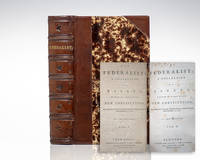
1788125980New York: Printed and Sold by J. and A. McLean 1788. First edition of The Federalist one of the rarest and most significant books in American political history which "exerted a powerful influence in procuring the adoption of the Federal Constitution." 12 mo two volumes bound in one bound in full contemporary calf rebacked preserving most of original gilt-ruled spine with red morocco label. In very good condition. Housed in a custom half morocco clamshell box. An exceptional example of this landmark book. When Alexander Hamilton invited his fellow New Yorker John Jay and James Madison a Virginian to join him in writing the series of essays published as The Federalist it was to meet the immediate need of convincing the reluctant New York State electorate of the necessity of ratifying the newly proposed Constitution of the United States. The 85 essays under the pseudonym 'Publius' were designed as political propaganda not as a treatise of political philosophy. In spite of this The Federalist survives as one of the new nation's most important contributions to the theory of government" PMM 234. The Federalist "exerted a powerful influence in procuring the adoption of the Federal Constitution not only in New York but in the other states. There is probably no work in so small a compass that contains so much valuable political information. The true principles of a republican form of government are here unfolded with great clearness and simplicity" Church 1230. "A generation passed before it was recognized that these essays by the principal author of the Constitution and its brilliant advocate were the most authoritative interpretation of the Constitution as drafted by the Convention of 1787. As a commentary and exposition of the Constitution the influence of the Federalist has been profound" Grolier American 100 56. Of the only 500 copies published Hamilton is said to have sent nearly 50 copies to Virginia for the ratifying convention. The remaining 450 copies sold poorly and "the publishers complained in October 1788 long after New York had ratified the Constitution that they still had several hundred unsold copies" Maggs 815. Printed and Sold by J. and A. McLean unknown books
1788143916New York: Printed and Sold by J. and A. McLean 1788. First edition of The Federalist one of the rarest and most significant books in American political history. 12mo two volumes bound into one in half calf over marbled boards with raised bands gilt titles to the spine. In very good condition with light toning to the pages. Text blocks trimmed. Housed in a custom half morocco clamshell and chemise box. An exceptional example of this cornerstone of Americana. The significance of The Federalist has been recognized for more than 200 years George Washington wrote "The Federalist will merit the notice of posterity; because in it are candidly and ably discussed the principles of freedom and the topics of government which will always be interesting to mankind so long as they shall be connected in Civil Society." “When Alexander Hamilton invited his fellow New Yorker John Jay and James Madison a Virginian to join him in writing the series of essays published as The Federalist it was to meet the immediate need of convincing the reluctant New York State electorate of the necessity of ratifying the newly proposed Constitution of the United States. The 85 essays under the pseudonym ‘Publius’ were designed as political propaganda not as a treatise of political philosophy. In spite of this The Federalist survives as one of the new nation’s most important contributions to the theory of government†PMM 234. The Federalist “exerted a powerful influence in procuring the adoption of the Federal Constitution not only in New York but in the other states. There is probably no work in so small a compass that contains so much valuable political information. The true principles of a republican form of government are here unfolded with great clearness and simplicity†Church 1230. “A generation passed before it was recognized that these essays by the principal author of the Constitution and its brilliant advocate were the most authoritative interpretation of the Constitution as drafted by the Convention of 1787. As a commentary and exposition of the Constitution the influence of the Federalist has been profound†Grolier American 100 56. "Of the only 500 copies published Hamilton is said to have sent nearly 50 copies to Virginia for the ratifying convention. The remaining 450 copies sold poorly and “the publishers complained in October 1788 long after New York had ratified the Constitution that they still had several hundred unsold copies†Maggs 815. Printed and Sold by J. and A. McLean hardcover
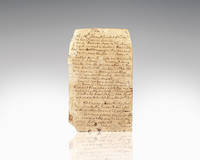
1762142654Mount Vernon March 1762. Autograph manuscript being George Washington's diary entries for a portion of March 1762 detailing the fruit grafts that he has accomplished. 2 pages 5 14/16 x 3 10/16 inches irregular on a leaf of laid paper Mount Vernon March 1762; browned left margin of recto waterstained and abraded causing a loss of text in most lines small abrasion at center of recto obscuring three words. Accompanied by an autograph note signed by James Kirke Paulding: "Memorandum in the hand of Washington taken from an old almanac for 1762 in the possession of JK Paulding." A rare Washington relic: perhaps the only leaf from Washington's diary in private hands. According to the Washington Papers these two pages were initially a blank leaf interleaved in a printed almanac that a Mrs. J. Washington gave to novelist and Secretary of the Navy James Kirke Paulding. The balance of the diary thirteen pages written on interleaved blanks in the Virginia Almanack for the Year of our Lord God 1762 was sold at Sotheby's Parke Bernet 6 December 1977 lot 35. The identifying note by Paulding accompanying the present leaf indicates that it was him who separated this leaf from the diary. Donald Jackson and Dorothy Twohig editors of The Diaries of George Washington state that the entry for 24 March 1762 was transferred from a dated memorandum on the back cover of the diary—the present leaf provides the actual entry for that day. Paulding served in the Van Buren administration as Secretary of the Navy between 1838 and 1841; it is most likely that is when the diary passed into his hands. Mrs. J. Washington is most likely Jane Charlotte Blackburn Washington 1786–1855 wife of John Augustine Washington 1789–1832. John Augustine a nephew of Bushrod Washington inherited Mount Vernon from Bushrod Washington who died without issue. Jackson and Twohig tabulate the location of all known diaries and diary fragments of George Washington. The great majority of these are in the Library of Congress with other examples in the Public Records Office London the Historical Society of Pennsylvania the Detroit Public Library the Virginia Historical Society Columbia University and Mount Vernon. Writing to a commission of the Mount Vernon Ladies' Association in 1924 John C. Fitzpatrick exclaimed: "Now that I have read every word of these Diaries from the earliest to the last one it is impossible to consider them in any light than that of a marvelous record. It is impossible for anyone to arrive at a true understanding or comprehension of George Washington without reading his diary record" Diaries of George Washington 1:xix. Washington kept no daily records until 1760; even then his keeping of diaries was erratic until 1768. His preference was to record his entries on blank pages interleaved in the Virginia Almanack; after the war he adopted blank memorandum books. But by 1795 he returned to the Almanack. Washington's biographer John Marshall and editor Jared Sparks together with Washington's nephew Bushrod carelessly dispensed his papers as souvenirs. The 1797 diary was given to Christopher Hughes who broke it up and dispersed it among friends in America and Europe. Margaret and Robert Adams of Philadelphia were the recipients of the diaries of 1795 and 1798. The whereabouts of these diaries is presently unknown as is the remainder of the Paulding diary of 1762. The entry for March 1762 is the first spring in which Washington was full owner of Mount Vernon. Since 1754 Washington had been leasing the life rights to the estate from the widow of his half brother Lawrence. The plantation became his by right of inheritance when Anne Fairfax Washington died 14 March 1761 with no surviving heirs. By March of 1762 Washington was busy grafting trees in his fruit garden: "18th. Transplanted 5 Cata … ye Birch by Quarter. Several Damson trees to the Peach Orchard. And a Bullock Heart Cherry tree from Colo. Mason's in the corner of the garden near the Spanish Chestnut." Washington has also grafted "four Apricots on Peach. Six taken just from the Nursery & transplanted into the corners adjoining the lower walk of the garden. Note the scions were cut a fortnight or three weeks ago and burried but the Bud … very much." Scion wood is vigorous growth trimmed from desirable trees in late winter for early spring grafting. Washington apparently cut the scions in February and then stored them carefully until he was ready to begin grafting in March. Typically grafting commences in April but as Virginia enjoys a relatively mild climate it could begin in March. In another entry Washington has "grafted two very early May Cherrys from Colo. Masons remarkably large and fine upon wild cherry stock standing in the middle of these Bordr." Washington also planted and grafted a number of varieties of pears plums and apples. "in the third row black Pear of —cester. Very good for baking. In the fourth row 5 Spanish pears wch are very fine. They hang till November and keep thro the winter as well as apples. Note. All these grafts from Colo. Masons." Varieties of cherries mentioned in the diary originated from England. Washington grafts the Bullock cherry or Ox Heart a dark red cherry with large heart-shaped fruit which ripens in July although Washington states May. The Carnation cherry also mentioned in a graft is a large light red cherry used for making brandy and preserves. The magnum bonum plum also known as the egg plum bears fruit that is white and yellow. The generous Colonel Mason is his neighbor George Mason whose plantation Gunston Hall was located sixteen miles south of Alexandria. Washington and Mason were both enthusiastic farmers and the two frequently exchanged thoughts on agriculture as well as on politics. Washington's diary indicates that his fruit trees were organized in four quadrants: north east north west south west and south east. There were up to nine rows of trees in the quadrants with numerous cross walks. The Diaries of George Washington 1:316 provides an illustration of a contemporary quadrant-style arrangement of an orchard from Batty Langley's New Principles of Gardening London 1728 which would have been familiar to Washington. Prior to his presidency Washington was by occupation a planter and he imported luxuries and other goods from England paying for them by exporting tobacco. In 1765 because of erosion and other soil problems he changed Mount Vernon’s primary cash crop from tobacco to wheat and expanded operations to include corn flour milling and fishing. His success in these new endeavors led him to soon be counted among the political and social elite in Virginia. From 1768 to 1775 he invited some 2000 guests to his Mount Vernon estate mostly those whom he considered people of rank. Following the conclusion of the Revolutionary War Washington returned to Mount Vernon where he oversaw the completion of the remodeling work at Mount Vernon which transformed his residence into the mansion that survives to this day although his financial situation was not strong. Creditors paid him in depreciated wartime currency and he owed significant amounts in taxes and wages. Mount Vernon had made no profit during his absence and he saw persistently poor crop yields due to pestilence and poor weather. Again Washington diversified by undertaking a new landscaping plan and succeeded in cultivating a range of fast-growing trees and shrubs that were native to North America. unknown
1783138381Paris: D. Pierres/Pissot Pere & Fils Libraries 1783. First French edition of the Constitution of the United States of America inscribed by Founding Father Benjamin Franklin who had the translation published and personally distributed each of the 600 copies produced. Octavo bound in one quarter calf with gilt ruling to the spine burgundy morocco spine label lettered in gilt. Presentation copy inscribed by Benjamin Franklin on the front free endpaper "A Madame Madame la Presidente de Manieres sic de la parte du. B. Franklin." The recipient Madame Durey de Meinires was a a French writer best known for her translations of Samuel Johnson David Hume and Sarah Fielding. On March 24th 1783 Franklin wrote to the Comte de Vergennes "I am desirous of printing a translation of the Constitutions of the United States of America published at Philadelphia by Order of Congress. Several of these Constitutions have already appeared in the English and American newspapers but there has never yet been a complete translation of them." At Franklin's suggestion the Duc de La Rochefoucault produced the first French translation and Franklin is believed to have contributed the fifty-plus footnotes. Franklin had 600 copies of Constitutions des Treize Etats-Unis de l'Amerique privately printed by Philippe-Denis Pierres first printer ordinary of Louis XVI which were not made available for sale. Franklin distributed them himself and was happy to fulfill the request of Madame Durey de Meinires who wished to receive a copy. On August 31 1783 Franklin sent a copy of the newly published volume to Madame Durey de Meinires along with a letter "I send with great Pleasure the Constitutions of America to my dear & much respected Neighbour being happy to have any thing in my Power to give that she will do me the honour to accept and that may be agreeable to her." The inscribed page included in the present volume was previously sold as a loose flyleaf by Charles Hamilton in 1959 and it has since been professionally tipped into an edition of the book with which it was originally sent. The book contains the Constitutions of each of the thirteen States of America the Declaration of Independence of the 4th of July 1776 the Friendship and Commerce Treaty the Alliance Treaty between France and the United States as well as the treaties between the United States and the Netherlands and Sweden. The title page contains the first appearance of imprint of the United States seal in a book. Franklin's grand gesture in publishing and distributing these constitutions‚ about which there was intense interest and curiosity among statesmen‚ was one of his chief achievements as a propagandist for the new American republic. In good condition. Benjamin Franklin earned the title of "The First American" for his early and indefatigable campaigning for colonial unity initially as an author and spokesman in London for several colonies. As the first United States Ambassador to France he exemplified the emerging American nation. Franklin’s contributions to science and politics were immense and his passion for making books more available to a broader audience prompted him to establish North America’s first subscription library. In 1731 Franklin convinced the members of his Junto a mutual improvement club he founded to pool their money to purchase books they would collectively share. The collection became the Library Company of Philadelphia and is now regarded as the predecessor to the public library. Franklin was also instrumental in the establishment of the Library of the Pennsylvania Hospital North America’s first medical library the Pennsylvania State Library The Library of the American Philosophical Society and the Library of the University of Pennsylvania. D. Pierres/Pissot, Pere & Fils, Libraries unknown
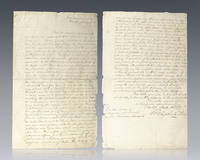
1781125872April 10 1781. Exceptionally rare autograph letter signed by George Washington as Commander-in-Chief of the Continental Army to French ally Jean-Baptiste Donatien de Vimeur comte de Rochambeau whose military assistance in the Siege of Yorktown essentially ended the Revolutionary War. The body of the letter is entirely in the hand of Alexander Hamilton and dated 10 April 1781. In the spring of 1781 officials from Massachusetts approached Rochambeau with a proposal to attack the British post at the mouth of the Penobscot river which had been established in June 1779 to secure timber for shipyards in Halifax and to protect Nova Scotia from any American advance. On April 6 Rochambeau informed Washington that he was willing to send a detachment of troops and that Admiral Destouches would offer naval assistance but observing that he was under Washington's command he would await his approval before approving the action Rochambeau to Washington 6 April 1781 Papers of George Washington Library of Congress. Washington here responds offering his gratitude that Destouches who had only recently lost a naval engagement with the British in an unsuccessful attempt to relieve Lafayette in Virginia would be willing "to undertake the expedition to Penobscot and to you for your readiness to furnish a detachment of troops for the same purpose. The object is certainly worth attention and if it can be effected will be very agreeable to the States particularly to those of the East." He trusts that Destouches "can best judge from the situation of the enemy's fleet how far it may be attempted with prudence and Your Excellency from the information you have recently received what number of troops will be sufficient for the enterprise--I am persuaded it will be calculated how far it is probable the enemy may follow with a part of their fleet--whether the post can be carried by a coup de main or may require so much time as to make it likely the operation will be interrupted before its conclusion--in case of a superior squadron being sent by the enemy what possibility there is of protection or a safe retreat for the ships and even for the land force through an unsettled country in which numbers perished for want of provision in a former attempt--All these are points too important not to have been well weighed and your conversations with the Massachusetts deputies will have been able to enlighten you upon them." Here he is referencing the unsuccessful attempt by Massachusetts in 1779 to destroy the post abandoned when British ships with reinforcements forced an arduous overland retreat by the Americans. Despite his assurances that <span class="match">Rochambeau</span> and Destouches had matters well in hand <span class="match">Washington</span> took the "liberty to remark on two things--one that it appears to me frigates without any ships of the line will answer the purpose as well as with them and less will be risked than by dividing the body of the fleet. Frigates especially the forty fours will afford a safe escort to the troops against any thing now in those Seas and with respect to a detachment from the enemy's fleet it would be always proportioned to the force we should send and if we have two sixty fours they would even be an object for their whole fleet. The other observation I would make is that dispatch being essential to success it will in my opinion be adviseable not to depend on any cooperation of the Militia but to send at once such a force from your army as you deem completely adequate to a speedy reduction of the post. The country in the neighbourhood of Penobscot is too thinly inhabited to afford any resource of Militia there and to assemble and convey them from remote places would announce your design--retard your operations and give leisure to the enemy to counteract you. Indeed I would recommend for the sake of secrecy to conceal your determination from the State itself." On 15 April <span class="match">Rochambeau</span> replied to <span class="match">Washington</span> observing that while he had sufficient troops to spare "your Excellency's observations upon the Separation of our fleet and upon the danger to be interrupted by superior forces during the course of the Expedition which Mr Destouches does not Look on as possible to be undertaken with his frigates only are the motives which cause this project to be Laid aside for the present moment." <span class="match">Rochambeau</span> to <span class="match">Washington</span> 15 April 1781 Papers of George <span class="match">Washington</span> Library of Congress. Soon <span class="match">Washington</span> and <span class="match">Rochambeau</span>'s attention returned again to Virginia and within months their combined forces would be closing in on Yorktown. In near fine condition. Exceptionally rare and desirable being the only communication between the storied commanders of the Yorktown campaign to appear at auction in more than a century. In 1780 French nobleman Jean-Baptiste Donatien de Vimeur comte de Rochambeau was appointed commander of land forces as part of the project code named Expedition Particuliere. He was given the rank of Lieutenant General in command of some 7000 French troops and sent to join the Continental Army under George Washington during the American Revolutionary War. He landed at Newport Rhode Island on 10 July but was held there inactive for a year due to his reluctance to abandon the French fleet blockaded by the British in Narragansett Bay. The College in the Colony of Rhode Island and Providence Plantations now known as Brown University served as an encampment site for some of Rochambeau's troops and the College Edifice was converted into a military hospital now known as University Hall.3 In July 1781 the force left Rhode Island and marched across Connecticut to join Washington on the Hudson River in Mount Kisco New York. Washington and Rochambeau then marched their combined forces to the siege of Yorktown and the Battle of the Chesapeake. On 22 September they combined with the Marquis de Lafayette's troops and forced heavily outnumbered and trapped Lord Cornwallis to surrender on 19 October. The siege of Yorktown was a decisive victory for the American Continental Army and proved to be the last major land battle of the American Revolutionary War in the North American region as the surrender by Cornwallis and the capture of both him and his army prompted the British government to negotiate an end to the conflict and ultimately resulted in the Treaty of Paris of 1783. unknown books
1781125872April 10 1781. Highly important letter signed “Go: Washington†as Commander-in-Chief 2 pages folio “Head Quarters New Windsor April 10 1781†to his French ally Jean-Baptiste Donatien de Vimeur comte de Rochambeau the body of the letter in the hand of his trusted aide-de-camp Alexander Hamilton; horizontal fold separation repaired minor tears and chips along margins. In the spring of 1781 officials from Massachusetts approached Rochambeau with a proposal to attack the British post at the mouth of the Penobscot river— established in June 1779 to secure timber for shipyards in Halifax and to protect Nova Scotia from any American advance. On 6 April Rochambeau informed Washington he was willing to send a detachment of troops and that Admiral Destouches was willing to offer naval assistance. But observing that he was under Washington's command he would await his approval before approving the action Rochambeau to Washington 6 April 1781 Papers of George Washington Library of Congress. Washington responds in the present letter offering his gratitude. The Commander-in Chief explains that Destouches who had only recently lost a naval engagement with the British in an unsuccessful attempt to relieve Lafayette in Virginia would be willing “to undertake the expedition to Penobscot and to you for your readiness to furnish a detachment of troops for the same purpose. The object is certainly worth attention and if it can be effected will be very agreeable to the States particularly to those of the East.†He trusts that Destouches “can best judge from the situation of the enemy's fleet how far it may be attempted with prudence and Your Excellency from the information you have recently received what number of troops will be sufficient for the enterprise—I am persuaded it will be calculated how far it is probable the enemy may follow with a part of their fleet—whether the post can be carried by a coup de main or may require so much time as to make it likely the operation will be interrupted before its conclusion—in case of a superior squadron being sent by the enemy what possibility there is of protection or a safe retreat for the ships and even for the land force through an unsettled country in which numbers perished for want of provision in a former attempt—All these are points too important not to have been well weighed and your conversations with the Massachusetts deputies will have been able to enlighten you upon them." Here Washington is referencing the unsuccessful attempt by Massachusetts in 1779 to destroy the post abandoned when British ships with reinforcements forced an arduous overland retreat by the Americans. Despite his assurances that Rochambeau and Destouches have matters well in hand Washington takes the “liberty to remark on two things—one that it appears to me frigates without any ships of the line will answer the purpose as well as with them and less will be risked than by dividing the body of the fleet. Frigates especially the forty fours will afford a safe escort to the troops against any thing now in those Seas and with respect to a detachment from the enemy’s fleet it would be always proportioned to the force we should send and if we have two sixty fours they would even be an object for their whole fleet. The other observation I would make is that dispatch being essential to success it will in my opinion be adviseable not to depend on any cooperation of the Militia but to send at once such a force from your army as you deem completely adequate to a speedy reduction of the post. The country in the neighbourhood of Penobscot is too thinly inhabited to afford any resource of Militia there and to assemble and convey them from remote places would announce your design—retard your operations and give leisure to the enemy to counteract you. Indeed I would recommend for the sake of secrecy to conceal your determination from the State itself.†On 15 April Rochambeau replies to Washington observing that while he had sufficient troops to spare “your Excellency’s observations upon the Separation of our fleet and upon the danger to be interrupted by superior forces during the course of the Expedition which Mr Destouches does not Look on as possible to be undertaken with his frigates only are the motives which cause this project to be Laid aside for the present moment.†Rochambeau to Washington 15 April 1781 Papers of George Washington Library of Congress. It was not long before the attention of both Washington and Rochambeau returned again to Virginia and within months their combined forces would be closing in on Yorktown. The sole communication between the storied commanders of the Yorktown campaign to appear at auction in more than a century. Most of the letters from Washington to Rochambeau were kept by the Rochambeau family until 1952 when the collection was sold to H.P. Kraus who in turn sold them to Paul Mellon in 1958. In 1992 Mellon bequeathed the collection to Yale University and the collection is now housed at the Beinecke Library. The only other communication from Washington to Rochambeau that can be found in auction records was part of the collection of James Crimmons Anderson Galleries 5 May 1904 being Washington’s autograph letter signed of 13 July 1781 to Rochambeau for the reconnaissance in force of the British defenses around northern Manhattan. Provenance: The family of Charles-René-Dominique Sochet Destouches. In 1780 French nobleman Jean-Baptiste Donatien de Vimeur comte de Rochambeau was appointed commander of land forces as part of the project code named Expédition Particulière. He was given the rank of Lieutenant General in command of some 7000 French troops and sent to join the Continental Army under George Washington during the American Revolutionary War. He landed at Newport Rhode Island on 10 July but was held there inactive for a year due to his reluctance to abandon the French fleet blockaded by the British in Narragansett Bay. The College in the Colony of Rhode Island and Providence Plantations now known as Brown University served as an encampment site for some of Rochambeau's troops and the College Edifice was converted into a military hospital now known as University Hall.3 In July 1781 the force left Rhode Island and marched across Connecticut to join Washington on the Hudson River in Mount Kisco New York. Washington and Rochambeau then marched their combined forces to the siege of Yorktown and the Battle of the Chesapeake. On 22 September they combined with the Marquis de Lafayette's troops and forced heavily outnumbered and trapped Lord Cornwallis to surrender on 19 October. The siege of Yorktown was a decisive victory for the American Continental Army and proved to be the last major land battle of the American Revolutionary War in the North American region as the surrender by Cornwallis and the capture of both him and his army prompted the British government to negotiate an end to the conflict and ultimately resulted in the Treaty of Paris of 1783. unknown
179167693s. l. Londres London Paris Toulon. 1791. Fine. s. l. Londres London Paris Toulon. 1791-1832 12 000 feuillets de divers formats en feuilles Unpublished political scientific and historical archives The complete manuscript unpublished papers of Louis Chevalier de Sade 1753-1832 author of the Lexicon politique and cousin of the famous Marquis. The important geopolitical historical and scientific archives of a learned aristocrat a privileged witness of the end of the Ancien Régime the French Revolution the Consulate Empire and Restoration. A unique fund of research on the implementation of a constitutional monarchy. Exceptional collection of the Chevalier Louis de Sade's personal archives the cousin of the Marquis de Sade representing 12000 handwritten pages including several thousand unpublished and written by his hand. The Chevalier shows a thought system that he describes as «holistic» including historical political and scientific reflections. Louis Chevalier de SADE If we take the French Revolution as the birth of an experiment both secular and political the Chevalier de Sade was without doubt one of its early critics. Not only of the Revolution which had many other detractors but of its political ideology which would go on profoundly to impact the two hundred years that followed. What he calls «positive politics» is «based on reasoning and experience». «The theory did have some attractions for me; I studied it with care I savored its principles. Now I see their value only in terms of the impact of their implementation what we've seen them produce in the peoples of which history has given me knowledge. This is my method; I know that it is all in all the opposite of the methods utilized by the men who have governed us and written our constitutions to this very day without deviation. This continuous divergence between what has been done and what should never have been done increased my confidence in the path to be followed and at the same time fortified my determination to keep to the views I had adopted of judging laws by the historic consequences they entail rather than by the lyrical supposedly conclusive metaphysical arguments with which these innovators continually and still to this day assault us.» The Chevalier de Sade who saw the world in terms of his own time and place could be nothing other than a Royalist. There were practically no examples of democracy in the history known to the Chevalier apart from the Classical democracies of Greece and Rome which had been experiments only in very elitist forms of democracy. These were very well known to this political scientist whose papers contain 7000 pages dedicated to the history of the Classical world. The republic ushered in by the Revolution was more than just a political system it was the realization of a philosophical political ideal. And while most of those opposed to the new regime saw in it above all a threat to their personal situations their religious beliefs or even more simply their habits the writings of the Chevalier de Sade show no such dogmatic influence; or at least he never uses dogma to justify his arguments. Louis de Sade a gentleman without a fortune and without significant ties was conservative through philosophical and historical conviction and not out of interest. It is with this perfect intellectual honesty that he studies the essays memoirs and political or theoretical works of his contemporaries. Running counter to Enlightenment thought the Chevalier's view of society owed very little to philosophy. Though he puts together a serious theoretical history of the development of Man from the condition of «savages» to the forging of various societies he does not posit Man's ideal nature as some of his contemporaries did. Rather the Chevalier examines the gap between nature and the civilized being without passing moral or philosophical judgment as was the fashion at the time. «The political error that damned Europe in the 18th unknown
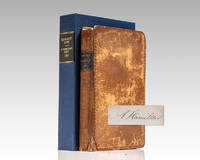
1793151910London: Printed for E. and R. Brooke Bell-Yard near Temple-Bar 1793. Third edition of this important late-eighteenth-century legal treatise from the library of Alexander Hamilton signed twice by him and additionally by his eldest son Philip Hamilton. Octavo bound in full calf with stamping to the spine and panels in blind. Signed by Alexander Hamilton on the title page “A. Hamilton†and again on the final leaf "Alexander Hamilton." Additionally signed twice by Hamilton's eldest son Philip Hamilton on the verso of the front board. In November 1801 Philip Hamilton 1782–1801 a recent Columbia College graduate then beginning the study of law was killed in a duel with the New York attorney George Eacker. The quarrel arose from remarks Eacker had made disparaging Alexander Hamilton which Philip then nineteen took it upon himself to answer. He died of his wound the following day. Less than three years later on 11 July 1804 his father met Vice President Aaron Burr on the duelling ground at Weehawken and was himself mortally wounded dying the next afternoon. In good condition. Housed in a custom clamshell box. Books bearing Alexander Hamilton’s signature are known; examples bearing Philip Hamilton’s signature are markedly uncommon owing to his early death. Volumes containing the signatures of both father and son together are of the utmost scarcity. Cooke's Bankrupt Laws was a standard late-eighteenth-century treatise on the English statutes governing insolvency the administration of bankrupt estates and the procedures attending commissions of bankruptcy. Works of this kind belonged to the practical literature consulted by attorneys whose practice touched questions of commerce credit and debt. That Hamilton kept such a volume in his library accords with his work at the bar and more pointedly with his tenure as the first Secretary of the Treasury in which the credit of the United States the management of the public debt and the architecture of American finance were the central concerns of his office. Printed for E. and R. Brooke, Bell-Yard, near Temple-Bar unknown
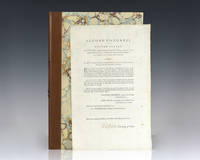
1792125388Philadelphia: Childs & Swaine 1792. Scarce printing of an early United States law providing for the funding of the national debt signed by Thomas Jefferson as Secretary of State. Folio one page. The document which also carries the printed signatures of President George Washington Vice President John Adams and House Speaker Jonathan Trumbull was approved January 23 1792. Individual acts and bills of the first Congresses were routinely printed for public consumption. A provision was made however to print a few copies of each act for dissemination to the states and to have each copy signed by Secretary of State Thomas Jefferson. One of the main priorities of the federal government in the early national period was to pay down the debt of the United States. The national debt was incurred during the Revolution and augmented in 1790 when the Congress passed the Assumption Act in accordance with a plan devised by Alexander Hamilton. Because contacting the numerous and geographically dispersed holders of the debt proved more difficult than expected it became necessary to extend the time allowed by law for making the relevant financial arrangements. The present act accomplished this and made a special extension of five months for Vermont which gave the new state time to calculate the amount of debt. Despite Jefferson's vehement opposition to Hamilton's plan when it was formulated his position as Secretary of State necessitated his signature on the presentation copies of the acts that effected it. In fine condition. Housed in a custom half morocco folding case. Scarce with only one other example signed by Jefferson located. American Founding Father Thomas Jefferson was the principal author of the Declaration of Independence and later served as the third President of the United States from 1801 to 1809. Prior to his presidency he was elected the second Vice President of the United States serving under John Adams from 1797 to 1801. A proponent of democracy republicanism and individual rights motivating American colonists to break from Great Britain and form a new nation he produced formative documents and decisions at both the state and national level. Jefferson was an avid bibliophile and by the end of his life had amassed a large library and wine collection. Childs & Swaine unknown
1792125388Philadelphia: Childs & Swaine 1792. Scarce printing of an early United States law providing for the funding of the national debt signed by Thomas Jefferson as Secretary of State. Folio one page. The document which also carries the printed signatures of President George Washington Vice President John Adams and House Speaker Jonathan Trumbull was approved January 23 1792. Individual acts and bills of the first Congresses were routinely printed for public consumption. A provision was made however to print a few copies of each act for dissemination to the states and to have each copy signed by Secretary of State Thomas Jefferson. One of the main priorities of the federal government in the early national period was to pay down the debt of the United States. The national debt was incurred during the Revolution and augmented in 1790 when the Congress passed the Assumption Act in accordance with a plan devised by Alexander Hamilton. Because contacting the numerous and geographically dispersed holders of the debt proved more difficult than expected it became necessary to extend the time allowed by law for making the relevant financial arrangements. The present act accomplished this and made a special extension of five months for Vermont which gave the new state time to calculate the amount of debt. Despite Jefferson's vehement opposition to Hamilton's plan when it was formulated his position as Secretary of State necessitated his signature on the presentation copies of the acts that effected it. In fine condition. Housed in a custom half morocco folding case. Scarce with only one other example signed by Jefferson located. American Founding Father Thomas Jefferson was the principal author of the Declaration of Independence and later served as the third President of the United States from 1801 to 1809. Prior to his presidency he was elected the second Vice President of the United States serving under John Adams from 1797 to 1801. A proponent of democracy republicanism and individual rights motivating American colonists to break from Great Britain and form a new nation he produced formative documents and decisions at both the state and national level. Jefferson was an avid bibliophile and by the end of his life had amassed a large library and wine collection. Childs & Swaine unknown books
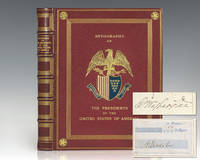
17831253841783-1956. Elaborately bound collection of Presidential autographs containing the autograph of each of the first 34 Presidents of the United States from George Washington to Dwight D. Eisenhower. Quarto bound in full red morocco by Riviere & Son with gilt titles and ruling to the spine in six compartments within raised gilt bands gilt presidential seal to the front panel with white and blue morocco onlays gilt arms and motto of George Washington to the rear panel with white and blue morocco onlays and his gilt signature in facsimile centerpieces within quintuple gilt ruling with star emblems at each corner blue morocco doublures with multiple gilt presidential signatures blue silk endpapers. This complete series of autographs of the first 34 Presidents of the United States contains the signature of each mounted on an album leaf opposite a loosely tissue-guarded engraved portrait of each. The collection includes: the signature of George Washington on an envelope addressed to Major General Knox as Secretary of the Society of the Cincinnati November 3 1783; a clipped signature of John Adams; clipped signature of Thomas Jefferson; the signature of James Madison on an envelope addressed to Reverend Frederick Freeman of Manayunk Pennsylvania; and inscription signed by James Monroe; the signature of John Quincy Adams on an envelope addressed to William Plumer jun. Esq. in Epping New Hampshire; a partially printed land grant signed by Andrew Jackson dated 1831 registering the purchase of 20 acres in Detroit by Peter Aldrich; clipped signature of Martin Van Buren; clipped signature of William Henry Harrison; signed inscription from John Tyler; signed inscription from James Polk; clipped signature of Zachary Taylor dated Baton Rouge March 5 1841; clipped signature of Millard Fillmore; clipped signature of Franklin Pierce; clipped signature of James Buchanan on a document dated July 18 1858; clipped signature of Abraham Lincoln; endorsement signed by Andrew Johnson as President; clipped signature of Ulysses S. Grant; card signed by Rutherford B. Hayes; inscription signed by James Garfield; large card signed by Chester A. Arthur and dated May 22 1884; autograph noted signed by Grover Cleveland declining an invitation dated November 16 1890; an Executive Mansion card signed by William McKinely; clipped signature of Theodore Roosevelt; clipped signature of William Howard Taft; clipped signature of Woodrow Wilson; typed letter signed by Warren G. Harding as President dated June 4 1923 on White House letterhead; card signed by Calvin Coolidge; White House card signed by Herbert Hoover; typed letter signed by Franklin D. Roosevelt as Assistant Secretary of the Navy February 15 1917. Laid in is a typed letter signed by Harry S. Truman as President June 30 1950 on White House stationery and a typed letter signed by Dwight Eisenhower. TLS as President November 13 1956 on White House stationery. In fine condition. Housed in a custom folding chemise and half morocco slipcase. An exceptional collection and presentation. Note_ unknown
17831253841783-1956. Elaborately bound collection of Presidential autographs containing the autograph of each of the first 34 Presidents of the United States from George Washington to Dwight D. Eisenhower. Quarto bound in full red morocco by Riviere & Son with gilt titles and ruling to the spine in six compartments within raised gilt bands gilt presidential seal to the front panel with white and blue morocco onlays gilt arms and motto of George Washington to the rear panel with white and blue morocco onlays and his gilt signature in facsimile centerpieces within quintuple gilt ruling with star emblems at each corner blue morocco doublures with multiple gilt presidential signatures blue silk endpapers. This complete series of autographs of the first 34 Presidents of the United States contains the signature of each mounted on an album leaf opposite a loosely tissue-guarded engraved portrait of each. The collection includes: the signature of George Washington on an envelope addressed to Major General Knox as Secretary <span class="match">of</span> <span class="match">the</span> Society <span class="match">of</span> <span class="match">the</span> Cincinnati November 3 1783; a clipped signature of John Adams; clipped signature of Thomas Jefferson; the signature of James Madison on an envelope addressed to Reverend Frederick Freeman of Manayunk Pennsylvania; and inscription signed by James Monroe; the signature of John Quincy Adams on an envelope addressed to William Plumer jun. Esq. in Epping New Hampshire; a partially printed land grant signed by Andrew Jackson dated 1831 registering <span class="match">the</span> purchase <span class="match">of</span> 20 acres in Detroit by Peter Aldrich; clipped signature of Martin Van Buren; clipped signature of William Henry Harrison; signed inscription from John Tyler; signed inscription from James Polk; clipped signature of Zachary Taylor dated Baton Rouge March 5 1841; clipped signature of Millard Fillmore; clipped signature of Franklin Pierce; clipped signature of James Buchanan on a document dated July 18 1858; clipped signature of Abraham Lincoln; endorsement signed by Andrew Johnson as President; clipped signature of Ulysses S. Grant; card signed by Ru<span class="match">the</span>rford B. Hayes; inscription signed by James Garfield; large card signed by Chester A. Arthur and dated May 22 1884; autograph noted signed by Grover Cleveland declining an invitation dated November 16 1890; an Executive Mansion card signed by William McKinely; clipped signature of <span class="match">The</span>odore Roosevelt; clipped signature of William Howard Taft; clipped signature of Woodrow Wilson; typed letter signed by Warren G. Harding as President dated June 4 1923 on White House letterhead; card signed by Calvin Coolidge; White House card signed by Herbert Hoover; typed letter signed by Franklin D. Roosevelt as Assistant Secretary <span class="match">of</span> <span class="match">the</span> Navy February 15 1917. Laid in is a typed letter signed by Harry S. Truman as President June 30 1950 on White House stationery and a typed letter signed by Dwight Eisenhower. TLS as President November 13 1956 on White House stationery. In fine condition. Housed in a custom folding chemise and half morocco slipcase. An exceptional collection and presentation. unknown books
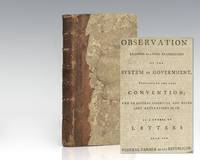
1787106800New York 1787. Rare first edition of the definitive and most important work in the Anti-Federalist canon; the antithesis of the The Federalist Papers. Octavo bound in the original calf over original boards with six raised bands edges speckled red. In very good condition. An exceptional example. On November 8 1787 the New York Journal began to advertise a new pamphlet entitled Observations Leading to a Fair Examination of the System of Government Proposed by the Late Convention; and to Several Essential and Necessary Alterations in It. In a Number of Letters from the Federal Farmer to the Republican. This pamphlet contained the first five Federal Farmer letters dated October 8 to 13. The first edition was replete with errors and a second corrected printing appeared within a week. Among the Federalists Alexander Hamilton as Publius Edward Carrington and Noah Webster acknowledged the Federal Farmer as in Hamilton's words the "most plausible" Anti-Federalist. Only one Federalist Timothy Pickering took the time to develop a complete critical response to the Federal Farmer. Though this was not published during the course of the constitutional debates it survives in a personal letter. Pickering described the Federal Farmer as "a wolfe in sheep's cloathing" and too focused on a misplaced fear of aristocracy. The work has been attributed to Richard Henry Lee a presiding officer of the Continental Congress writing under the pseudonym 'Federal Farmer'. Through these the first five letters the Federal Farmer argues that the plan of the Constitution while claimed to be a federal system and seeming to be so in some respects will in the end annihilate the states by consolidating them into one national government. This concern over consolidation was among the most important of the Anti-Federalist objections to the Constitution; they saw the destruction of state sovereignty as inimical to freedom. Honest federalists in the view of the Federal Farmer wished for the substantial preservation of the state governments but sought a federal government that was more than merely advisory. The letters indicate that the Federal Farmer ascribed to the compact theory of federalism. The Federal Farmer letters are among the best-written and convincing pieces in the Anti-Federalist canon and make regular appearances in collections of Anti-Federalist writing. "Though sometimes discursive and repetitious the letters skillfully written moderate in tone and thoughtful were perhaps the most eloquent and persuasive anti-federalist writings" Ketcham 256. hardcover books
1787106800New York 1787. Rare first edition of the definitive and most important work in the Anti-Federalist canon; the antithesis of the The Federalist Papers. Octavo bound in half calf over boards with six raised bands edges speckled red. In very good condition. An exceptional example. On November 8 1787 the New York Journal began to advertise a new pamphlet entitled Observations Leading to a Fair Examination of the System of Government Proposed by the Late Convention; and to Several Essential and Necessary Alterations in It. In a Number of Letters from the Federal Farmer to the Republican. This pamphlet contained the first five Federal Farmer letters dated October 8 to 13. The first edition was replete with errors and a second corrected printing appeared within a week. Among the Federalists Alexander Hamilton as Publius Edward Carrington and Noah Webster acknowledged the Federal Farmer as in Hamilton's words the "most plausible" Anti-Federalist. Only one Federalist Timothy Pickering took the time to develop a complete critical response to the Federal Farmer. Though this was not published during the course of the constitutional debates it survives in a personal letter. Pickering described the Federal Farmer as "a wolfe in sheep's cloathing" and too focused on a misplaced fear of aristocracy. The work has been attributed to Richard Henry Lee a presiding officer of the Continental Congress writing under the pseudonym 'Federal Farmer'. Through these the first five letters the Federal Farmer argues that the plan of the Constitution while claimed to be a federal system and seeming to be so in some respects will in the end annihilate the states by consolidating them into one national government. This concern over consolidation was among the most important of the Anti-Federalist objections to the Constitution; they saw the destruction of state sovereignty as inimical to freedom. Honest federalists in the view of the Federal Farmer wished for the substantial preservation of the state governments but sought a federal government that was more than merely advisory. The letters indicate that the Federal Farmer ascribed to the compact theory of federalism. The Federal Farmer letters are among the best-written and convincing pieces in the Anti-Federalist canon and make regular appearances in collections of Anti-Federalist writing. "Though sometimes discursive and repetitious the letters skillfully written moderate in tone and thoughtful were perhaps the most eloquent and persuasive anti-federalist writings" Ketcham 256. hardcover
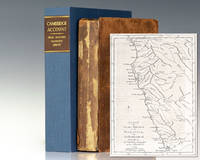
1761137375London: Printed for T. Jefferys 1761. Benjamin Franklin's first edition copy of Cambridge's account of the progression of the Seven Years' War in India from Franklin's private library. Quarto bound in full contemporary calf marbled endpapers illustrated with 12 engraved maps and plans and 6 plates mostly folding. From the private library of Benjamin Franklin. Franklin's contributions to science and politics were immense and his passion for making books more available to a broader audience prompted him to establish North America's first subscription library. In 1731 Franklin convinced the members of his Junto a mutual improvement club he founded to pool their money to purchase books they would collectively share. The collection became the Library Company of Philadelphia and is now regarded as the predecessor to the public library. Franklin was also instrumental in the establishment of the Library of the Pennsylvania Hospital North America's first medical library the Pennsylvania State Library The Library of the American Philosophical Society and the Library of the University of Pennsylvania. Franklin's private library has a long and complex history and although he was known to have produced a list its contents shortly before his death it has never been discovered. After his death in 1790 a large portion of his library became the property of his grandson William Temple Franklin who upon receiving it quickly sold it to financier and Signer of the Declaration of Independence Robert Morris. When Morris went bankrupt at the end of the decade the collection went into the hands of Philadelphia bookseller and former French tutor Nicholas G. Dufief in 1801 who began offering volumes for sale to the public. Dufief attempted to interest Congress in obtaining most of the library but ultimately sent most of it to auction. On March 12 1803 Philadelphia auctioneers Shannon & Poalk sold the library and Philadelphia attorney William Rawle purchased the present volume inscribing it: "W. Rawle 1803 – bo't at sale of Dr. Franklin's library." Dufief was also known to have compiled a list of the contents of Franklin's library but it has never been recovered and although printed catalogs were known to be issued advertising the contents of the 1803 Shannon & Poalk auction a copy has not been located. Philadelphia autograph collector Ferdinand J. Dreer obtained this copy and in 1886 and presented it to the Society of the Sons of St. George. In good condition. With Dreer's bookplate and presentation inscription. Housed in a custom clamshell box. Rare and desirable from Franklin's private library and with noted provenance. Benjamin Franklin earned the title of "The First American" for his early and indefatigable campaigning for colonial unity initially as an author and spokesman in London for several colonies. As the first United States Ambassador to France he exemplified the emerging American nation. Franklin was foundational in defining the American ethos as a marriage of the practical values of thrift hard work education community spirit self-governing institutions and opposition to authoritarianism both political and religious with the scientific and tolerant values of the Enlightenment. In the words of historian Henry Steele Commager "In a Franklin could be merged the virtues of Puritanism without its defects the illumination of the Enlightenment without its heat." To Walter Isaacson this makes Franklin "the most accomplished American of his age and the most influential in inventing the type of society America would become." Printed for T. Jefferys unknown
1790141583January 24 1790. Rare autograph letter signed by George Washington as the first President of the United States. Quarto one page the letter reads in full "New York Jany 24th 1790 Sir Capt. Burnett delivered me your letter of the 18th and is so obliging as to take charge of this answer - It is my sincere opinion that the land mentioned in it is worth what I asked for it--to wit four dollars per acre and once would have sold for it; but if in the present scarcity of cash it rather fetch that sum let those who are really inclinable to buy come forward like men that are in earnest and say what they will give--If they or their Agent have seen the land and without this it is useless to name any price have examined its qualities and improvements they can say what they will give and ought to act with candour. -On these terms I am ready to treat with them. It is not my intention to dispose of the land for a song nor is it my wish to higgle or make many words to the bargain--for which reason I pray them to come to a decision at once and that you would inform me of the result. At any rate it would be proper for you to write to me & soon that I may not miss any other offer should any be made to. Sir Yr most Obed. Hble Serv G Washington." In very good condition silked on recto and verso. Matted and framed. The entire piece measures 18 inches by 15 inches. An exceptional letter. American statesman and soldier George Washington served as the first President of the United States from 1789 to 1797 and was one of the Founding Fathers of the United States. He served as Commander-in-Chief of the Continental Army during the American Revolutionary War and later presided over the 1787 convention that drafted the United States Constitution. He is popularly considered the driving force behind the nation's establishment and came to be known as the "father of the country" both during his lifetime and to this day. unknown
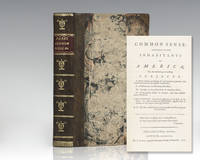
177696237J. Almon J.S. Jordan and J. Stockdale: London 1776-1793. Finely bound collection of the works of Thomas Paine including the rare first British editions of Common Sense and Plain Truth London: J. Almon 1776 second editions of Rights of Man Parts I & II London: J.S. Jordan 1791-1792 complete with half-titles present and a rare early printing of John Quincy Adams' response to Paine's Rights of Man London: J. Stockdale 1793 attributed to his father John Adams and written when John Quincy Adams was 26 years old. Octavo bound in three quarters morocco over marbled boards with gilt titles and tooling to the spine red morocco spine label all edges speckled black. In near fine condition. A rare and desirable collection. One of the founding fathers of the United States Thomas Paine authored two of the most influential pamphlets at the start of the American Revolution which ultimately inspired the 1776 Declaration of Independence. Virtually every American rebel read Paine's powerful pamphlet Common Sense which crystallized the American Revolution and demand for independence from Britain. John Adams asserted "without the pen of the author of Common Sense the sword of Washington would have been raised in vain." London hardcover books
177696237J. Almon J.S. Jordan and J. Stockdale: London 1776-1793. Finely bound collection of the works of Thomas Paine including the rare first British editions of Common Sense and Plain Truth London: J. Almon 1776 second editions of Rights of Man Parts I & II London: J.S. Jordan 1791-1792 complete with half-titles present and a rare early printing of John Quincy Adams' response to Paine's Rights of Man London: J. Stockdale 1793 attributed to his father John Adams and written when John Quincy Adams was 26 years old. Octavo bound in three quarters morocco over marbled boards with gilt titles and tooling to the spine red morocco spine label all edges speckled black. In near fine condition. A rare and desirable collection. One of the founding fathers of the United States Thomas Paine authored two of the most influential pamphlets at the start of the American Revolution which ultimately inspired the 1776 Declaration of Independence. Virtually every American rebel read Paine’s powerful pamphlet Common Sense which crystallized the American Revolution and demand for independence from Britain. John Adams asserted "without the pen of the author of Common Sense the sword of Washington would have been raised in vain. London hardcover
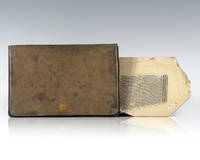
17591342281759. Original swatch from Martha Washington's golden yellow silk wedding dress given by her as a gift to Mrs. Alexander Hamilton Elizabeth and handed down through generations of the Hamilton family. The silk swatch measures roughly 2.75 inches by 2 inches mounted on a stiff paper card inscribed in pencil on the verso "A bit of Martha Washington's wedding dress Wh. was Mrs. Alex Hamilton's" in the hand of Hamilton's granddaughter-in-law Mrs. Allan McLane Hamilton and from her collection. Hamilton’s grandson Allan McLane Hamilton was a prominent psychiatrist and founded the New York Psychiatric Society. In 1910 he published The Intimate Life of Alexander Hamilton which was published by Scribner & Sons. In very good condition. Housed in an antique leather carrying case. An exceptional association with wonderful provenance. On May 15 1750 at age 18 Martha Dandridge Custis married Daniel Parke Custis a rich planter two decades her senior and moved to his residence White House Plantation in New Kent County Virginia. The couple had four children together and Daniel Parke Custis's death in 1757 left Martha a rich young widow at age 26 with independent control over a dower inheritance for her lifetime and trustee control over the inheritance of her minor children. In all she was left in custody of some 17500 acres of land and 300 slaves apart from other investments and cash. Martha Custis age 27 and George Washington age 26 married on January 6 1759 at the White House plantation after only three months of courtship. The wedding was grand. George's suit was of blue and silver cloth with red trimming and gold knee buckles. The bride wore purple silk shoes with spangled buckles which are displayed at Mount Vernon. The couple honeymooned at the Custis family's White House plantation for several weeks before setting up house at George's Mount Vernon estate. hardcover
1776106523Philadelphia: Printed and sold by R. Bell in Third-Street 1776. Scarce 1776 separate edition of the Large Additions to Common Sense. The title reads in full: Large Additions To Common Sense: Addressed To The Inhabitants Of America On The Following Interesting Subjects. I. The American Patriot's Prayer. II. American Independancy defended by Candidus. III. The Propriety of Independancy by Demophilus The dread of Tyrants and the sole resource Of those that under grim Oppression groan. Thomson. IV. A Review of the American Contest with some Strictures on the King's Speech. Addressed to All Parents in the Thirteen United Colonies by a Friend To Posterity And Mankind. V. Letter to Lord Dartmouth by an English American. VI. Observations on Lord North's Conciliatory Plan by Sincerus. To Which Is Added And Given An Appendix to Common Sense; Together with an Address to the People Called Quakers on their Testimony concerning Kings and Government and the Present Commotions in America. Octavo bound in three quarters morocco over boards gilt titles and five raised bands to the spine marbled endpapers. In very good condition internally very clean. Rare with only two examples appearing at auction in the last 80 years. One of the founding fathers of the United States Thomas Paine authored two of the most influential pamphlets at the start of the American Revolution which ultimately inspired the 1776 Declaration of Independence. Virtually every American rebel read Paine's powerful pamphlet Common Sense which crystallized the American Revolution and demand for independence from Britain. John Adams asserted "without the pen of the author of Common Sense the sword of Washington would have been raised in vain." The 1776 Large Additions lends insight into the fascinating publishing history of the most important and popular tract of the American Revolution. After the publication of the first edition of Common Sense by Bell in 1776 in a small edition of 1000 copies Paine was greatly disappointed when Bell advised him there were no profits. He had intended to donate the proceeds to the causes of liberty and independence. Paine and Bell 44 had an immediate falling out and Paine subsequently hired Bradford to print a competing edition. This naturally infuriated Bell who included an attack on the still anonymous author in his next printing. The controversy between Bell and Paine played out in the press over the next several weeks and in no small part helped further ignite the popularity and widespread dissemination of Common Sense. Bell tried to compete against Bradford with a second unauthorized edition and gathered these additions to differentiate his work for the purpose of marketing. Nevertheless Bell could not easily compete since Paine refused to copyright the work and granted free permission for anyone to reprint it. Howes P22 states that "Paine was not the author of these Additions; they were gathered from various sources by Bell to make his edition 3 times larger than the enlarged edition issued at Philadelphia by Bradford to whom Paine had turned after his estrangement from Bell. Some copies were issued separately - and paged" as in the present example " . to permit their being bound with the first and second editions of Common Sense. Printed and sold, by R. Bell in Third-Street hardcover books
1776106523Philadelphia: Printed and sold by R. Bell in Third-Street 1776. Scarce 1776 separate edition of the Large Additions to Common Sense. The title reads in full: Large Additions To Common Sense: Addressed To The Inhabitants Of America On The Following Interesting Subjects. I. The American Patriot’s Prayer. II. American Independancy defended by Candidus. III. The Propriety of Independancy by Demophilus The dread of Tyrants and the sole resource Of those that under grim Oppression groan. Thomson. IV. A Review of the American Contest with some Strictures on the King’s Speech. Addressed to All Parents in the Thirteen United Colonies by a Friend To Posterity And Mankind. V. Letter to Lord Dartmouth by an English American. VI. Observations on Lord North’s Conciliatory Plan by Sincerus. To Which Is Added And Given An Appendix to Common Sense; Together with an Address to the People Called Quakers on their Testimony concerning Kings and Government and the Present Commotions in America. Octavo bound in three quarter morocco over boards gilt titles and five raised bands to the spine marbled endpapers. In very good condition internally very clean. Rare with only two examples appearing at auction in the last 80 years. One of the founding fathers of the United States Thomas Paine authored two of the most influential pamphlets at the start of the American Revolution which ultimately inspired the 1776 Declaration of Independence. Virtually every American rebel read Paine’s powerful pamphlet Common Sense which crystallized the American Revolution and demand for independence from Britain. John Adams asserted "without the pen of the author of Common Sense the sword of Washington would have been raised in vain." The 1776 Large Additions lends insight into the fascinating publishing history of the most important and popular tract of the American Revolution. After the publication of the first edition of Common Sense by Bell in 1776 in a small edition of 1000 copies Paine was greatly disappointed when Bell advised him there were no profits. He had intended to donate the proceeds to the causes of liberty and independence. Paine and Bell 44 had an immediate falling out and Paine subsequently hired Bradford to print a competing edition. This naturally infuriated Bell who included an attack on the still anonymous author in his next printing. The controversy between Bell and Paine played out in the press over the next several weeks and in no small part helped further ignite the popularity and widespread dissemination of Common Sense. Bell tried to compete against Bradford with a second unauthorized edition and gathered these additions to differentiate his work for the purpose of marketing. Nevertheless Bell could not easily compete since Paine refused to copyright the work and granted free permission for anyone to reprint it. Howes P22 states that “Paine was not the author of these Additions; they were gathered from various sources by Bell to make his edition 3 times larger than the enlarged edition issued at Philadelphia by Bradford to whom Paine had turned after his estrangement from Bell. Some copies were issued separately - and paged†as in the present example “ . to permit their being bound with the first and second editions of Common Sense. Printed and sold, by R. Bell in Third-Street hardcover
1794125183Philadelphia: Printed by D. Humphreys for M. Carey 1794. Exceedingly rare first American edition and the earliest obtainable example of the first American bestseller. Octavo two volumes bound into one in three quarter calf over marbled boards morocco spine label lettered in gilt marbled endpapers. Although it was preceded by the first English edition published in 1791 no examples of the first English edition have been traced at auction. In very good condition. Bookplate to the pastedown bibliographic description tipped in. Housed in a custom cloth chemise and half morocco clamshell slipcase. Exceedingly rare with only one other example of the first American edition traced at auction in the last 75 years. Susana Rowson's best-selling novel Charlotte Temple relates the tale of 15-year-old English schoolgirl Charlotte Temple who is lured away from her prestigious boarding school by British army officer John Montraville. While en route to New York Montraville seduces Charlotte who he swiftly abandons upon arrival to his post and after a downward spiral into remorse illness poverty and the birth of a child she dies. Seduction novels were popular in the 18th century and the widely read Charlotte Temple went through more than 200 editions. Rowson a committed republican used the success of the novel to protest the sexual double standard that ruined the lives of women like Charlotte. Later in life she wrote a sequel that was published posthumously. Printed by D. Humphreys for M. Carey hardcover books