8 829 résultats
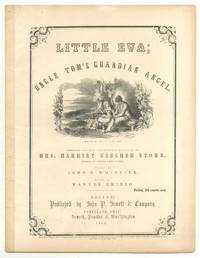
1852569579Boston: John P. Jewett & Company 1852. Softcover. Very Good. First edition. Black-and-white engraving by Baker & Smith after artist Hammatt Billings on the front wrapper. Folio. 4pp. Illustrated wrappers. External tape repair along the spine center leaves detached but present soiling and a dampstain to the rear wrapper not affecting the interior content still very good. The illustration depicts Eva and Tom reading the Bible in the arbor an image that captivated the public at the time spawning many commercial print reproductions as well as actors staging the scene for the production of photo cards. Jo-Ann Morgan of the Department of African American Studies at Western Illinois University writes "Among those initial six engravings Little Eva reading the Bible to Uncle Tom in the arbor was according to Billings' biographer James F. O'Gorman 'without doubt the most important image of the first edition.' Unlike the slave Madonna or praying supplicant there was no visual precedent for a grown black man in the prime of life cozied up with a tiny white girl alone out in nature. John P. Jewett & Company unknown
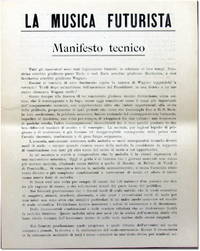
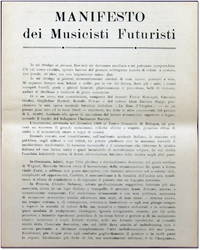
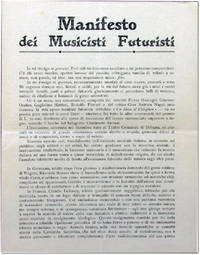
191126863Milan: Direzione del Movimento Futurista 1911. Single sheet folded once to make 4pp. Soft horizontal fold to middle else a nice example of this early Futurist music manifesto. The first musician to "surrender to the persuasion of promises and liberation" Pratella was courted early on by Marinetti to join his new movement that he hoped would breathe new life into Italian culture. Though not as nihilistic as Russolo's Art of Noises published three years later he still makes what at the time were revolutionary demands that musicians break from the traditional proclaiming in a later manifesto that" the new order of disorder should be created by destroying the ancient schemes." <br/><br/> Direzione del Movimento Futurista unknown
191026862Milan: Direzione del Movimento Futurista 1910. Single sheet folded once to make 4pp. Soft horizontal fold to middle else a nice example of this early Futurist manifesto the first on music. The first musician to "surrender to the persuasion of promises and liberation" Pratella was courted early on by Marinetti to join his new movement that he hoped would breathe new life into Italian culture. Though not as nihilistic as Russolo's Art of Noises published three years later he still makes what at the time were revolutionary demands that musicians break from the traditional proclaiming in a later manifesto that" the new order of disorder should be created by destroying the ancient schemes." <br/><br/> Direzione del Movimento Futurista unknown
191126861Milan: Direzione del Movimento Futurista 1911. Single sheet folded once to make 4pp. Soft horizontal fold to middle with a few tiny spots of loss to the rear else a very good example of this early Futurist manifesto the first on music. The first musician to "surrender to the persuasion of promises and liberation" Pratella was courted early on by Marinetti to join his new movement that he hoped would breathe new life into Italian culture. Though not as nihilistic as Russolo's Art of Noises published three years later he still makes what at the time were revolutionary demands that musicians break from the traditional proclaiming in a later manifesto that" the new order of disorder should be created by destroying the ancient schemes." <br /> <br /> Ref: Pontus Hulten. Futurism and Futurisms525-7; 544-5. <br/><br/> Direzione del Movimento Futurista unknown
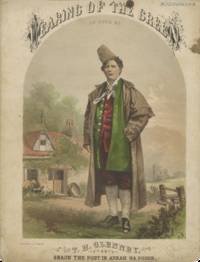
1865List3656Philadelphia: Chas. W. Trumpler 1865. 5 pp good condition / New York: H.B. Dodworth/T. Birch and Son 1865 5 pp good. Two folio sheet music pieces with hand-colored pictorial covers 13x10 and 14x11 inches. General age toning and scattered spotting one with a small tack hole at upper margin; good overall. A pair of Chicago-issued theatrical song sheets connected with Dion Boucicault’s popular Irish melodrama Arrah-na-Pogue first produced 1864 one of the most frequently staged Irish plays in America during the later nineteenth century. Boucicault incorporated his own version of the patriotic ballad “The Wearing of the Green†into the drama helping to popularize the song with theatre audiences in Britain and the United States. Each sheet bears a vivid hand-colored lithographic pictorial cover showing a performer in costume before a rustic Irish landscape. The first is “The Wearing of the Green As Sung by J. E. McDonough in ‘Arrah Na Pogue’†depicting McDonough full-length in stage dress with green scarf and hat ribbon. The second is “The Wearing of the Green As Sung by H. T. Glenney as ‘Shaun the Post’ in ‘Arrah Na Pogue’†likewise presenting the performer in costume; this example carries the imprint H. H. Hopkins at the upper right and retains a small tack hole at the top margin.<br /> <br /> “The Wearing of the Green†itself originated as a nationalist ballad associated with the Irish Rebellion of 1798 when supporters of the United Irishmen adopted the color green as a symbol of resistance to British rule. After the rebellion was suppressed wearing green clothing or shamrocks could mark a person as a rebel sympathizer and lead to arrest. The song lamented these persecutions and circulated widely in printed broadsides and songsters. Boucicault’s theatrical adaptation for Arrah-na-Pogue became the best-known nineteenth-century version ensuring the song’s continued popularity on both the Irish and American stage. Chas. W. Trumpler unknown
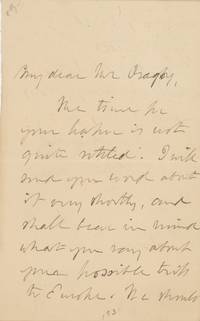
1880List1817Newport 1880. Single page with writing on both sides signed by Howe. Fine condition. Fine. A short but interesting note from Julia Ward Howe to Albert Bagby the Illinois-born musician who trained with Liszt in Germany and would eventually be a longtime host of “Mr. Bagby’s Musical Mornings†at the Waldorf-Astoria in New York where it was a fixture among the high society set. Bagby’s career as a host started after presenting a paper to the Newport Town and Country Club while Howe was president. After he presented his paper on Liszt at the club he was approached by Howe’s daughter Maude Howe Elliot about turning the paper into a lecture. This would end up being the catalyst for him to abandon performing and devote himself to lectures and after giving his first presentation on Liszt to a small audience in his Manhattan studio he began his regular series at the Waldorf-Astoria. <br /> <br /> The letter reads as follows:<br /> <br /> My dear Mr. Bagby <br /> <br /> The time for your paper is not quite settled. I will send you word about it very shortly and shall bear in mind what you say about your possible trip to Europe. We should be much disappointed to lose your lecture and I hope that we shall certainly hear you.<br /> <br /> Yours sincerely<br /> Julia W. Howe<br /> <br /> July 31st <br /> Newport R.I.<br /> <br /> An interesting note documenting an event that would be essential for Bagby’s career. unknown
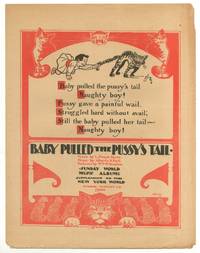
1900571772New York: New York World / Geo M. Hill Co 1900. Softcover. Near Fine. First New York World edition. Pictures by Wm. W. Denslow. Folio. One sheet folded to make four pages. Owner stamp in the bottom margin of the third page and light edgewear including a few small tears along the edges else near fine. For voice and piano. OCLC locates two holdings of this edition. New York World / Geo M. Hill Co unknown
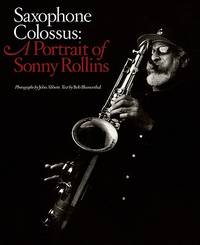
201026419NY: Abrams. Fine in Fine dust jacket. 2010. First Edition; First Printing. Hardcover. 978-0-8109-9615-1 . Signed by Rollins Blumenthal and Abbot on the title page. ; Small 4to 9" - 11" tall; 160 pages; Signed by Collection of Signatures . Abrams hardcover
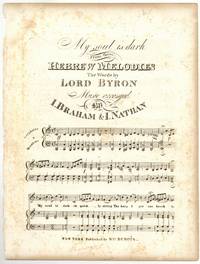
1818602018New York: Wm. Dubois 1818. Softcover. Very Good. Early American edition possibly first. Folio. Single bifolium making four pages. Foxing throughout notched and worn along the fold from once being bound within an album light dampstaining along the top corners of the front cover affecting throughout and a small tear on the foredge affecting both pages still a very good copy. For voice and piano. This piece is from a collaboration between Lord Byron and composer Isaac Nathan who initially studied to be a rabbi originally published as a collection of songs in 1815 under the title "Hebrew Melodies." Nathan claimed that the tunes were derived from ancient Jewish temple music though apparently this is largely untrue with most being derived from European folk songs that over time came to be used in synagogue services. The "I. Braham" credited above the music is actually a popular Jewish singer from the time John Braham whom Nathan allegedly convinced to lend his name to the project in exchange for half the profits. Once published the work caused a bit of a backlash for Byron due to the pronounced prejudice against the Jewish people in England with some reviewers criticizing Byron for working on the project Byron not being Jewish himself. OCLC locates only two holdings of this piece. Wm. Dubois unknown
1870009875Leipzig: E. W. Fritzsch 1870. Book. Very Good. Hardcover. First Edition. 8vo - over 7¾" - 9¾" tall. The first two years of this weekly publication 1870-1871 bound in two volumes original cloth spine over paper covered boards Very Good light rubbing to bindings 844 840 pages. With illustrations music and advertisements Jahrgang 1 was edited by Oscar Paul and E.W. Fritzsch; Jahrgang 2 and later years by E.W. Fritzsch alone. An important German music periodical for four decades. E. W. Fritzsch Hardcover
1916610830New York: The Dutch Treat Club 1916. Softcover. Very Good. Presumably the first edition. "Produced under the personal terribly direction of William Merrigan Daly." Quarto. 63pp. Stapled unprinted wrappers. Soiling and rubbing to the wrappers and bumping to the corners still a very good copy. Contains 13 numbers for voice and piano plus dialog. Performed at Delmonico's on Monday evening February 28 1916. The operetta's lively introduction states "The Dutch Treat Club on the occasion of its Tenth Annual Explosion presents this operetta of the Loose School. Believe us we had one hell of a time keeping the cast together until to-night! During rehearsals they kept dropping off over the telephone like flies!" The Dutch Treat Club is a New York social club for artists musicians and performers that remains active to this day. The cast for this performance included such figures as August Hutaf John Barnes Wells Howard Chandler Christy Herb Roth Rea Irvin Fontaine Fox and more. OCLC locates only three physical holdings of this piece. NB: The University of Toronto digitized their holding and it includes as a decorative half-title page an image of a painting by James Montgomery Flagg with the same title which according to the website artnet was supposedly painted in 1920 and did not include the title at the top as shown in the UT holding. This copy does not contain this image and it is unclear if it was originally intended to be included. The Dutch Treat Club unknown
019016Music Theatre Incorporated 0 Book. Very Good. Soft cover. Mimeographed sheets bradbound in red stiff paper wrappers. Top front and bottom rear wrapper tips missing small pieces missing from spine ends and one from the back cover. Play title and Mimeographing service name and address on front cover. Property of Music Theatre Incorporated with address and phone number on title page. A very nice copy of this scare play script. "The original Broadway production opened on May 13 1954 at the St. James Theatre and ran for 1063 performances with a brief stop at the Shubert Theatre at the end of the run. It was revived in 1973 and again in 2006 by The Roundabout Theatre Company. The original production produced by Frederick Brisson Robert E. Griffith and Harold S. Prince1 won a Tony Award for Best Musical." "This production is also noted for starting the career of Shirley MacLaine. A relative unknown at the time she was selected to understudy Carol Haney's role. Starting in late-May 1954 MacLaine filled the role for several months as Haney was out of commission with an injured ankle. Director/producer Hal B. Wallis was an audience member at one of MacLaine's performances and signed her as a contract player for Paramount Pictures.". Music Theatre Incorporated 0 Paperback
195923098Brighton Sussex UK: Amati Publishing. Fine in Very Good dust jacket. 1959-1969. First Edition; First Printing. Hardcover. The DJ of volume 3 is missing a large piece at the lower left front. Note that this does not include volume 6. ; Small 4to 9" - 11" tall . Amati Publishing hardcover
1963BOOKS055797ICopenhagen: Emil Hjorth & Sonner. Fine copy in the original black leather stamped in silver. 1963. 1st. leather. 4to 89 pp. Limited to 500 copies translated into English by Johanne Kastor Hansen . Emil Hjorth & Sonner hardcover
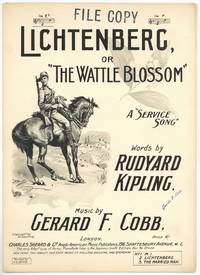
1904587851London: Charles Sheard & Co 1904. Softcover. Very Good. First edition. Folio. Two nested bifolia making eight pages. Composer's name stamp and "file copy" stamp on the front cover outer bifolium separating a bit at both ends of the fold light edgewear and toning a very good and complete copy. For voice and piano. Plate imprint "Lichenberg. E." The following note is printed above the music "The blossoms of the Australian Wattle Tree a species of Acacia emit a remarkably fragrant perfume more particularly after rain: the sudden recognition of this scent on an occasion during the Transvaal campaign awakens thoughts of 'Home sweet home' in the breast of an Australian Trooper." Gerard F. Cobb is primarily remembered for his musical settings to Kipling's words this perhaps being his last such composition as he passed away in March of the year it was published. This song is unrecorded by OCLC and appears equally scarce in the trade; in fact the only references we can find to the piece online are are The Kipling Society citing a record of it in Rudyard Kipling A Bibliographical Catalogue by James McGregor Stewart and a 2005 recording released by ABC Records-Australia on an album titled When the Empire Calls. A rare and intriguing piece. Charles Sheard & Co unknown
1855009868Paris: Adrien Le Clere et Cie 1855. Book. Very Good. Hardcover. SIGNED AND INSCRIBED BY AUTHOR. First Edition. 8vo - over 7¾" - 9¾" tall. Two volumes bound as one. Lambillotte's Esthetiqu du Chant Gregorien 1 preliminary leaf vi 418 pages frontispiece portrait facsimile folded table with Abbe Raillard's Memoire Sur La Restauration De Chant Gregorien Paris 1862 Librairie Catholique et Classique de Perisse Freres folded table 46 pages bound at rear with original wrappers and SCARCE SIGNED AND INSCRIBED BY AUTHOR at front wrapper -"A Monsieur Bellaquet Secretaire Gen. du Ministaire d l'Etat F. Raillard" the book being trimmed for binding causing partial loss of the signature.Both books bound as one in contemporary quarter leather over marbled boards gilt lettering at spine hand written label top corner front cover. Very Good scattered light toning edges of boards rubbed prior owner name in ink front end page. A significant refernce work for the study of Gregorian chant. Adrien Le Clere et Cie Hardcover
1838616818Boston: Parker & Ditson 1838. Softcover. Good. Sheet music. Folio. Two nested bifolia making eight pages. Outer bifolium notched and worn along the fold from once being bound within an album as a result the bifolia remain bound together dampstains along the edges of the front cover lightly affecting throughout light foxing along the margins throughout bookseller stamp on the front cover a complete but good only copy. For voice and piano. The front cover states "composed & especially dedicated to M.M. Noah Esq. of New York. As a slight token of grateful remembrance of early kindness to a stranger." According to the Smithsonian Art Museum "Mordecai Manuel Noah 1785-1851 was possibly the most influential Jewish figure in the United States during the early nineteenth century. He was a lawyer journalist playwright politician judge editor and surveyor. Parker & Ditson unknown
19882110502151103506Kondo shubbansha 1988. Soft Cover. Fine. Number of books: 3 Kondo shubbansha paperback
1952058640New York: Random House 1952. First Printing . Hardcover. Near Fine/No Jacket. 8vo - over 7¾" - 9¾" tall. Bennewitz John photos. 135pp.; HB beige w/red-photocover; rubbed w/spine&edges sunned; sml.stain; cleantight pgs. "A Random House Play" Hardback copy of revival presented at Broadhurst Theater NY Jan.3 1952. Signed by Vifienne Segal Vera Harold Lang Joey Helen Gallagher Gladys - Tony winner 3 b/w photos. <br/> <br/> Random House hardcover
1937005398Milano: G. Ricordi & C. Editori 1937. First edition. Wraps. Very Good. Scarce libretto of a strange Futurist one act opera with talking a tree Euphobia shrubs and airplanes among the characters some of which are actually human --aviators soldiers and natives -- even if they intone like actors in a Greek tragedy. This oddball propagandistic work more an oratorio than opera celebrates war "sweet war" aviation and territorial conquest -- the things that cast a spell on so many Futurists and which were the essence of Fascism. Three copies located on OCLC of this libretto brochure at Berkeley Harvard and one in Italy. There are copies of the printed music elsewhere. The work was first performed at the Maggio Musicale Fiorentino in 1937. 8vo. 20 by 13 cm. 23 pp. Dedicated to Mussolini. Pavolini like many adherents of the Futurist Movement came to embrace Fascism. In his case he had a brother who was a prominent member of the Fascist heirarchy. After the war Pavolini found success as a screenwriter. Age toning to the leaves. G. Ricordi & C. Editori unknown
1808053278Dedham Masschusetts: Printed for the Author 1808. 1st Edition . Leather Bound. Good. 8vo - over 7¾ - 9¾" tall. Oblong Octavo. Title Leaf 7-111 1 pages. Appears complete. Hardcover with an early full calf leather wrap sewn over the binding with connecting strings over the insides of the covers. The front flyleaf is cut along the top edge and the edges of the front flyleaf are browned from the leather. Early writing on the flyleaf reads "My Book" and a later pencil inscription reads "Miss A. W. Wood / Mass / 1882". The next leaf is the title page which is browned around the edges from the binding. The verso of the title page has a printed notice from the District of Massachusetts. The following leaf is the first page of the text with "The Meridian Harmony" at the top. The text is toned and has some foxing. The entirety of the book is scored music; some of the tunes have lyrics. The terminal leaf is paginated 111 on the recto and has the Index on the verso. The index is alphabetical and appears complete with the tunes listed from "Anglesea" to "Zion". Lacks the blank rear flyleaf. Rare. We find two copies on Worldcat. A sound copy. <br/> <br/> Printed for the Author hardcover
10056First Edition . Hardcover. Good. About 60 pieces of music bound into 2 folio volumes by the owner/collector Hattie Savage. One is still in its original binding; the other we have had rebound in new black textured cloth quite similar to the original with the original leather piece stamped with the owner's name pasted on the front cover. There are waterstains on the foreedge of many pieces in the rebound volume. The non-rebound volume has a waterstain on the front cover but none inside. It was bound professionally by J.G. Roberts & Co. of Boston and they provided an engraved Contents page which has the titles filled in by hand. The other volume has a cruder but still accurate contents page.Includes those marked with a have a lithograph on the cover: Dreaming of Home and Mother Ordway 1868 The Swamp Angel Wilder 1863 The Moon Is Shining Brightly Manahan/Turner 1865 If Your Foot Is Pretty Show It Bishop 1857 Our Way across the Sea Down by the River Side I Stray Morris/Thomas 1861 Tenting on the Old Camp Ground Kittredge 1864 My Mother's Kiss Is on My Brow Smith/Catlin 1865 The Maiden's Prayer Adams/Badarzewska 1860 There's Beauty Everywhere Laurence 1859 Oh! Leave Me Not My Darling One Holder 1861 Tramp! Tramp! Tramp! Root 1864 In Peace Again Turner 1865 Wrap the Flag around Me Boys! & The Soldier's Dream Song Taylor 1862 Sally Come Up Buckley 1862 Oh! My Heart Goes Pit a Pat 1865 The Battle-Cry of Freedom Root 1862 Just after the Battle Root 1863 Viva l'America Millard 1859 We Are Coming Home Tomorrow Wilder 1865 Yes I Would the War Were Over Hawthorne 1863 Evangeline Hays 1865 The War Is Nearly Over Smith/Buckley 1863 Comrades Lay Me Gently Down Smith/Catlin 1865 Isabella and Her Gingham Umbrella Clifton 1864 Bonnie Allene Bishop 1859 Tapioca Warden 1864 Whispering Hope Keller 1864 Polly Perkins of Abington Green Clifton 1864 Come Where My Love Lies Dreaming Foster arr. Dressler 1862 Gen. Gilmore's Grand March Baumbach 1863 The Printers Polka Parish 1863 Faust Soldiers Chorus Richards n.d. Faust Grand March Lanner n.d. Golden Robin Polka Bousquet 1863 Waltz from Faust Baumbach 1864 Woodland Waltz Metcalf 1857 Battle of Prague Kotzwara n.d. The Monastery Richards n.d. Caledonian Potpourri Tappan 1862 Maiden's Prayer arr. Spindler 1858 Freddie March Muller 1863 The Army Grand March Grobe 1861 Gen. Butler's Grand March Hamm 1863 La Favorita Valse Fetherston 1864 Leonora W.H.F. n.d. Marching Along Burditt 1862 Battle of Waterloo Anderson n.d. General Banks Grand March Mack 1862 Silvery Shower Baumbach 1854 The Sultan's Polka d'Albert n.d. states 75th edition! Tinney's New Lancers Swiss Air Czerny n.d. Echo of the Valley Fowler 1856 The Feast of Roses Hervey n.d. Turkish March Mozart n.d. Grand Union March on the Potomac Pickens 1861 Gertrude Dietrich 1863 Moonlight Polka Baumbach 1863 Hattie Jordan 1863 41st Regiment March Bendelari 1862 and Lightfoot Spindler n.d. Most were bound in with their covers; a few were not. Perhaps half of these were published by Oliver Ditson Boston and a smaller number by Firth of New York or Firth and Pond. This set will require extra postage; please contact us with any questions. <br/> <br/> hardcover
192857175E-002: Edition Russe De Musique. Very Good. 1928. Hardcover. Hardcover. Folio. Edition Russe de Musique. 1928. 94 pgs. For voice and piano. Signed by Arthur Hackett Tenor; Margaret Mattenauer Mezzo-Soprano& Payl Leyssac and Serge Koussewitzky The Conductor and one other person I have yet to identify. Laid in material playbill from the first US performance laid in. Bound in cloth with gilt titles present to the spine. Boards have wear present to the extremities of the boards corners and extremities bumped and rubbed; stain present to the rear board Previous owner's note stating that this copy had been signed at the first US performance of this opera First Presentation in America with the Harvard Glee Club at the Boston Symphony Orchestra on 2/24/1928 & 2/25/1928. Stamp of Schirmer music present to the FFEP and the titel page. Text is clean and free of marks. Binding tight and solid. Oedipus rex is an "Opera-oratorio after Sophocles" by Igor Stravinsky scored for orchestra speaker soloists and male chorus. The libretto based on Sophocles's tragedy was written by Jean Cocteau in French and then translated by Abbé Jean Daniélou into Latin; the narration however is performed in the language of the audience. E-133 . Edition Russe De Musique hardcover
194920409Lucerne: Triton Verla 1949. First Edition. Hardcover. Paper pastedown on boards and spine. Very Good. Fritz Krumenacher -- Bühnenbilder und Kostüme von Fritz Krumenacher. An incredibly charming and most original children's "play" depicting the eternal battle between field and house mice told with verse and pictorially through illustrations revealed on the stage or what is also the window of the peepshow with each pinwheel containing six scenes each numbered. One is to look at this piece of quasi-theater as presenting a six act play with six scenes each the scene described with four lines of verse in the poetic text underneath the pinwheel's window. Also this is a truly scarce book with OCLC First Search showing a single institutional holding this one in Switzerland where the book had been published in the early post-war period. 8vo. 25 by 18.5 cm. Unpaginated seven leaves with three leaves with pinwheels on both sides for a total of six pinwheels technically one might count the pinwheels as more than a single leaf but we do not. After title thin paper leaf alternates with pinwheel leaf. Cover stained a bit. Paper pastedown shipped and rubbed mostly along the spine. Some scattered foxing and soiling within. All the pinwheels are functional. Triton Verla hardcover
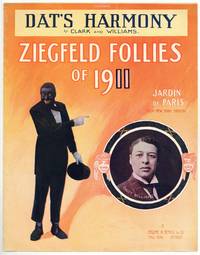
1911588772New York: Jerome H. Remick 1911. Softcover. Near Fine. Stated "Operatic Edition" possibly first thus. Folio. Originally a single bifolium with a single sheet insert making six pages. The previous owner has very skillfully sewn the insert into the bifolium some light rubbing to the exterior else near fine. For voice and piano written in dialect. Plate imprint "Dat's Harmony 3." Composer and performer Bert Williams appears on the front cover both with blackface and without. Williams was a Bahaman-born American singer and performer and was one of the best selling Black recording artists prior to 1920. A Black performer wearing blackface was not an uncommon sight at the time in an article on the subject for JSTOR Daily Dorothy Berry cites historian James Dormon explaining that these performers "were 'Blacks playing whites playing Blacks' but that the performer’s racial identity convinced audiences and critics that they represented the reality of Blackness and that the reality was the 'cn'" a complication that illustrates the proverbial tightrope Black performers were forced to navigate when trying to sell entertainment to white audiences while also portraying their own unique experiences. The choice to present Williams on the cover twice is a troubling one even more so when one notices how fair Williams' complexion is made to appear in the portrait photograph and that his blackface character seems to be pointing at him both are upsetting examples of the colorism present in show business at the time. This is all punctuated with the equally troubling choice to include two smiling caricatures of Native Americans that in no way connects to the lyrics. We know of a variant cover in which the image of Williams in blackface is replaced with an illustration of a female jester who appears to be white holding a mirror in one hand and a marotte in the other though we have no knowledge of any precedence. A striking and seemingly uncommon piece. Jerome H. Remick unknown