8 829 résultats
Schwartz Senstad, SusanIn Pristine Condition. unknown
ria9781848722262_inpHardcover. New. New Book; Fast Shipping from UK; Not signed; Not First Edition; Are we born selfish or primed to help others Does stress make people more antisocial Can we ever be genuinely altruistic This book explores some of the dilemmas at the heart of being human. Integrating cutting edge studies with in-de hardcover

1930254918Anton Böhm & Sohn Augsburg 1930. Hardcover Leder mit Leinenrücken und -ecken und Goldprägung und Lesebändchen 5. Auflage Zustand: Rücken Ecken Kanten bestoßen. Manche Seiten sind geklebt. Anton Böhm & Sohn, Augsburg, hardcover
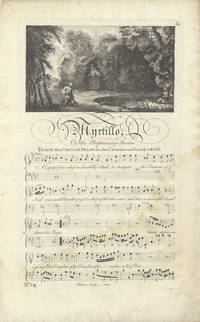
174036706London 1740. Unbound. Very Good. 4 leaves with large elaborate vignettes to heads illustrating the song with music and text below set for voice and figured bass. Ca. 326 x 200 mm. 12.75" x 7.85" plate mark; ca. 392 x 247 mm. 15.45" x 9.75" sheet size.<br /> <br /> Slightly worn; minor browning to edges; minor soiling and dampstaining; inner edges slightly frayed; small tears to edges. From the second edition of Bickham's monumental work first published in 1737-1739. BUC p. 107. RISM BII p. 245. <br /> <br /> "Bickham 1706-1771 was principally famous in music circles for his two illustrated folio volumes The Musical Entertainer first issued in fortnightly parts each containing four plates from January 1737 to December 1739. The 200 plates are songs headed and surrounded with pictorial embellishments illustrative of the song . and engraved in the style of and even copied directly from Gravelot and Watteau. This work was the first of its kind to be published in England and quickly produced imitators such as Lampe's British Melody engraved by Benjamin Cole." Frank Kidson et al. in Grove Music Online. <br /> <br /> A charming group of engravings.<br /> <br /> The Musical Entertainer is considered one of the finest 18th century illustrated books. Complete copies of this monumental work are exceptionally rare. unknown
192476385Berkeley: V.p. 1924-1932. Seven Indian Songs from the Yosemite Valley. Berkeley: National Society of Colonial Dames; 1924. First edition. Folio 9 x 12 inches. 18 2 pp. Publisher's printed tan wrappers.Five Songs from the Tundras: An Eskimo Song Cycle. Berkeley: D. N. Lehmer 1932. Folio 9 x 12 inches. 910 2 pp. Publisher's printed white wrappers.Indian Songs from the Mesas. Berkeley: D. N. Lehmer 1932. Folio 9 x 12 inches. 1314 2 pp. Publisher's printed white wrappers.Derrick Norman Lehman was a multifaceted man of great learning. Lehmer was awarded his Ph.D. in mathematics in 1900 from the University of Chicago for his thesis Asymptotic Evaluation of Certain Totient-Sums. He went on to publish a number of important papers in the field of advanced mathematics the most famous of which was his "Factor Stencils" that was published in 1929. But oddly and like many mathematicians he had a real penchant for writing music. Over a period of years he published many collections of songs which he composed including Seven Indian Songs from the Yosemite Valley 1924 Down the stream and other Indian songs 1927 Indian camp-fire songs 1930 Indian songs from the Northland 1931 Fingers of the sun and other Indian songs from the Sierra slopes 1931 Songs from the Mesas 1932 Songs from the Tundras 1932 The Ballad of San Francisco Bay 1937 and Five Little songs 1937. These are not transciptions of actual songs but Lehmer's interpretations. V.p. unknown
196831757New York: Leo Feist 1968. 4 pp. 1 vols. 4to. Pictorial self wrappers with photo of King on upper cover. Very good. 4 pp. 1 vols. 4to. Rare: OCLC locates only the Yale and the British Library copies. This example bears a gift inscription to Clarence L. Holte 1909-1993 the prominent African-American bibliophile and publisher of "The Basic Afro-American Reprint Library Leo Feist unknown
193384259Washington D.C.: Published by Elder Lightfoot Michaux 1933. Unbound. Very Good. Sheet music. One quarto leaf folded to make four pages. Measuring 6" x 9" closed. Printed in blue. Horizontal crease light old folds and modest additional wear and soil very good. The theme song of Michaux's Church of God dedicated here to Franklin D. Roosevelt who is pictured on the final page. Evangelist Michaux was known for his gospel singing prowess and was something of a television pioneer hosting a religious television show from the nation's capital in 1948-49. While Ezra Pound was incarcerated in St. Elizabeth's Hospital he included a reference to Lightfoot in his Canto 95. OCLC locates only two copies of a 1932 edition with no mention of the FDR content. Published by Elder Lightfoot Michaux unknown
1915603092Atlantic City NJ: The Trader Elliott Co 1915. Softcover. Good. First edition. Quarto. Single bifolium with a single-sheet-insert making six pages. Owner name on the front cover a large tear to the insert but the music remains legible bumping to the corners and soiling and rubbing to the exterior a complete but good only copy. For voice and piano featuring a vocal quartet version as well for two tenors baritone and bass. Plate imprint "'Eleanor' - 3." The back cover features a sample of "Meet Me at the Frisco Fair Tango" also by Trader and Elliott with the somewhat humorous note "For sale where you bought this." The front cover states that this song is "based upon the poem of the same name by Edgar Allen Poe" but there is no poem by Poe with such a title there is the poem "Lenore" 1843 originally published as “A Pæan†in 1831 and the short story "Eleanora" 1842 though the lyrics to this song do not match up well with either. If we were to guess the lyrics here are inspired by the idyllic scenes that open "Eleanora" describing our lovers dwelling happily in "The Valley of the Many-Colored Grass" which according to this song appear to exist "deep in the hills of old Tennessee." A novel piece with a unique albeit ambiguous association to the writing of Edgar Allen Poe. OCLC locates only a single holding and it appears to be equally scarce in the trade. The Trader Elliott Co unknown
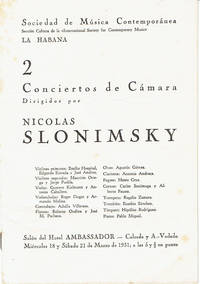
193131483Havana Cuba: Sociedad de Musica Contemporanea 1931. 1931. Very good. - Octavo. 8-page program printed on cream stock including 6 pages of notes on the music by the conductor. The program has been folded twice & there is a very light diagonal crease to each page. There is some light foxing to the margins. Very good. <p>The program for an important pair of concerts conducted in Havana Cuba in 1931 by Russian-born conductor Nicolas Slonimsky. The program includes a 1-page bio of Slonimsky and six pages of his program notes translated into Spanish. The first concert includes Carl Ruggles' "Men and Mountains" and Charles Ives' "Three Places in New England" as well as works by Mozart Arthur Honegger and Ernest Bloch. The second presents Henry Cowell's "Sinfonietta" Amadeo Roldan's "Ritmica" Number 4 Alejandro Caturla's "Bende" and music by Bach Prokofieff and Bartok. The text is in Spanish.<p>Rare. Havana, Cuba: Sociedad de Musica Contemporanea, 1931. unknown
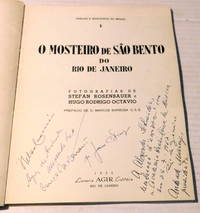
1955100045<p>Rio de Janeiro Brazil: Livraria Agir Editora 1955. 1955. Very good. - Quarto 11-1/2 inches high by 9 inches wide. Softcover bound in color pictorial wraps. The covers are lightly soiled and the corners creased. The head of the spine is lightly chipped and there is a small short tear to the lower inner edge of the front cover & spine. 70 unnumbered pages profusely illustrated in color and black & white from photographs of the Monastary of Saint Benedict by Stefan Rosenbauer & Hugo Rodrigo Octavio. Very good.</p><p>A wonderful photographic record of the Monastery of Saint Benedict in Rio de Janeiro.</p><p>Inscribed & signed on April 25 1967 to the classical violinist Alexander Schneider by the musicologist Andrade Muricy and also signed by the composer Renzo Massarani the composer & conductor Father Jaime Cavalcanti Diniz and 3 others that we have not been able to decipher.</p><p>In the "New Grove Dictionary of Music and Musicians" Michael Steinberg describes the Lithuanian-American Jewish classical violinist Alexander Schneider 1908-1993 as "one of the most unquenchably energetic figures in the public musical life of the USA". Schneider dedicated his life to nurturing chamber music and musicians.</p><p>Andrade Muricy 1895-1984 was a musicologist and author of books on Villa-Lobos and Carlos Gomes. He signs here as President of the "Academia Brasileira de Musica".</p><p>Renzo Massarani 1898-1975 was an Italian-born Jewish composer whose works were banned during the rise of fascism in Italy. He emigrated to Brazil in 1939 becoming a citizen in 1945.</p><p>Father Jaime Cavalcanti Diniz 1924-1989 was a composer & conductor from the Brazilian state of Pernambuco. He was a founder and director of the "Sociedade Brasileira de Musicologia".</p><p>The text is in Portuguese.</p> Rio de Janeiro, Brazil: Livraria Agir Editora, 1955. paperback
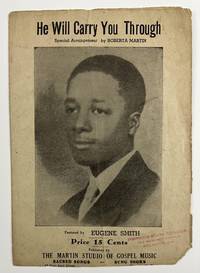
19443560Chicago: Martin Studio of Music 1944. Good. 4pp. on a single folded sheet. Heavy vertical crease moderate soiling and staining a few short closed tears bottom edge of first leaf trimmed close affecting a few words in the address of the publisher. Rare sheet music for the hymn "He Will Carry You through" by R.H. Palmer as arranged by legendary gospel music publisher Roberta Martin owner of Chicago's Martin Studio of Music. The front cover pictures Eugene Smith who apparently performed the song regularly and to some renown. The inner two pages print the sheet music and the final leaf prints a catalogue of Martin's other available sheet music. A much-condensed version of Roberta Martin's biography on the Encyclopedia of Arkansas reads as follows:<br /> <br /> "Roberta Evelyn Winston Martin Austin was one of the most significant figures during gospel music’s golden age 1945-1960. A performer and publisher she reached iconic status in Chicago Illinois where she influenced numerous artists such as Alex Bradford James Cleveland and Albertina Walker and had an impact on an entire industry with her innovation and business acumen. In 1932 Martin joined Thomas Dorsey and Theodore Frye’s Chicago-based Young People’s Choir and was eventually employed as the choir’s pianist. A 1933 concert featuring the Bertha Wise Quartet led Martin to develop a new style of her own. That same year Martin and Frye founded the Martin-Frye Quartet. Later renamed the Roberta Martin Singers the group’s early members included Robert Anderson James Lawrence Norsalus McKissick Eugene Smith Romance Watson and Willie Webb. Martin accompanied the group as pianist but also sang the occasional solo. The Roberta Martin Singers were a hit in the 1940s and 1950s recording for the Apollo and Savoy record labels and earning several gold records. In the early 1940s female voices -- namely those of Bessie Folk and Delois Barrett -- were added. In 1939 Martin established her Roberta Martin Studio of Music a Chicago-based gospel music publishing house which distributed her compositions as well as those of James Cleveland Dorothy Norwood and Alex Bradford. Martin was honored posthumously by the Smithsonian Institution in 1981 with a colloquium and by the U.S. Postal Service on July 15 1998 with a commemorative postage stamp."<br /> <br /> OCLC records three copies at Yale Broward County Libraries and the Chicago Public Library. Martin Studio of Music unknown
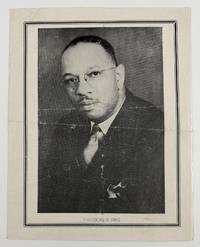
19494586Chicago: Theodore R. Frye 1949. Very good. 3pp. on a single folded sheet. Old folds and creases minor wear. A rare advertising circular issued by Theodore R. Frye Publishers of Chicago touted here as "America's Favorite and Best Seller in Gospel Song Books." The main advertisement is for the three volumes of "Frye's Echoes of the Baptist Music Convention" that are "Just Off the Press!" with a long description of their contents. The work also includes a price list of ten other Frye publications and a short note on a book called Improving the Music in the Church by Kenneth Morris. The front cover is almost entirely taken up with a portrait of Frye. Theodore R. Frye was an important figure in the history and development of gospel music. He helped found the National Convention of Gospel Choirs and Choruses along with Thomas A. Dorsey and helped launch the career of Mahalia Jackson. We could locate no other copies of this music advertising circular. Theodore R. Frye unknown
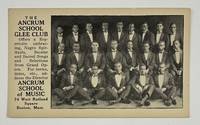
19205984N.p. probably Boston 1920. Very good. Photographically-illustrated trade card on stiff cardstock 3.25 x 5.5 inches. Minor wear and toning. A handsome promotional card for the Ancrum School Glee Club an African-American singing group based in Boston. The card is comprised of a photographic image of twenty-two tuxedoed young African American males covering about three-fourths of the space with printed text at left. Estelle Ancrum Forster founded the Ancrum School of Music at 74 West Rutland Square in Boston in 1905 and advertised in a few editions of The Negro Motorist's Green Book as late as 1941. The school appears to have served African American students. Forster was according to the sixth edition of Who's Who in Colored America a graduate of the New England Conservatory of Music. unknown
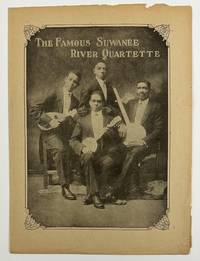
19203089Philadelphia 1920. Good. 4pp. on a single folded sheet. Quarto. Tanned and somewhat brittle minor edge chipping some short closed edge tears. A seemingly unrecorded promotional touting the talents of the now-obscure Famous Suwanee River Quartette. The group formed in Cleveland Ohio around 1910 and led by John Gantt traveled extensively for almost fifteen years and became especially well-known for their rendition of "Old Black Joe" which is mentioned here. The present pamphlet a most ephemeral item advertises the group with press releases reviews "recent press comments" descriptions of the musical strengths of Gantt as well as the other performers as a whole. The text claims that "Mr. Gantt is entitled to supremacy in this field.he is a master interpreter of the songs melodies and folk lore of the Southern Negro." The work is illustrated with photographs of the musicians with their instruments on both the front cover and the internal two-page spread. No copies in OCLC. unknown
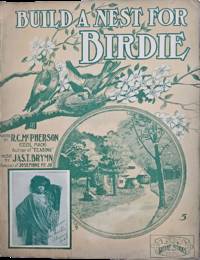
1906List3634New York City: The Gotham-Attucks Music Company 1906. Sheet music measuring 10 ½ x 13 ½ inches. 6 pp including covers. Wrinkling and small tears and chips to bottom margin some wrinkling to top right. Manuscript pencil “H Williams†on cover erased. Very good to excellent. Sheet music for “Build a Nest for Birdie†with music by James Tim Brymn 1881–1946 and lyrics by Richard C. McPherson 1873–1944 better known as Cecil Mack prominently featuring an inset photographic portrait of singer dancer and choreographer Ada Overton Walker 1880–1914 widely billed as the “Queen of the Cakewalk.†Walker a central figure of early twentieth-century African American musical theatre was closely associated with the Williams and Walker company and appeared in landmark productions including In Dahomey 1903 Abyssinia 1906 and Bandanna Land 1908; she frequently introduced new songs through stage performance. Brymn and Mack were frequent collaborators producing popular songs such as “Good Morning Carrie†1901 “Josephine My Jo†1902 and “Please Go ‘Way and Let Me Sleep†1902. Mack an important lyricist and entrepreneur within early Black commercial music networks co-founded the Gotham Music Company with composer Will Marion Cook; in 1905 the firm merged with the Attucks Music Company to form Gotham-Attucks one of the most significant African American–controlled publishing enterprises of the era. The company played a key role in promoting Black composers performers and theatrical material at a time when mainstream publishing houses often marginalized African American creators issuing titles such as Bert Williams and Alex Rogers’ “Nobody†1905 and Cecil Mack Lew Brown and Ford Dabney’s “That’s Why They Call Me Shine†1910. OCLC locates six institutional holdings. The Gotham-Attucks Music Company unknown
186851793Detroit: Published by C.J. Whitney No. 187 Jefferson Ave. Calvert Lithograph Co. 1868. Folio. 9.75 x 14.25 in. printed colour chromolithograph printer’s proof for sheet music printed border & wide margin minor dustsoiling creasing upper fore-edge some minor offsetting from old glue marks on verso still a VG- exemplar. First edition thus of this very rare and early example of colour lithography by the famed Calvert Co. in Detroit. McChesney was a popular songwriter after the Civil War with a number incorporating colour lithograph images including I will kiss your tears away 1871 Grace with the golden hair 1871 and Kiss papa good night 1866. The Calvert Lithograph Company was founded in 1863 by Thomas Calvert and by the 1870s had become one of the largest lithographers in the U.S. and later by the 1890s employing over 300 employees. Published by C.J. Whitney, No. 187 Jefferson Ave., Calvert Lithograph Co., unknown
1958List3652New York: Famous Music Corp 1958. Folio sheet music 4 pp. including cover. Fine copy. The surprisingly uncommon sheet music for the theme song from the cult science-fiction horror film The Blob 1958 issued the year of the film’s release. The music was composed by the young Burt Bacharach with lyrics by Mack David and the song was recorded by the vocal group The Five Blobs as the film’s title theme. Unlike the ominous orchestral themes typical of horror films of the period the song presents the story with playful novelty humor warning listeners to “Beware of the Blob†as the amorphous creature descends on a small Pennsylvania town. The film itself produced by Paramount Pictures and starring Steve McQueen in one of his earliest leading roles became a drive-in theater sensation and later a staple of late-night television. Its distinctive theme song with Bacharach’s catchy melody and tongue-in-cheek lyrics helped establish the film’s lasting cult reputation.<br /> <br /> An appealing example of mid-century movie tie-in sheet music associated with one of the best-known science-fiction horror films of the 1950s. Scarily uncommon in OCLC with only two copies held at BYU and University of North Texas. Famous Music Corp unknown
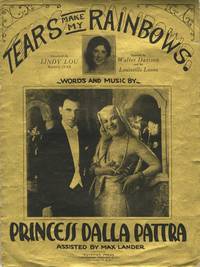
1932List3665Chicago Illinois: Egyptian Press 1932. Folio 5 pp. Wraps torn at seam slightly musty odor good condition. An unrecorded composition by a woman who travelled through the midwest claiming to be a descendant of Cleopatra using the name Princess Dalla Pattra. The details of the princess are murky as she disappears from newspaper records after 1930 when she admitted in court to using a manager to stage a publicity stunt in St. Louis.1 In her hearing she also admitted that she had been arrested for embezzlement in San Francisco in 1920. Two years later rather inexplicably this songsheet was published in collaboration with a Max Lander who according to patent records was English. <br /> <br /> The introduction to the song reads: “Hear the desert winds shriek and the tom-toms in the distance thrilling with the weird undertone of the desert night then the calm as the Royal Egyptian Maiden sings her love song to her desert prince.†We find no record of the composition in OCLC or anywhere else or of the princess in newspapers after her 1930 court appearance with the only findable record of her continued impersonation a patent registered in 19312 and this song sheet. <br /> <br /> 1 “St. Louis Wonders if it Got a Fooling†Kirksville Daily Express and Kirksville Daily News April 6 1930.<br /> 2 “Only to be with you just for a day†Catalog of Copyright Entries Part 3: Musical Compositions Library of Congress Copyright Office 1932 22760 accessed at ​​https://archive.org/details/bub_gb_ZS5jAAAAIAAJ/page/1165/. Egyptian Press unknown
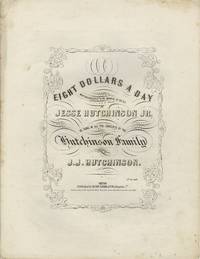
1848List3669Boston Massachusetts: Olivery Ditson 1848. Folio 14 x 10 ½ inches 5 pp. Slight splitting to covers contents fine very good plus overall. The sheet for the anti-politician polemic “Eight Dollars a Day" which was apparently a crowd favorite at the Hutchinson Family’s performances. The song lambastes the political class and its waste insinuating among other things that the politicians were spending their bloated salary on alcohol: “A flaming speech is made by one when the call is yea or nay But all are agreed with the question comes of Eight dollars a day.†The song was written in 1848 early in the Hutchinson Family’s period moving toward social activism and four years after their most famous abolition-themed compositions.1 Judging by the twelve copies held at libraries this was probably one of the better selling titles in their repertoire from the time period. <br /> <br /> 1 Philip D. Jordan “The Hutchinson Family in the Story of American Music†Minnesota History 22 no. 2 1941: 113–32. Olivery Ditson unknown
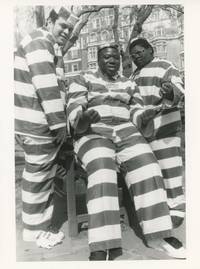
1985List2737Providence Rhode Island 1985. Approximately 5 x 7 inches. Very good contrast; overall near fine. With stamp on verso attributing photo to Peter Mountain and London Features International Ltd. Near fine. Promotional photograph for the hip-hop trio The Fat Boys; from left to right: Mark “Prince Markie Dee†Morales 1968–2021 Damon “Kool Rock-Ski†Wimbley b. 1966 and Darren “Buff Love†Robinson 1967–1995. The Fat Boys were a hip-hop group formed in Brooklyn New York in the 1980s. They are especially known for their contributions to modern beatboxing and their humorous lyrics. This photograph which shows the Boys in “jailhouse†costumes in front of a row of apartment buildings was probably taken by unit stills photographer Peter Mountain. unknown
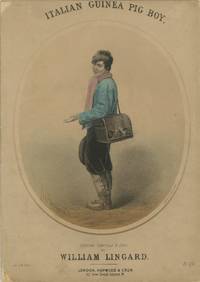
List3684Folio 9 ½ x 13 inches 5 pp. Margins trimmed quite tight to title with some loss to publisher information on rear cover small chips else near fine with the hand colored lithographic cover by H.C. Maguire in fine condition. Near Fine. An interesting piece of sheet music perhaps shedding light on the term “guinea†as it applies to Italians which though it originated in Europe migrated to the United States. Lingard’s song begins “I’m poor Italian guinea pig boy Straight from Florence I come with my stock.†The song was anthologized later in Lingard songsters. The song is proof that the term was being used in performance and theater circles before the mass arrival of Italians in the United States. “Guinea†was also widely used to describe people of dark complexion during the period stemming from the Guinea region of West Africa. With an attractive lithographic cover of a cheerful enough looking boy extending his hand. We find two copies of this sheet at Oxford and the British Library with none held in the United States. unknown
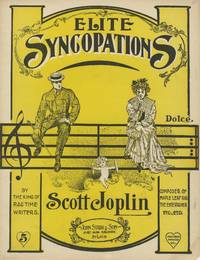
1902List3686St. Louis: John Stark & Son 1902. Large-format folio sheet music for piano solo. Trimmed to 9¼ x 12 inches. Light edge wear with small chips to lower corner approx. ¼ inch else very good; a bright and attractive example. Very good. First edition of one of Scott Joplin’s classic ragtime compositions issued during his most productive period with the St. Louis publisher John Stark. Joplin 1868–1917 widely known as the “King of Ragtime†helped establish ragtime as a sophisticated form of American popular music through works such as “Maple Leaf Rag†“The Entertainer†and “Elite Syncopations.†As Joplin himself insisted when defending the genre from critics “Syncopations are no indication of light or trashy music†a remark reflecting his ambition to elevate ragtime compositions such as this into carefully structured piano works. The pictorial cover engraved by Fred Graf of St. Louis shows a fashionable couple seated upon a musical staff while a cherub below plays the cymbals. John Stark & Son unknown
191934793Washington DC: Navy Department Commission on Training Camp Activities 1919. First Edition. Oblong 12mo 10x13.5cm.; publisher's dark blue staple-bound card wrappers; 298pp.; chiefly musical scores two full-page photographic illus. linocuts by John Held throughout. A hint of toning to wrapper extremities else Very Good to Near Fine. Collection of patriotic songs with illustrations by a young John Held signed in image either "JH" or "J. Held" but otherwise unattributed to him. The noted Jazz Age cartoonist had already had work published in Vanity Fair though after the United States entered World War I he worked for Naval Intelligence in Central America as an illustrator and cartographer. Navy Department Commission on Training Camp Activities unknown
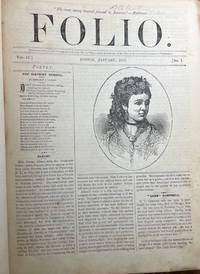
187536045Boston: White Smith & Company 1875. First Edition. Hardcover. Fair. Small folio. 12" tall. Two volumes in one. Volume 12 January to June: 234 pages. Volume 13 July to December: 234 pages 2. Brownish marbled paper covered boards with leather corners and spine. Scuffs and scratches to the marbled paper covered boards. Leather is dry cracked scuffed. Large chip head of the spine. Board edges joints and corners are rubbed and scuffed. Several of the songs are creased with closed edge tears some small edge chips and some repaired tears. Large closed tear on pages 3 and 4 and pages 137 and 138 no loss of content. Light to moderate toning to the contents with some light damp stains towards the back. Fair. <br /> <br /> Contents include several music scores advertisements and short articles. One article with a nice drawn portrait records that Blind Tom has performed many times at Music Hall. Other interesting contributions includes an article on the Fiske Singers and Slave Songs of the South. Volume in fair condition only. White, Smith & Company hardcover
191113095New York: The American Indian League 1911. 8pp. Original printed wrappers stapled. Minor edge wear short closed edge tear some sunning to edges. Internally clean. Very good. A stated second edition of this rare work collecting eight Native American songs emanating from a variety of tribes. The lyrics have been translated into English from original songs from the Chippewa Omaha Arapaho Navajo and Ojibway. The work was prepared by Reverend William Brewster Humphrey who provides an introduction which opens "The discovery that the North American Indians had anything that could be classed as music is of very recent date hardly more than thirty years ago. Only within the last two or three years have these songs attracted public attention but now the demand for them is rapidly increasing. He provides additional background on the music and credits some notable musicologists for their work in collecting Native American songs. Humphrey also mentions that another pamphlet published by the American Indian League prints an address entitled Indians Use of Song which "tells the stories of the songs and with them makes an interesting one hour program." Some titles of the present songs include "Manitou Listens to Me" "Song of the Leader" "The Canoeist's Love Song" and "Death Song." A rare work though an exact institutional count of copies held is difficult given the only record in OCLC reports digital copies. The American Indian League unknown