DELANNOY (Marcel). Lettre manuscrite d'une page et demie, datée 5 Avril 1955 (28 lignes).Livre Rare Book

77 892 résultats
15428
2007133168Stuttgart. März 2007. 150 Seiten. Mit zahlreichen teils farbig faks. Abbildungen und einer Musik-CD als Beilage. Illustrierte Originalbroschur. (Geringe Gebrauchsspuren). 30x21 cm
Firenze, 2012; br., pp. 362, ill., cm 17x24.
200734813-ym1047Berlin: mbv 2007. 3 ungezählte Blatt und 252 Seiten. Original Karton (gering bestoßen, sonst sehr gutes und absolut sauberes Exemplar). Gr.8°.
RO30161506. NON DATE. In-12. Broché. Bon état, Couv. convenable, Dos satisfaisant, Intérieur frais. 1 album contenant 2 disques audio 33 tours - pochette en bon état. . . . Classification : 410-33 Tours
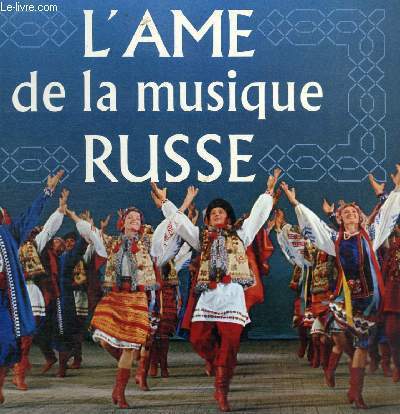
RO30161524. NON DATE. In-12. Broché. Bon état, Couv. convenable, Dos satisfaisant, Intérieur frais. 1 disque audio 33 tours - pochette en bon état. . . . Classification : 410-33 Tours
1985RO30161540. 1985. In-12. Broché. Bon état, Couv. convenable, Dos satisfaisant, Intérieur frais. 1 disque audio 33 tours - pochette en bon état. . . . Classification : 410-33 Tours
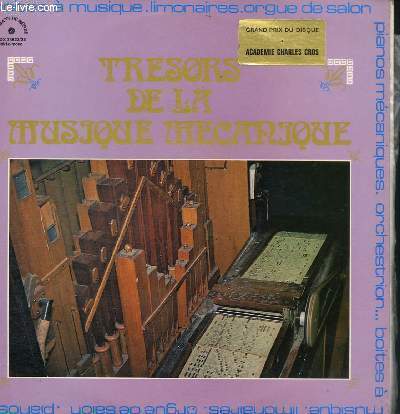
R130005274"RCA. non daté. In-12. Broché. Bon état, Couv. convenable, Dos satisfaisant, Intérieur frais. Pochette en couleurs, fabriqués en France pour sélection du ""READER'S DIGEST"". Coffret.. . . . Classification : 410-33 Tours"
RO30336022Connaissance de la musique. Non daté. In-12. En feuillets. Bon état, Livré sans Couverture, Dos satisfaisant, Intérieur frais. 2 pages recto verso.. . . . Classification Dewey : 780-Musique
R130005181LE CHANT DU MONDE. non daté. In-12. Broché. Bon état, Couv. convenable, Dos satisfaisant, Intérieur frais. Pochette en couleurs, biographie de FEAX HEREWT et de Y. & D.ANEZO BOUILHOL à l'intérieur de la pochette. Quelques photo en noir et blanc.. . . . Classification : 410-33 Tours
1966RO30316077Arthaud. 1966. In-8. Broché. Bon état, Couv. convenable, Dos satisfaisant, Intérieur frais. 280 pages. Couverture contrepliée. Ex-libris à l'encre en page de garde et de faux-titre.. . . . Classification Dewey : 780-Musique
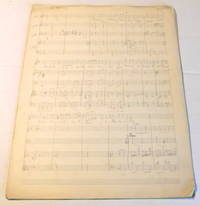
Folio (ca. 275 x 327 mm). 11, (5), 2 pp. In ink and pencil on staved paper with 6 systems of 2 staves, as well as 24 staves respectively. In contemporary red wrappers with handwritten cover-title. Unpublished manuscript of the piano cycle comprising three compositions titled "Défilé" (marked "Modéré, mais bien cadencé"), "Soir" (marked "Lent"), and "Poursuite" (marked "Vif"). The first two went on to be arranged for harmonic orchestra in 1935 and 1936, and were subsequently published under the title "Soir et Défilé" in 1937 (Éditions Sociales Internationales). Jolivet had already orchestrated "Soir" for the small orchestra of Marius-François Gaillard in 1935. The cycle premiered at the Société Nationale on 25 February 1933, performed by the pianist Monique Haas. - The first two "croquis" bear numerous annotations for orchestration in crayon and pencil; "Défilé" is crossed out in blue crayon. Following the 11 pages of the "croquis" is a revised version of "Défilé" (3 pp.) as well as a pencil draft for an orchestration of the same for small orchestra (title-page and 2 numbered pages). - With 5 stamps of the "Société des auteurs, compositeurs & éditeurs de musique", dated 18 July 1932, as well as one stamp of the "Commission d'examen des bulletins". Wrappers loose, some slight marginal tears. Kayas, André Jolivet (Paris, 2005), pp. 235f. Hilda Jolivet, Avec André Jolivet (Paris, 1978).
Titel, 8 SS. Lose gefalt. Bögen. Qu.-Folio. "6 Bagatellen für Piano-Forte" (opus 4) des Berliner Musikpädagogen. Bleistift- und z. T. Buntstiftüberarbeitungen; oberhalb der "No. 1" signiert. Die Noten dieses Frühwerks erschienen 1852 bei Senff in Leipzig. - Der junge Bargiel, Halbbruder Clara Schumanns, war Soloaltist im Berliner Domchor gewesen; nach Beendigung seiner Studien am Leipziger Konservatorium (u. a. bei Moscheles) "kehrte er nach Berlin zurück, wirkte hier zunächst als Privatlehrer und begründete seinen Ruf als Komponist" (MGG I, 1268).
R130005552STEREO - MONO. non daté. In-12. Broché. Bon état, Couv. convenable, Dos satisfaisant, Intérieur frais. Pochette en couleurs, petit livre à l'intérieur de la pochette.. . . . Classification : 410-33 Tours
I: 21½ SS. auf 11 Bll. Gr.-4to. - II: 63 SS. auf 32 Bll. Folio. Stark bearbeitetes, unvollständiges Manuskript eines bibliographisch nicht nachweisbaren Aufsatzes über das Transponieren. Die Fassung Nr. I dürfte hierbei als Grundlage für Fassung Nr. II gedient haben, doch weist diese (wie aus folgender Gegenüberstellung der einzelnen Kapitel ersichtlich) nicht allein vom Umfang sondern auch vom Inhalt her deutliche Unterschiede auf. - I: 1. "Uiber den Bau der diatonischen Scala". 2. "Intervalle". 3. Verwand[t]schaft der Töne". 4. "Accordfolge mancher bekannter Cadenzen". 5. "Schlüssel". 6. "Deren Verhältniß [!] zu einander". 7. "Practische Beyspiele". 8. "Transposition". 9. "Chromatische Vorkommniße [!]". 10. "Andere Vortheile" (alle Zitate von S. 5). - II: "Die Transpositionslehre zerfällt in folgende Abschnitte": I. "Über den Bau der diat. Scala". II. "Intervalle". III. Verwand[t]schaft der Töne". IV. "Accordfolge mancher bekannter Cadenzen". V. "Schlüssel". V.1. "deren Verhältnisse zueinander". V.2. "Populäre Erklärungsmethoden". V.3. "deren Übersicht". VI. "Transponiren". VII. Unterschiede der älteren Schreibart v. der neuen". VIII. "Transposition für andere Instrumente". IX. "Erfahrungssätze, die Erleichterungen bezwecken" (alle Zitate von S. 9). - Der aus Butschowitz (Mähren) gebürtige Musiker und Musikpädagoge, der als "einer der besten Pianisten seiner Zeit" gilt (MGG IV, 276) erfuhr seinen Klavier- und Kompositionsunterricht durch Anton Halm und Ignaz von Seyfried und wurde 1833 Professor am Konservatorium der Gesellschaft der Musikfreunde, wo er bis 1856 als Klavierpädagoge wirkte. Fischhof gilt als "Meister der klassischen Wiener Klavierschule [...] er trat besonders als Interpret Bachs, Beethovens, Mendelssohn Bartholdys und Chopins hervor. Seine umfangreiche Musikbibliothek mit Manuskripten und Autographen war vor allem für die Bach- und Beethovenforschung von Bedeutung" (DBE). Zu Fischhof vgl. (Auswahl) die entspr. Artikel in ADB, NDB, ÖBL, MGG, Riemann, Wininger und Wurzbach.
18 SS. auf 9 Bll. Gr.-4to. Mit einer weiteren Entwurfsfassung (A) und einem separaten Entwurf zu Kapitel 5 ("Uiber die Schlüssel", B). Stark bearbeitetes, vollständiges Manuskript eines bibliographisch nicht nachweisbaren Aufsatzes über das Transponieren: "Ich habe es für nothwendig erachtet, Manches vorzustellen, worüber in den gewöhnlichen Klavierschulen zu wenig oder gar Nichts gesagt ist, und welches doch Jedem, der transponiren will, zu wissen nöthig ist. Hier folgt die Uibersicht der Gegenstände, wie sie der Reihe nach in Folgendem erörtert werden" (S. 3.).Die nun folgenden 10 Kapitel sind mit Ausnahme des siebten (von diesem nur die Überschrift) und zehnten (fehlt ganz) wohl vollständig hier erhalten (das neunte Kapitel wohl nur teilweise): 1. "Uiber den Bau der Scala". 2. "Intervalle". 3. Verwand[t]schaft der Töne". 4. "Accordfolge mancher bekannter Cadenzen". 5. "Schlüssel". 6. "Deren Verhältniß [!] zueinander". 7. "Practische Beyspiele". 8. "Transposition". 9. "Chromatische Angelegenheiten". 10. "Andere Vortheile". - Beiliegend eine unvollständige bzw. auch möglicherweise in sich abgeschlossene frühe Entwurfsfassung des Manuskripts (A; 8 SS. auf 4 Bll. sowie ein 4seitig beschriebenes Doppelblatt mit Notizen und Entwürfen), das diesem gegenüber ein irrtümlich mit "12 [recte: 11] Entwicklung der Transposition" bezeichnetes Kapitel aufweist, sowie eine frühere Fassung von Kapitel 5 (B; 4 SS. auf Doppelblatt). - Der aus Butschowitz (Mähren) gebürtige Musiker und Musikpädagoge, der als "einer der besten Pianisten seiner Zeit" gilt (MGG IV, 276) erfuhr seinen Klavier- und Kompositionsunterricht durch Anton Halm und Ignaz von Seyfried und wurde 1833 Professor am Konservatorium der Gesellschaft der Musikfreunde, wo er bis 1856 als Klavierpädagoge wirkte. Fischhof gilt als "Meister der klassischen Wiener Klavierschule [...] er trat besonders als Interpret Bachs, Beethovens, Mendelssohn Bartholdys und Chopins hervor. Seine umfangreiche Musikbibliothek mit Manuskripten und Autographen war vor allem für die Bach- und Beethovenforschung von Bedeutung" (DBE). Zu Fischhof vgl. (Auswahl) die entspr. Artikel in ADB, NDB, ÖBL, MGG, Riemann, Wininger und Wurzbach.
192296239July 1922. 1922. Good. - Quarto 14 inches high by 10-3/4 inches wide. Printed self-wraps. What is offered here is the American composer Douglas Moore's original pencil manuscript for his composition "A Sad Song" with lyrics by Stephen Vincent Benet written in Moore's hand and signed by him. The composition for Voice Violin Cello and Piano is written on a signature consisting of 4 pages of music paper. Titled by the composer at top left the score is signed by him at top right. Halfway down the second page Moore has penciled the word "probably" in the margin followed by dots above 3 bars of music. The pages are slightly soiled with creases to the edges and corners. Good.<p>Together with what appears to be an INK COPY of the score for Voice and Piano with the 3-page score penned in an unknown hand and with a few pencil corrections on 2 sheets of GSNY music paper. Dated July 1922 under the composer's name at the top right of the first page this is the Soprano's copy and is inscribed "A Sad Song to Louise Llewellyn de Jarecka" along the top. The pages are slightly soiled particularly along the edges. The creased edges and corners are chipped with a small piece out from the bottom left corner of the first sheet not affecting the score.<p>Also with a LITHOGRAPHED version of the copyist's holograph manuscript "composed for The Chamber Ensemble" with the words added in pencil in an unknown hand. This is a 3-page score printed and penciled on a signature consisting of 2 sheets of G. Schirmer music paper. The pages are slightly soiled particularly along the edges. There are creases with minor chipping to the edges and corners. Good. <p>These are the soprano Louise Llewellyn Jarecka's personal copies of the score which she first performed with the Chamber Ensemble of NY at the home of Mrs. Randolph Guggenheimer located at 923 5th Avenue in NYC on November 25 1922. The score was arranged for the Chamber Ensemble of NY by the composer. Jarecka subsequently performed the work with the Chamber Ensemble of NY at a Chamber Music Society of Cleveland concert in the Wade Park Manor Ballroom in Cleveland Ohio on November 6 1923.<p>A review by James H. Rogers in the Cleveland Plain Dealer published on page 11 of the November 7 1923 edition of the paper reads: "Singer with Trio Shows Rare Gifts: Chamber Ensemble of New York Gives Pleasing Program at Manor". "At the concert on Nov. 6 1923 Soprano Louise Llewellyn Jarecka sang Moore's 'A Sad Song'. The song is original with a lot of sparkle to it and it is cleverly and ingeniously put together."<p>Stephen Vincent Benet's poem "A Sad Song" was subsequently published in his book "Tiger Joy" in 1925. Douglas Moore met Benet at Yale in 1915. They became close friends which resulted in several collaborations in the 1930's. In a letter to his future wife Rosemary Carr penned from Paris on February 19 1921 Benet writes: "Dear Jane . Thanks for your letter. It was nice of you to write. Doug is going to put the poem about you & the pig "A Sad Song" to music." Benet often celebrated his love for his wife in poems such as in "A Sad Song". In most of his poems he referred to her as Rosemary but he sometimes referred to her as Jane.<p>The American composer educator and author Douglas Stuart Moore 1893-1969 studied at Yale University under D.S. Smith and Horatio Parker. While at Yale Moore composed several songs including Yale's "fight song" "Goodnight Harvard". After serving in the First World War Moore traveled to Paris where he studied with Vincent d'Indy and subsequently Nadia Boulanger and Charles Tournemire. A year before composing "A Sad Song" Moore became Director of Music and organist at the Cleveland Museum of Art. Moore was Professor of Composition at Columbia University from 1926 through 1962. As Secretary of the Alice M. Ditson Fund during the years of the Second World War Moore helped numerous European musicians escape to the US and helped arrange stipends for composers such as Bela Bartok who was paid to transcribe the folk songs in his collection. Among his compositions Moore is best known for his operas "The Devil and Daniel Webster" "The Ballad of Baby Doe" and "Giants in the Earth" the latter of which won him the Pulitzer Prize for Music in 1951<p>The concert singer & writer Louise Llewellyn Jarecka 1880-1954 was the wife of the composer Tadeusz Jarecki. A student of Marcella Sembrich Jarecka was invited by President Wilson to sing at the White House. During the 1920's and 1930's she sang with many European Orchestras and in the Polish Opera.<p>RARE. July, 1922. paperback
(Codice LO/7119) In 8° (24 cm) 128 pp. Brossura editoriale, ottimo stato. ~~~ SPEDIZIONE IN ITALIA SEMPRE TRACCIATA
Firenze, 2015; br., pp. VI-482, ill. b/n, cm 17x24. (Biblioteca dell'"Archivum Romanicum". Serie I: Storia, Letteratura, Paleografia. 433).
106.775Paris, Annuaire général du spectacle en France, 1944. 15 x 25, 996 pp., nombreuses illustrations et pages publicitaires, reliure carton brun d'édition (cartonnage), bon état.
Folio. Title page, 3 pp. Ink and Pen. Setting of Nikolaus Lenau's "An die Wolke" ("Zieh nicht so schnell vorüber") for voice and piano. - Small damage and tears to edges and foldings.
4to. 2 pp. (90 lines). Original draft for Wagner's famous oration held on December 15, 1844, when Carl Maria von Weber's remains were laid to rest at the Catholic cemetery in Dresden. The mortal remains of Weber, who had died in London in 1826, were transferred back to Germany in 1844 on the initiative of Wagner, and were finally buried there. - With small departures printed in: Richard Wagner, Gesammelte Schriften und Dichtungen, II, 1871, 61 ff., also: Gesammelte Schriften und Dichtungen, 4th ed., vol. 2, 1907, 46 ff. A facsimile of the fair copy of Wagner's speech, which has also survived, is published in Julius Kapp, Richard Wagner. Sein Leben, sein Werk, seine Welt in 260 Bildern, Berlin 1933, 40. - Provenance: Cäcile Geyer, Wagners half-sister (1815 - 1893), their son Ferdinand Avenarius (1856 - 1923), and his stepson Wolfgang Schumann (1887 - 1964), afterwards in private collection. - Mild toning and slightly spotty; small damage to edges.
(21) Bll. mit sechs Kompositionen für Klavier und Singstimme mit unterlegtem Text. Brauner Lederband der Zeit mit goldgepr. Mäander-Bordüre, Vorderdeckel mit einer Stickerei auf Stramin ("Andenken") mit Schmuckbordüre und Goldperlchen, vorderer Spiegel mit Wagners auf Stramin gesticktem Monogramm in Goldrahmen. Kl.-qu.-Folio (295:231 mm). Im vorliegenden Album finden sich die sorgfältigen Abschriften der Lieder 1) "Glockentöne von Proch" (op. 21 von Heinrich Proch); 2) "Mein' Hütten von A. Müller" ("Mein Hütten laß i nit […]" von Anton Müller); 3) "Im Thale von Proch"; 4) "C' est une larme. Romance de P. Lafont" (Charles Philippe Lafont, französ. Violinspieler, 1781-1839); 5) "Wach auf! von Loewe" (Carl Loewe, 1796-1869, "Der Hahn hat gekräht, die Lerche singt [...]"); 6) "Lied von Paul Fleming aus Oehlenschlägers Inseln im Südmeer" ("Laß Dich nur Nichts nicht dauern mit Trauern [...]"). - "Zur freundlichen Erinnerung", wie es am Titel heißt, "gesammelt von Albert Wagner / Würzburg den 8ten October 1839". Albert Wagner, der ältere Bruder von Richard Wagner, war nach Stationen in Leipzig, Breslau, Hamburg und Augsburg seit 1829 in Würzburg tätig. In den 1840er Jahren gab er seine Sängerlaufbahn infolge eines zunehmend stärker werdenden Halsleidens auf; von 1852 bis 1865 wirkte er als Regisseur an der Berliner Hofoper. - Die ersten und letzten Bll. stellenweise etwas fleckig; der Einband stellenweise etwas beschabt und berieben, gleichmäßig gebräunt und teils leicht fleckig; die Stickerei am Vorderdeckel leicht stockfleckig.
36545Bruxelles, Didier Hatier/RTBF Editions, 1988. 14 x 24, 197 pp., quelques illustrations, broché, bon état (sauf quelques annotations au bic sur la page de garde avant).
Coll. "Scritture". Il saggio, da pag. 53, è diviso in sette sezioni cominciate dai seguenti capitoli: Mezz'ora di silenzio; Angeli con trombe; Squilli di resurrezione; Il rumore presso Dio; Questione della luce prima della luce; Animali celesti; La trina distruzione In ottimo stato