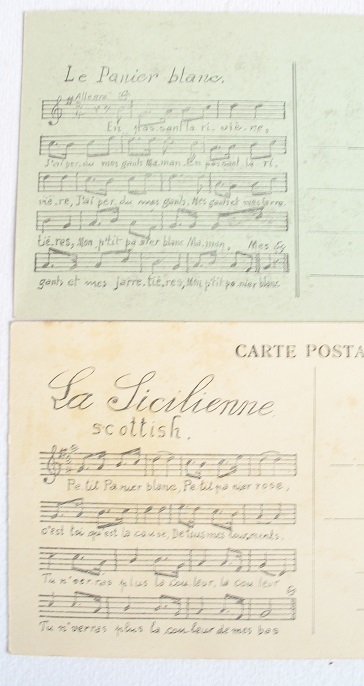
LAVAULT (Paul) - CARTE POSTALE - POSTCARD - POSTKARTE.Livre Rare Book
Werner Skorjanetz - Livres Anciens · Carouge, Suisse10,00 CHF≈ 9,56 €
78 266 résultats
8vo. Together 1½ pp. In the earlier letter, Terrasse expresses his wish to meet the recipient, although he fears that it will be "difficult to talk usefully" on the "day of the premiere" at the Grand Théâtre in Lyon: "Il nous sera peut-être bien difficile de pouvoir parler utilement mardi, jour de première, mais je serai heureux de faire cotre connaissance, vous me trouverez vraisemblablement au Grand-Théâtre [...]". The premiere in question was undoubtably that of Terrasse's opera "Pantagruel" with a libretto by Alfred Jarry and Eugène Démolder, inspired by Rabelais. The premiere took place on 30 January 1911. Terrasse had previously composed incidental music for Jarry's famous "Ubu Roi". - In the letter from 16 April 1919, Terrasse asks an unnamed friend and collaborator to become a co-sponsor of his friend, the dramatist Marc Bonis-Charancle (1859-1939), in a society that Bonis-Charancle has recently joined, possibly the Société des auteurs, compositeurs et éditeurs de musique (SACEM), where Terrasse had been a member of since 1892: "Je viens de vous demander de vouloir bien être parrain avec moi pour un vieil ami qui vient d'être reçu sociétaire. Il s'appelle Bonis-Charancle - il est pour le moment en Angleterre [...]". - The letter from 1911 on stationery of the "Hôtel Terminus" in Lyon. This letter shows several tears partly affecting the letterhead, creases, some browning, and minimal foxing.
(Oblong) 8vo. 1½ pp. on on 3ff. Both letters probably to the librarian and editor of the "Journal musical" Baudouin La Londre, concerning forthcoming articles. In the earlier letter Malherbe apologizes for the delay of an article on the bibliography of Don Giovanni: "En vous envoyant le programme que vous m'avez demandé, je vous rassure au sujet de votre article, auquel je travaille en ce moment et qui m'a nécessité plus de recherches que je ne l'avais cru tout d'abord de là un retard que je vous prie d'excuser. Vendredi je peux être en mesure de vous adresser la chose. J'aurais voulu être complet dans mon étude bibliographique; mais il y faut énoncer surtout pour la publication étrangère qu'il s'agira donc de simples: Notes pour servir à la Bibliographie de Don Giovanni [...]". - The letter from 6 June 1897 was sent together with a finished article, apparently an abridged version of the preface of one of Malherbe's books: "Voici la préface. Il m'a suffi d'y pratiquer une coupure pour lui donner la forme ou du moins l'aspect [...]". In 1897 Malherbe had published "Le Centenaire de Donizetti et l'exposition de Bergame". - Well preserved.
12mo. Together 4½ pp. on bifolia. In an interesting letter to the composer Victor Massé, Marmontel congratulates his colleague at the Paris Conservatory on a cantata by his student Paul Puget: "Mes cordiales félicitations pour la belle Cantate de Puget. On reconnait dans l'ensemble et les détails de cette partition l'excellente direction du maître, et le brillant élève vous fait grand honneur. [...]". The cantata in question is very likely "Mazeppa", which won Puget the Prix de Rome in 1873. - The second letter to an unnamed administrator at the Conservatory concerns the organisation of upcoming auditions and the problem of "the sensitivity of the parents" during such events: "Voici sauf les rectifications qui vous paraitrons convenables et aussi l'intercalation [?] des trois morceaux chant, violon et chœur. Le classement des morceaux dans l'ordre me parait le plus avantageux. Les élèves de mon cher [...] débutèrent elles ? Dans ma lettre je lui laisse tout à fait le choix. Voyons à éviter les froissements d'amour propre, les susceptibilités des parents c'est là toujours l'écueil [?] des auditions, la plus part des élèves ayant la petite faiblesse de s'exagérer le mérite personnel [...]". - The letter concerning the audition with traces of former mounting and a tear affecting the text.
8vo. Together 2½ pp. The dated letter, written to an unnamed friend, was sent with tickets to a concert that the recipient had promised to attend: "Je viens vous rappeler la promesse que vous m'avez faite d'assister à mon concert, permettez moi donc de vous prier d'accepter quelques billets que je me fais un grand plaisir de vous offrir [...]". - The second letter to an unnamed female recipient, probably Lefébure-Wély's mother or another close relative, is humorously introduced as the "orthography of a student of the École des frères after 4 years, 4 months, 4 days, 4 hours, and 17 minutes of assiduous work" and continues in an imaginary phonetic French with an invitation to lunch: "Madam, je çuis onteu devoufer dégeuner aucito çamedit, met sais de votref aute, vous me gâté ci facileman qu’œuf se la me cèmble trait bon hé qu’œuf jàbus e. brefe [...]". A small ink drawing of a barrel organ near the bottom of the second page completes this charming document from Lefébure-Wély's youth. - Louis James Alfred Lefébure-Wély assisted his father as the organist of Saint-Roch in Paris from the age of 8. When he was 14 his father died, and he succeeded him as official organist of Saint-Roch. In 1832 he entered the Paris Conservatoire, studying organ and composition. As a performer, Lefébure-Wély played a major role in the development of the French symphonic organ style and was rated above eminent contemporaries including César Franck. - Dated letter somewhat brittle, with foxing and several tears. Both letters with traces of former mounting.
8vo. Together (1+1½ =) 2½ pp. With autogr. address. Both letters to the Comtesse de Beauregard (the wife Charles de Beauregard, editor of "La Gazette de France") discussing various matters and common friends: "Il m'été impossible de répéter avec Mlle Dietz [...]". In the second letter, he regrets being unable to attend an event due to his mother's illness: "une lettre que je reçois et qui m'apprend la maladie de ma mère me fait à partir immédiatement pour Lyon [...]". - One letter with traces of folding and a small tear in the inside crease.
8vo. Together (1+2 =) 3 pp. With autogr. addresses. Both letters to the Comtesse de Beauregard (the wife Charles de Beauregard, editor of "La Gazette de France"), who had invited him to an event which he is unable to attend, being otherwise engaged: "Mon engagement contracté puis plusieurs jours ne me permettre pas de me rendre [?] à l'aimable invitation que vous avez bien voulu faire pour Dimanche [...]". - Both letters in good condition.
8vo. Together (3+2 =) 5 pp. on 2 bifolia. To an acquaintance about several musical pieces she would like to have copied, mentioning the 288 scribes he provided her with during his time as director of the Gymnase Musical Militaire, a position he no longer holds, for which reason he refers her to the copying bureau of the Paris Opera and the librarian and professor of composition, Aimé Leborne (1799-1866), whom he deems the most knowledgeable musician in all of France: "Autrefois, lorsque j'étais Directeur du Gymnase Musical Militaire, je me serais empressé de mettre à votre disposition 288 copistes, tant bons, que médiocres, ou mauvais. Aujourd'hui, que j'ai l'honneur de n'être plus rien, je vous engage de vous adresser au bureau de copie à l'Opéra. Soyez assez bonne pour écrire deux lignes à mon bon ami Le Borne en lui disant que c'est de ma part. Vous lui adressez les Morceaux que vous voulez faire copier [...] Mr Aimé Le Borne, qui est bibliothécaire de l'Opéra, est, comme moi Professeur de Composition au Conservatoire, et à mon avis le plus savant Musicien de France [...]" (20 May 1849). - Probably to the same, praising her Agnus Dei and its elegant melody, mentioning minor changes he made to the harmony, and offering a Kyrie he composed for Gioachino Rossini, which, as it needs only the accompaniment of an organ, can easily be staged in the countryside: "Voici, Madame, votre Agnus Dei prosodié d'une manière plus humaine. Il est joli et la Mélodie en est fort élégante. Ainsi que vous m'en avez donné l'Ordre j'ai fait quelques petits changements dans l'harmonie; maintenant le tout est d'un accord parfait. Permettez moi de vous offrir un méchant Kyrie que j'ai composé pour mon ami Rossini. Comme il n'y a qu'un accompagnement d'Orgue seulement il vous [sera] facile de le faire exécuter à la campagne […]" (23 Dec. 1858). - With former collector's numbers "91" and "92" in pencil. Traces of former mounting on reverse. Slightly creased.
(Oblong) 8vo. Together 2½ pp. on bifolium. One with autograph address verso. To M. du Chanoy about mistaking two letters from a mutual friend for his own: "Deux lettres de notre ami Du Fomanard [?] dont la signature m'a toujours paru être la vôtre ont causé mon erreur. Demain, j'irai chercher vos paroles, et vous portant les lettres remplies de ma faute, qui [...] font mal vers mes Conventions [...]". The date "22 Mars 1822" in another hand near top left corner. - To M. de Saint-Martin, declining an invitation, as he is preoccupied with important engagments from Saturday to Wednesday: "Aimable et Cher Amphytrion, je reçois à l'instant votre invitation. Et voilà que l'honneur me dit d'une soif aigre que j'ai du Samedi jusque au Mardi par certains engagements qu'on ne viole pas, que dupiez-vous me traiter comme un nègre je dois les respecter - j'obléis, mais, hélas! Loin d'un ancien ami [...] le plaisir des jours gras sera pour moi bien maigre [...]". - With former collector's numbers "106" and "115" in pencil. Traces of former mounting on reverse. The letter to de Saint-Martin somewhat creased.
8vo, and 4to. (1+2 =) 3 pp. on bifolia and single leaf. One of which with autogr. address verso. To the lawyer and painter Edmond Hédouin in Boulogne-sur-Mer about several problems that have arisen concerning the engraving of a musical publication which, with Duchambge's care, will hopefully be effected as planned, and she promises that Hédouin will receive his copies soon. Furthermore, Duchambge begs Hédouin's forgiveness for not having used his pretty verses because they did not appear sufficiently musical to be set to a song. Instead she promises to publish some of his poems in her annual album. Hédouin should suggest texts for a ballad of no more than four verses, and Monsieur Merle will take care of the matter: "Enfin, Monsieur, demain, vos exemplaires partiront - et j'espère que vous les recevrez promptemens - ce n'est pas ma faute je vous assure si les graveurs y ont mis tant de négligence [...]" (12 May 1835). Duchambge has severe financial problems, which she hopes the recipient - through the good offices of a Monsieur Merle - might help to ease by means of a recommendation to the Duke of Bassano, Hugues-Bernard Maret. Although Duchambge knows Maret as a generous man, she notes the fickleness of human nature, of which Montaigne was so well aware: "Je connais le duc de Bassano [...] mais, l'homme est ondoyant dit Montaigne - moi, j'ajoute que la fortune est oublieuse, et que les honneurs dessèchent par fois les coeurs [...]" (dated "Wednesday evening"). - One letter with blindstamped monogram and tear due to opening of the letter. The other letter with a small clipping.
8vo. Together 3 pp. on 2 bifolia. To the singer Mme. du Chanoy, surprised at not having seen her at their reunions, suspecting she might not have received the invitation, and hoping she will attend the rehearsal at the Salle Érard in Paris the following day: "Dans mon étonnement de ne plus vous voir à nos réunions, il me vient la pensée que vous n'avez peut-être pas reçu de convocation imprimée. C'est pourquoi je me permets de vous écrire ne vous demandant pour toute réponse que votre présence à la répetition de demain 4 heures Salle Erard [...]" (Paris, 3 Feb. 1874). On headed stationery of the Société Académique de Musique Sacrée. - Probably to the same, inviting her to perform at a soirée in St Germain the following night despite her being in mourning, pointing out that she will not be the only one wearing black, as several other people, including himself, are also mourning, encouraging her attendance by mentioning the shortage of altos as well as her lovely voice, and giving her the date and time of the rehearsal: "Vous seriez bien aimable de ne pas manquer demain à la soirée qui aura lieu à 9 heures ou Ministère rue de Grenelle St. Germain No 110. Je sais que vous êtes en grand deuil, mais vous ne serez pas seule en noir car plusieurs personnes sont en deuil comme moi du reste. Nous serons très heureux de vous avoir, car vous savez que les altos sont en minorité et nous regretterions bien l'absence de votre bonne voix et de votre talent de musicienne. Il y a répétition demain à 4 heures au ministère [...]" (undated). - The 1874 letter with former collector's number "78" in pencil; small marginal flaws. Both letters with traces of former mounting on reverse.
8vo. Together 3 pp. In French. The dated letter to an unidentified lady concerns her subscription to a concert series of the Paris conservatory and the closing of the conservatory's concert hall in Rue Bergère (Rue du Conservatoire). Viguier informs the recipient that he met his friend, the cellist and conservatory professor Hippolyte Rabaud, who assured him of the continuation of her subscription. He laments the closing of the concert hall, where he had been a "soloist and member of the society" for so long. Viguier doubts plans to reconstruct the concert hall on the site of military barracks: "Like you, I believe that we will never regain what we have lost". - In the undated letter Viguier announces that he will send a concert programme. - Both letters with traces of former mounting. The letter from 1897 with some foxing.
8vo. 2 pp. on 2 bifolia. One with autograph address verso. To the tenor Alexis Dupont (1796-1874) about his anticipated return to the stage and the opera "Les Huguenots", mailing the part of Témoin for him to study, a part he can either keep singing or exchange for the couplets of Bois Rosé, hoping he will perform the following Monday: "J'espère, mon cher Alexis, que vous ne priverez pas plus longtems les Huguenots de votre présence & de votre talent. Je vous envois avec cette lettre le septuor, en vous priant d'apprendre le plus tôt qu'il vous sera possible la partie de Témoin, que vous chanterez à l'avenir, soit que vous consentiez à alterner pour les couplets de Bois rosé soit que vous préfériez chanter toujours cette partie de Témoin. Veuillez donc, mon cher Alexis, vous en occuper, et faites moi savoir aussi, je vous prie, si vous chanterez Lundi, je l'espère [...]" (Paris, 26 March, no year). On headed stationery of the Académie Royale de Musique. - To M. Asseline about a message for a talented artist, which he is to deliver the following morning through the Comte de Paris, making sure to praise and recommend the young man to him, and promising to visit Asseline after successfully completing that task: "Cher Asseline, je reçois votre message pour le jeune St. Jaim, & je m'empresserai de le lui apporter demain matin de la grace du Comte de Paris, quoique vous me disiez, en lui donnant les éloges qui mérite notre petit artiste. Je lui transmetterai aussi les votres [...] J'irai vous voir, pour vous rendre compte de ma mission [...]" ("Dimanche"). Handwritten note regarding the former collector and donor of the autograph: "donné par M. Asseline". - With former collector's numbers "89" and "90" in pencil. Traces of former mounting on verso.
8vo. Together 4 pp. on 2 bifolia. One with autograph address verso. To Madame du Chanoy about a rehearsal at her place, mentioning her having reminded two other participants to arrive on time: "Chère Dame, la répétition aura lieu chez vous Dimanche de onze heures à une heure. Je ne voudrais pas vous faire manquer le vrai plaisir du conservatoire. Je viens d'écrire à Anschutz [?] et à Septinelli [?] [...] de se trouver de bonne heure chez vous et j'irai [...]". On stationery with engraved initials. - Likely to the same, regretting to see her leave and being unable to listen to her play the piano or the organ in the morning any more, and about having left her flat to go to Versailles, where she hopes to find a way to get to Eaux-de-Pouguets to benefit her health: "Vous êtes mille fois aimable, chère Madame, de ne m'avoir pas oubliée, mais vous m'apprenez une fort triste nouvelle, celle de votre départ de la maison [...] Je n'en reviens pas, et je vous regrette de tout coeur. Je ne sais plus, moi même, ce que je veux faire, car mon appartement fort agréable à la vue est par le fait inhabitable en cas de maladie, je viens d'en faire la très pénible expérience. Il est de Versailles que je vous écris, je m'y suis réfugié, où que j'ai été un peu mieux portante, je suis venue y [...] pour m'aider à gagner les eaux de Pougues où je vais aller faire une session. Je sais que vous jugez dans nos environs, mais ce n'est plus la même chose, je ne vous entendrai plus le matin, sur le piano ou sur l'orgue, redire de divines mélodies qui gagnent encore sous vos doigts habiles [...]". - With former collector's numbers "117" and "118" in pencil. Traces of former mounting on reverse; a few small marginal flaws.
8vo. Together 3 pp. The letter from 1896 to the musicologist Jacques-Gabriel Prod'homme, thanking him for a copy of his book on Berlioz's "La Damnation de Faust" and for a favourable article on Lamoureux: "Je viens vous remercie de m'avoir envoyé votre très intéressant et remarquable volume sur 'La Damnation de Faust' de Berlioz et la notice que vous avez publiée sur moi dans l'Enclos du mois de Juillet 1895. Je tiens à vous dire que je suis très sensible à votre gracieuse pensée et profondément touché de votre bienveillance". - The second letter to the music publisher Carl Enoch, concerning the upcoming stage premiere of Emmanuel Chabrier's unfinished last opera Briséïs. Lamoureux had conducted the first concert staging of the piece in 1897 and expresses his joy that it will soon be staged at the opera, mentioning the flutist Paul Taffanel and the opera director Pedro Gailhard as being involved in the project. He also mentions that Chabrier's widow "essentially thinks that it is she who directs the piece", as she is "the interpreter of the feelings of her poor husband". Briséïs premiered on 8 May 1899 at the Paris Opera, a few months later than Lamoureux had expected. The interesting letter in full: "J'apprends avec plaisir par plusieurs personnes, que les études de Briséïs à l'opéra sont commencées, et que l'on espère passer en Janvier. Je voudrais en causer avec vous. Malheureusement je suis encore cloué dans mon lit et dans l'impossibilité de sortir. Pouvez-vous me dire si Taffanel suit les répétitions au piano ? Vous savez que Mme Chabrier tient essentiellement à ce que ce soit lui qui dirige l'ouvrage. Elle est, en cela, l'interprète des sentiments de son pauvre mari. Mr Bertrand doit se souvenir, du reste, que je lui dit lorsque j'ai eu l'occasion de le voir avec vous, et Mr Gailhard, lui-même, ne doit pas avoir oublié que cela a été convenu dans les entrevues que nous avons eues avec lui dans le cabinet directorial de l'Opéra [...]". - Minor foxing. The letter from 1898 with traces of former mounting.
8vo and oblong 12mo. Together 3 pp. The earlier letter was written to thank an admired artist: "Je pense bien fidèlement à vous, mon cher Maître et ami et je vous redis ma profonde et constante gratitude". - The second letter was to offer a box for a representation of Ambroise Thomas' Mignon at the Opéra-Comique to an unnamed woman. - Louis Beydt was among the last composers of the traditional French operetta and a prolific composer of incidental music and film music. His short directorate of the Opéra-Comique from 1952 to 1952 was marked by the 50th anniversary production of Debussy's Pelléas et Mélisande and the first French production of The Rake's Progress. - The letter from 1931 somewhat creased, on stationery with embossed letterhead "34. Rue de Liège, VIIIe". The letter from 1952 on stationery of the Opéra-Comique.
4to. Together 3¼ pp. The earlier letter is addressed to the director of the Opéra-Comique, either Jacques Rouché or Henri Büsser, and concerns the death of Thiriet's father-in-law, the architect Charles-Auguste Risler, and the future of his recently premiered opera "Le Bourgeois Falaise". Thiriet expresses his concern that no further performances of the piece are scheduled and speculates about possible reasons for the relatively cold reception of the most recent performance, including "worries about the last metro" and the queue at the wardrobe, which should not lead to its removal from the programme: "Je crois que le peu de chaleur du public après la dernière représentation tenait surtout du souci du 'dernier métro' et la ruée au vestiaire; peut-être les gens sont-ils moins disposés à rire après la mort de Mimi qu'avant ? Toujours est-il que le public a paru s'amuser au cours de la représentation et à quatre endroits différents à applaudi ! Puis-je espérer que mon petit acte n'a pas été frappé d'un arrêt trop impitoyable et dont je ne m'expliquerais mal la sévérité?" Thiriet also announces the libretto and score for his opera "La Véridique Histoire du Docteur". - The later letter is addressed to a radio host who was supposed to present a recording of "Le Bourgeois de Falaise" a few days later. Thiriet offers the recipient to listen to the recording beforehand and mentions plans for a reprise at the Opéra-Comique that were supported by Jacques Jaujard: "Monsieur Gressier me fait savoir que vous avez bien voulu accepter de présenter la diffusion du 'Bourgeois de Falaise' qui sera donnée par la Radio vendredi prochain 25 Février à 20 heures, chaîne Nationale. Je vous en remercie très cordialement et ne pouvais espérer d'honneur et d'agrément plus grandes en cette circonstance. Si vos occupations vous le permettent, je serais heureuse que vous puissiez écouter cette exécution, qui s'annonce excellente [...]". - The earlier letter on mourning paper with recipient's marks in crayon, several tears, and somewhat creased. The later letter with traces of folds.
4to. 1½ pp. on 2 ff. With 2 autograph envelopes. Both to his friend Henri Bloch, concerning the reception of a legacy by the soprano Félia Litvinne, which Bloch and his sister plan to donate to the "Musée de l'Opéra". Hahn promises to address a thank-you letter for this contribution to the opera's literary archive: "Des occupations sans nombre m'ont jusqu'à présent empêché de faire prendre chez vous les reliques de la pauvre Félia dont votre soeur et vous avez bien voulu me faire don pour le Musée de l'Opéra [...]" (8 Jan. 1946). - In the second letter Hahn gratefully mentions, more generally and poetically, the range of items donated from the soprano's former property as "glowing vestiges". Hahn also inquires which name he should set in the inscription installed over Brunhild's weapons: "Le public sera certainement heureux, comme nous le somme nous-mêmes, de pouvoir contempler ces beaux objets, si évocateurs d'une des plus belles incarnations dramatiques et lyriques dont s'enorgueillisse notre théâtre, et ces vestiges éclatants contribueront à perpétuer le souvenir de la grande artiste que fût notre chère Félia Litvinne [...]" (9 Feb. 1946). - Both letters with printed letterhead and vignette of the "Académie Nationale de Musiqe et de Danse".
8vo, and 4to. Together (1+3 =) 4 pp. on 2 bifolia. With autograph addresses. To the composer Auguste Matthieu Panseron, requesting an appointment to introduce a young music student in search for a teacher: "Une jeune personne, qui fait Son état de la Musique à Nancy est venue passer quelques mois à Paris dans l'intention de prendre des leçons des meilleurs maitres [...]" (8 Sept. 1828). - To the violinist Pierre Baillot, asking his opinion on Azaïs's articles on acoustics in the "Revue Musicale", published by the composer François-Joseph Fétis. Furthermore, Azaïs proposes a cooperation to Baillot, who could himself perform Azaïs's music or direct such a performance. They would - Azaïs seems certain of it - create something different and successfully avant-garde: "Vous recevez vraisemblablement l'utile est estimable Recueil que Mr. Fétis publie sous le titre de Revue Musical. Vous avez pu y voir quelques lettres de moi sur l'Acoustique j'ai eu la douceur d'apprendre qu'elles avaient intéressé plusieurs Musiciens. C'est votre suffrage surtout que j'ai désiré [...] En entremêlant mes improvisations de Morceaux de Musique choisis et exécutés par vous, ou, sous votre direction, par des personnes dignes de vous être associées, nous ferions une chose neuve, variée, susceptible de développement, et qui le me semble, mériterait des succès [...]" (8 Jan. 1832). - With traces of old mounting and a marginal tear from opening the letter. - Interesting documents of musical entrepreneurship, informed by the general social awakening during the years immediately before and after the July Revolution.
8vo. Together (3+3 =) 6 pp. on 2 bifolia. With 2 autograph envelopes. To the French violin maker and art historian Albert Jacquot (1853-1915) in Nancy about the ongoing deliberations of the jury of the 1889 Paris world fair, regarding the reward Jacquot is to receive for his exhibited instruments, meetings Ambroise was unable fully to attend due to his duties at the conservatory: "J'ai eu le regret de ne pouvoir prendre part aux dernières délibérations du Jury de la Classe 13, les concours publics du Conservatoire ne me l'ont pas permis. Il m'était donc difficile, après coup, de combattre les décisions de mes collègues de ce Jury. Mais j'ai lieu d'espèrer que Messieurs Gand [i. e. the violin maker Gautrot Gand] et Thibouville [i. e. the instrument maker Jérôme Thibouville-Lamy] seraient comme moi favorables à toute proposition tendant à élever votre récompense [...]" (Île Illiec, 5. Sept. 1889). - To the same in Paris, happy to find that one of his compositions, a religious march, was skillfully performed during a mass at St. Cécile in Nancy, with thanks for Jacquot's tireless efforts to support his art, as well as congratulations to Jacquot's father, who was recently awarded the cross of the League of Honour: "Vous avez eu l'obligence de m'annoncer que (grace à vous, j'en suis sur) on avait placé une ancienne marche religieuse de moi dans le programme de la Messe de Ste Cécile remarquablement exécutée récemment à la Cathédrale de Nancy. Je vous sais gré de votre zèle et du Concours dévoué que vous ne cessez de donner aux intérêts de l'Art. Tous doivent l'apprécier. Vous m'informez aussi que Monsieur votre père vient enfin d'obtenir la distinction qui vous tenait tant au coeur: La Croix de la Légion d'Honneur. Je vous en félicite, vous et lui [...]" (Paris, 17 Nov. 1892). On headed stationery of the Conservatoire National. - One letter with small marginal tears, partly rebacked with strips of paper. One envelope rather worn around the edges.
8vo and oblong 12mo. Altogether 3½ pp. on 3 ff. Includes a printed obituary. 4to. To the music journalist and publisher Baudoin La Londre. Two postcards from October 1896 concern an article that Ernst had written for La Londre's "Journal musical". The later postcard accompanied Ernst's corrections of the proof. He tries to clarify a misunderstanding and gives his consent to throw out a veiled reference to the famous Belgian music critic Maurice Kufferath: "Par ce courier, je vous renvoie l'épreuve corrigée. Merci. Ne prenez pas le mot 'ennui' dans un sens péjoratif en ce qui concerne le J. musical; il ne correspondait plus de tant à ma pensée, qui était d'indiquer la gêne que j'éprouve à dire du mal d'une traduction, quelle qu'elle soit. Aussi je l'ai remplacé par le mot 'embarras'. J'ai aussi supprimé un membre de phrase où M. Kufferath aurait pu se reconnaître, et cela uniquement à cause de vous et de votre journal. Si même vous voulez supprimer la phrase relative au 'critique musical autorisé', j'y consens d'avance. [...]" (postmarked 19 Oct. 1896). - The letter from 22 Feb. 1897 concerns a meeting with Georges Hartmann, librettist and French distributor of the German music publisher Schott, after Ernst's return from Bayreuth: "Après avoir reçu votre lettre, je me suis rendu ce matin chez le représentant des éditeurs Schott, M. Hartmann, 10, place de la Madeleine. Il était parti pour Anvers - et moi je pars pour Bayreuth dans trois jours! Je crois donc qu'il faut attendre mon retour (vers le 5 ou 6 mars). Vous pourriez peut-être en attendant prendre sang, c'est-à-dire écrire un mot à Mr. Hartmann, qui reviendra d'ice quelque jours. S'il ne vous envoie pas un exemplaire (il n'est pas sur même qu'il en ait) je tâcherai d'en faire donner un, quand je serai revenu, par la maison Schott, après entente avec lui [...]". - The obituary announces Alfred Ernst's funeral in Saint-Étienne-du-Mont on 17 May 1898. - All autographs well preserved. Obituary shows several tears and unprofessional repairs with adhesive tape.
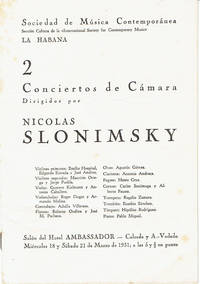
193131483Havana Cuba: Sociedad de Musica Contemporanea 1931. 1931. Very good. - Octavo. 8-page program printed on cream stock including 6 pages of notes on the music by the conductor. The program has been folded twice & there is a very light diagonal crease to each page. There is some light foxing to the margins. Very good. <p>The program for an important pair of concerts conducted in Havana Cuba in 1931 by Russian-born conductor Nicolas Slonimsky. The program includes a 1-page bio of Slonimsky and six pages of his program notes translated into Spanish. The first concert includes Carl Ruggles' "Men and Mountains" and Charles Ives' "Three Places in New England" as well as works by Mozart Arthur Honegger and Ernest Bloch. The second presents Henry Cowell's "Sinfonietta" Amadeo Roldan's "Ritmica" Number 4 Alejandro Caturla's "Bende" and music by Bach Prokofieff and Bartok. The text is in Spanish.<p>Rare. Havana, Cuba: Sociedad de Musica Contemporanea, 1931. unknown
5 S. Gestochen. Gr. 4°. Randschaden. 1. Andenken (Mattheson) 2. Sie liebt mich! (Goethe).
R320100661DEUTSCHE GRAMMOPHON GESELLSCHAFT. NON DATE. In-Folio. Relié. Bon état, Couv. convenable, Dos satisfaisant, Intérieur frais. 2 DISQUES NINYLES 33t accompagnés d'unedescription des disques de 4 PAGES - Sous plats rigides toilés verts (muets). 2 PHOTOS DISPONIBLES - . . . . Classification Dewey : 780-Musique
DEUTSCHE GRAMMOPHON GESELLSCHAFT. NON DATE. In-Folio Carré. Relié. Bon état. Couv. convenable. Dos satisfaisant. Intérieur frais. 2 DISQUES NINYLES 33t accompagnés d'unedescription des disques de 4 PAGES - Sous plats rigides toilés verts (muets). 2 PHOTOS DISPONIBLES - NOTA : "Cette anthologie a été constituée essentiellement par des emprunts à divers disques de la collcton "Archiv-Produktion"" .