CollectifLivre Rare Book
78 265 résultats
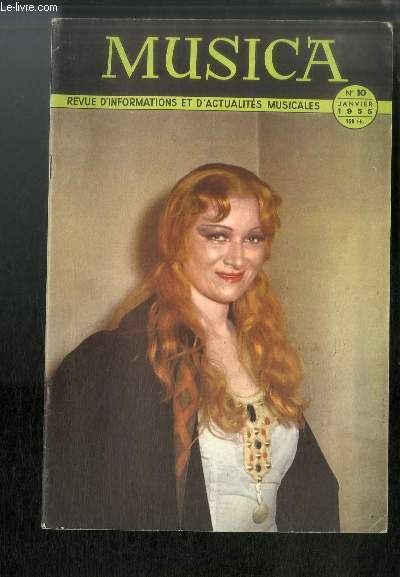
1955RO10017336Musica. Janvier 1955. In-12. Broché. Bon état, Couv. convenable, Dos satisfaisant, Intérieur frais. 46 pages. Illustrations noir et blanc et en couleurs dans et hors texte.. . . . Classification Dewey : 780-Musique
1955RO10017345Musica. Octobre 1955. In-12. Broché. Bon état, Couv. convenable, Dos satisfaisant, Intérieur frais. 46 pages. Illustrations noir et blanc et en couleurs dans et hors texte.. . . . Classification Dewey : 780-Musique
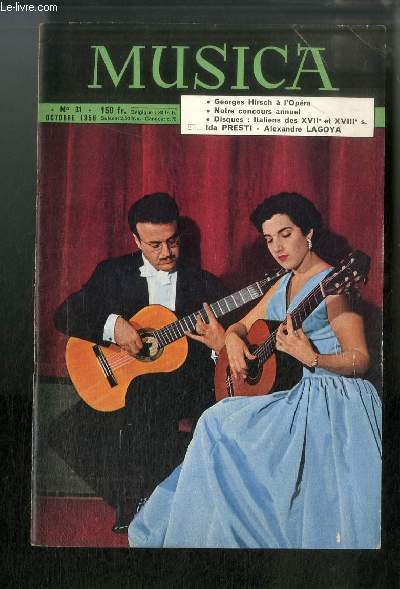
1956RO10017357Musica. Octobre 1956. In-12. Broché. Bon état, Couv. convenable, Dos satisfaisant, Intérieur frais. 46 pages. Illustrations noir et blanc et en couleurs dans et hors texte.. . . . Classification Dewey : 780-Musique
1957RO10017364Musica. Avril 1957. In-12. Broché. Bon état, Couv. convenable, Dos satisfaisant, Intérieur frais. 46 pages. Illustrations noir et blanc et en couleurs dans et hors texte.. . . . Classification Dewey : 780-Musique
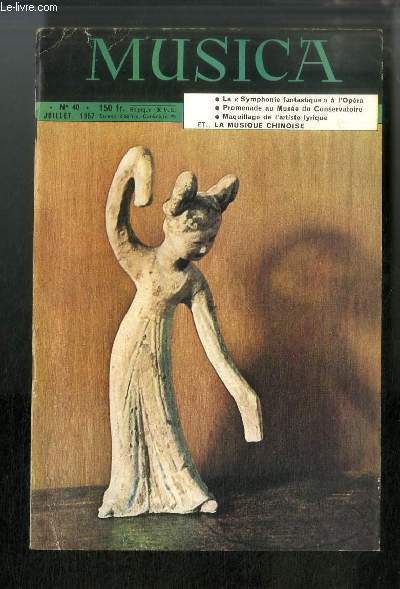
1957RO10017366Musica. Juillet 1957. In-12. Broché. Bon état, Couv. convenable, Dos satisfaisant, Intérieur frais. 46 pages. Illustrations noir et blanc et en couleurs dans et hors texte.. . . . Classification Dewey : 780-Musique
1960RO10017399Musica. Avril 1960. In-12. Broché. Bon état, Couv. convenable, Dos satisfaisant, Intérieur frais. 51 pages. Illustrations noir et blanc et en couleurs dans et hors texte.. . . . Classification Dewey : 780-Musique
1962RO10017420Musica. Janvier 1962. In-12. Broché. Bon état, Couv. convenable, Dos satisfaisant, Intérieur frais. 60 pages. Illustrations noir et blanc et en couleurs dans et hors texte.. . . . Classification Dewey : 780-Musique
2007R100057840Christian Bourgeois. 2007. In-12. Broché. Etat d'usage, Couv. convenable, Dos satisfaisant, Intérieur acceptable. 264 pages - quelques pages désolidarisées.. . . . Classification Dewey : 780-Musique
2002RO30321733Du Chêne. 2002. In-4. Relié. Bon état, Couv. convenable, Dos satisfaisant, Intérieur frais. 95 pages. Nombreuses photos en couleurs et noir et blanc, dans et hrs texte, dont contre-plats. Jaquette correcte.. Avec Jaquette. . A l'italienne. Classification Dewey : 780-Musique
1935ROD0046671DESCLEE DE BROUWER. 1935. In-12. Broché. Bon état, Couv. défraîchie, Dos satisfaisant, Intérieur bon état. 179pp. qq photog n&b hors texte. . . . Classification Dewey : 780-Musique
R320014039HACHETTE. NON DATE. In-12. Broché. Etat d'usage, Couv. défraîchie, Dos satisfaisant, Papier jauni. 306 pages augmentées de quelques phrases musicales.. . . . Classification Dewey : 780-Musique
1924R200105163Librairie Hachette. 1924. In-8. Broché. Etat d'usage, Couv. convenable, Dos satisfaisant, Papier jauni. 303 pages. Quelques rousseurs et pliures. 1er plat désolidarisé et avec quelques manques.. . . . Classification Dewey : 780-Musique
63795Paris, Librairie Hachette, 1908. "12 x 19, 306 pp., broché, non coupé, état moyen (couverture défraîchie; papier jauni)."
7894"P., Société d’éditions géographiques, maritimes et coloniales; 1929. In 4° demi-percaline bleue, 242 pp."
199223677New Haven: Yale University Press. As New in As New dust jacket. 1992. Hardcover. 0300054955 . First printing. As new in like dust jacket. . Yale University Press hardcover books
4to (220 x 265 mm). 16 pp. With 6 lithographed illustrations on 5 plates. Contemporary blue glazed wrappers. Only edition. - The composer Barraga (1825-99) served as choir master and music teacher in Munich (cf. RISM). His doctrine followed the mathematical system of harmony established by Georg Joseph Vogler (1749-1814), a composer of the Mannheim school and a diligent reformer of baroque organs. Barraga's theory describes harmonical and metrical knowledge as the grammar of musical rhetoric, while the necessary prerequisite for the representation of beauty is logic, paired with sentiment. Harmonical and metrical relations are to be expressed by a system of signs similar to the Roman numeral analysis anticipated by Vogler, of which Barraga provides numerous examples in the text and on the plates. For the author, music is to be conceived as a living "mathematica integra", as attested by Mozart in particular. Perhaps surprisingly, Barraga does not mention Johann Sebastian Bach. - Very light foxing; wrappers slightly creased. A clean copy on large paper. OCLC 831087605.
75071Paris, Nouvelles Editions Debresse, 1957. 13 x 21, 263 pp., broché, bon état (couverture défraîchie).
180013767Dublin Goulding 1800 en ff. in-4, , titre, 5pp., musique gravée,
Folio. Title, 30 pp. Brown ink on 12-stave paper, 4 systems of 3 staves per page. Sewn. Louis Drouet dedicated his arrangement of melodies from Donizetti's opera "Belisario" (1836) for flute and piano to his daughter Lina Drouet. The piece was intended to be performed as a "morceau de salon". - Often referred to as the "Paganini of the flute", Louis Drouet was one of the most celebrated flautists of his time. The son of an expatriate French barber in Amsterdam was an autodidact before entering the Paris conservatory at the age of seven. At 16, he was first flutist and teacher of Louis Bonaparte, then King of Holland. An international career as a flute virtuoso followed. Among his stage partners and friends was Felix Mendelssohn. In 1840, Drouet was appointed director of music by Ernest I, Duke of Saxe-Coburg-Gotha. - The title written in a different hand. Some foxing and browning; tears to the fold of the title-leaf.
187024841london Stannard & Co 1870 Une Chromolithographie Originale en couleurs, ornant la première page d'une partition intitulée : "Nantes (fantasia on subjects from Mozarts Twelfth Mass) - Cathedral Gems Series No. 1 by LOUIS DUPUIS", Format total de la gravure : Hauteur : 33 centimètres Largeur : 23 centimètres, format de la gravure seule : 26 cm de haut par 19,5 cm de large, gravure sur papier épais blanc, avec imprimé en bas à droite de la litho couleur : PACKER & GRIFFIN LITH. + imprimé en bas à droite : Stannard & Co. 7 Poland Street London + imprimé en bas au centre CATHEDRAL OF NANTES, et aussi imprimé en haut de la litho couleur : NANTES, sans date (1870) LONDRES Stannard & Co Editeurs de Musique,
Blue octavo (light purple spine); 390 p, [32] p of b&w plates; 23 cm. In Portuguese. || Singers -- Brazil -- Biography. || Brazilian singer who was accused of denouncing fellow artists who were involved in political left-wing movements in the 1970s.
Oblong folio (ca. 316 x 226 mm). Brown ink on paper, 16 staves (Johnson, Tyson & Winter Nr. 2). 3 pp. on 2 leaves (separate, second leaf mounted to a cloth stub with another, blank sheet of contemporary paper). A total of 217 measures (omitting preludes) with deletions and corrections throughout. Stored in custom-made red morocco portfolio with cloth interior flaps and brass applications on both covers (342 x 248 mm). First draft for the lied "Neue Liebe, neues Leben", a setting of a 1775 poem by Johann Wolfgang von Goethe, begun in late 1798. The present sketch, jotted down without interruptions in a very cursory, almost rushed hand already contains the melody and the words with no expression markings, but includes occasional bass sections as well as parts of the piano accompaniment at the end of verses; it shows several important departures from the version printed in 1810. At the head of the page, written in a different ink and pen and comprising the first four staves, are the first eight bars of the finale of Beethoven's String Quartet No. 1 in F major (Op. 18, No. 1, composed between 1798 and 1800, published in 1801), providing the violin voice with the theme chorus of triplets. - The lied in its present version (WoO 127) was published in early 1808, nearly a decade after this first sketch, by Simrock in Bonn as the first part of the "III deutsche Lieder", apparently without the composer's consent. Beethoven subsequently revised his work (the manuscript of that revision, dated "1809", is today kept at the Beethoven Haus in Bonn) and published it the following year with Breitkopf & Härtel in Leipzig as part of his "Sechs Gesänge" (Op. 75, No. 2). "Il s'agit du monologue d'un amant que la rencontre d'un nouvel amour a bouleversé au point de ne plus savoir où il en est : sa tentation est alors de fuir ce qui le rend étranger à lui-même" (E. Brisson). In 1811 Beethoven presented a manuscript copy of that second version, the first leaf of which is also kept in Bonn (while most of the remainder is at the Pierpont Morgan Library in New York), to Bettina Brentano on the occasion of her wedding to Achim von Arnim. Nohl has pointed out that the present first draft with its "dramatic, aria-styled phrasings" retains a somewhat "grandiose and dark quality" as compared to the reduced later version, and "if one were to interpret the urgent stride so vividly apparent in this sketch, dashed off, as it seems, without a single interruption and in a mood of deep emotional excitation, then one feels instinctively that forces of an even greater passion than such as Bettina could have aroused in Beethoven must have been at work here" (cf. p. 695). - Occasional quite insignificant brownstaining; altogether very crisp. Both leaves annotated with Beethoven's name in a near-contemporary hand. At the head of the first page is the "mysterious caption" (cf. Nohl), also by a different, early hand: "Der Schluß von seinem letzten Septuor als Motto für den Text" (apparently referring to Beethoven's Septet, Op. 20, also written in 1799; a tentative explanation is advanced by van der Zanden, p. 168). - Beethoven manuscripts written before 1800 almost never come to market; no other complete autograph manuscript of this version is known. The two leaves formerly were a single bifolium owned by baroness Anna von Gleichenstein, the sister of Beethoven's friend Therese Malfatti (remembered as a possible dedicatee of "Für Elise"), which was soon separated. Even in 1865, when Nohl edited the first leaf, its counterpart was no longer in the possession of the Gleichenstein family. The first sheet later surfaced in the archives of the music publisher Schott in Mainz and was sold at Sotheby's in 2002 (6 December, lot 14: £65,725). The second leaf was offered in 1968 by Hans Schneider of Tutzing in his catalogue 136 (lot 37, DM 17,800; then again in cat. 142, lot 266, with illustration on p. 45) and was acquired in 1969 by a private collector who had it auctioned by Venator & Hanstein in Cologne in 2011 (cat. 118, lot 861: EUR 108,000). Now that both leaves have been reunited, Hans Schneider's words, written half a century ago about only the final 62 measures, are no less true: "Through Beethoven's synthesis of his own music with a text by Goethe we are presented with a musical autograph as desirable as it is beautiful" (cat. 136, p. 37). WoO 127. Beethoven, Werke (Neue Ausgabe), Abt. 12.1, Lieder und Gesänge mit Klavierbegleitung. Kritischer Bericht (Munich, 1990), no. 18, pp. 20f., and cf. no. 41, pp. 47-49. Ludwig Nohl, "Eine Beethoven'sche Skizze", Recensionen und Mittheilungen über Theater und Musik 44 (4 Nov. 1865), pp. 695-697 (an edition of the first leaf only). Max Unger, "Neue Liebe, neues Leben. Die Urschrift und die Geschichte eines Goethe-Beethoven-Liedes", Zeitschrift für Musik 103.9 (Sept. 1936), pp. 1049-1075, here at pp. 1060-1062. Jos van der Zanden, "The Shakespeare Connection: Beethoven's String Quartet Op. 18 No. 1 and the Vienna Haustheater", Eighteenth-Century Music 18.1 (March 2021), pp. 151-170, here at p. 168 note 106.
1895RO20167144BUREAUX DE LA REVUE DU CHANT GREGORIEN. 1895. In-8. Broché. Etat d'usage, Couv. défraîchie, Dos abîmé, Intérieur frais. 24 pages - quelques partitions dans le texte.. . . . Classification Dewey : 780-Musique
1 S. Qu.-8vo. Acht Zeilen in zweizeiligem System für Klavier. Montiert auf Trägerkarton, auf dem Döring einem namentlich nicht genannten Adressaten in Wien berichtet: "Der Anfang dieses Stückes ist der ersten Nummer meiner 'Lose Blätter' benannten Klavierstücke entnommen, die unter Opus 177 - Dresden bei L. Hoffarth - erschienen sind. Möchten sie auch im lieben Wien freundliche Aufnahme finden". - Döring war Schüler des Leipziger Konservatoriums und Privatschüler von Hauptmann und Lobe; 1858 wurde er Lehrer am Dresdner Konservatorium und verfaßte "eine große Zahl trefflicher Klavierunterrichtswerke" (Riemann, 11. Aufl., 1929, s. v.).
Pieghevole (Misure cm. 21x30 piegato in quattro facciate) che contiene "Nuove Canzoni Napoletane" (solo testi) con i seguenti titoli: 'A luna e 'o mare; Il vero Charleston!...; Passione madrilena; Argentina; Meridiana; Voglio a tte!; Scugnizzo; Fantasia 'e surdato. Editore presumibilmente napoletano (32b).