17 327 résultats
(Franckfurdt am Mayn (= Frankfurt am Main), durch Weygand Han/ in der Schnurgassen/ zum Krug (on colophon), [ca. 1550]). Small 4to (18 x 13,5 cm.). Full vellum bdg. made from a manuscript leaf, written in red and black ink, w. red (1- and 2-line) and one blue (2-line) initial, two columns (ca. 1450). Lacking about 1/3 of f. B1, affecting a schedule, small lower part of a woodcut of Saturn and probably about 8 lines of text also lacking lower corner of D4, not affecting text or illustr. T-p. soiled and professionally repaired at outer left margin, not affecting text or illustr. overall some soiling and brownspotting. A few small marginal wormholes. T-p. printed in red and black and w. large woodcut illustr. of the four elements, months, starsigns etc. incoorprated into a system, 7 woodcut-illustr. of the planets humanized, 12 woodcut illustr. of the starsigns, 3 woodcut illustr. figures of systems, 11 woodcut illustr. of sceneries belonging to the different months, one woodcut illustr. of a naked man showing which parts of his body are affected by which starsigns. A few woodcut vignettes. (37) ff.
First offprint in the original wrappers, of Einstein's paper on the subject of intermolecular forces. - Edition: In this work Einstein calculated the rate of chemical reactions in a gas by means of observations on the propagation of sound (see Mason, »Physical Acoustics«, p. 13), an important contribution to modern acoustics. - Condition: Very fine indeed. - Rarity: According to Weil early offprints of Einstein’s papers may also be qualified as original and also highly collectable editions, however they were printed in a certain, but still small print run for commercial use (mainly to sell them to fellow natural scientists): „No doubt, the first appearance in a periodical is the „original edition“, but I have to leave it open for collectors, librarians and others to decide whether these offprints in wrappers, mostly with a printed title on them (especially in the »Sitzungsberichte der Königlich Preussischen Akademie der Wissenschaften«) are also „original editions“. These offprints are printed from the same setting as the text, but often with new pagination.“ (p. 4). Additionally to offprints like the present, some copies bearing the imprint „Überreicht vom Verfasser“ [Presented by the Author]. ABPC (1973ff.) and APO (1988ff.) record only 1 copy of this edition at auction (2011). - Reference: Boni-Russ-L. 119; Collected Papers, vol. 7, 39; Schilpp-Shields 135; Weil 110.
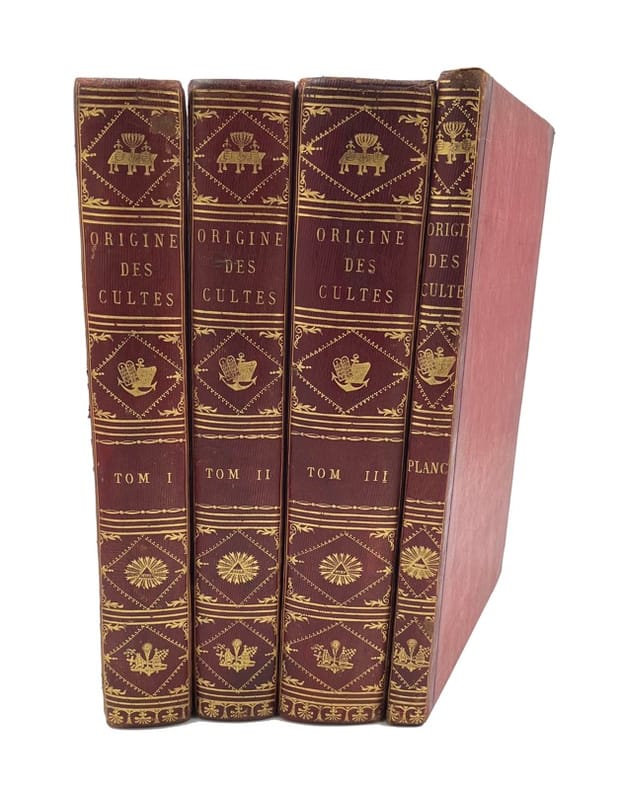
239987Paris, H. Agasse, an III (1795) 4 vol. in-4 carrés, demi-chevrette cerise à coins, dos lisses cloisonnés et ornés de symboles religieux dorés (de haut en bas : une ménorah, les Tables de la Torah, un tétragramme et un autel supportant ciboire, croix, mitre et tiare) (reliure de l'époque). Petits frottements à certains mors, des rousseurs.
In-16 p. (mm. 161x108), p. pergamena molle antica con legacci (risg. rifatti), tit. ms. al dorso, 227 cc.num., 1 c.b., con alcuni disegni astronomici nel t. "Edizione originale" di questa rara opera del carmelitano Francesco Giuntini (Junctinus o Junctin) (1523-1590), maestro di teologia, letterato e uno degli astrologi più famosi della seconda metà del Cinquecento. Fu tra i primi a ripudiare le antiche tavole astronomiche e ad usare quelle di Copernico, pur non accettandone la riforma. Cfr. Cantamessa, “Astrologia”, I,1838: “Autore, 3 anni più tardi, dell’enorme "Speculum astrologiae" nel quale quest’opera è riprodotta, il Giuntini anche qui scrive di astrologia, sia pure esclusivamente riguardo alle cosiddette Rivoluzioni, cioè agli oroscopi per ciascun anno o per anni determinati, calcolati e tracciati sulla base dell’oroscopo di nascita, o radicale ("Radix").. Giuntini, come tutti gli astrologi dei secoli XVI e XVII, ha l’irresistibile tentazione di drammatizzare”. Cfr. anche Adams,I,J-439 - Caillet,II,5694: “Junctin était correcteur de l’imprimerie où a été édité cet ouvrage” - Non citata dal Riccardi. Qualche lieviss. uniforme arross. altrimenti esemplare ben conservato.
<p>19 cm, cartella editoriale completamente illustrata, chiusura con nastri, un cartoncino esplicativo inciso fronte retro a colori acquarellati, un globo ripiegato a 6 spicchi di carte geografiche colorate a mano legati da cordoncini con fermagli. Il cartoncino illustrato riporta sulle due facciate il "Meccanismo del Gllobo artificiale" e lo "Zodiaco ecclittico". Prima e quarta copertina illustrate da raffinate incisioni, alla prima cop. titolo in grande cornice allegorica con diverse figure, all'ultima cop. la raffigurazione dello zodiaco ed alcune note esplicative "L'oggetto di questo piccolo meccanismo è di presentare, come un trastullo, la cognizione e la forma della Terra, e di dare una piena idea della sua divisione fisica e politica.." ; "Nota: Il Globo s'arrotonda disponendo in giro i foglietti, poi si riuniscono alto e basso facendo scorrere i fermagli sui cordoncini; il globo così disposto.." Il Globo è perfettamente conservato, tracce d'uso ed aloni alla prima copertina, esemplare privo dell'opuscolo di 16 pagine segnalato dai repertori. Rara prima edizione italiana del globo meccanico di Legrand che non riporta l'anno di stampa a differenza delle edizioni successive.</p>
In -8°, pp. (2), 112; mezza pergamena. Prima edizione in volume del trattato di Menelao Alessandrino (I sec. d.C.), considerato il primo trattato di trigonometria sferica che si conosca, e che contiene anche la dimostrazione del teorema ancor oggi noto come Teorema di Menelao. Una edizione precedente dei tre libri compare anche nell’insieme di testi curato da Francesco Maurolico, che tradusse Teodosio, Euclide, Autolico e appunto Menelao in un suo lavoro dedicato agli studi della sfera (Messina, 1558). Nel 1644 Mersenne ripubblica gli “Sphaericorum libri”, sempre in un volume che comprende altri scritti (“Universae geometriae...”, Parigi, Bertier: il volume è citato da Leopardi nella sua “Storia dell’astronomia”), e sulla base del volume precedentemente citato. La presente edizione era stata curata, su fonti non coincidenti con le edizioni rammentate, dal celebre astronomo Edmund Halley per la stampa universitaria oxfordiana, nel 1712. Ma l’edizione del ’12, stampata solo parzialmente, non fu completata se non nel ’58 come postuma, quando fu chiesto a George Costard e James Bradley, entrambi astronomi a Oxford di curare la pubblicazione del lavoro. Mancano, in questa copia, le otto pagine di prefazione di Costard, numerate a parte, mentre il trattato in sé è completo: la copia è perfettamente conforme a quella conservata nella biblioteca bodleiana di Oxford. Una copia, sempre conforme a questa, e qualificata come quella del 1713-14 è stata venduta nel 2005 da Sotheby’s, asta Macclesfield. First edition in a volume of the Menelaus Alexandrinus work, considered the first spheric trigonometry essay ever known, also containing the demonstration of the theorem still known after Menelaus name. An earlier edition of the three books was also published in a collection of texts edited by Francesco Maurolico, who translated Theodosius, Euclides, Autholicus and Menelaus in a work dedicated to sphere studies (Messina, 1558). In 1644 Mersenne republish the “Sphaericorum libri”, always in a volume including more works (“Universae geometriae…”, Paris, Bertier), based on the Maurolico’s work. The Oxford edition was edited, based on different sources than the Maurolico ones, by the famous astronomer Edmund Halley, in 1712. But that edition was never published, and it was only partially printed in 1713-14. Only in 1758 the book was completed by George Costard and James Bradley, both Oxford’s astronomers. In the present copy the eight introduction pages of Costard are missing, while the essay is complete: the copy is identical to the one kept by the Bodleian Library of Oxford. A copy, still similar to this one and qualified as the 1713-14’s one, was sold in 2005, at Sotheby’s, Macclesfield auction.
First offprint in the original wrappers of this „fundamental paper on nuclear fission which eventually lead to the creation of the atomic bomb.“ (Dibner) – Contents, Edition: The German radio and nuclear chemists Otto Hahn and Fritz Straßmann "bombarding uranium with neutrons (as indicated by Fermi in the mid-1930s), found that treating the bombarded uranium with barium resulted in some strongly radioactive material. By late 1938 they suspected that uranium fission had occurred.“ These epochal findings had been presented by Hahn and Straßmann to the Prussian Academy on May 25th 1939. Their paper indicates in detail „fission of the uranium nucleus into two parts of about equal size with the release of much energy.“ – The publication date for the present offprint is stated „18th Sept. 1939“ in the colophon (not numbered p. 2). Known are also separate printings in the same typeset with wrappers on orange stock quoting „Einzelausgabe“ (separate edition) and the price information („RM 1,50“) on title page, and with a different list of „Sonderausgaben“ (separate printings) published by the Prussian Academy between 1927 and 1939 at rear cover. – Alongside the aforementioned an Austrian woman scientist of Jewish descent, Lise Meitner, colleague of the authors at the Berlin Kaiser-Wilhelm-Institute of Chemistry for decades, also contributed heavily to their findings. Meitner had to flee Nazi Germany in 1938 but continued her research in exile, e.g. in Copenhagen, where she worked in the laboratory of Niels Bohr. Through Bohr and Fermi this nuclear energy was to become a reality in the atomic pile and the bomb blasts of 1945 as well as in the nuclear power stations of the following decades. Hahn received the Nobel Prize for Chemistry in 1944, and together with Meitner and Strassmann, the Fermi award in 1966.“ (All quotes Dibner). If the 1st paper from 1939 contains the first comprehensive description of this core nuclear achievement, the following two corresponding papers published by Hahn and Straßmann with support by chemist Hans Götte during the Second World War in 1942 („Einiges über die experimentelle Entwirrung der bei der Spaltung des Urans auftretenden Elemente und Atomarten.“) and 1944 („Die chemische Abscheidung der bei der Spaltung des Urans entstehenden Elemente und Atomarten.“) describe experiments to identify the fission fragments. - Condition: Cover with some finger stains and traces of water stains, otherwise well preserved copy indeed. - Reference: Dibner, Heralds of Science, 168; Norman 963 (paper 1 only); Poggendorff VIIa/2, 355; Scheld 191.
15969288Basel, Henricpetri, 1596. 8 Bl., 230 S., 1 weißes Bl., 24 Bl., 423 S. Mit 12, teils gefalt. Tafeln u. zahlr. Textholzschnitten. Grüner Pergamentband der Zeit.
172163741CBLeipzig, Verlag Philipp Wilhelm Stock, 1721. 4°. 19 x 15,5 cm. 115 Seiten. Marmorierter Pappband der Zeit mit goldgeprägtem Titel auf schwarzem Lederrückenschild sowie mit rotem Sprengschnitt. [7 Warenabbildungen]
In-24 gr. (mm. 149x89), p. pergamena antica (risg. rifatti), titolo ms. al dorso, 4 cc.nn., pp. 69,(3), con 1 xilografia a piena pag. nel testo che raffigura il Sole, la Terra e la Luna in diverse posizioni, oltre a 2 tavv. f.t., più volte ripieg., che illustrano la Luna nelle sue fasi (piena, crescente e calante), pure inc. su legno. Testo in latino e greco. Dissertazione scientifica (tenutasi nell’Accademia di Uppsala il 30 ottobre 1686), suddivisa in 5 brevi capitoli: “De Luna Onomatologia - De Materia Lunae - De Maculis Lunae - De Lumine Lunae - De Influxu Lunae”. Ne fu relatore lo svedese Andrea Spole (Spolius) (1630-1699), professore di matematica alle Università di Lund e Uppsala. "Rarissima e unica edizione". L’Autore di questa “disputatio” è il matematico svedese Samuel A. Krook (1661-1716); fu nominato professore di matematica a Pernau nel 1701 ma non riuscì a ricoprìre questa posizione. Pubblicò almanacchi tra il 1691 e il 1716 con saggi da lui scritti di carattere astronomico, storico e cronologico e partecipò ai preparativi per la riforma del calendario svedese. Cfr. Liden “Catalogus disputationum” (Upsaliae,1778), p. 434, che cita la ns. edizione - Cfr. anche Cantamessa,III, 7630 e Poggendorff,II, p. 975 per Spole. Opera sconosciuta alle principali bibliografie e presente in sole 6 biblioteche (4 svedesi, la British Library e 1 biblioteca dell’Università dell’Arizona). Non figura su ICCU. Antica nota di possesso al frontesp.; corto del margine super.; una tavola restaur. per strappo; pagine ingiallite, ma complessivam. buon esemplare.
In 16, leg. in pelle con titolo e nervi al dorso, pp. 399, incisione allegorica in antip., ritratto di Voltaire, piccole incisioni ad inizio di ogni capitolo, tavv. n.t.Fori di tarlo al dorso e ai piatti, buone condizioni.ATTENTION.If the book is older than 50 years Please contact us BEFORE to order it.In this caseits not immediately available to export and we will send you more information about cost and timing.Luogo di pubblicazione AmsterdamEditore Jacques DesbordesAnno pubblicazione 1738Materia/Argomento Filosofia, Astronomia, Scienza
In 8°, leg. coeve in piena pelle con nervi, ricchi fregi agli scomparti e tassello al dorso con tit. in oro impresso, tagli policromi e sguardie marmorizzate. - Histoire de l'astronomie ancienne...1 vol.: pp. XXIV-527. Con 3 tavv. incise in rame f.t. più volte pieg. - Seguono i 3 voll. de l'Histoire de l'astronomie moderne: pp. XVI-728 con 13 tavv. f.t. ; (4nn)-751-(1bnn) con 5 tavv. f.t.; (4nn)-415. Pregevole raro insieme dei 3 voll. dedicati all'astronomia moderna, qui preceduti e impreziositi dal vol. dedicato all'astronomia antica. Belle fresche tavole incise in rame e più volte piegate poste sul finire dei volumi e raffiguranti planisferi zodiacali, strumenti ottici e scientifici, anche nei loro dettagli, sistemi planetari...Normali segni d'uso alle cuffie dei 4 voll. e minime spellature agli angoli. In generale bella fresca conservazione.
6598A Paris de l imprimerie du Cercle-Social, rue du Théâtre-Français No 4 l'an IV de la République Française (1796) 2 volumes demi veau dos lise 2 pièces de titre fleurons entre les faux nerf 314 et 312 pages
158311101Lyon, s.n. (François Conrard), 1583 ; in-8 ; demi-vélin à petits coins, étiquette orange titre manuscrit (reliure probablement de la mi-XIXe) ; (32), 362, (10) pp., *-2*-8 A-Z8 [croix]2 ; marque 2 au titre.
19868007575<p>Scotland: Pentland Press. Signed On Front End-Sheet By Author. Stated First Published In 1986 The Pentland Press Ltd. 1986 Blue Hard Covers Tiny Worn Speck On Bottom Edge Otherwise Sharp Corners And Edges Spine Square. Bright Silver Letters On Spine. 116 Thick Bright White Pages Are Tightly Bound. Approx. 45 Color Plates And Many B/W Illustrations Throughout. Appendix Bibliography And List Of Plates. Book Protected By Clear Protective Cover Over Boards. No Dust Jacket. See Photos 63-N . Very Good. Hardcover. 1st Edition. 1986.</p> Pentland Press hardcover
1540144470Edition Leipzig, 1969 ( 1540 ). Gr.-Fol., Ledereinband im original Karton
16796783Paris, 1679. 4to. Cont.hvellum. Engr.frontisp. (26),448,(66),88 pp. and 43 fine engravings in the text. Tear in one leaf rep., no loss. - Houzeau & Lancaster 1037. A good large copy with a few pencilnotes.
Paris, 1679. 4to. Cont.hvellum. Engr.frontisp. (26),448,(66),88 pp. and 43 fine engravings in the text. Tear in one leaf rep., no loss. - Houzeau & Lancaster 1037. A good large copy with a few pencilnotes.
1968ZA-08354Berlin, Heidelberg, New York, Springer Verlag, 1930 - 1968. Hellbraune Halbleinenbände mit goldgeprägten Rückentiteln. Buchdeckel in beiger Marmorierung und mit leinenverstärkten Außenkanten. Farblich passende Vorsätze. Format: 23,5 x 15,5 cm. Buchrücken zum größten Teil mit kleinen Signaturschildchen der Universitäts-Sternwarte Bonn. Führende deutsche Wissenschaftszeitschrift zur Astrophysik. Bände 1 bis 69 sowie die Generalregister für die Bände 1 bis 50 sowie die Bände 51 bis 69. Fehlend (missing): Bände 5 (1932), 6 (1933), 22 (1943/44) und 29 (1951).
1612953521Moguntiae [Mainz]: Anton Hierat. 1612. Quart, 33 x 20 cm. (Einband gebräunt und fleckig, die beiden Bindebänder erneuert, Titel mit handschriftlichem Besitzvermerk und an den Rändern mit Japanpapier verstärkt, innen teils stark gebräunt und feuchtigkeitsrandig) [16 Warenabbildungen] 6 Blatt, 596 Seiten, 14 Bl., 122 S., 1 weißes Blatt, 59, 20, 23 S. Ganzpergament der Zeit, vollständig restauriert und neu aufgezogen,
7994P., Moreau, 1702, un volume in 12 relié en pleine basane, dos orné de fers dorés (reliure de l'époque), (petit accroc sans gravité à la coiffe, mouillures pâles dans les marges de quelques feuillets), (12), 277pp., 9pp., 4 PLANCHES
177281984Verlag des Buchladens der Realschule, Berlin 1765 - 1772. 8 Bl., 488 S. mit 5 gefaltete Kufpertafeln - 11 Bl., 815 S., 58 Bl. (Mondtafeln) und 11 gefaltete -Kupfertafeln - - 10 Bl., 569 S. und 16 gefaltete Kupfertafeln, 8°, Pappbände der Zeit mit Rückentitel auf (teils fragmentarischem) Rückenschild, Bibliotheks-Exemplare (ordnungsgemäß entwidmet) mit Papier-Rückenschildern, Stempel auf Titel, Einbände leicht berieben und bestoßen (Kapitale stärker), Papier vereinzelt gering braunfleckig, insgesamt gutes und innen sauberes Exemplar,
[Fig. Bologna-Carracci] (cm.21,5) Ottima piena pergamena originale titolo al dorso. --cc.8nn., pp.432 (440). Bellissima antiporta figurata disegnata da Agostino Carracci e 17 imprese, sempre in rame per lo più del Carracci. + figure geometriche, epigrafi, ecc.Notevoli 2 figure astronomiche a fondo nero con costellazioni osservate dal Montanari e da Galileo. E' la più importante pubblicazione degli accademici Gelati di Bologna, EDIZIONE ORIGINALE. tratta vari argomenti: armi, imprese, musica, filosofia, politica, fisica, astronomia, terme, giochi ecc.di insigni autori come BOMBACI, MARSILI, MONTANARI.Esemplare bellissimo molto fresco e nitido con rami in ottima tiratura. --GRAESSE I 9, AUTORI ITALIANI DEL '600 3509, PRAZ II 3, CICOGNARA 1830, FETIS III p.4 E VIII p.397, FRATI G477. Ex libris autografo alla sguardia "Salvatore Betti 1824" Per notizie sul Betti (1792-1882) vedi, Pitrè G. "Profili Biografici"Palermo 1878 pag.9.[f30] Libro
1957608007Berlin, Haude u. Spener/Dümmler, 1812-1957. Hprgt., Hldr., Hlwd., Pp. u. Broschur (teilw. Unaufgeschn.). Teilw. m. Rsch. Teilw. St. u. Sign. a. Tit. Einige Rücken/Einbde. stockfl. bzw. angerissen. Fehlt: 1823 1 Taf.
In -12°, pergamena, 8 tavv.